SNP DETECTION
BY: MANISHA JUGLANI
MSc Biotechnology 2nd year
CHANDIGARH GROUP OF COLLEGES, MOHALI,PUNJAB
INTRODUCTION:
SNP
•SINGLE NUCLEOTIDE POLYMORPHISM
•The most common type of genetic variation among people.
•Each SNP represents a difference in a single DNA building block, called a nucleotides.
•DNA sequence variation occurring when a single nucleotide adenine (A), thymine (T),
cytosine (C), or guanine (G]) in the genome (or other shared sequence) differs
between members of a species or paired chromosomes in an individual.
•A minor allele frequency.
•Act as genetic markers/ molecular markers.
SNP
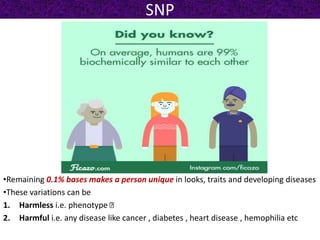
•Remaining 0.1% bases makes a person unique in looks, traits and developing diseases
•These variations can be
1. Harmless i.e. phenotype
2. Harmful i.e. any disease like cancer , diabetes , heart disease , hemophilia etc
SNP
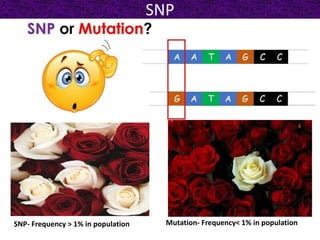
SNP- Frequency > 1% in population Mutation- Frequency< 1% in population
SNP DETECTION:
SNP DETECTION
• Ideal SNP detection method does not exist.
• SNP detection technologies are used to scan for
1. New polymorphisms
2. To determine the allele(s) of a known polymorphism in target sequences
• SNP detection can be broadly classified into two areas:
A. Unknown SNP :
B. Known SNP :
SNP DETECTION
A. Unknown SNP :
scanning DNA sequences for previously unknown polymorphisms.
i. Global approach
ii. Targeted approach
B. Known SNP :
Screening (genotyping) individuals for known polymorphisms
i. The technologies capable of scanning DNA for new polymorphisms can be
used in screening individuals for known polymorphisms.
ii. There are many more options for SNP genotyping, like: Hybridization,
Primer extension , ligation, Mass spectrometry , etc.
A. Unknown SNP
SNP DETECTION
•A. Unknown SNP :
i. Global approach -
•The main issue with global SNP discovery is that on average,
•There is one SNP in every 1,000 bp of DNA when two human genomes
are compared to each other.
•One must be able to scan 1,000 bp pieces of DNA in a generic way.
SNP DETECTION
•A. Unknown SNP :
i. Global approach -
•The main subtypes:
1) Restriction fragment length polymorphisms (RFLPs) :
2) PCR:
3) Resequencing approach:
4) Sequence the human genome by whole genome
shotgun sequencing:
SNP DETECTION
•A. Unknown SNP :
i. Global approach -
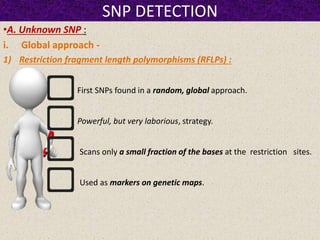
1) Restriction fragment length polymorphisms (RFLPs) :
First SNPs found in a random, global approach.
Powerful, but very laborious, strategy.
Scans only a small fraction of the bases at the restriction sites.
Used as markers on genetic maps.
SNP DETECTION
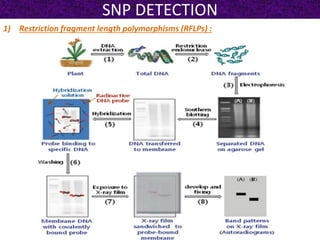
1) Restriction fragment length polymorphisms (RFLPs) :
SNP DETECTION
•A. Unknown SNP :
i. Global approach -
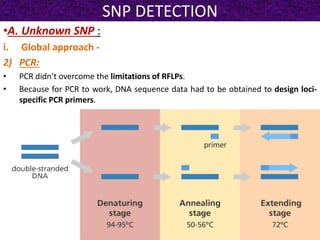
2) PCR:
• PCR didn’t overcome the limitations of RFLPs.
• Because for PCR to work, DNA sequence data had to be obtained to design loci-
specific PCR primers.
SNP DETECTION
•A. Unknown SNP :
i. Global approach -
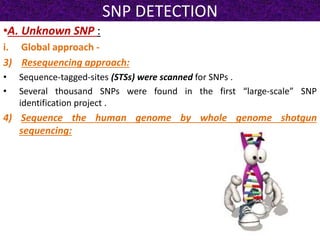
3) Resequencing approach:
• Sequence-tagged-sites (STSs) were scanned for SNPs .
• Several thousand SNPs were found in the first “large-scale” SNP
identification project .
4) Sequence the human genome by whole genome shotgun
sequencing:
SNP DETECTION
•A. Unknown SNP :
ii) Targeted approach-
• Detecting SNPs only in the regions of interest.
• DNA sequencing is the gold standard of SNP discovery.
• DNA sequencing was quite labor intensive and costly
• Until very recently and several highly successful polymorphism scanning
methods were developed to scan DNA fragments for SNPs and mutations.
1. Denaturing Gradient Gel Electrophoresis
2. Chemical Cleavage of Mismatch (CCM)
3. Single Strand Conformation Polymorphism (SSCP)
4. MutS Protein-binding Assays
5. Denaturing High Performance Liquid Chromatography (DHPLC)
6. UNG-Mediated T-Sequencing
7. RNA-Mediated Finger printing with MALDI MS Detection
8. Direct DNA Sequencing
SNP DETECTION
•A. Unknown SNP :
ii) Targeted approach-
1. Denaturing Gradient Gel Electrophoresis
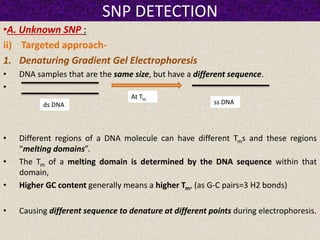
• DNA samples that are the same size, but have a different sequence.
•
• Different regions of a DNA molecule can have different Tms and these regions
“melting domains”.
• The Tm of a melting domain is determined by the DNA sequence within that
domain,
• Higher GC content generally means a higher Tm, (as G-C pairs=3 H2 bonds)
• Causing different sequence to denature at different points during electrophoresis.
ds DNA
At Tm
ss DNA
SNP DETECTION
•A. Unknown SNP :
ii) Targeted approach-
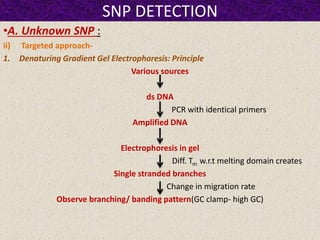
1. Denaturing Gradient Gel Electrophoresis: Principle
Various sources
ds DNA
PCR with identical primers
Amplified DNA
Electrophoresis in gel
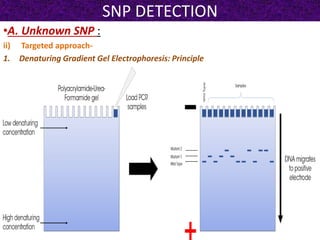
Diff. Tm w.r.t melting domain creates
Single stranded branches
Change in migration rate
Observe branching/ banding pattern(GC clamp- high GC)
SNP DETECTION
•A. Unknown SNP :
ii) Targeted approach-
1. Denaturing Gradient Gel Electrophoresis: Principle
SNP DETECTION
•A. Unknown SNP :
ii) Targeted approach-
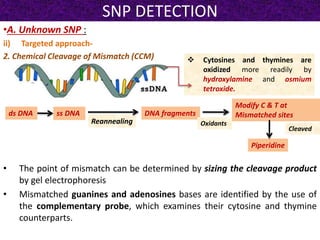
2. Chemical Cleavage of Mismatch (CCM)
• The point of mismatch can be determined by sizing the cleavage product
by gel electrophoresis
• Mismatched guanines and adenosines bases are identified by the use of
the complementary probe, which examines their cytosine and thymine
counterparts.
 Cytosines and thymines are
oxidized more readily by
hydroxylamine and osmium
tetroxide.
ds DNA DNA fragments
Modify C & T at
Mismatched sites
Reannealing
ss DNA
Oxidants
Cleaved
Piperidine
SNP DETECTION
•A. Unknown SNP :
ii) Targeted approach-
2. Chemical Cleavage of Mismatch
(CCM)
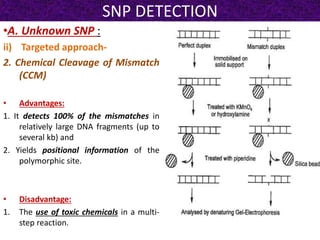
• Advantages:
1. It detects 100% of the mismatches in
relatively large DNA fragments (up to
several kb) and
2. Yields positional information of the
polymorphic site.
• Disadvantage:
1. The use of toxic chemicals in a multi-
step reaction.
SNP DETECTION
•A. Unknown SNP :
ii) Targeted approach-
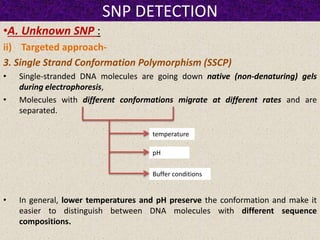
3. Single Strand Conformation Polymorphism (SSCP)
• Single-stranded DNA molecules are going down native (non-denaturing) gels
during electrophoresis,
• Molecules with different conformations migrate at different rates and are
separated.
• In general, lower temperatures and pH preserve the conformation and make it
easier to distinguish between DNA molecules with different sequence
compositions.
temperature
Buffer conditions
pH
SNP DETECTION
•A. Unknown SNP :
ii) Targeted approach-
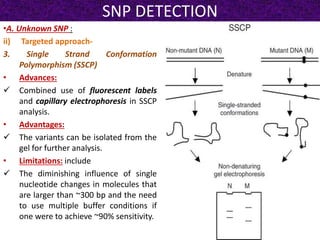
3. Single Strand Conformation
Polymorphism (SSCP)
• Advances:
 Combined use of fluorescent labels
and capillary electrophoresis in SSCP
analysis.
• Advantages:
 The variants can be isolated from the
gel for further analysis.
• Limitations: include
 The diminishing influence of single
nucleotide changes in molecules that
are larger than ~300 bp and the need
to use multiple buffer conditions if
one were to achieve ~90% sensitivity.
SNP DETECTION
•A. Unknown SNP :
ii) Targeted approach-
4. MutS Protein-binding Assays
• Non-gel based SNP scanning methods
• Proteins in the DNA mismatch repair pathway have been used in SNP discovery.
• The E. coli MutS protein recognizes and binds to heteroduplex DNA with up to 3
mismatched bases in a row.
• The use of a gel-shift assay provides a way to detect MutS binding
• Disadvantages:
 The high false positive rate due to PCR errors
 It’s inability to distinguish between different polymorphisms contained within the
same DNA fragment.
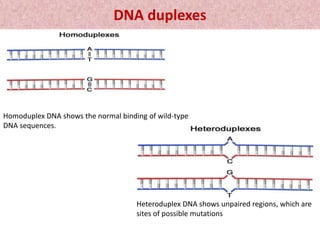
DNA duplexes
Homoduplex DNA shows the normal binding of wild-type
DNA sequences.
Heteroduplex DNA shows unpaired regions, which are
sites of possible mutations
SNP DETECTION
•A. Unknown SNP :
ii) Targeted approach-
5. Denaturing High Performance Liquid Chromatography (DHPLC)
• A variant of heteroduplex analysis.
• DHPLC is a very simple method to implement.
• Instead of using a gel and separating the DNA fragments by electrophoresis,
• A modified resin and HPLC are employed for fragment analysis.
• The method has high sensitivity and reproducibility.
• Drawback: limited throughput of the system, since samples are processed one at
a time.
SNP DETECTION
•A. Unknown SNP :
ii) Targeted approach-
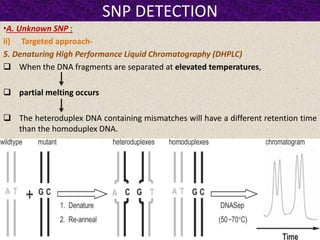
5. Denaturing High Performance Liquid Chromatography (DHPLC)
 When the DNA fragments are separated at elevated temperatures,
 partial melting occurs
 The heteroduplex DNA containing mismatches will have a different retention time
than the homoduplex DNA.
SNP DETECTION
•A. Unknown SNP :
ii) Targeted approach-
6. UNG-Mediated T-Sequencing
• The uracil N-glycosylase (UNG) mediated sequencing method utilizes:
o Amplified DNAUNG
dUTP UNG removes the uracil base
o Removes uracil base
endonuclease IV cleavage of the molecule
or sodium hydroxide
at the abasic sites by either.
• Detect >90% of all single nucleotide polymorphisms.
• Examines full length DNA fragments
• Besides the fact that G>C and C>G changes are not detected, the results only give
partial sequence information and both strands must be scanned to achieve an
acceptable detection rate.
SNP DETECTION
•A. Unknown SNP :
ii) Targeted approach-
7. RNA-Mediated Finger printing with MALDI MS Detection
• Uses RNase T1 and MALDI mass spectrometry to detect sequence variations.
• RNase T1- base-specific (the G base) digestion
• Mass spectrometry- determination of the “G” pattern
• Any sequence variation that involves a G base will change the number and size of
the fragments and are easily detected by MALDI MS.
• Sequence variations involving only A/U bases will result in mass shifts that are at
times not resolvable.
 The most attractive feature of this method is the speed of detection.
 MALDI MS is not as labor intensive or time consuming.
 The size pattern is precise and highly reproducible .
 The weakness of this method is that it is unable to detect all polymorphisms.
SNP DETECTION
•A. Unknown SNP :
ii) Targeted approach-
8. Direct DNA Sequencing
• Until very recently, direct DNA sequencing was laborious and expensive.
• DNA sequencing as a scanning method for SNPs is highly competitive.
• The recently-developed mutant Taq DNA 48 Kwok polymerase containing an
F667Y mutation vastly improved the DNA sequence quality:
 because of its ability to incorporate the chain terminating
dideoxyribosenucleoside triphosphates (ddNTPs)
 and their fluorescently labeled analogs at rates that are similar to
those for the natural deoxyribosenucleoside triphosphates (dNTPs)
SNP DETECTION
•A. Unknown SNP :
ii) Targeted approach-
8. Direct DNA Sequencing
• Prior to the general use of automated DNA sequence analyzers and fluorescent
DNA sequencing,
• A simple technique of sequence comparison was to load all the “A”, “C”, “G”, and
“T” sequencing reactions of the samples being tested side-by-side so that one
could scan the autoradiograms by inspection.
• The presence of polymorphisms is represented by missing or additional bands in
the sequencing ladder.
• Advantages: It yields the complete information.
• Disadvantages:
 The need for high quality amplified DNA samples,
 Added expense when universal primer sequences are added to PCR primers,and
 expensive automatic sequence analyzing instruments, are becoming easier to
overcome.
B. known SNP
SNP DETECTION
B. known SNP :
1. Hybridization
2. Primer extension
3. Allele specific
oligonucleotide Ligation
4. Mass spectrometry
SNP DETECTION
•A. known SNP :
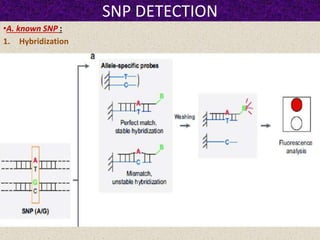
1. Hybridization
Hybridization is the process of
• combining two complementary single-stranded DNA or RNA
molecules and
• allowing them to form a single double-stranded molecule through
base pairing.
• Hybridization is a part of many important laboratory techniques
such as polymerase chain reaction and Southern blotting.
• No enzymes are involved in allelic discrimination.
SNP DETECTION
•A. known SNP :
1. Hybridization
SNP DETECTION
•A. known SNP :
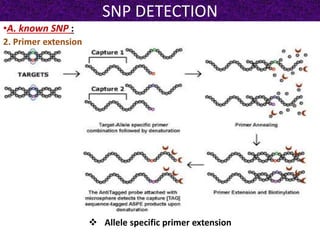
2. Primer extension
• Primer extension is a technique whereby the 5' ends of RNA can be
mapped - that is, they can be sequenced and properly identified.
• Determine the start site of transcription by which its sequence is
known.
• Used to quantify the amount of transcript in an in vitro
transcription system.
• Determine the locations of breaks or modified bases in a mixed
population of RNA or DNA samples.
• This is useful in applications like footprinting.
SNP DETECTION
•A. known SNP :
2. Primer extension
 Allele specific primer extension
SNP DETECTION
•A. known SNP :
3. Allele specific oligonucleotide Ligation:
• DNA ligase catalyzes the ligation of the 3' end of a DNA fragment to
the 5' end of a directly adjacent DNA fragment.
• This mechanism can be used to interrogate a SNP :
 by hybridizing two probes directly over the SNP polymorphic site,
 whereby ligation can occur if the probes are identical to the target
DNA.
SNP DETECTION
•A. known SNP :
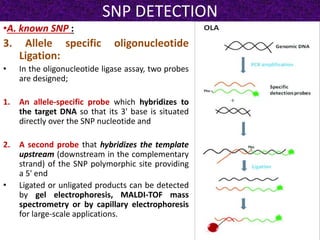
3. Allele specific oligonucleotide
Ligation:
• In the oligonucleotide ligase assay, two probes
are designed;
1. An allele-specific probe which hybridizes to
the target DNA so that its 3' base is situated
directly over the SNP nucleotide and
2. A second probe that hybridizes the template
upstream (downstream in the complementary
strand) of the SNP polymorphic site providing
a 5' end
• Ligated or unligated products can be detected
by gel electrophoresis, MALDI-TOF mass
spectrometry or by capillary electrophoresis
for large-scale applications.
SNP DETECTION
•A. known SNP :
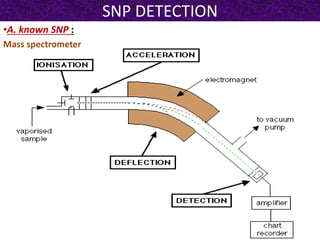
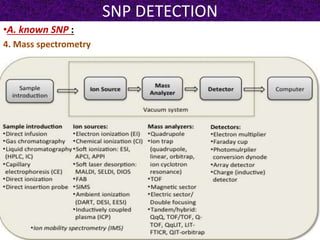
4. Mass spectrometry
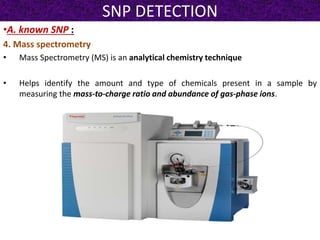
• Mass Spectrometry (MS) is an analytical chemistry technique
• Helps identify the amount and type of chemicals present in a sample by
measuring the mass-to-charge ratio and abundance of gas-phase ions.
SNP DETECTION
•A. known SNP :
Mass spectrometer
SNP DETECTION
•A. known SNP :
4. Mass spectrometry
THANK YOU

Ppt snp detection

  • 1.
    SNP DETECTION BY: MANISHAJUGLANI MSc Biotechnology 2nd year CHANDIGARH GROUP OF COLLEGES, MOHALI,PUNJAB
  • 2.
  • 3.
    SNP •SINGLE NUCLEOTIDE POLYMORPHISM •Themost common type of genetic variation among people. •Each SNP represents a difference in a single DNA building block, called a nucleotides. •DNA sequence variation occurring when a single nucleotide adenine (A), thymine (T), cytosine (C), or guanine (G]) in the genome (or other shared sequence) differs between members of a species or paired chromosomes in an individual. •A minor allele frequency. •Act as genetic markers/ molecular markers.
  • 4.
    SNP •Remaining 0.1% basesmakes a person unique in looks, traits and developing diseases •These variations can be 1. Harmless i.e. phenotype 2. Harmful i.e. any disease like cancer , diabetes , heart disease , hemophilia etc
  • 5.
    SNP SNP- Frequency >1% in population Mutation- Frequency< 1% in population
  • 6.
  • 7.
    SNP DETECTION • IdealSNP detection method does not exist. • SNP detection technologies are used to scan for 1. New polymorphisms 2. To determine the allele(s) of a known polymorphism in target sequences • SNP detection can be broadly classified into two areas: A. Unknown SNP : B. Known SNP :
  • 8.
    SNP DETECTION A. UnknownSNP : scanning DNA sequences for previously unknown polymorphisms. i. Global approach ii. Targeted approach B. Known SNP : Screening (genotyping) individuals for known polymorphisms i. The technologies capable of scanning DNA for new polymorphisms can be used in screening individuals for known polymorphisms. ii. There are many more options for SNP genotyping, like: Hybridization, Primer extension , ligation, Mass spectrometry , etc.
  • 9.
  • 10.
    SNP DETECTION •A. UnknownSNP : i. Global approach - •The main issue with global SNP discovery is that on average, •There is one SNP in every 1,000 bp of DNA when two human genomes are compared to each other. •One must be able to scan 1,000 bp pieces of DNA in a generic way.
  • 11.
    SNP DETECTION •A. UnknownSNP : i. Global approach - •The main subtypes: 1) Restriction fragment length polymorphisms (RFLPs) : 2) PCR: 3) Resequencing approach: 4) Sequence the human genome by whole genome shotgun sequencing:
  • 12.
    SNP DETECTION •A. UnknownSNP : i. Global approach - 1) Restriction fragment length polymorphisms (RFLPs) : First SNPs found in a random, global approach. Powerful, but very laborious, strategy. Scans only a small fraction of the bases at the restriction sites. Used as markers on genetic maps.
  • 13.
    SNP DETECTION 1) Restrictionfragment length polymorphisms (RFLPs) :
  • 14.
    SNP DETECTION •A. UnknownSNP : i. Global approach - 2) PCR: • PCR didn’t overcome the limitations of RFLPs. • Because for PCR to work, DNA sequence data had to be obtained to design loci- specific PCR primers.
  • 15.
    SNP DETECTION •A. UnknownSNP : i. Global approach - 3) Resequencing approach: • Sequence-tagged-sites (STSs) were scanned for SNPs . • Several thousand SNPs were found in the first “large-scale” SNP identification project . 4) Sequence the human genome by whole genome shotgun sequencing:
  • 16.
    SNP DETECTION •A. UnknownSNP : ii) Targeted approach- • Detecting SNPs only in the regions of interest. • DNA sequencing is the gold standard of SNP discovery. • DNA sequencing was quite labor intensive and costly • Until very recently and several highly successful polymorphism scanning methods were developed to scan DNA fragments for SNPs and mutations. 1. Denaturing Gradient Gel Electrophoresis 2. Chemical Cleavage of Mismatch (CCM) 3. Single Strand Conformation Polymorphism (SSCP) 4. MutS Protein-binding Assays 5. Denaturing High Performance Liquid Chromatography (DHPLC) 6. UNG-Mediated T-Sequencing 7. RNA-Mediated Finger printing with MALDI MS Detection 8. Direct DNA Sequencing
  • 17.
    SNP DETECTION •A. UnknownSNP : ii) Targeted approach- 1. Denaturing Gradient Gel Electrophoresis • DNA samples that are the same size, but have a different sequence. • • Different regions of a DNA molecule can have different Tms and these regions “melting domains”. • The Tm of a melting domain is determined by the DNA sequence within that domain, • Higher GC content generally means a higher Tm, (as G-C pairs=3 H2 bonds) • Causing different sequence to denature at different points during electrophoresis. ds DNA At Tm ss DNA
  • 18.
    SNP DETECTION •A. UnknownSNP : ii) Targeted approach- 1. Denaturing Gradient Gel Electrophoresis: Principle Various sources ds DNA PCR with identical primers Amplified DNA Electrophoresis in gel Diff. Tm w.r.t melting domain creates Single stranded branches Change in migration rate Observe branching/ banding pattern(GC clamp- high GC)
  • 19.
    SNP DETECTION •A. UnknownSNP : ii) Targeted approach- 1. Denaturing Gradient Gel Electrophoresis: Principle
  • 20.
    SNP DETECTION •A. UnknownSNP : ii) Targeted approach- 2. Chemical Cleavage of Mismatch (CCM) • The point of mismatch can be determined by sizing the cleavage product by gel electrophoresis • Mismatched guanines and adenosines bases are identified by the use of the complementary probe, which examines their cytosine and thymine counterparts.  Cytosines and thymines are oxidized more readily by hydroxylamine and osmium tetroxide. ds DNA DNA fragments Modify C & T at Mismatched sites Reannealing ss DNA Oxidants Cleaved Piperidine
  • 21.
    SNP DETECTION •A. UnknownSNP : ii) Targeted approach- 2. Chemical Cleavage of Mismatch (CCM) • Advantages: 1. It detects 100% of the mismatches in relatively large DNA fragments (up to several kb) and 2. Yields positional information of the polymorphic site. • Disadvantage: 1. The use of toxic chemicals in a multi- step reaction.
  • 22.
    SNP DETECTION •A. UnknownSNP : ii) Targeted approach- 3. Single Strand Conformation Polymorphism (SSCP) • Single-stranded DNA molecules are going down native (non-denaturing) gels during electrophoresis, • Molecules with different conformations migrate at different rates and are separated. • In general, lower temperatures and pH preserve the conformation and make it easier to distinguish between DNA molecules with different sequence compositions. temperature Buffer conditions pH
  • 23.
    SNP DETECTION •A. UnknownSNP : ii) Targeted approach- 3. Single Strand Conformation Polymorphism (SSCP) • Advances:  Combined use of fluorescent labels and capillary electrophoresis in SSCP analysis. • Advantages:  The variants can be isolated from the gel for further analysis. • Limitations: include  The diminishing influence of single nucleotide changes in molecules that are larger than ~300 bp and the need to use multiple buffer conditions if one were to achieve ~90% sensitivity.
  • 24.
    SNP DETECTION •A. UnknownSNP : ii) Targeted approach- 4. MutS Protein-binding Assays • Non-gel based SNP scanning methods • Proteins in the DNA mismatch repair pathway have been used in SNP discovery. • The E. coli MutS protein recognizes and binds to heteroduplex DNA with up to 3 mismatched bases in a row. • The use of a gel-shift assay provides a way to detect MutS binding • Disadvantages:  The high false positive rate due to PCR errors  It’s inability to distinguish between different polymorphisms contained within the same DNA fragment.
  • 25.
    DNA duplexes Homoduplex DNAshows the normal binding of wild-type DNA sequences. Heteroduplex DNA shows unpaired regions, which are sites of possible mutations
  • 26.
    SNP DETECTION •A. UnknownSNP : ii) Targeted approach- 5. Denaturing High Performance Liquid Chromatography (DHPLC) • A variant of heteroduplex analysis. • DHPLC is a very simple method to implement. • Instead of using a gel and separating the DNA fragments by electrophoresis, • A modified resin and HPLC are employed for fragment analysis. • The method has high sensitivity and reproducibility. • Drawback: limited throughput of the system, since samples are processed one at a time.
  • 27.
    SNP DETECTION •A. UnknownSNP : ii) Targeted approach- 5. Denaturing High Performance Liquid Chromatography (DHPLC)  When the DNA fragments are separated at elevated temperatures,  partial melting occurs  The heteroduplex DNA containing mismatches will have a different retention time than the homoduplex DNA.
  • 28.
    SNP DETECTION •A. UnknownSNP : ii) Targeted approach- 6. UNG-Mediated T-Sequencing • The uracil N-glycosylase (UNG) mediated sequencing method utilizes: o Amplified DNAUNG dUTP UNG removes the uracil base o Removes uracil base endonuclease IV cleavage of the molecule or sodium hydroxide at the abasic sites by either. • Detect >90% of all single nucleotide polymorphisms. • Examines full length DNA fragments • Besides the fact that G>C and C>G changes are not detected, the results only give partial sequence information and both strands must be scanned to achieve an acceptable detection rate.
  • 29.
    SNP DETECTION •A. UnknownSNP : ii) Targeted approach- 7. RNA-Mediated Finger printing with MALDI MS Detection • Uses RNase T1 and MALDI mass spectrometry to detect sequence variations. • RNase T1- base-specific (the G base) digestion • Mass spectrometry- determination of the “G” pattern • Any sequence variation that involves a G base will change the number and size of the fragments and are easily detected by MALDI MS. • Sequence variations involving only A/U bases will result in mass shifts that are at times not resolvable.  The most attractive feature of this method is the speed of detection.  MALDI MS is not as labor intensive or time consuming.  The size pattern is precise and highly reproducible .  The weakness of this method is that it is unable to detect all polymorphisms.
  • 30.
    SNP DETECTION •A. UnknownSNP : ii) Targeted approach- 8. Direct DNA Sequencing • Until very recently, direct DNA sequencing was laborious and expensive. • DNA sequencing as a scanning method for SNPs is highly competitive. • The recently-developed mutant Taq DNA 48 Kwok polymerase containing an F667Y mutation vastly improved the DNA sequence quality:  because of its ability to incorporate the chain terminating dideoxyribosenucleoside triphosphates (ddNTPs)  and their fluorescently labeled analogs at rates that are similar to those for the natural deoxyribosenucleoside triphosphates (dNTPs)
  • 31.
    SNP DETECTION •A. UnknownSNP : ii) Targeted approach- 8. Direct DNA Sequencing • Prior to the general use of automated DNA sequence analyzers and fluorescent DNA sequencing, • A simple technique of sequence comparison was to load all the “A”, “C”, “G”, and “T” sequencing reactions of the samples being tested side-by-side so that one could scan the autoradiograms by inspection. • The presence of polymorphisms is represented by missing or additional bands in the sequencing ladder. • Advantages: It yields the complete information. • Disadvantages:  The need for high quality amplified DNA samples,  Added expense when universal primer sequences are added to PCR primers,and  expensive automatic sequence analyzing instruments, are becoming easier to overcome.
  • 32.
  • 33.
    SNP DETECTION B. knownSNP : 1. Hybridization 2. Primer extension 3. Allele specific oligonucleotide Ligation 4. Mass spectrometry
  • 34.
    SNP DETECTION •A. knownSNP : 1. Hybridization Hybridization is the process of • combining two complementary single-stranded DNA or RNA molecules and • allowing them to form a single double-stranded molecule through base pairing. • Hybridization is a part of many important laboratory techniques such as polymerase chain reaction and Southern blotting. • No enzymes are involved in allelic discrimination.
  • 35.
    SNP DETECTION •A. knownSNP : 1. Hybridization
  • 36.
    SNP DETECTION •A. knownSNP : 2. Primer extension • Primer extension is a technique whereby the 5' ends of RNA can be mapped - that is, they can be sequenced and properly identified. • Determine the start site of transcription by which its sequence is known. • Used to quantify the amount of transcript in an in vitro transcription system. • Determine the locations of breaks or modified bases in a mixed population of RNA or DNA samples. • This is useful in applications like footprinting.
  • 37.
    SNP DETECTION •A. knownSNP : 2. Primer extension  Allele specific primer extension
  • 38.
    SNP DETECTION •A. knownSNP : 3. Allele specific oligonucleotide Ligation: • DNA ligase catalyzes the ligation of the 3' end of a DNA fragment to the 5' end of a directly adjacent DNA fragment. • This mechanism can be used to interrogate a SNP :  by hybridizing two probes directly over the SNP polymorphic site,  whereby ligation can occur if the probes are identical to the target DNA.
  • 39.
    SNP DETECTION •A. knownSNP : 3. Allele specific oligonucleotide Ligation: • In the oligonucleotide ligase assay, two probes are designed; 1. An allele-specific probe which hybridizes to the target DNA so that its 3' base is situated directly over the SNP nucleotide and 2. A second probe that hybridizes the template upstream (downstream in the complementary strand) of the SNP polymorphic site providing a 5' end • Ligated or unligated products can be detected by gel electrophoresis, MALDI-TOF mass spectrometry or by capillary electrophoresis for large-scale applications.
  • 40.
    SNP DETECTION •A. knownSNP : 4. Mass spectrometry • Mass Spectrometry (MS) is an analytical chemistry technique • Helps identify the amount and type of chemicals present in a sample by measuring the mass-to-charge ratio and abundance of gas-phase ions.
  • 41.
    SNP DETECTION •A. knownSNP : Mass spectrometer
  • 42.
    SNP DETECTION •A. knownSNP : 4. Mass spectrometry
  • 43.