PT.RAVISHANKAR SHUKLA UNIVERSITY
RAIPUR (CG)
SOS IN BIOTECHNOLOGY
SEMINAR ON
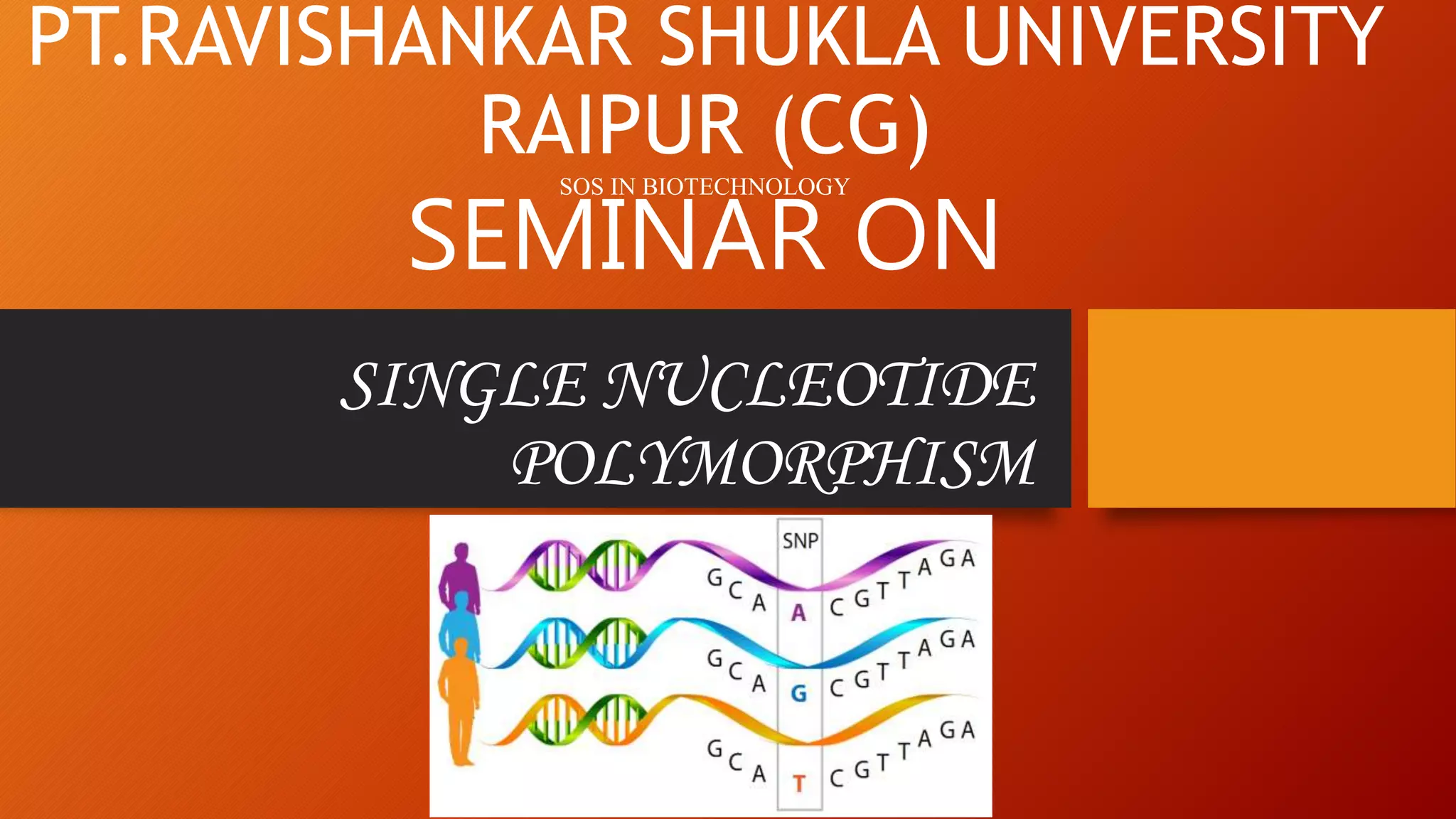
SINGLE NUCLEOTIDE
POLYMORPHISM
POLYMORPHISM
•Polymorphism is a genetic term that
means ‘many shapes’
•It is the ability to appear in different
form
SINGLE NUCLEOTIDE POLYMORPHISM
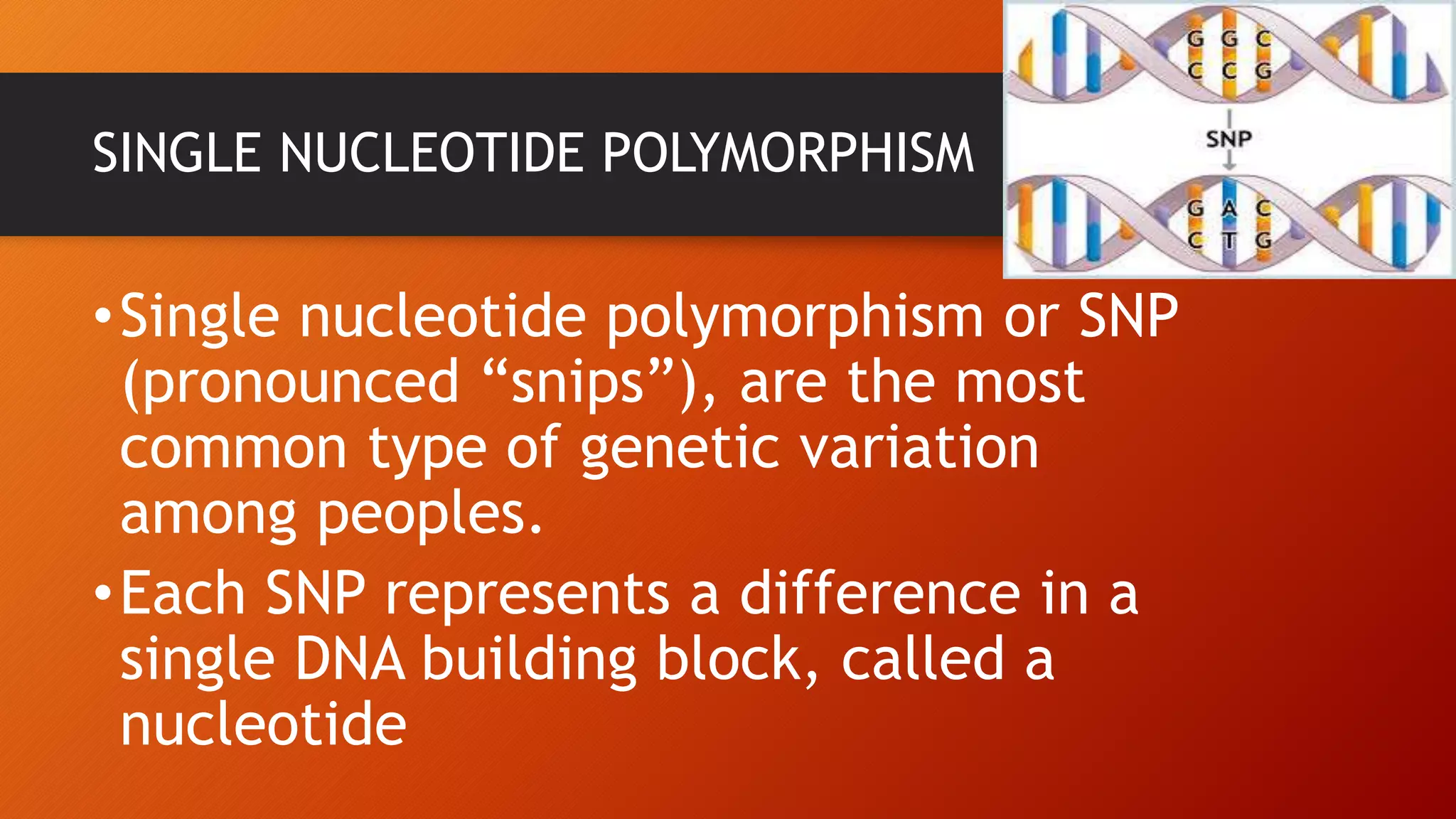
•Single nucleotide polymorphism or SNP
(pronounced “snips”), are the most
common type of genetic variation
among peoples.
•Each SNP represents a difference in a
single DNA building block, called a
nucleotide
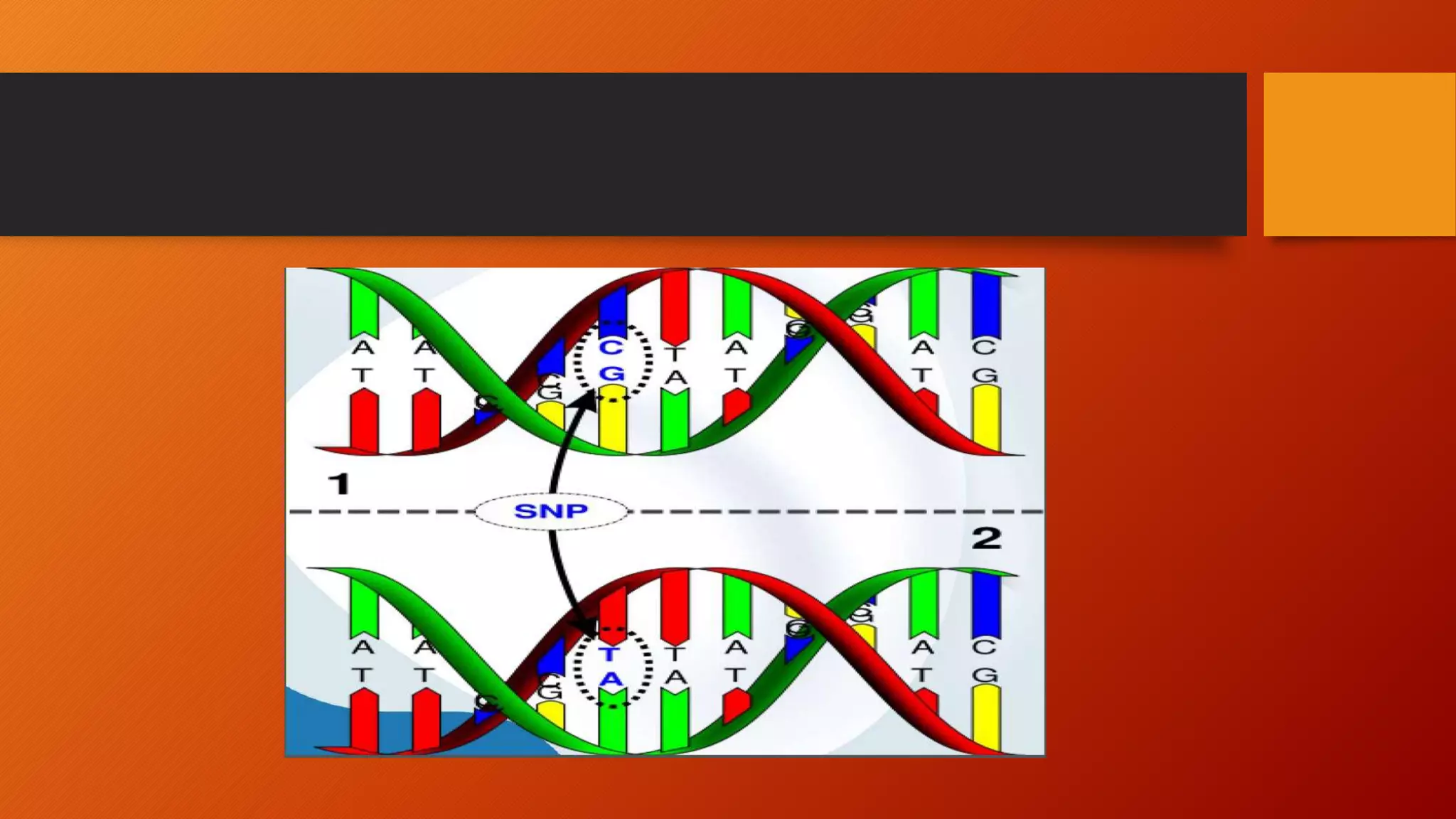
•It is a DNA sequence variation occurring
when a single nucleotide A, T ,G, C in
the genome differs between members
of a species
•For ex. Two sequenced DNA fragments
from different individuals, AAGCCTA to
AAGCTTA , contain a difference in a
single nucleotide
SNPs FACTS
• SNP are found in coding (mostly) and non-coding regions.
• Occur with a very high frequency about 1 in 1000 bases
to 1 in 100 to 300 bases.
• The abundance of SNPs and the ease with which they can
be measured make these genetic variations significant.
• SNPs close to particular gene acts as a marker for that
gene.
• SNPs in coding regions may alter the protein structure
made by that coding region.
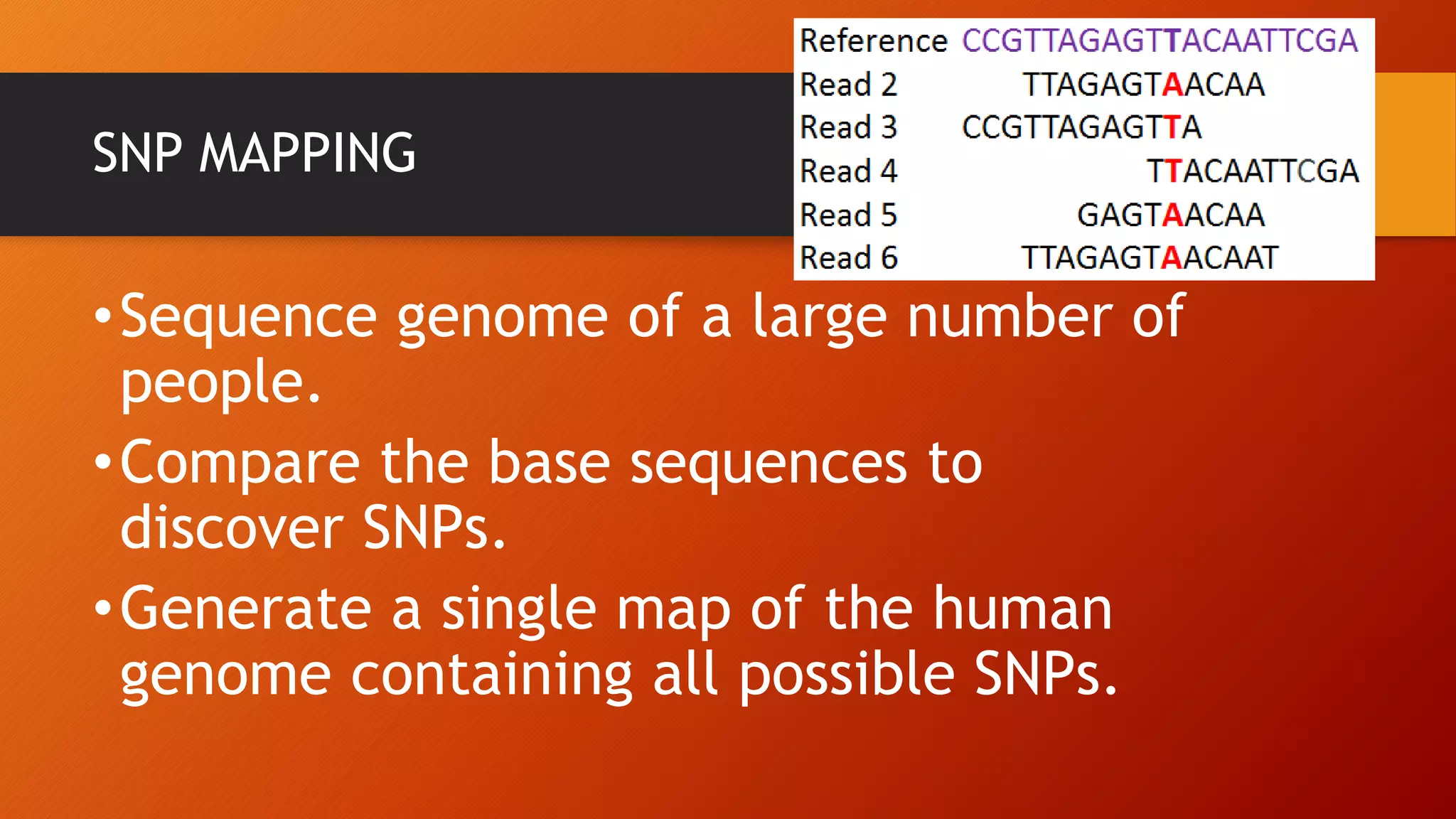
SNP MAPPING
•Sequence genome of a large number of
people.
•Compare the base sequences to
discover SNPs.
•Generate a single map of the human
genome containing all possible SNPs.
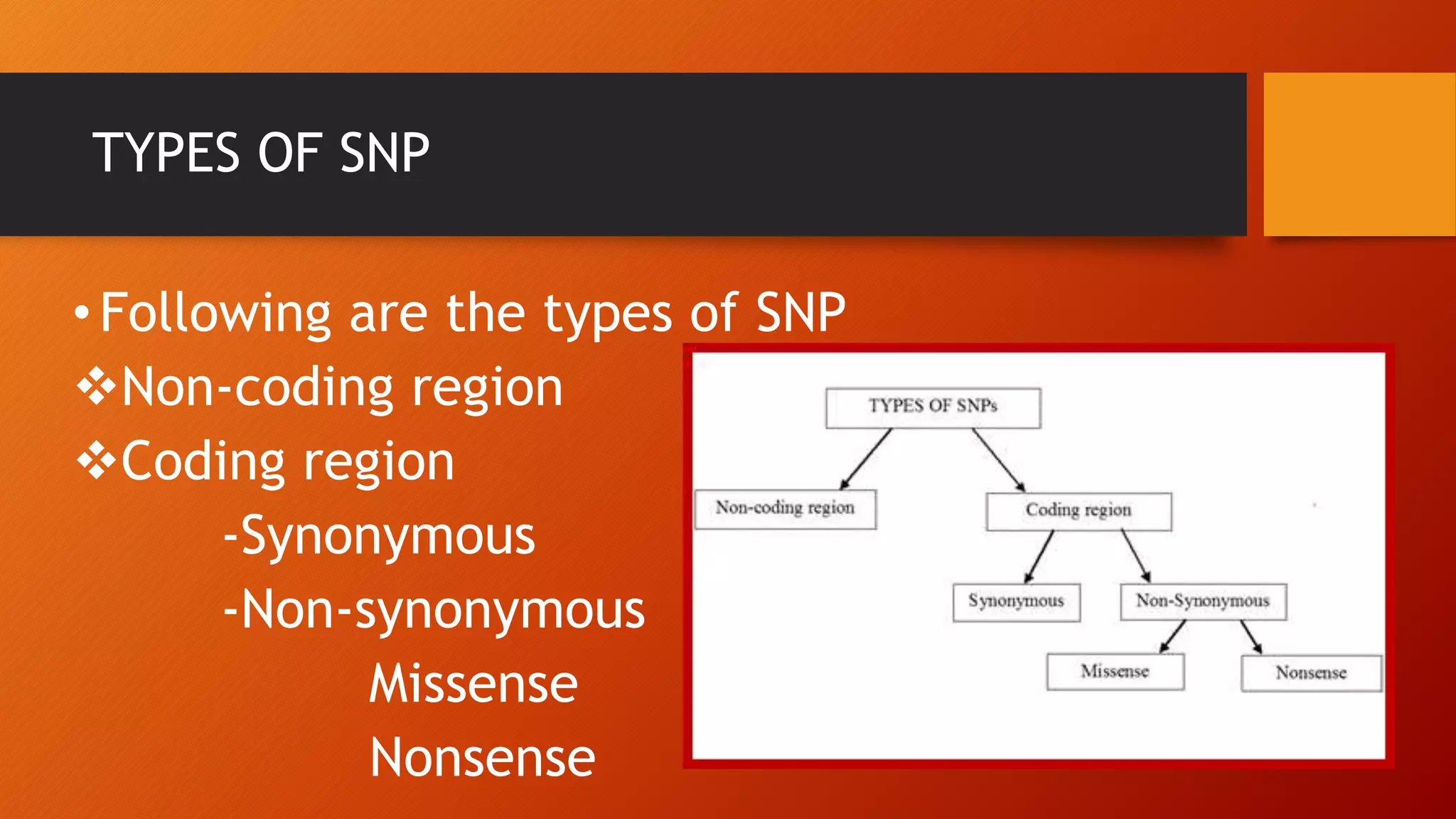
TYPES OF SNP
•Following are the types of SNP
Non-coding region
Coding region
-Synonymous
-Non-synonymous
Missense
Nonsense
•NON CODING REGION
A segment of DNA that does comprise a
gene and thus don’t code for a protein.
•CODING REGION
Regions of DNA/RNA sequences that code
for proteins
SYNONYMOUS
A SNP in which both forms lead to the same polypeptide
sequences is termed as synonymous(sometime called a
silent mutation).
NON SYNOYMOUS
If a different polypeptides sequences is produced they are
non synonymous. A non synonymous change may either be
missense or nonsense, where a missense change results in
a different amino acid, while a nonsense change results in
a premature stop codon.
EFFECT OF SNP
SILENT
Alter the function of the protein
•Directly ; alter an amino acid sequence
•Indirectly ; alter the function of the
regulatory sequences.
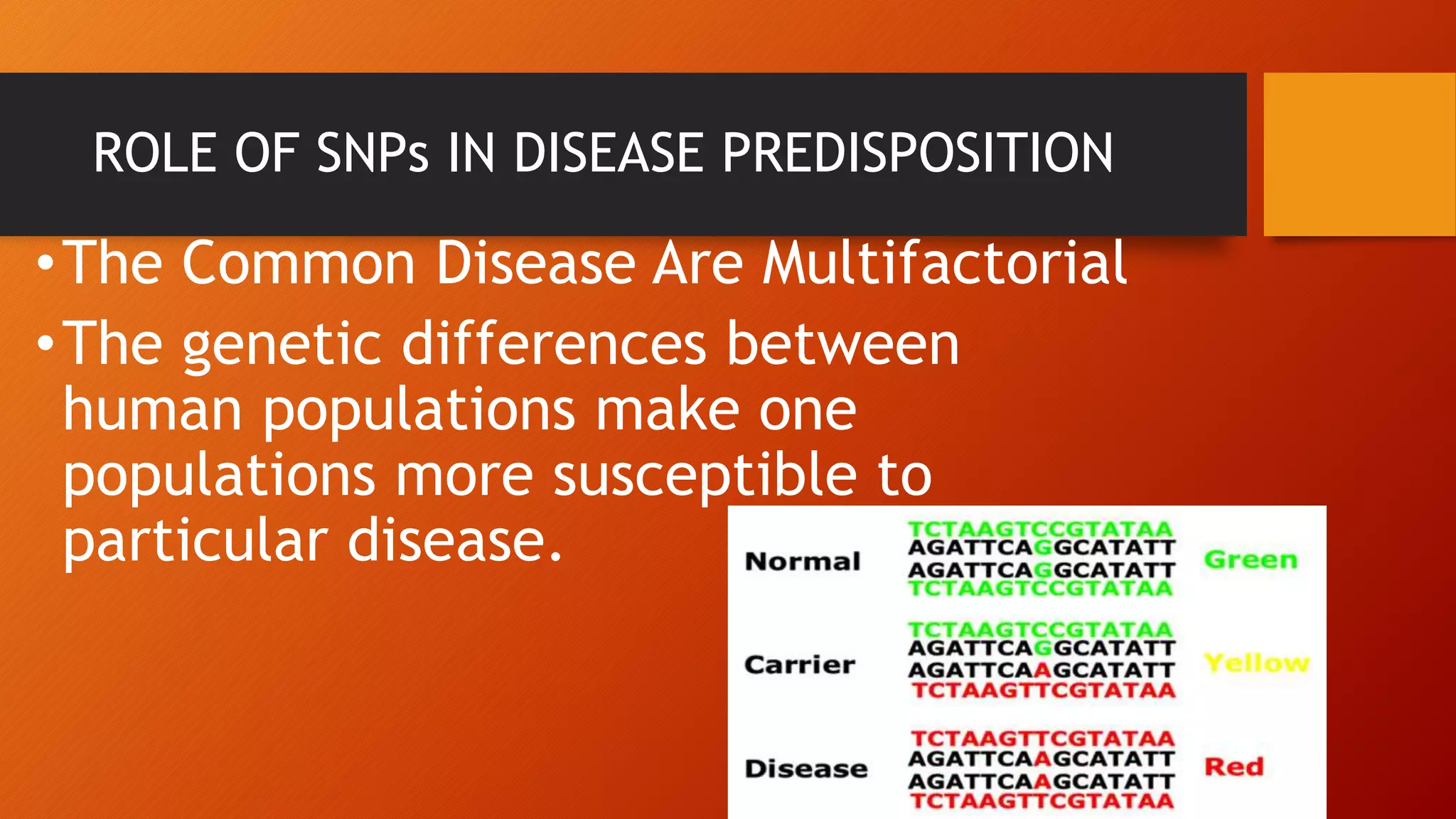
ROLE OF SNPs IN DISEASE PREDISPOSITION
•The Common Disease Are Multifactorial
•The genetic differences between
human populations make one
populations more susceptible to
particular disease.
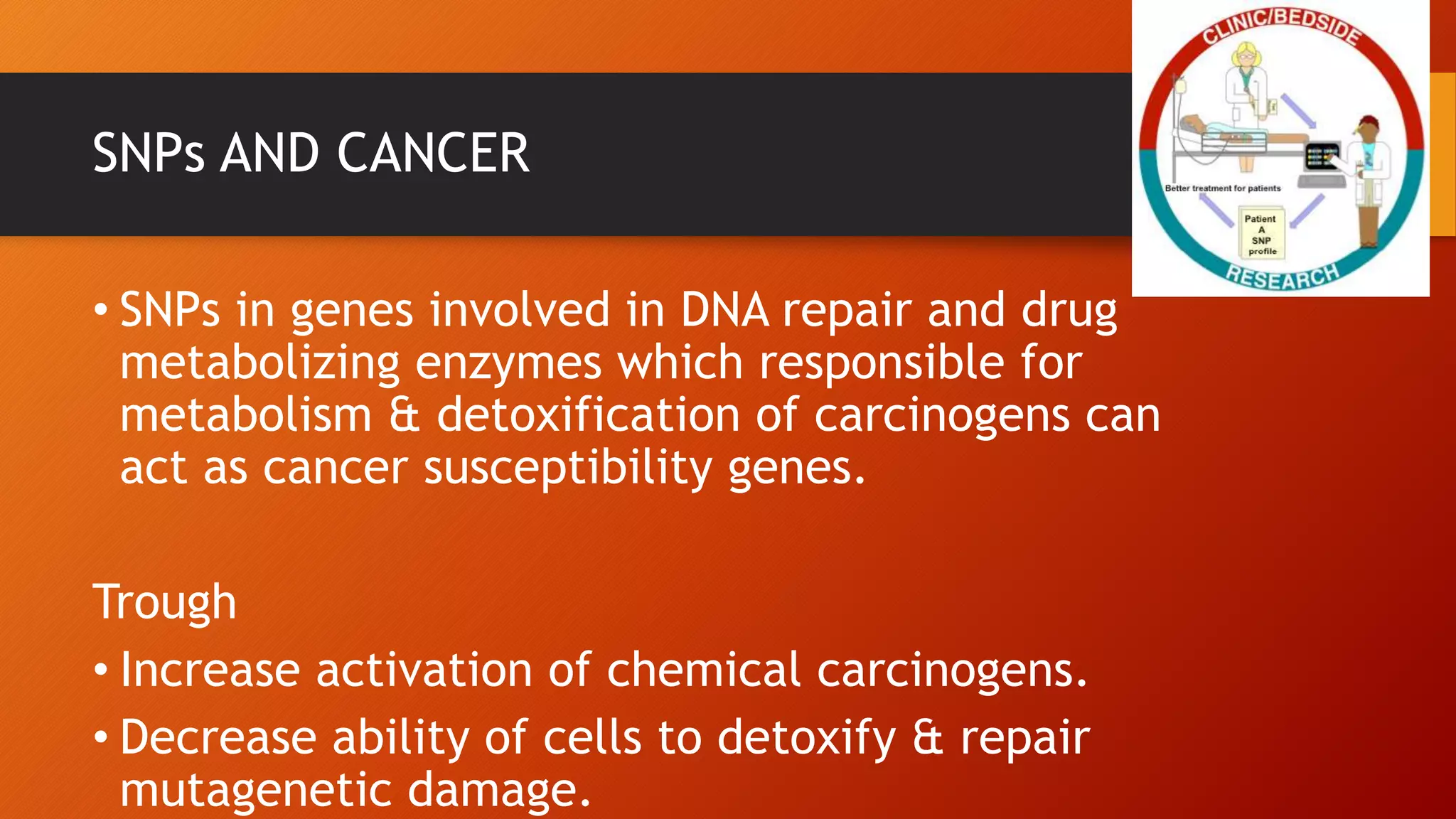
SNPs AND CANCER
• SNPs in genes involved in DNA repair and drug
metabolizing enzymes which responsible for
metabolism & detoxification of carcinogens can
act as cancer susceptibility genes.
Trough
• Increase activation of chemical carcinogens.
• Decrease ability of cells to detoxify & repair
mutagenetic damage.
METHODS OF IDENTIFICATION SNPs
A.Detection of known SNPs
B.Identification of new SNPs
DETECTION OF KNOWN SNPs
• A) GEL-BASED GENOTYPING METHODS
1. PCR with restriction enzyme coupled analysis.
2. Amplification refractory mutation
systems(ARMS)
3. Oligonucleotide ligation assay.
4. Minisequencing.
DETECTION OF KNOWN SNPs
•B) NON GEL BASED HIGH THROUGHPUT
GENOTYPING TECHNOLOGIES
•1) hybridization using fluorescence
resonance energy transfer detection(Taq
man genotyping, Molecular beacons).
•2) high density chip array.
IDENTIFICATION OF NEW SNPs
•1) Conformation-based mutation
scanning.
•2) direct DNA sequencing.
Conformation-based mutation scanning.
•Single-strand conformation polymorphism
(SSCP).
- most widely used methods.
PRINCIPLE
Single strand DNA tend to fold into complex
structure which determines the mobility of
the DNA strand in non denaturing gel.
USE AND IMPORTANCE OF SNPs
•Variations in the DNA sequences of humans
can affect how many humans develop
diseases and respond to pathogens ,
chemical, drugs, vaccines, and other
agents.
•SNPs are also thought to be key enablers in
realizing the concept of personalized
medicine
APPLICATIONS
•Gene discovery and mapping
•Association based candidate polymorphism
testing
•diagnostics/risk profiling
•Response prediction
•Homogeneity testing/study design
•Gene function identification
CONCLUSION
• A single nucleotide polymorphism is a DNA
sequence variation occurring when a single
nucleotide genome differs between members of a
species.
• They can act as biological markers, helping
scientists locate genes that are associated with
disease. When SNPs occur within a gene or in
regulatory region near a gene, they may play a
more direct role in disease by affecting the genes
functions.
REFERENCES
• Gene cloning and DNA analysis 6 edition- T.A Brown
• https://ghr.nlm.nih.gov/primer/genomicresearch/snp
• https://en.wikipedia.org/wiki/Single-nucleotide_polymorphism
• https://www.youtube.com/watch?v=x4m1_P5Ljf8
Single Nucleotide Polymorphism

Single Nucleotide Polymorphism

  • 1.
    PT.RAVISHANKAR SHUKLA UNIVERSITY RAIPUR(CG) SOS IN BIOTECHNOLOGY SEMINAR ON SINGLE NUCLEOTIDE POLYMORPHISM
  • 2.
    POLYMORPHISM •Polymorphism is agenetic term that means ‘many shapes’ •It is the ability to appear in different form
  • 3.
    SINGLE NUCLEOTIDE POLYMORPHISM •Singlenucleotide polymorphism or SNP (pronounced “snips”), are the most common type of genetic variation among peoples. •Each SNP represents a difference in a single DNA building block, called a nucleotide
  • 4.
    •It is aDNA sequence variation occurring when a single nucleotide A, T ,G, C in the genome differs between members of a species •For ex. Two sequenced DNA fragments from different individuals, AAGCCTA to AAGCTTA , contain a difference in a single nucleotide
  • 6.
    SNPs FACTS • SNPare found in coding (mostly) and non-coding regions. • Occur with a very high frequency about 1 in 1000 bases to 1 in 100 to 300 bases. • The abundance of SNPs and the ease with which they can be measured make these genetic variations significant. • SNPs close to particular gene acts as a marker for that gene. • SNPs in coding regions may alter the protein structure made by that coding region.
  • 7.
    SNP MAPPING •Sequence genomeof a large number of people. •Compare the base sequences to discover SNPs. •Generate a single map of the human genome containing all possible SNPs.
  • 8.
    TYPES OF SNP •Followingare the types of SNP Non-coding region Coding region -Synonymous -Non-synonymous Missense Nonsense
  • 9.
    •NON CODING REGION Asegment of DNA that does comprise a gene and thus don’t code for a protein. •CODING REGION Regions of DNA/RNA sequences that code for proteins
  • 10.
    SYNONYMOUS A SNP inwhich both forms lead to the same polypeptide sequences is termed as synonymous(sometime called a silent mutation). NON SYNOYMOUS If a different polypeptides sequences is produced they are non synonymous. A non synonymous change may either be missense or nonsense, where a missense change results in a different amino acid, while a nonsense change results in a premature stop codon.
  • 11.
    EFFECT OF SNP SILENT Alterthe function of the protein •Directly ; alter an amino acid sequence •Indirectly ; alter the function of the regulatory sequences.
  • 12.
    ROLE OF SNPsIN DISEASE PREDISPOSITION •The Common Disease Are Multifactorial •The genetic differences between human populations make one populations more susceptible to particular disease.
  • 13.
    SNPs AND CANCER •SNPs in genes involved in DNA repair and drug metabolizing enzymes which responsible for metabolism & detoxification of carcinogens can act as cancer susceptibility genes. Trough • Increase activation of chemical carcinogens. • Decrease ability of cells to detoxify & repair mutagenetic damage.
  • 14.
    METHODS OF IDENTIFICATIONSNPs A.Detection of known SNPs B.Identification of new SNPs
  • 15.
    DETECTION OF KNOWNSNPs • A) GEL-BASED GENOTYPING METHODS 1. PCR with restriction enzyme coupled analysis. 2. Amplification refractory mutation systems(ARMS) 3. Oligonucleotide ligation assay. 4. Minisequencing.
  • 16.
    DETECTION OF KNOWNSNPs •B) NON GEL BASED HIGH THROUGHPUT GENOTYPING TECHNOLOGIES •1) hybridization using fluorescence resonance energy transfer detection(Taq man genotyping, Molecular beacons). •2) high density chip array.
  • 17.
    IDENTIFICATION OF NEWSNPs •1) Conformation-based mutation scanning. •2) direct DNA sequencing.
  • 18.
    Conformation-based mutation scanning. •Single-strandconformation polymorphism (SSCP). - most widely used methods. PRINCIPLE Single strand DNA tend to fold into complex structure which determines the mobility of the DNA strand in non denaturing gel.
  • 19.
    USE AND IMPORTANCEOF SNPs •Variations in the DNA sequences of humans can affect how many humans develop diseases and respond to pathogens , chemical, drugs, vaccines, and other agents. •SNPs are also thought to be key enablers in realizing the concept of personalized medicine
  • 20.
    APPLICATIONS •Gene discovery andmapping •Association based candidate polymorphism testing •diagnostics/risk profiling •Response prediction •Homogeneity testing/study design •Gene function identification
  • 21.
    CONCLUSION • A singlenucleotide polymorphism is a DNA sequence variation occurring when a single nucleotide genome differs between members of a species. • They can act as biological markers, helping scientists locate genes that are associated with disease. When SNPs occur within a gene or in regulatory region near a gene, they may play a more direct role in disease by affecting the genes functions.
  • 22.
    REFERENCES • Gene cloningand DNA analysis 6 edition- T.A Brown • https://ghr.nlm.nih.gov/primer/genomicresearch/snp • https://en.wikipedia.org/wiki/Single-nucleotide_polymorphism • https://www.youtube.com/watch?v=x4m1_P5Ljf8