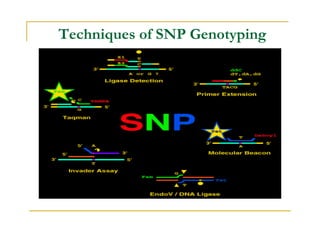
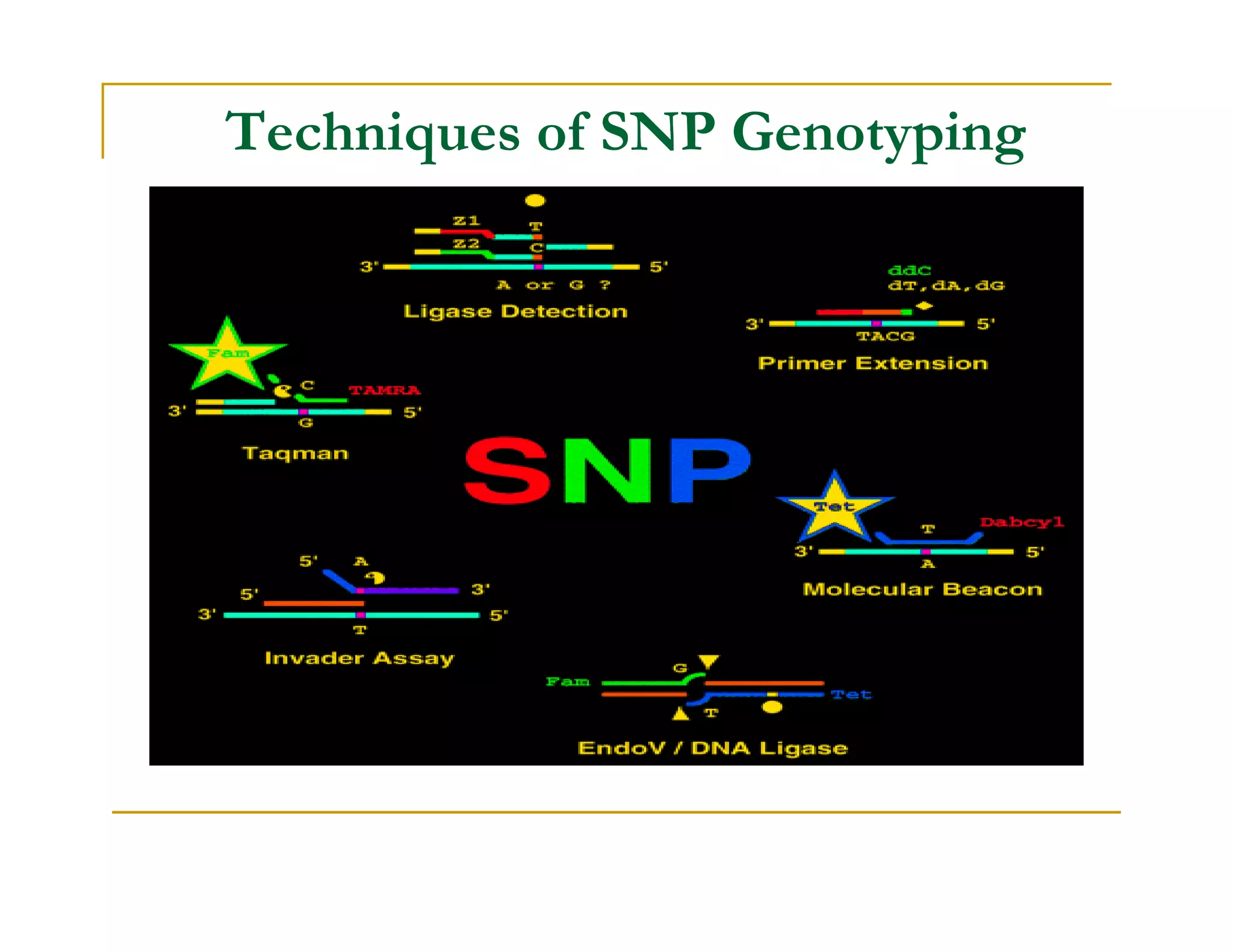
Techniques of SNP Genotyping
SNPs
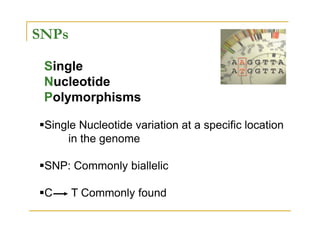
Single
Nucleotide
Polymorphisms
Single Nucleotide variation at a specific locationSingle Nucleotide variation at a specific location
in the genome
SNP: Commonly biallelic
C T Commonly found
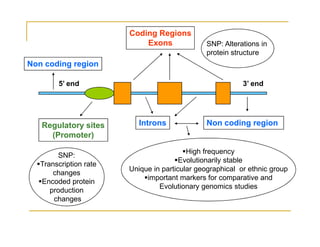
Regulatory sites
Coding Regions
Exons
Introns Non coding region
3’ end5’ end
SNP: Alterations in
protein structure
Non coding region
Regulatory sites
(Promoter)
Introns Non coding region
SNP:
Transcription rate
changes
Encoded protein
production
changes
High frequency
Evolutionarily stable
Unique in particular geographical or ethnic group
important markers for comparative and
Evolutionary genomics studies
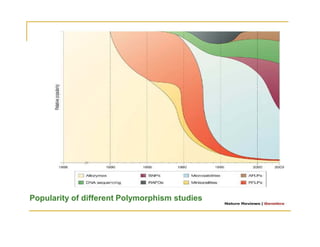
Popularity of different Polymorphism studies
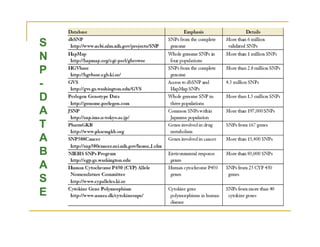
SS
NN
PP
--
DD
AA
TTTT
AA
BB
AA
SS
EE
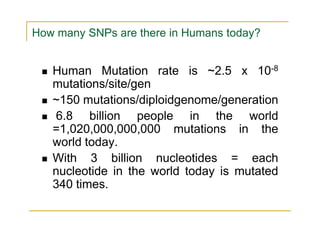
How many SNPs are there in Humans today?
Human Mutation rate is ~2.5 x 10⁻⁸
mutations/site/gen
~150 mutations/diploidgenome/generation
6.8 billion people in the world
=1,020,000,000,000 mutations in the=1,020,000,000,000 mutations in the
world today.
With 3 billion nucleotides = each
nucleotide in the world today is mutated
340 times.
What can SNPs tell you?
Linkage Disequilibrium
Recombination
Association Studies
Demographic eventsDemographic events
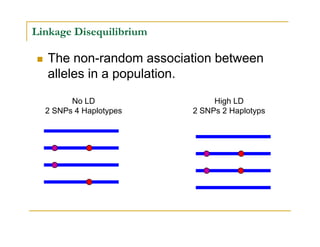
Linkage Disequilibrium
The non-random association between
alleles in a population.
No LD
2 SNPs 4 Haplotypes
High LD
2 SNPs 2 Haplotyps
Association studies
An association between a genetic variant and a
phenotype.
Two groups: Disease Group Control (random pop)
Look for a variant which is in high freq in your disease
group in respect to the control.
Cystic Fibrosis was the first successful association
study, based on RFLPs. (Kerem et al Science 1989)
SNP at Promoter (-169C- susceptible/T non
susceptible) region of FCRL3 for Rheumatoid arthritis
in Japanese population (Kochi et al., Nat Genet. 2005
Jun; 37(6):652.)
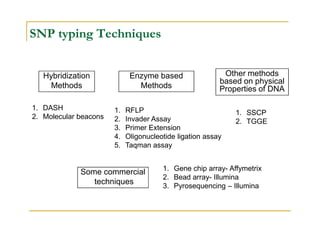
SNP typing Techniques
Hybridization
Methods
Enzyme based
Methods
Other methods
based on physical
Properties of DNA
1. DASH
2. Molecular beacons
1. RFLP
2. Invader Assay
1. SSCP
2. TGGE
Some commercial
techniques
3. Primer Extension
4. Oligonucleotide ligation assay
5. Taqman assay
2. TGGE
1. Gene chip array- Affymetrix
2. Bead array- Illumina
3. Pyrosequencing – Illumina
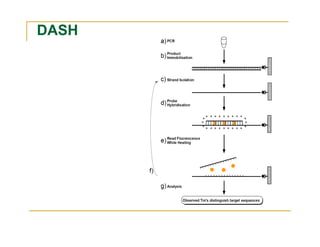
DASH
PCR is performed using one of the primers contains a 5’
biotin.
Resulting products immobilized by a streptavidin-coated
microtiter plate.
The non-biotynylated strand is removed by NaOH
solution.
Hybridized with an oligonucleotide probe, (hybridization
buffer containing a fluorescent double-strand-specificbuffer containing a fluorescent double-strand-specific
intercalating dye).
The sample is heated slowly from room temperature to
above denaturing temperature while continually
monitoring fluorescence.
By plotting the negative derivative (slope of the
fluorescence Vs temp.), denaturation points are clearly
seen as peaks. Peak temperature values can be used
for final allele determination.
DASH
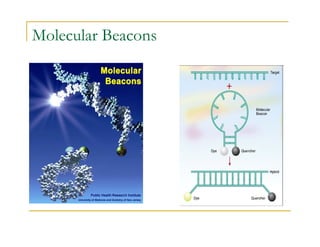
Molecular Beacons
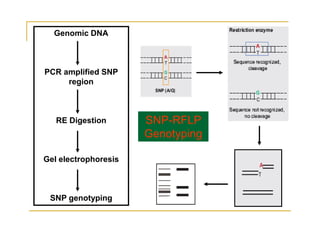
Genomic DNA
PCR amplified SNP
region
RE Digestion SNP-RFLPRE Digestion
Gel electrophoresis
SNP genotyping
SNP-RFLP
Genotyping
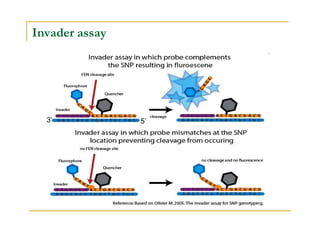
Invader assay
3’ 5’3’ 5’
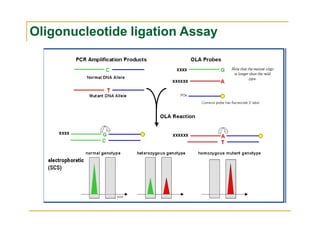
Oligonucleotide ligation Assay
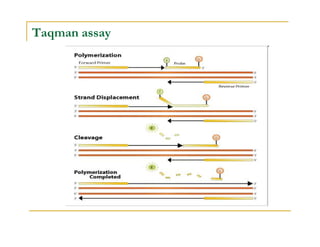
Taqman assay
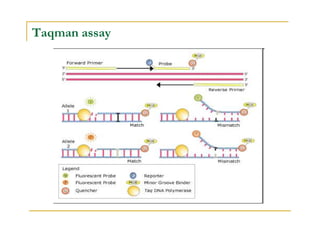
Taqman assay
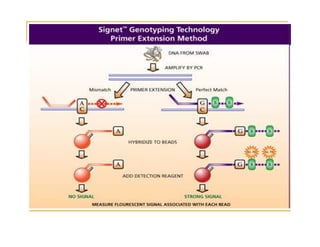
Primer extension (CPE- Mass analysis)
Mass analysis
MALDI-TOF MS
Commercial SNP assays:
Pin pint assay
Mass EXTEND
SPC-SBE
GOOD assay
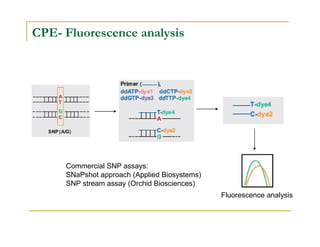
CPE- Fluorescence analysis
Commercial SNP assays:
SNaPshot approach (Applied Biosystems)
SNP stream assay (Orchid Biosciences)
Fluorescence analysis
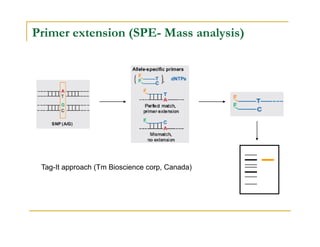
Primer extension (SPE- Mass analysis)
Tag-It approach (Tm Bioscience corp, Canada)
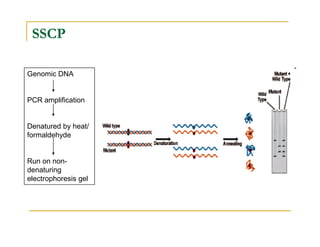
SSCP
Genomic DNA
PCR amplification
Denatured by heat/Denatured by heat/
formaldehyde
Run on non-
denaturing
electrophoresis gel
Pros & cons
PROS
Rapid
Technically simple
Inexpensive
Uses commonly available equipment
Detects 60-95% of mutations in short DNA strandsDetects 60-95% of mutations in short DNA strands
CONS
Need to sequence DNA to identify specific mutation
ssDNA conformation is highly dependent on temperature and
it is not generally apparent what the ideal temperature is.
Sensitivity drops when sequences longer than 400 bp are
used (Costabile et al. 2006).
C
G
G
C
C
G
G
GG
C
C
A
A
T
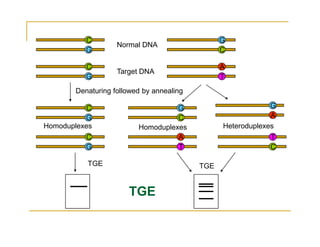
Normal DNA
Target DNA
Denaturing followed by annealing
Homoduplexes Homoduplexes Heteroduplexes
C
G C
A T
T
Homoduplexes Homoduplexes Heteroduplexes
TGE TGE
TGE
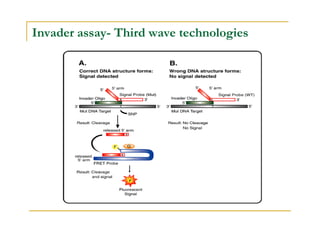
Invader assay- Third wave technologies
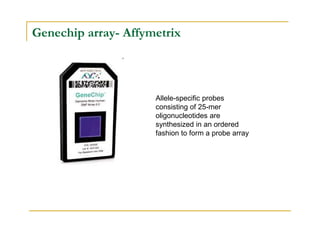
Genechip array- Affymetrix
Allele-specific probes
consisting of 25-mer
oligonucleotides are
synthesized in an orderedsynthesized in an ordered
fashion to form a probe array
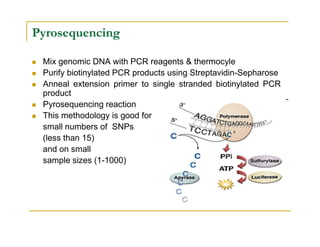
Pyrosequencing
Mix genomic DNA with PCR reagents & thermocyle
Purify biotinylated PCR products using Streptavidin-Sepharose
Anneal extension primer to single stranded biotinylated PCR
product
Pyrosequencing reaction
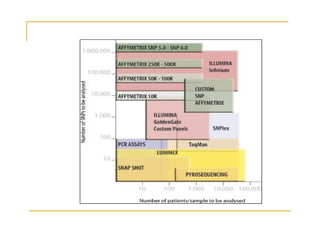
This methodology is good for
small numbers of SNPssmall numbers of SNPs
(less than 15)
and on small
sample sizes (1-1000)
Thank You … !Thank You … !

SNP Genotyping Technologies

  • 1.
  • 2.
    SNPs Single Nucleotide Polymorphisms Single Nucleotide variationat a specific locationSingle Nucleotide variation at a specific location in the genome SNP: Commonly biallelic C T Commonly found
  • 3.
    Regulatory sites Coding Regions Exons IntronsNon coding region 3’ end5’ end SNP: Alterations in protein structure Non coding region Regulatory sites (Promoter) Introns Non coding region SNP: Transcription rate changes Encoded protein production changes High frequency Evolutionarily stable Unique in particular geographical or ethnic group important markers for comparative and Evolutionary genomics studies
  • 4.
    Popularity of differentPolymorphism studies
  • 5.
  • 6.
    How many SNPsare there in Humans today? Human Mutation rate is ~2.5 x 10⁻⁸ mutations/site/gen ~150 mutations/diploidgenome/generation 6.8 billion people in the world =1,020,000,000,000 mutations in the=1,020,000,000,000 mutations in the world today. With 3 billion nucleotides = each nucleotide in the world today is mutated 340 times.
  • 7.
    What can SNPstell you? Linkage Disequilibrium Recombination Association Studies Demographic eventsDemographic events
  • 8.
    Linkage Disequilibrium The non-randomassociation between alleles in a population. No LD 2 SNPs 4 Haplotypes High LD 2 SNPs 2 Haplotyps
  • 9.
    Association studies An associationbetween a genetic variant and a phenotype. Two groups: Disease Group Control (random pop) Look for a variant which is in high freq in your disease group in respect to the control. Cystic Fibrosis was the first successful association study, based on RFLPs. (Kerem et al Science 1989) SNP at Promoter (-169C- susceptible/T non susceptible) region of FCRL3 for Rheumatoid arthritis in Japanese population (Kochi et al., Nat Genet. 2005 Jun; 37(6):652.)
  • 10.
    SNP typing Techniques Hybridization Methods Enzymebased Methods Other methods based on physical Properties of DNA 1. DASH 2. Molecular beacons 1. RFLP 2. Invader Assay 1. SSCP 2. TGGE Some commercial techniques 3. Primer Extension 4. Oligonucleotide ligation assay 5. Taqman assay 2. TGGE 1. Gene chip array- Affymetrix 2. Bead array- Illumina 3. Pyrosequencing – Illumina
  • 11.
    DASH PCR is performedusing one of the primers contains a 5’ biotin. Resulting products immobilized by a streptavidin-coated microtiter plate. The non-biotynylated strand is removed by NaOH solution. Hybridized with an oligonucleotide probe, (hybridization buffer containing a fluorescent double-strand-specificbuffer containing a fluorescent double-strand-specific intercalating dye). The sample is heated slowly from room temperature to above denaturing temperature while continually monitoring fluorescence. By plotting the negative derivative (slope of the fluorescence Vs temp.), denaturation points are clearly seen as peaks. Peak temperature values can be used for final allele determination.
  • 12.
  • 13.
  • 14.
    Genomic DNA PCR amplifiedSNP region RE Digestion SNP-RFLPRE Digestion Gel electrophoresis SNP genotyping SNP-RFLP Genotyping
  • 15.
  • 16.
  • 17.
  • 18.
  • 19.
    Primer extension (CPE-Mass analysis) Mass analysis MALDI-TOF MS Commercial SNP assays: Pin pint assay Mass EXTEND SPC-SBE GOOD assay
  • 20.
    CPE- Fluorescence analysis CommercialSNP assays: SNaPshot approach (Applied Biosystems) SNP stream assay (Orchid Biosciences) Fluorescence analysis
  • 21.
    Primer extension (SPE-Mass analysis) Tag-It approach (Tm Bioscience corp, Canada)
  • 22.
    SSCP Genomic DNA PCR amplification Denaturedby heat/Denatured by heat/ formaldehyde Run on non- denaturing electrophoresis gel
  • 23.
    Pros & cons PROS Rapid Technicallysimple Inexpensive Uses commonly available equipment Detects 60-95% of mutations in short DNA strandsDetects 60-95% of mutations in short DNA strands CONS Need to sequence DNA to identify specific mutation ssDNA conformation is highly dependent on temperature and it is not generally apparent what the ideal temperature is. Sensitivity drops when sequences longer than 400 bp are used (Costabile et al. 2006).
  • 24.
    C G G C C G G GG C C A A T Normal DNA Target DNA Denaturingfollowed by annealing Homoduplexes Homoduplexes Heteroduplexes C G C A T T Homoduplexes Homoduplexes Heteroduplexes TGE TGE TGE
  • 26.
    Invader assay- Thirdwave technologies
  • 27.
    Genechip array- Affymetrix Allele-specificprobes consisting of 25-mer oligonucleotides are synthesized in an orderedsynthesized in an ordered fashion to form a probe array
  • 28.
    Pyrosequencing Mix genomic DNAwith PCR reagents & thermocyle Purify biotinylated PCR products using Streptavidin-Sepharose Anneal extension primer to single stranded biotinylated PCR product Pyrosequencing reaction This methodology is good for small numbers of SNPssmall numbers of SNPs (less than 15) and on small sample sizes (1-1000)
  • 32.
    Thank You …!Thank You … !