Single Nucleotide
Single Nucleotide
Polymorphisms (SNPs),
Haplotypes, Linkage
Haplotypes, Linkage
Disequilibrium, and the
Human Genome
Human Genome
Manish Anand
Manish Anand
Nihar Sheth
Nihar Sheth
Jim Costello
Jim Costello
Univ. of Indiana
Univ. of Indiana
24
24th
th
November, 2003
November, 2003
Biological Background
►How can researchers hope to identify and
How can researchers hope to identify and
study all the changes that occur in so
many different diseases?
►How can they explain why some people
How can they explain why some people
respond to treatment and not others?
‘
‘SNP’
SNP’ is the answer to these questions…
is the answer to these questions…
►So what exactly are SNPs?
So what exactly are SNPs?
►How are they involved in so many
How are they involved in so many
different aspects of health?
What is SNP ?
What is SNP ?
►A
A SNP
SNP is defined as a single base change
is defined as a single base change
in a DNA sequence that occurs in a
significant proportion (more than 1
percent) of a large population.
Some Facts
Some Facts
► In human beings, 99.9 percent bases are same.
In human beings, 99.9 percent bases are same.
► Remaining 0.1 percent makes a person unique.
Remaining 0.1 percent makes a person unique.
 Different attributes / characteristics / traits
Different attributes / characteristics / traits
► how a person looks,
how a person looks,
► diseases he or she develops.
diseases he or she develops.
► These variations can be:
These variations can be:
 Harmless (change in phenotype)
Harmless (change in phenotype)
 Harmful (diabetes, cancer, heart disease, Huntington's disease,
Harmful (diabetes, cancer, heart disease, Huntington's disease,
and hemophilia )
and hemophilia )
 Latent (variations found in coding and regulatory regions, are
Latent (variations found in coding and regulatory regions, are
not harmful on their own, and the change in each gene only
becomes apparent under certain conditions e.g. susceptibility
to lung cancer)
to lung cancer)
SNP facts
SNP facts
► SNPs are found in
SNPs are found in
 coding and (mostly) noncoding regions.
coding and (mostly) noncoding regions.
► Occur with a very high frequency
Occur with a very high frequency
 about 1 in 1000 bases to 1 in 100 to 300 bases.
about 1 in 1000 bases to 1 in 100 to 300 bases.
► The abundance of SNPs and the ease with which they can
The abundance of SNPs and the ease with which they can
be measured make these genetic variations significant.
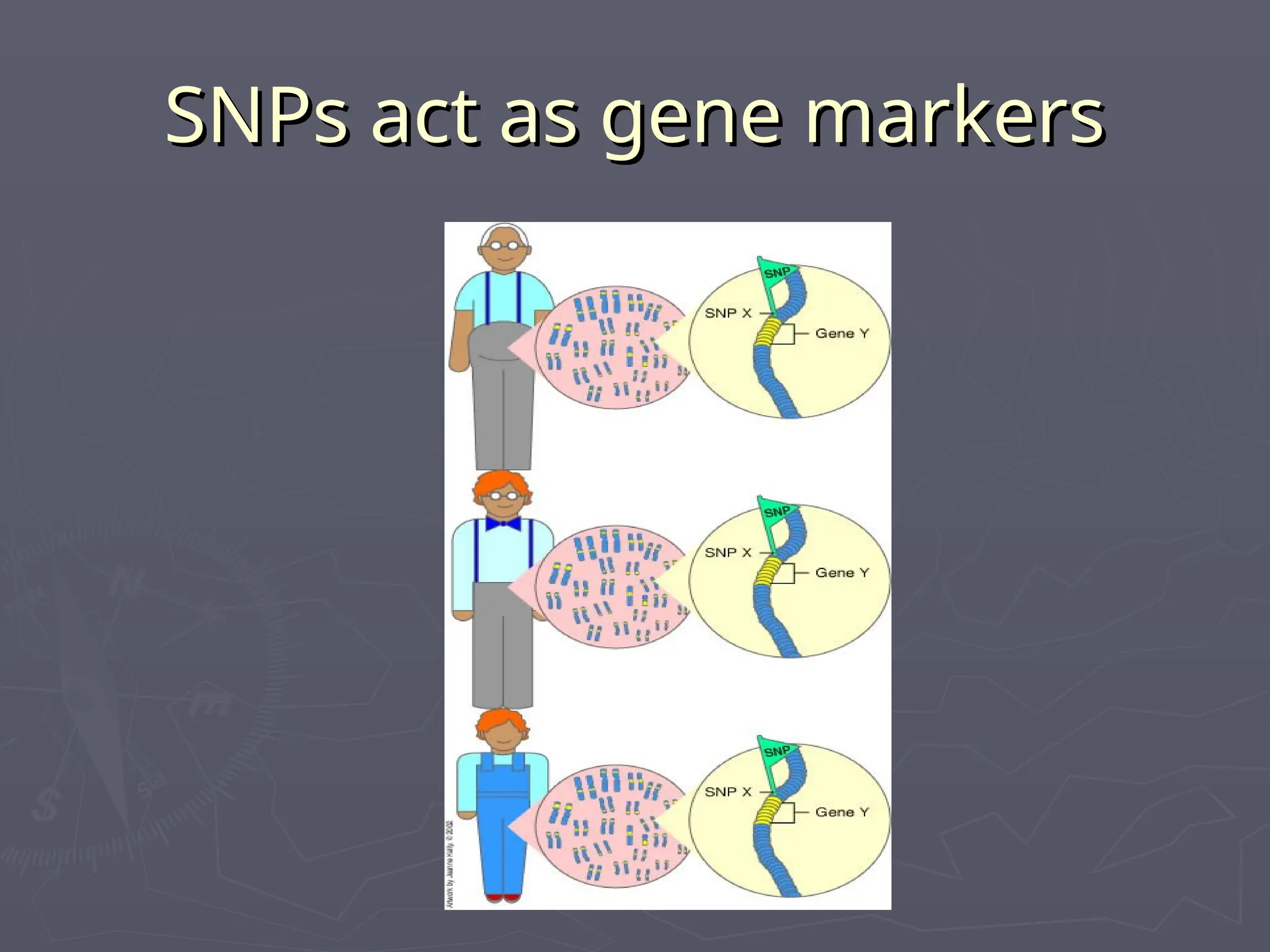
► SNPs close to particular gene acts as a marker for that
SNPs close to particular gene acts as a marker for that
gene.
gene.
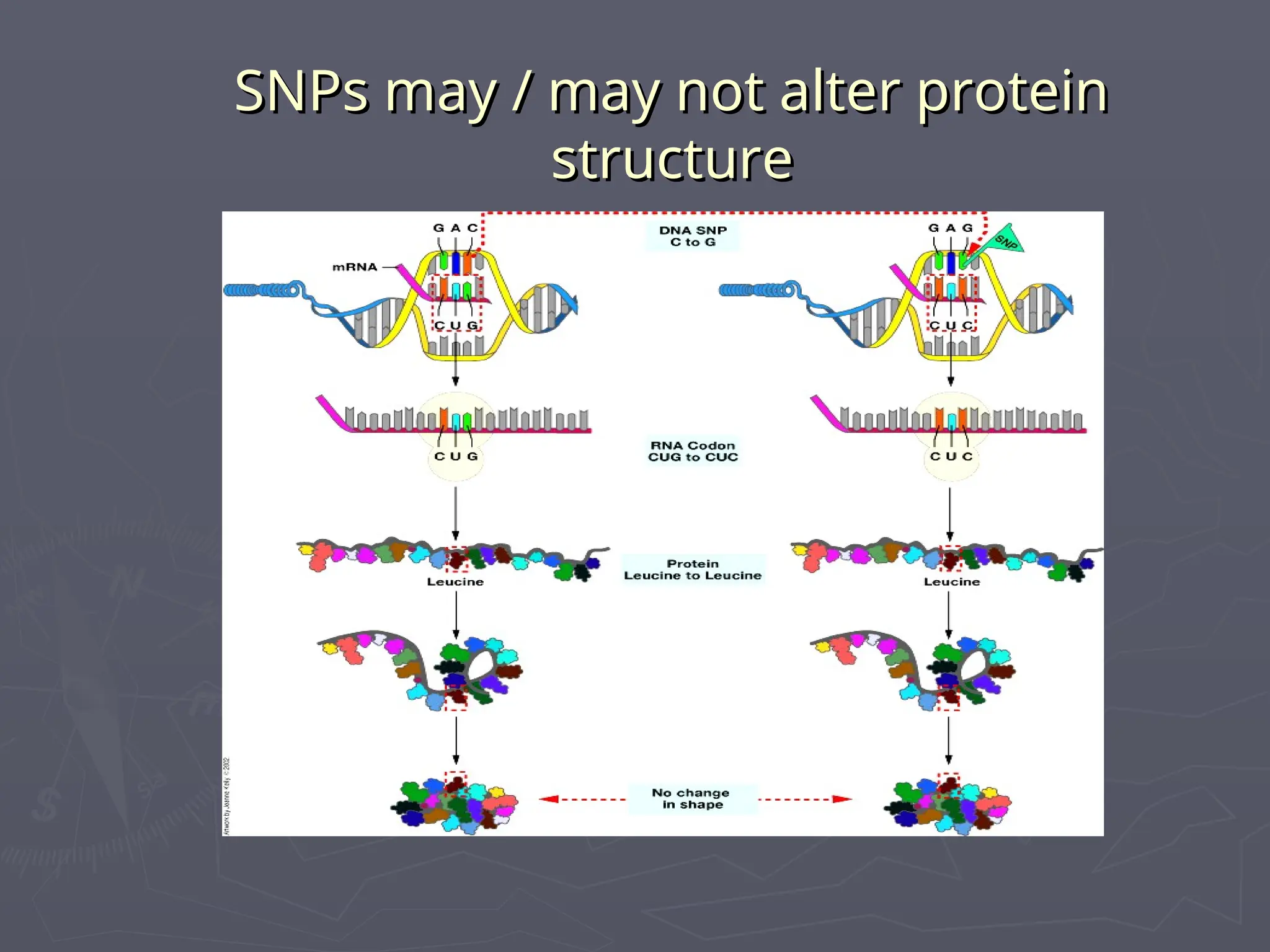
► SNPs in coding regions may alter the protein structure
SNPs in coding regions may alter the protein structure
made by that coding region.
SNPs may / may not alter protein
structure
structure
SNPs act as gene markers
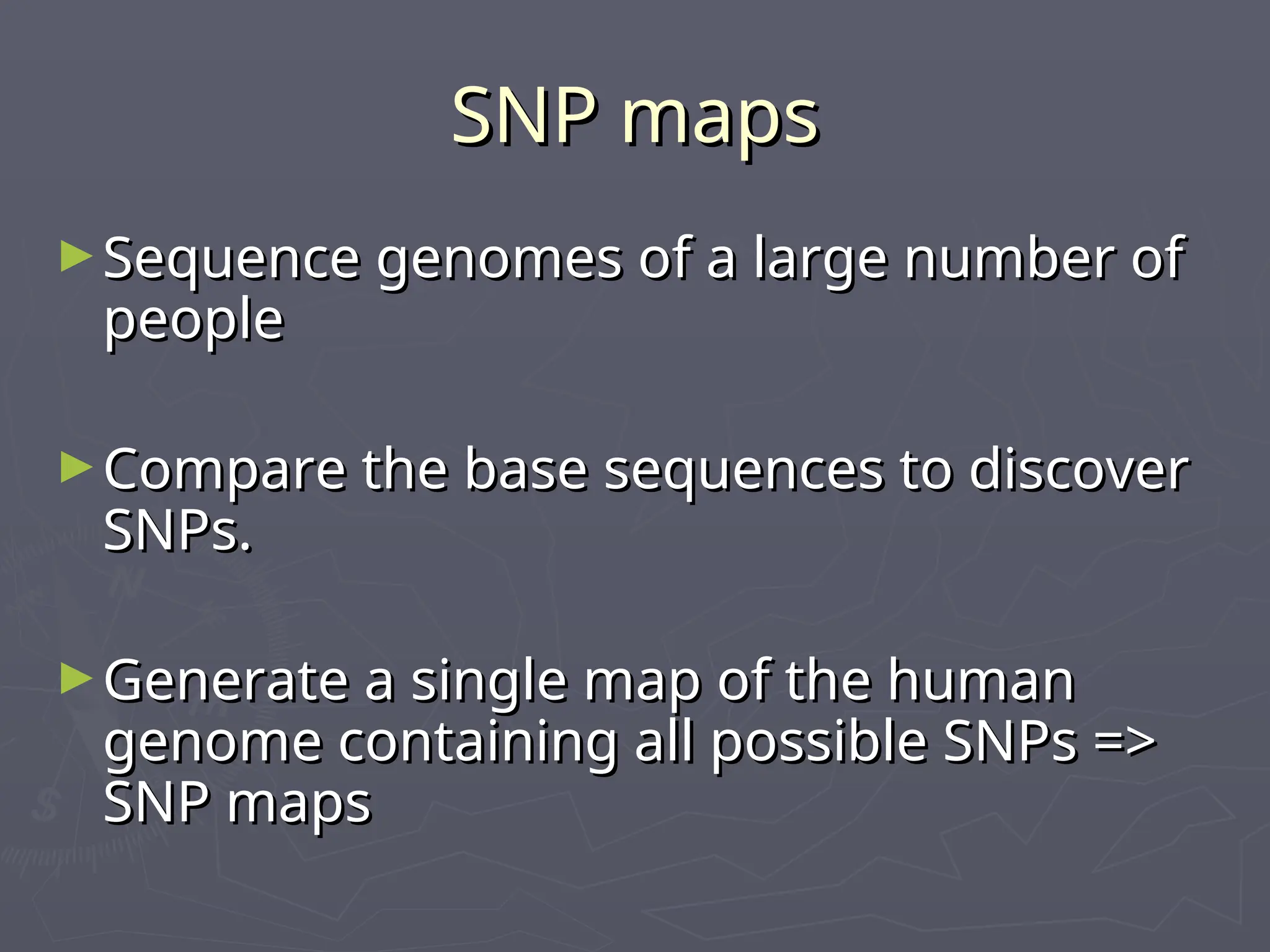
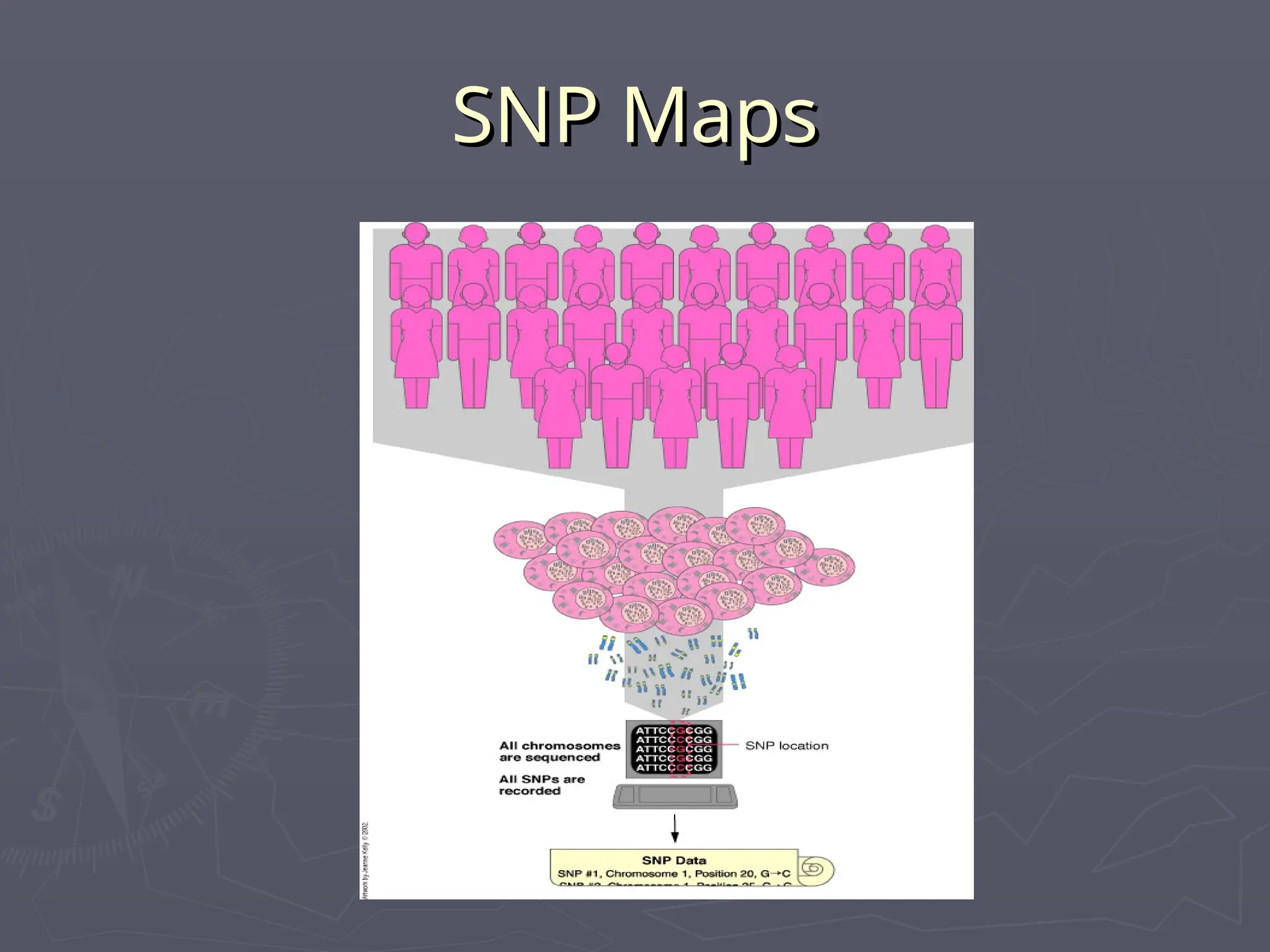
SNP maps
SNP maps
►Sequence genomes of a large number of
Sequence genomes of a large number of
people
people
►Compare the base sequences to discover
Compare the base sequences to discover
SNPs.
SNPs.
►Generate a single map of the human
Generate a single map of the human
genome containing all possible SNPs =>
SNP maps
SNP maps
SNP Maps
SNP Maps
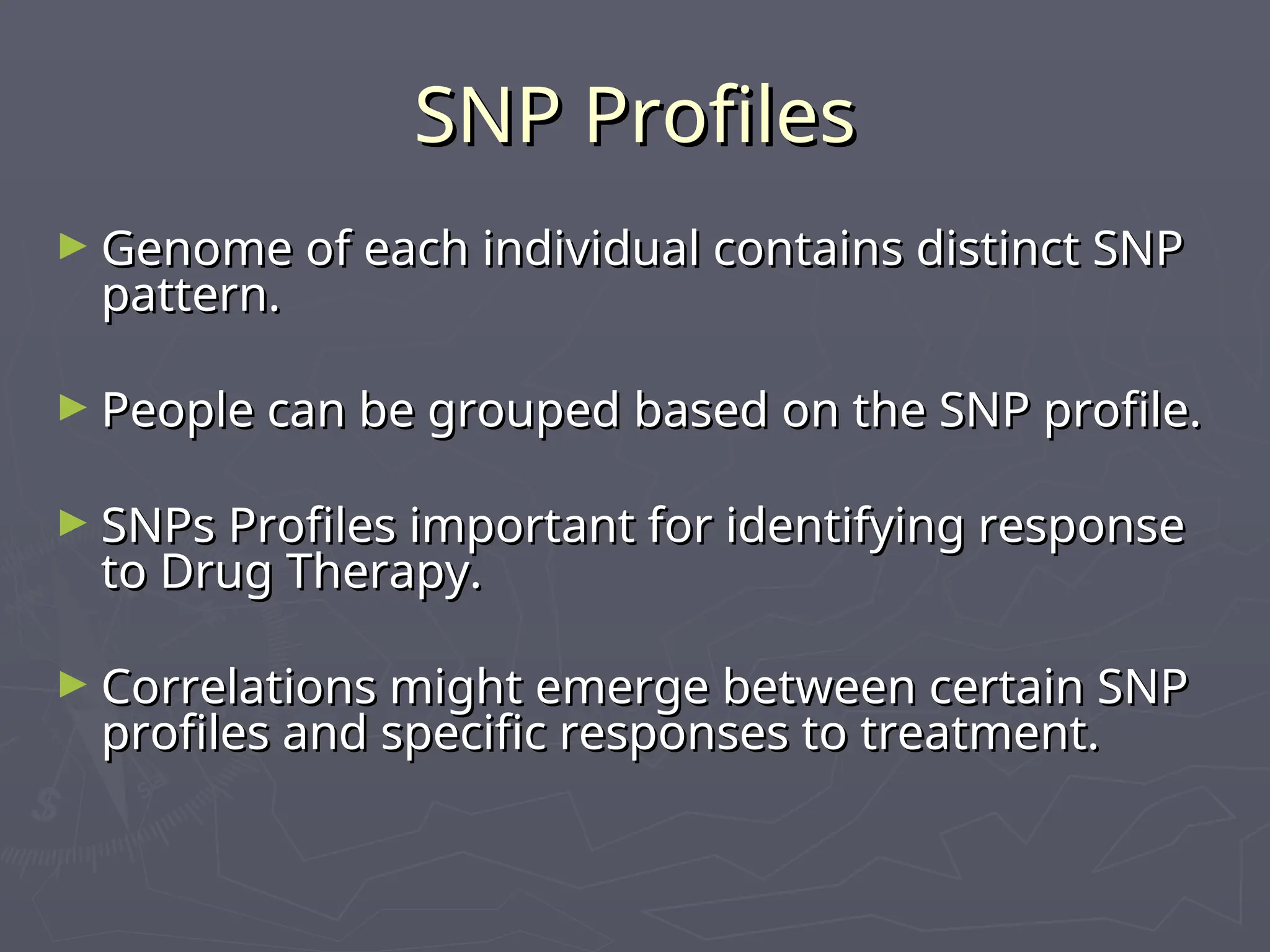
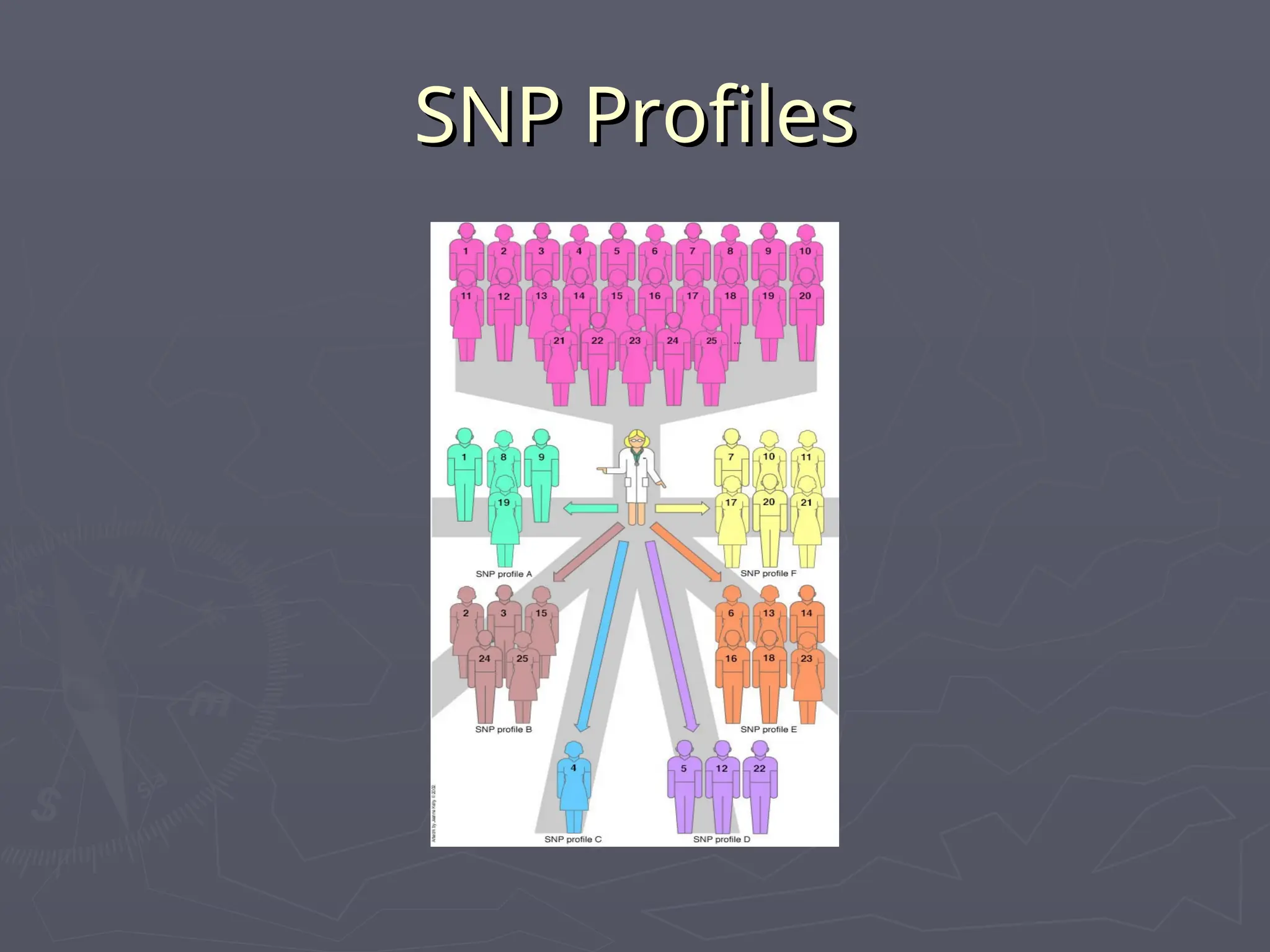
SNP Profiles
SNP Profiles
► Genome of each individual contains distinct SNP
Genome of each individual contains distinct SNP
pattern.
pattern.
► People can be grouped based on the SNP profile.
People can be grouped based on the SNP profile.
► SNPs Profiles important for identifying response
SNPs Profiles important for identifying response
to Drug Therapy.
to Drug Therapy.
► Correlations might emerge between certain SNP
Correlations might emerge between certain SNP
profiles and specific responses to treatment.
SNP Profiles
SNP Profiles
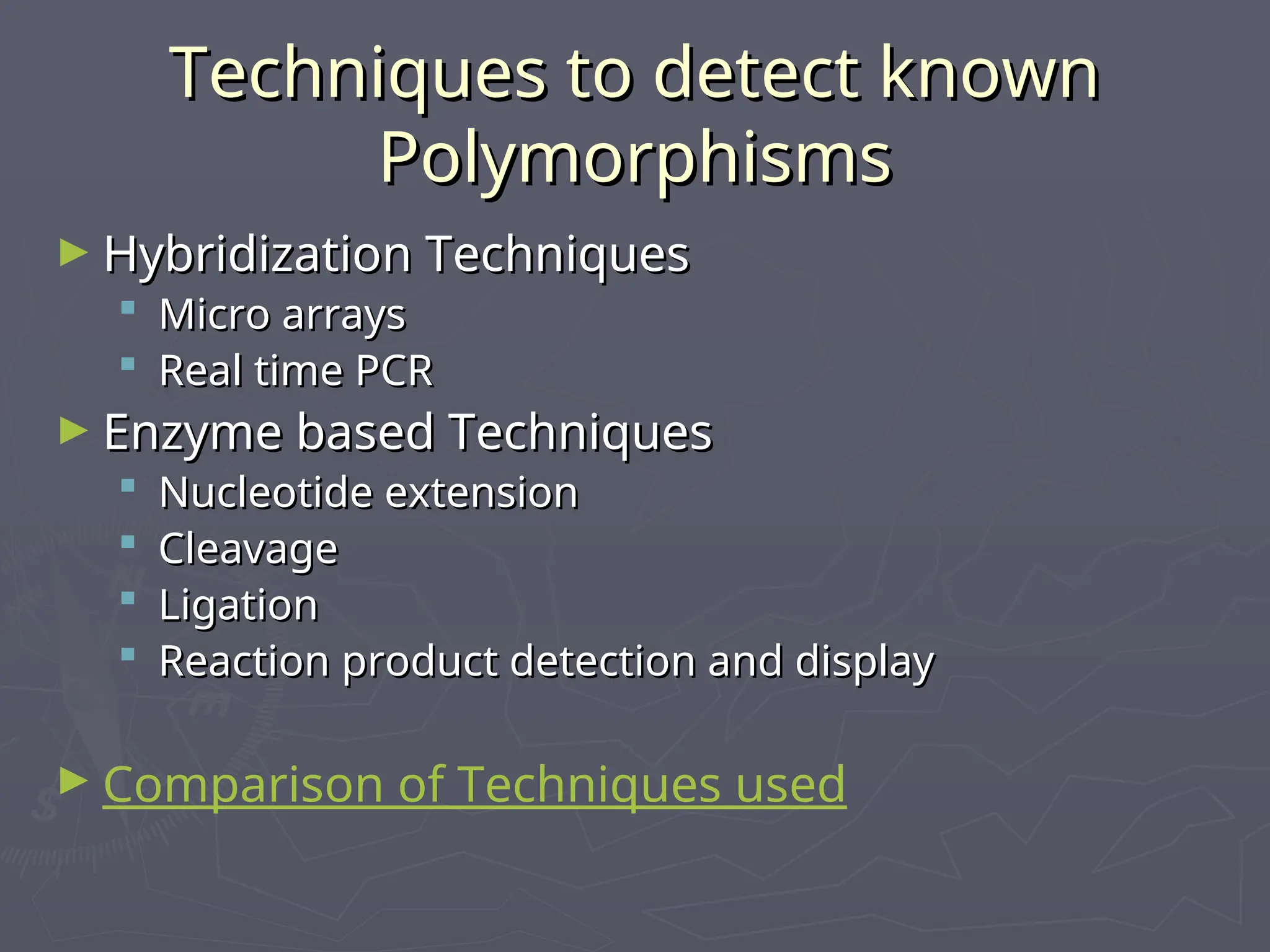
Techniques to detect known
Polymorphisms
Polymorphisms
► Hybridization Techniques
Hybridization Techniques
 Micro arrays
Micro arrays
 Real time PCR
Real time PCR
► Enzyme based Techniques
Enzyme based Techniques
 Nucleotide extension
Nucleotide extension
 Cleavage
Cleavage
 Ligation
Ligation
 Reaction product detection and display
Reaction product detection and display
► Comparison of Techniques used
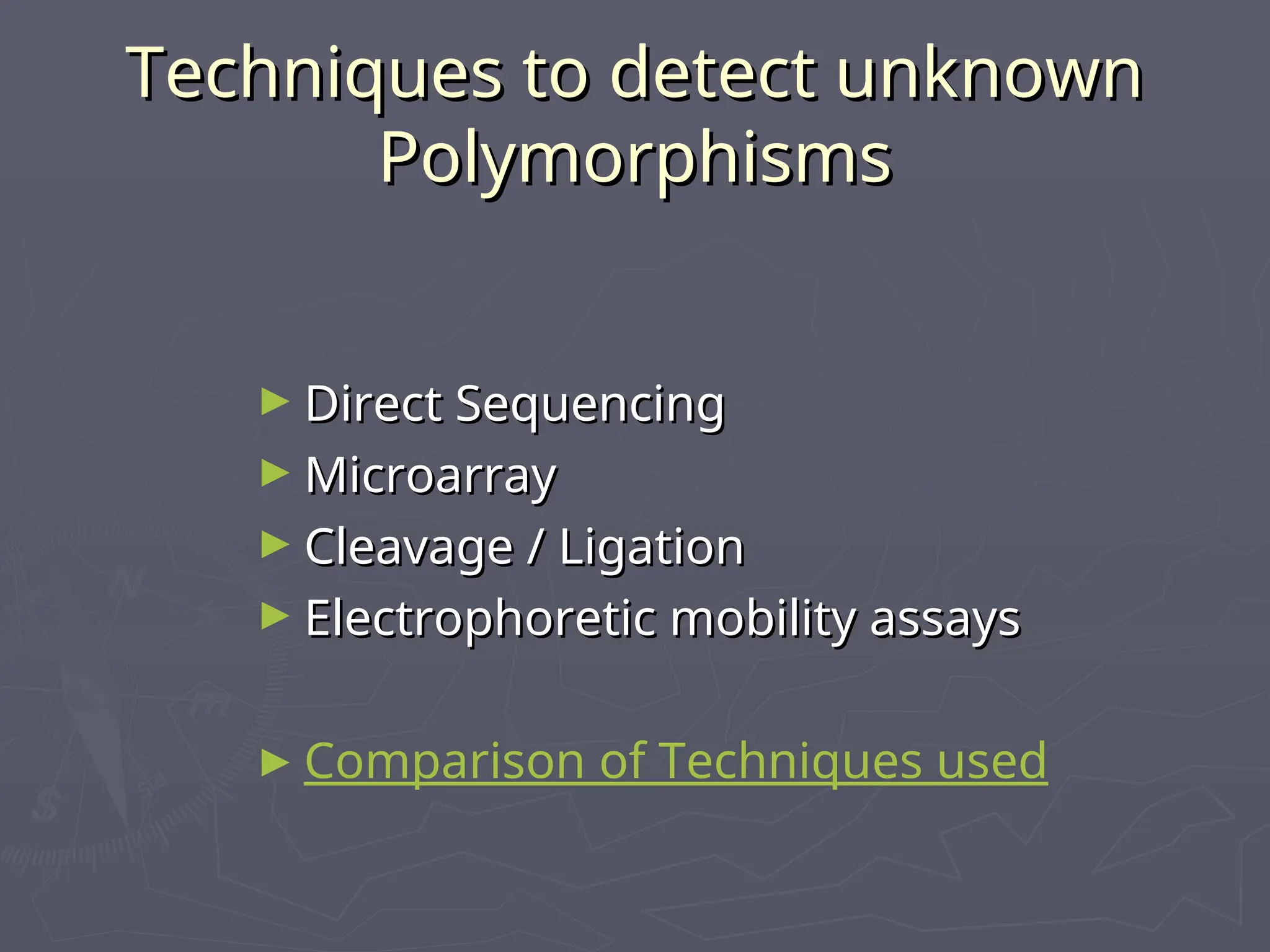
Techniques to detect unknown
Polymorphisms
Polymorphisms
► Direct Sequencing
Direct Sequencing
► Microarray
Microarray
► Cleavage / Ligation
Cleavage / Ligation
► Electrophoretic mobility assays
Electrophoretic mobility assays
► Comparison of Techniques used
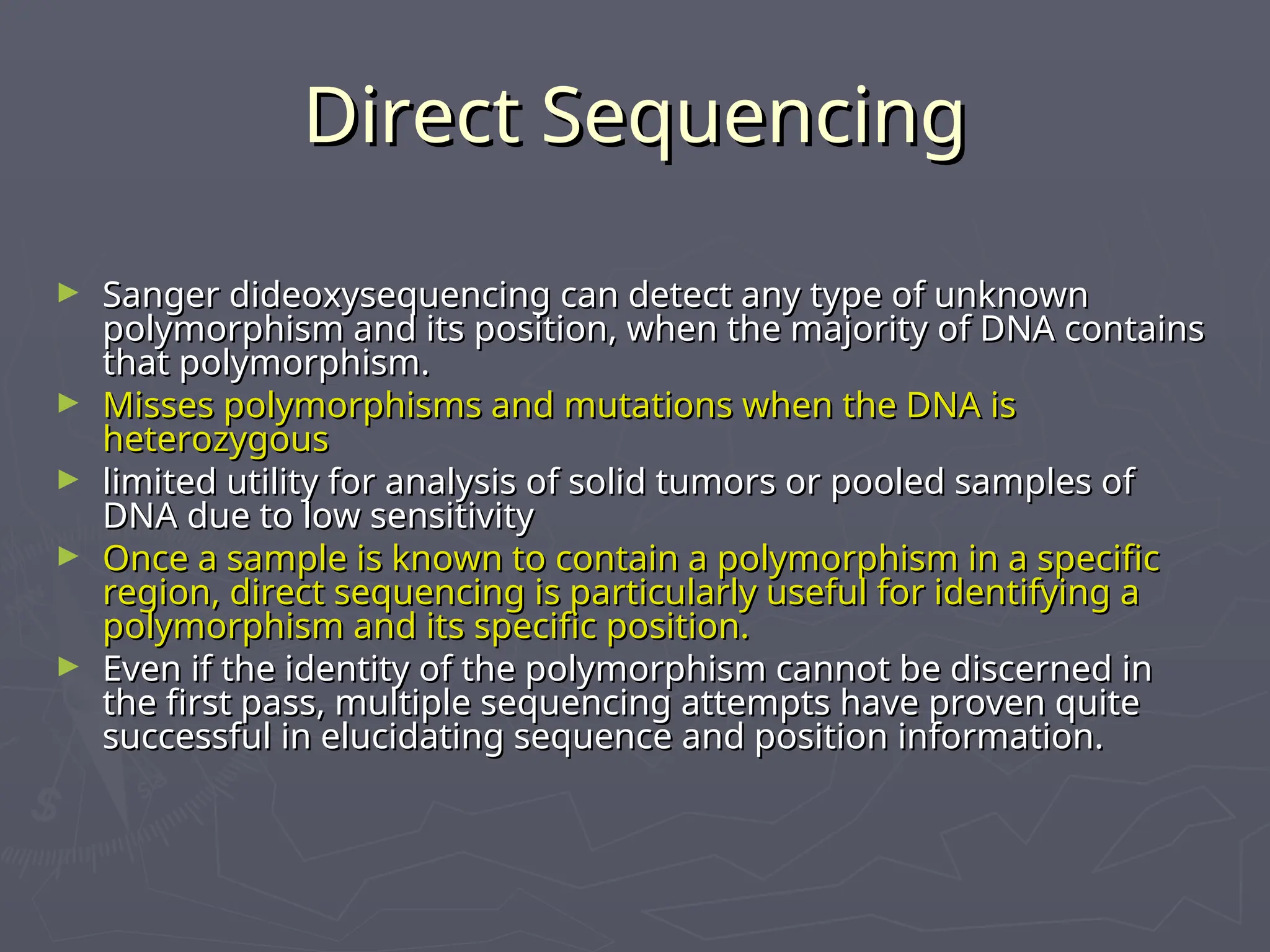
Direct Sequencing
Direct Sequencing
► Sanger dideoxysequencing can detect any type of unknown
Sanger dideoxysequencing can detect any type of unknown
polymorphism and its position, when the majority of DNA contains
that polymorphism.
that polymorphism.
► Misses polymorphisms and mutations when the DNA is
Misses polymorphisms and mutations when the DNA is
heterozygous
heterozygous
► limited utility for analysis of solid tumors or pooled samples of
limited utility for analysis of solid tumors or pooled samples of
DNA due to low sensitivity
► Once a sample is known to contain a polymorphism in a specific
Once a sample is known to contain a polymorphism in a specific
region, direct sequencing is particularly useful for identifying a
polymorphism and its specific position.
► Even if the identity of the polymorphism cannot be discerned in
Even if the identity of the polymorphism cannot be discerned in
the first pass, multiple sequencing attempts have proven quite
successful in elucidating sequence and position information.
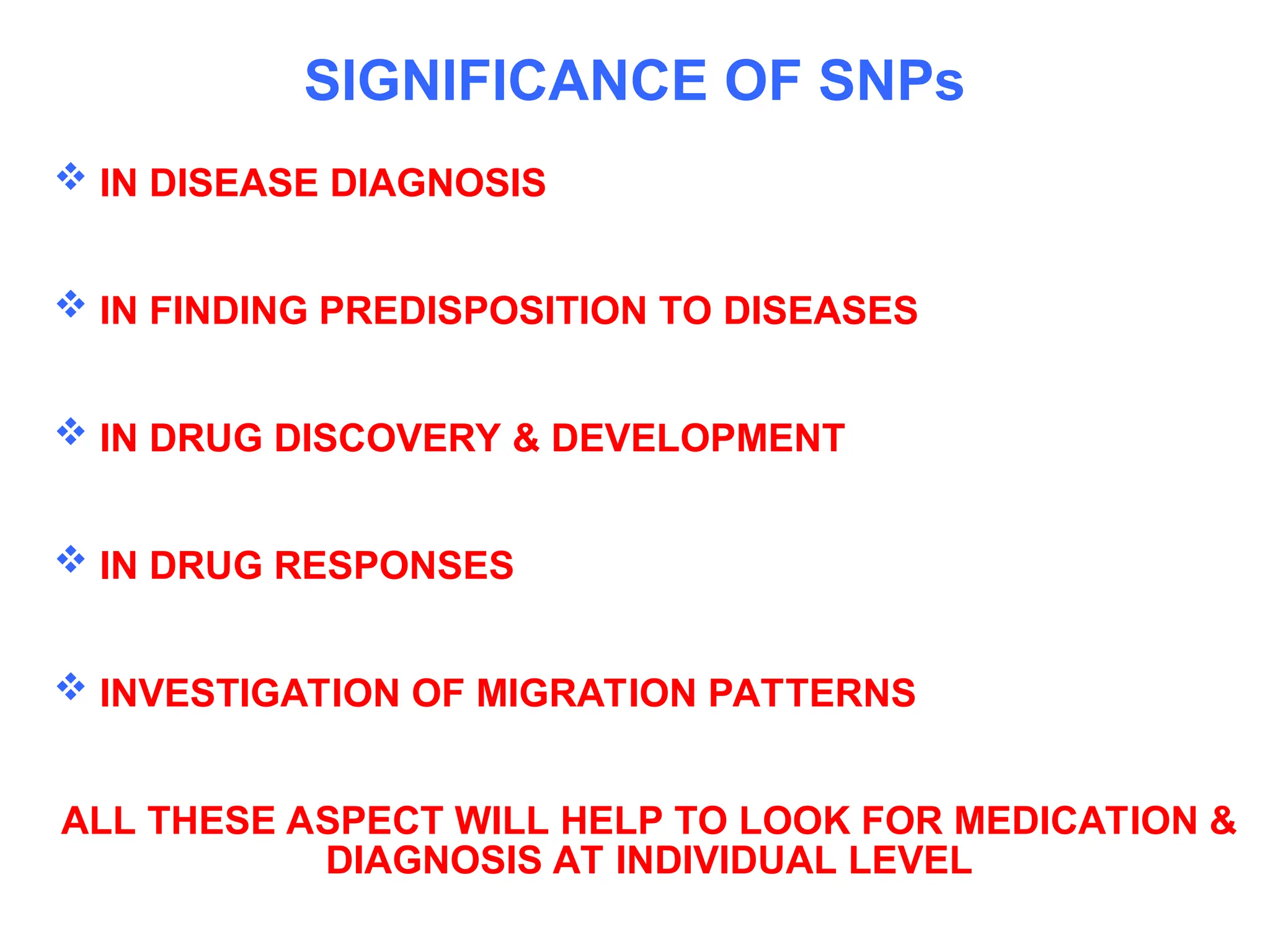
SIGNIFICANCE OF SNPs
 IN DISEASE DIAGNOSIS
 IN FINDING PREDISPOSITION TO DISEASES
 IN DRUG DISCOVERY & DEVELOPMENT
 IN DRUG RESPONSES
 INVESTIGATION OF MIGRATION PATTERNS
ALL THESE ASPECT WILL HELP TO LOOK FOR MEDICATION &
DIAGNOSIS AT INDIVIDUAL LEVEL
Feb. 25. 2003 SI Hung
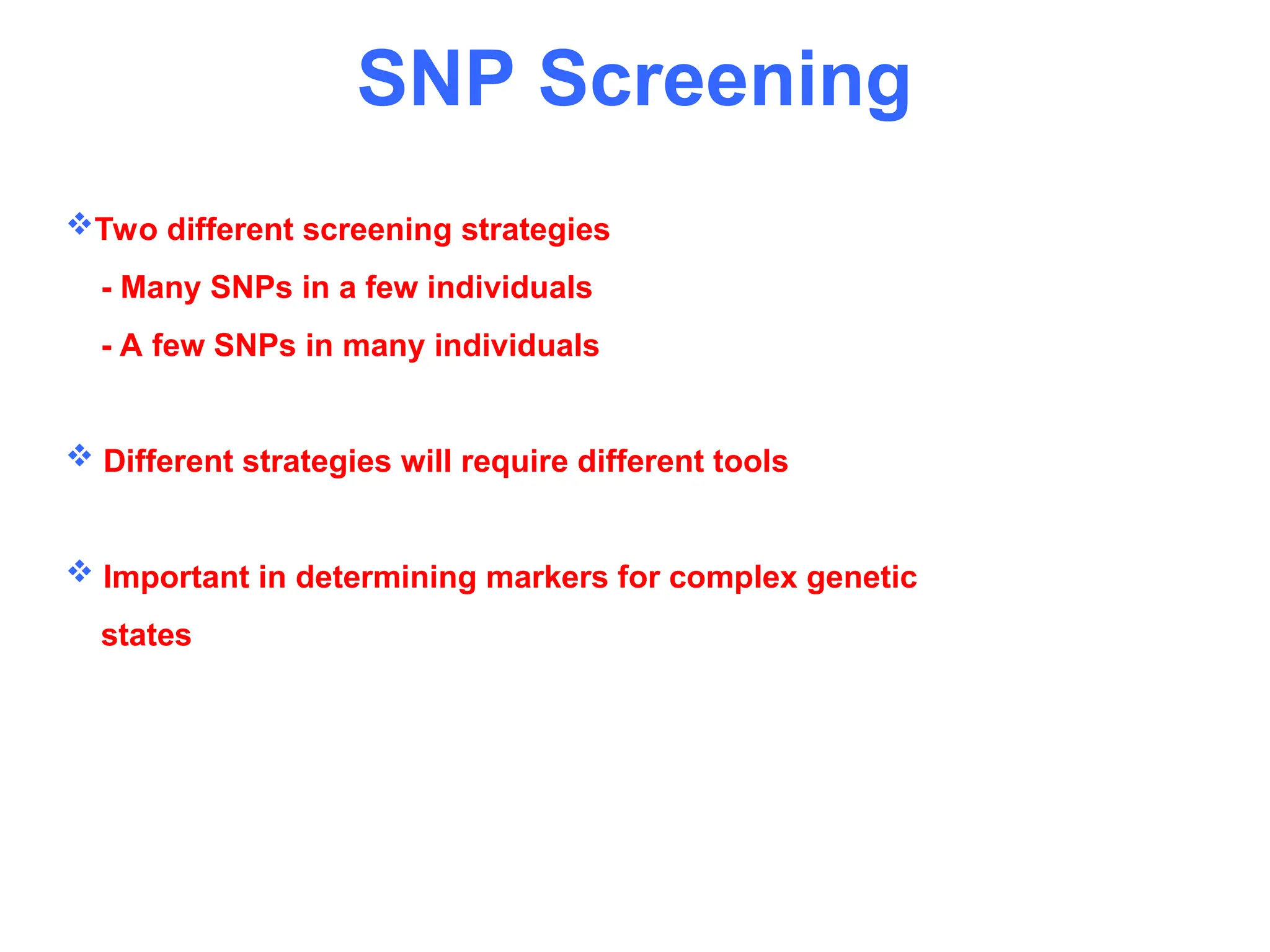
Two different screening strategies
- Many SNPs in a few individuals
- A few SNPs in many individuals
 Different strategies will require different tools
 Important in determining markers for complex genetic
states
SNP Screening
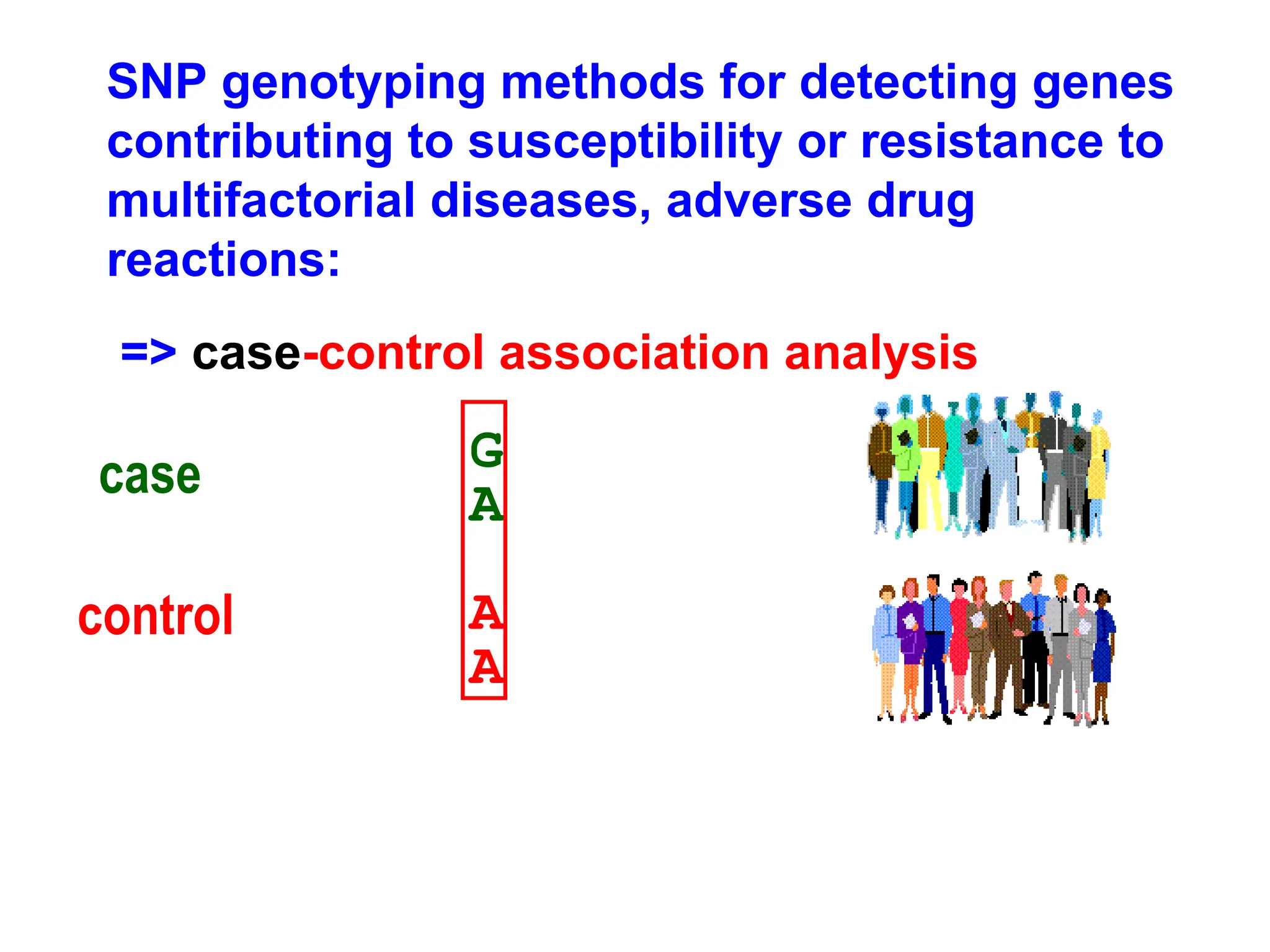
SNP genotyping methods for detecting genes
contributing to susceptibility or resistance to
multifactorial diseases, adverse drug
reactions:
=> case-control association analysis
case
control
….GCCGTTGAC….
….GCCATTGAC….
….GCCATTGAC….
….GCCATTGAC….
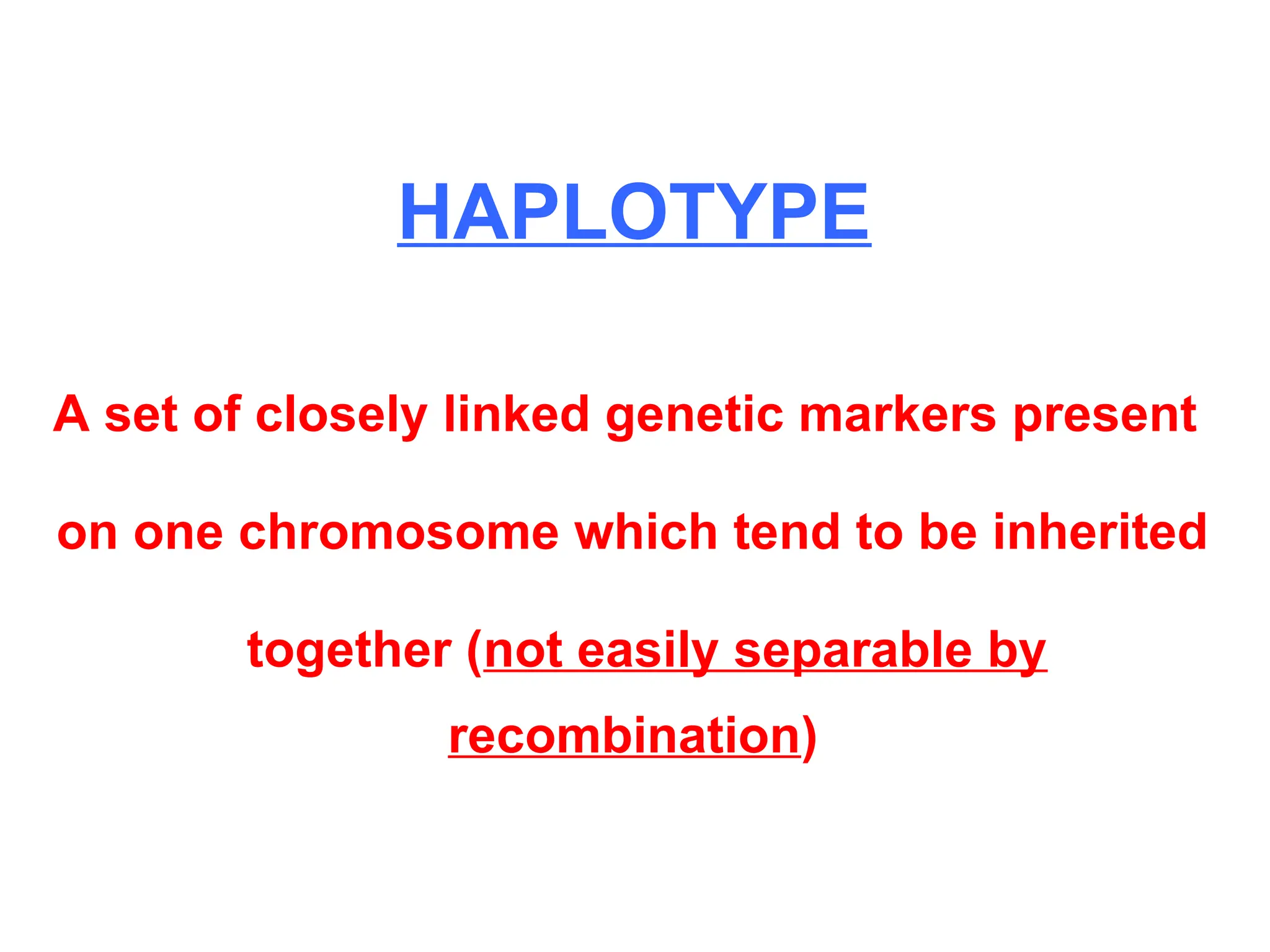
A set of closely linked genetic markers present
on one chromosome which tend to be inherited
together (not easily separable by
recombination)
HAPLOTYPE
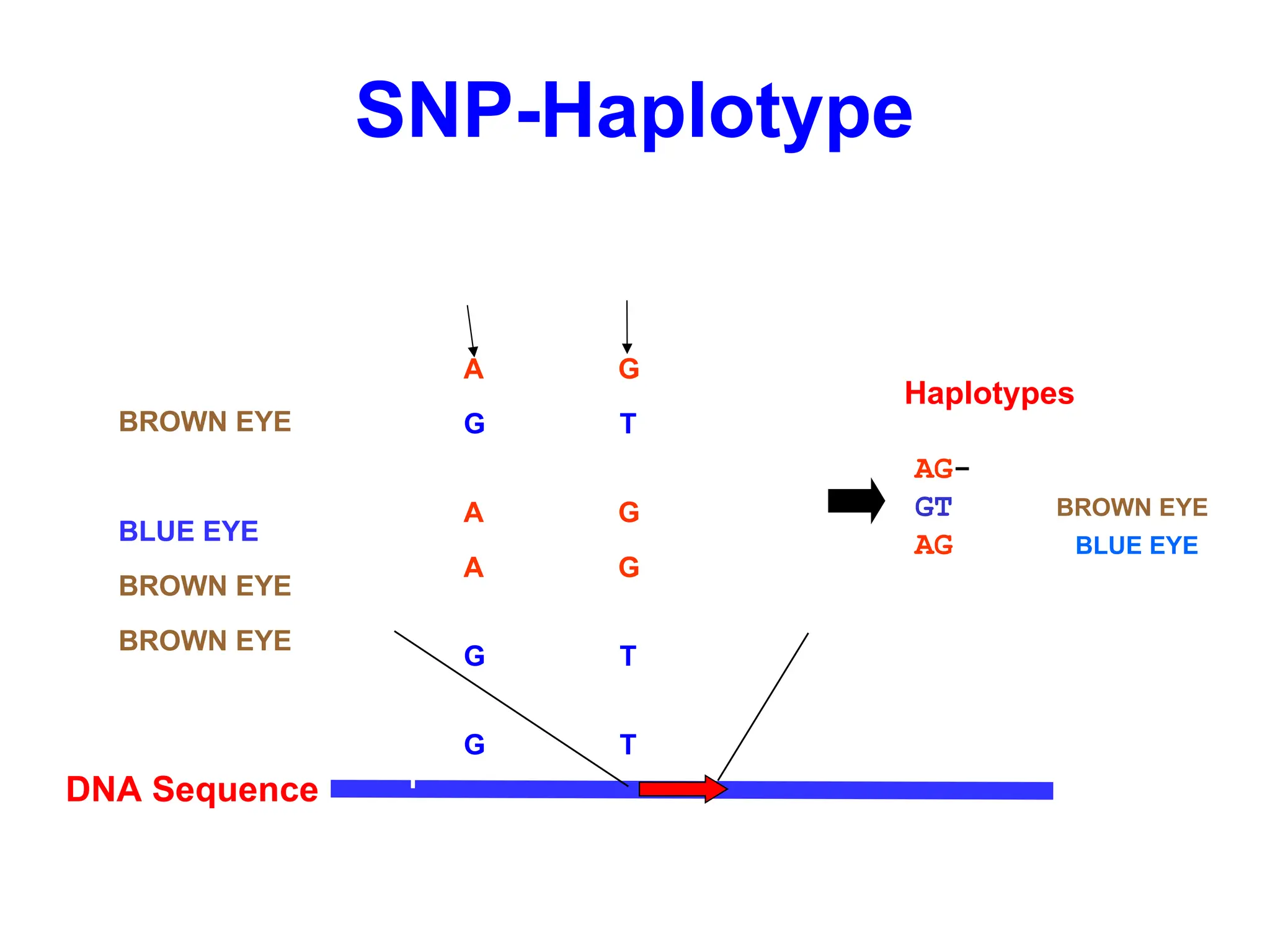
SNP-Haplotype
DNA Sequence
GATATTCGTACGGA-T
GATGTTCGTACTGAA
T
GATATTCGTACGGA-T
GATATTCGTACGGAA
T
GATGTTCGTACTGAA
T
GATGTTCGTACTGAA
T
SNP
SNP
1
2
3
4
5
6
AG- 2/6(BLACK EYE)
GTA 3/6(BROWN EYE)
AGA 1/6 (BLUE EYE)
Haplotypes
Phenotype
BLACK EYE
BROWN EYE
BLACK EYE
BLUE EYE
BROWN EYE
BROWN EYE
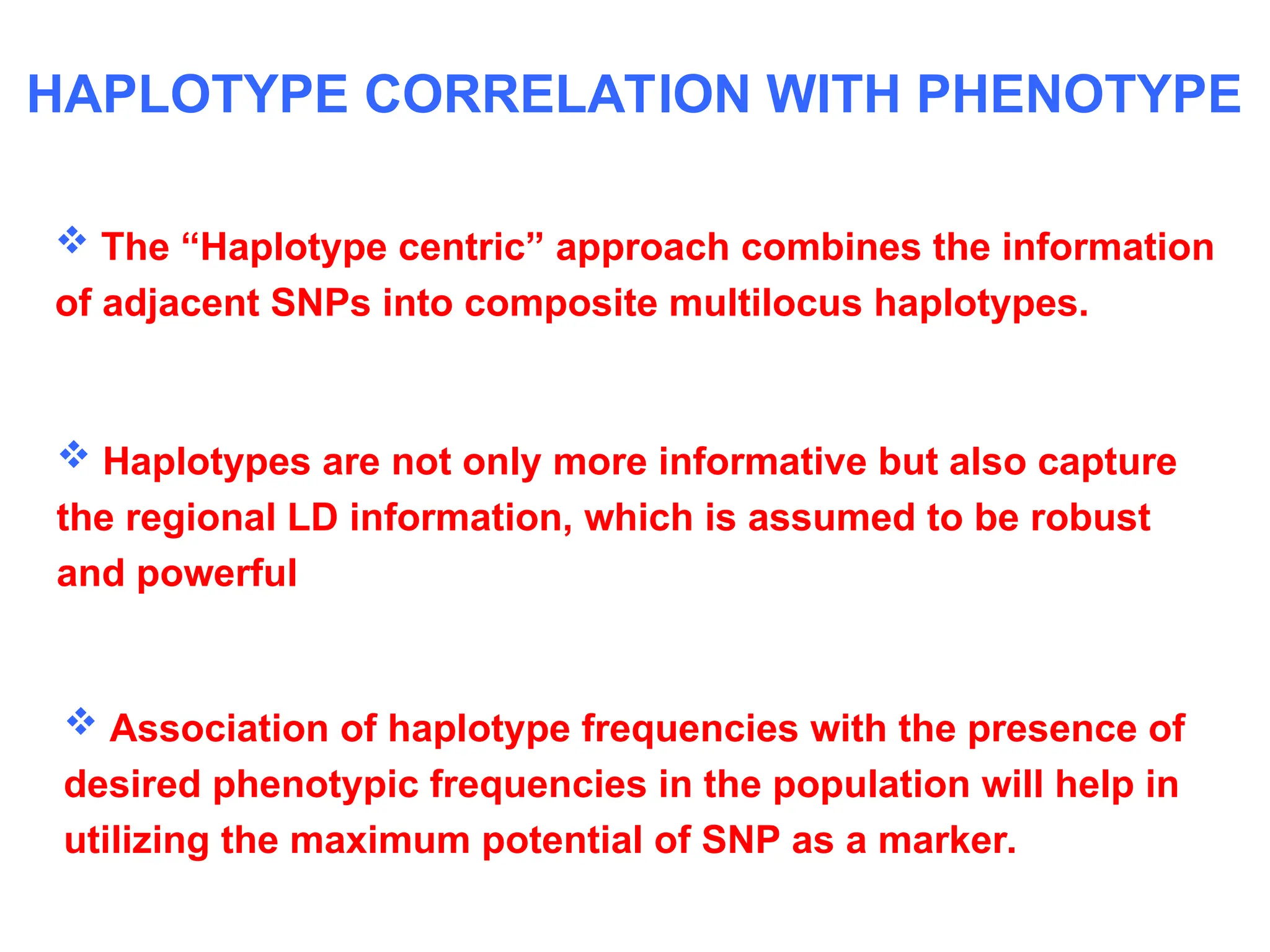
 Association of haplotype frequencies with the presence of
desired phenotypic frequencies in the population will help in
utilizing the maximum potential of SNP as a marker.
HAPLOTYPE CORRELATION WITH PHENOTYPE
 The “Haplotype centric” approach combines the information
of adjacent SNPs into composite multilocus haplotypes.
 Haplotypes are not only more informative but also capture
the regional LD information, which is assumed to be robust
and powerful
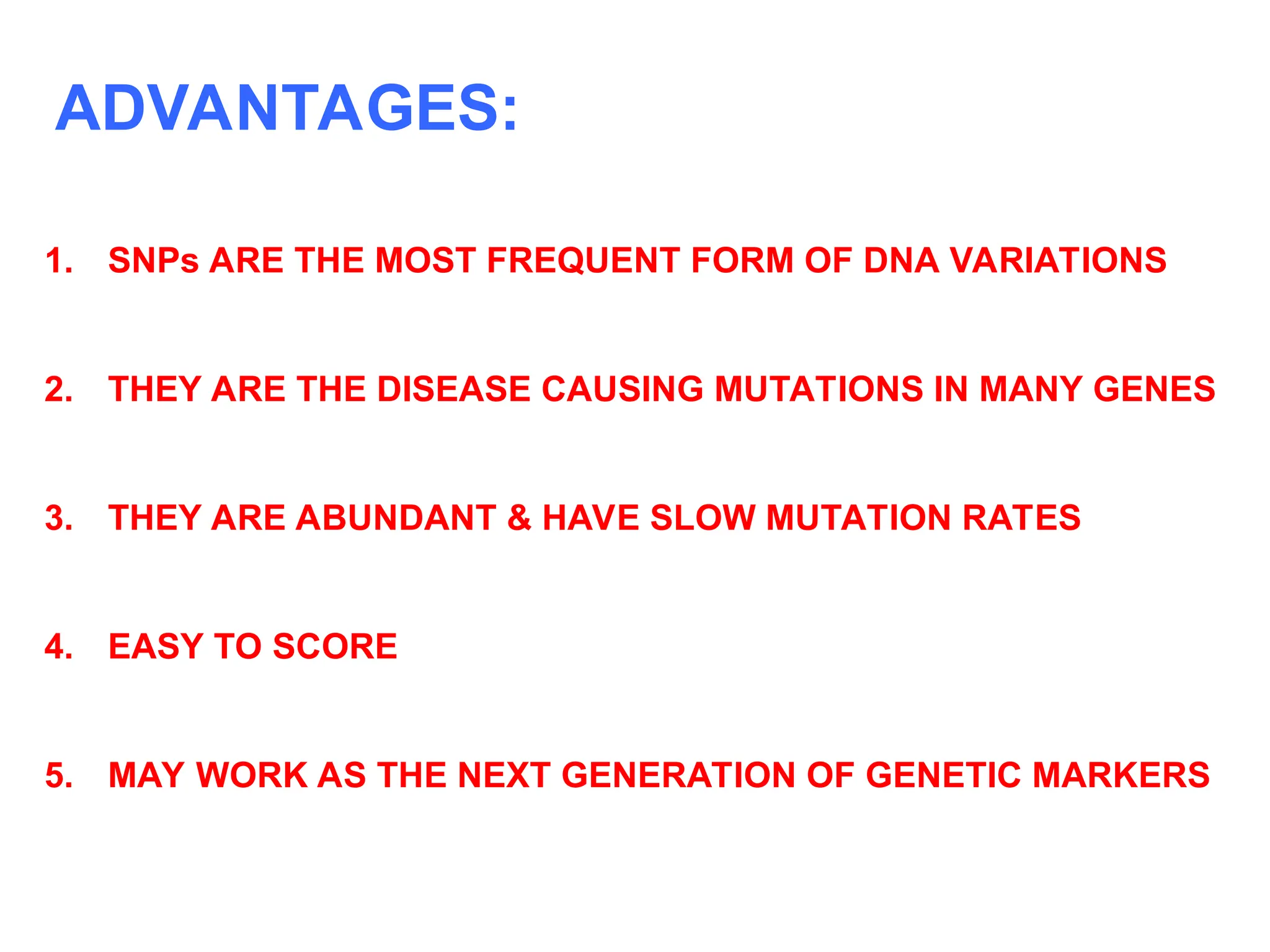
1. SNPs ARE THE MOST FREQUENT FORM OF DNA VARIATIONS
2. THEY ARE THE DISEASE CAUSING MUTATIONS IN MANY GENES
3. THEY ARE ABUNDANT & HAVE SLOW MUTATION RATES
4. EASY TO SCORE
5. MAY WORK AS THE NEXT GENERATION OF GENETIC MARKERS
ADVANTAGES:
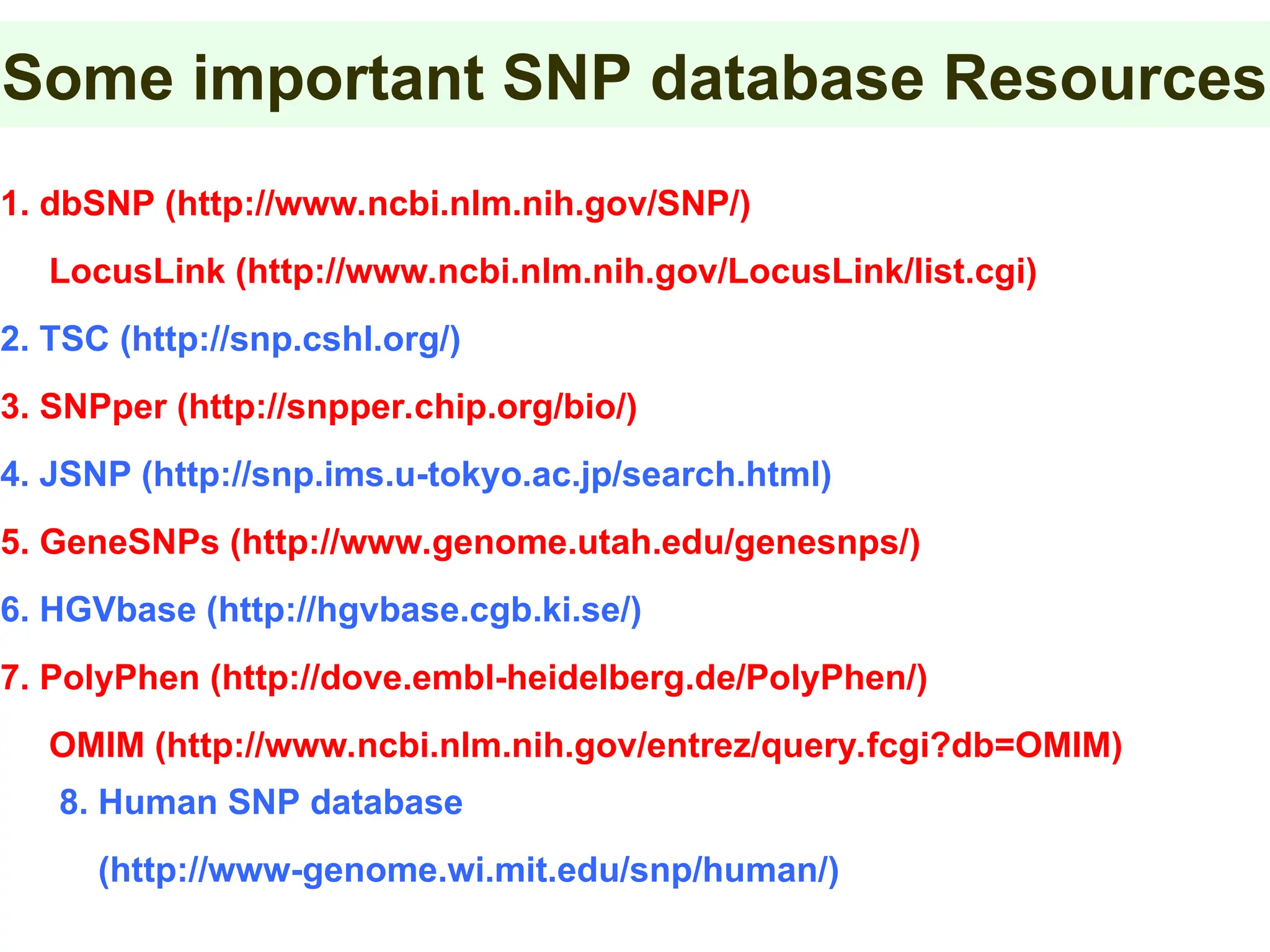
Some important SNP database Resources
1. dbSNP (http://www.ncbi.nlm.nih.gov/SNP/)
LocusLink (http://www.ncbi.nlm.nih.gov/LocusLink/list.cgi)
2. TSC (http://snp.cshl.org/)
3. SNPper (http://snpper.chip.org/bio/)
4. JSNP (http://snp.ims.u-tokyo.ac.jp/search.html)
5. GeneSNPs (http://www.genome.utah.edu/genesnps/)
6. HGVbase (http://hgvbase.cgb.ki.se/)
7. PolyPhen (http://dove.embl-heidelberg.de/PolyPhen/)
OMIM (http://www.ncbi.nlm.nih.gov/entrez/query.fcgi?db=OMIM)
Feb. 25. 2003 SI Hung
8. Human SNP database
(http://www-genome.wi.mit.edu/snp/human/)

Lecture6b-SNPmmmmmmmmmmmmmmmmmmmmmms.ppt

  • 1.
    Single Nucleotide Single Nucleotide Polymorphisms(SNPs), Polymorphisms (SNPs), Haplotypes, Linkage Haplotypes, Linkage Disequilibrium, and the Disequilibrium, and the Human Genome Human Genome Manish Anand Manish Anand Nihar Sheth Nihar Sheth Jim Costello Jim Costello Univ. of Indiana Univ. of Indiana 24 24th th November, 2003 November, 2003
  • 2.
    Biological Background Biological Background ►Howcan researchers hope to identify and How can researchers hope to identify and study all the changes that occur in so study all the changes that occur in so many different diseases? many different diseases? ►How can they explain why some people How can they explain why some people respond to treatment and not others? respond to treatment and not others?
  • 3.
    ‘ ‘SNP’ SNP’ is theanswer to these questions… is the answer to these questions… ►So what exactly are SNPs? So what exactly are SNPs? ►How are they involved in so many How are they involved in so many different aspects of health? different aspects of health?
  • 4.
    What is SNP? What is SNP ? ►A A SNP SNP is defined as a single base change is defined as a single base change in a DNA sequence that occurs in a in a DNA sequence that occurs in a significant proportion (more than 1 significant proportion (more than 1 percent) of a large population. percent) of a large population.
  • 5.
    Some Facts Some Facts ►In human beings, 99.9 percent bases are same. In human beings, 99.9 percent bases are same. ► Remaining 0.1 percent makes a person unique. Remaining 0.1 percent makes a person unique.  Different attributes / characteristics / traits Different attributes / characteristics / traits ► how a person looks, how a person looks, ► diseases he or she develops. diseases he or she develops. ► These variations can be: These variations can be:  Harmless (change in phenotype) Harmless (change in phenotype)  Harmful (diabetes, cancer, heart disease, Huntington's disease, Harmful (diabetes, cancer, heart disease, Huntington's disease, and hemophilia ) and hemophilia )  Latent (variations found in coding and regulatory regions, are Latent (variations found in coding and regulatory regions, are not harmful on their own, and the change in each gene only not harmful on their own, and the change in each gene only becomes apparent under certain conditions e.g. susceptibility becomes apparent under certain conditions e.g. susceptibility to lung cancer) to lung cancer)
  • 6.
    SNP facts SNP facts ►SNPs are found in SNPs are found in  coding and (mostly) noncoding regions. coding and (mostly) noncoding regions. ► Occur with a very high frequency Occur with a very high frequency  about 1 in 1000 bases to 1 in 100 to 300 bases. about 1 in 1000 bases to 1 in 100 to 300 bases. ► The abundance of SNPs and the ease with which they can The abundance of SNPs and the ease with which they can be measured make these genetic variations significant. be measured make these genetic variations significant. ► SNPs close to particular gene acts as a marker for that SNPs close to particular gene acts as a marker for that gene. gene. ► SNPs in coding regions may alter the protein structure SNPs in coding regions may alter the protein structure made by that coding region. made by that coding region.
  • 7.
    SNPs may /may not alter protein SNPs may / may not alter protein structure structure
  • 8.
    SNPs act asgene markers SNPs act as gene markers
  • 9.
    SNP maps SNP maps ►Sequencegenomes of a large number of Sequence genomes of a large number of people people ►Compare the base sequences to discover Compare the base sequences to discover SNPs. SNPs. ►Generate a single map of the human Generate a single map of the human genome containing all possible SNPs => genome containing all possible SNPs => SNP maps SNP maps
  • 10.
  • 11.
    SNP Profiles SNP Profiles ►Genome of each individual contains distinct SNP Genome of each individual contains distinct SNP pattern. pattern. ► People can be grouped based on the SNP profile. People can be grouped based on the SNP profile. ► SNPs Profiles important for identifying response SNPs Profiles important for identifying response to Drug Therapy. to Drug Therapy. ► Correlations might emerge between certain SNP Correlations might emerge between certain SNP profiles and specific responses to treatment. profiles and specific responses to treatment.
  • 12.
  • 13.
    Techniques to detectknown Techniques to detect known Polymorphisms Polymorphisms ► Hybridization Techniques Hybridization Techniques  Micro arrays Micro arrays  Real time PCR Real time PCR ► Enzyme based Techniques Enzyme based Techniques  Nucleotide extension Nucleotide extension  Cleavage Cleavage  Ligation Ligation  Reaction product detection and display Reaction product detection and display ► Comparison of Techniques used
  • 14.
    Techniques to detectunknown Techniques to detect unknown Polymorphisms Polymorphisms ► Direct Sequencing Direct Sequencing ► Microarray Microarray ► Cleavage / Ligation Cleavage / Ligation ► Electrophoretic mobility assays Electrophoretic mobility assays ► Comparison of Techniques used
  • 15.
    Direct Sequencing Direct Sequencing ►Sanger dideoxysequencing can detect any type of unknown Sanger dideoxysequencing can detect any type of unknown polymorphism and its position, when the majority of DNA contains polymorphism and its position, when the majority of DNA contains that polymorphism. that polymorphism. ► Misses polymorphisms and mutations when the DNA is Misses polymorphisms and mutations when the DNA is heterozygous heterozygous ► limited utility for analysis of solid tumors or pooled samples of limited utility for analysis of solid tumors or pooled samples of DNA due to low sensitivity DNA due to low sensitivity ► Once a sample is known to contain a polymorphism in a specific Once a sample is known to contain a polymorphism in a specific region, direct sequencing is particularly useful for identifying a region, direct sequencing is particularly useful for identifying a polymorphism and its specific position. polymorphism and its specific position. ► Even if the identity of the polymorphism cannot be discerned in Even if the identity of the polymorphism cannot be discerned in the first pass, multiple sequencing attempts have proven quite the first pass, multiple sequencing attempts have proven quite successful in elucidating sequence and position information. successful in elucidating sequence and position information.
  • 16.
    SIGNIFICANCE OF SNPs IN DISEASE DIAGNOSIS  IN FINDING PREDISPOSITION TO DISEASES  IN DRUG DISCOVERY & DEVELOPMENT  IN DRUG RESPONSES  INVESTIGATION OF MIGRATION PATTERNS ALL THESE ASPECT WILL HELP TO LOOK FOR MEDICATION & DIAGNOSIS AT INDIVIDUAL LEVEL Feb. 25. 2003 SI Hung
  • 17.
    Two different screeningstrategies - Many SNPs in a few individuals - A few SNPs in many individuals  Different strategies will require different tools  Important in determining markers for complex genetic states SNP Screening
  • 18.
    SNP genotyping methodsfor detecting genes contributing to susceptibility or resistance to multifactorial diseases, adverse drug reactions: => case-control association analysis case control ….GCCGTTGAC…. ….GCCATTGAC…. ….GCCATTGAC…. ….GCCATTGAC….
  • 19.
    A set ofclosely linked genetic markers present on one chromosome which tend to be inherited together (not easily separable by recombination) HAPLOTYPE
  • 20.
    SNP-Haplotype DNA Sequence GATATTCGTACGGA-T GATGTTCGTACTGAA T GATATTCGTACGGA-T GATATTCGTACGGAA T GATGTTCGTACTGAA T GATGTTCGTACTGAA T SNP SNP 1 2 3 4 5 6 AG- 2/6(BLACKEYE) GTA 3/6(BROWN EYE) AGA 1/6 (BLUE EYE) Haplotypes Phenotype BLACK EYE BROWN EYE BLACK EYE BLUE EYE BROWN EYE BROWN EYE
  • 21.
     Association ofhaplotype frequencies with the presence of desired phenotypic frequencies in the population will help in utilizing the maximum potential of SNP as a marker. HAPLOTYPE CORRELATION WITH PHENOTYPE  The “Haplotype centric” approach combines the information of adjacent SNPs into composite multilocus haplotypes.  Haplotypes are not only more informative but also capture the regional LD information, which is assumed to be robust and powerful
  • 22.
    1. SNPs ARETHE MOST FREQUENT FORM OF DNA VARIATIONS 2. THEY ARE THE DISEASE CAUSING MUTATIONS IN MANY GENES 3. THEY ARE ABUNDANT & HAVE SLOW MUTATION RATES 4. EASY TO SCORE 5. MAY WORK AS THE NEXT GENERATION OF GENETIC MARKERS ADVANTAGES:
  • 23.
    Some important SNPdatabase Resources 1. dbSNP (http://www.ncbi.nlm.nih.gov/SNP/) LocusLink (http://www.ncbi.nlm.nih.gov/LocusLink/list.cgi) 2. TSC (http://snp.cshl.org/) 3. SNPper (http://snpper.chip.org/bio/) 4. JSNP (http://snp.ims.u-tokyo.ac.jp/search.html) 5. GeneSNPs (http://www.genome.utah.edu/genesnps/) 6. HGVbase (http://hgvbase.cgb.ki.se/) 7. PolyPhen (http://dove.embl-heidelberg.de/PolyPhen/) OMIM (http://www.ncbi.nlm.nih.gov/entrez/query.fcgi?db=OMIM) Feb. 25. 2003 SI Hung 8. Human SNP database (http://www-genome.wi.mit.edu/snp/human/)

Editor's Notes

  • #20 SNP Simple to measure & understand Haplotype have the advantage in the appropriate circumstances of carrying more information about the genotype-phenotype link than do the underlying SNPs.