PRESENTED BY
BIPUL JYOTI DAS
M.Sc BIOTECHNOLOGY
3RD SEMESTER
ROLL NO: 17
CENTRE FOR STUDIES IN BIOTECHNOLOGY
DIBRUGARH UNIVERSITY
1
Single Nucleotide
Polymorphism
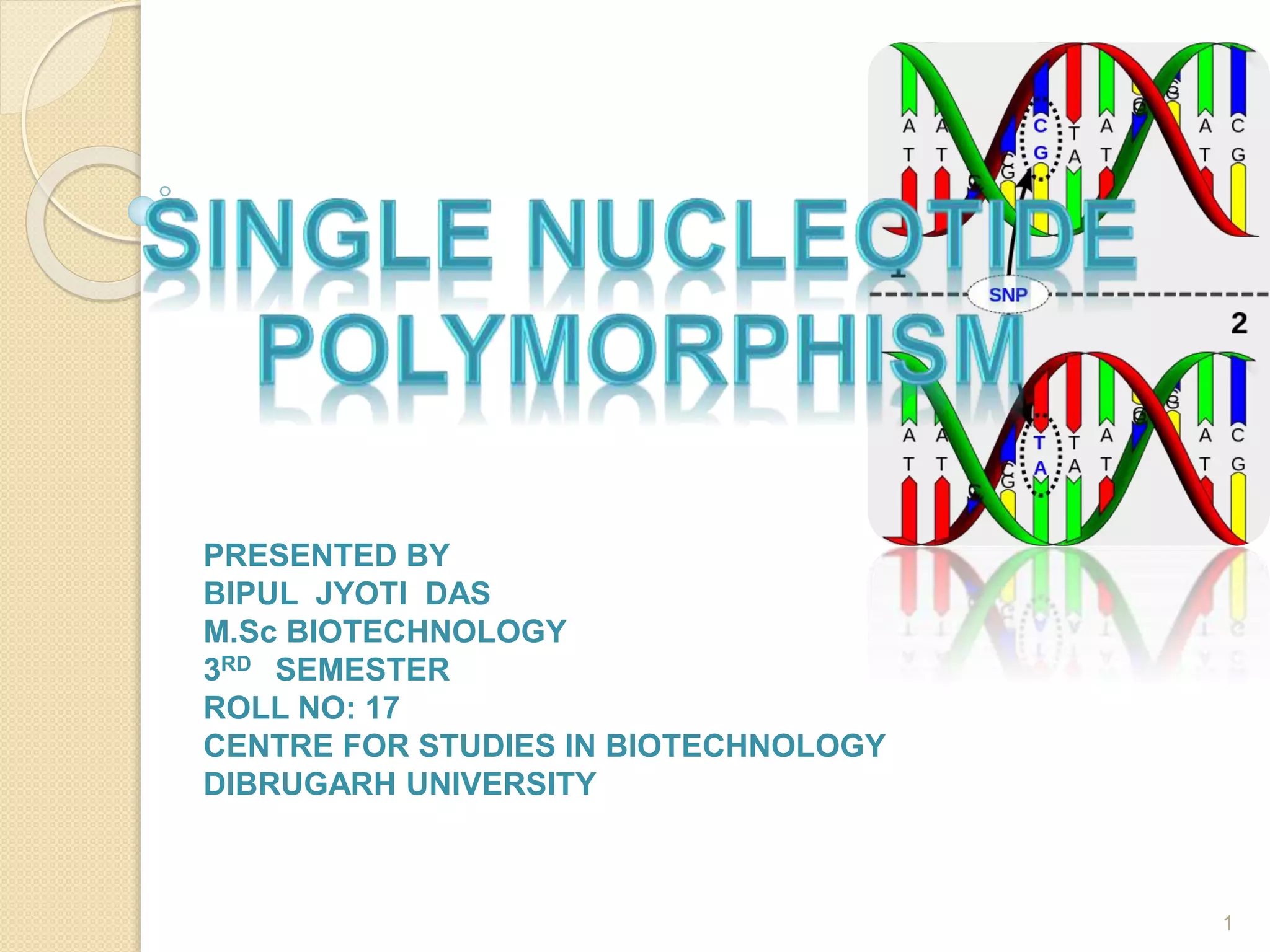
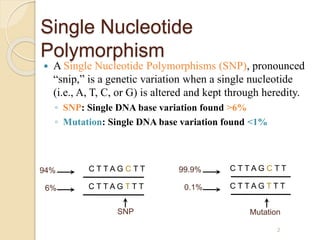
 A Single Nucleotide Polymorphisms (SNP), pronounced
“snip,” is a genetic variation when a single nucleotide
(i.e., A, T, C, or G) is altered and kept through heredity.
◦ SNP: Single DNA base variation found >6%
◦ Mutation: Single DNA base variation found <1%
C T T A G C T T
C T T A G T T T
SNP
C T T A G C T T
C T T A G T T T
Mutation
94%
6%
99.9%
0.1%
2
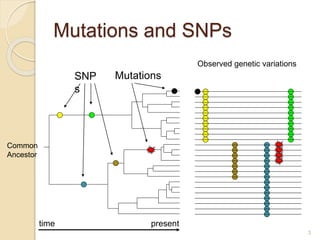
Mutations and SNPs
Common
Ancestor
time present
Observed genetic variations
MutationsSNP
s
3
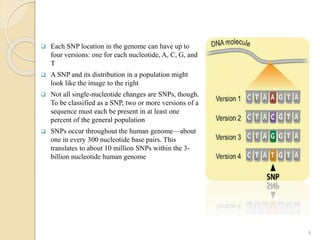
 Each SNP location in the genome can have up to
four versions: one for each nucleotide, A, C, G, and
T
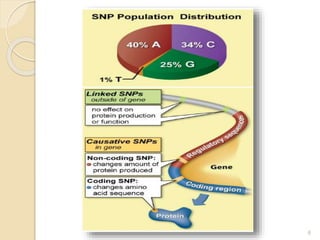
 A SNP and its distribution in a population might
look like the image to the right
 Not all single-nucleotide changes are SNPs, though.
To be classified as a SNP, two or more versions of a
sequence must each be present in at least one
percent of the general population
 SNPs occur throughout the human genome—about
one in every 300 nucleotide base pairs. This
translates to about 10 million SNPs within the 3-
billion nucleotide human genome
4
SNPs and disease-causing
mutations: Not the same!
 First, to be classified as a SNP, the change must be present in at
least 1% of the general population. No known disease-causing
mutation is this common
 Second, most disease-causing mutations occur within a gene's
coding or regulatory regions and affect the function of the protein
encoded by the gene. Unlike mutations, SNPs are not necessarily
located within genes, and they do not always affect the way a
protein functions
5
6
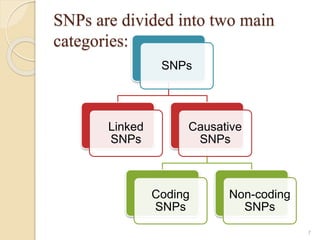
SNPs are divided into two main
categories:
SNPs
Linked
SNPs
Causative
SNPs
Coding
SNPs
Non-coding
SNPs
7
Linked SNPs
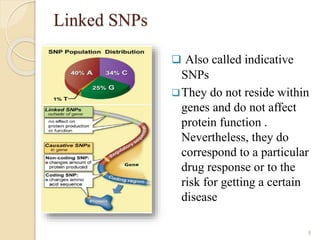
 Also called indicative
SNPs
They do not reside within
genes and do not affect
protein function .
Nevertheless, they do
correspond to a particular
drug response or to the
risk for getting a certain
disease
8
Causative SNPs
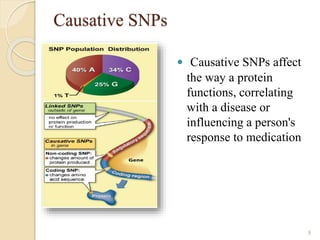
 Causative SNPs affect
the way a protein
functions, correlating
with a disease or
influencing a person's
response to medication
9
Coding SNPs
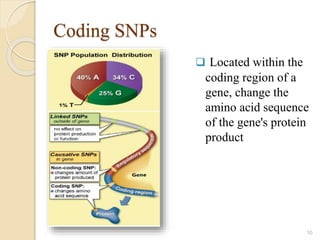
 Located within the
coding region of a
gene, change the
amino acid sequence
of the gene's protein
product
10
Non-coding SNPs
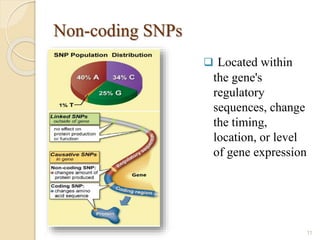
 Located within
the gene's
regulatory
sequences, change
the timing,
location, or level
of gene expression
11
eSNP ( Expression SNP )
SNPs that are not present in the coding - coding
region may still affect gene splicing ,
transcription factor binding , Messenger RNA
degradation, or the sequence of noncoding RNA
Gene expression affected by this type of SNP is
referred to as an eSNP and may be present
upstream or downstream from the gene
12
Finding SNPs in the human
genome
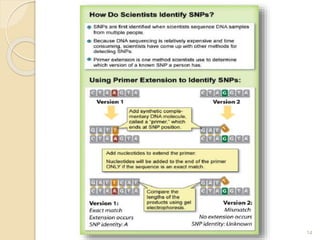
Scientists approach the problem of identifying ,
cataloging, and characterizing
SNPs in two main ways:
 Genomic approaches
 Functional approaches
13
14
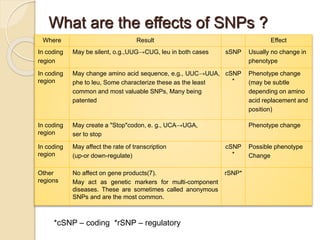
What are the effects of SNPs ?
Where Result Effect
In coding
region
May be silent, o.g.,UUG→CUG, leu in both cases sSNP Usually no change in
phenotype
In coding
region
May change amino acid sequence, e.g., UUC→UUA,
phe to leu, Some characterize these as the least
common and most valuable SNPs, Many being
patented
cSNP
*
Phenotype change
(may be subtle
depending on amino
acid replacement and
position)
In coding
region
May create a "Stop"codon, e. g., UCA→UGA,
ser to stop
Phenotype change
In coding
region
May affect the rate of transcription
(up-or down-regulate)
cSNP
*
Possible phenotype
Change
Other
regions
No affect on gene products(7).
May act as genetic markers for multi-component
diseases. These are sometimes called anonymous

SNPs and are the most common.
rSNP*
*cSNP – coding *rSNP – regulatory
SNP analysis
16
Analytical methods to discover novel SNPs and
detect known SNPs include:
DNA sequencing
Capillary electrophoresis
Mass spectrometry
Electrochemical analysis
Gel electrophoresis
Restriction fragment length polymorphism etc
A wide range of human diseases
result from SNPs.
17
Sickle–cell anemia
 β Thalassemia
Cystic fibrosis etc
Sickle–cell anemia
Sickle cell disease (SCD): a recessively
inherited chronic hemolytic anemia
Caused by a single nucleotide substitution in
the β globin gene on chromosome 11
Hemoglobin S (most common): GTG  GAG
results in substitution of valine (hydrophobic) for
glutamate (hydrophilic)
Applying SNP profile to drug
choices
19
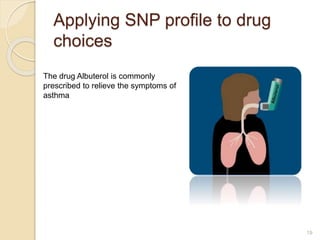
The drug Albuterol is commonly
prescribed to relieve the symptoms of
asthma
20
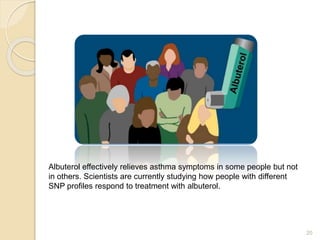
Albuterol effectively relieves asthma symptoms in some people but not
in others. Scientists are currently studying how people with different
SNP profiles respond to treatment with albuterol.
21
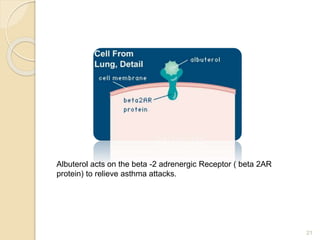
Albuterol acts on the beta -2 adrenergic Receptor ( beta 2AR
protein) to relieve asthma attacks.
22
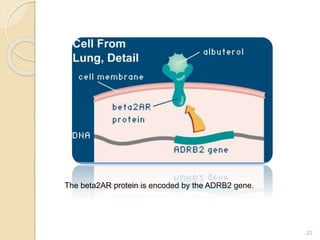
The beta2AR protein is encoded by the ADRB2 gene.
23
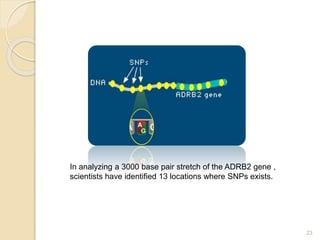
In analyzing a 3000 base pair stretch of the ADRB2 gene ,
scientists have identified 13 locations where SNPs exists.
24
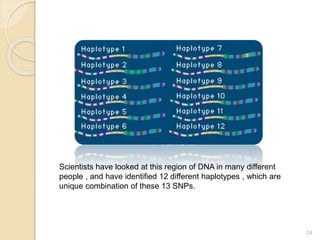
Scientists have looked at this region of DNA in many different
people , and have identified 12 different haplotypes , which are
unique combination of these 13 SNPs.
A set of closely linked genetic markers present on one chromosome
which tend to be inherited together (not easily separable by
recombination)
HAPLOTYPE
26
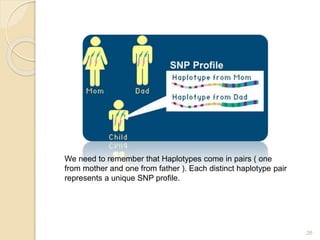
We need to remember that Haplotypes come in pairs ( one
from mother and one from father ). Each distinct haplotype pair
represents a unique SNP profile.
27
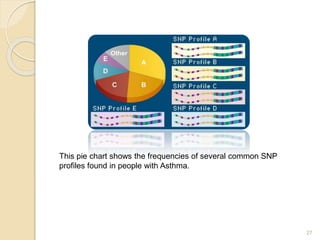
This pie chart shows the frequencies of several common SNP
profiles found in people with Asthma.
28
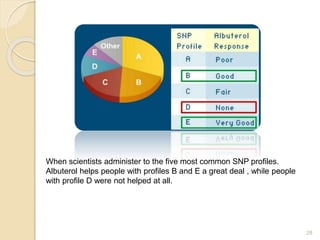
When scientists administer to the five most common SNP profiles.
Albuterol helps people with profiles B and E a great deal , while people
with profile D were not helped at all.
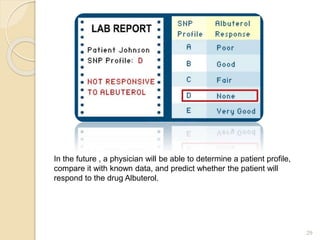
29
In the future , a physician will be able to determine a patient profile,
compare it with known data, and predict whether the patient will
respond to the drug Albuterol.
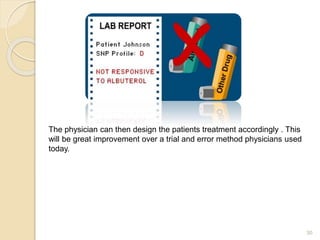
30
The physician can then design the patients treatment accordingly . This
will be great improvement over a trial and error method physicians used
today.
Recent Research
 Association of interleukin-1β–511 C/T polymorphism with tobacco-
associated cancer innortheast India: a study on oral and gastric cancer
M Lakhanpal, DS Yadav, TR Devi, LC Singh, KJ Singh… - Cancer
genetics, 2014 - Elsevier
 A pilot study evaluating genetic alterations that drive tobacco-and betel quid-
associated oral cancer in Northeast India
DS Yadav, I Chattopadhyay, A Verma, TR Devi… - Tumor Biology, 2014 -
Springer
 Accumulation of mutations over the complete mitochondrial genome in
tobacco-related oral cancer from northeast India
R Mondal, SK Ghosh - Mitochondrial DNA, 2013
 Molecular diagnosis of Wilson disease using prevalent mutations and
informative single-nucleotide polymorphism markers
A Gupta, M Maulik, P Nasipuri… - Clinical …, 2007 - Am Assoc Clin Chem
References
^ Nachman, Michael W. (2001). "Single nucleotide polymorphisms
and recombination rate in humans". Trends in genetics 17 (9): 481–
485. (https://www.ncbi.nlm.nih.gov/pubmed/11525814).
^ Sachidanandam, Ravi; Weissman, David; Schmidt, Steven C.;
Kakol, Jerzy M.; Stein, Lincoln D.; Marth,Gabor; Sherry, Steve;
Mullikin, James C. et al. (2001). "A map of human genome sequence
variation containing
1.42 million single nucleotide polymorphisms". Nature 409 (6822):
928–33.
(https://www.ncbi.nlm.nih.gov/pubmed/11237013).
^ Fareed, M., Afzal, M (2013) "Single nucleotide polymorphism in
genome-wide association of human
population: A tool for broad spectrum service". Egyptian Journal of
Medical Human Genetics 14: 123–134.
.
References
Websites
 https://www.ncbi.nlm.nih.gov/pubmed/88735
 http://en.wikipedia.org/wiki/Single-nucleotide_polymorphism
 http://www.nature.com/nrg/journal/v5/n2/glossary/nrg1270_glossary.
html
 http://www.SNPedia.com
 http://sickle.bwh.harvard.edu/scd_background.html
 http://ghr.nlm.nih.gov/handbook/genomicresearch/snp
33
Single nucleotide polymorphism

Single nucleotide polymorphism

  • 1.
    PRESENTED BY BIPUL JYOTIDAS M.Sc BIOTECHNOLOGY 3RD SEMESTER ROLL NO: 17 CENTRE FOR STUDIES IN BIOTECHNOLOGY DIBRUGARH UNIVERSITY 1
  • 2.
    Single Nucleotide Polymorphism  ASingle Nucleotide Polymorphisms (SNP), pronounced “snip,” is a genetic variation when a single nucleotide (i.e., A, T, C, or G) is altered and kept through heredity. ◦ SNP: Single DNA base variation found >6% ◦ Mutation: Single DNA base variation found <1% C T T A G C T T C T T A G T T T SNP C T T A G C T T C T T A G T T T Mutation 94% 6% 99.9% 0.1% 2
  • 3.
    Mutations and SNPs Common Ancestor timepresent Observed genetic variations MutationsSNP s 3
  • 4.
     Each SNPlocation in the genome can have up to four versions: one for each nucleotide, A, C, G, and T  A SNP and its distribution in a population might look like the image to the right  Not all single-nucleotide changes are SNPs, though. To be classified as a SNP, two or more versions of a sequence must each be present in at least one percent of the general population  SNPs occur throughout the human genome—about one in every 300 nucleotide base pairs. This translates to about 10 million SNPs within the 3- billion nucleotide human genome 4
  • 5.
    SNPs and disease-causing mutations:Not the same!  First, to be classified as a SNP, the change must be present in at least 1% of the general population. No known disease-causing mutation is this common  Second, most disease-causing mutations occur within a gene's coding or regulatory regions and affect the function of the protein encoded by the gene. Unlike mutations, SNPs are not necessarily located within genes, and they do not always affect the way a protein functions 5
  • 6.
  • 7.
    SNPs are dividedinto two main categories: SNPs Linked SNPs Causative SNPs Coding SNPs Non-coding SNPs 7
  • 8.
    Linked SNPs  Alsocalled indicative SNPs They do not reside within genes and do not affect protein function . Nevertheless, they do correspond to a particular drug response or to the risk for getting a certain disease 8
  • 9.
    Causative SNPs  CausativeSNPs affect the way a protein functions, correlating with a disease or influencing a person's response to medication 9
  • 10.
    Coding SNPs  Locatedwithin the coding region of a gene, change the amino acid sequence of the gene's protein product 10
  • 11.
    Non-coding SNPs  Locatedwithin the gene's regulatory sequences, change the timing, location, or level of gene expression 11
  • 12.
    eSNP ( ExpressionSNP ) SNPs that are not present in the coding - coding region may still affect gene splicing , transcription factor binding , Messenger RNA degradation, or the sequence of noncoding RNA Gene expression affected by this type of SNP is referred to as an eSNP and may be present upstream or downstream from the gene 12
  • 13.
    Finding SNPs inthe human genome Scientists approach the problem of identifying , cataloging, and characterizing SNPs in two main ways:  Genomic approaches  Functional approaches 13
  • 14.
  • 15.
    What are theeffects of SNPs ? Where Result Effect In coding region May be silent, o.g.,UUG→CUG, leu in both cases sSNP Usually no change in phenotype In coding region May change amino acid sequence, e.g., UUC→UUA, phe to leu, Some characterize these as the least common and most valuable SNPs, Many being patented cSNP * Phenotype change (may be subtle depending on amino acid replacement and position) In coding region May create a "Stop"codon, e. g., UCA→UGA, ser to stop Phenotype change In coding region May affect the rate of transcription (up-or down-regulate) cSNP * Possible phenotype Change Other regions No affect on gene products(7). May act as genetic markers for multi-component diseases. These are sometimes called anonymous SNPs and are the most common. rSNP* *cSNP – coding *rSNP – regulatory
  • 16.
    SNP analysis 16 Analytical methodsto discover novel SNPs and detect known SNPs include: DNA sequencing Capillary electrophoresis Mass spectrometry Electrochemical analysis Gel electrophoresis Restriction fragment length polymorphism etc
  • 17.
    A wide rangeof human diseases result from SNPs. 17 Sickle–cell anemia  β Thalassemia Cystic fibrosis etc
  • 18.
    Sickle–cell anemia Sickle celldisease (SCD): a recessively inherited chronic hemolytic anemia Caused by a single nucleotide substitution in the β globin gene on chromosome 11 Hemoglobin S (most common): GTG  GAG results in substitution of valine (hydrophobic) for glutamate (hydrophilic)
  • 19.
    Applying SNP profileto drug choices 19 The drug Albuterol is commonly prescribed to relieve the symptoms of asthma
  • 20.
    20 Albuterol effectively relievesasthma symptoms in some people but not in others. Scientists are currently studying how people with different SNP profiles respond to treatment with albuterol.
  • 21.
    21 Albuterol acts onthe beta -2 adrenergic Receptor ( beta 2AR protein) to relieve asthma attacks.
  • 22.
    22 The beta2AR proteinis encoded by the ADRB2 gene.
  • 23.
    23 In analyzing a3000 base pair stretch of the ADRB2 gene , scientists have identified 13 locations where SNPs exists.
  • 24.
    24 Scientists have lookedat this region of DNA in many different people , and have identified 12 different haplotypes , which are unique combination of these 13 SNPs.
  • 25.
    A set ofclosely linked genetic markers present on one chromosome which tend to be inherited together (not easily separable by recombination) HAPLOTYPE
  • 26.
    26 We need toremember that Haplotypes come in pairs ( one from mother and one from father ). Each distinct haplotype pair represents a unique SNP profile.
  • 27.
    27 This pie chartshows the frequencies of several common SNP profiles found in people with Asthma.
  • 28.
    28 When scientists administerto the five most common SNP profiles. Albuterol helps people with profiles B and E a great deal , while people with profile D were not helped at all.
  • 29.
    29 In the future, a physician will be able to determine a patient profile, compare it with known data, and predict whether the patient will respond to the drug Albuterol.
  • 30.
    30 The physician canthen design the patients treatment accordingly . This will be great improvement over a trial and error method physicians used today.
  • 31.
    Recent Research  Associationof interleukin-1β–511 C/T polymorphism with tobacco- associated cancer innortheast India: a study on oral and gastric cancer M Lakhanpal, DS Yadav, TR Devi, LC Singh, KJ Singh… - Cancer genetics, 2014 - Elsevier  A pilot study evaluating genetic alterations that drive tobacco-and betel quid- associated oral cancer in Northeast India DS Yadav, I Chattopadhyay, A Verma, TR Devi… - Tumor Biology, 2014 - Springer  Accumulation of mutations over the complete mitochondrial genome in tobacco-related oral cancer from northeast India R Mondal, SK Ghosh - Mitochondrial DNA, 2013  Molecular diagnosis of Wilson disease using prevalent mutations and informative single-nucleotide polymorphism markers A Gupta, M Maulik, P Nasipuri… - Clinical …, 2007 - Am Assoc Clin Chem
  • 32.
    References ^ Nachman, MichaelW. (2001). "Single nucleotide polymorphisms and recombination rate in humans". Trends in genetics 17 (9): 481– 485. (https://www.ncbi.nlm.nih.gov/pubmed/11525814). ^ Sachidanandam, Ravi; Weissman, David; Schmidt, Steven C.; Kakol, Jerzy M.; Stein, Lincoln D.; Marth,Gabor; Sherry, Steve; Mullikin, James C. et al. (2001). "A map of human genome sequence variation containing 1.42 million single nucleotide polymorphisms". Nature 409 (6822): 928–33. (https://www.ncbi.nlm.nih.gov/pubmed/11237013). ^ Fareed, M., Afzal, M (2013) "Single nucleotide polymorphism in genome-wide association of human population: A tool for broad spectrum service". Egyptian Journal of Medical Human Genetics 14: 123–134. .
  • 33.
    References Websites  https://www.ncbi.nlm.nih.gov/pubmed/88735  http://en.wikipedia.org/wiki/Single-nucleotide_polymorphism http://www.nature.com/nrg/journal/v5/n2/glossary/nrg1270_glossary. html  http://www.SNPedia.com  http://sickle.bwh.harvard.edu/scd_background.html  http://ghr.nlm.nih.gov/handbook/genomicresearch/snp 33