SIMPLEX METHOD
BY - ABHISHEK DUTTA
Q – CONSIDER THE LPP -
• max Z = 3𝑥1 +2𝑥2 𝑠𝑢𝑏𝑗𝑒𝑐𝑡 𝑡𝑜 𝑐𝑜𝑛𝑠𝑡𝑟𝑎𝑖𝑛𝑡𝑠 −
• 𝒙𝟏 +𝒙𝟐 ≤ 4
• 𝒙𝟏 - 𝒙𝟐 ≤ 2
• 𝒙𝟏, 𝒙𝟐 ≥ 0
• Now
• 𝒙𝟏 +𝒙𝟐 ≤ 4 --adding slack variable 𝒙𝟏 +𝒙𝟐 + 𝒙𝟑 = 4
• 𝒙𝟏 - 𝒙𝟐 ≤ 2 --adding slack variable 𝒙𝟏 - 𝒙𝟐 + 𝒙𝟒 = 2
• 𝒙𝟏, 𝒙𝟐 ≥ 0
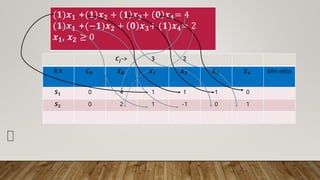
𝑪𝒋-> 3 2
B.V. 𝑪𝑩 𝑿𝑩 𝑿𝟏 𝑿𝟐 𝑿𝟑 𝑿𝟒 Min ratio
𝑺𝟏 0 4 1 1 1 0
𝑺𝟐 0 2 1 -1 0 1
(𝟏)𝒙𝟏 +(𝟏)𝒙𝟐 + 𝟏 𝒙𝟑+ 𝟎 𝒙𝟒= 4
(𝟏)𝒙𝟏 +(−𝟏)𝒙𝟐 + 𝟎 𝒙𝟑+ (𝟏)𝒙𝟒= 2
𝒙𝟏, 𝒙𝟐 ≥ 0
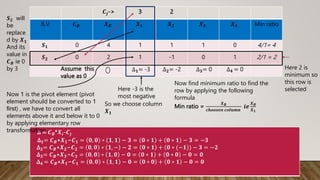
𝑪𝒋-> 3 2
B.V. 𝑪𝑩 𝑿𝑩 𝑿𝟏 𝑿𝟐 𝑿𝟑 𝑿𝟒 Min ratio
𝑺𝟏 0 4 1 1 1 0 4/1= 4
𝑺𝟐 0 2 1 -1 0 1 2/1 = 2
∆𝟏= -3 ∆𝟐= -2 ∆𝟑= 0 ∆𝟒 = 0
∆ = 𝑪𝑩*𝑿𝒊-𝑪𝒋
∆𝟏= 𝑪𝑩∗𝑿𝟏−𝑪𝟏 = 𝟎, 𝟎 ∗ 𝟏, 𝟏 − 𝟑 = 𝟎 ∗ 𝟏 + 𝟎 ∗ 𝟏 − 𝟑 = −𝟑
∆𝟐= 𝑪𝑩∗𝑿𝟐−𝑪𝟐 = 𝟎, 𝟎 ∗ 𝟏, − − 𝟐 = 𝟎 ∗ 𝟏 + 𝟎 ∗ (−𝟏 ) − 𝟑 = −𝟐
∆𝟑= 𝑪𝑩∗𝑿𝟑−𝑪𝟑 = 𝟎, 𝟎 ∗ 𝟏, 𝟎 − 𝟎 = 𝟎 ∗ 𝟏 + 𝟎 ∗ 𝟎 − 𝟎 = 𝟎
∆𝟒 = 𝑪𝑩∗𝑿𝟏−𝑪𝟏 = 𝟎, 𝟎 ∗ 𝟏, 𝟏 − 𝟎 = 𝟎 ∗ 𝟎 + 𝟎 ∗ 𝟏 − 𝟎 = 𝟎
Here -3 is the
most negative
So we choose column
𝑿𝟏
Now find minimum ratio to find the
row by applying the following
formula
Min ratio =
𝑿𝑩
𝒄𝒉𝒐𝒐𝒔𝒆𝒏 𝒄𝒐𝒍𝒖𝒎𝒏
𝒊𝒆
𝑿𝑩
𝑿𝟏
Here 2 is
minimum so
this row is
selected
Now 1 is the pivot element (pivot
element should be converted to 1
first) , we have to convert all
elements above it and below it to 0
by applying elementary row
transformation
𝑺𝟐 will
be
replace
d by 𝑿𝟏
And its
value in
𝑪𝑩 ie 0
by 3 Assume this
value as 0
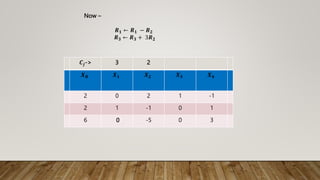
𝑪𝒋-> 3 2
𝑿𝑩 𝑿𝟏 𝑿𝟐 𝑿𝟑 𝑿𝟒
2 0 2 1 -1
2 1 -1 0 1
6 0 -5 0 3
Now –
𝑹𝟏 ← 𝑹𝟏 − 𝑹𝟐
𝑹𝟑 ← 𝑹𝟑 + 3𝑹𝟐
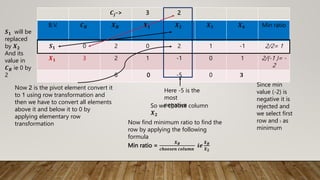
𝑪𝒋-> 3 2
B.V. 𝑪𝑩 𝑿𝑩 𝑿𝟏 𝑿𝟐 𝑿𝟑 𝑿𝟒 Min ratio
𝑺𝟏 0 2 0 2 1 -1 2/2= 1
𝑿𝟏 3 2 1 -1 0 1 2/(-1 )= -
2
6 0 -5 0 𝟑
Here -5 is the
most
negative
So we choose column
𝑿𝟐
Now find minimum ratio to find the
row by applying the following
formula
Min ratio =
𝑿𝑩
𝒄𝒉𝒐𝒐𝒔𝒆𝒏 𝒄𝒐𝒍𝒖𝒎𝒏
𝒊𝒆
𝑿𝑩
𝑿𝟐
Since min
value (-2) is
negative it is
rejected and
we select first
row and 1 as
minimum
𝑺𝟏 will be
replaced
by 𝑿𝟐
And its
value in
𝑪𝑩 ie 0 by
2
Now 2 is the pivot element convert it
to 1 using row transformation and
then we have to convert all elements
above it and below it to 0 by
applying elementary row
transformation
𝑪𝒋-> 3 2
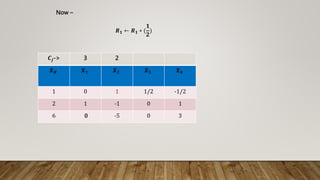
𝑿𝑩 𝑿𝟏 𝑿𝟐 𝑿𝟑 𝑿𝟒
1 0 1 1/2 -1/2
2 1 -1 0 1
6 0 -5 0 3
Now –
𝑹𝟏 ← 𝑹𝟏 ∗ (
𝟏
𝟐
)
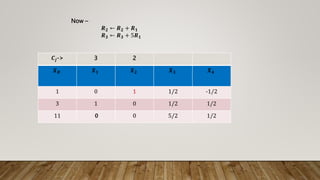
Now –
𝑹𝟐 ← 𝑹𝟐 + 𝑹𝟏
𝑹𝟑 ← 𝑹𝟑 + 5𝑹𝟏
𝑪𝒋-> 3 2
𝑿𝑩 𝑿𝟏 𝑿𝟐 𝑿𝟑 𝑿𝟒
1 0 1 1/2 -1/2
3 1 0 1/2 1/2
11 0 0 5/2 1/2
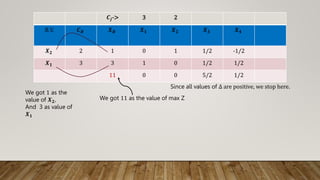
𝑪𝒋-> 3 2
B.V. 𝑪𝑩 𝑿𝑩 𝑿𝟏 𝑿𝟐 𝑿𝟑 𝑿𝟒
𝑿𝟐 2 1 0 1 1/2 -1/2
𝑿𝟏 3 3 1 0 1/2 1/2
11 0 0 5/2 1/2
Since all values of ∆ are positive, we stop here.
We got 11 as the value of max Z
We got 1 as the
value of 𝑿𝟐,
And 3 as value of
𝑿𝟏
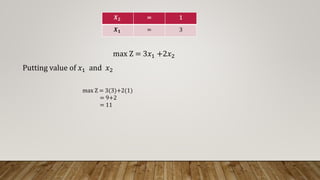
𝑿𝟐 = 1
𝑿𝟏 = 3
max Z = 3𝑥1 +2𝑥2
Putting value of 𝑥1 and 𝑥2
max Z = 3(3)+2(1)
= 9+2
= 11
Simplex Method

Simplex Method

  • 1.
    SIMPLEX METHOD BY -ABHISHEK DUTTA
  • 2.
    Q – CONSIDERTHE LPP - • max Z = 3𝑥1 +2𝑥2 𝑠𝑢𝑏𝑗𝑒𝑐𝑡 𝑡𝑜 𝑐𝑜𝑛𝑠𝑡𝑟𝑎𝑖𝑛𝑡𝑠 − • 𝒙𝟏 +𝒙𝟐 ≤ 4 • 𝒙𝟏 - 𝒙𝟐 ≤ 2 • 𝒙𝟏, 𝒙𝟐 ≥ 0 • Now • 𝒙𝟏 +𝒙𝟐 ≤ 4 --adding slack variable 𝒙𝟏 +𝒙𝟐 + 𝒙𝟑 = 4 • 𝒙𝟏 - 𝒙𝟐 ≤ 2 --adding slack variable 𝒙𝟏 - 𝒙𝟐 + 𝒙𝟒 = 2 • 𝒙𝟏, 𝒙𝟐 ≥ 0
  • 3.
    𝑪𝒋-> 3 2 B.V.𝑪𝑩 𝑿𝑩 𝑿𝟏 𝑿𝟐 𝑿𝟑 𝑿𝟒 Min ratio 𝑺𝟏 0 4 1 1 1 0 𝑺𝟐 0 2 1 -1 0 1 (𝟏)𝒙𝟏 +(𝟏)𝒙𝟐 + 𝟏 𝒙𝟑+ 𝟎 𝒙𝟒= 4 (𝟏)𝒙𝟏 +(−𝟏)𝒙𝟐 + 𝟎 𝒙𝟑+ (𝟏)𝒙𝟒= 2 𝒙𝟏, 𝒙𝟐 ≥ 0
  • 4.
    𝑪𝒋-> 3 2 B.V.𝑪𝑩 𝑿𝑩 𝑿𝟏 𝑿𝟐 𝑿𝟑 𝑿𝟒 Min ratio 𝑺𝟏 0 4 1 1 1 0 4/1= 4 𝑺𝟐 0 2 1 -1 0 1 2/1 = 2 ∆𝟏= -3 ∆𝟐= -2 ∆𝟑= 0 ∆𝟒 = 0 ∆ = 𝑪𝑩*𝑿𝒊-𝑪𝒋 ∆𝟏= 𝑪𝑩∗𝑿𝟏−𝑪𝟏 = 𝟎, 𝟎 ∗ 𝟏, 𝟏 − 𝟑 = 𝟎 ∗ 𝟏 + 𝟎 ∗ 𝟏 − 𝟑 = −𝟑 ∆𝟐= 𝑪𝑩∗𝑿𝟐−𝑪𝟐 = 𝟎, 𝟎 ∗ 𝟏, − − 𝟐 = 𝟎 ∗ 𝟏 + 𝟎 ∗ (−𝟏 ) − 𝟑 = −𝟐 ∆𝟑= 𝑪𝑩∗𝑿𝟑−𝑪𝟑 = 𝟎, 𝟎 ∗ 𝟏, 𝟎 − 𝟎 = 𝟎 ∗ 𝟏 + 𝟎 ∗ 𝟎 − 𝟎 = 𝟎 ∆𝟒 = 𝑪𝑩∗𝑿𝟏−𝑪𝟏 = 𝟎, 𝟎 ∗ 𝟏, 𝟏 − 𝟎 = 𝟎 ∗ 𝟎 + 𝟎 ∗ 𝟏 − 𝟎 = 𝟎 Here -3 is the most negative So we choose column 𝑿𝟏 Now find minimum ratio to find the row by applying the following formula Min ratio = 𝑿𝑩 𝒄𝒉𝒐𝒐𝒔𝒆𝒏 𝒄𝒐𝒍𝒖𝒎𝒏 𝒊𝒆 𝑿𝑩 𝑿𝟏 Here 2 is minimum so this row is selected Now 1 is the pivot element (pivot element should be converted to 1 first) , we have to convert all elements above it and below it to 0 by applying elementary row transformation 𝑺𝟐 will be replace d by 𝑿𝟏 And its value in 𝑪𝑩 ie 0 by 3 Assume this value as 0
  • 5.
    𝑪𝒋-> 3 2 𝑿𝑩𝑿𝟏 𝑿𝟐 𝑿𝟑 𝑿𝟒 2 0 2 1 -1 2 1 -1 0 1 6 0 -5 0 3 Now – 𝑹𝟏 ← 𝑹𝟏 − 𝑹𝟐 𝑹𝟑 ← 𝑹𝟑 + 3𝑹𝟐
  • 6.
    𝑪𝒋-> 3 2 B.V.𝑪𝑩 𝑿𝑩 𝑿𝟏 𝑿𝟐 𝑿𝟑 𝑿𝟒 Min ratio 𝑺𝟏 0 2 0 2 1 -1 2/2= 1 𝑿𝟏 3 2 1 -1 0 1 2/(-1 )= - 2 6 0 -5 0 𝟑 Here -5 is the most negative So we choose column 𝑿𝟐 Now find minimum ratio to find the row by applying the following formula Min ratio = 𝑿𝑩 𝒄𝒉𝒐𝒐𝒔𝒆𝒏 𝒄𝒐𝒍𝒖𝒎𝒏 𝒊𝒆 𝑿𝑩 𝑿𝟐 Since min value (-2) is negative it is rejected and we select first row and 1 as minimum 𝑺𝟏 will be replaced by 𝑿𝟐 And its value in 𝑪𝑩 ie 0 by 2 Now 2 is the pivot element convert it to 1 using row transformation and then we have to convert all elements above it and below it to 0 by applying elementary row transformation
  • 7.
    𝑪𝒋-> 3 2 𝑿𝑩𝑿𝟏 𝑿𝟐 𝑿𝟑 𝑿𝟒 1 0 1 1/2 -1/2 2 1 -1 0 1 6 0 -5 0 3 Now – 𝑹𝟏 ← 𝑹𝟏 ∗ ( 𝟏 𝟐 )
  • 8.
    Now – 𝑹𝟐 ←𝑹𝟐 + 𝑹𝟏 𝑹𝟑 ← 𝑹𝟑 + 5𝑹𝟏 𝑪𝒋-> 3 2 𝑿𝑩 𝑿𝟏 𝑿𝟐 𝑿𝟑 𝑿𝟒 1 0 1 1/2 -1/2 3 1 0 1/2 1/2 11 0 0 5/2 1/2
  • 9.
    𝑪𝒋-> 3 2 B.V.𝑪𝑩 𝑿𝑩 𝑿𝟏 𝑿𝟐 𝑿𝟑 𝑿𝟒 𝑿𝟐 2 1 0 1 1/2 -1/2 𝑿𝟏 3 3 1 0 1/2 1/2 11 0 0 5/2 1/2 Since all values of ∆ are positive, we stop here. We got 11 as the value of max Z We got 1 as the value of 𝑿𝟐, And 3 as value of 𝑿𝟏
  • 10.
    𝑿𝟐 = 1 𝑿𝟏= 3 max Z = 3𝑥1 +2𝑥2 Putting value of 𝑥1 and 𝑥2 max Z = 3(3)+2(1) = 9+2 = 11