IMPLICIT FUNCTION
1
MadebyMeet
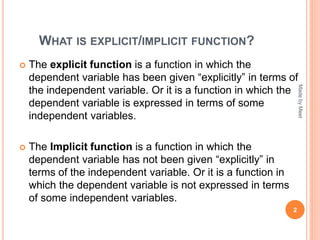
WHAT IS EXPLICIT/IMPLICIT FUNCTION?
 The explicit function is a function in which the
dependent variable has been given “explicitly” in terms of
the independent variable. Or it is a function in which the
dependent variable is expressed in terms of some
independent variables.
 The Implicit function is a function in which the
dependent variable has not been given “explicitly” in
terms of the independent variable. Or it is a function in
which the dependent variable is not expressed in terms
of some independent variables.
2
MadebyMeet
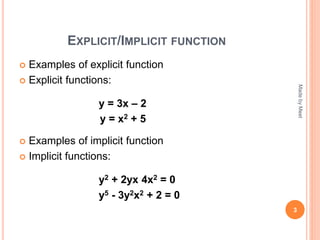
EXPLICIT/IMPLICIT FUNCTION
 Examples of explicit function
 Explicit functions:
y = 3x – 2
y = x2 + 5
 Examples of implicit function
 Implicit functions:
y2 + 2yx 4x2 = 0
y5 - 3y2x2 + 2 = 0
3
MadebyMeet
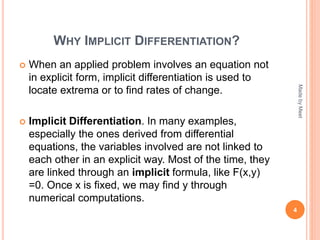
WHY IMPLICIT DIFFERENTIATION?
 When an applied problem involves an equation not
in explicit form, implicit differentiation is used to
locate extrema or to find rates of change.
 Implicit Differentiation. In many examples,
especially the ones derived from differential
equations, the variables involved are not linked to
each other in an explicit way. Most of the time, they
are linked through an implicit formula, like F(x,y)
=0. Once x is fixed, we may find y through
numerical computations.
4
MadebyMeet
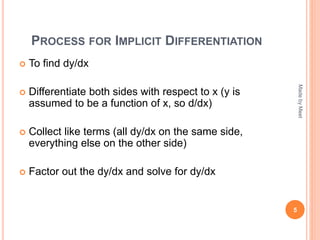
PROCESS FOR IMPLICIT DIFFERENTIATION
 To find dy/dx
 Differentiate both sides with respect to x (y is
assumed to be a function of x, so d/dx)
 Collect like terms (all dy/dx on the same side,
everything else on the other side)
 Factor out the dy/dx and solve for dy/dx
5
MadebyMeet
EXAMPLE
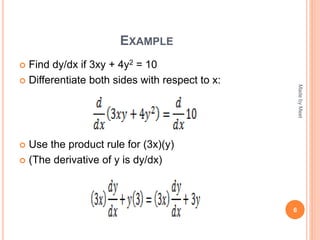
 Find dy/dx if 3xy + 4y2 = 10
 Differentiate both sides with respect to x:
 Use the product rule for (3x)(y)
 (The derivative of y is dy/dx)
6
MadebyMeet
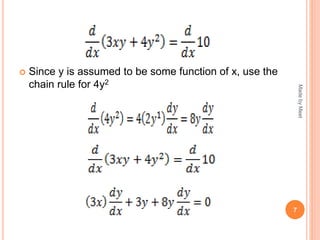
 Since y is assumed to be some function of x, use the
chain rule for 4y2
7
MadebyMeet
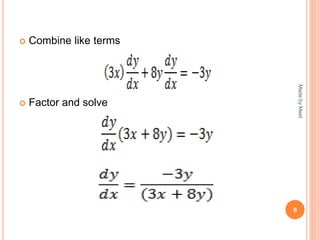
 Combine like terms
 Factor and solve
8
MadebyMeet
TOTAL DERIVATIVE
9
MadebyMeet
WHAT IS TOTAL DERIVATIVE?
 he total derivative is the derivative with respect to
of the function that depends on the variable not only
directly but also via the intermediate variables . It
can be calculated using the formula.
 This rule is called the chain rule for the partial
derivatives of functions of functions.
10
MadebyMeet
TOTAL DERIVATIVE
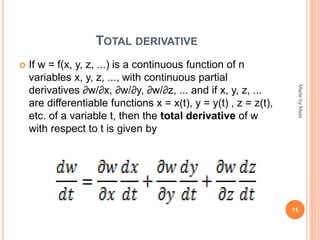
 If w = f(x, y, z, ...) is a continuous function of n
variables x, y, z, ..., with continuous partial
derivatives ∂w/∂x, ∂w/∂y, ∂w/∂z, ... and if x, y, z, ...
are differentiable functions x = x(t), y = y(t) , z = z(t),
etc. of a variable t, then the total derivative of w
with respect to t is given by
11
MadebyMeet
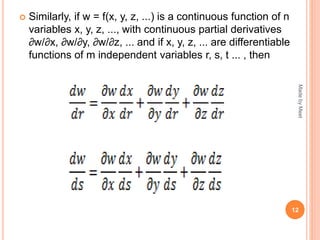
 Similarly, if w = f(x, y, z, ...) is a continuous function of n
variables x, y, z, ..., with continuous partial derivatives
∂w/∂x, ∂w/∂y, ∂w/∂z, ... and if x, y, z, ... are differentiable
functions of m independent variables r, s, t ... , then
12
MadebyMeet
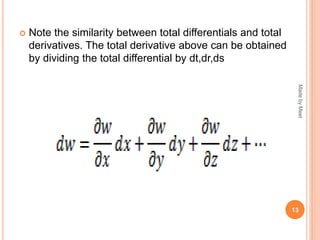
 Note the similarity between total differentials and total
derivatives. The total derivative above can be obtained
by dividing the total differential by dt,dr,ds
13
MadebyMeet
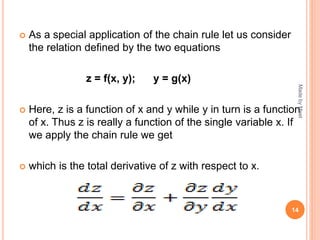
 As a special application of the chain rule let us consider
the relation defined by the two equations
z = f(x, y); y = g(x)
 Here, z is a function of x and y while y in turn is a function
of x. Thus z is really a function of the single variable x. If
we apply the chain rule we get
 which is the total derivative of z with respect to x.
14
MadebyMeet
THANK YOU
15
MadebyMeet

Implicit function and Total derivative

  • 1.
  • 2.
    WHAT IS EXPLICIT/IMPLICITFUNCTION?  The explicit function is a function in which the dependent variable has been given “explicitly” in terms of the independent variable. Or it is a function in which the dependent variable is expressed in terms of some independent variables.  The Implicit function is a function in which the dependent variable has not been given “explicitly” in terms of the independent variable. Or it is a function in which the dependent variable is not expressed in terms of some independent variables. 2 MadebyMeet
  • 3.
    EXPLICIT/IMPLICIT FUNCTION  Examplesof explicit function  Explicit functions: y = 3x – 2 y = x2 + 5  Examples of implicit function  Implicit functions: y2 + 2yx 4x2 = 0 y5 - 3y2x2 + 2 = 0 3 MadebyMeet
  • 4.
    WHY IMPLICIT DIFFERENTIATION? When an applied problem involves an equation not in explicit form, implicit differentiation is used to locate extrema or to find rates of change.  Implicit Differentiation. In many examples, especially the ones derived from differential equations, the variables involved are not linked to each other in an explicit way. Most of the time, they are linked through an implicit formula, like F(x,y) =0. Once x is fixed, we may find y through numerical computations. 4 MadebyMeet
  • 5.
    PROCESS FOR IMPLICITDIFFERENTIATION  To find dy/dx  Differentiate both sides with respect to x (y is assumed to be a function of x, so d/dx)  Collect like terms (all dy/dx on the same side, everything else on the other side)  Factor out the dy/dx and solve for dy/dx 5 MadebyMeet
  • 6.
    EXAMPLE  Find dy/dxif 3xy + 4y2 = 10  Differentiate both sides with respect to x:  Use the product rule for (3x)(y)  (The derivative of y is dy/dx) 6 MadebyMeet
  • 7.
     Since yis assumed to be some function of x, use the chain rule for 4y2 7 MadebyMeet
  • 8.
     Combine liketerms  Factor and solve 8 MadebyMeet
  • 9.
  • 10.
    WHAT IS TOTALDERIVATIVE?  he total derivative is the derivative with respect to of the function that depends on the variable not only directly but also via the intermediate variables . It can be calculated using the formula.  This rule is called the chain rule for the partial derivatives of functions of functions. 10 MadebyMeet
  • 11.
    TOTAL DERIVATIVE  Ifw = f(x, y, z, ...) is a continuous function of n variables x, y, z, ..., with continuous partial derivatives ∂w/∂x, ∂w/∂y, ∂w/∂z, ... and if x, y, z, ... are differentiable functions x = x(t), y = y(t) , z = z(t), etc. of a variable t, then the total derivative of w with respect to t is given by 11 MadebyMeet
  • 12.
     Similarly, ifw = f(x, y, z, ...) is a continuous function of n variables x, y, z, ..., with continuous partial derivatives ∂w/∂x, ∂w/∂y, ∂w/∂z, ... and if x, y, z, ... are differentiable functions of m independent variables r, s, t ... , then 12 MadebyMeet
  • 13.
     Note thesimilarity between total differentials and total derivatives. The total derivative above can be obtained by dividing the total differential by dt,dr,ds 13 MadebyMeet
  • 14.
     As aspecial application of the chain rule let us consider the relation defined by the two equations z = f(x, y); y = g(x)  Here, z is a function of x and y while y in turn is a function of x. Thus z is really a function of the single variable x. If we apply the chain rule we get  which is the total derivative of z with respect to x. 14 MadebyMeet
  • 15.