Dual Simplex Method

Assume we have a maximization problem.

Step (0): Correction! We need all reduced costs (i.e., not the original cT vector but
c T = c T B −1 A − c T ) in the simplex tableau to be nonnegative before we can even attempt
        B
to use the method.

Example (Corrected from class on 10/14)

                   max    -2x1     - 2x2     - x3
                   s.t.   x1       +3x2      +3x3     +x4            = 12
                          -2x1     +10x2     +x3              -x5    = 21
                                   xj ≥ 0

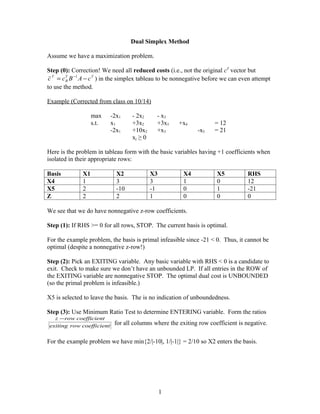
Here is the problem in tableau form with the basic variables having +1 coefficients when
isolated in their appropriate rows:

Basis         X1            X2              X3          X4            X5          RHS
X4            1             3               3           1             0           12
X5            2             -10             -1          0             1           -21
Z             2             2               1           0             0           0

We see that we do have nonnegative z-row coefficients.

Step (1): If RHS >= 0 for all rows, STOP. The current basis is optimal.

For the example problem, the basis is primal infeasible since -21 < 0. Thus, it cannot be
optimal (despite a nonnegative z-row!)

Step (2): Pick an EXITING variable. Any basic variable with RHS < 0 is a candidate to
exit. Check to make sure we don’t have an unbounded LP. If all entries in the ROW of
the EXITING variable are nonnegative STOP. The optimal dual cost is UNBOUNDED
(so the primal problem is infeasible.)

X5 is selected to leave the basis. The is no indication of unboundedness.

Step (3): Use Minimum Ratio Test to determine ENTERING variable. Form the ratios
  z − row coefficient
exiting row coefficient    for all columns where the exiting row coefficient is negative.

For the example problem we have min{2/|-10|, 1/|-1|} = 2/10 so X2 enters the basis.


                                                 1
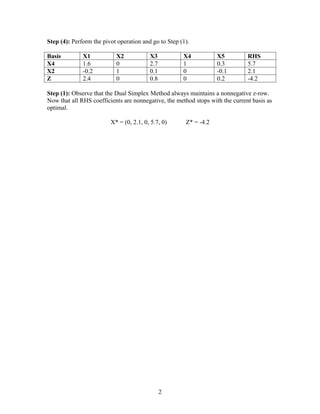
Step (4): Perform the pivot operation and go to Step (1).

Basis         X1           X2            X3           X4           X5          RHS
X4            1.6          0             2.7          1            0.3         5.7
X2            -0.2         1             0.1          0            -0.1        2.1
Z             2.4          0             0.8          0            0.2         -4.2

Step (1): Observe that the Dual Simplex Method always maintains a nonnegative z-row.
Now that all RHS coefficients are nonnegative, the method stops with the current basis as
optimal.

                         X* = (0, 2.1, 0, 5.7, 0)      Z* = -4.2


                                               2

Dual simplexmethod

  • 1.
    Dual Simplex Method Assumewe have a maximization problem. Step (0): Correction! We need all reduced costs (i.e., not the original cT vector but c T = c T B −1 A − c T ) in the simplex tableau to be nonnegative before we can even attempt B to use the method. Example (Corrected from class on 10/14) max -2x1 - 2x2 - x3 s.t. x1 +3x2 +3x3 +x4 = 12 -2x1 +10x2 +x3 -x5 = 21 xj ≥ 0 Here is the problem in tableau form with the basic variables having +1 coefficients when isolated in their appropriate rows: Basis X1 X2 X3 X4 X5 RHS X4 1 3 3 1 0 12 X5 2 -10 -1 0 1 -21 Z 2 2 1 0 0 0 We see that we do have nonnegative z-row coefficients. Step (1): If RHS >= 0 for all rows, STOP. The current basis is optimal. For the example problem, the basis is primal infeasible since -21 < 0. Thus, it cannot be optimal (despite a nonnegative z-row!) Step (2): Pick an EXITING variable. Any basic variable with RHS < 0 is a candidate to exit. Check to make sure we don’t have an unbounded LP. If all entries in the ROW of the EXITING variable are nonnegative STOP. The optimal dual cost is UNBOUNDED (so the primal problem is infeasible.) X5 is selected to leave the basis. The is no indication of unboundedness. Step (3): Use Minimum Ratio Test to determine ENTERING variable. Form the ratios z − row coefficient exiting row coefficient for all columns where the exiting row coefficient is negative. For the example problem we have min{2/|-10|, 1/|-1|} = 2/10 so X2 enters the basis. 1
  • 2.
    Step (4): Performthe pivot operation and go to Step (1). Basis X1 X2 X3 X4 X5 RHS X4 1.6 0 2.7 1 0.3 5.7 X2 -0.2 1 0.1 0 -0.1 2.1 Z 2.4 0 0.8 0 0.2 -4.2 Step (1): Observe that the Dual Simplex Method always maintains a nonnegative z-row. Now that all RHS coefficients are nonnegative, the method stops with the current basis as optimal. X* = (0, 2.1, 0, 5.7, 0) Z* = -4.2 2