DUALITY
Duality Theory Every LP problem (called the ‘Primal’) has associated with another problem called the ‘Dual’. The ‘Dual’ problem is an LP defined directly and systematically from the original (or Primal) LP model. The optimal solution of one problem yields the optimal solution to the other. Duality ease the calculations for the problems, whose number of variables is large.
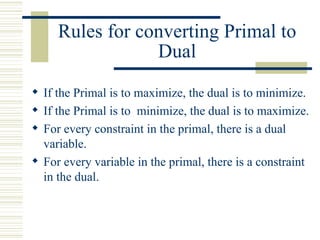
Rules for converting Primal to Dual If the Primal is to maximize, the dual is to minimize. If the Primal is to  minimize, the dual is to maximize. For every constraint in the primal, there is a dual variable. For every variable in the primal, there is a constraint in the dual.
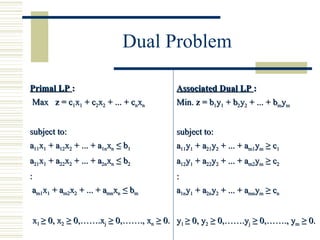
Dual Problem Primal LP  : Max  z = c 1 x 1  + c 2 x 2  + ... + c n x n subject to: a 11 x 1  + a 12 x 2  + ... + a 1n x n  ≤ b 1 a 21 x 1  + a 22 x 2  + ... + a 2n x n  ≤ b 2 : a m1 x 1  + a m2 x 2  + ... + a mn x n  ≤ b m  x 1  ≥ 0, x 2  ≥ 0,…….x j  ≥ 0,……., x n  ≥ 0. Associated Dual LP  : Min. z = b 1 y 1  + b 2 y 2  + ... + b m y m subject to: a 11 y 1  + a 21 y 2  + ... + a m1 y m  ≥ c 1 a 12 y 1  + a 22 y 2  + ... + a m2 y m  ≥ c 2 : a 1n y 1  + a 2n y 2  + ... + a mn y m  ≥ c n y 1  ≥ 0, y 2  ≥ 0,…….y j  ≥ 0,……., y m  ≥ 0.
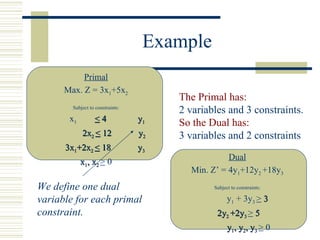
Example Primal Max. Z = 3x 1 +5x 2 Subject to constraints: x 1  <  4  y 1 2x 2  <  12  y 2 3x 1 +2x 2  <  18  y 3 x 1 , x 2  >  0 The Primal has: 2 variables and 3 constraints. So the Dual has: 3 variables and 2 constraints Dual Min. Z’ = 4y 1 +12y 2  +18y 3 Subject to constraints: y 1  + 3y 3  >  3  2y 2  +2y 3  >  5  y 1 , y 2 , y 3  >  0 We define one dual variable for each primal constraint.
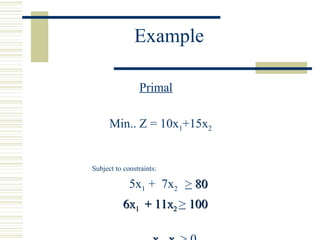
Example Primal Min.. Z = 10x 1 +15x 2 Subject to constraints: 5x 1  +  7x 2  >  80  6x 1  + 11x 2  >  100  x 1 , x 2  >  0
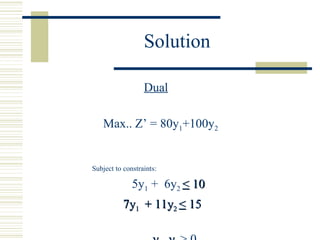
Solution Dual Max.. Z’ = 80y 1 +100y 2 Subject to constraints: 5y 1  +  6y 2  <  10  7y 1  + 11y 2  <  15  y 1 , y 2  >  0
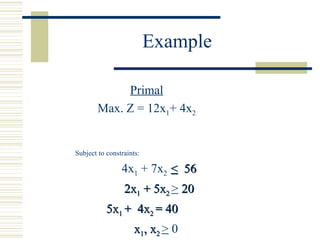
Example Primal Max. Z = 12x 1 + 4x 2 Subject to constraints: 4x 1  + 7x 2  <   56  2x 1  + 5x 2  >  20  5x 1  +  4x 2  = 40  x 1 , x 2  >  0
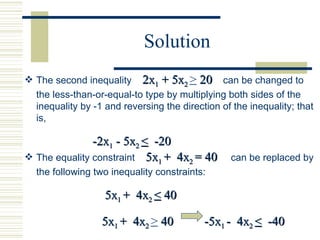
Solution The equality constraint  5x 1  +  4x 2  = 40   can be replaced by the following two inequality constraints: 5x 1  +  4x 2  <  40 5x 1  +  4x 2  >  40  -5x 1  -  4x 2  <   -40 The second inequality  2x 1  + 5x 2  >  20   can be changed to the less-than-or-equal-to type by multiplying both sides of the inequality by -1 and reversing the direction of the inequality; that is,  -2x 1  - 5x 2  <   -20
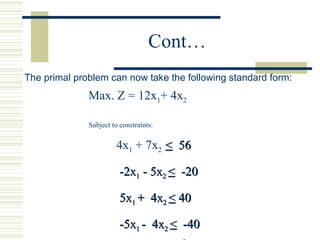
Cont… The primal problem can now take the following standard form: Max. Z = 12x 1 + 4x 2 Subject to constraints: 4x 1  + 7x 2  <   56 -2x 1  - 5x 2  <   -20 5x 1  +  4x 2  <  40 -5x 1  -  4x 2  <   -40 x 1 , x 2  >  0
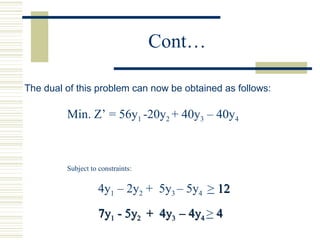
Cont… Min. Z’ = 56y 1  -20y 2  + 40y 3  – 40y 4 Subject to constraints: 4y 1  – 2y 2  +  5y 3  – 5y 4   >  12  7y 1  - 5y 2  +  4y 3  – 4y 4  >  4  y 1 , y 2 , y 3 , y 4  >  0 The dual of this problem can now be obtained as follows:
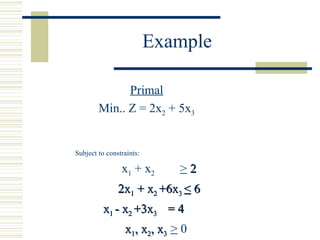
Example Primal Min.. Z = 2x 2  + 5x 3 Subject to constraints: x 1  + x 2  >  2  2x 1  + x 2  +6x 3  <  6  x 1  - x 2  +3x 3  = 4  x 1 , x 2 , x 3  >  0
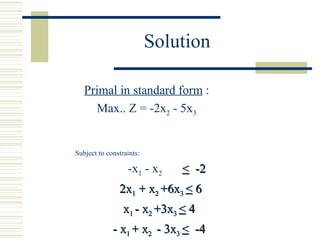
Solution Primal in standard form  : Max.. Z = -2x 2  - 5x 3 Subject to constraints: -x 1  - x 2  <   -2  2x 1  + x 2  +6x 3  <  6  x 1  - x 2  +3x 3  <  4  - x 1  + x 2  - 3x 3  <   -4  x 1 , x 2 , x 3  >  0
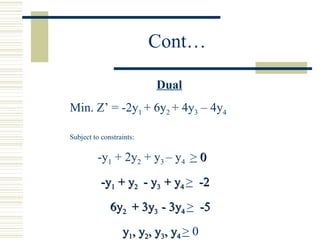
Cont… Dual Min. Z’ = -2y 1  + 6y 2  + 4y 3  – 4y 4 Subject to constraints: -y 1  + 2y 2  + y 3  – y 4   >  0  -y 1  + y 2  - y 3  + y 4  >   -2  6y 2  + 3y 3  - 3y 4  >   -5 y 1 , y 2 , y 3 , y 4  >  0
DUAL SIMPLEX METHOD
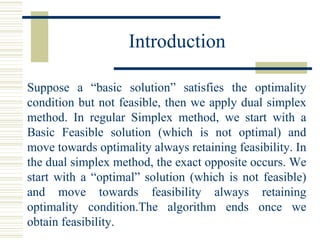
Introduction Suppose a “basic solution” satisfies the optimality condition but not feasible, then we apply dual simplex method. In regular Simplex method, we start with a Basic Feasible solution (which is not optimal) and move towards optimality always retaining feasibility. In the dual simplex method, the exact opposite occurs. We start with a “optimal” solution (which is not feasible) and move towards feasibility always retaining optimality condition.The algorithm ends once we obtain feasibility.
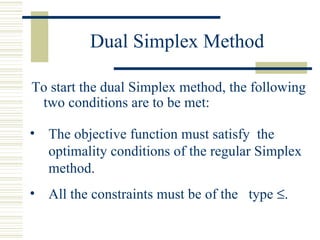
Dual Simplex Method To start the dual Simplex method, the following two conditions are to be met: The objective function must satisfy  the optimality conditions of the regular Simplex method. All the constraints must be of the  type   .
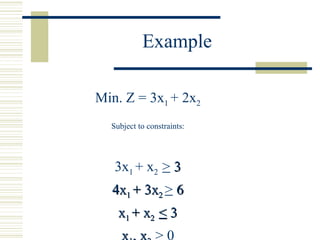
Example Min. Z = 3x 1  + 2x 2 Subject to constraints: 3x 1  + x 2  >  3 4x 1  + 3x 2  >  6 x 1  + x 2  <  3 x 1 , x 2  >  0
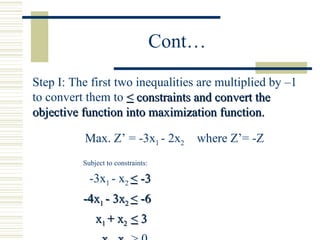
Cont… Step I: The first two inequalities are multiplied by –1 to convert them to  <  constraints and convert the objective function into maximization function. Max. Z’ = -3x 1  - 2x 2  where Z’= -Z  Subject to constraints: -3x 1  - x 2  <  -3  -4x 1  - 3x 2  <  -6 x 1  + x 2  <  3 x 1 , x 2  >  0
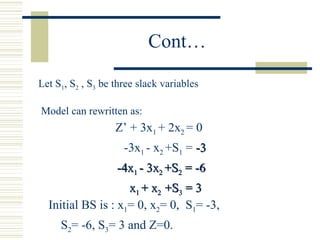
Cont… Let S 1 , S 2  , S 3  be three slack variables Model can rewritten as: Z’ + 3x 1  + 2x 2  = 0 -3x 1  - x 2  +S 1  =  -3  -4x 1  - 3x 2  +S 2  = -6 x 1  + x 2  +S 3  = 3 Initial BS is : x 1 = 0, x 2 = 0,  S 1 = -3,  S 2 = -6, S 3 = 3 and Z=0.
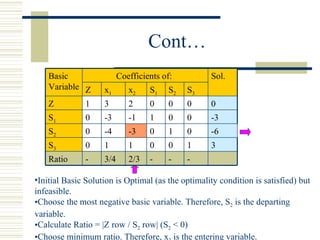
Cont… Initial Basic Solution is Optimal (as the optimality condition is satisfied) but infeasible.  Choose the most negative basic variable. Therefore, S 2  is the departing variable. Calculate Ratio = |Z row / S 2  row| (S 2  < 0) Choose minimum ratio. Therefore, x 2  is the entering variable.  - - - 2/3 3/4 -  Ratio 3 1 0 0 1 1 0 S 3 -6 0 1 0 -3 -4 0 S 2 -3 0 0 1 -1 -3 0 S 1 0 0 0 0 2 3 1 Z Sol. S 3 S 2 S 1 x 2 x 1 Z Coefficients of:  Basic Variable
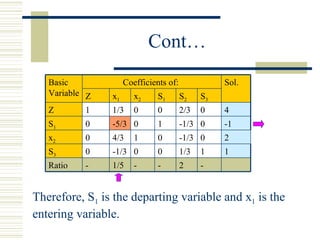
Cont… Therefore, S 1  is the departing variable and x 1  is the entering variable.  - 2 - - 1/5 -  Ratio 1 1 1/3 0 0 -1/3 0 S 3 2 0 -1/3 0 1 4/3 0 x 2 -1 0 -1/3 1 0 -5/3 0 S 1 4 0 2/3 0 0 1/3 1 Z Sol. S 3 S 2 S 1 x 2 x 1 Z Coefficients of:  Basic Variable
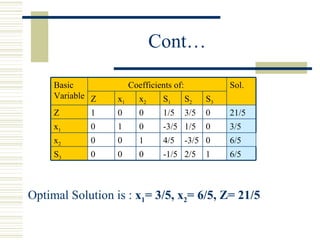
Cont… Optimal Solution is :  x 1 = 3/5, x 2 = 6/5, Z= 21/5 6/5 1 2/5 -1/5 0 0 0 S 3 6/5 0 -3/5 4/5 1 0 0 x 2 3/5 0 1/5 -3/5 0 1 0 x 1 21/5 0 3/5 1/5 0 0 1 Z Sol. S 3 S 2 S 1 x 2 x 1 Z Coefficients of:  Basic Variable
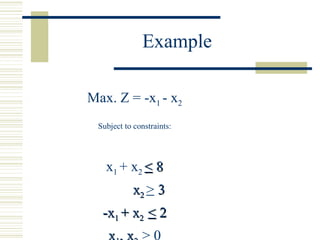
Example Max. Z = -x 1  - x 2 Subject to constraints: x 1  + x 2  <  8 x 2  >  3 -x 1  + x 2  <  2 x 1 , x 2  >  0
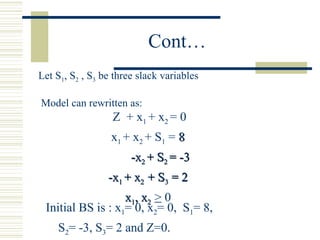
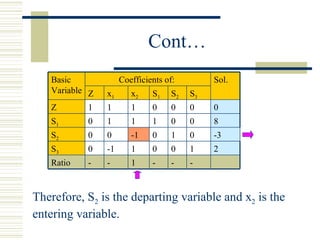
Cont… Let S 1 , S 2  , S 3  be three slack variables Model can rewritten as: Z  + x 1  + x 2  = 0 x 1  + x 2  + S 1  =  8 -x 2  + S 2  = -3 -x 1  + x 2  + S 3  = 2 x 1 , x 2  >  0 Initial BS is : x 1 = 0, x 2 = 0,  S 1 = 8,  S 2 = -3, S 3 = 2 and Z=0.
Cont… Therefore, S 2  is the departing variable and x 2  is the entering variable.  - - - 1 - -  Ratio 2 1 0 0 1 -1 0 S 3 -3 0 1 0 -1 0 0 S 2 8 0 0 1 1 1 0 S 1 0 0 0 0 1 1 1 Z Sol. S 3 S 2 S 1 x 2 x 1 Z Coefficients of:  Basic Variable
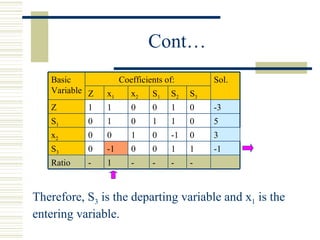
Cont… Therefore, S 3  is the departing variable and x 1  is the entering variable.  - - - - 1 -  Ratio -1 1 1 0 0 -1 0 S 3 3 0 -1 0 1 0 0 x 2 5 0 1 1 0 1 0 S 1 -3 0 1 0 0 1 1 Z Sol. S 3 S 2 S 1 x 2 x 1 Z Coefficients of:  Basic Variable
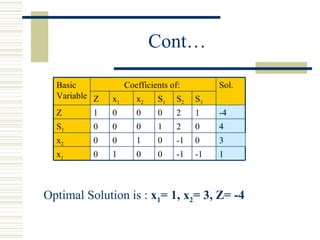
Cont… Optimal Solution is :  x 1 = 1, x 2 = 3, Z= -4 1 -1 -1 0 0 1 0 x 1 3 0 -1 0 1 0 0 x 2 4 0 2 1 0 0 0 S 1 -4 1 2 0 0 0 1 Z Sol. S 3 S 2 S 1 x 2 x 1 Z Coefficients of:  Basic Variable

Duality

  • 1.
  • 2.
    Duality Theory EveryLP problem (called the ‘Primal’) has associated with another problem called the ‘Dual’. The ‘Dual’ problem is an LP defined directly and systematically from the original (or Primal) LP model. The optimal solution of one problem yields the optimal solution to the other. Duality ease the calculations for the problems, whose number of variables is large.
  • 3.
    Rules for convertingPrimal to Dual If the Primal is to maximize, the dual is to minimize. If the Primal is to minimize, the dual is to maximize. For every constraint in the primal, there is a dual variable. For every variable in the primal, there is a constraint in the dual.
  • 4.
    Dual Problem PrimalLP : Max z = c 1 x 1 + c 2 x 2 + ... + c n x n subject to: a 11 x 1 + a 12 x 2 + ... + a 1n x n ≤ b 1 a 21 x 1 + a 22 x 2 + ... + a 2n x n ≤ b 2 : a m1 x 1 + a m2 x 2 + ... + a mn x n ≤ b m x 1 ≥ 0, x 2 ≥ 0,…….x j ≥ 0,……., x n ≥ 0. Associated Dual LP : Min. z = b 1 y 1 + b 2 y 2 + ... + b m y m subject to: a 11 y 1 + a 21 y 2 + ... + a m1 y m ≥ c 1 a 12 y 1 + a 22 y 2 + ... + a m2 y m ≥ c 2 : a 1n y 1 + a 2n y 2 + ... + a mn y m ≥ c n y 1 ≥ 0, y 2 ≥ 0,…….y j ≥ 0,……., y m ≥ 0.
  • 5.
    Example Primal Max.Z = 3x 1 +5x 2 Subject to constraints: x 1 < 4 y 1 2x 2 < 12 y 2 3x 1 +2x 2 < 18 y 3 x 1 , x 2 > 0 The Primal has: 2 variables and 3 constraints. So the Dual has: 3 variables and 2 constraints Dual Min. Z’ = 4y 1 +12y 2 +18y 3 Subject to constraints: y 1 + 3y 3 > 3 2y 2 +2y 3 > 5 y 1 , y 2 , y 3 > 0 We define one dual variable for each primal constraint.
  • 6.
    Example Primal Min..Z = 10x 1 +15x 2 Subject to constraints: 5x 1 + 7x 2 > 80 6x 1 + 11x 2 > 100 x 1 , x 2 > 0
  • 7.
    Solution Dual Max..Z’ = 80y 1 +100y 2 Subject to constraints: 5y 1 + 6y 2 < 10 7y 1 + 11y 2 < 15 y 1 , y 2 > 0
  • 8.
    Example Primal Max.Z = 12x 1 + 4x 2 Subject to constraints: 4x 1 + 7x 2 < 56 2x 1 + 5x 2 > 20 5x 1 + 4x 2 = 40 x 1 , x 2 > 0
  • 9.
    Solution The equalityconstraint 5x 1 + 4x 2 = 40 can be replaced by the following two inequality constraints: 5x 1 + 4x 2 < 40 5x 1 + 4x 2 > 40 -5x 1 - 4x 2 < -40 The second inequality 2x 1 + 5x 2 > 20 can be changed to the less-than-or-equal-to type by multiplying both sides of the inequality by -1 and reversing the direction of the inequality; that is, -2x 1 - 5x 2 < -20
  • 10.
    Cont… The primalproblem can now take the following standard form: Max. Z = 12x 1 + 4x 2 Subject to constraints: 4x 1 + 7x 2 < 56 -2x 1 - 5x 2 < -20 5x 1 + 4x 2 < 40 -5x 1 - 4x 2 < -40 x 1 , x 2 > 0
  • 11.
    Cont… Min. Z’= 56y 1 -20y 2 + 40y 3 – 40y 4 Subject to constraints: 4y 1 – 2y 2 + 5y 3 – 5y 4 > 12 7y 1 - 5y 2 + 4y 3 – 4y 4 > 4 y 1 , y 2 , y 3 , y 4 > 0 The dual of this problem can now be obtained as follows:
  • 12.
    Example Primal Min..Z = 2x 2 + 5x 3 Subject to constraints: x 1 + x 2 > 2 2x 1 + x 2 +6x 3 < 6 x 1 - x 2 +3x 3 = 4 x 1 , x 2 , x 3 > 0
  • 13.
    Solution Primal instandard form : Max.. Z = -2x 2 - 5x 3 Subject to constraints: -x 1 - x 2 < -2 2x 1 + x 2 +6x 3 < 6 x 1 - x 2 +3x 3 < 4 - x 1 + x 2 - 3x 3 < -4 x 1 , x 2 , x 3 > 0
  • 14.
    Cont… Dual Min.Z’ = -2y 1 + 6y 2 + 4y 3 – 4y 4 Subject to constraints: -y 1 + 2y 2 + y 3 – y 4 > 0 -y 1 + y 2 - y 3 + y 4 > -2 6y 2 + 3y 3 - 3y 4 > -5 y 1 , y 2 , y 3 , y 4 > 0
  • 15.
  • 16.
    Introduction Suppose a“basic solution” satisfies the optimality condition but not feasible, then we apply dual simplex method. In regular Simplex method, we start with a Basic Feasible solution (which is not optimal) and move towards optimality always retaining feasibility. In the dual simplex method, the exact opposite occurs. We start with a “optimal” solution (which is not feasible) and move towards feasibility always retaining optimality condition.The algorithm ends once we obtain feasibility.
  • 17.
    Dual Simplex MethodTo start the dual Simplex method, the following two conditions are to be met: The objective function must satisfy the optimality conditions of the regular Simplex method. All the constraints must be of the type  .
  • 18.
    Example Min. Z= 3x 1 + 2x 2 Subject to constraints: 3x 1 + x 2 > 3 4x 1 + 3x 2 > 6 x 1 + x 2 < 3 x 1 , x 2 > 0
  • 19.
    Cont… Step I:The first two inequalities are multiplied by –1 to convert them to < constraints and convert the objective function into maximization function. Max. Z’ = -3x 1 - 2x 2 where Z’= -Z Subject to constraints: -3x 1 - x 2 < -3 -4x 1 - 3x 2 < -6 x 1 + x 2 < 3 x 1 , x 2 > 0
  • 20.
    Cont… Let S1 , S 2 , S 3 be three slack variables Model can rewritten as: Z’ + 3x 1 + 2x 2 = 0 -3x 1 - x 2 +S 1 = -3 -4x 1 - 3x 2 +S 2 = -6 x 1 + x 2 +S 3 = 3 Initial BS is : x 1 = 0, x 2 = 0, S 1 = -3, S 2 = -6, S 3 = 3 and Z=0.
  • 21.
    Cont… Initial BasicSolution is Optimal (as the optimality condition is satisfied) but infeasible. Choose the most negative basic variable. Therefore, S 2 is the departing variable. Calculate Ratio = |Z row / S 2 row| (S 2 < 0) Choose minimum ratio. Therefore, x 2 is the entering variable. - - - 2/3 3/4 - Ratio 3 1 0 0 1 1 0 S 3 -6 0 1 0 -3 -4 0 S 2 -3 0 0 1 -1 -3 0 S 1 0 0 0 0 2 3 1 Z Sol. S 3 S 2 S 1 x 2 x 1 Z Coefficients of: Basic Variable
  • 22.
    Cont… Therefore, S1 is the departing variable and x 1 is the entering variable. - 2 - - 1/5 - Ratio 1 1 1/3 0 0 -1/3 0 S 3 2 0 -1/3 0 1 4/3 0 x 2 -1 0 -1/3 1 0 -5/3 0 S 1 4 0 2/3 0 0 1/3 1 Z Sol. S 3 S 2 S 1 x 2 x 1 Z Coefficients of: Basic Variable
  • 23.
    Cont… Optimal Solutionis : x 1 = 3/5, x 2 = 6/5, Z= 21/5 6/5 1 2/5 -1/5 0 0 0 S 3 6/5 0 -3/5 4/5 1 0 0 x 2 3/5 0 1/5 -3/5 0 1 0 x 1 21/5 0 3/5 1/5 0 0 1 Z Sol. S 3 S 2 S 1 x 2 x 1 Z Coefficients of: Basic Variable
  • 24.
    Example Max. Z= -x 1 - x 2 Subject to constraints: x 1 + x 2 < 8 x 2 > 3 -x 1 + x 2 < 2 x 1 , x 2 > 0
  • 25.
    Cont… Let S1 , S 2 , S 3 be three slack variables Model can rewritten as: Z + x 1 + x 2 = 0 x 1 + x 2 + S 1 = 8 -x 2 + S 2 = -3 -x 1 + x 2 + S 3 = 2 x 1 , x 2 > 0 Initial BS is : x 1 = 0, x 2 = 0, S 1 = 8, S 2 = -3, S 3 = 2 and Z=0.
  • 26.
    Cont… Therefore, S2 is the departing variable and x 2 is the entering variable. - - - 1 - - Ratio 2 1 0 0 1 -1 0 S 3 -3 0 1 0 -1 0 0 S 2 8 0 0 1 1 1 0 S 1 0 0 0 0 1 1 1 Z Sol. S 3 S 2 S 1 x 2 x 1 Z Coefficients of: Basic Variable
  • 27.
    Cont… Therefore, S3 is the departing variable and x 1 is the entering variable. - - - - 1 - Ratio -1 1 1 0 0 -1 0 S 3 3 0 -1 0 1 0 0 x 2 5 0 1 1 0 1 0 S 1 -3 0 1 0 0 1 1 Z Sol. S 3 S 2 S 1 x 2 x 1 Z Coefficients of: Basic Variable
  • 28.
    Cont… Optimal Solutionis : x 1 = 1, x 2 = 3, Z= -4 1 -1 -1 0 0 1 0 x 1 3 0 -1 0 1 0 0 x 2 4 0 2 1 0 0 0 S 1 -4 1 2 0 0 0 1 Z Sol. S 3 S 2 S 1 x 2 x 1 Z Coefficients of: Basic Variable