The document summarizes the simplex method for solving linear programming problems involving maximization. It involves 12 steps: 1) Formulating the LPP, 2) Introducing slack, surplus and artificial variables, 3) Formulating the initial basic solution, 4) Constructing the initial simplex table, 5) Checking for positive elements in the Cj-Zj row, 6) Identifying the incoming basic variable, 7) Choosing the incoming basic variable if multiple positives exist, 8) Identifying the outgoing basic variable, 9) Constructing the next simplex table using row operations, 10) Completing the new simplex table, 11) Repeating steps 5-10, and 12) Terminating when the
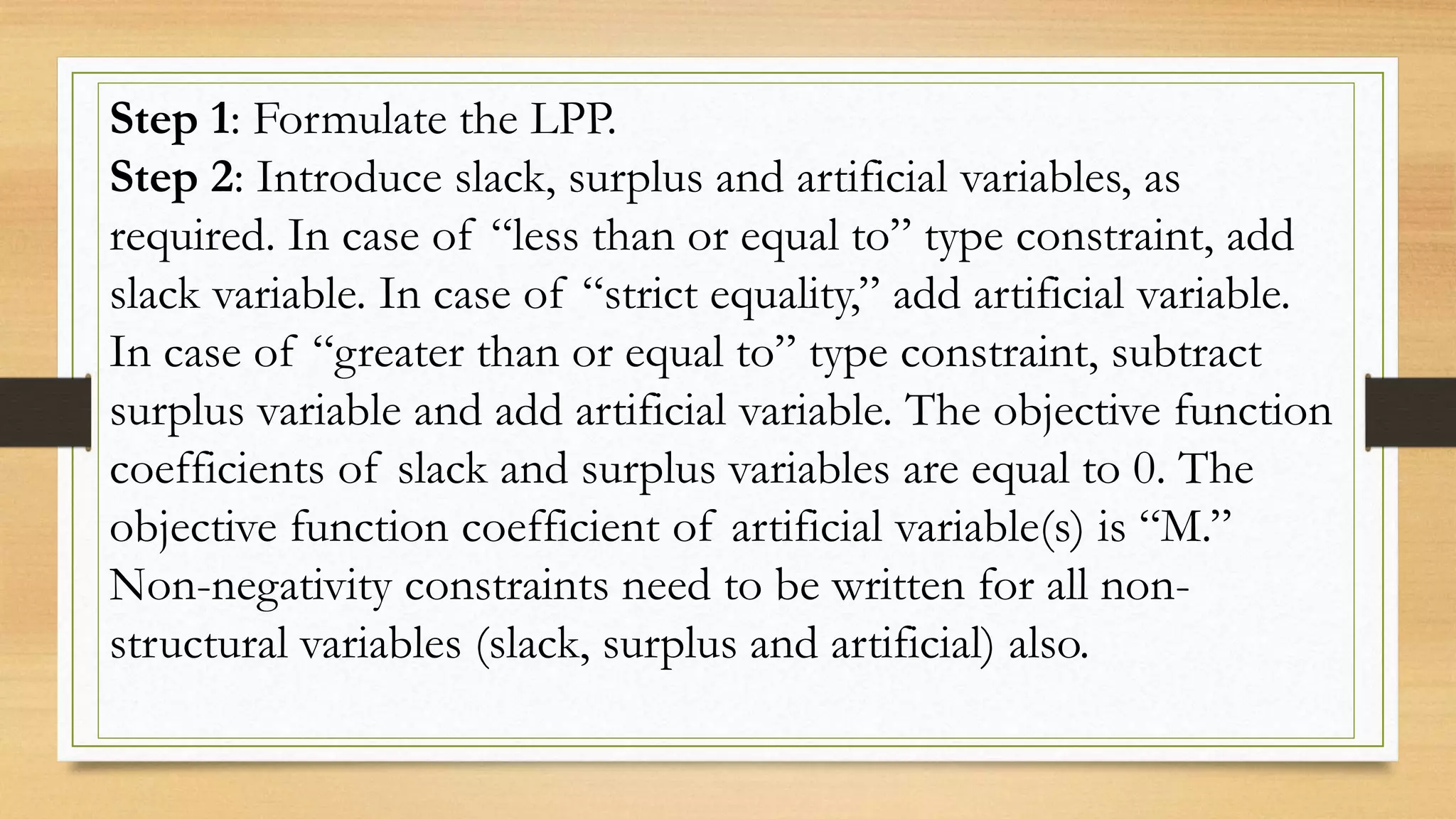
Step 1: Formulatethe LPP.
Step 2: Introduce slack, surplus and artificial variables, as
required. In case of “less than or equal to” type constraint, add
slack variable. In case of “strict equality,” add artificial variable.
In case of “greater than or equal to” type constraint, subtract
surplus variable and add artificial variable. The objective function
coefficients of slack and surplus variables are equal to 0. The
objective function coefficient of artificial variable(s) is “M.”
Non-negativity constraints need to be written for all non-
structural variables (slack, surplus and artificial) also.
3.
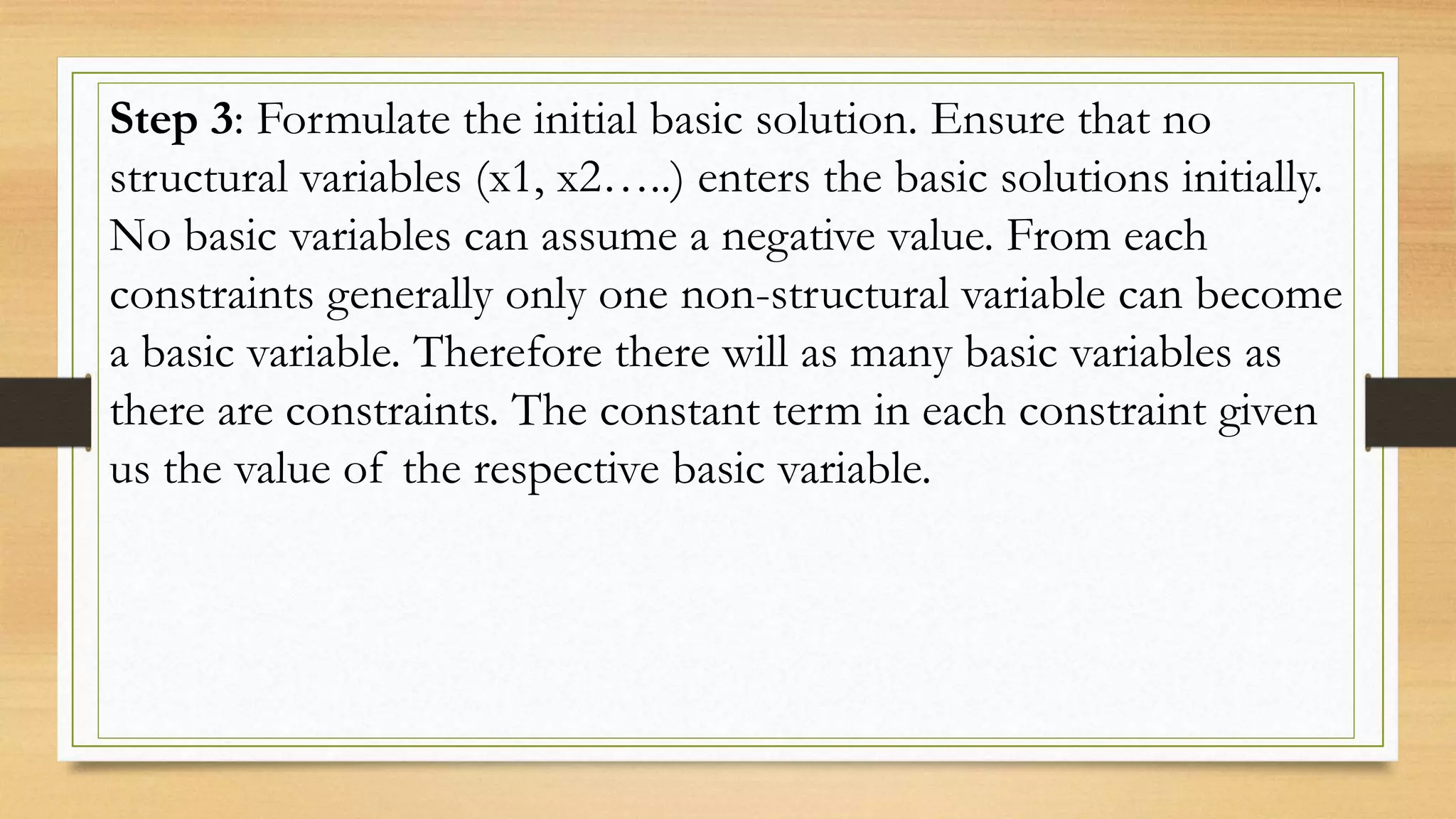
Step 3: Formulatethe initial basic solution. Ensure that no
structural variables (x1, x2…..) enters the basic solutions initially.
No basic variables can assume a negative value. From each
constraints generally only one non-structural variable can become
a basic variable. Therefore there will as many basic variables as
there are constraints. The constant term in each constraint given
us the value of the respective basic variable.
4.
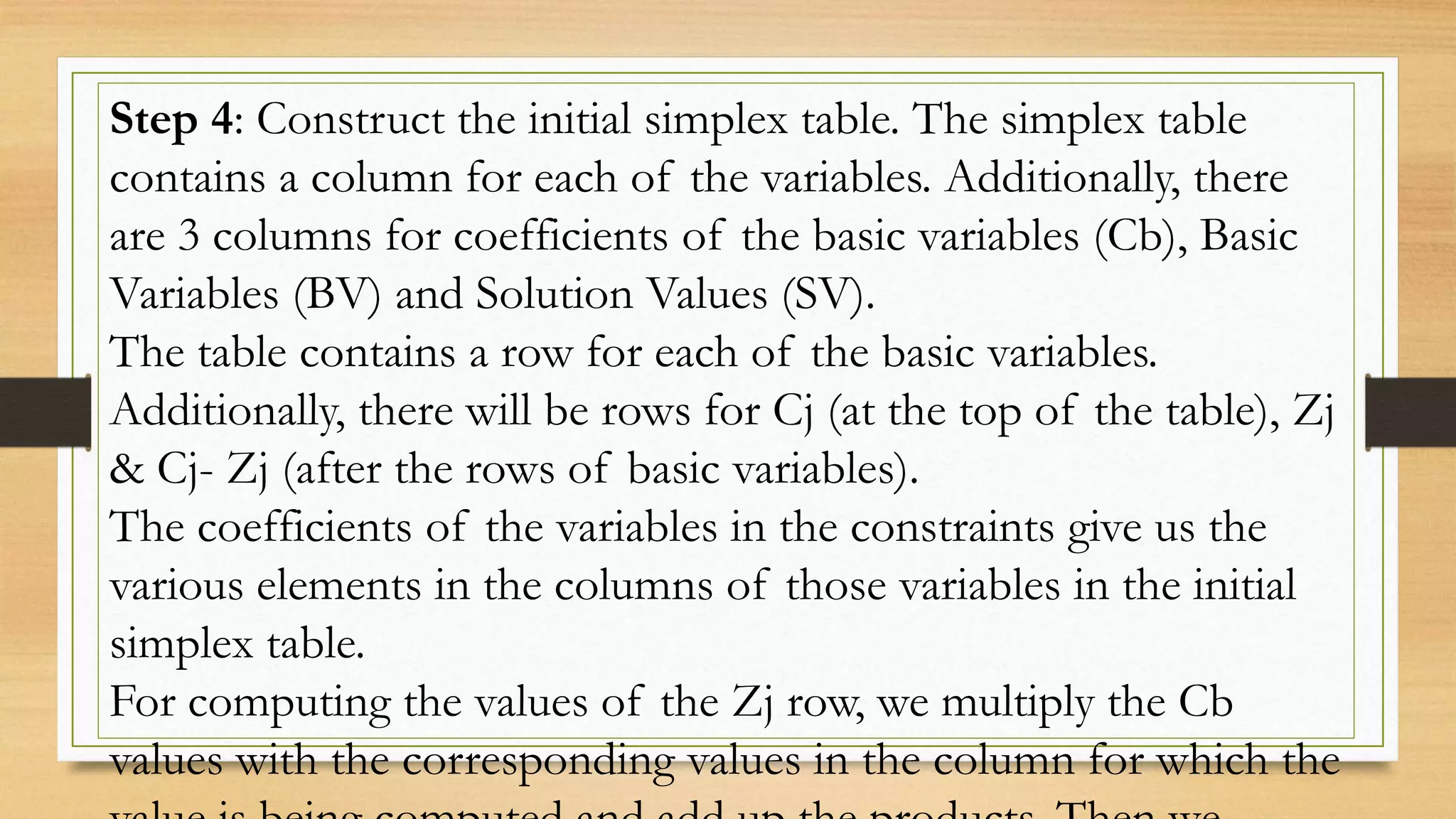
Step 4: Constructthe initial simplex table. The simplex table
contains a column for each of the variables. Additionally, there
are 3 columns for coefficients of the basic variables (Cb), Basic
Variables (BV) and Solution Values (SV).
The table contains a row for each of the basic variables.
Additionally, there will be rows for Cj (at the top of the table), Zj
& Cj- Zj (after the rows of basic variables).
The coefficients of the variables in the constraints give us the
various elements in the columns of those variables in the initial
simplex table.
For computing the values of the Zj row, we multiply the Cb
values with the corresponding values in the column for which the
5.
Step 4: Constructthe initial simplex table. The simplex table
contains a column for each of the variables. Additionally, there
are 3 columns for coefficients of the basic variables (Cb), Basic
Variables (BV) and Solution Values (SV).
The table contains a row for each of the basic variables.
Additionally, there will be rows for Cj (at the top of the table), Zj
& Cj- Zj (after the rows of basic variables).
The coefficients of the variables in the constraints give us the
various elements in the columns of those variables in the initial
simplex table.
6.
Step 4 (contd.):For computing the values of the Zj row, we
multiply the Cb values with the corresponding values in the
column for which the value is being computed and add up the
products. Then we compute the Cj - Zj row by subtracting the Zj
values from the corresponding Cj values.
7.
Step 5: SimplexCriterion 1. Examine the Cj-Zj row for any
positive element. (As long as the Cj-Zj row contains even one
positive element, the optimum (maximum) value of the objective
function (z) has not been reached. For finding the maximum
value of z, it needs to be ensured that all the values in the
Cj-Zj row are either zero or negative.)…
8.
Step 6: Ifthe Cj-Zj row contains only one positive element, the
corresponding variable will be the incoming basic variable in
the next simplex table. (The column of this variable is called the
optimum column.)
Step 7: If the Cj-Zj row contains more than one positive
element, then the variable corresponding to the largest of these
positive elements becomes the incoming basic variable for the
next simplex table...
9.
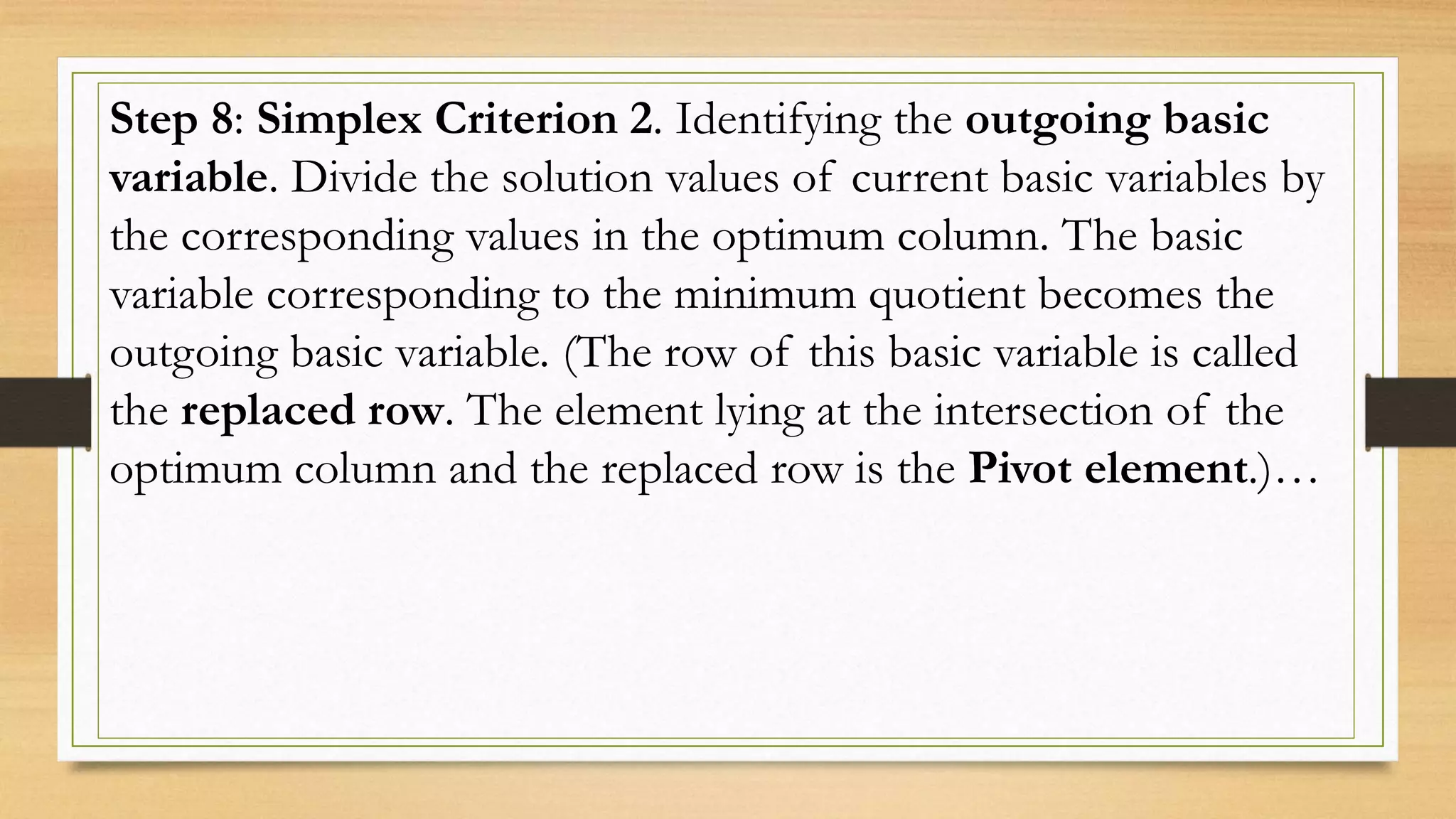
Step 8: SimplexCriterion 2. Identifying the outgoing basic
variable. Divide the solution values of current basic variables by
the corresponding values in the optimum column. The basic
variable corresponding to the minimum quotient becomes the
outgoing basic variable. (The row of this basic variable is called
the replaced row. The element lying at the intersection of the
optimum column and the replaced row is the Pivot element.)…
10.
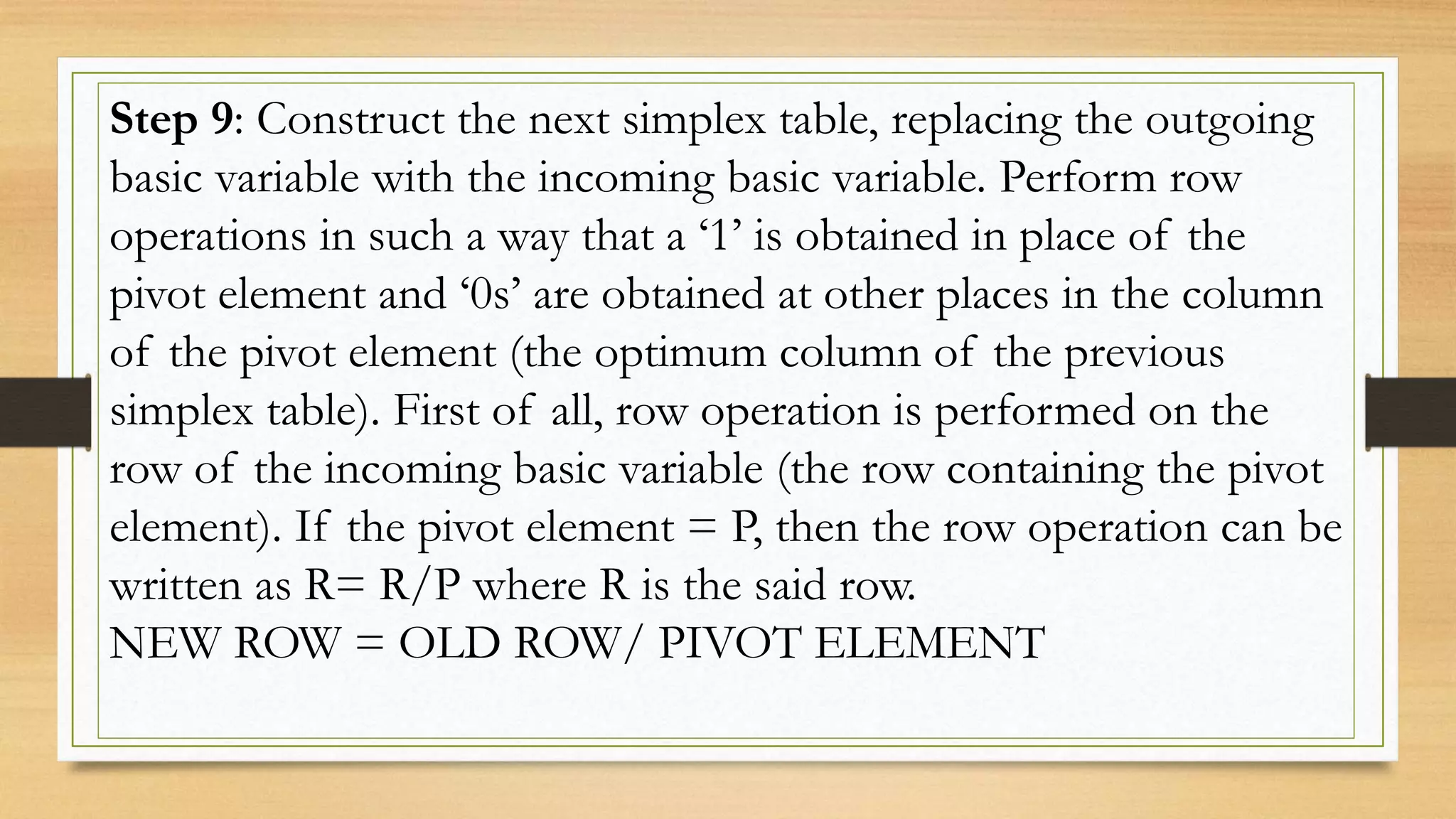
Step 9: Constructthe next simplex table, replacing the outgoing
basic variable with the incoming basic variable. Perform row
operations in such a way that a ‘1’ is obtained in place of the
pivot element and ‘0s’ are obtained at other places in the column
of the pivot element (the optimum column of the previous
simplex table). First of all, row operation is performed on the
row of the incoming basic variable (the row containing the pivot
element). If the pivot element = P, then the row operation can be
written as R= R/P where R is the said row.
NEW ROW = OLD ROW/ PIVOT ELEMENT
11.
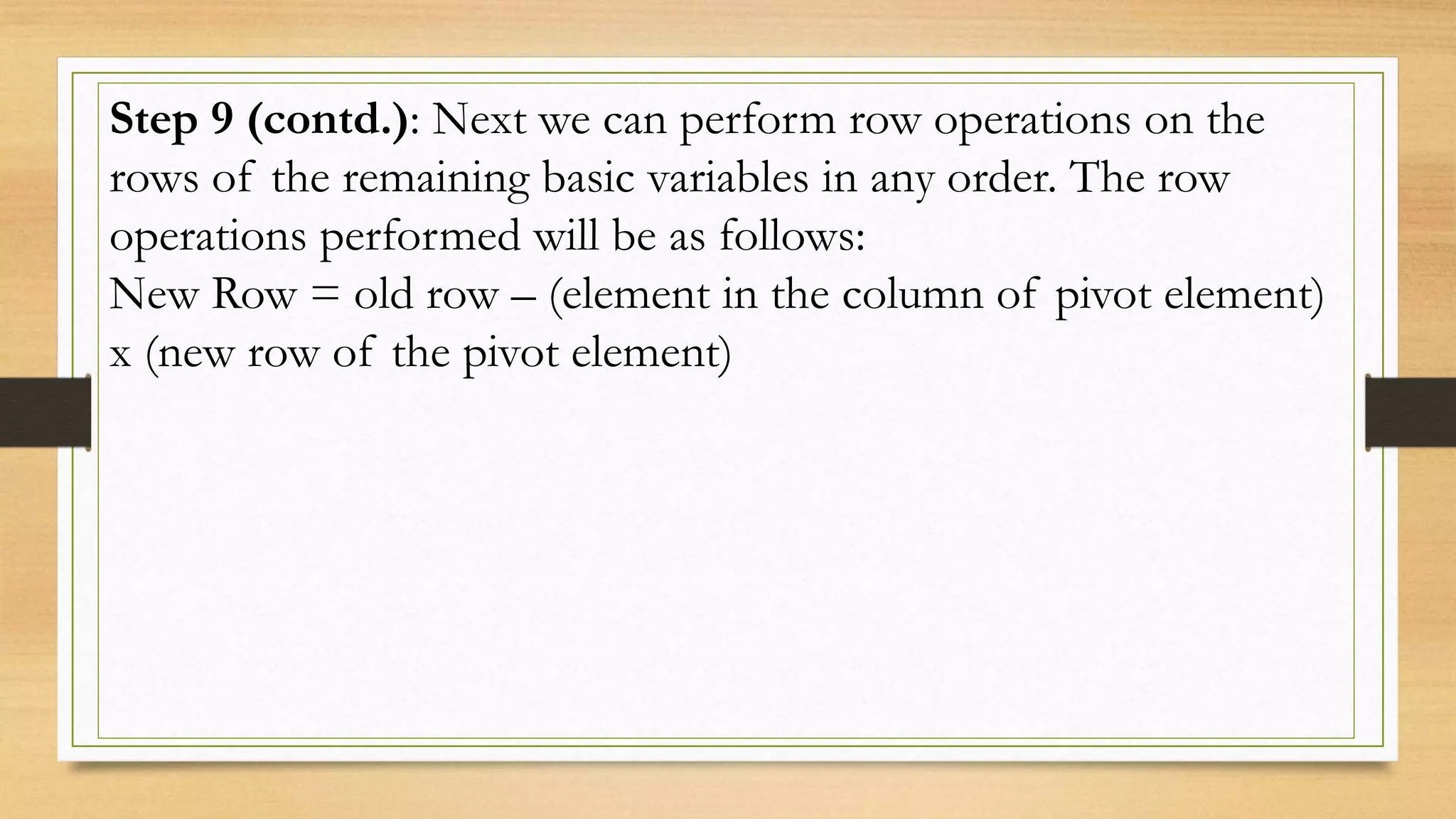
Step 9 (contd.):Next we can perform row operations on the
rows of the remaining basic variables in any order. The row
operations performed will be as follows:
New Row = old row – (element in the column of pivot element)
x (new row of the pivot element)
12.
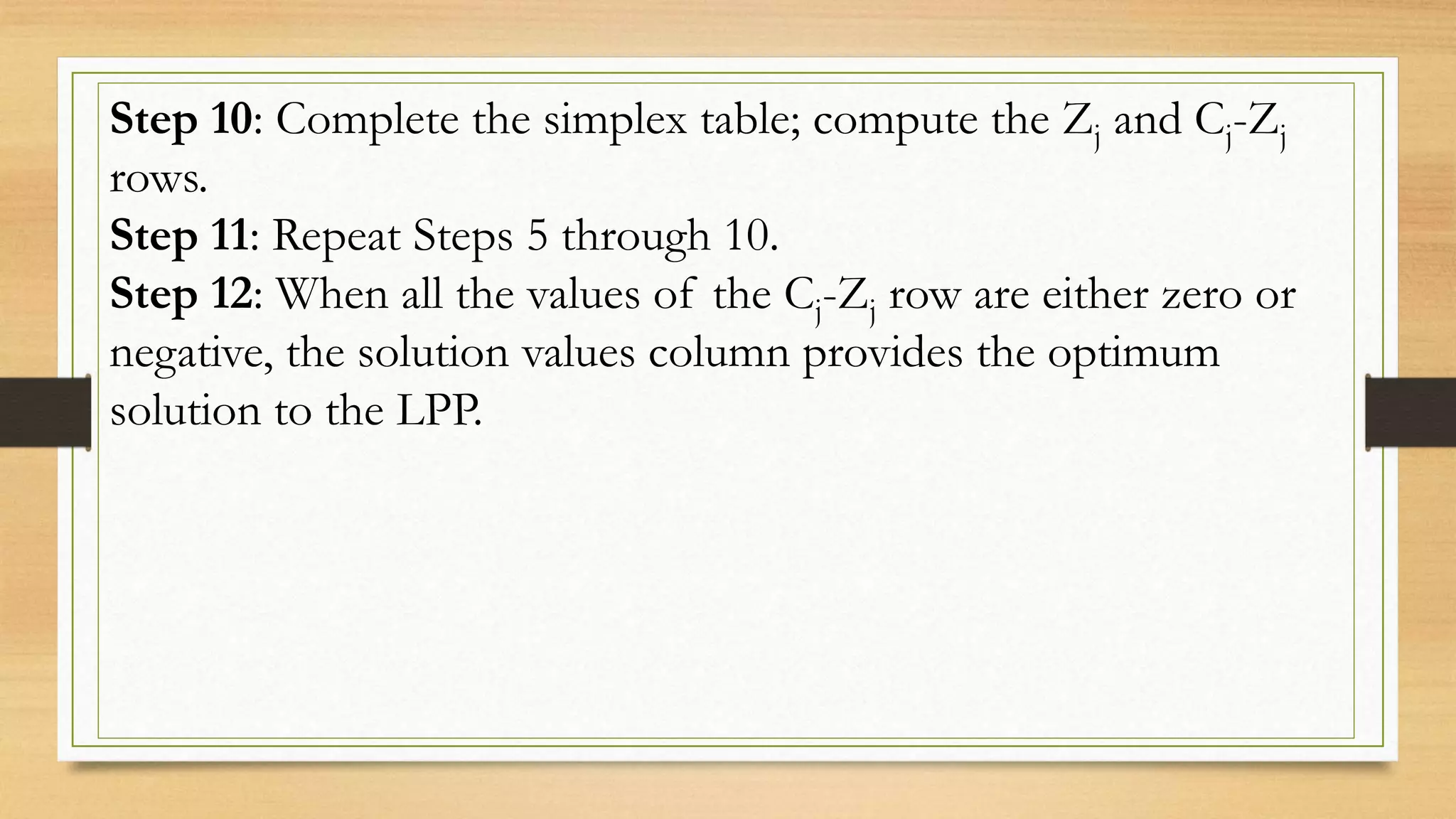
Step 10: Completethe simplex table; compute the Zj and Cj-Zj
rows.
Step 11: Repeat Steps 5 through 10.
Step 12: When all the values of the Cj-Zj row are either zero or
negative, the solution values column provides the optimum
solution to the LPP.