Presented By:
Hafiz Muhammad Amjad
Safi Ullah Nasir
Rimsha Riaz
1
Outline
Introduction
Optimization Problem
Characteristics And Features
Greedy Properties.
Greedy Approach
The Coin Changing Problem.
Traveling Salesman.
MST
Kruskal’s And Prim’s Algorithm.
Huffman Code.
Advantages And Disadvantages
2
Greedy Introduction
Greedy algorithms are simple and straightforward.
They are shortsighted in their approach
A greedy algorithm is similar to a dynamic
programming algorithm, but the difference is that
solutions to the sub problems do not have to be known
at each stage
It is used to solve the optimization problems.
3
Optimization Problems
An optimization problem is one in which you want to find,
not just a solution, but the best solution
A “greedy algorithm” sometimes works well for
optimization problems
A greedy algorithm works in phases. At each phase:
You take the best you can get right now, without regard
for future consequences
You hope that by choosing a local optimum at each step,
you will end up at a global optimum
4
Characteristics And Features
To construct the solution in an optimal way.
Algorithm Maintains two sets
One contains chosen items and
The other contains rejected items.
Greedy algorithms make good local choices in the
hope that They result in
An optimal solution.
Feasible solutions.
5
Greedy Property
It consists of two property.
1. Greedy-Choice Property:
It says that a globally optimal solution can be arrived at by
making a locally optimal choice.
2. Optimal Substructure:
An optimal global solution contains the optimal solutions
of all its sub problems.
6
Greedy Approach
Greedy Algorithm works by making the decision that seems
most promising at any moment; it never reconsiders this
decision, whatever situation may arise later.
As an example consider the problem of "Making Change".
Coins available are:
100 cents
25 cents
10 cents
15 cents
1 cent
7
CONTINUED…
Problem:
Make a change of a given amount using the smallest possible
number of coins.
Solution:
The coin is selected using greedy criterion: at each stage
increases the total amount of change constructed as much as
possible.
To assure feasibility i.e. the change given exactly equals the
desired amount of the solution
8
Coin Changing Problem
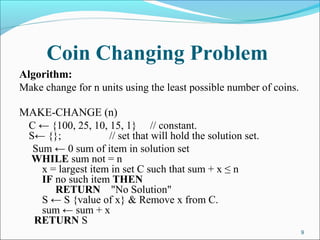
Algorithm:
Make change for n units using the least possible number of coins.
MAKE-CHANGE (n)
C ← {100, 25, 10, 15, 1} // constant.
S← {}; // set that will hold the solution set.
Sum ← 0 sum of item in solution set
WHILE sum not = n
x = largest item in set C such that sum + x ≤ n
IF no such item THEN
RETURN "No Solution"
S ← S {value of x} & Remove x from C.
sum ← sum + x
RETURN S
9
Traveling Salesman
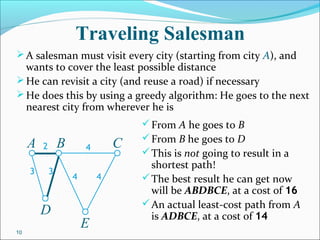
A salesman must visit every city (starting from city A), and
wants to cover the least possible distance
He can revisit a city (and reuse a road) if necessary
He does this by using a greedy algorithm: He goes to the next
nearest city from wherever he is
From A he goes to B
From B he goes to D
This is not going to result in a
shortest path!
The best result he can get now
will be ABDBCE, at a cost of 16
An actual least-cost path from A
is ADBCE, at a cost of 14
10
E
A B C
D
2
3 3
4
4 4
An Example Of MST
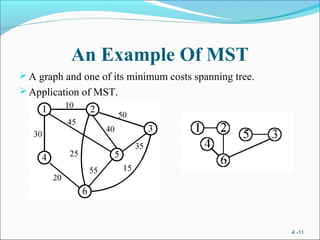
A graph and one of its minimum costs spanning tree.
Application of MST.
4 -11
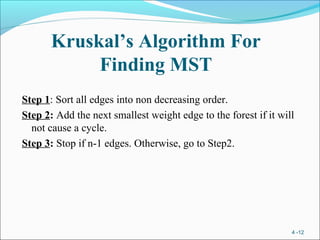
Kruskal’s Algorithm For
Finding MST
Step 1: Sort all edges into non decreasing order.
Step 2: Add the next smallest weight edge to the forest if it will
not cause a cycle.
Step 3: Stop if n-1 edges. Otherwise, go to Step2.
4 -12
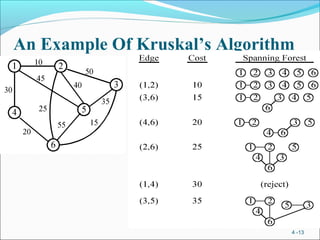
An Example Of Kruskal’s Algorithm
4 -13
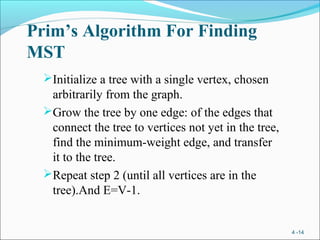
Prim’s Algorithm For Finding
MST
Initialize a tree with a single vertex, chosen
arbitrarily from the graph.
Grow the tree by one edge: of the edges that
connect the tree to vertices not yet in the tree,
find the minimum-weight edge, and transfer
it to the tree.
Repeat step 2 (until all vertices are in the
tree).And E=V-1.
4 -14
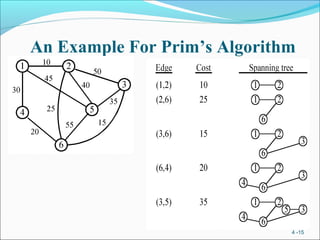
An Example For Prim’s Algorithm
4 -15
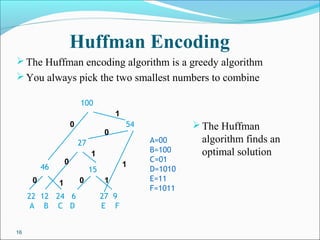
Huffman Encoding
The Huffman encoding algorithm is a greedy algorithm
You always pick the two smallest numbers to combine
The Huffman
algorithm finds an
optimal solution
16
22 12 24 6 27 9
A B C D E F
15
27
46
54
100
A=00
B=100
C=01
D=1010
E=11
F=1011
0
1
0 1
0
1
0
1
0 1
Advantages And Disadvantages
Advantages:
They are easier to implement.
They require much less computing resources.
They are much faster to execute.
Greedy algorithms are used to solve optimization
problems
Disadvantages:
Their only disadvantage being that they not always reach
the global optimum solution.
 On the other hand, even when the global optimum
solution is not reached, most of the times the reached sub-
optimal solution is a very good solution.
17
18

Greedy Algorihm

  • 1.
    Presented By: Hafiz MuhammadAmjad Safi Ullah Nasir Rimsha Riaz 1
  • 2.
    Outline Introduction Optimization Problem Characteristics AndFeatures Greedy Properties. Greedy Approach The Coin Changing Problem. Traveling Salesman. MST Kruskal’s And Prim’s Algorithm. Huffman Code. Advantages And Disadvantages 2
  • 3.
    Greedy Introduction Greedy algorithmsare simple and straightforward. They are shortsighted in their approach A greedy algorithm is similar to a dynamic programming algorithm, but the difference is that solutions to the sub problems do not have to be known at each stage It is used to solve the optimization problems. 3
  • 4.
    Optimization Problems An optimizationproblem is one in which you want to find, not just a solution, but the best solution A “greedy algorithm” sometimes works well for optimization problems A greedy algorithm works in phases. At each phase: You take the best you can get right now, without regard for future consequences You hope that by choosing a local optimum at each step, you will end up at a global optimum 4
  • 5.
    Characteristics And Features Toconstruct the solution in an optimal way. Algorithm Maintains two sets One contains chosen items and The other contains rejected items. Greedy algorithms make good local choices in the hope that They result in An optimal solution. Feasible solutions. 5
  • 6.
    Greedy Property It consistsof two property. 1. Greedy-Choice Property: It says that a globally optimal solution can be arrived at by making a locally optimal choice. 2. Optimal Substructure: An optimal global solution contains the optimal solutions of all its sub problems. 6
  • 7.
    Greedy Approach Greedy Algorithmworks by making the decision that seems most promising at any moment; it never reconsiders this decision, whatever situation may arise later. As an example consider the problem of "Making Change". Coins available are: 100 cents 25 cents 10 cents 15 cents 1 cent 7
  • 8.
    CONTINUED… Problem: Make a changeof a given amount using the smallest possible number of coins. Solution: The coin is selected using greedy criterion: at each stage increases the total amount of change constructed as much as possible. To assure feasibility i.e. the change given exactly equals the desired amount of the solution 8
  • 9.
    Coin Changing Problem Algorithm: Makechange for n units using the least possible number of coins. MAKE-CHANGE (n) C ← {100, 25, 10, 15, 1} // constant. S← {}; // set that will hold the solution set. Sum ← 0 sum of item in solution set WHILE sum not = n x = largest item in set C such that sum + x ≤ n IF no such item THEN RETURN "No Solution" S ← S {value of x} & Remove x from C. sum ← sum + x RETURN S 9
  • 10.
    Traveling Salesman A salesmanmust visit every city (starting from city A), and wants to cover the least possible distance He can revisit a city (and reuse a road) if necessary He does this by using a greedy algorithm: He goes to the next nearest city from wherever he is From A he goes to B From B he goes to D This is not going to result in a shortest path! The best result he can get now will be ABDBCE, at a cost of 16 An actual least-cost path from A is ADBCE, at a cost of 14 10 E A B C D 2 3 3 4 4 4
  • 11.
    An Example OfMST A graph and one of its minimum costs spanning tree. Application of MST. 4 -11
  • 12.
    Kruskal’s Algorithm For FindingMST Step 1: Sort all edges into non decreasing order. Step 2: Add the next smallest weight edge to the forest if it will not cause a cycle. Step 3: Stop if n-1 edges. Otherwise, go to Step2. 4 -12
  • 13.
    An Example OfKruskal’s Algorithm 4 -13
  • 14.
    Prim’s Algorithm ForFinding MST Initialize a tree with a single vertex, chosen arbitrarily from the graph. Grow the tree by one edge: of the edges that connect the tree to vertices not yet in the tree, find the minimum-weight edge, and transfer it to the tree. Repeat step 2 (until all vertices are in the tree).And E=V-1. 4 -14
  • 15.
    An Example ForPrim’s Algorithm 4 -15
  • 16.
    Huffman Encoding The Huffmanencoding algorithm is a greedy algorithm You always pick the two smallest numbers to combine The Huffman algorithm finds an optimal solution 16 22 12 24 6 27 9 A B C D E F 15 27 46 54 100 A=00 B=100 C=01 D=1010 E=11 F=1011 0 1 0 1 0 1 0 1 0 1
  • 17.
    Advantages And Disadvantages Advantages: Theyare easier to implement. They require much less computing resources. They are much faster to execute. Greedy algorithms are used to solve optimization problems Disadvantages: Their only disadvantage being that they not always reach the global optimum solution.  On the other hand, even when the global optimum solution is not reached, most of the times the reached sub- optimal solution is a very good solution. 17
  • 18.