Simple Harmonic
Motion
Physics
1/23/2013
Simple Harmonic Motion
 simple harmonic motion (SHM) –
vibration about an equilibrium position
in which a restoring force is
proportional to the displacement from
equilibrium
 two common types of SHM are a
vibrating spring and an oscillating
pendulum
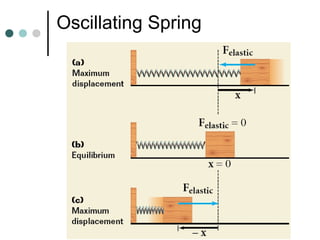
 springs can vibrate horizontally (on a
frictionless surface) or vertically
Oscillating Spring
SHM and Oscillating Springs
 in an oscillating spring, maximum
velocity (with Felastic = 0) is experienced
at the equilibrium point; as the spring
moves away from the equilibrium
point, the spring begins to exert a
force that causes the velocity to
decrease
 the force exerted is maximum when
the spring is at maximum
displacement (either compressed or
stretched)
SHM and Oscillating Springs
 at maximum displacement, the
velocity is zero; since the spring is
either stretched or compressed at this
point, a force is again exerted to start
the motion over again
 in an ideal system, the mass-spring
system would oscillate indefinitely
SHM and Oscillating Springs
 damping occurs when friction slows
the motion of the vibrating mass,
which causes the system to come to
rest after a period of time
 if we observe a mass-spring system
over a short period of time, damping is
minimal and we can assume an ideal
mass-spring system
SHM and Oscillating Springs
 in a mass-spring system, the spring
force is always trying to pull or push
the mass back toward equilibrium;
because of this, we call this force a
restoring force
 in SHM, the restoring force is
proportional to the mass’
displacement; this results in all SHM
to be a simple back-and-forth motion
over the same path
Hooke’s Law
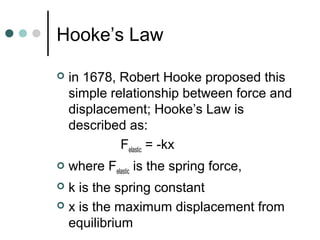
 in 1678, Robert Hooke proposed this
simple relationship between force and
displacement; Hooke’s Law is
described as:
Felastic = -kx
 where Felastic is the spring force,
 k is the spring constant
 x is the maximum displacement from
equilibrium
Hooke’s Law
 the negative sign shows us that the force is
a restoring force, always moving the object
back to its equilibrium position
 the spring constant has units of
Newtons/meter
 the spring constant tells us how resistant a
spring is to being compressed or stretched
(how many Newtons of force are required to
stretch or compress the spring 1 meter)
 when stretched or compressed, a spring
has potential energy
Simple Pendulum
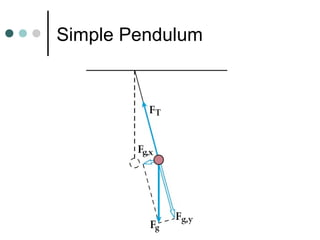
 simple pendulum – consists of a mass
(called a bob) that is attached to a
fixed string; we assume that the mass
of the bob is concentrated at a point at
the center of mass of the bob and the
mass of the string is negligible; we
also disregard friction and air
resistance
Simple Pendulum
Simple Pendulum
 for small amplitude angles (less than
15°), a pendulum exhibits SHM
 at maximum displacement from
equilibrium, a pendulum bob has
maximum potential energy; at
equilibrium, this PE has been
converted to KE
 amplitude – the displacement from
equilibrium
Period and Frequency
 period (T) – the time, in seconds, to
execute one complete cycle of motion;
units are seconds per 1 cycle
 frequency (f) – the number of
complete cycles of motion that occur
in one second; units are cycles per 1
second (also called hertz)
Period and Frequency
 frequency is the reciprocal of period, so
 the period of a simple pendulum depends
on the length of the string and the value for
free-fall acceleration (in most cases, gravity)
Period of a Simple
Pendulum
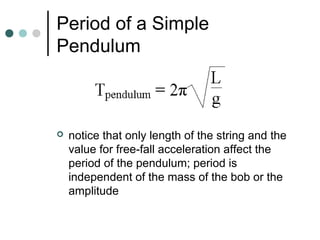
 notice that only length of the string and the
value for free-fall acceleration affect the
period of the pendulum; period is
independent of the mass of the bob or the
amplitude
Period of a Mass-Spring
System
 period of a mass-spring system depends on
mass and the spring constant
 notice that only the mass and the spring
constant affect the period of a spring; period
is independent of amplitude (only for
springs that obey Hooke’s Law)
Comparison of a Pendulum
and an Oscillating Spring

simple harmonic motion

  • 1.
  • 2.
    Simple Harmonic Motion simple harmonic motion (SHM) – vibration about an equilibrium position in which a restoring force is proportional to the displacement from equilibrium  two common types of SHM are a vibrating spring and an oscillating pendulum  springs can vibrate horizontally (on a frictionless surface) or vertically
  • 3.
  • 4.
    SHM and OscillatingSprings  in an oscillating spring, maximum velocity (with Felastic = 0) is experienced at the equilibrium point; as the spring moves away from the equilibrium point, the spring begins to exert a force that causes the velocity to decrease  the force exerted is maximum when the spring is at maximum displacement (either compressed or stretched)
  • 5.
    SHM and OscillatingSprings  at maximum displacement, the velocity is zero; since the spring is either stretched or compressed at this point, a force is again exerted to start the motion over again  in an ideal system, the mass-spring system would oscillate indefinitely
  • 6.
    SHM and OscillatingSprings  damping occurs when friction slows the motion of the vibrating mass, which causes the system to come to rest after a period of time  if we observe a mass-spring system over a short period of time, damping is minimal and we can assume an ideal mass-spring system
  • 7.
    SHM and OscillatingSprings  in a mass-spring system, the spring force is always trying to pull or push the mass back toward equilibrium; because of this, we call this force a restoring force  in SHM, the restoring force is proportional to the mass’ displacement; this results in all SHM to be a simple back-and-forth motion over the same path
  • 8.
    Hooke’s Law  in1678, Robert Hooke proposed this simple relationship between force and displacement; Hooke’s Law is described as: Felastic = -kx  where Felastic is the spring force,  k is the spring constant  x is the maximum displacement from equilibrium
  • 9.
    Hooke’s Law  thenegative sign shows us that the force is a restoring force, always moving the object back to its equilibrium position  the spring constant has units of Newtons/meter  the spring constant tells us how resistant a spring is to being compressed or stretched (how many Newtons of force are required to stretch or compress the spring 1 meter)  when stretched or compressed, a spring has potential energy
  • 10.
    Simple Pendulum  simplependulum – consists of a mass (called a bob) that is attached to a fixed string; we assume that the mass of the bob is concentrated at a point at the center of mass of the bob and the mass of the string is negligible; we also disregard friction and air resistance
  • 11.
  • 12.
    Simple Pendulum  forsmall amplitude angles (less than 15°), a pendulum exhibits SHM  at maximum displacement from equilibrium, a pendulum bob has maximum potential energy; at equilibrium, this PE has been converted to KE  amplitude – the displacement from equilibrium
  • 13.
    Period and Frequency period (T) – the time, in seconds, to execute one complete cycle of motion; units are seconds per 1 cycle  frequency (f) – the number of complete cycles of motion that occur in one second; units are cycles per 1 second (also called hertz)
  • 14.
    Period and Frequency frequency is the reciprocal of period, so  the period of a simple pendulum depends on the length of the string and the value for free-fall acceleration (in most cases, gravity)
  • 15.
    Period of aSimple Pendulum  notice that only length of the string and the value for free-fall acceleration affect the period of the pendulum; period is independent of the mass of the bob or the amplitude
  • 16.
    Period of aMass-Spring System  period of a mass-spring system depends on mass and the spring constant  notice that only the mass and the spring constant affect the period of a spring; period is independent of amplitude (only for springs that obey Hooke’s Law)
  • 17.
    Comparison of aPendulum and an Oscillating Spring