The Doppler Effect
™  According to Sheldon Cooper of the Big Bang Theory,
the Doppler effect is “the apparent change in the
frequency of a wave caused by relative motion between
the source of the wave and the observer.”
™  It affects any type of wave including light and sound.
™  The Doppler effect only applies when the motion is
directly towards or away between the source and the
observer.
The Doppler Effect
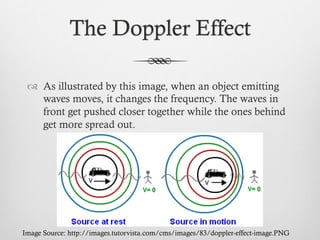
™  As illustrated by this image, when an object emitting
waves moves, it changes the frequency. The waves in
front get pushed closer together while the ones behind
get more spread out.
Image Source: http://images.tutorvista.com/cms/images/83/doppler-effect-image.PNG
The Doppler Effect
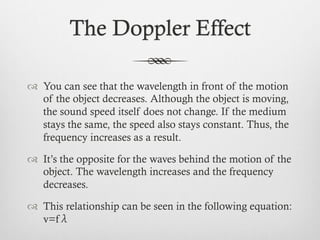
™  You can see that the wavelength in front of the motion
of the object decreases. Although the object is moving,
the sound speed itself does not change. If the medium
stays the same, the speed also stays constant. Thus, the
frequency increases as a result.
™  It’s the opposite for the waves behind the motion of the
object. The wavelength increases and the frequency
decreases.
™  This relationship can be seen in the following equation:
v=fλ
Equations
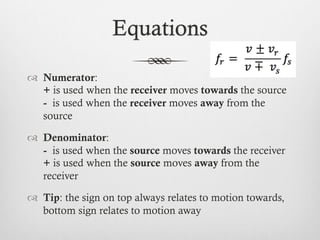
™  The relationship between the frequencies of the
receiver and the source of the waves is denoted by the
following equation where v is the speed of sound, vr is
the speed of the receiver, vs is the speed of the source
and fr and fs are the frequencies of the source and the
receiver respectively.
Equations
™  Numerator:
+ is used when the receiver moves towards the source
- is used when the receiver moves away from the
source
™  Denominator:
- is used when the source moves towards the receiver
+ is used when the source moves away from the
receiver
™  Tip: the sign on top always relates to motion towards,
bottom sign relates to motion away
Question
™  You robbed a bank and speed away in a car at 80 m/s.
A police car is chasing you from behind at 95 m/s. Its
siren, sounding at a frequency of 775 Hz, makes you
anxious. Make a prediction. Do you expect the
frequency you hear to be higher or lower? Calculate the
frequency will you hear due to the motion of the cars.
95 m/s
775 Hz 80 m/s
Image Source: http://fc05.deviantart.net/fs71/f/2012/088/2/8/bmw_car_chase_by_domino3d-d4ub8uw.jpg
Solution
™  You should expect to hear a higher frequency because
the motion of the police car is headed towards you,
pushing the wave fronts of sound closer together and
increasing the frequency that you’ll hear them at.
™  Looking at the question, you are given vr= 80 m/s,
vs= 95 m/s, and fs= 775 Hz, and you know the speed
of sound in air is 343 m/s. The easy part is plugging
them into the equation. Then you just have to decide
on whether to use + or – signs.
Solution
™  Since you are moving away from the police car, you
use a – sign in the numerator, and since the police car
is moving towards you, you use a – sign in the
denominator. Plugging in the numbers gives you:
™  So you get fr= 822 m/s, which is the frequency you
hear from the siren which is higher than 775 m/s as
predicted.
Question
™  You are standing beside a lake when suddenly a scary
looking goose comes running through the grass towards you
at a constant speed, honking angrily. You hear a frequency of
84.0 Hz. The goose as it turns out, is not mad at you, but
rather at the kid chasing its goslings, and runs straight
through your legs. After it passes, you hear a frequency of
56.0 Hz. What is the speed of the goose?
Image Source: http://hollypointassociation.org/a_angry_goose_400p.jpg
Solution
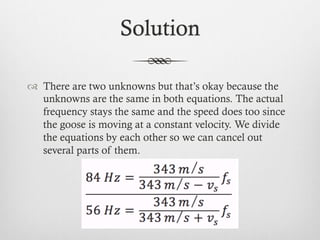
™  We know 2 frequencies: As the goose comes towards
us and as it goes away from us. So, we need to use 2
equations. We don’t know the actual frequency. With
what we know, these are the 2 equations we get:
™  We have a – in the 1st equation because the goose is
moving towards us, + in the 2nd because it moves away
Solution
™  There are two unknowns but that’s okay because the
unknowns are the same in both equations. The actual
frequency stays the same and the speed does too since
the goose is moving at a constant velocity. We divide
the equations by each other so we can cancel out
several parts of them.
Solution
™  84/56 is 3/2. fs and the 343 m/s in the numerator of
the top and the bottom equations cancel out leaving
you with:
Clarification
™  If you are confused about the previous slide, this is
where I will explain. If not, skip this slide.
™  These are equivalent to each other because when you
divide by a fraction, you simply multiply by the
reciprocal (flip the fraction). Since 343 m/s cancels
out, you are left with:
Solution
™  Cross multiply, distribute, gather the like terms on
separate sides to isolate the variable vs. Then solve for
vs.
™  Final answer: The goose was running at 68.6 m/s

The Doppler Effect

  • 2.
    The Doppler Effect ™ According to Sheldon Cooper of the Big Bang Theory, the Doppler effect is “the apparent change in the frequency of a wave caused by relative motion between the source of the wave and the observer.” ™  It affects any type of wave including light and sound. ™  The Doppler effect only applies when the motion is directly towards or away between the source and the observer.
  • 3.
    The Doppler Effect ™ As illustrated by this image, when an object emitting waves moves, it changes the frequency. The waves in front get pushed closer together while the ones behind get more spread out. Image Source: http://images.tutorvista.com/cms/images/83/doppler-effect-image.PNG
  • 4.
    The Doppler Effect ™ You can see that the wavelength in front of the motion of the object decreases. Although the object is moving, the sound speed itself does not change. If the medium stays the same, the speed also stays constant. Thus, the frequency increases as a result. ™  It’s the opposite for the waves behind the motion of the object. The wavelength increases and the frequency decreases. ™  This relationship can be seen in the following equation: v=fλ
  • 5.
    Equations ™  The relationshipbetween the frequencies of the receiver and the source of the waves is denoted by the following equation where v is the speed of sound, vr is the speed of the receiver, vs is the speed of the source and fr and fs are the frequencies of the source and the receiver respectively.
  • 6.
    Equations ™  Numerator: + isused when the receiver moves towards the source - is used when the receiver moves away from the source ™  Denominator: - is used when the source moves towards the receiver + is used when the source moves away from the receiver ™  Tip: the sign on top always relates to motion towards, bottom sign relates to motion away
  • 7.
    Question ™  You robbeda bank and speed away in a car at 80 m/s. A police car is chasing you from behind at 95 m/s. Its siren, sounding at a frequency of 775 Hz, makes you anxious. Make a prediction. Do you expect the frequency you hear to be higher or lower? Calculate the frequency will you hear due to the motion of the cars. 95 m/s 775 Hz 80 m/s Image Source: http://fc05.deviantart.net/fs71/f/2012/088/2/8/bmw_car_chase_by_domino3d-d4ub8uw.jpg
  • 8.
    Solution ™  You shouldexpect to hear a higher frequency because the motion of the police car is headed towards you, pushing the wave fronts of sound closer together and increasing the frequency that you’ll hear them at. ™  Looking at the question, you are given vr= 80 m/s, vs= 95 m/s, and fs= 775 Hz, and you know the speed of sound in air is 343 m/s. The easy part is plugging them into the equation. Then you just have to decide on whether to use + or – signs.
  • 9.
    Solution ™  Since youare moving away from the police car, you use a – sign in the numerator, and since the police car is moving towards you, you use a – sign in the denominator. Plugging in the numbers gives you: ™  So you get fr= 822 m/s, which is the frequency you hear from the siren which is higher than 775 m/s as predicted.
  • 10.
    Question ™  You arestanding beside a lake when suddenly a scary looking goose comes running through the grass towards you at a constant speed, honking angrily. You hear a frequency of 84.0 Hz. The goose as it turns out, is not mad at you, but rather at the kid chasing its goslings, and runs straight through your legs. After it passes, you hear a frequency of 56.0 Hz. What is the speed of the goose? Image Source: http://hollypointassociation.org/a_angry_goose_400p.jpg
  • 11.
    Solution ™  We know2 frequencies: As the goose comes towards us and as it goes away from us. So, we need to use 2 equations. We don’t know the actual frequency. With what we know, these are the 2 equations we get: ™  We have a – in the 1st equation because the goose is moving towards us, + in the 2nd because it moves away
  • 12.
    Solution ™  There aretwo unknowns but that’s okay because the unknowns are the same in both equations. The actual frequency stays the same and the speed does too since the goose is moving at a constant velocity. We divide the equations by each other so we can cancel out several parts of them.
  • 13.
    Solution ™  84/56 is3/2. fs and the 343 m/s in the numerator of the top and the bottom equations cancel out leaving you with:
  • 14.
    Clarification ™  If youare confused about the previous slide, this is where I will explain. If not, skip this slide. ™  These are equivalent to each other because when you divide by a fraction, you simply multiply by the reciprocal (flip the fraction). Since 343 m/s cancels out, you are left with:
  • 15.
    Solution ™  Cross multiply,distribute, gather the like terms on separate sides to isolate the variable vs. Then solve for vs. ™  Final answer: The goose was running at 68.6 m/s