IntroductionKey featuresApplicationsSimple Harmonic Motion
Simple Harmonic Motion is a type of periodic or oscillatory motionThe object moves back and forth over the same path, like a mass on a spring or a pendulumWe’re interested in it because we can use it to generalise about and predict the behaviour of a variety of repetitive motionsWhat is SHM?
Period is the time taken for the motion to repeat one cycleFrequency is the number of cycles in a secondExample: a cork bobbing on water is observed to move up and down twelve times in one minute. Find the frequency and the periodT = 60/12 = 5.7s		f = 1/T = 1/5.7 = 0.18HzDefinitions and vocabulary – 1
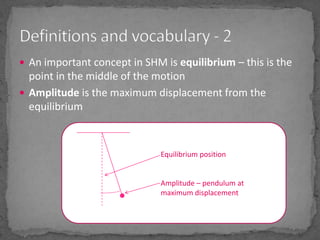
An important concept in SHM is equilibrium – this is the point in the middle of the motionAmplitude is the maximum displacement from the equilibriumDefinitions and vocabulary - 2Equilibrium positionAmplitude – pendulum at maximum displacement
In SHM, we consider displacement, velocity, acceleration, force and energyDefinitions and vocabulary - 3
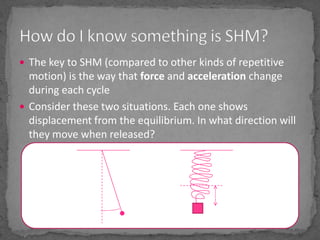
The key to SHM (compared to other kinds of repetitive motion) is the way that force and acceleration change during each cycleConsider these two situations. Each one shows displacement from the equilibrium. In what direction will they move when released?How do I know something is SHM?
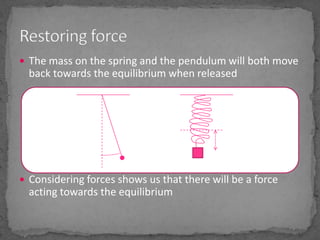
The mass on the spring and the pendulum will both move back towards the equilibrium when releasedConsidering forces shows us that there will be a force acting towards the equilibriumRestoring force
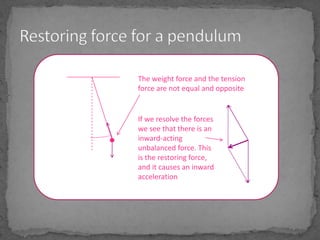
Restoring force for a pendulumThe weight force and the tension force are not equal and oppositeIf we resolve the forces we see that there is an inward-acting unbalanced force. This is the restoring force, and it causes an inward acceleration
For motion to be Simple Harmonic Motion:there must be a restoring force acting towards the equilibriumthe force is larger when the displacement is larger, and is a maximum at maximum displacementthe force is zero at the equilibrium positionRestoring force
We can also state the conditions for SHM using accelerationFor motion to be Simple Harmonic Motion:The acceleration is directly proportional to the displacement from the equilibrium positionThe acceleration is always directed towards the equilibrium positionAcceleration
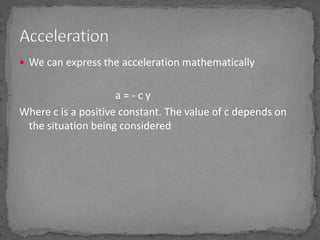
We can express the acceleration mathematically			a = - c yWhere c is a positive constant. The value of c depends on the situation being consideredAcceleration
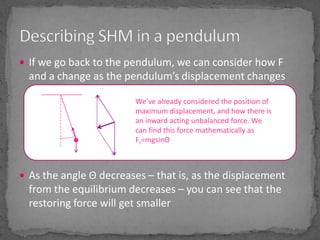
If we go back to the pendulum, we can consider how F and a change as the pendulum’s displacement changesAs the angle Θ decreases – that is, as the displacement from the equilibrium decreases – you can see that the restoring force will get smallerDescribing SHM in a pendulumWe’ve already considered the position of maximum displacement, and how there is an inward acting unbalanced force. We can find this force mathematically as Fr=mgsinΘ
Since we know that the restoring force is unbalanced, we know, via Newton’s First Law, that there will be acceleration. If the force gets smaller as the displacement gets closer to equilibrium, the acceleration must get smaller tooAt equilibrium, the weight force and the tension force are balanced, so the restoring force is zero and so, therefore, is the accelerationDescribing SHM in a pendulum

Simple harmonic motion

  • 1.
  • 2.
    Simple Harmonic Motionis a type of periodic or oscillatory motionThe object moves back and forth over the same path, like a mass on a spring or a pendulumWe’re interested in it because we can use it to generalise about and predict the behaviour of a variety of repetitive motionsWhat is SHM?
  • 3.
    Period is thetime taken for the motion to repeat one cycleFrequency is the number of cycles in a secondExample: a cork bobbing on water is observed to move up and down twelve times in one minute. Find the frequency and the periodT = 60/12 = 5.7s f = 1/T = 1/5.7 = 0.18HzDefinitions and vocabulary – 1
  • 4.
    An important conceptin SHM is equilibrium – this is the point in the middle of the motionAmplitude is the maximum displacement from the equilibriumDefinitions and vocabulary - 2Equilibrium positionAmplitude – pendulum at maximum displacement
  • 5.
    In SHM, weconsider displacement, velocity, acceleration, force and energyDefinitions and vocabulary - 3
  • 6.
    The key toSHM (compared to other kinds of repetitive motion) is the way that force and acceleration change during each cycleConsider these two situations. Each one shows displacement from the equilibrium. In what direction will they move when released?How do I know something is SHM?
  • 7.
    The mass onthe spring and the pendulum will both move back towards the equilibrium when releasedConsidering forces shows us that there will be a force acting towards the equilibriumRestoring force
  • 8.
    Restoring force fora pendulumThe weight force and the tension force are not equal and oppositeIf we resolve the forces we see that there is an inward-acting unbalanced force. This is the restoring force, and it causes an inward acceleration
  • 9.
    For motion tobe Simple Harmonic Motion:there must be a restoring force acting towards the equilibriumthe force is larger when the displacement is larger, and is a maximum at maximum displacementthe force is zero at the equilibrium positionRestoring force
  • 10.
    We can alsostate the conditions for SHM using accelerationFor motion to be Simple Harmonic Motion:The acceleration is directly proportional to the displacement from the equilibrium positionThe acceleration is always directed towards the equilibrium positionAcceleration
  • 11.
    We can expressthe acceleration mathematically a = - c yWhere c is a positive constant. The value of c depends on the situation being consideredAcceleration
  • 12.
    If we goback to the pendulum, we can consider how F and a change as the pendulum’s displacement changesAs the angle Θ decreases – that is, as the displacement from the equilibrium decreases – you can see that the restoring force will get smallerDescribing SHM in a pendulumWe’ve already considered the position of maximum displacement, and how there is an inward acting unbalanced force. We can find this force mathematically as Fr=mgsinΘ
  • 13.
    Since we knowthat the restoring force is unbalanced, we know, via Newton’s First Law, that there will be acceleration. If the force gets smaller as the displacement gets closer to equilibrium, the acceleration must get smaller tooAt equilibrium, the weight force and the tension force are balanced, so the restoring force is zero and so, therefore, is the accelerationDescribing SHM in a pendulum

Editor's Notes

  • #11 Since we know that unbalanced forces cause acceleration, we can also state the conditions for SHM using acceleration – and, in fact, this is usually how they are stated