University Physics with Modern Physics
Fifteenth Edition, Global Edition, in SI Units
Chapter 14
Periodic Motion
Copyright © 2020 Pearson Education Ltd. All Rights Reserved
Learning Outcomes
In this chapter, you’ll learn…
• how to describe oscillations in terms of amplitude, period,
frequency, and angular frequency.
• how to apply the ideas of simple harmonic motion to
different physical situations.
• how to analyze the motions of a pendulum.
• what determines how rapidly an oscillation dies out.
• how a driving force applied to an oscillator at a particular
frequency can cause a very large response, or resonance.
Copyright © 2020 Pearson Education Ltd. All Rights Reserved
Introduction
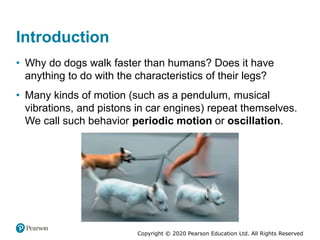
• Why do dogs walk faster than humans? Does it have
anything to do with the characteristics of their legs?
• Many kinds of motion (such as a pendulum, musical
vibrations, and pistons in car engines) repeat themselves.
We call such behavior periodic motion or oscillation.
Copyright © 2020 Pearson Education Ltd. All Rights Reserved
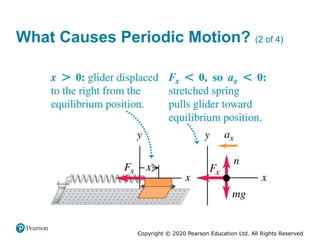
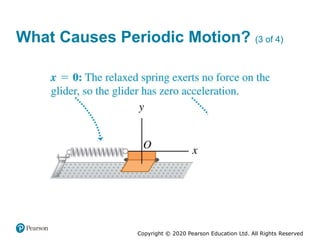
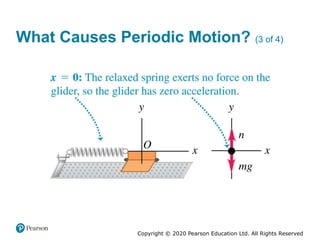
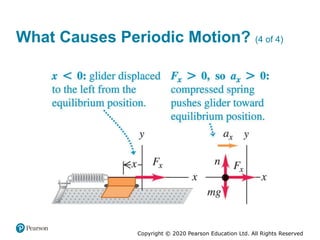
What Causes Periodic Motion? (1 of 4)
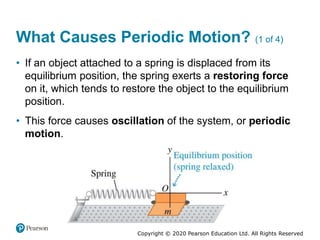
• If an object attached to a spring is displaced from its
equilibrium position, the spring exerts a restoring force
on it, which tends to restore the object to the equilibrium
position.
• This force causes oscillation of the system, or periodic
motion.
Copyright © 2020 Pearson Education Ltd. All Rights Reserved
What Causes Periodic Motion? (2 of 4)
Copyright © 2020 Pearson Education Ltd. All Rights Reserved
What Causes Periodic Motion? (3 of 4)
Copyright © 2020 Pearson Education Ltd. All Rights Reserved
What Causes Periodic Motion? (3 of 4)
Copyright © 2020 Pearson Education Ltd. All Rights Reserved
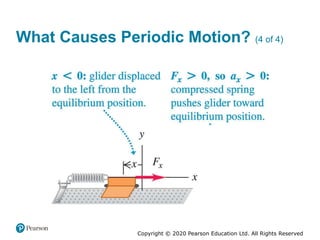
What Causes Periodic Motion? (4 of 4)
Copyright © 2020 Pearson Education Ltd. All Rights Reserved
What Causes Periodic Motion? (4 of 4)
Copyright © 2020 Pearson Education Ltd. All Rights Reserved
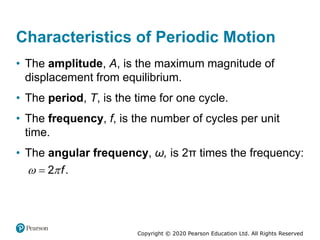
Characteristics of Periodic Motion
• The amplitude, A, is the maximum magnitude of
displacement from equilibrium.
• The period, T, is the time for one cycle.
• The frequency, f, is the number of cycles per unit
time.
• The angular frequency, ω, is 2π times the frequency:
2 .
f
 

Copyright © 2020 Pearson Education Ltd. All Rights Reserved
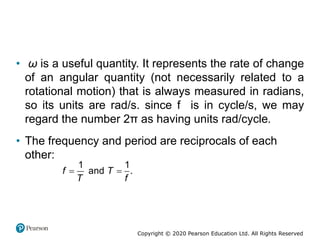
• ω is a useful quantity. It represents the rate of change
of an angular quantity (not necessarily related to a
rotational motion) that is always measured in radians,
so its units are rad/s. since f is in cycle/s, we may
regard the number 2π as having units rad/cycle.
• The frequency and period are reciprocals of each
other:
 
1 1
and .
f T
T f
Copyright © 2020 Pearson Education Ltd. All Rights Reserved
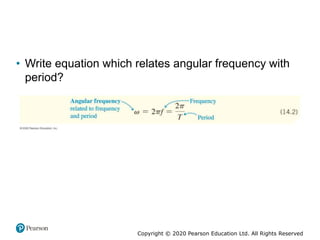
• Write equation which relates angular frequency with
period?
Copyright © 2020 Pearson Education Ltd. All Rights Reserved
• Write equation which relates angular frequency with
period?
Copyright © 2020 Pearson Education Ltd. All Rights Reserved
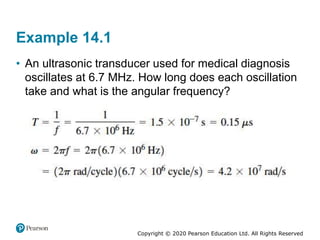
Example 14.1
• An ultrasonic transducer used for medical diagnosis
oscillates at 6.7 MHz. How long does each oscillation
take and what is the angular frequency?
Copyright © 2020 Pearson Education Ltd. All Rights Reserved
Example 14.1
• An ultrasonic transducer used for medical diagnosis
oscillates at 6.7 MHz. How long does each oscillation
take and what is the angular frequency?
Copyright © 2020 Pearson Education Ltd. All Rights Reserved
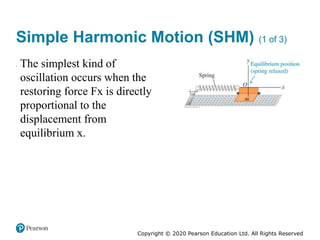
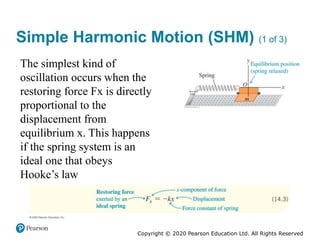
Simple Harmonic Motion (SHM) (1 of 3)
• The simplest kind of
oscillation occurs when the
restoring force Fx is directly
proportional to the
displacement from
equilibrium x.
Copyright © 2020 Pearson Education Ltd. All Rights Reserved
Simple Harmonic Motion (SHM) (1 of 3)
• The simplest kind of
oscillation occurs when the
restoring force Fx is directly
proportional to the
displacement from
equilibrium x. This happens
if the spring system is an
ideal one that obeys
Hooke’s law
Copyright © 2020 Pearson Education Ltd. All Rights Reserved
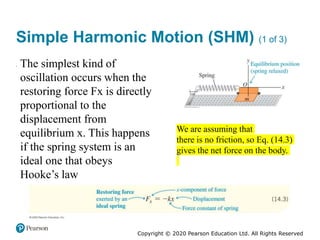
Simple Harmonic Motion (SHM) (1 of 3)
• The simplest kind of
oscillation occurs when the
restoring force Fx is directly
proportional to the
displacement from
equilibrium x. This happens
if the spring system is an
ideal one that obeys
Hooke’s law
We are assuming that
there is no friction, so Eq. (14.3)
gives the net force on the body.
Copyright © 2020 Pearson Education Ltd. All Rights Reserved
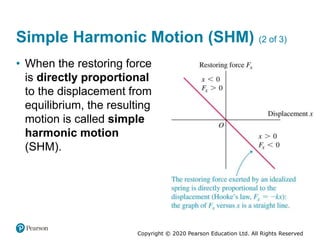
Simple Harmonic Motion (SHM) (2 of 3)
• When the restoring force
is directly proportional
to the displacement from
equilibrium, the resulting
motion is called simple
harmonic motion
(SHM).
Copyright © 2020 Pearson Education Ltd. All Rights Reserved
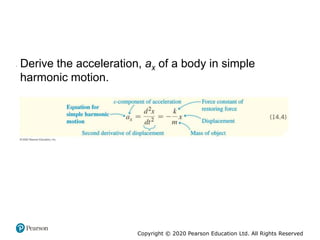
• Derive the acceleration, ax of a body in simple
harmonic motion.
Copyright © 2020 Pearson Education Ltd. All Rights Reserved
• Derive the acceleration, ax of a body in simple
harmonic motion.
Copyright © 2020 Pearson Education Ltd. All Rights Reserved
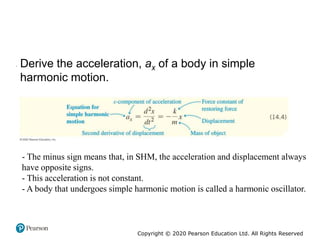
• Derive the acceleration, ax of a body in simple
harmonic motion.
- The minus sign means that, in SHM, the acceleration and displacement always
have opposite signs.
- This acceleration is not constant.
- A body that undergoes simple harmonic motion is called a harmonic oscillator.
Copyright © 2020 Pearson Education Ltd. All Rights Reserved
Simple Harmonic Motion (SHM) (3 of 3)
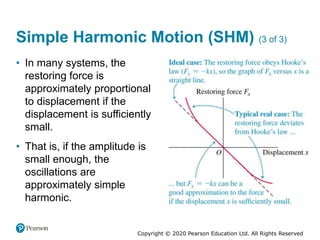
• In many systems, the
restoring force is
approximately proportional
to displacement if the
displacement is sufficiently
small.
• That is, if the amplitude is
small enough, the
oscillations are
approximately simple
harmonic.
Copyright © 2020 Pearson Education Ltd. All Rights Reserved
Why is simple harmonic motion
important?
 Not all periodic motions are simple harmonic; in periodic motion in general,
the restoring force depends on displacement in a more complicated way than in
Eq. (14.3).
 But in many systems the restoring force is approximately proportional to
displacement if the displacement is sufficiently small. That is, if the amplitude
is small enough, the oscillations of such systems are approximately simple
harmonic and therefore approximately described by Eq. (14.4).
 Thus we can use SHM as an approximate model for many different periodic
motions:
 such as the vibration of a tuning fork,
 the electric current in an alternating-current circuit,
 the oscillations of atoms in molecules and solids.
Copyright © 2020 Pearson Education Ltd. All Rights Reserved
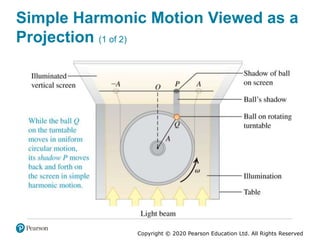
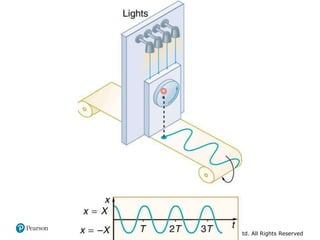
Simple Harmonic Motion Viewed as a
Projection (1 of 2)
Copyright © 2020 Pearson Education Ltd. All Rights Reserved
Simple Harmonic Motion Viewed as a
Projection (2 of 2)
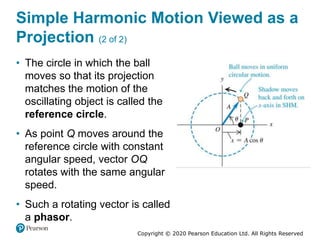
• The circle in which the ball
moves so that its projection
matches the motion of the
oscillating object is called the
reference circle.
• As point Q moves around the
reference circle with constant
angular speed, vector OQ
rotates with the same angular
speed.
• Such a rotating vector is called
a phasor.
Copyright © 2020 Pearson Education Ltd. All Rights Reserved
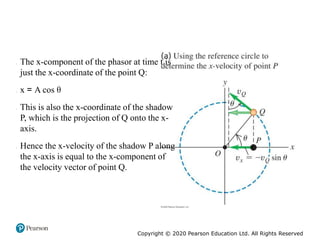
• The x-component of the phasor at time t is
just the x-coordinate of the point Q:
• x = A cos θ
• This is also the x-coordinate of the shadow
P, which is the projection of Q onto the x-
axis.
• Hence the x-velocity of the shadow P along
the x-axis is equal to the x-component of
the velocity vector of point Q.
Copyright © 2020 Pearson Education Ltd. All Rights Reserved
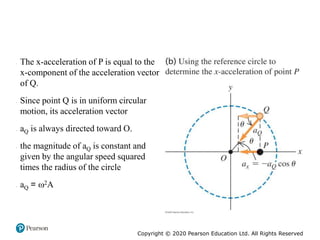
• The x-acceleration of P is equal to the
x-component of the acceleration vector
of Q.
• Since point Q is in uniform circular
motion, its acceleration vector
• aQ is always directed toward O.
• the magnitude of aQ is constant and
given by the angular speed squared
times the radius of the circle
• aQ = 2A
Copyright © 2020 Pearson Education Ltd. All Rights Reserved
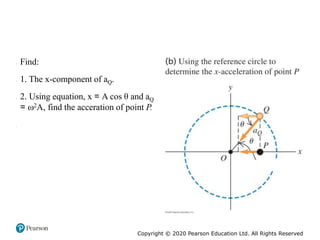
• Find:
• 1. The x-component of aQ.
• 2. Using equation, x = A cos θ and aQ
= 2A, find the acceration of point P.
•
Copyright © 2020 Pearson Education Ltd. All Rights Reserved
Characteristics of SHM (1 of 2)
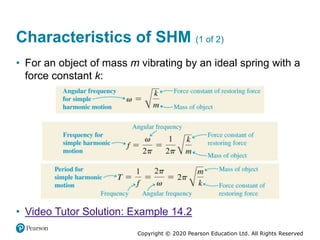
• For an object of mass m vibrating by an ideal spring with a
force constant k:
• Video Tutor Solution: Example 14.2
Copyright © 2020 Pearson Education Ltd. All Rights Reserved
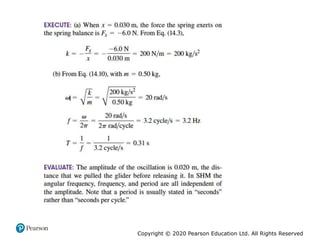
Example 14.2
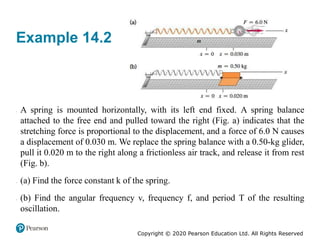
• A spring is mounted horizontally, with its left end fixed. A spring balance
attached to the free end and pulled toward the right (Fig. a) indicates that the
stretching force is proportional to the displacement, and a force of 6.0 N causes
a displacement of 0.030 m. We replace the spring balance with a 0.50-kg glider,
pull it 0.020 m to the right along a frictionless air track, and release it from rest
(Fig. b).
• (a) Find the force constant k of the spring.
• (b) Find the angular frequency v, frequency f, and period T of the resulting
oscillation.
Copyright © 2020 Pearson Education Ltd. All Rights Reserved
Characteristics of SHM (2 of 2)
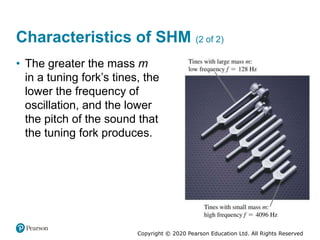
• The greater the mass m
in a tuning fork’s tines, the
lower the frequency of
oscillation, and the lower
the pitch of the sound that
the tuning fork produces.
Copyright © 2020 Pearson Education Ltd. All Rights Reserved
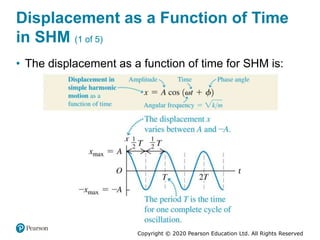
Displacement as a Function of Time
in SHM (1 of 5)
• The displacement as a function of time for SHM is:
Copyright © 2020 Pearson Education Ltd. All Rights Reserved
Displacement as a Function of Time
in SHM (2 of 5)
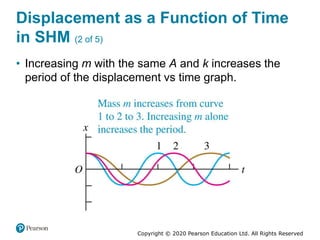
• Increasing m with the same A and k increases the
period of the displacement vs time graph.
Copyright © 2020 Pearson Education Ltd. All Rights Reserved
Displacement as a Function of Time
in SHM (3 of 5)
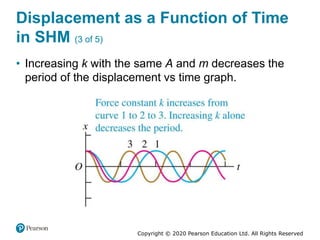
• Increasing k with the same A and m decreases the
period of the displacement vs time graph.
Copyright © 2020 Pearson Education Ltd. All Rights Reserved
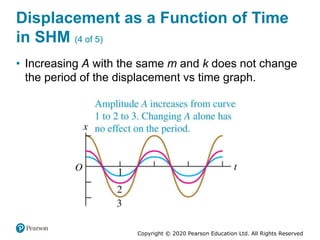
Displacement as a Function of Time
in SHM (4 of 5)
• Increasing A with the same m and k does not change
the period of the displacement vs time graph.
Copyright © 2020 Pearson Education Ltd. All Rights Reserved
Displacement as a Function of Time
in SHM (5 of 5)
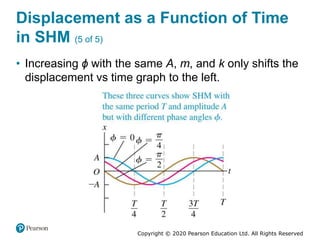
• Increasing ϕ with the same A, m, and k only shifts the
displacement vs time graph to the left.
Copyright © 2020 Pearson Education Ltd. All Rights Reserved
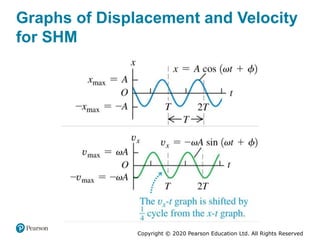
Graphs of Displacement and Velocity
for SHM
Copyright © 2020 Pearson Education Ltd. All Rights Reserved
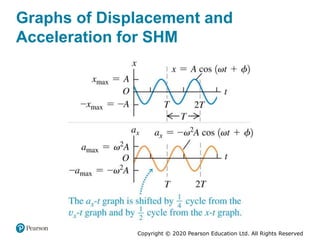
Graphs of Displacement and
Acceleration for SHM
Copyright © 2020 Pearson Education Ltd. All Rights Reserved
Energy in SHM
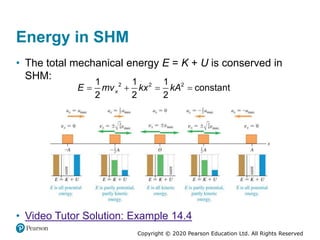
• The total mechanical energy E = K + U is conserved in
SHM:
2 2 2
1 1 1
constant
2 2 2
x
E mv kx kA
   
• Video Tutor Solution: Example 14.4
Copyright © 2020 Pearson Education Ltd. All Rights Reserved
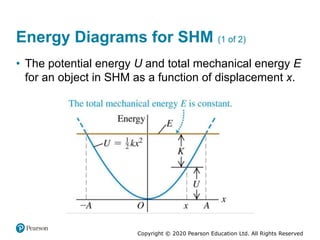
Energy Diagrams for SHM (1 of 2)
• The potential energy U and total mechanical energy E
for an object in SHM as a function of displacement x.
Copyright © 2020 Pearson Education Ltd. All Rights Reserved
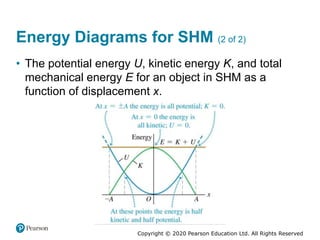
Energy Diagrams for SHM (2 of 2)
• The potential energy U, kinetic energy K, and total
mechanical energy E for an object in SHM as a
function of displacement x.
Copyright © 2020 Pearson Education Ltd. All Rights Reserved
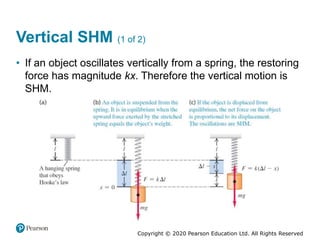
Vertical SHM (1 of 2)
• If an object oscillates vertically from a spring, the restoring
force has magnitude kx. Therefore the vertical motion is
SHM.
Copyright © 2020 Pearson Education Ltd. All Rights Reserved
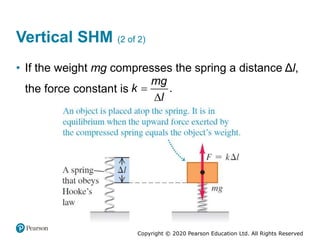
Vertical SHM (2 of 2)
• If the weight mg compresses the spring a distance Δl,
the force constant is 

.
mg
k
l
Copyright © 2020 Pearson Education Ltd. All Rights Reserved
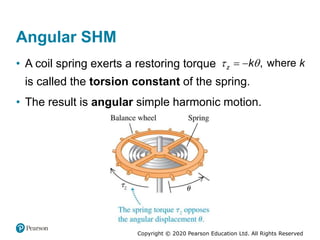
Angular SHM
• A coil spring exerts a restoring torque , where
z k k
 
 
is called the torsion constant of the spring.
• The result is angular simple harmonic motion.
Copyright © 2020 Pearson Education Ltd. All Rights Reserved
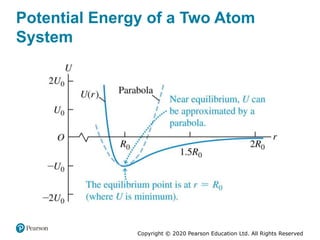
Potential Energy of a Two Atom
System
Copyright © 2020 Pearson Education Ltd. All Rights Reserved
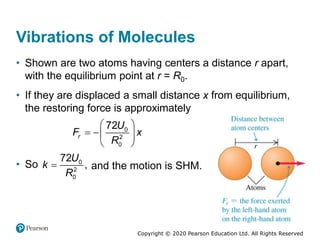
Vibrations of Molecules
• Shown are two atoms having centers a distance r apart,
with the equilibrium point at r = R0.
• If they are displaced a small distance x from equilibrium,
the restoring force is approximately
 
  
 
0
2
0
72
r
U
F x
R
• So  0
2
0
72
,
U
k
R
and the motion is SHM.
Copyright © 2020 Pearson Education Ltd. All Rights Reserved
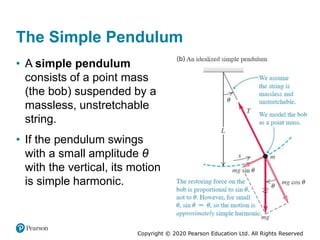
The Simple Pendulum
• A simple pendulum
consists of a point mass
(the bob) suspended by a
massless, unstretchable
string.
• If the pendulum swings
with a small amplitude θ
with the vertical, its motion
is simple harmonic.
Copyright © 2020 Pearson Education Ltd. All Rights Reserved
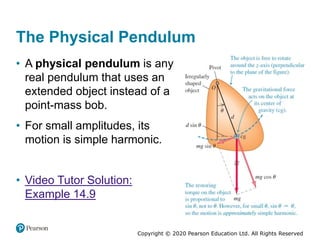
The Physical Pendulum
• A physical pendulum is any
real pendulum that uses an
extended object instead of a
point-mass bob.
• For small amplitudes, its
motion is simple harmonic.
• Video Tutor Solution:
Example 14.9
Copyright © 2020 Pearson Education Ltd. All Rights Reserved
Tyrannosaurus Rex and the Physical
Pendulum
• We can model the leg of Tyrannosaurus rex as a
physical pendulum.
Copyright © 2020 Pearson Education Ltd. All Rights Reserved
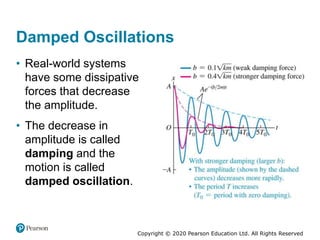
Damped Oscillations
• Real-world systems
have some dissipative
forces that decrease
the amplitude.
• The decrease in
amplitude is called
damping and the
motion is called
damped oscillation.
Copyright © 2020 Pearson Education Ltd. All Rights Reserved
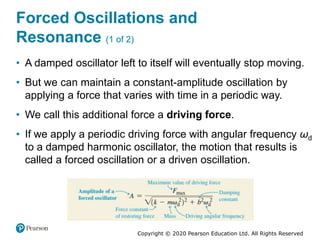
Forced Oscillations and
Resonance (1 of 2)
• A damped oscillator left to itself will eventually stop moving.
• But we can maintain a constant-amplitude oscillation by
applying a force that varies with time in a periodic way.
• We call this additional force a driving force.
• If we apply a periodic driving force with angular frequency ωd
to a damped harmonic oscillator, the motion that results is
called a forced oscillation or a driven oscillation.
Copyright © 2020 Pearson Education Ltd. All Rights Reserved
Forced Oscillations and
Resonance (2 of 2)
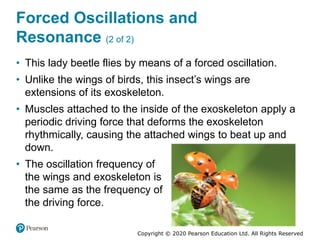
• This lady beetle flies by means of a forced oscillation.
• Unlike the wings of birds, this insect’s wings are
extensions of its exoskeleton.
• Muscles attached to the inside of the exoskeleton apply a
periodic driving force that deforms the exoskeleton
rhythmically, causing the attached wings to beat up and
down.
• The oscillation frequency of
the wings and exoskeleton is
the same as the frequency of
the driving force.

YF15e_CH14_ADA_PPT_LectureOutline (1).pptx

  • 1.
    University Physics withModern Physics Fifteenth Edition, Global Edition, in SI Units Chapter 14 Periodic Motion Copyright © 2020 Pearson Education Ltd. All Rights Reserved
  • 2.
    Copyright © 2020Pearson Education Ltd. All Rights Reserved Learning Outcomes In this chapter, you’ll learn… • how to describe oscillations in terms of amplitude, period, frequency, and angular frequency. • how to apply the ideas of simple harmonic motion to different physical situations. • how to analyze the motions of a pendulum. • what determines how rapidly an oscillation dies out. • how a driving force applied to an oscillator at a particular frequency can cause a very large response, or resonance.
  • 3.
    Copyright © 2020Pearson Education Ltd. All Rights Reserved Introduction • Why do dogs walk faster than humans? Does it have anything to do with the characteristics of their legs? • Many kinds of motion (such as a pendulum, musical vibrations, and pistons in car engines) repeat themselves. We call such behavior periodic motion or oscillation.
  • 4.
    Copyright © 2020Pearson Education Ltd. All Rights Reserved What Causes Periodic Motion? (1 of 4) • If an object attached to a spring is displaced from its equilibrium position, the spring exerts a restoring force on it, which tends to restore the object to the equilibrium position. • This force causes oscillation of the system, or periodic motion.
  • 5.
    Copyright © 2020Pearson Education Ltd. All Rights Reserved What Causes Periodic Motion? (2 of 4)
  • 6.
    Copyright © 2020Pearson Education Ltd. All Rights Reserved What Causes Periodic Motion? (3 of 4)
  • 7.
    Copyright © 2020Pearson Education Ltd. All Rights Reserved What Causes Periodic Motion? (3 of 4)
  • 8.
    Copyright © 2020Pearson Education Ltd. All Rights Reserved What Causes Periodic Motion? (4 of 4)
  • 9.
    Copyright © 2020Pearson Education Ltd. All Rights Reserved What Causes Periodic Motion? (4 of 4)
  • 10.
    Copyright © 2020Pearson Education Ltd. All Rights Reserved Characteristics of Periodic Motion • The amplitude, A, is the maximum magnitude of displacement from equilibrium. • The period, T, is the time for one cycle. • The frequency, f, is the number of cycles per unit time. • The angular frequency, ω, is 2π times the frequency: 2 . f   
  • 11.
    Copyright © 2020Pearson Education Ltd. All Rights Reserved • ω is a useful quantity. It represents the rate of change of an angular quantity (not necessarily related to a rotational motion) that is always measured in radians, so its units are rad/s. since f is in cycle/s, we may regard the number 2π as having units rad/cycle. • The frequency and period are reciprocals of each other:   1 1 and . f T T f
  • 12.
    Copyright © 2020Pearson Education Ltd. All Rights Reserved • Write equation which relates angular frequency with period?
  • 13.
    Copyright © 2020Pearson Education Ltd. All Rights Reserved • Write equation which relates angular frequency with period?
  • 14.
    Copyright © 2020Pearson Education Ltd. All Rights Reserved Example 14.1 • An ultrasonic transducer used for medical diagnosis oscillates at 6.7 MHz. How long does each oscillation take and what is the angular frequency?
  • 15.
    Copyright © 2020Pearson Education Ltd. All Rights Reserved Example 14.1 • An ultrasonic transducer used for medical diagnosis oscillates at 6.7 MHz. How long does each oscillation take and what is the angular frequency?
  • 16.
    Copyright © 2020Pearson Education Ltd. All Rights Reserved Simple Harmonic Motion (SHM) (1 of 3) • The simplest kind of oscillation occurs when the restoring force Fx is directly proportional to the displacement from equilibrium x.
  • 17.
    Copyright © 2020Pearson Education Ltd. All Rights Reserved Simple Harmonic Motion (SHM) (1 of 3) • The simplest kind of oscillation occurs when the restoring force Fx is directly proportional to the displacement from equilibrium x. This happens if the spring system is an ideal one that obeys Hooke’s law
  • 18.
    Copyright © 2020Pearson Education Ltd. All Rights Reserved Simple Harmonic Motion (SHM) (1 of 3) • The simplest kind of oscillation occurs when the restoring force Fx is directly proportional to the displacement from equilibrium x. This happens if the spring system is an ideal one that obeys Hooke’s law We are assuming that there is no friction, so Eq. (14.3) gives the net force on the body.
  • 19.
    Copyright © 2020Pearson Education Ltd. All Rights Reserved Simple Harmonic Motion (SHM) (2 of 3) • When the restoring force is directly proportional to the displacement from equilibrium, the resulting motion is called simple harmonic motion (SHM).
  • 20.
    Copyright © 2020Pearson Education Ltd. All Rights Reserved • Derive the acceleration, ax of a body in simple harmonic motion.
  • 21.
    Copyright © 2020Pearson Education Ltd. All Rights Reserved • Derive the acceleration, ax of a body in simple harmonic motion.
  • 22.
    Copyright © 2020Pearson Education Ltd. All Rights Reserved • Derive the acceleration, ax of a body in simple harmonic motion. - The minus sign means that, in SHM, the acceleration and displacement always have opposite signs. - This acceleration is not constant. - A body that undergoes simple harmonic motion is called a harmonic oscillator.
  • 23.
    Copyright © 2020Pearson Education Ltd. All Rights Reserved Simple Harmonic Motion (SHM) (3 of 3) • In many systems, the restoring force is approximately proportional to displacement if the displacement is sufficiently small. • That is, if the amplitude is small enough, the oscillations are approximately simple harmonic.
  • 24.
    Copyright © 2020Pearson Education Ltd. All Rights Reserved Why is simple harmonic motion important?  Not all periodic motions are simple harmonic; in periodic motion in general, the restoring force depends on displacement in a more complicated way than in Eq. (14.3).  But in many systems the restoring force is approximately proportional to displacement if the displacement is sufficiently small. That is, if the amplitude is small enough, the oscillations of such systems are approximately simple harmonic and therefore approximately described by Eq. (14.4).  Thus we can use SHM as an approximate model for many different periodic motions:  such as the vibration of a tuning fork,  the electric current in an alternating-current circuit,  the oscillations of atoms in molecules and solids.
  • 25.
    Copyright © 2020Pearson Education Ltd. All Rights Reserved Simple Harmonic Motion Viewed as a Projection (1 of 2)
  • 26.
    Copyright © 2020Pearson Education Ltd. All Rights Reserved
  • 27.
    Copyright © 2020Pearson Education Ltd. All Rights Reserved Simple Harmonic Motion Viewed as a Projection (2 of 2) • The circle in which the ball moves so that its projection matches the motion of the oscillating object is called the reference circle. • As point Q moves around the reference circle with constant angular speed, vector OQ rotates with the same angular speed. • Such a rotating vector is called a phasor.
  • 28.
    Copyright © 2020Pearson Education Ltd. All Rights Reserved • The x-component of the phasor at time t is just the x-coordinate of the point Q: • x = A cos θ • This is also the x-coordinate of the shadow P, which is the projection of Q onto the x- axis. • Hence the x-velocity of the shadow P along the x-axis is equal to the x-component of the velocity vector of point Q.
  • 29.
    Copyright © 2020Pearson Education Ltd. All Rights Reserved • The x-acceleration of P is equal to the x-component of the acceleration vector of Q. • Since point Q is in uniform circular motion, its acceleration vector • aQ is always directed toward O. • the magnitude of aQ is constant and given by the angular speed squared times the radius of the circle • aQ = 2A
  • 30.
    Copyright © 2020Pearson Education Ltd. All Rights Reserved • Find: • 1. The x-component of aQ. • 2. Using equation, x = A cos θ and aQ = 2A, find the acceration of point P. •
  • 31.
    Copyright © 2020Pearson Education Ltd. All Rights Reserved Characteristics of SHM (1 of 2) • For an object of mass m vibrating by an ideal spring with a force constant k: • Video Tutor Solution: Example 14.2
  • 32.
    Copyright © 2020Pearson Education Ltd. All Rights Reserved Example 14.2 • A spring is mounted horizontally, with its left end fixed. A spring balance attached to the free end and pulled toward the right (Fig. a) indicates that the stretching force is proportional to the displacement, and a force of 6.0 N causes a displacement of 0.030 m. We replace the spring balance with a 0.50-kg glider, pull it 0.020 m to the right along a frictionless air track, and release it from rest (Fig. b). • (a) Find the force constant k of the spring. • (b) Find the angular frequency v, frequency f, and period T of the resulting oscillation.
  • 33.
    Copyright © 2020Pearson Education Ltd. All Rights Reserved
  • 34.
    Copyright © 2020Pearson Education Ltd. All Rights Reserved
  • 35.
    Copyright © 2020Pearson Education Ltd. All Rights Reserved Characteristics of SHM (2 of 2) • The greater the mass m in a tuning fork’s tines, the lower the frequency of oscillation, and the lower the pitch of the sound that the tuning fork produces.
  • 36.
    Copyright © 2020Pearson Education Ltd. All Rights Reserved
  • 37.
    Copyright © 2020Pearson Education Ltd. All Rights Reserved Displacement as a Function of Time in SHM (1 of 5) • The displacement as a function of time for SHM is:
  • 38.
    Copyright © 2020Pearson Education Ltd. All Rights Reserved Displacement as a Function of Time in SHM (2 of 5) • Increasing m with the same A and k increases the period of the displacement vs time graph.
  • 39.
    Copyright © 2020Pearson Education Ltd. All Rights Reserved Displacement as a Function of Time in SHM (3 of 5) • Increasing k with the same A and m decreases the period of the displacement vs time graph.
  • 40.
    Copyright © 2020Pearson Education Ltd. All Rights Reserved Displacement as a Function of Time in SHM (4 of 5) • Increasing A with the same m and k does not change the period of the displacement vs time graph.
  • 41.
    Copyright © 2020Pearson Education Ltd. All Rights Reserved Displacement as a Function of Time in SHM (5 of 5) • Increasing ϕ with the same A, m, and k only shifts the displacement vs time graph to the left.
  • 42.
    Copyright © 2020Pearson Education Ltd. All Rights Reserved Graphs of Displacement and Velocity for SHM
  • 43.
    Copyright © 2020Pearson Education Ltd. All Rights Reserved Graphs of Displacement and Acceleration for SHM
  • 44.
    Copyright © 2020Pearson Education Ltd. All Rights Reserved Energy in SHM • The total mechanical energy E = K + U is conserved in SHM: 2 2 2 1 1 1 constant 2 2 2 x E mv kx kA     • Video Tutor Solution: Example 14.4
  • 45.
    Copyright © 2020Pearson Education Ltd. All Rights Reserved Energy Diagrams for SHM (1 of 2) • The potential energy U and total mechanical energy E for an object in SHM as a function of displacement x.
  • 46.
    Copyright © 2020Pearson Education Ltd. All Rights Reserved Energy Diagrams for SHM (2 of 2) • The potential energy U, kinetic energy K, and total mechanical energy E for an object in SHM as a function of displacement x.
  • 47.
    Copyright © 2020Pearson Education Ltd. All Rights Reserved Vertical SHM (1 of 2) • If an object oscillates vertically from a spring, the restoring force has magnitude kx. Therefore the vertical motion is SHM.
  • 48.
    Copyright © 2020Pearson Education Ltd. All Rights Reserved Vertical SHM (2 of 2) • If the weight mg compresses the spring a distance Δl, the force constant is   . mg k l
  • 49.
    Copyright © 2020Pearson Education Ltd. All Rights Reserved Angular SHM • A coil spring exerts a restoring torque , where z k k     is called the torsion constant of the spring. • The result is angular simple harmonic motion.
  • 50.
    Copyright © 2020Pearson Education Ltd. All Rights Reserved Potential Energy of a Two Atom System
  • 51.
    Copyright © 2020Pearson Education Ltd. All Rights Reserved Vibrations of Molecules • Shown are two atoms having centers a distance r apart, with the equilibrium point at r = R0. • If they are displaced a small distance x from equilibrium, the restoring force is approximately        0 2 0 72 r U F x R • So  0 2 0 72 , U k R and the motion is SHM.
  • 52.
    Copyright © 2020Pearson Education Ltd. All Rights Reserved The Simple Pendulum • A simple pendulum consists of a point mass (the bob) suspended by a massless, unstretchable string. • If the pendulum swings with a small amplitude θ with the vertical, its motion is simple harmonic.
  • 53.
    Copyright © 2020Pearson Education Ltd. All Rights Reserved The Physical Pendulum • A physical pendulum is any real pendulum that uses an extended object instead of a point-mass bob. • For small amplitudes, its motion is simple harmonic. • Video Tutor Solution: Example 14.9
  • 54.
    Copyright © 2020Pearson Education Ltd. All Rights Reserved Tyrannosaurus Rex and the Physical Pendulum • We can model the leg of Tyrannosaurus rex as a physical pendulum.
  • 55.
    Copyright © 2020Pearson Education Ltd. All Rights Reserved Damped Oscillations • Real-world systems have some dissipative forces that decrease the amplitude. • The decrease in amplitude is called damping and the motion is called damped oscillation.
  • 56.
    Copyright © 2020Pearson Education Ltd. All Rights Reserved Forced Oscillations and Resonance (1 of 2) • A damped oscillator left to itself will eventually stop moving. • But we can maintain a constant-amplitude oscillation by applying a force that varies with time in a periodic way. • We call this additional force a driving force. • If we apply a periodic driving force with angular frequency ωd to a damped harmonic oscillator, the motion that results is called a forced oscillation or a driven oscillation.
  • 57.
    Copyright © 2020Pearson Education Ltd. All Rights Reserved Forced Oscillations and Resonance (2 of 2) • This lady beetle flies by means of a forced oscillation. • Unlike the wings of birds, this insect’s wings are extensions of its exoskeleton. • Muscles attached to the inside of the exoskeleton apply a periodic driving force that deforms the exoskeleton rhythmically, causing the attached wings to beat up and down. • The oscillation frequency of the wings and exoskeleton is the same as the frequency of the driving force.