Drilling Engineering 1 Course 
3rd Ed. , 3rd Experience
1. 
Rotary Drilling Systems 
2. 
Power System 
A. 
equipment 
B. 
calculations
rig systems 
 
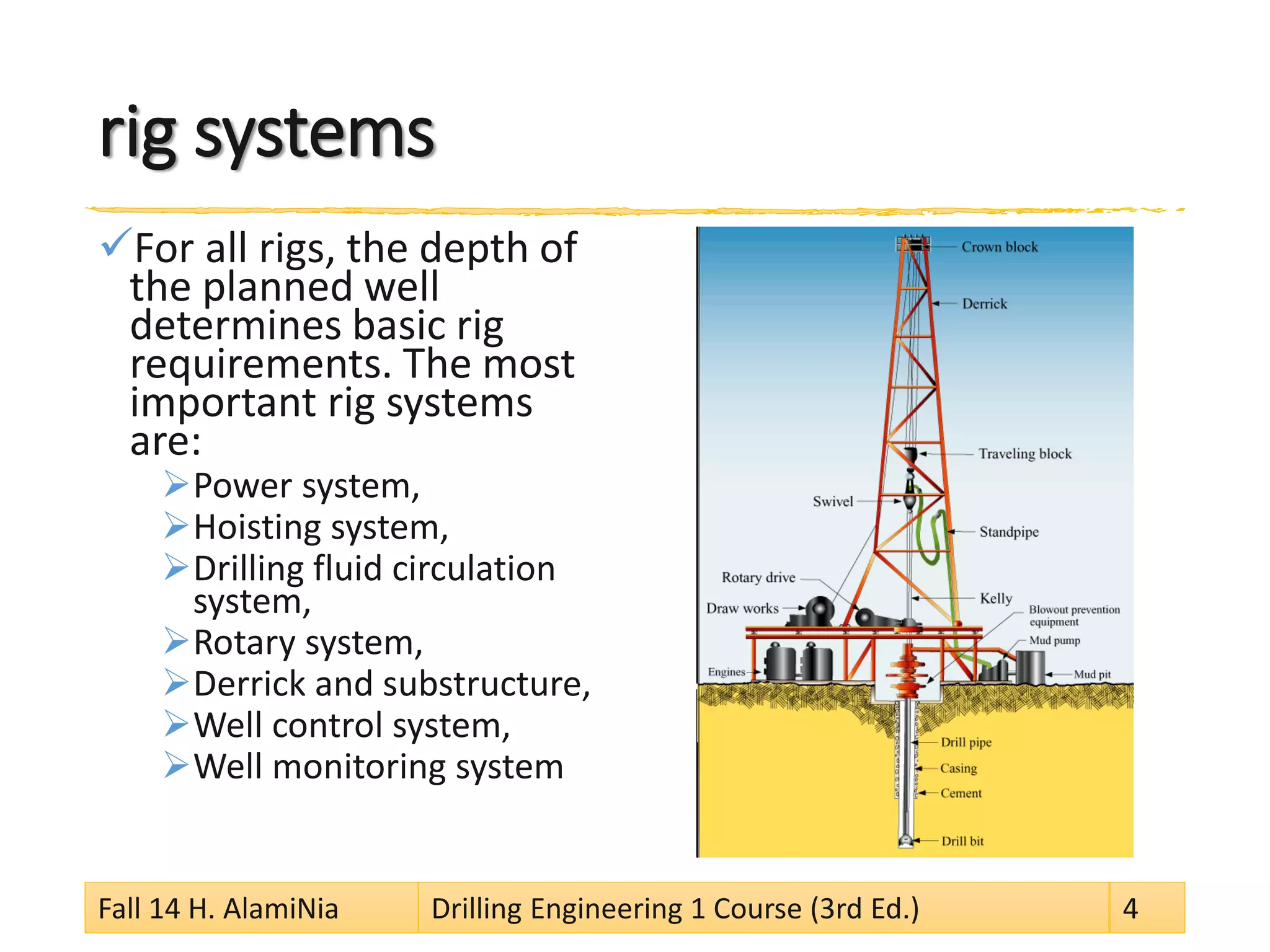
For all rigs, the depth of the planned well determines basic rig requirements. The most important rig systems are: 
 
Power system, 
 
Hoisting system, 
 
Drilling fluid circulation system, 
 
Rotary system, 
 
Derrick and substructure, 
 
Well control system, 
 
Well monitoring system 
Fall 14 H. AlamiNia Drilling Engineering 1 Course (3rd Ed.) 4
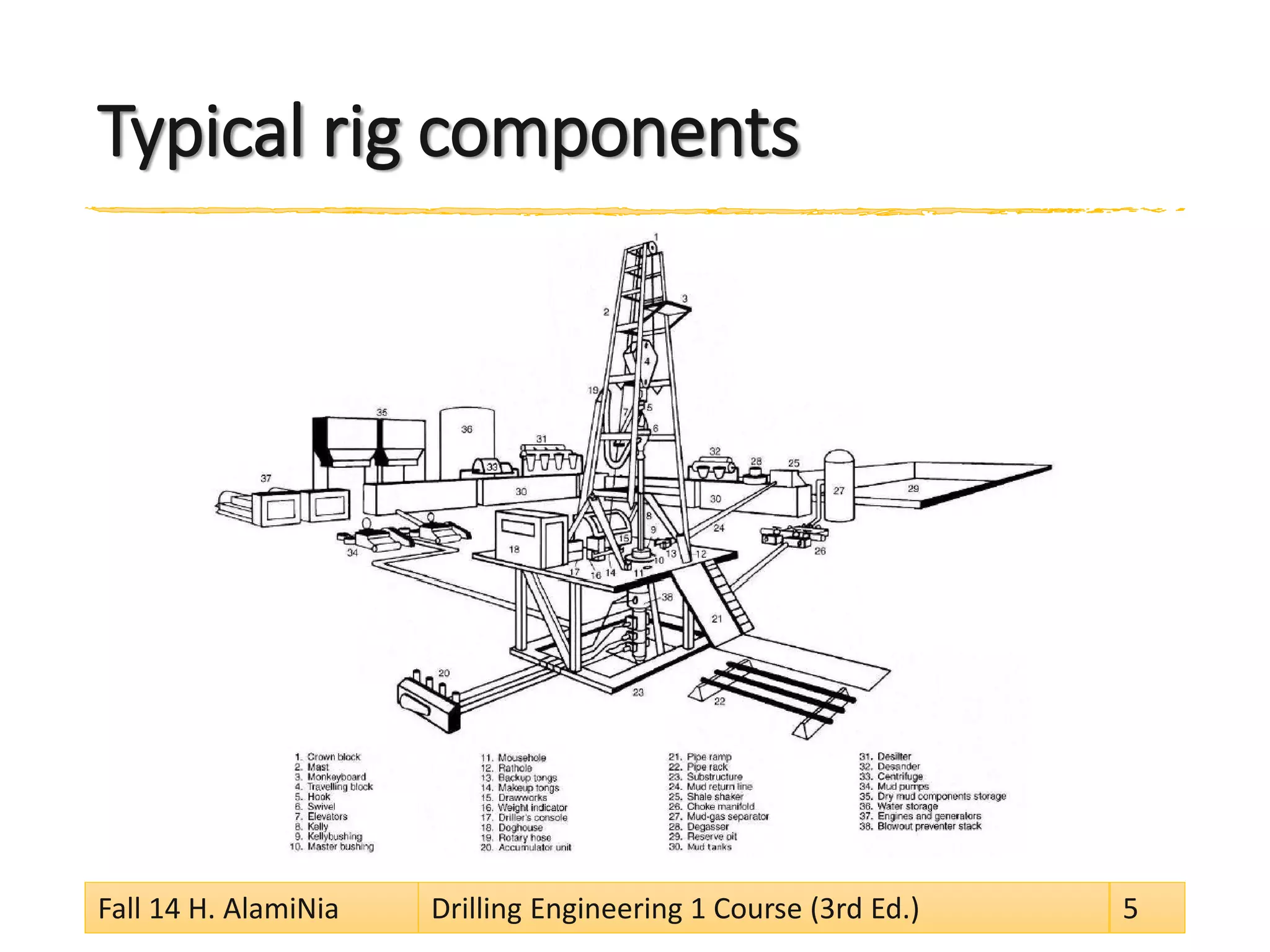
Typical rig components 
Fall 14 H. AlamiNia Drilling Engineering 1 Course (3rd Ed.) 5
power supply 
 
The power system of a rotary drilling rig has to supply power to all the other systems. 
 
the system must provide power for 
 
pumps in general, rig light, air compressors, etc. 
 
Since the largest power consumers on a rotary drilling rig are 
 
the hoisting, the circulation system, and the rotary system, 
 
these components determine mainly the total power requirements. Fall 14 H. AlamiNia Drilling Engineering 1 Course (3rd Ed.) 7
Power consumption 
 
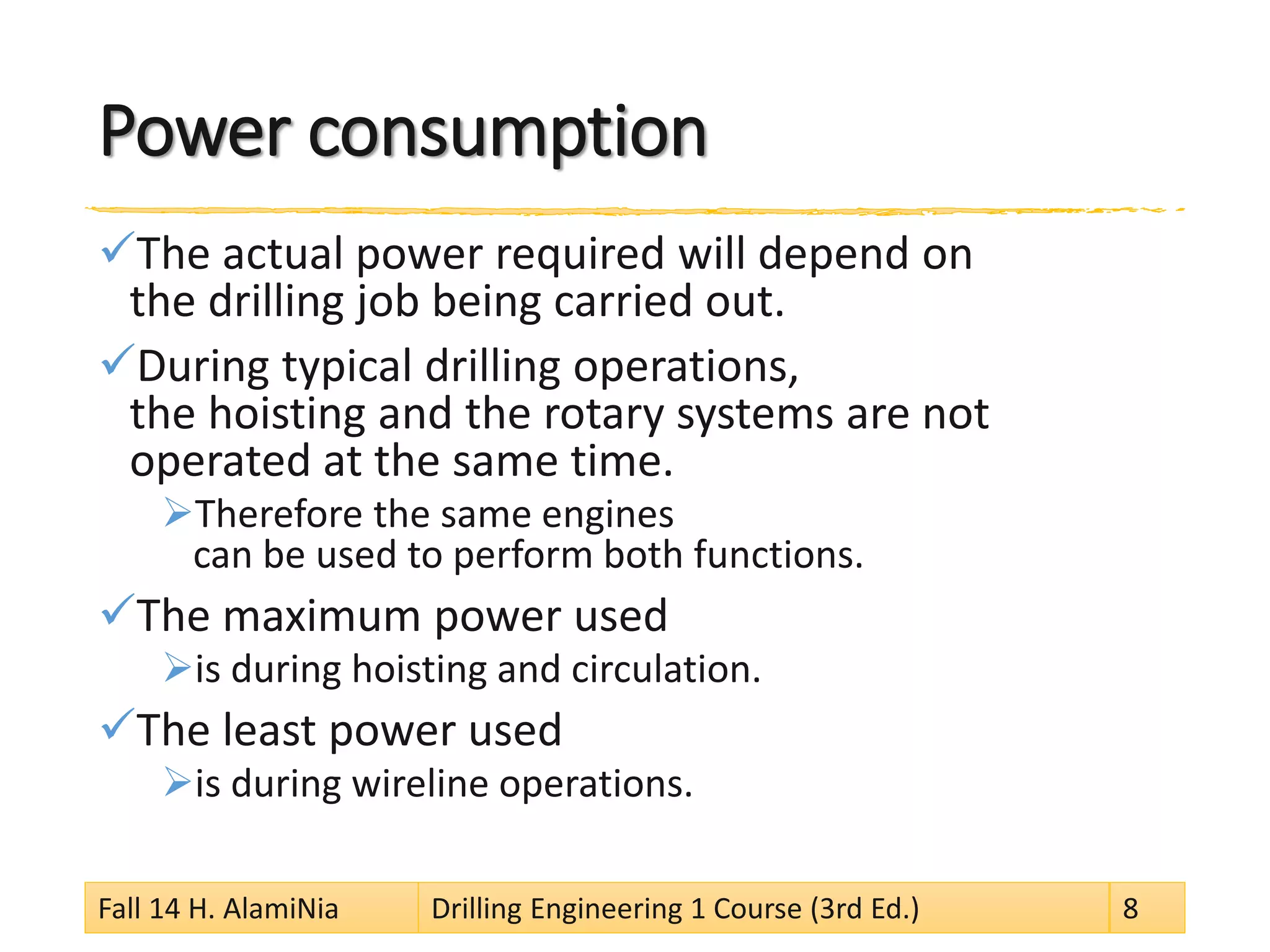
The actual power required will depend on the drilling job being carried out. 
 
During typical drilling operations, the hoisting and the rotary systems are not operated at the same time. 
 
Therefore the same engines can be used to perform both functions. 
 
The maximum power used 
 
is during hoisting and circulation. 
 
The least power used 
 
is during wireline operations. 
Fall 14 H. AlamiNia Drilling Engineering 1 Course (3rd Ed.) 8
power system 
 
Drilling rig power systems are classified 
 
as direct drive type (internal combustion engines supply mechanical power to the rig ) 
 
and electric type. 
 
In both cases, 
 
the sources of energy are diesel fueled engines. 
 
Most rigs use 
 
1 to 3 engines to power the drawworks and rotary table. 
 
The engines are usually rated between 400 and 800 hp. 
 
As guideline, power requirements 
 
for most onshore rigs are between 1,000 to 3,000 hp. 
 
Offshore rigs in general use much more power. 
Fall 14 H. AlamiNia Drilling Engineering 1 Course (3rd Ed.) 9
Sample of a land rig power supply 
Fall 14 H. AlamiNia Drilling Engineering 1 Course (3rd Ed.) 10
SCR Unit 
 
The power on modern rigs is most commonly generated by diesel-electric power units. 
 
The power produced is AC current which is then converted to DC current by the use of SCR (Silicon Controlled Rectifier). 
 
The current is delivered by cables 
 
to electric motors attached directly to the equipment involved such as 
 
mud pumps, rotary table, Drawworks etc. 
Fall 14 H. AlamiNia Drilling Engineering 1 Course (3rd Ed.) 11
power system performance 
 
The performance of a rig power system is characterized by 
 
the output horsepower, 
 
torque, 
 
and fuel consumption for various engine speeds. 
 
These three parameters are related by the efficiency of each system. 
Fall 14 H. AlamiNia Drilling Engineering 1 Course (3rd Ed.) 12
energy consumption by the engines 
 
Heating values of fuels 
 
The energy consumed by the engines comes from burning fuels. 
 
The engine transforms the chemical energy of the fuel into work. 
 
No engine can transform totally the chemical energy into work. 
 
Most of the energy that enters the engine is lost as heat. 
 
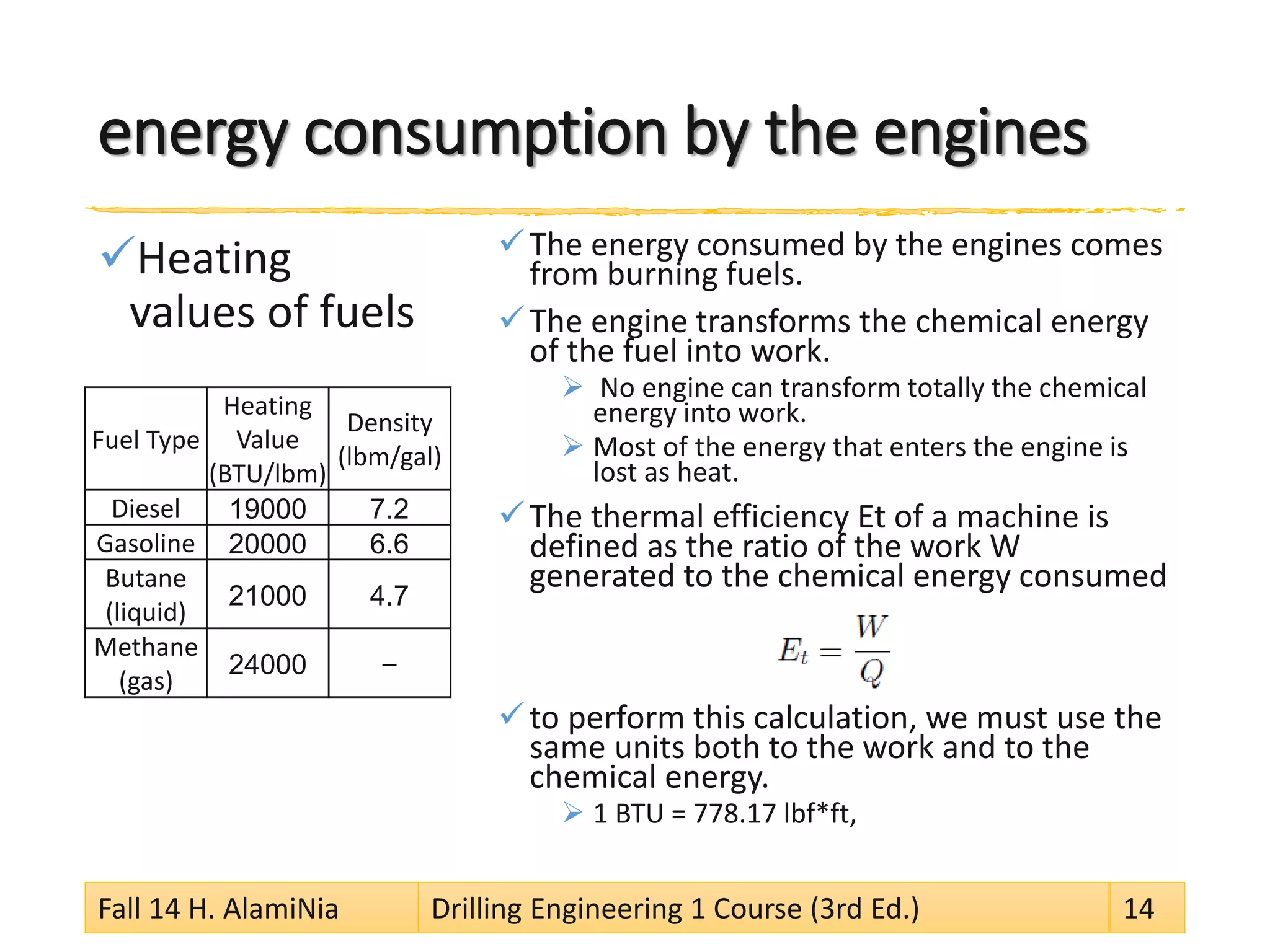
The thermal efficiency Et of a machine is defined as the ratio of the work W generated to the chemical energy consumed 
 
to perform this calculation, we must use the same units both to the work and to the chemical energy. 
 
1 BTU = 778.17 lbf*ft, 
Fall 14 H. AlamiNia Drilling Engineering 1 Course (3rd Ed.) 14 
Fuel Type 
Heating Value(BTU/lbm) 
Density(lbm/gal) 
Diesel 
19000 
7.2 
Gasoline 
20000 
6.6 
Butane (liquid) 
21000 
4.7 
Methane (gas) 
24000 
–
thermal efficiency 
 
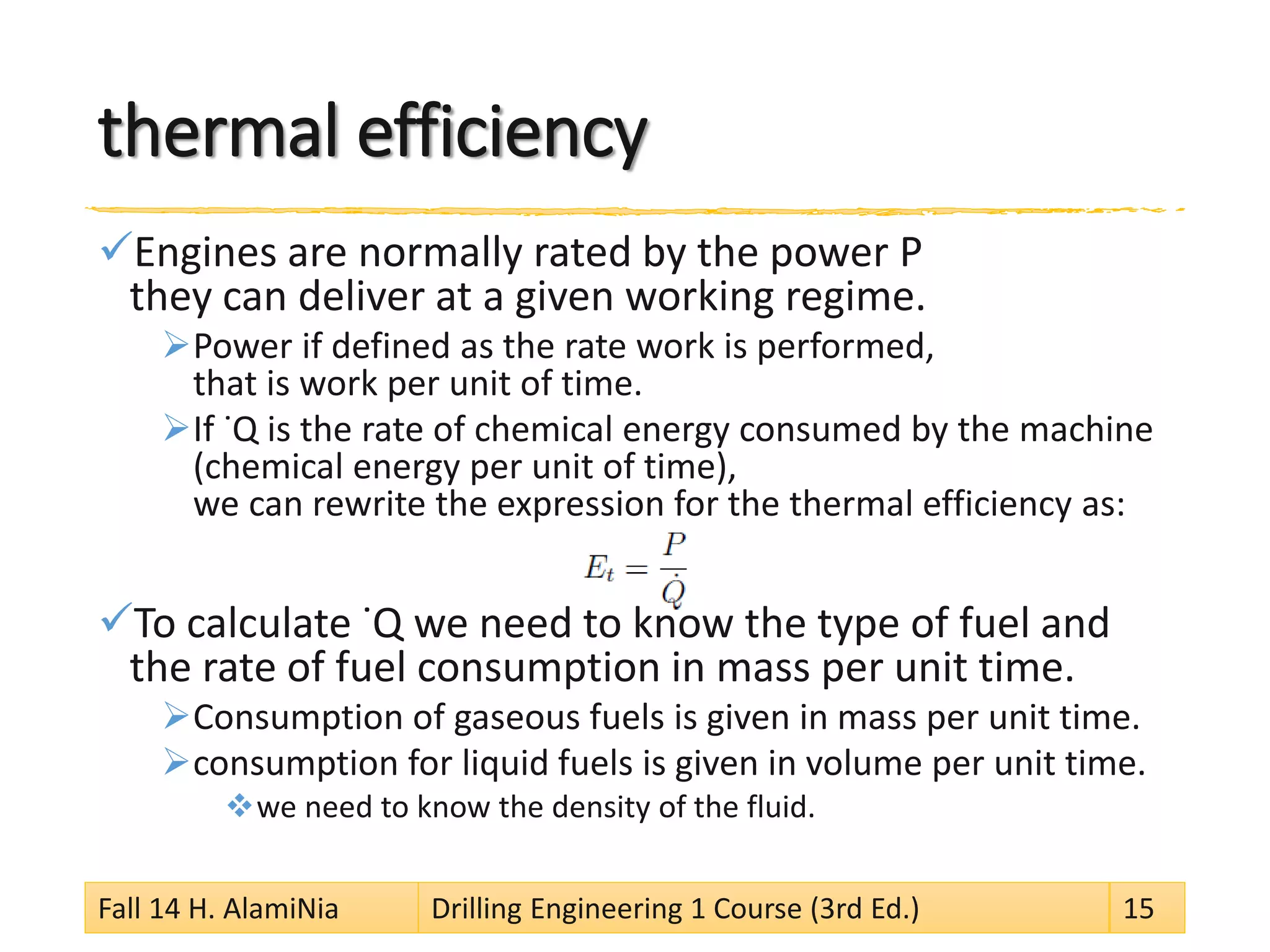
Engines are normally rated by the power P they can deliver at a given working regime. 
 
Power if defined as the rate work is performed, that is work per unit of time. 
 
If ˙Q is the rate of chemical energy consumed by the machine (chemical energy per unit of time), we can rewrite the expression for the thermal efficiency as: 
 
To calculate ˙Q we need to know the type of fuel and the rate of fuel consumption in mass per unit time. 
 
Consumption of gaseous fuels is given in mass per unit time. 
 
consumption for liquid fuels is given in volume per unit time. 
 
we need to know the density of the fluid. 
Fall 14 H. AlamiNia Drilling Engineering 1 Course (3rd Ed.) 15
output power 
 
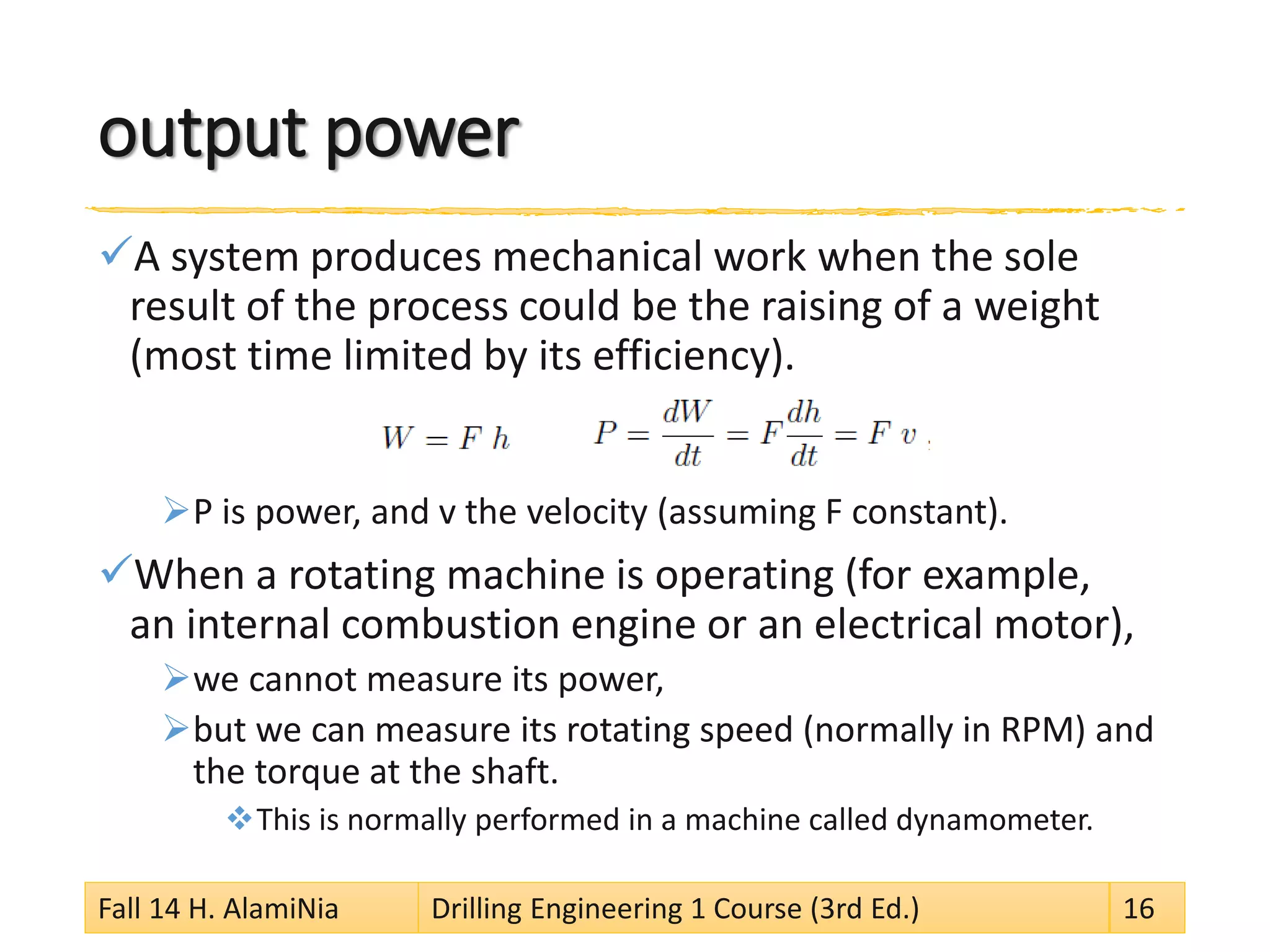
A system produces mechanical work when the sole result of the process could be the raising of a weight (most time limited by its efficiency). 
 
P is power, and v the velocity (assuming F constant). 
 
When a rotating machine is operating (for example, an internal combustion engine or an electrical motor), 
 
we cannot measure its power, 
 
but we can measure its rotating speed (normally in RPM) and the torque at the shaft. 
 
This is normally performed in a machine called dynamometer. Fall 14 H. AlamiNia Drilling Engineering 1 Course (3rd Ed.) 16
output power 
 
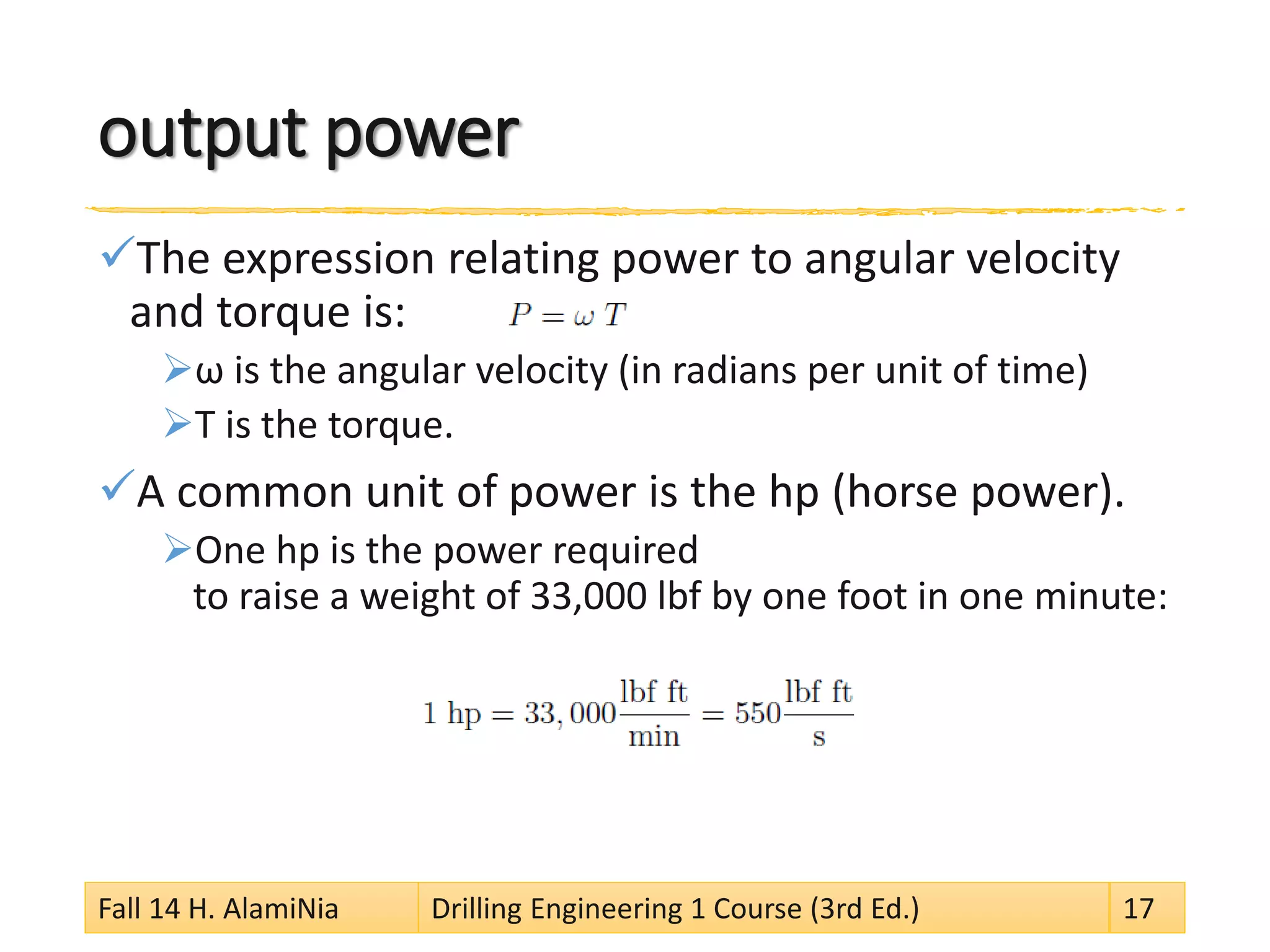
The expression relating power to angular velocity and torque is: 
 
ω is the angular velocity (in radians per unit of time) 
 
T is the torque. 
 
A common unit of power is the hp (horse power). 
 
One hp is the power required to raise a weight of 33,000 lbf by one foot in one minute: 
Fall 14 H. AlamiNia Drilling Engineering 1 Course (3rd Ed.) 17
output power 
 
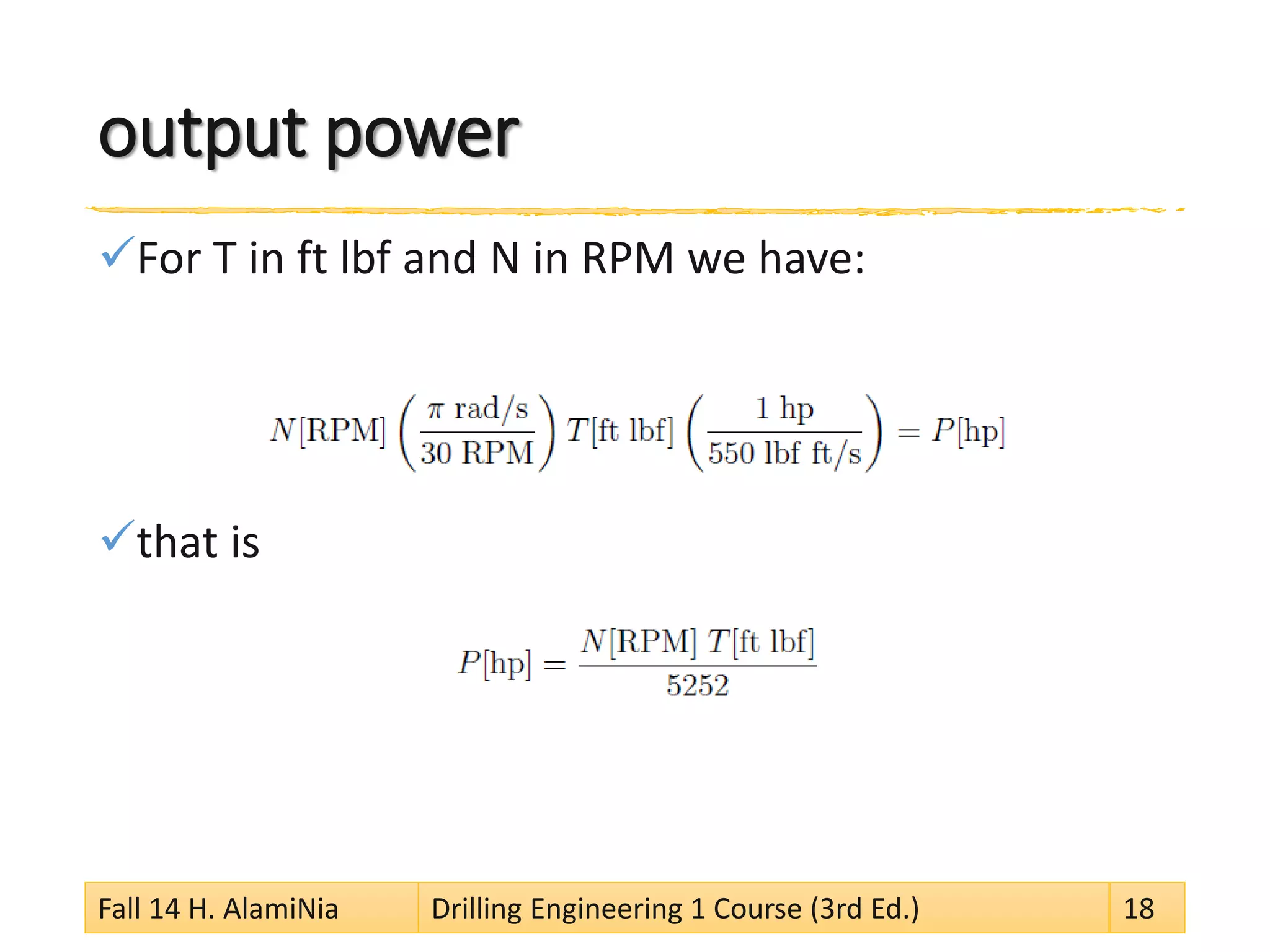
For T in ft lbf and N in RPM we have: 
 
that is 
Fall 14 H. AlamiNia Drilling Engineering 1 Course (3rd Ed.) 18
mechanical horsepower Correction 
 
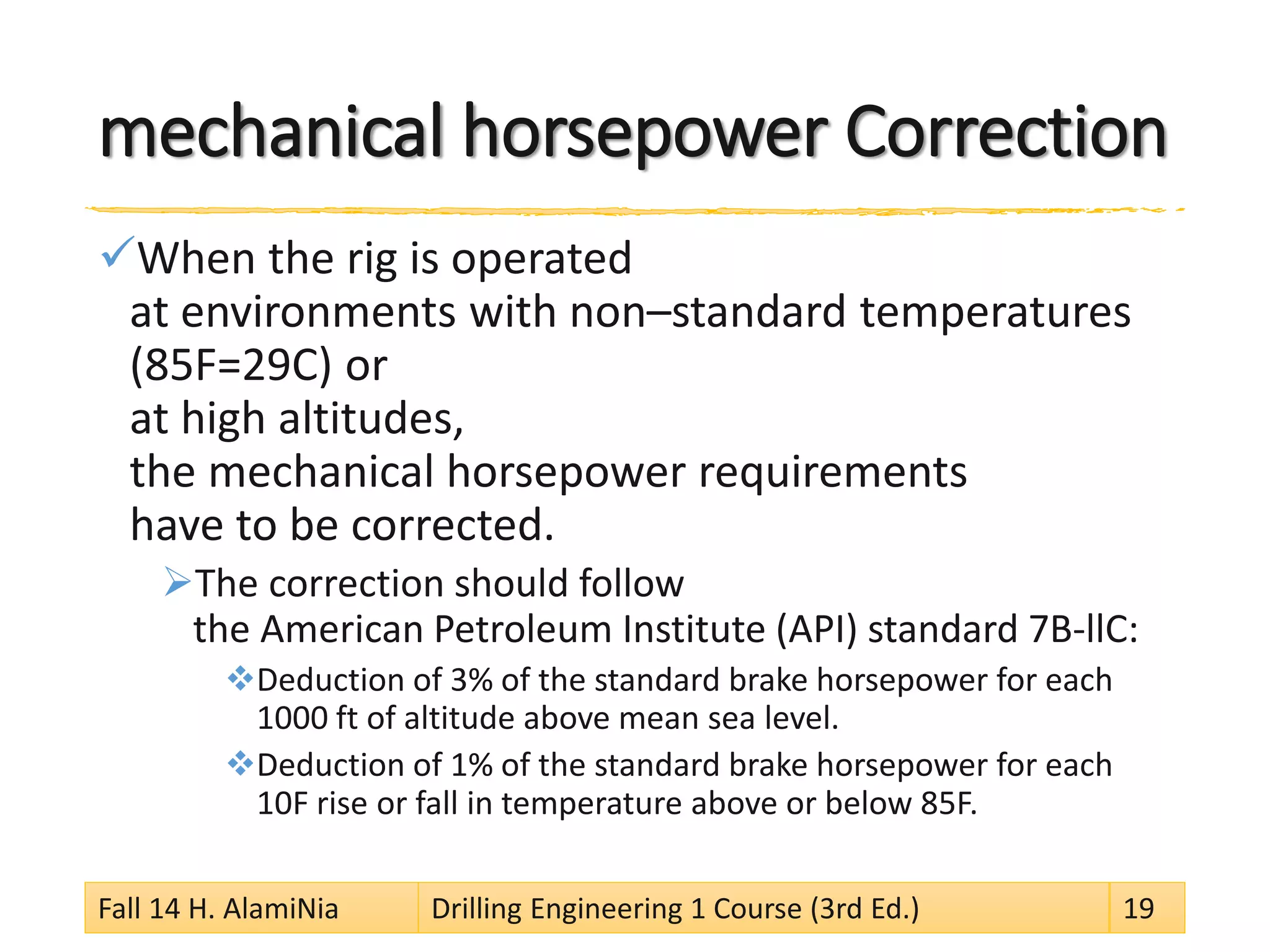
When the rig is operated at environments with non–standard temperatures (85F=29C) or at high altitudes, the mechanical horsepower requirements have to be corrected. 
 
The correction should follow the American Petroleum Institute (API) standard 7B-llC: 
 
Deduction of 3% of the standard brake horsepower for each 1000 ft of altitude above mean sea level. 
 
Deduction of 1% of the standard brake horsepower for each 10F rise or fall in temperature above or below 85F. 
Fall 14 H. AlamiNia Drilling Engineering 1 Course (3rd Ed.) 19
Calculation of the output power and the overall efficiency 
 
A diesel engine gives an output torque of 1740 ft lbf at an engine speed of 1200 RPM. 
 
If the fuel consumption rate was 31.5 gal/hr, 
 
what is the output power and 
 
the overall efficiency of the engine? 
Fall 14 H. AlamiNia Drilling Engineering 1 Course (3rd Ed.) 20
the output power and the overall efficiency 
 
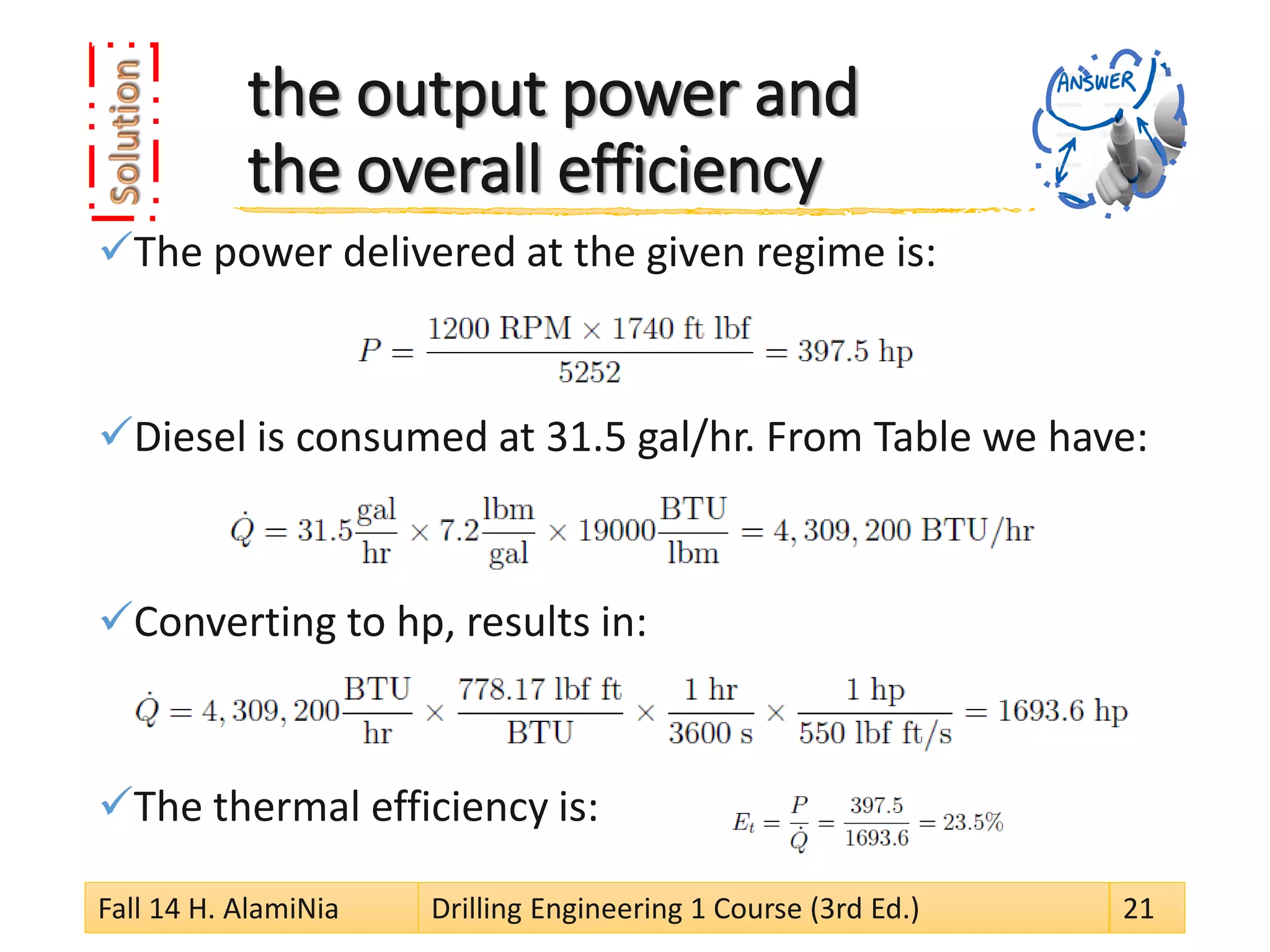
The power delivered at the given regime is: 
 
Diesel is consumed at 31.5 gal/hr. From Table we have: 
 
Converting to hp, results in: 
 
The thermal efficiency is: 
Fall 14 H. AlamiNia Drilling Engineering 1 Course (3rd Ed.) 21
1.(CDF) Jorge H.B. Sampaio Jr. “Drilling Engineering Fundamentals.” Master of Petroleum Engineering. Curtin University of Technology, 2007. 
Chapter 2 
2.(WEC) Rabia, Hussain. Well Engineering & Construction. Entrac Consulting Limited, 2002. 
Chapter 16

Power System

  • 1.
    Drilling Engineering 1Course 3rd Ed. , 3rd Experience
  • 2.
    1. Rotary DrillingSystems 2. Power System A. equipment B. calculations
  • 4.
    rig systems  For all rigs, the depth of the planned well determines basic rig requirements. The most important rig systems are:  Power system,  Hoisting system,  Drilling fluid circulation system,  Rotary system,  Derrick and substructure,  Well control system,  Well monitoring system Fall 14 H. AlamiNia Drilling Engineering 1 Course (3rd Ed.) 4
  • 5.
    Typical rig components Fall 14 H. AlamiNia Drilling Engineering 1 Course (3rd Ed.) 5
  • 7.
    power supply  The power system of a rotary drilling rig has to supply power to all the other systems.  the system must provide power for  pumps in general, rig light, air compressors, etc.  Since the largest power consumers on a rotary drilling rig are  the hoisting, the circulation system, and the rotary system,  these components determine mainly the total power requirements. Fall 14 H. AlamiNia Drilling Engineering 1 Course (3rd Ed.) 7
  • 8.
    Power consumption  The actual power required will depend on the drilling job being carried out.  During typical drilling operations, the hoisting and the rotary systems are not operated at the same time.  Therefore the same engines can be used to perform both functions.  The maximum power used  is during hoisting and circulation.  The least power used  is during wireline operations. Fall 14 H. AlamiNia Drilling Engineering 1 Course (3rd Ed.) 8
  • 9.
    power system  Drilling rig power systems are classified  as direct drive type (internal combustion engines supply mechanical power to the rig )  and electric type.  In both cases,  the sources of energy are diesel fueled engines.  Most rigs use  1 to 3 engines to power the drawworks and rotary table.  The engines are usually rated between 400 and 800 hp.  As guideline, power requirements  for most onshore rigs are between 1,000 to 3,000 hp.  Offshore rigs in general use much more power. Fall 14 H. AlamiNia Drilling Engineering 1 Course (3rd Ed.) 9
  • 10.
    Sample of aland rig power supply Fall 14 H. AlamiNia Drilling Engineering 1 Course (3rd Ed.) 10
  • 11.
    SCR Unit  The power on modern rigs is most commonly generated by diesel-electric power units.  The power produced is AC current which is then converted to DC current by the use of SCR (Silicon Controlled Rectifier).  The current is delivered by cables  to electric motors attached directly to the equipment involved such as  mud pumps, rotary table, Drawworks etc. Fall 14 H. AlamiNia Drilling Engineering 1 Course (3rd Ed.) 11
  • 12.
    power system performance  The performance of a rig power system is characterized by  the output horsepower,  torque,  and fuel consumption for various engine speeds.  These three parameters are related by the efficiency of each system. Fall 14 H. AlamiNia Drilling Engineering 1 Course (3rd Ed.) 12
  • 14.
    energy consumption bythe engines  Heating values of fuels  The energy consumed by the engines comes from burning fuels.  The engine transforms the chemical energy of the fuel into work.  No engine can transform totally the chemical energy into work.  Most of the energy that enters the engine is lost as heat.  The thermal efficiency Et of a machine is defined as the ratio of the work W generated to the chemical energy consumed  to perform this calculation, we must use the same units both to the work and to the chemical energy.  1 BTU = 778.17 lbf*ft, Fall 14 H. AlamiNia Drilling Engineering 1 Course (3rd Ed.) 14 Fuel Type Heating Value(BTU/lbm) Density(lbm/gal) Diesel 19000 7.2 Gasoline 20000 6.6 Butane (liquid) 21000 4.7 Methane (gas) 24000 –
  • 15.
    thermal efficiency  Engines are normally rated by the power P they can deliver at a given working regime.  Power if defined as the rate work is performed, that is work per unit of time.  If ˙Q is the rate of chemical energy consumed by the machine (chemical energy per unit of time), we can rewrite the expression for the thermal efficiency as:  To calculate ˙Q we need to know the type of fuel and the rate of fuel consumption in mass per unit time.  Consumption of gaseous fuels is given in mass per unit time.  consumption for liquid fuels is given in volume per unit time.  we need to know the density of the fluid. Fall 14 H. AlamiNia Drilling Engineering 1 Course (3rd Ed.) 15
  • 16.
    output power  A system produces mechanical work when the sole result of the process could be the raising of a weight (most time limited by its efficiency).  P is power, and v the velocity (assuming F constant).  When a rotating machine is operating (for example, an internal combustion engine or an electrical motor),  we cannot measure its power,  but we can measure its rotating speed (normally in RPM) and the torque at the shaft.  This is normally performed in a machine called dynamometer. Fall 14 H. AlamiNia Drilling Engineering 1 Course (3rd Ed.) 16
  • 17.
    output power  The expression relating power to angular velocity and torque is:  ω is the angular velocity (in radians per unit of time)  T is the torque.  A common unit of power is the hp (horse power).  One hp is the power required to raise a weight of 33,000 lbf by one foot in one minute: Fall 14 H. AlamiNia Drilling Engineering 1 Course (3rd Ed.) 17
  • 18.
    output power  For T in ft lbf and N in RPM we have:  that is Fall 14 H. AlamiNia Drilling Engineering 1 Course (3rd Ed.) 18
  • 19.
    mechanical horsepower Correction  When the rig is operated at environments with non–standard temperatures (85F=29C) or at high altitudes, the mechanical horsepower requirements have to be corrected.  The correction should follow the American Petroleum Institute (API) standard 7B-llC:  Deduction of 3% of the standard brake horsepower for each 1000 ft of altitude above mean sea level.  Deduction of 1% of the standard brake horsepower for each 10F rise or fall in temperature above or below 85F. Fall 14 H. AlamiNia Drilling Engineering 1 Course (3rd Ed.) 19
  • 20.
    Calculation of theoutput power and the overall efficiency  A diesel engine gives an output torque of 1740 ft lbf at an engine speed of 1200 RPM.  If the fuel consumption rate was 31.5 gal/hr,  what is the output power and  the overall efficiency of the engine? Fall 14 H. AlamiNia Drilling Engineering 1 Course (3rd Ed.) 20
  • 21.
    the output powerand the overall efficiency  The power delivered at the given regime is:  Diesel is consumed at 31.5 gal/hr. From Table we have:  Converting to hp, results in:  The thermal efficiency is: Fall 14 H. AlamiNia Drilling Engineering 1 Course (3rd Ed.) 21
  • 22.
    1.(CDF) Jorge H.B.Sampaio Jr. “Drilling Engineering Fundamentals.” Master of Petroleum Engineering. Curtin University of Technology, 2007. Chapter 2 2.(WEC) Rabia, Hussain. Well Engineering & Construction. Entrac Consulting Limited, 2002. Chapter 16