presents
a                production


    Doppler
     Effect
         1
Doppler effect
              Source stands still and
            emits waves all around it. All
             observers experience the
                  same frequency.

                       Source travels to the
                       right. Waves emitted
                          forward have a
                      shortened wavelength;
                      waves emitted behind
                        have a lengthened
                            wavelength.
      Images: Bauer
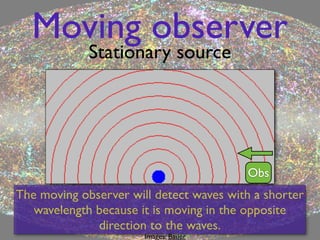
Moving observer
             Stationary source


                                         Obs
The moving observer will detect waves with a shorter
   wavelength because it is moving in the opposite
              direction to the waves.
                       Images: Bauer
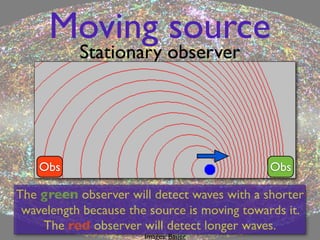
Moving source
           Stationary observer


    Obs                                      Obs

The green observer will detect waves with a shorter
 wavelength because the source is moving towards it.
    The red observer will detect longer waves.
                       Images: Bauer
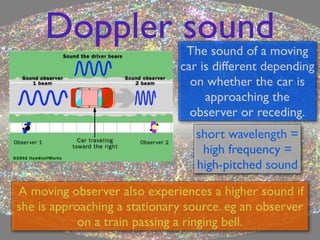
Doppler sound             The sound of a moving
                              car is different depending
                                on whether the car is
                                   approaching the
                                observer or receding.
                                 short wavelength =
                                  high frequency =
                                 high-pitched sound

A moving observer also experiences a higher sound if
she is approaching a stationary source. eg an observer
            on a train passing a ringing bell.
Doppler calculation                 f’ = frequency detected
                                    f = frequency emitted
                                    v = velocity of sound
                                    uo = velocity of observer
                                    us = velocity of source
When the velocities are in opposite directions, we add them.

 A police car siren emits a    Speed of sound = 330 m/s
sound of frequency 600 Hz A cyclist approaches at 18
while travelling at 40.0 m/s. m/s a stationary transformer
What does this sound like humming at 50.0 Hz. What
 to a stationary observer      wavelength of sound does
 behind the car? [535 Hz]        she measure? [6.26 m]
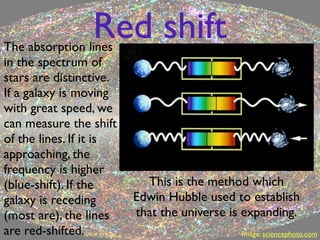
Red shift
The absorption lines
in the spectrum of
stars are distinctive.
If a galaxy is moving
with great speed, we
can measure the shift
of the lines. If it is
approaching, the
frequency is higher
(blue-shift). If the       This is the method which
galaxy is receding       Edwin Hubble used to establish
(most are), the lines    that the universe is expanding.
are red-shifted.                             Image: sciencephoto.com
Calculating red shift
                       ∆f = change in frequency
                       v = relative speed of source and observer
 An approximation of   c = speed of light (300 000 km/s)
the Doppler formulas   f = original frequency
    when c >> v
    A star emits light at 456 THz which is detected
     at the earth as 416 THz. What is the speed of
      the star relative to the Earth? [26 300 km/s]
     Infra-red radiation from a police radar gun
    bounces off a car travelling at 30 m/s. The car
  receives a frequency of 200 THz; what will be the
           change in frequency? [20 MHz]
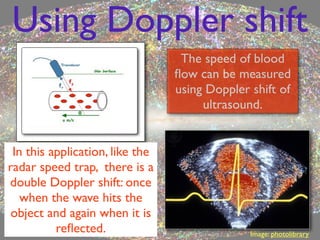
Using Doppler shift
                                  The speed of blood
                                 flow can be measured
                                 using Doppler shift of
                                      ultrasound.


 In this application, like the
radar speed trap, there is a
double Doppler shift: once
   when the wave hits the
 object and again when it is
          reflected.                            Image: photolibrary
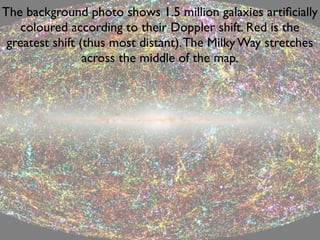
The background photo shows 1.5 million galaxies artificially
    coloured according to their Doppler shift. Red is the
 greatest shift (thus most distant). The Milky Way stretches
                 across the middle of the map.
a                                            production


          MUCH MORE AT
http://nothingnerdy.wikispaces.com
    http://nothingnerdy.wikispaces.com/11.2+Doppler+effect
                              11

IB Physics Doppler effect flippingphysics by Nothingnerdy

  • 1.
    presents a production Doppler Effect 1
  • 2.
    Doppler effect Source stands still and emits waves all around it. All observers experience the same frequency. Source travels to the right. Waves emitted forward have a shortened wavelength; waves emitted behind have a lengthened wavelength. Images: Bauer
  • 3.
    Moving observer Stationary source Obs The moving observer will detect waves with a shorter wavelength because it is moving in the opposite direction to the waves. Images: Bauer
  • 4.
    Moving source Stationary observer Obs Obs The green observer will detect waves with a shorter wavelength because the source is moving towards it. The red observer will detect longer waves. Images: Bauer
  • 5.
    Doppler sound The sound of a moving car is different depending on whether the car is approaching the observer or receding. short wavelength = high frequency = high-pitched sound A moving observer also experiences a higher sound if she is approaching a stationary source. eg an observer on a train passing a ringing bell.
  • 6.
    Doppler calculation f’ = frequency detected f = frequency emitted v = velocity of sound uo = velocity of observer us = velocity of source When the velocities are in opposite directions, we add them. A police car siren emits a Speed of sound = 330 m/s sound of frequency 600 Hz A cyclist approaches at 18 while travelling at 40.0 m/s. m/s a stationary transformer What does this sound like humming at 50.0 Hz. What to a stationary observer wavelength of sound does behind the car? [535 Hz] she measure? [6.26 m]
  • 7.
    Red shift The absorptionlines in the spectrum of stars are distinctive. If a galaxy is moving with great speed, we can measure the shift of the lines. If it is approaching, the frequency is higher (blue-shift). If the This is the method which galaxy is receding Edwin Hubble used to establish (most are), the lines that the universe is expanding. are red-shifted. Image: sciencephoto.com
  • 8.
    Calculating red shift ∆f = change in frequency v = relative speed of source and observer An approximation of c = speed of light (300 000 km/s) the Doppler formulas f = original frequency when c >> v A star emits light at 456 THz which is detected at the earth as 416 THz. What is the speed of the star relative to the Earth? [26 300 km/s] Infra-red radiation from a police radar gun bounces off a car travelling at 30 m/s. The car receives a frequency of 200 THz; what will be the change in frequency? [20 MHz]
  • 9.
    Using Doppler shift The speed of blood flow can be measured using Doppler shift of ultrasound. In this application, like the radar speed trap, there is a double Doppler shift: once when the wave hits the object and again when it is reflected. Image: photolibrary
  • 10.
    The background photoshows 1.5 million galaxies artificially coloured according to their Doppler shift. Red is the greatest shift (thus most distant). The Milky Way stretches across the middle of the map.
  • 11.
    a production MUCH MORE AT http://nothingnerdy.wikispaces.com http://nothingnerdy.wikispaces.com/11.2+Doppler+effect 11

Editor's Notes