Presented By : Himanshu K. Khanna FAITH ACADEMY
Simple harmonic motion (SHM)  is the motion of a simple harmonic oscillator, a motion that is neither driven nor damped.  The motion is periodic and sinusoidal. With constant amplitude; the acceleration of a body executing SHM is directly proportional to the displacement of the body from the equilibrium position and is always directed towards the equilibrium position.
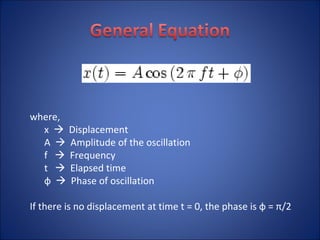
where, x     Displacement A     Amplitude of the oscillation f     Frequency t     Elapsed time ф      Phase of oscillation If there is no displacement at time t = 0, the phase is  ф  =  π /2
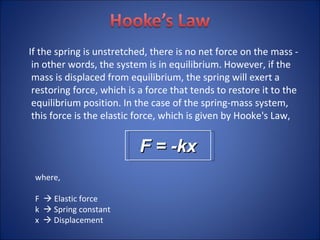
If the spring is unstretched, there is no net force on the mass - in other words, the system is in equilibrium. However, if the mass is displaced from equilibrium, the spring will exert a restoring force, which is a force that tends to restore it to the equilibrium position. In the case of the spring-mass system, this force is the elastic force, which is given by Hooke's Law,  F = -kx where, F    Elastic force k    Spring constant x    Displacement
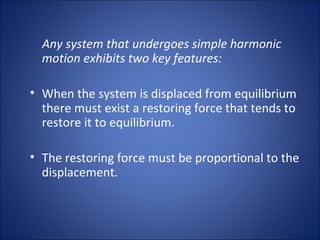
Any system that undergoes simple harmonic motion exhibits two key features: When the system is displaced from equilibrium there must exist a restoring force that tends to restore it to equilibrium. The restoring force must be proportional to the displacement.
 
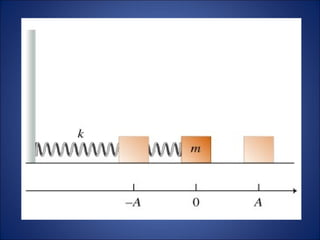
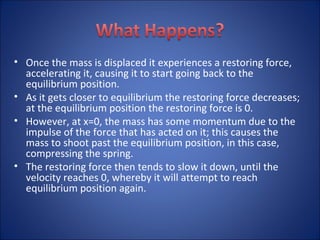
Once the mass is displaced it experiences a restoring force, accelerating it, causing it to start going back to the equilibrium position.  As it gets closer to equilibrium the restoring force decreases; at the equilibrium position the restoring force is 0.  However, at x=0, the mass has some momentum due to the impulse of the force that has acted on it; this causes the mass to shoot past the equilibrium position, in this case, compressing the spring.  The restoring force then tends to slow it down, until the velocity reaches 0, whereby it will attempt to reach equilibrium position again.
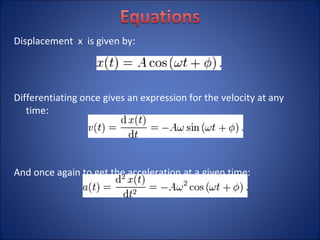
Displacement  x  is given by: Differentiating once gives an expression for the velocity at any time: And once again to get the acceleration at a given time:
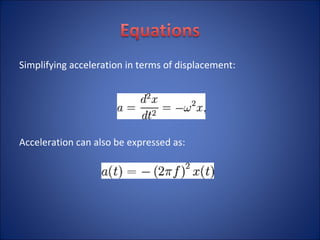
Simplifying acceleration in terms of displacement: Acceleration can also be expressed as:
Mass on a spring Uniform circular motion Mass on a simple pendulum
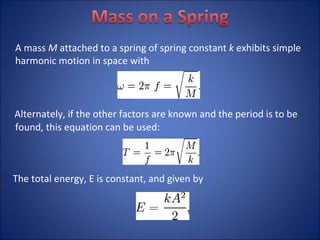
A mass  M  attached to a spring of spring constant  k  exhibits simple harmonic motion in space with Alternately, if the other factors are known and the period is to be found, this equation can be used: The total energy, E is constant, and given by
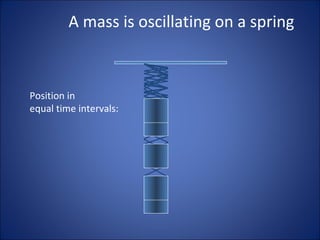
A mass is oscillating on a spring Position in equal time intervals:
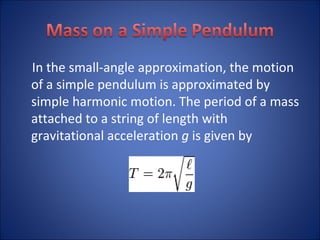
In the small-angle approximation, the motion of a simple pendulum is approximated by simple harmonic motion. The period of a mass attached to a string of length with gravitational acceleration  g  is given by
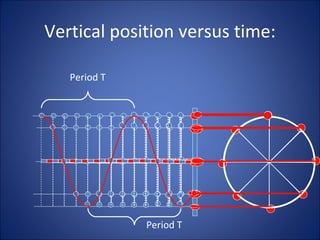
Simple harmonic motion can in some cases be considered to be the one-dimensional projection of uniform circular motion. If an object moves with angular frequency ω around a circle of radius  R  centered at the origin of the  x-y  plane, then its motion along the  x  and the  y  coordinates is simple harmonic with amplitude  R  and angular speed ω.
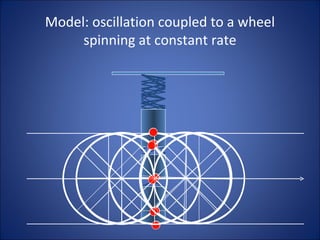
Model: oscillation coupled to a wheel spinning at constant rate
Vertical position versus time: Period T Period T
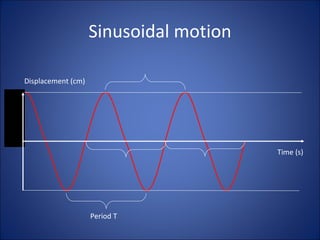
Sinusoidal motion Time (s) Displacement (cm) Period T
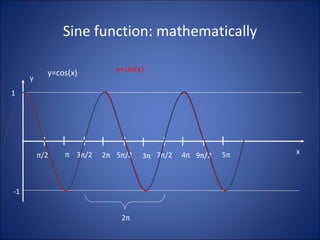
Sine function: mathematically x y 2 π   -1 1 y=sin(x) y=cos(x) π /2 π 3 π /2 2 π 5 π /2 3 π 7 π /2 4 π 9 π /2 5 π
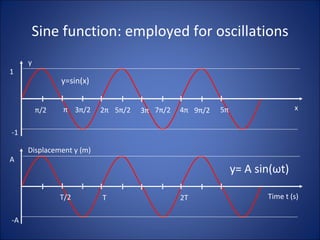
Sine function: employed for oscillations Time t (s) Displacement y (m) -A A y= A sin( ω t) x y π /2 π 3 π /2 2 π 5 π /2 3 π 7 π /2 4 π 9 π /2 5 π -1 1 y=sin(x) T/2 T 2T
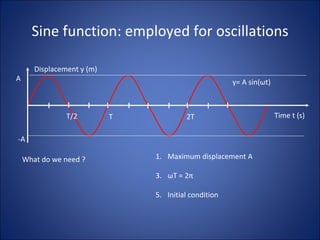
Sine function: employed for oscillations What do we need ? Maximum displacement A ω T = 2 π Initial condition Time t (s) Displacement y (m) T/2 T 2T -A A y= A sin( ω t)

Simple harmonic motion

  • 1.
    Presented By :Himanshu K. Khanna FAITH ACADEMY
  • 2.
    Simple harmonic motion(SHM) is the motion of a simple harmonic oscillator, a motion that is neither driven nor damped. The motion is periodic and sinusoidal. With constant amplitude; the acceleration of a body executing SHM is directly proportional to the displacement of the body from the equilibrium position and is always directed towards the equilibrium position.
  • 3.
    where, x  Displacement A  Amplitude of the oscillation f  Frequency t  Elapsed time ф  Phase of oscillation If there is no displacement at time t = 0, the phase is ф = π /2
  • 4.
    If the springis unstretched, there is no net force on the mass - in other words, the system is in equilibrium. However, if the mass is displaced from equilibrium, the spring will exert a restoring force, which is a force that tends to restore it to the equilibrium position. In the case of the spring-mass system, this force is the elastic force, which is given by Hooke's Law, F = -kx where, F  Elastic force k  Spring constant x  Displacement
  • 5.
    Any system thatundergoes simple harmonic motion exhibits two key features: When the system is displaced from equilibrium there must exist a restoring force that tends to restore it to equilibrium. The restoring force must be proportional to the displacement.
  • 6.
  • 7.
    Once the massis displaced it experiences a restoring force, accelerating it, causing it to start going back to the equilibrium position. As it gets closer to equilibrium the restoring force decreases; at the equilibrium position the restoring force is 0. However, at x=0, the mass has some momentum due to the impulse of the force that has acted on it; this causes the mass to shoot past the equilibrium position, in this case, compressing the spring. The restoring force then tends to slow it down, until the velocity reaches 0, whereby it will attempt to reach equilibrium position again.
  • 8.
    Displacement x is given by: Differentiating once gives an expression for the velocity at any time: And once again to get the acceleration at a given time:
  • 9.
    Simplifying acceleration interms of displacement: Acceleration can also be expressed as:
  • 10.
    Mass on aspring Uniform circular motion Mass on a simple pendulum
  • 11.
    A mass M attached to a spring of spring constant k exhibits simple harmonic motion in space with Alternately, if the other factors are known and the period is to be found, this equation can be used: The total energy, E is constant, and given by
  • 12.
    A mass isoscillating on a spring Position in equal time intervals:
  • 13.
    In the small-angleapproximation, the motion of a simple pendulum is approximated by simple harmonic motion. The period of a mass attached to a string of length with gravitational acceleration g is given by
  • 14.
    Simple harmonic motioncan in some cases be considered to be the one-dimensional projection of uniform circular motion. If an object moves with angular frequency ω around a circle of radius R centered at the origin of the x-y plane, then its motion along the x and the y coordinates is simple harmonic with amplitude R and angular speed ω.
  • 15.
    Model: oscillation coupledto a wheel spinning at constant rate
  • 16.
    Vertical position versustime: Period T Period T
  • 17.
    Sinusoidal motion Time(s) Displacement (cm) Period T
  • 18.
    Sine function: mathematicallyx y 2 π -1 1 y=sin(x) y=cos(x) π /2 π 3 π /2 2 π 5 π /2 3 π 7 π /2 4 π 9 π /2 5 π
  • 19.
    Sine function: employedfor oscillations Time t (s) Displacement y (m) -A A y= A sin( ω t) x y π /2 π 3 π /2 2 π 5 π /2 3 π 7 π /2 4 π 9 π /2 5 π -1 1 y=sin(x) T/2 T 2T
  • 20.
    Sine function: employedfor oscillations What do we need ? Maximum displacement A ω T = 2 π Initial condition Time t (s) Displacement y (m) T/2 T 2T -A A y= A sin( ω t)