
1. Nagendra P
2. Pramod M Jadhav
RNA functions
• Storage/transfer of genetic information
• Structural
• Catalytic
• Regulatory
RNAi
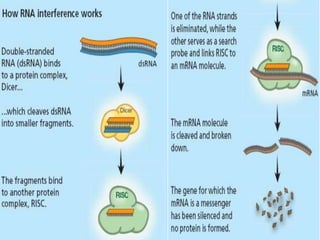
• RNA interference (RNAi) is a biological process in which RNA molecules
inhibit gene expression, by the destruction of specific mRNA molecules.
• Historically, it was known by other names, including
co-suppression, post-transcriptional gene silencing (PTGS), and quelling.
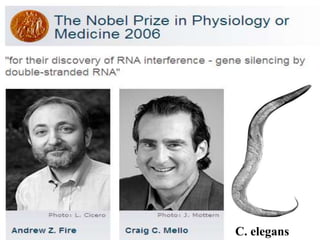
• Andrew Fire and Craig C. Mello shared the 2006 Nobel Prize in Physiology
or Medicine for their work on RNA interference in the nematode worm
Caenorhabditis elegans.
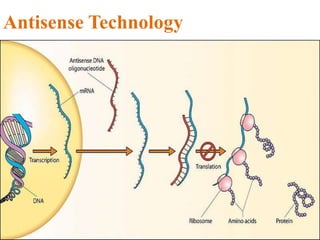
• RNAi is now known as precise, efficient, stable and better than antisense
technology for gene suppression.
• microRNA (miRNA) and
• small interfering RNA (siRNA) – are central to RNA interference.
C. elegans
Antisense Technology
Sh RNA
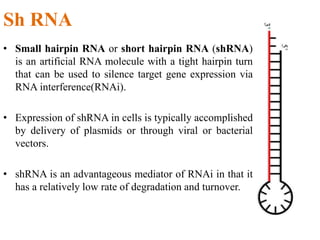
• Small hairpin RNA or short hairpin RNA (shRNA)
is an artificial RNA molecule with a tight hairpin turn
that can be used to silence target gene expression via
RNA interference(RNAi).
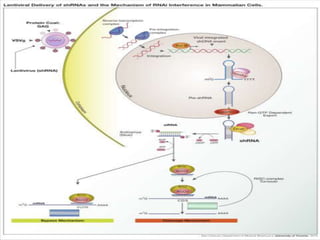
• Expression of shRNA in cells is typically accomplished
by delivery of plasmids or through viral or bacterial
vectors.
• shRNA is an advantageous mediator of RNAi in that it
has a relatively low rate of degradation and turnover.
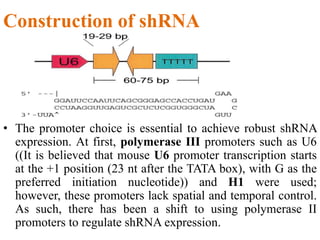
Construction of shRNA
• The promoter choice is essential to achieve robust shRNA
expression. At first, polymerase III promoters such as U6
((It is believed that mouse U6 promoter transcription starts
at the +1 position (23 nt after the TATA box), with G as the
preferred initiation nucleotide)) and H1 were used;
however, these promoters lack spatial and temporal control.
As such, there has been a shift to using polymerase II
promoters to regulate shRNA expression.
Application
Agriculture
• Improving Disease Resistance
• Improving Insect and Nematode Resistance
• Improving Resistance against Parasitic Weeds
• Improving Drought Tolerance
• Improving Nutritional Value
Medicine
• Gradalis, Inc. developed the FANG vaccine, which
is used in treatment of advanced cancers.
• Marina Biotech developed CEQ508 which is used to
treat Familial Adenomatous Polyposis.
Challenges
Several challenges typically confront shRNA-based therapeutics.
• viral based gene therapy approaches have proved dangerous in past clinical
trials. Some patients treated with viral vectors for Wiskott-Aldrich
syndrome developed acute T-cell leukaemia.
• If the shRNA is expressed at levels that are too high the cell might not be
able to correctly process the endogenous RNA which could cause significant
problems.
• Another challenge is the possibility that the patient might mount an immune
response against the therapy.
• Finally, there might be off-target effects and the shRNA could silence other
unintended genes.
References
• Silhavy, D. (2005) Agro-infiltration: A versatile tool for RNAi studies in
plants, in Gene silencing by RNA interference: Technology and application
(Sohail, M., Ed.), pp 357-363, CRC press, Boca Raton.
• Paddison, PJ; Caudy, AA; Bernstein, E; Hannon, GJ; Conklin, DS (15 April
2002). “Short hairpin RNAs (shRNAs) induce sequence-specific silencing in
mammalian cells.”. Genes & Development. 16 (8): 948–58.
doi:10.1101/gad.981002. PMID 11959843.
• Burnett, John C.; Rossi, John J.; Tiemann, Katrin (2011). “Current progress
of siRNA/shRNA therapeutics in clinical trials”. Biotechnology Journal. 6
(9): 1130–1146. doi:10.1002/biot.201100054. ISSN 1860-6768.
• Bagasra O, Prilliman KR (2004). “RNA interference: the molecular immune
system” (PDF). J. Mol. Histol. 35 (6): 545–53. doi:10.1007/s10735-004-
2192-8. PMID 15614608.
Short hairpin rna

Short hairpin rna

  • 1.
    1. Nagendra P 2.Pramod M Jadhav
  • 2.
    RNA functions • Storage/transferof genetic information • Structural • Catalytic • Regulatory
  • 4.
    RNAi • RNA interference(RNAi) is a biological process in which RNA molecules inhibit gene expression, by the destruction of specific mRNA molecules. • Historically, it was known by other names, including co-suppression, post-transcriptional gene silencing (PTGS), and quelling. • Andrew Fire and Craig C. Mello shared the 2006 Nobel Prize in Physiology or Medicine for their work on RNA interference in the nematode worm Caenorhabditis elegans. • RNAi is now known as precise, efficient, stable and better than antisense technology for gene suppression. • microRNA (miRNA) and • small interfering RNA (siRNA) – are central to RNA interference.
  • 5.
  • 6.
  • 8.
    Sh RNA • Smallhairpin RNA or short hairpin RNA (shRNA) is an artificial RNA molecule with a tight hairpin turn that can be used to silence target gene expression via RNA interference(RNAi). • Expression of shRNA in cells is typically accomplished by delivery of plasmids or through viral or bacterial vectors. • shRNA is an advantageous mediator of RNAi in that it has a relatively low rate of degradation and turnover.
  • 9.
    Construction of shRNA •The promoter choice is essential to achieve robust shRNA expression. At first, polymerase III promoters such as U6 ((It is believed that mouse U6 promoter transcription starts at the +1 position (23 nt after the TATA box), with G as the preferred initiation nucleotide)) and H1 were used; however, these promoters lack spatial and temporal control. As such, there has been a shift to using polymerase II promoters to regulate shRNA expression.
  • 11.
    Application Agriculture • Improving DiseaseResistance • Improving Insect and Nematode Resistance • Improving Resistance against Parasitic Weeds • Improving Drought Tolerance • Improving Nutritional Value
  • 12.
    Medicine • Gradalis, Inc.developed the FANG vaccine, which is used in treatment of advanced cancers. • Marina Biotech developed CEQ508 which is used to treat Familial Adenomatous Polyposis.
  • 13.
    Challenges Several challenges typicallyconfront shRNA-based therapeutics. • viral based gene therapy approaches have proved dangerous in past clinical trials. Some patients treated with viral vectors for Wiskott-Aldrich syndrome developed acute T-cell leukaemia. • If the shRNA is expressed at levels that are too high the cell might not be able to correctly process the endogenous RNA which could cause significant problems. • Another challenge is the possibility that the patient might mount an immune response against the therapy. • Finally, there might be off-target effects and the shRNA could silence other unintended genes.
  • 14.
    References • Silhavy, D.(2005) Agro-infiltration: A versatile tool for RNAi studies in plants, in Gene silencing by RNA interference: Technology and application (Sohail, M., Ed.), pp 357-363, CRC press, Boca Raton. • Paddison, PJ; Caudy, AA; Bernstein, E; Hannon, GJ; Conklin, DS (15 April 2002). “Short hairpin RNAs (shRNAs) induce sequence-specific silencing in mammalian cells.”. Genes & Development. 16 (8): 948–58. doi:10.1101/gad.981002. PMID 11959843. • Burnett, John C.; Rossi, John J.; Tiemann, Katrin (2011). “Current progress of siRNA/shRNA therapeutics in clinical trials”. Biotechnology Journal. 6 (9): 1130–1146. doi:10.1002/biot.201100054. ISSN 1860-6768. • Bagasra O, Prilliman KR (2004). “RNA interference: the molecular immune system” (PDF). J. Mol. Histol. 35 (6): 545–53. doi:10.1007/s10735-004- 2192-8. PMID 15614608.