SEMINAR ON 
1 
EVALUATION OF RECOMBINANT PROTEINS 
Presented by, 
D. Pranitha, 
M. Pharmacy 2sem, 
Pharmaceutics.
CONTENTS 
Introduction 
Gene expression 
Protein Expression and Purification 
Production of Recombinant Proteins 
Applications 
Conclusion 
References 
2
Introduction 
• Proteins are the most abundant organic molecules of the living 
system. They have significant role in structural and functional 
organisation of the cell. 
• Proteins that result from the expression of recombinant DNA within 
living cells are termed recombinant proteins. 
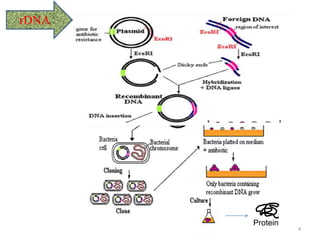
• Recombinant DNA technology involves taking genetic material from 
one source and recombining it in vitro with another source followed 
by introducing of recombined material into host cell. 
• Once a Recombinant DNA is inserted into bacteria, these bacteria 
will make protein based on this rDNA.This protein is know as 
Recombinant Protein. 
3
Protein 
4 
rDNA
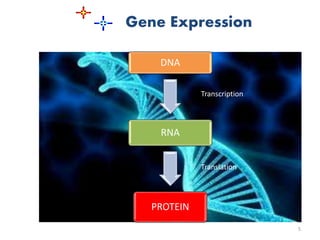
Gene Expression 
DNA 
RNA 
PROTEIN 
5 
Transcription 
Translation
Protein Expression and Purification 
• Isolation of genes. 
• Insertion of isolated gene to expression vector. 
• Transfer of recombinant vector into host cell through 
Transformation. 
• Identification and isolation of cells containing recombinant 
vector. 
• Growth of cells through fermentation. 
• Isolation and purification of protein. 
6
Production of Recombinant protein 
• There are basically two methods for producing recombinant 
proteins. 
• One is the molecular Cloning a laboratory method used to make 
recombinant DNA. 
• The other method is the Polymerase chain reaction used to 
proceed the replication of any specific DNA sequence selected . 
• The basic difference between the two methods is that molecular 
cloning incorporates the replication of the DNA within a living 
cell, whereas PCR replicates DNA in the test tube, without 
living cells. 
7
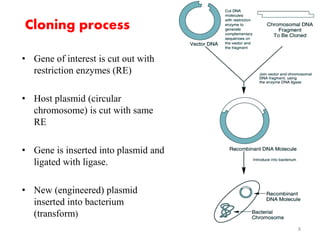
Cloning process 
• Gene of interest is cut out with 
restriction enzymes (RE) 
• Host plasmid (circular 
chromosome) is cut with same 
RE 
• Gene is inserted into plasmid and 
ligated with ligase. 
• New (engineered) plasmid 
inserted into bacterium 
(transform) 
8
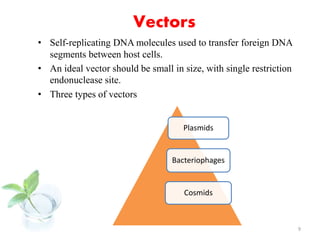
Vectors 
• Self-replicating DNA molecules used to transfer foreign DNA 
segments between host cells. 
• An ideal vector should be small in size, with single restriction 
endonuclease site. 
• Three types of vectors 
9 
Plasmids 
Bacteriophages 
Cosmids
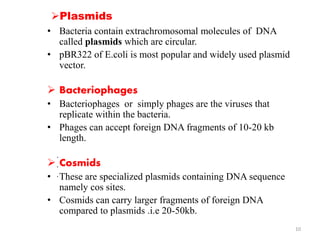
Plasmids 
• Bacteria contain extrachromosomal molecules of DNA 
called plasmids which are circular. 
• pBR322 of E.coli is most popular and widely used plasmid 
vector. 
 Bacteriophages 
• Bacteriophages or simply phages are the viruses that 
replicate within the bacteria. 
• Phages can accept foreign DNA fragments of 10-20 kb 
length. 
 Cosmids 
• These are specialized plasmids containing DNA sequence 
namely cos sites. 
• Cosmids can carry larger fragments of foreign DNA 
compared to plasmids .i.e 20-50kb. 
10 
. 
. 
.
Polymerize chain reaction 
• A method for amplifying DNA segments using cycles of 
denaturation, annealing to primers, and DNA polymerase-directed 
DNA synthesis 
• PCR copies a DNA molecule without restriction enzymes, vectors, 
or host cells . 
• Faster and easier than conventional cloning. 
• First Step in PCR: Denaturation 
1. DNA is heated to break the hydrogen bonds between the two 
polynucleotide strands. 
• Two single-stranded DNA molecules serve as templates. 
11
Second Step in PCR: Annealing 
2. Short nucleotide sequences (primers for DNA replication) are 
mixed with the DNA and bind to complementary regions on 
single-stranded DNA . 
• Takes place at lower temperature. 
• Primers are 20-30 nucleotides long, synthesized in the 
laboratory. 
 Third Step in PCR: DNA Synthesis 
3. The enzyme Taq polymerase is added to synthesize a 
complementary DNA strand. 
• Taq is a DNA polymerase from a bacterium found in hot 
springs. 
• These three steps make up one PCR cycle . 
12
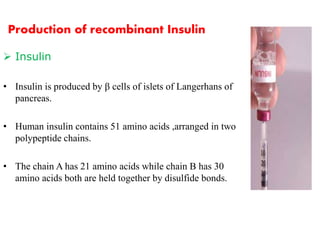
Production of recombinant Insulin 
 Insulin 
• Insulin is produced by β cells of islets of Langerhans of 
pancreas. 
• Human insulin contains 51 amino acids ,arranged in two 
polypeptide chains. 
• The chain A has 21 amino acids while chain B has 30 
amino acids both are held together by disulfide bonds.
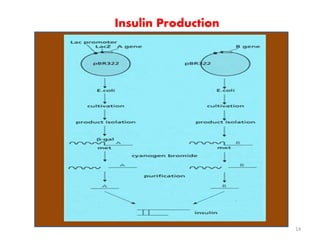
Insulin Production 
14
APPLICATIONS 
• Several proteins are created from recombinant DNA 
(recombinant proteins) and are used in medical applications. 
• Hematopoietic growth factor. 
• Interferon’s 
• Hormones 
• Recombinant protein vaccines 
• Tissue/bone growth factors and clotting factors 
• Biological response modifiers 
• Monoclonal/Diagnostic/Therapeutic antibodies 
• Recombinant proteins is extensively used in biotechnology, 
medicine and research. 
15
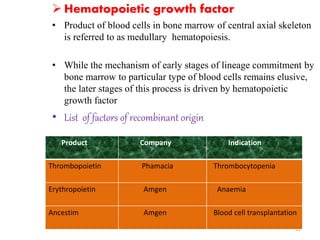
 Hematopoietic growth factor 
• Product of blood cells in bone marrow of central axial skeleton 
is referred to as medullary hematopoiesis. 
• While the mechanism of early stages of lineage commitment by 
bone marrow to particular type of blood cells remains elusive, 
the later stages of this process is driven by hematopoietic 
growth factor 
• List of factors of recombinant origin 
16 
Product Company Indication 
Thrombopoietin Phamacia Thrombocytopenia 
Erythropoietin Amgen Anaemia 
Ancestim Amgen Blood cell transplantation
Antibody Structure 
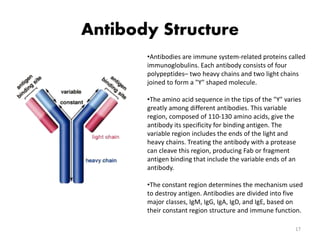
•Antibodies are immune system-related proteins called 
immunoglobulins. Each antibody consists of four 
polypeptides– two heavy chains and two light chains 
joined to form a "Y" shaped molecule. 
•The amino acid sequence in the tips of the "Y" varies 
greatly among different antibodies. This variable 
region, composed of 110-130 amino acids, give the 
antibody its specificity for binding antigen. The 
variable region includes the ends of the light and 
heavy chains. Treating the antibody with a protease 
can cleave this region, producing Fab or fragment 
antigen binding that include the variable ends of an 
antibody. 
•The constant region determines the mechanism used 
to destroy antigen. Antibodies are divided into five 
major classes, IgM, IgG, IgA, IgD, and IgE, based on 
their constant region structure and immune function. 
17
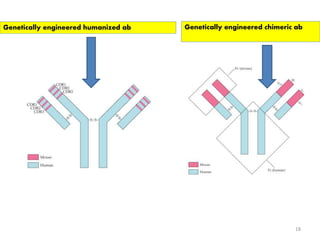
Genetically engineered humanized ab Genetically engineered chimeric ab 
18
 Interferons 
• In 1957 it was noted that infected by viruses produces protein called 
Interferon ,viral resistance to native cells. 
• Inability to produce sufficient quality and inadequate purity, limits the 
clinical use of interferons. 
• The problem of both purity and quality were resolved using 
recombinant DNA technology. 
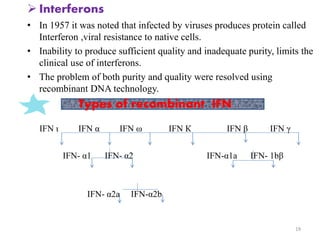
IFN ι IFN α IFN ω IFN К IFN β IFN γ 
IFN- α1 IFN- α2 IFN-α1a IFN- 1bβ 
IFN- α2a IFN-α2b 
19 
Types of recombinant IFN
 Hormones 
• Initially peptide and hormones used clinically were extracted 
and purified from animal or human source. 
• Since these extraction may also contain animal proteins or 
peptides their use can lead to development of antibodies. 
• There were limitations on use due to scarcity, contamination 
with other peptides and in some cases ineffectiveness. 
• By introduction of recombinant DNA techniques, 
synthesizing of proteins and peptides takes place. 
• In 1982 first recombinant protein hormone , insulin was 
introduced in USA. 
20
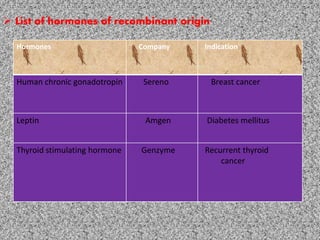
 List of hormones of recombinant origin 
21 
Hormones Company Indication 
Human chronic gonadotropin Sereno Breast cancer 
Leptin Amgen Diabetes mellitus 
Thyroid stimulating hormone Genzyme Recurrent thyroid 
cancer
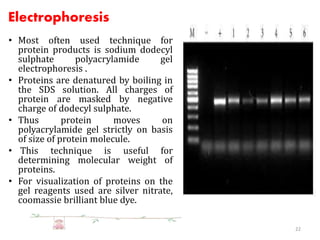
Electrophoresis 
• Most often used technique for 
protein products is sodium dodecyl 
sulphate polyacrylamide gel 
electrophoresis . 
• Proteins are denatured by boiling in 
the SDS solution. All charges of 
protein are masked by negative 
charge of dodecyl sulphate. 
• Thus protein moves on 
polyacrylamide gel strictly on basis 
of size of protein molecule. 
• This technique is useful for 
determining molecular weight of 
proteins. 
• For visualization of proteins on the 
gel reagents used are silver nitrate, 
coomassie brilliant blue dye. 
22
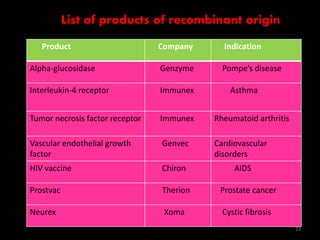
List of products of recombinant origin 
Product Company Indication 
Alpha-glucosidase Genzyme Pompe’s disease 
Interleukin-4 receptor Immunex Asthma 
Tumor necrosis factor receptor Immunex Rheumatoid arthritis 
Vascular endothelial growth 
factor 
Genvec Cardiovascular 
disorders 
HIV vaccine Chiron AIDS 
Prostvac Therion Prostate cancer 
Neurex Xoma Cystic fibrosis 
23
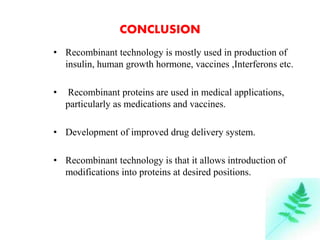
CONCLUSION 
• Recombinant technology is mostly used in production of 
insulin, human growth hormone, vaccines ,Interferons etc. 
• Recombinant proteins are used in medical applications, 
particularly as medications and vaccines. 
• Development of improved drug delivery system. 
• Recombinant technology is that it allows introduction of 
modifications into proteins at desired positions. 
24
REFERENCES 
• Daan J.A.Crommelin, Robert D.Sindelar. Pharmaceutical 
Biotechnology: An Introduction for Pharmacists and Pharmaceutical 
Scientists. 2nd Edition. London: Taylor & Francis Routledge; pg no.5- 
18 
• U.Satyanarayana. Biotechnology ,pg no.75-85;189-198 
 WEBSITES 
 http://www.innovateus.net/science/what-are-recombinant-proteins . 
 http://en.wikipedia.org/wiki/Recombinant_DNA . 
 http://www.accessexcellence.org/RC/VL/GG/plasmid.php 
25
26

Recombinant protein

  • 1.
    SEMINAR ON 1 EVALUATION OF RECOMBINANT PROTEINS Presented by, D. Pranitha, M. Pharmacy 2sem, Pharmaceutics.
  • 2.
    CONTENTS Introduction Geneexpression Protein Expression and Purification Production of Recombinant Proteins Applications Conclusion References 2
  • 3.
    Introduction • Proteinsare the most abundant organic molecules of the living system. They have significant role in structural and functional organisation of the cell. • Proteins that result from the expression of recombinant DNA within living cells are termed recombinant proteins. • Recombinant DNA technology involves taking genetic material from one source and recombining it in vitro with another source followed by introducing of recombined material into host cell. • Once a Recombinant DNA is inserted into bacteria, these bacteria will make protein based on this rDNA.This protein is know as Recombinant Protein. 3
  • 4.
  • 5.
    Gene Expression DNA RNA PROTEIN 5 Transcription Translation
  • 6.
    Protein Expression andPurification • Isolation of genes. • Insertion of isolated gene to expression vector. • Transfer of recombinant vector into host cell through Transformation. • Identification and isolation of cells containing recombinant vector. • Growth of cells through fermentation. • Isolation and purification of protein. 6
  • 7.
    Production of Recombinantprotein • There are basically two methods for producing recombinant proteins. • One is the molecular Cloning a laboratory method used to make recombinant DNA. • The other method is the Polymerase chain reaction used to proceed the replication of any specific DNA sequence selected . • The basic difference between the two methods is that molecular cloning incorporates the replication of the DNA within a living cell, whereas PCR replicates DNA in the test tube, without living cells. 7
  • 8.
    Cloning process •Gene of interest is cut out with restriction enzymes (RE) • Host plasmid (circular chromosome) is cut with same RE • Gene is inserted into plasmid and ligated with ligase. • New (engineered) plasmid inserted into bacterium (transform) 8
  • 9.
    Vectors • Self-replicatingDNA molecules used to transfer foreign DNA segments between host cells. • An ideal vector should be small in size, with single restriction endonuclease site. • Three types of vectors 9 Plasmids Bacteriophages Cosmids
  • 10.
    Plasmids • Bacteriacontain extrachromosomal molecules of DNA called plasmids which are circular. • pBR322 of E.coli is most popular and widely used plasmid vector.  Bacteriophages • Bacteriophages or simply phages are the viruses that replicate within the bacteria. • Phages can accept foreign DNA fragments of 10-20 kb length.  Cosmids • These are specialized plasmids containing DNA sequence namely cos sites. • Cosmids can carry larger fragments of foreign DNA compared to plasmids .i.e 20-50kb. 10 . . .
  • 11.
    Polymerize chain reaction • A method for amplifying DNA segments using cycles of denaturation, annealing to primers, and DNA polymerase-directed DNA synthesis • PCR copies a DNA molecule without restriction enzymes, vectors, or host cells . • Faster and easier than conventional cloning. • First Step in PCR: Denaturation 1. DNA is heated to break the hydrogen bonds between the two polynucleotide strands. • Two single-stranded DNA molecules serve as templates. 11
  • 12.
    Second Step inPCR: Annealing 2. Short nucleotide sequences (primers for DNA replication) are mixed with the DNA and bind to complementary regions on single-stranded DNA . • Takes place at lower temperature. • Primers are 20-30 nucleotides long, synthesized in the laboratory.  Third Step in PCR: DNA Synthesis 3. The enzyme Taq polymerase is added to synthesize a complementary DNA strand. • Taq is a DNA polymerase from a bacterium found in hot springs. • These three steps make up one PCR cycle . 12
  • 13.
    Production of recombinantInsulin  Insulin • Insulin is produced by β cells of islets of Langerhans of pancreas. • Human insulin contains 51 amino acids ,arranged in two polypeptide chains. • The chain A has 21 amino acids while chain B has 30 amino acids both are held together by disulfide bonds.
  • 14.
  • 15.
    APPLICATIONS • Severalproteins are created from recombinant DNA (recombinant proteins) and are used in medical applications. • Hematopoietic growth factor. • Interferon’s • Hormones • Recombinant protein vaccines • Tissue/bone growth factors and clotting factors • Biological response modifiers • Monoclonal/Diagnostic/Therapeutic antibodies • Recombinant proteins is extensively used in biotechnology, medicine and research. 15
  • 16.
     Hematopoietic growthfactor • Product of blood cells in bone marrow of central axial skeleton is referred to as medullary hematopoiesis. • While the mechanism of early stages of lineage commitment by bone marrow to particular type of blood cells remains elusive, the later stages of this process is driven by hematopoietic growth factor • List of factors of recombinant origin 16 Product Company Indication Thrombopoietin Phamacia Thrombocytopenia Erythropoietin Amgen Anaemia Ancestim Amgen Blood cell transplantation
  • 17.
    Antibody Structure •Antibodiesare immune system-related proteins called immunoglobulins. Each antibody consists of four polypeptides– two heavy chains and two light chains joined to form a "Y" shaped molecule. •The amino acid sequence in the tips of the "Y" varies greatly among different antibodies. This variable region, composed of 110-130 amino acids, give the antibody its specificity for binding antigen. The variable region includes the ends of the light and heavy chains. Treating the antibody with a protease can cleave this region, producing Fab or fragment antigen binding that include the variable ends of an antibody. •The constant region determines the mechanism used to destroy antigen. Antibodies are divided into five major classes, IgM, IgG, IgA, IgD, and IgE, based on their constant region structure and immune function. 17
  • 18.
    Genetically engineered humanizedab Genetically engineered chimeric ab 18
  • 19.
     Interferons •In 1957 it was noted that infected by viruses produces protein called Interferon ,viral resistance to native cells. • Inability to produce sufficient quality and inadequate purity, limits the clinical use of interferons. • The problem of both purity and quality were resolved using recombinant DNA technology. IFN ι IFN α IFN ω IFN К IFN β IFN γ IFN- α1 IFN- α2 IFN-α1a IFN- 1bβ IFN- α2a IFN-α2b 19 Types of recombinant IFN
  • 20.
     Hormones •Initially peptide and hormones used clinically were extracted and purified from animal or human source. • Since these extraction may also contain animal proteins or peptides their use can lead to development of antibodies. • There were limitations on use due to scarcity, contamination with other peptides and in some cases ineffectiveness. • By introduction of recombinant DNA techniques, synthesizing of proteins and peptides takes place. • In 1982 first recombinant protein hormone , insulin was introduced in USA. 20
  • 21.
     List ofhormones of recombinant origin 21 Hormones Company Indication Human chronic gonadotropin Sereno Breast cancer Leptin Amgen Diabetes mellitus Thyroid stimulating hormone Genzyme Recurrent thyroid cancer
  • 22.
    Electrophoresis • Mostoften used technique for protein products is sodium dodecyl sulphate polyacrylamide gel electrophoresis . • Proteins are denatured by boiling in the SDS solution. All charges of protein are masked by negative charge of dodecyl sulphate. • Thus protein moves on polyacrylamide gel strictly on basis of size of protein molecule. • This technique is useful for determining molecular weight of proteins. • For visualization of proteins on the gel reagents used are silver nitrate, coomassie brilliant blue dye. 22
  • 23.
    List of productsof recombinant origin Product Company Indication Alpha-glucosidase Genzyme Pompe’s disease Interleukin-4 receptor Immunex Asthma Tumor necrosis factor receptor Immunex Rheumatoid arthritis Vascular endothelial growth factor Genvec Cardiovascular disorders HIV vaccine Chiron AIDS Prostvac Therion Prostate cancer Neurex Xoma Cystic fibrosis 23
  • 24.
    CONCLUSION • Recombinanttechnology is mostly used in production of insulin, human growth hormone, vaccines ,Interferons etc. • Recombinant proteins are used in medical applications, particularly as medications and vaccines. • Development of improved drug delivery system. • Recombinant technology is that it allows introduction of modifications into proteins at desired positions. 24
  • 25.
    REFERENCES • DaanJ.A.Crommelin, Robert D.Sindelar. Pharmaceutical Biotechnology: An Introduction for Pharmacists and Pharmaceutical Scientists. 2nd Edition. London: Taylor & Francis Routledge; pg no.5- 18 • U.Satyanarayana. Biotechnology ,pg no.75-85;189-198  WEBSITES  http://www.innovateus.net/science/what-are-recombinant-proteins .  http://en.wikipedia.org/wiki/Recombinant_DNA .  http://www.accessexcellence.org/RC/VL/GG/plasmid.php 25
  • 26.