8-Nov-16 1Planar Passive Components and Filters
Lumped Elements in MICs
• lumped elements, which by definition are
small in size in comparison with the guide
wavelength in any transmission line that may
be associated with them.
• Examples of lumped elements are resistors,
capacitors, inductors, discontinuities, and
resonators.
8-Nov-16 2Planar Passive Components and Filters
• Lumped elements are usually easily realized in
RF or low-frequency microwave applications.
• At higher microwave frequencies, and
particularly at millimetre-wave frequencies,
lumped elements are very difficult, or even
impossible, to achieve because of dimensional
limitations in fabrication technologies.
• The upper limit for the use of lumped elements
is approximately 40 GHz, and for higher
frequencies, only distributed elements are
practical.
8-Nov-16 3Planar Passive Components and Filters
• The advantages are usually small dimensions,
wideband characteristics, and low production
cost.
• Their drawbacks are lower Q and lower
power-handling capability as compared with
distributed circuits.
8-Nov-16 4Planar Passive Components and Filters
CAPACITORS
• Capacitors are lumped circuit elements that store
energy by virtue of electric fields. For MICs,
capacitors can be conveniently realized in several
different configurations.
• Chip capacitors are frequently used in the
construction of MICs when relatively high
capacitance values are required in circuit
applications.
• In these cases, the chips are attached to the
transmission lines by various bonding techniques
8-Nov-16 Planar Passive Components and Filters 5
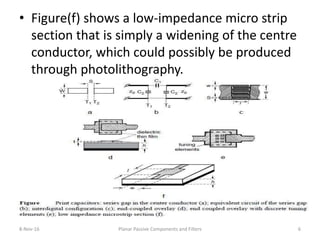
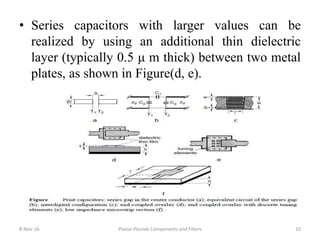
• Figure(f) shows a low-impedance micro strip
section that is simply a widening of the centre
conductor, which could possibly be produced
through photolithography.
8-Nov-16 Planar Passive Components and Filters 6
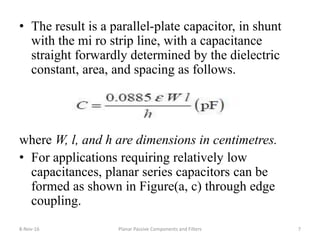
• The result is a parallel-plate capacitor, in shunt
with the mi ro strip line, with a capacitance
straight forwardly determined by the dielectric
constant, area, and spacing as follows.
where W, l, and h are dimensions in centimetres.
• For applications requiring relatively low
capacitances, planar series capacitors can be
formed as shown in Figure(a, c) through edge
coupling.
8-Nov-16 Planar Passive Components and Filters 7
• They do not require any dielectric films, which
simplify the design.
• Due to high current densities at the edges, they
exhibit low Q-factors, typically less than 50 at
operating frequencies in the 10-GHz range.
• Capacitance values for these edge-coupled types
are typically less than 0.5 pF.
8-Nov-16 Planar Passive Components and Filters 8
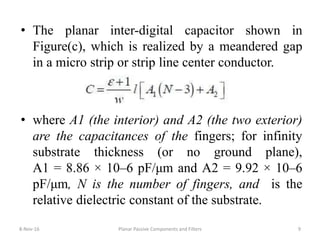
• The planar inter-digital capacitor shown in
Figure(c), which is realized by a meandered gap
in a micro strip or strip line center conductor.
• where A1 (the interior) and A2 (the two exterior)
are the capacitances of the fingers; for infinity
substrate thickness (or no ground plane),
A1 = 8.86 × 10⁻⁶ pF/μm and A2 = 9.92 × 10⁻⁶
pF/μm, N is the number of fingers, and is the
relative dielectric constant of the substrate.
8-Nov-16 Planar Passive Components and Filters 9
• Series capacitors with larger values can be
realized by using an additional thin dielectric
layer (typically 0.5 μ m thick) between two metal
plates, as shown in Figure(d, e).
8-Nov-16 Planar Passive Components and Filters 10
• These overlay structures use dielectric film
materials, such as silicon nitride Si3N4 ( = 6.8),
SiO2( = 4–5), Ta2O5 ( = 20–25), Al2O3 ( = 6–10)
etc.
• These capacitors are used to achieve higher
values in small areas. Tolerances of these
capacitance normally run from 10% to 15%. For
better capacitance control and tuning capability,
we can use overlay configurations with tuning
elements [Figure 4.1(e)].
• Overlay capacitor values as high as 10 pF can be
realized within small areas.
8-Nov-16 Planar Passive Components and Filters 11
INDUCTORS
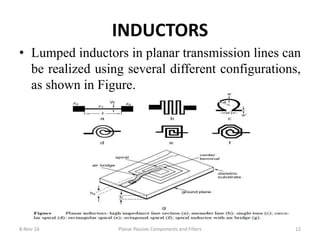
• Lumped inductors in planar transmission lines can
be realized using several different configurations,
as shown in Figure.
8-Nov-16 Planar Passive Components and Filters 12
• The simplest configuration [Figure(a)] consists of a short
section of high-impedance line that is achieved by simply
narrowing the center conductor over a short length.
where l, W, and t (conductor thickness) are in centimetres,
and kg is a correction factor to take into account the effect
of a ground plane.
for W/H>0.05 where h is the spacing from the ground
plane.
8-Nov-16 Planar Passive Components and Filters 13
8-Nov-16 Planar Passive Components and Filters 14
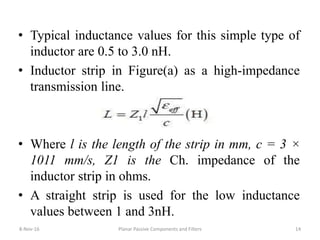
• Typical inductance values for this simple type of
inductor are 0.5 to 3.0 nH.
• Inductor strip in Figure(a) as a high-impedance
transmission line.
• Where l is the length of the strip in mm, c = 3 ×
1011 mm/s, Z1 is the Ch. impedance of the
inductor strip in ohms.
• A straight strip is used for the low inductance
values between 1 and 3nH.
• The meander line inductor [Figure(b)] is used to
reduce the area occupied by the element.
• In the meander inductor, adjacent conductors have
equal and opposite current flows, which reduce
the total inductance.
• A single-turn circular inductor in Figure(c) has an
inductance.
where a, W, and t are in centimetres.
8-Nov-16 Planar Passive Components and Filters 15
• Spiral inductors can have a circular [Figure (d)], a
rectangular [Figure(e)], or an octagonal [Figure
(f)] configuration.
• The general relationship for a circular spiral is
where a = (D + d)/4, c = (D – d)/2, D and d are,
respectively, the maximum and minimum
diameters of a circular spiral, in millimetres, and
n is the number of turns.
8-Nov-16 Planar Passive Components and Filters 16
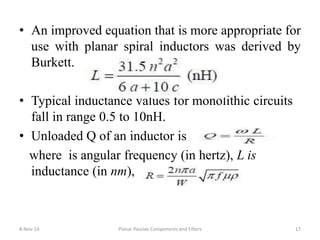
• An improved equation that is more appropriate for
use with planar spiral inductors was derived by
Burkett.
• Typical inductance values for monolithic circuits
fall in range 0.5 to 10nH.
• Unloaded Q of an inductor is
where is angular frequency (in hertz), L is
inductance (in nm),
8-Nov-16 Planar Passive Components and Filters 17
RESISTORS
• The desirable characteristics of film resistors are:
a) Low temperature coefficient of resistance
(TCR).
b) Good adhesion of the resistive film to substrate
and conductors.
c) Minimal dimensions because transmission line
effects are to be ignored.
d) Adequate dissipation capability.
e) Good stable resistance value, which should not
change with time.
8-Nov-16 Planar Passive Components and Filters 18
• Lumped-element resistors can be used in
attenuators, dividers/combiners, and biasing
circuits, and they can also act as matched
terminations.
• Resistors for MIC may be realized in chip form
or fabricated by planar construction.
8-Nov-16 Planar Passive Components and Filters 19
8-Nov-16 Planar Passive Components and Filters 20
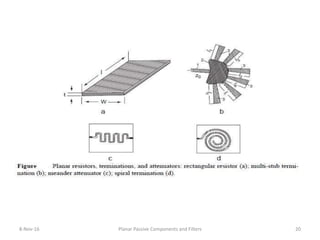
• Planar resistors are produced by depositing films
of lossy metal on the dielectric base.
• Nichrome and tantalum are widely used due to
their good stability and low TCR.
• The resistance of a film rectangular resistor
[Figure(a)] of length l, width W, and thickness t is
given by
8-Nov-16 Planar Passive Components and Filters 21
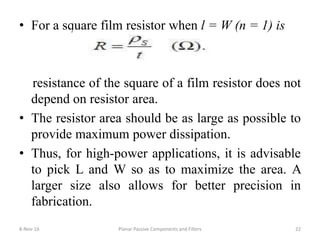
• For a square film resistor when l = W (n = 1) is
resistance of the square of a film resistor does not
depend on resistor area.
• The resistor area should be as large as possible to
provide maximum power dissipation.
• Thus, for high-power applications, it is advisable
to pick L and W so as to maximize the area. A
larger size also allows for better precision in
fabrication.
8-Nov-16 Planar Passive Components and Filters 22
• The biggest problems in planar resistor are the
parasitic capacitance and inductance, which make
the film resistor exhibit a frequency dependence
at high frequency range.
• Lumped resistors are used in the design of
matched terminations.
• Resistive attenuators (pads) have many
applications as series loss elements, step
attenuators , and return loss control devices.
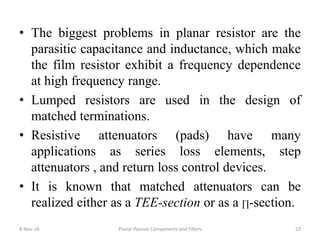
• It is known that matched attenuators can be
realized either as a TEE-section or as a ∏-section.
8-Nov-16 Planar Passive Components and Filters 23
Filters
• RF and microwave filters suppress unwanted signals
and separate signals of different frequencies.
• Filters can be classified into five different categories
of characteristics.
1. Frequency selection:
a. Low-pass frequency (LPF).
b. High-pass frequency (HPF).
c. Band-pass frequency (BPF).
d. Band-stop frequency (BSF).
8-Nov-16 Planar Passive Components and Filters 24
2. Filter response:
a. Chebyshev.
b. Butterworth.
c. Other (elliptical, Bessel, Gaussian, and so
forth).
3. Percentage bandwidth:
a. Narrowband (0%–20%).
b. Moderate band (10%–50%).
c. Wideband (over 50%).
4. Type of elements:
a. Distributed elements.
b. Lumped elements.
8-Nov-16 Planar Passive Components and Filters 25
5. Construction types:
a. Stepped impedance.
b. Parallel coupled line.
c. End-coupled line.
d. Inter digital.
e. Comb-line.
f. Hairpin.
g. Irregular line.
8-Nov-16 Planar Passive Components and Filters 26
Low-pass frequency (LPF)
• The low-pass has the cut-off frequency, defined
by the specified insertion loss in decibels, at
which the pass-band ends.
• The LPF transfers energy to the load at
frequencies lower than the cut-off frequency with
minimal attenuation and reflects an increasing
fraction of the energy back to the source as the
frequency is increased above the cut-off
frequency.
8-Nov-16 Planar Passive Components and Filters 27
• In the case of LPF, all frequencies below a set
frequency are selected, and all frequencies
above this same set frequency are unwanted.
8-Nov-16 Planar Passive Components and Filters 28
Stepped-Impedance LPF
• TEM structures of strip-line and micro strip lines
are ideal for LPFs.
• A waveguide LPF is not possible because
waveguides have low cut-off frequencies.
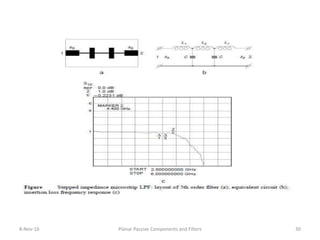
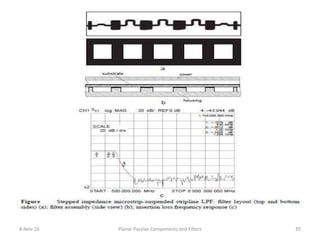
• Figure illustrates the relationship between a
microwave low-pass filter and a low-frequency
low-pass filter prototype.
8-Nov-16 Planar Passive Components and Filters 29
8-Nov-16 Planar Passive Components and Filters 30
• A short section of a high-impedance transmission
line can approximate a series inductance.
• A short section of a low-impedance transmission
line can approximate a shunt capacitor.
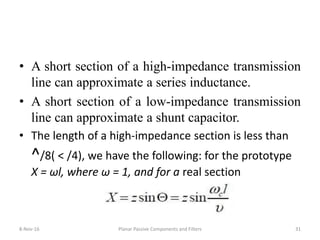
• The length of a high-impedance section is less than
^/8( < /4), we have the following: for the prototype
X = ωl, where ω = 1, and for a real section
8-Nov-16 Planar Passive Components and Filters 31
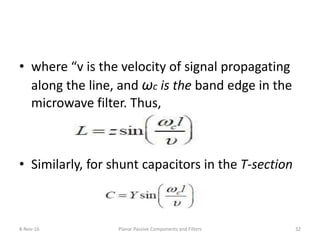
• where “v is the velocity of signal propagating
along the line, and ωc is the band edge in the
microwave filter. Thus,
• Similarly, for shunt capacitors in the T-section
8-Nov-16 Planar Passive Components and Filters 32
• If we connect ∏- and T-sections, or cascade the
equivalent high- and low-impedance transmission
lines using these elements as basic building
blocks, we obtain a low-pass filter.
• The filter selectivity increases with the number of
sections.
• A shorter section electrical length provides a
broader stop-band.
8-Nov-16 Planar Passive Components and Filters 33
• The input can be either a shunt capacitor or a
series inductor.
• Shunt capacitances should be realized by sections
having the lowest possible characteristic
impedance, while series inductances should be
realized by sections with the highest possible
impedance.
• Micro strip line has a relatively low Q-factor, and
if a lower loss LPF is required, higher Q
transmission lines are more suitable.
8-Nov-16 Planar Passive Components and Filters 34
8-Nov-16 Planar Passive Components and Filters 35
Lumped-Element LPF
• At lower frequencies, lumped-element LPFs are
more practical.
• Lumped-element LPF can be realized based on
lumped-element capacitors and print planar
inductors.
• Circuit elements in this filter must be much
smaller than the wavelength in the transmission
line.
• Application of lumped-element filters is limited
by the extremely small dimensions required.
8-Nov-16 Planar Passive Components and Filters 36
• Real lumped-element filters are designed in the
range of up to 2 GHz.
• The performance of lumped-element filters is
usually limited by the conductor loss of the
inductive elements.
8-Nov-16 Planar Passive Components and Filters 37
High-pass frequency (HPF)
• The HPF transfers energy to the load at
frequencies higher than the cut-off frequency
with minimal attenuation and reflects an
increasing fraction of the energy back to the
source as the frequency is decreased below the
cut-off frequency.
8-Nov-16 Planar Passive Components and Filters 38
Band-pass/stop frequency
• The BP and BS filter Ch. have two cutoff
frequencies, or band-edge frequencies, which are
defined by the specified insertion loss in decibels.
• In the BPF, energy is transferred to the load in a
band of frequencies between the lower and upper
cutoff frequencies.
• In the BSF energy transfers to the load in two
frequency bands: from dc to the lower bandstop
cutoff and from the upper bandstop cutoff to
infinite frequency.
8-Nov-16 Planar Passive Components and Filters 39
• BPFs are important components in different
systems. They provide frequency selectivity and
affect receiver sensitivity.
Parallel Coupled-Line BPF:
• The typical planar bandpass filter consists of a
cascade of parallel coupled half-wavelength-
long printed resonators that are open circuited
at both ends.
8-Nov-16 Planar Passive Components and Filters 40
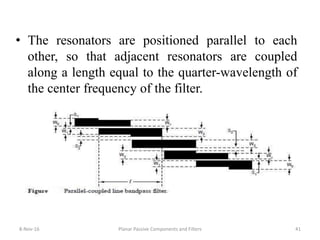
• The resonators are positioned parallel to each
other, so that adjacent resonators are coupled
along a length equal to the quarter-wavelength of
the center frequency of the filter.
8-Nov-16 Planar Passive Components and Filters 41
8-Nov-16 Planar Passive Components and Filters 42
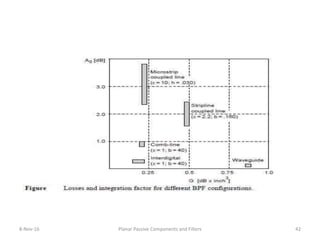
• Parallel-coupled micro strip band-pass filters are
small in size and easy to fabricate due to the
absence of short circuits.
• The disadvantages of these filters are parasitic
bandwidths, the difficulty of obtaining a narrow
band, and the radiation from open ends.
8-Nov-16 Planar Passive Components and Filters 43
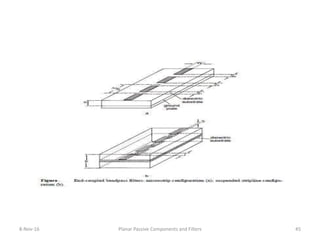
End-Coupled BPF
• A basic end-coupled micro strip or strip line BPF
consists of a series of half-wavelength-long strip
resonators spaced by capacitive gaps.
• An advantage of this filter is constant, narrow
width.
• The long and narrow end-coupled filters can fit
into a long metal housing, which has a higher cut-
off frequency for undesired waveguide modes.
8-Nov-16 Planar Passive Components and Filters 44
8-Nov-16 Planar Passive Components and Filters 45
• The end coupled BPF becomes extremely long as
the frequency is decreased. Its length is two times
greater than the length of the parallel coupled
filter.
• Resonators in an end-coupled BPF are close in
length. The distances between the centers of the
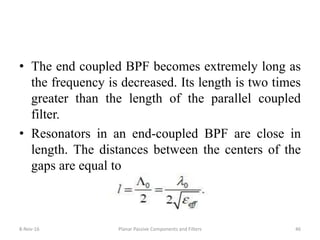
gaps are equal to
8-Nov-16 Planar Passive Components and Filters 46
• An end-coupled single-layer BPF provides only a
narrow band-pass.
• Medium-band and wideband filters require a
tighter coupling.
• Filters based on a two-layer configuration of
suspended strip-line [Figure] provide a compact
structure with wide pass-bands.
• End-coupled BPF, a wide range of coupling
coefficients is possible.
8-Nov-16 Planar Passive Components and Filters 47
Interdigital BPF
• An interdigital filter is constructed from an array
of quarter-wave long coupled lines by alternately
short- and open-circuiting opposite ends of each
conductor.
• Interdigital filters are usually designed for fixed
frequencies.
8-Nov-16 Planar Passive Components and Filters 48
8-Nov-16 Planar Passive Components and Filters 49
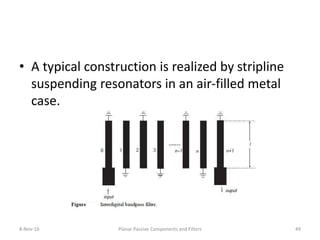
• A typical construction is realized by stripline
suspending resonators in an air-filled metal
case.
• Micro strip interdigital filters are compact, but
suffer from severe asymmetry of the filter
response due to the effect of coupling between
nonadjacent resonators.
• Interdigital filters achieve good electrical
characteristics (low losses and narrow or wide
passbands)
• The bandwidth of interdigital filters can vary
between 1% and 70%.
8-Nov-16 Planar Passive Components and Filters 50
• The filter has the maximum attenuation in the
areas of even harmonics.
• this type of filter construction is very solid and
reliable, it is expensive due to the required
machining and extremely tight tolerances.
• It is difficult in practice to build a shorted
resonator of exactly the desired quarter guide
wavelength.
8-Nov-16 Planar Passive Components and Filters 51
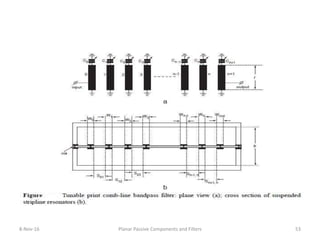
Comb-Line BPF
• Comb-line BPF consists of set of parallel
grounded resonators that are short-circuited
at one end, with a lumped capacitance
between the other end and ground.
• A comb-line filter with these capacitors and
stab-line resonators has very low losses
8-Nov-16 Planar Passive Components and Filters 52
8-Nov-16 Planar Passive Components and Filters 53
• The bandwidth of comb-line filters is a function
of the ground-plane spacing, b, to the wavelength
ratio (b/ᴧ) and spacing, S, between resonators.
• The bandwidth is greater for greater b/0 and S.
• A bandwidth of comb-line filters from 2% to 50%
can be obtained.
• Positioning the resonator closer together provides
wider bandwidth
8-Nov-16 Planar Passive Components and Filters 54
Hairpin BPF
• The hairpin filter does not require any ground
connection.
• Open-circuit resonators reduce free-space
radiation due to phase cancellation of fields at the
ends.
• The radiation decreases with decreasing space
between the folded lines of the hairpin
8-Nov-16 Planar Passive Components and Filters 55
8-Nov-16 Planar Passive Components and Filters 56
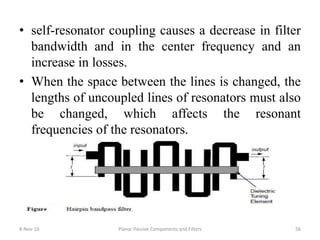
• self-resonator coupling causes a decrease in filter
bandwidth and in the center frequency and an
increase in losses.
• When the space between the lines is changed, the
lengths of uncoupled lines of resonators must also
be changed, which affects the resonant
frequencies of the resonators.
• Microstrip narrowband hairpin filters require
quite large resonator spacing in order to achieve.
• The center frequency can be adjusted by the
special dielectric plate(Figure) placed near the
symmetry plane the desired narrowband.
8-Nov-16 Planar Passive Components and Filters 57
Chebyshev and Butterworth
• The most popular solutions for the filter transfer
function are the Chebyshev and Butterworth
responses.
• Butterworth function filters have no ripples—
insertion loss is flat in the frequency band (thus,
the popular name “maximally flat”) and rises
monotonously with changing frequency.
8-Nov-16 Planar Passive Components and Filters 58
• The insertion loss for this response is
where
is the ripple factor, ar is the passband attenuation
ripple in decibels, is the desired angular
frequency, c is the cutoff angular frequency, and
n is the order of the filter (the number of reactive
elements required to obtain the desired response).
8-Nov-16 Planar Passive Components and Filters 59
• A Chebyshev function filter provides the sharpest
possible rise of the insertion loss with frequency
for a maximum specified passband insertion loss
ripple (small changes in the attenuation
characteristic of a passband).
• The Chebyshev function produces greater
rejection amplitude response than the Butterworth
function, but has a slight ripple in the passband
and greater phase shift and time- or group-delay
variations.
8-Nov-16 Planar Passive Components and Filters 60
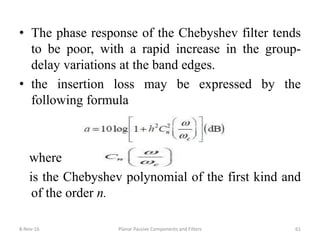
• The phase response of the Chebyshev filter tends
to be poor, with a rapid increase in the group-
delay variations at the band edges.
• the insertion loss may be expressed by the
following formula
where
is the Chebyshev polynomial of the first kind and
of the order n.
8-Nov-16 Planar Passive Components and Filters 61
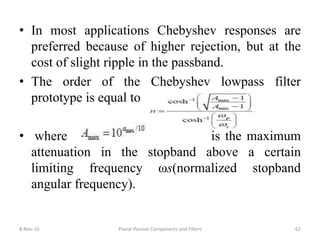
• In most applications Chebyshev responses are
preferred because of higher rejection, but at the
cost of slight ripple in the passband.
• The order of the Chebyshev lowpass filter
prototype is equal to
• where is the maximum
attenuation in the stopband above a certain
limiting frequency ωs(normalized stopband
angular frequency).
8-Nov-16 Planar Passive Components and Filters 62
8-Nov-16 Planar Passive Components and Filters 63
• is the minimum level of ripples
in the passband attenuation in the passband, p is
normalized angular passband frequency, and max
and min are attenuation in decibels.
• The order of the Butterworth lowpass filter
prototype is
8-Nov-16 Planar Passive Components and Filters 64

Planar Passive Components and Filters (MMICs)

  • 1.
    8-Nov-16 1Planar PassiveComponents and Filters
  • 2.
    Lumped Elements inMICs • lumped elements, which by definition are small in size in comparison with the guide wavelength in any transmission line that may be associated with them. • Examples of lumped elements are resistors, capacitors, inductors, discontinuities, and resonators. 8-Nov-16 2Planar Passive Components and Filters
  • 3.
    • Lumped elementsare usually easily realized in RF or low-frequency microwave applications. • At higher microwave frequencies, and particularly at millimetre-wave frequencies, lumped elements are very difficult, or even impossible, to achieve because of dimensional limitations in fabrication technologies. • The upper limit for the use of lumped elements is approximately 40 GHz, and for higher frequencies, only distributed elements are practical. 8-Nov-16 3Planar Passive Components and Filters
  • 4.
    • The advantagesare usually small dimensions, wideband characteristics, and low production cost. • Their drawbacks are lower Q and lower power-handling capability as compared with distributed circuits. 8-Nov-16 4Planar Passive Components and Filters
  • 5.
    CAPACITORS • Capacitors arelumped circuit elements that store energy by virtue of electric fields. For MICs, capacitors can be conveniently realized in several different configurations. • Chip capacitors are frequently used in the construction of MICs when relatively high capacitance values are required in circuit applications. • In these cases, the chips are attached to the transmission lines by various bonding techniques 8-Nov-16 Planar Passive Components and Filters 5
  • 6.
    • Figure(f) showsa low-impedance micro strip section that is simply a widening of the centre conductor, which could possibly be produced through photolithography. 8-Nov-16 Planar Passive Components and Filters 6
  • 7.
    • The resultis a parallel-plate capacitor, in shunt with the mi ro strip line, with a capacitance straight forwardly determined by the dielectric constant, area, and spacing as follows. where W, l, and h are dimensions in centimetres. • For applications requiring relatively low capacitances, planar series capacitors can be formed as shown in Figure(a, c) through edge coupling. 8-Nov-16 Planar Passive Components and Filters 7
  • 8.
    • They donot require any dielectric films, which simplify the design. • Due to high current densities at the edges, they exhibit low Q-factors, typically less than 50 at operating frequencies in the 10-GHz range. • Capacitance values for these edge-coupled types are typically less than 0.5 pF. 8-Nov-16 Planar Passive Components and Filters 8
  • 9.
    • The planarinter-digital capacitor shown in Figure(c), which is realized by a meandered gap in a micro strip or strip line center conductor. • where A1 (the interior) and A2 (the two exterior) are the capacitances of the fingers; for infinity substrate thickness (or no ground plane), A1 = 8.86 × 10⁻⁶ pF/μm and A2 = 9.92 × 10⁻⁶ pF/μm, N is the number of fingers, and is the relative dielectric constant of the substrate. 8-Nov-16 Planar Passive Components and Filters 9
  • 10.
    • Series capacitorswith larger values can be realized by using an additional thin dielectric layer (typically 0.5 μ m thick) between two metal plates, as shown in Figure(d, e). 8-Nov-16 Planar Passive Components and Filters 10
  • 11.
    • These overlaystructures use dielectric film materials, such as silicon nitride Si3N4 ( = 6.8), SiO2( = 4–5), Ta2O5 ( = 20–25), Al2O3 ( = 6–10) etc. • These capacitors are used to achieve higher values in small areas. Tolerances of these capacitance normally run from 10% to 15%. For better capacitance control and tuning capability, we can use overlay configurations with tuning elements [Figure 4.1(e)]. • Overlay capacitor values as high as 10 pF can be realized within small areas. 8-Nov-16 Planar Passive Components and Filters 11
  • 12.
    INDUCTORS • Lumped inductorsin planar transmission lines can be realized using several different configurations, as shown in Figure. 8-Nov-16 Planar Passive Components and Filters 12
  • 13.
    • The simplestconfiguration [Figure(a)] consists of a short section of high-impedance line that is achieved by simply narrowing the center conductor over a short length. where l, W, and t (conductor thickness) are in centimetres, and kg is a correction factor to take into account the effect of a ground plane. for W/H>0.05 where h is the spacing from the ground plane. 8-Nov-16 Planar Passive Components and Filters 13
  • 14.
    8-Nov-16 Planar PassiveComponents and Filters 14 • Typical inductance values for this simple type of inductor are 0.5 to 3.0 nH. • Inductor strip in Figure(a) as a high-impedance transmission line. • Where l is the length of the strip in mm, c = 3 × 1011 mm/s, Z1 is the Ch. impedance of the inductor strip in ohms. • A straight strip is used for the low inductance values between 1 and 3nH.
  • 15.
    • The meanderline inductor [Figure(b)] is used to reduce the area occupied by the element. • In the meander inductor, adjacent conductors have equal and opposite current flows, which reduce the total inductance. • A single-turn circular inductor in Figure(c) has an inductance. where a, W, and t are in centimetres. 8-Nov-16 Planar Passive Components and Filters 15
  • 16.
    • Spiral inductorscan have a circular [Figure (d)], a rectangular [Figure(e)], or an octagonal [Figure (f)] configuration. • The general relationship for a circular spiral is where a = (D + d)/4, c = (D – d)/2, D and d are, respectively, the maximum and minimum diameters of a circular spiral, in millimetres, and n is the number of turns. 8-Nov-16 Planar Passive Components and Filters 16
  • 17.
    • An improvedequation that is more appropriate for use with planar spiral inductors was derived by Burkett. • Typical inductance values for monolithic circuits fall in range 0.5 to 10nH. • Unloaded Q of an inductor is where is angular frequency (in hertz), L is inductance (in nm), 8-Nov-16 Planar Passive Components and Filters 17
  • 18.
    RESISTORS • The desirablecharacteristics of film resistors are: a) Low temperature coefficient of resistance (TCR). b) Good adhesion of the resistive film to substrate and conductors. c) Minimal dimensions because transmission line effects are to be ignored. d) Adequate dissipation capability. e) Good stable resistance value, which should not change with time. 8-Nov-16 Planar Passive Components and Filters 18
  • 19.
    • Lumped-element resistorscan be used in attenuators, dividers/combiners, and biasing circuits, and they can also act as matched terminations. • Resistors for MIC may be realized in chip form or fabricated by planar construction. 8-Nov-16 Planar Passive Components and Filters 19
  • 20.
    8-Nov-16 Planar PassiveComponents and Filters 20
  • 21.
    • Planar resistorsare produced by depositing films of lossy metal on the dielectric base. • Nichrome and tantalum are widely used due to their good stability and low TCR. • The resistance of a film rectangular resistor [Figure(a)] of length l, width W, and thickness t is given by 8-Nov-16 Planar Passive Components and Filters 21
  • 22.
    • For asquare film resistor when l = W (n = 1) is resistance of the square of a film resistor does not depend on resistor area. • The resistor area should be as large as possible to provide maximum power dissipation. • Thus, for high-power applications, it is advisable to pick L and W so as to maximize the area. A larger size also allows for better precision in fabrication. 8-Nov-16 Planar Passive Components and Filters 22
  • 23.
    • The biggestproblems in planar resistor are the parasitic capacitance and inductance, which make the film resistor exhibit a frequency dependence at high frequency range. • Lumped resistors are used in the design of matched terminations. • Resistive attenuators (pads) have many applications as series loss elements, step attenuators , and return loss control devices. • It is known that matched attenuators can be realized either as a TEE-section or as a ∏-section. 8-Nov-16 Planar Passive Components and Filters 23
  • 24.
    Filters • RF andmicrowave filters suppress unwanted signals and separate signals of different frequencies. • Filters can be classified into five different categories of characteristics. 1. Frequency selection: a. Low-pass frequency (LPF). b. High-pass frequency (HPF). c. Band-pass frequency (BPF). d. Band-stop frequency (BSF). 8-Nov-16 Planar Passive Components and Filters 24
  • 25.
    2. Filter response: a.Chebyshev. b. Butterworth. c. Other (elliptical, Bessel, Gaussian, and so forth). 3. Percentage bandwidth: a. Narrowband (0%–20%). b. Moderate band (10%–50%). c. Wideband (over 50%). 4. Type of elements: a. Distributed elements. b. Lumped elements. 8-Nov-16 Planar Passive Components and Filters 25
  • 26.
    5. Construction types: a.Stepped impedance. b. Parallel coupled line. c. End-coupled line. d. Inter digital. e. Comb-line. f. Hairpin. g. Irregular line. 8-Nov-16 Planar Passive Components and Filters 26
  • 27.
    Low-pass frequency (LPF) •The low-pass has the cut-off frequency, defined by the specified insertion loss in decibels, at which the pass-band ends. • The LPF transfers energy to the load at frequencies lower than the cut-off frequency with minimal attenuation and reflects an increasing fraction of the energy back to the source as the frequency is increased above the cut-off frequency. 8-Nov-16 Planar Passive Components and Filters 27
  • 28.
    • In thecase of LPF, all frequencies below a set frequency are selected, and all frequencies above this same set frequency are unwanted. 8-Nov-16 Planar Passive Components and Filters 28
  • 29.
    Stepped-Impedance LPF • TEMstructures of strip-line and micro strip lines are ideal for LPFs. • A waveguide LPF is not possible because waveguides have low cut-off frequencies. • Figure illustrates the relationship between a microwave low-pass filter and a low-frequency low-pass filter prototype. 8-Nov-16 Planar Passive Components and Filters 29
  • 30.
    8-Nov-16 Planar PassiveComponents and Filters 30
  • 31.
    • A shortsection of a high-impedance transmission line can approximate a series inductance. • A short section of a low-impedance transmission line can approximate a shunt capacitor. • The length of a high-impedance section is less than ^/8( < /4), we have the following: for the prototype X = ωl, where ω = 1, and for a real section 8-Nov-16 Planar Passive Components and Filters 31
  • 32.
    • where “vis the velocity of signal propagating along the line, and ωc is the band edge in the microwave filter. Thus, • Similarly, for shunt capacitors in the T-section 8-Nov-16 Planar Passive Components and Filters 32
  • 33.
    • If weconnect ∏- and T-sections, or cascade the equivalent high- and low-impedance transmission lines using these elements as basic building blocks, we obtain a low-pass filter. • The filter selectivity increases with the number of sections. • A shorter section electrical length provides a broader stop-band. 8-Nov-16 Planar Passive Components and Filters 33
  • 34.
    • The inputcan be either a shunt capacitor or a series inductor. • Shunt capacitances should be realized by sections having the lowest possible characteristic impedance, while series inductances should be realized by sections with the highest possible impedance. • Micro strip line has a relatively low Q-factor, and if a lower loss LPF is required, higher Q transmission lines are more suitable. 8-Nov-16 Planar Passive Components and Filters 34
  • 35.
    8-Nov-16 Planar PassiveComponents and Filters 35
  • 36.
    Lumped-Element LPF • Atlower frequencies, lumped-element LPFs are more practical. • Lumped-element LPF can be realized based on lumped-element capacitors and print planar inductors. • Circuit elements in this filter must be much smaller than the wavelength in the transmission line. • Application of lumped-element filters is limited by the extremely small dimensions required. 8-Nov-16 Planar Passive Components and Filters 36
  • 37.
    • Real lumped-elementfilters are designed in the range of up to 2 GHz. • The performance of lumped-element filters is usually limited by the conductor loss of the inductive elements. 8-Nov-16 Planar Passive Components and Filters 37
  • 38.
    High-pass frequency (HPF) •The HPF transfers energy to the load at frequencies higher than the cut-off frequency with minimal attenuation and reflects an increasing fraction of the energy back to the source as the frequency is decreased below the cut-off frequency. 8-Nov-16 Planar Passive Components and Filters 38
  • 39.
    Band-pass/stop frequency • TheBP and BS filter Ch. have two cutoff frequencies, or band-edge frequencies, which are defined by the specified insertion loss in decibels. • In the BPF, energy is transferred to the load in a band of frequencies between the lower and upper cutoff frequencies. • In the BSF energy transfers to the load in two frequency bands: from dc to the lower bandstop cutoff and from the upper bandstop cutoff to infinite frequency. 8-Nov-16 Planar Passive Components and Filters 39
  • 40.
    • BPFs areimportant components in different systems. They provide frequency selectivity and affect receiver sensitivity. Parallel Coupled-Line BPF: • The typical planar bandpass filter consists of a cascade of parallel coupled half-wavelength- long printed resonators that are open circuited at both ends. 8-Nov-16 Planar Passive Components and Filters 40
  • 41.
    • The resonatorsare positioned parallel to each other, so that adjacent resonators are coupled along a length equal to the quarter-wavelength of the center frequency of the filter. 8-Nov-16 Planar Passive Components and Filters 41
  • 42.
    8-Nov-16 Planar PassiveComponents and Filters 42
  • 43.
    • Parallel-coupled microstrip band-pass filters are small in size and easy to fabricate due to the absence of short circuits. • The disadvantages of these filters are parasitic bandwidths, the difficulty of obtaining a narrow band, and the radiation from open ends. 8-Nov-16 Planar Passive Components and Filters 43
  • 44.
    End-Coupled BPF • Abasic end-coupled micro strip or strip line BPF consists of a series of half-wavelength-long strip resonators spaced by capacitive gaps. • An advantage of this filter is constant, narrow width. • The long and narrow end-coupled filters can fit into a long metal housing, which has a higher cut- off frequency for undesired waveguide modes. 8-Nov-16 Planar Passive Components and Filters 44
  • 45.
    8-Nov-16 Planar PassiveComponents and Filters 45
  • 46.
    • The endcoupled BPF becomes extremely long as the frequency is decreased. Its length is two times greater than the length of the parallel coupled filter. • Resonators in an end-coupled BPF are close in length. The distances between the centers of the gaps are equal to 8-Nov-16 Planar Passive Components and Filters 46
  • 47.
    • An end-coupledsingle-layer BPF provides only a narrow band-pass. • Medium-band and wideband filters require a tighter coupling. • Filters based on a two-layer configuration of suspended strip-line [Figure] provide a compact structure with wide pass-bands. • End-coupled BPF, a wide range of coupling coefficients is possible. 8-Nov-16 Planar Passive Components and Filters 47
  • 48.
    Interdigital BPF • Aninterdigital filter is constructed from an array of quarter-wave long coupled lines by alternately short- and open-circuiting opposite ends of each conductor. • Interdigital filters are usually designed for fixed frequencies. 8-Nov-16 Planar Passive Components and Filters 48
  • 49.
    8-Nov-16 Planar PassiveComponents and Filters 49 • A typical construction is realized by stripline suspending resonators in an air-filled metal case.
  • 50.
    • Micro stripinterdigital filters are compact, but suffer from severe asymmetry of the filter response due to the effect of coupling between nonadjacent resonators. • Interdigital filters achieve good electrical characteristics (low losses and narrow or wide passbands) • The bandwidth of interdigital filters can vary between 1% and 70%. 8-Nov-16 Planar Passive Components and Filters 50
  • 51.
    • The filterhas the maximum attenuation in the areas of even harmonics. • this type of filter construction is very solid and reliable, it is expensive due to the required machining and extremely tight tolerances. • It is difficult in practice to build a shorted resonator of exactly the desired quarter guide wavelength. 8-Nov-16 Planar Passive Components and Filters 51
  • 52.
    Comb-Line BPF • Comb-lineBPF consists of set of parallel grounded resonators that are short-circuited at one end, with a lumped capacitance between the other end and ground. • A comb-line filter with these capacitors and stab-line resonators has very low losses 8-Nov-16 Planar Passive Components and Filters 52
  • 53.
    8-Nov-16 Planar PassiveComponents and Filters 53
  • 54.
    • The bandwidthof comb-line filters is a function of the ground-plane spacing, b, to the wavelength ratio (b/ᴧ) and spacing, S, between resonators. • The bandwidth is greater for greater b/0 and S. • A bandwidth of comb-line filters from 2% to 50% can be obtained. • Positioning the resonator closer together provides wider bandwidth 8-Nov-16 Planar Passive Components and Filters 54
  • 55.
    Hairpin BPF • Thehairpin filter does not require any ground connection. • Open-circuit resonators reduce free-space radiation due to phase cancellation of fields at the ends. • The radiation decreases with decreasing space between the folded lines of the hairpin 8-Nov-16 Planar Passive Components and Filters 55
  • 56.
    8-Nov-16 Planar PassiveComponents and Filters 56 • self-resonator coupling causes a decrease in filter bandwidth and in the center frequency and an increase in losses. • When the space between the lines is changed, the lengths of uncoupled lines of resonators must also be changed, which affects the resonant frequencies of the resonators.
  • 57.
    • Microstrip narrowbandhairpin filters require quite large resonator spacing in order to achieve. • The center frequency can be adjusted by the special dielectric plate(Figure) placed near the symmetry plane the desired narrowband. 8-Nov-16 Planar Passive Components and Filters 57
  • 58.
    Chebyshev and Butterworth •The most popular solutions for the filter transfer function are the Chebyshev and Butterworth responses. • Butterworth function filters have no ripples— insertion loss is flat in the frequency band (thus, the popular name “maximally flat”) and rises monotonously with changing frequency. 8-Nov-16 Planar Passive Components and Filters 58
  • 59.
    • The insertionloss for this response is where is the ripple factor, ar is the passband attenuation ripple in decibels, is the desired angular frequency, c is the cutoff angular frequency, and n is the order of the filter (the number of reactive elements required to obtain the desired response). 8-Nov-16 Planar Passive Components and Filters 59
  • 60.
    • A Chebyshevfunction filter provides the sharpest possible rise of the insertion loss with frequency for a maximum specified passband insertion loss ripple (small changes in the attenuation characteristic of a passband). • The Chebyshev function produces greater rejection amplitude response than the Butterworth function, but has a slight ripple in the passband and greater phase shift and time- or group-delay variations. 8-Nov-16 Planar Passive Components and Filters 60
  • 61.
    • The phaseresponse of the Chebyshev filter tends to be poor, with a rapid increase in the group- delay variations at the band edges. • the insertion loss may be expressed by the following formula where is the Chebyshev polynomial of the first kind and of the order n. 8-Nov-16 Planar Passive Components and Filters 61
  • 62.
    • In mostapplications Chebyshev responses are preferred because of higher rejection, but at the cost of slight ripple in the passband. • The order of the Chebyshev lowpass filter prototype is equal to • where is the maximum attenuation in the stopband above a certain limiting frequency ωs(normalized stopband angular frequency). 8-Nov-16 Planar Passive Components and Filters 62
  • 63.
    8-Nov-16 Planar PassiveComponents and Filters 63 • is the minimum level of ripples in the passband attenuation in the passband, p is normalized angular passband frequency, and max and min are attenuation in decibels. • The order of the Butterworth lowpass filter prototype is
  • 64.
    8-Nov-16 Planar PassiveComponents and Filters 64

Editor's Notes