1
PRESENTATION ON
PHAGE DISPLAY TECHNOLOGY
Prepared By:
Balaji Rathod
PGS16AGR7165
 Phage display technology has emerged in 1985 by
George Smith.
 Phage display is a laboratory technique for the study
of protein–protein, protein–peptide, and protein–
DNA interactions that uses bacteriophages to connect
proteins with the genetic
information that encodes them.
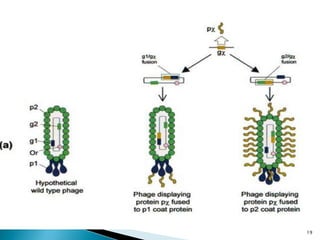
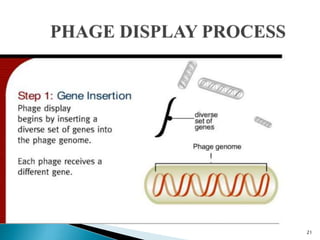
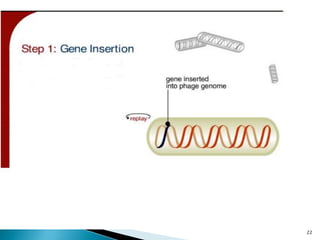
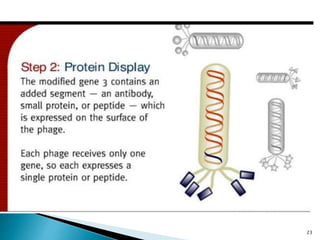
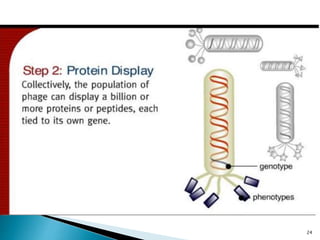
 In this technique, a gene encoding a protein of interest
is inserted into a phage coat protein gene, causing the
phage to "display" the protein on its outside while
containing the gene for the protein on its inside,
resulting in a connection
between genotype and phenotype. 2
3
 In this way, large libraries of proteins can be screened
and amplified in a process called in vitro selection, which
is analogous to natural selection.
 These displaying phages can then be screened against
other proteins, peptides or DNA sequences, in order to
detect interaction between the displayed protein and those
other molecules.
4
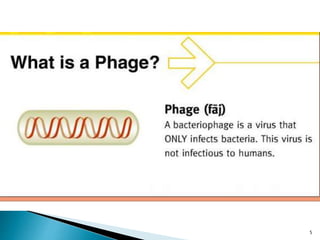
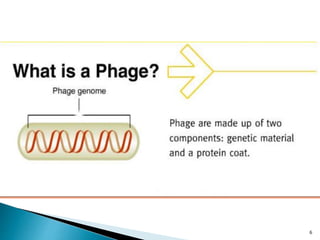
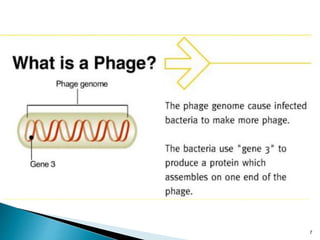
 The most common bacteriophages used in phage display
are filamentous phages viz., fd, f1, M13
5
6
7
8
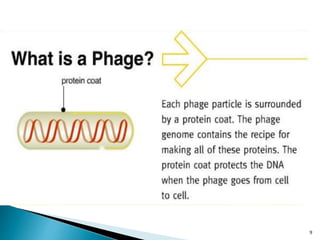
9
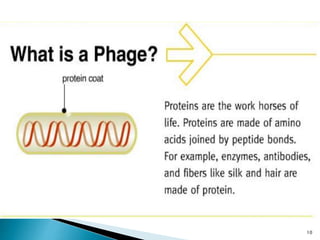
10
11
 They are more easily cloned and screening
 They do not require animals / cell culture
 They offer stable genetic sources
 They can be genetically manipulated
 purification is easy
 Cheap, simple, rapid and requires no special equipment
 They are useful as immunological agents
12
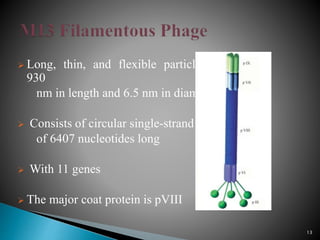
 Long, thin, and flexible particles of
930
nm in length and 6.5 nm in diameter
 Consists of circular single-strand DNA
of 6407 nucleotides long
 With 11 genes
 The major coat protein is pVIII
13
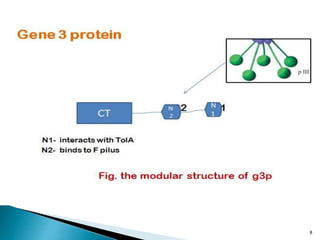
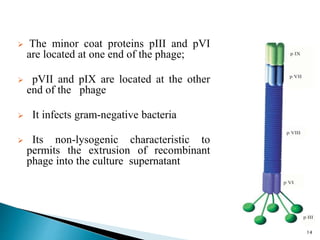
 The minor coat proteins pIII and pVI
are located at one end of the phage;
 pVII and pIX are located at the other
end of the phage
 It infects gram-negative bacteria
 Its non-lysogenic characteristic to
permits the extrusion of recombinant
phage into the culture supernatant
14
15
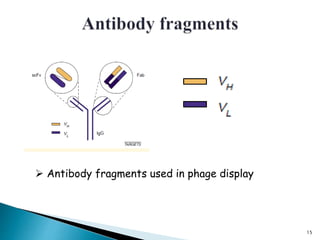
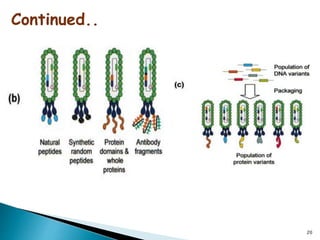
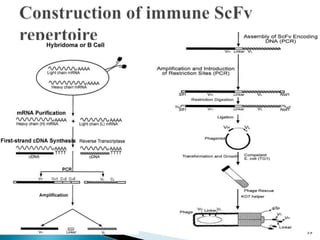
 Antibody fragments used in phage display
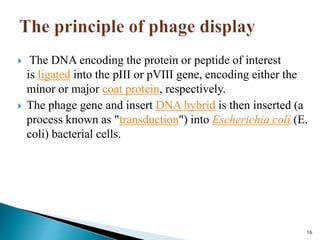
 The DNA encoding the protein or peptide of interest
is ligated into the pIII or pVIII gene, encoding either the
minor or major coat protein, respectively.
 The phage gene and insert DNA hybrid is then inserted (a
process known as "transduction") into Escherichia coli (E.
coli) bacterial cells.
16
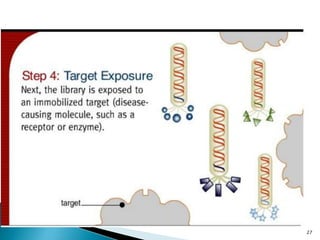
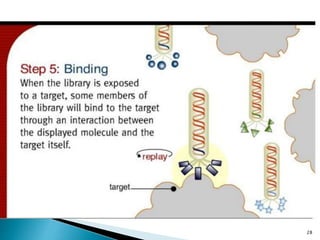
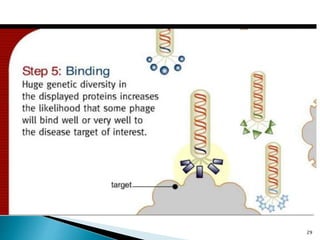
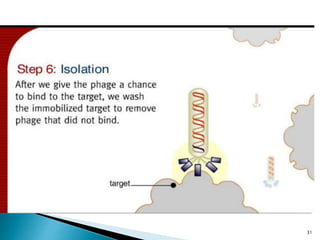
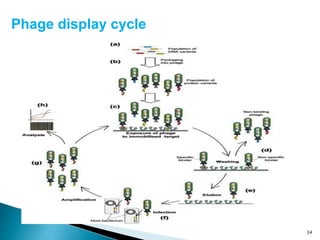
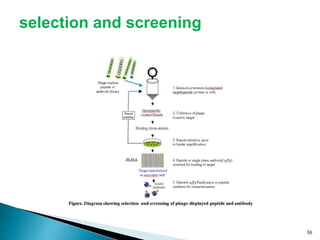
 By immobilizing a relevant DNA or protein target(s) to the
surface of a micro titer plate well, a phage that displays a
protein that binds to one of those targets on its surface will
remain while others are removed by washing.
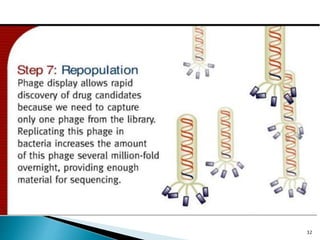
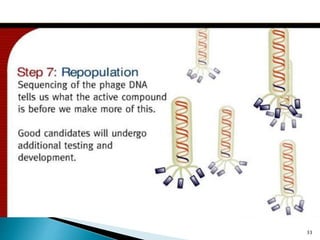
 Those that remain can be eluted, used to produce more
phage (by bacterial infection with helper phage) and so
produce a phage mixture that is enriched with relevant (i.e.
binding) phage.
17
 The repeated cycling of these steps is referred to
as 'panning', in reference to the enrichment of a sample of
gold by removing undesirable materials.
 Phage eluted in the final step can be used to infect a
suitable bacterial host, from which the phagemids can be
collected and the relevant DNA sequence excised and
sequenced to identify the relevant, interacting proteins or
protein fragments.
18
19
20
Continued..
21
22
23
24
25
26
27
28
29
30
31
32
33
34
Phage display cycle
35
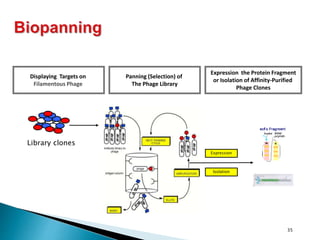
Displaying Targets on
Filamentous Phage
Panning (Selection) of
The Phage Library
Expression the Protein Fragment
or Isolation of Affinity-Purified
Phage Clones
Library clones
Expression
Isolation
36
selection and screening
37
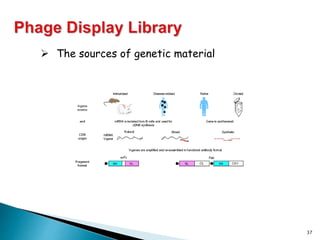
 The sources of genetic material
38
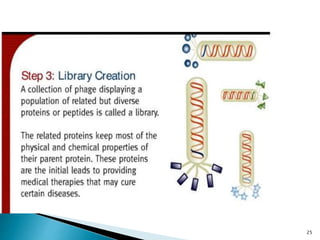
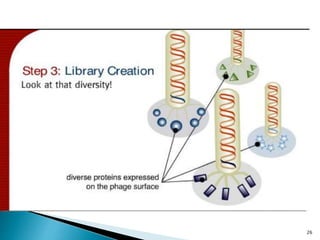
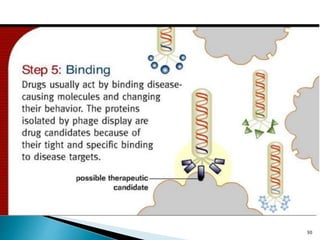
 The proteins that are created and isolated by phage display
process have a specific interaction with a known disease
target,making this a rapid, effective and focused drug
discovery method. The proteins are candidates for
effective drug therapies.
39
40
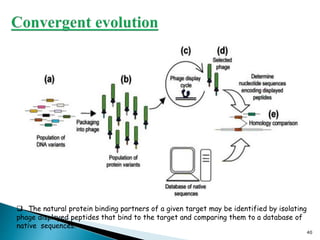
 . The natural protein binding partners of a given target may be identified by isolating
phage displayed peptides that bind to the target and comparing them to a database of
native sequences.
41
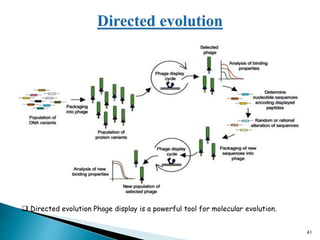
 Directed evolution Phage display is a powerful tool for molecular evolution.
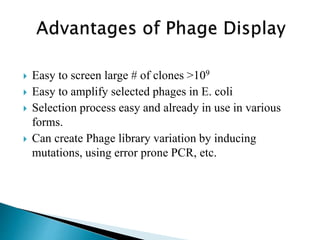
 Easy to screen large # of clones >109
 Easy to amplify selected phages in E. coli
 Selection process easy and already in use in various
forms.
 Can create Phage library variation by inducing
mutations, using error prone PCR, etc.
 Might not have long enough peptide insert so critical
folding can be disrupted.
 Could lose phage variations if first bind/wash step too
stringent.
 Affinities or binding that results during selection might
not work in vivo.
44

Phage display

  • 1.
    1 PRESENTATION ON PHAGE DISPLAYTECHNOLOGY Prepared By: Balaji Rathod PGS16AGR7165
  • 2.
     Phage displaytechnology has emerged in 1985 by George Smith.  Phage display is a laboratory technique for the study of protein–protein, protein–peptide, and protein– DNA interactions that uses bacteriophages to connect proteins with the genetic information that encodes them.  In this technique, a gene encoding a protein of interest is inserted into a phage coat protein gene, causing the phage to "display" the protein on its outside while containing the gene for the protein on its inside, resulting in a connection between genotype and phenotype. 2
  • 3.
    3  In thisway, large libraries of proteins can be screened and amplified in a process called in vitro selection, which is analogous to natural selection.  These displaying phages can then be screened against other proteins, peptides or DNA sequences, in order to detect interaction between the displayed protein and those other molecules.
  • 4.
    4  The mostcommon bacteriophages used in phage display are filamentous phages viz., fd, f1, M13
  • 5.
  • 6.
  • 7.
  • 8.
  • 9.
  • 10.
  • 11.
  • 12.
     They aremore easily cloned and screening  They do not require animals / cell culture  They offer stable genetic sources  They can be genetically manipulated  purification is easy  Cheap, simple, rapid and requires no special equipment  They are useful as immunological agents 12
  • 13.
     Long, thin,and flexible particles of 930 nm in length and 6.5 nm in diameter  Consists of circular single-strand DNA of 6407 nucleotides long  With 11 genes  The major coat protein is pVIII 13
  • 14.
     The minorcoat proteins pIII and pVI are located at one end of the phage;  pVII and pIX are located at the other end of the phage  It infects gram-negative bacteria  Its non-lysogenic characteristic to permits the extrusion of recombinant phage into the culture supernatant 14
  • 15.
    15  Antibody fragmentsused in phage display
  • 16.
     The DNAencoding the protein or peptide of interest is ligated into the pIII or pVIII gene, encoding either the minor or major coat protein, respectively.  The phage gene and insert DNA hybrid is then inserted (a process known as "transduction") into Escherichia coli (E. coli) bacterial cells. 16
  • 17.
     By immobilizinga relevant DNA or protein target(s) to the surface of a micro titer plate well, a phage that displays a protein that binds to one of those targets on its surface will remain while others are removed by washing.  Those that remain can be eluted, used to produce more phage (by bacterial infection with helper phage) and so produce a phage mixture that is enriched with relevant (i.e. binding) phage. 17
  • 18.
     The repeatedcycling of these steps is referred to as 'panning', in reference to the enrichment of a sample of gold by removing undesirable materials.  Phage eluted in the final step can be used to infect a suitable bacterial host, from which the phagemids can be collected and the relevant DNA sequence excised and sequenced to identify the relevant, interacting proteins or protein fragments. 18
  • 19.
  • 20.
  • 21.
  • 22.
  • 23.
  • 24.
  • 25.
  • 26.
  • 27.
  • 28.
  • 29.
  • 30.
  • 31.
  • 32.
  • 33.
  • 34.
  • 35.
    35 Displaying Targets on FilamentousPhage Panning (Selection) of The Phage Library Expression the Protein Fragment or Isolation of Affinity-Purified Phage Clones Library clones Expression Isolation
  • 36.
  • 37.
    37  The sourcesof genetic material
  • 38.
    38  The proteinsthat are created and isolated by phage display process have a specific interaction with a known disease target,making this a rapid, effective and focused drug discovery method. The proteins are candidates for effective drug therapies.
  • 39.
  • 40.
    40  . Thenatural protein binding partners of a given target may be identified by isolating phage displayed peptides that bind to the target and comparing them to a database of native sequences.
  • 41.
    41  Directed evolutionPhage display is a powerful tool for molecular evolution.
  • 42.
     Easy toscreen large # of clones >109  Easy to amplify selected phages in E. coli  Selection process easy and already in use in various forms.  Can create Phage library variation by inducing mutations, using error prone PCR, etc.
  • 43.
     Might nothave long enough peptide insert so critical folding can be disrupted.  Could lose phage variations if first bind/wash step too stringent.  Affinities or binding that results during selection might not work in vivo.
  • 44.