Sheet Metal Forming
2.810 Fall 2002
Professor Tim Gutowski
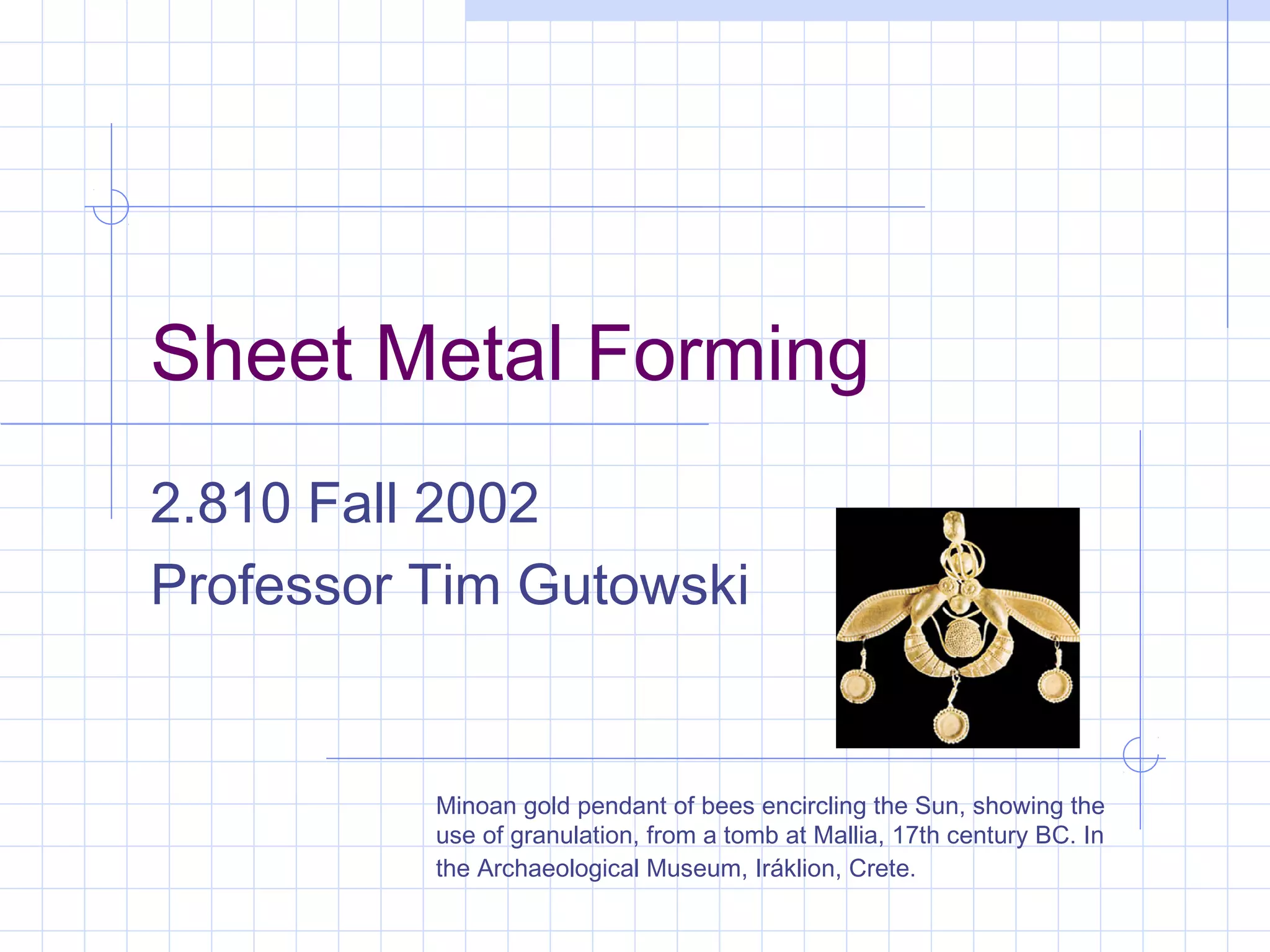
Minoan gold pendant of bees encircling the Sun, showing the
use of granulation, from a tomb at Mallia, 17th century BC. In
the Archaeological Museum, Iráklion, Crete.
Historical Note;
Sheet metal stamping was developed as a mass
production technology for the production of bicycles
around the 1890’s. This technology played an important
role in making the system of interchangeable parts
economical (perhaps for the first time).
Steps in making Hub Steps in Sprocket making
Stress Strain diagram – materials
selection
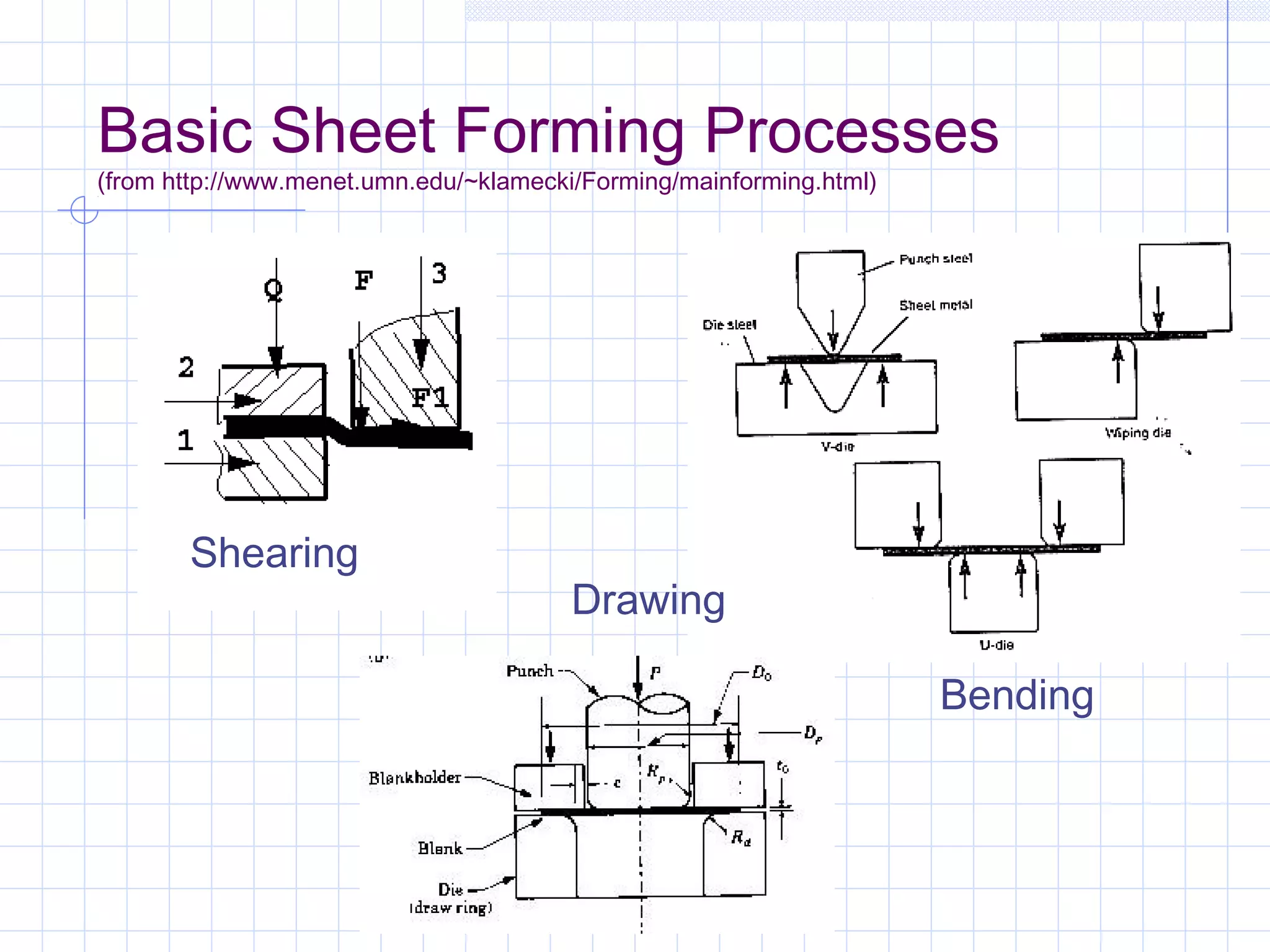
Basic Sheet Forming Processes
(from http://www.menet.umn.edu/~klamecki/Forming/mainforming.html)
Shearing
Bending
Drawing
Shear and corner press
Brake press
Finger press
Shearing Operation Force
Requirement
Die
Sheet
Punch T
D
Part or slug
F = 0.7 T L (UTS)
T = Sheet Thickness
L = Total length Sheared
UTS = Ultimate Tensile Strength of material
Yield Criteria
σ
τ
Y
Y/2
Tresca Mises
τ max = (2/3)1/2
Yτ max = (1/2) Y
Schematic of a Blanked Edge
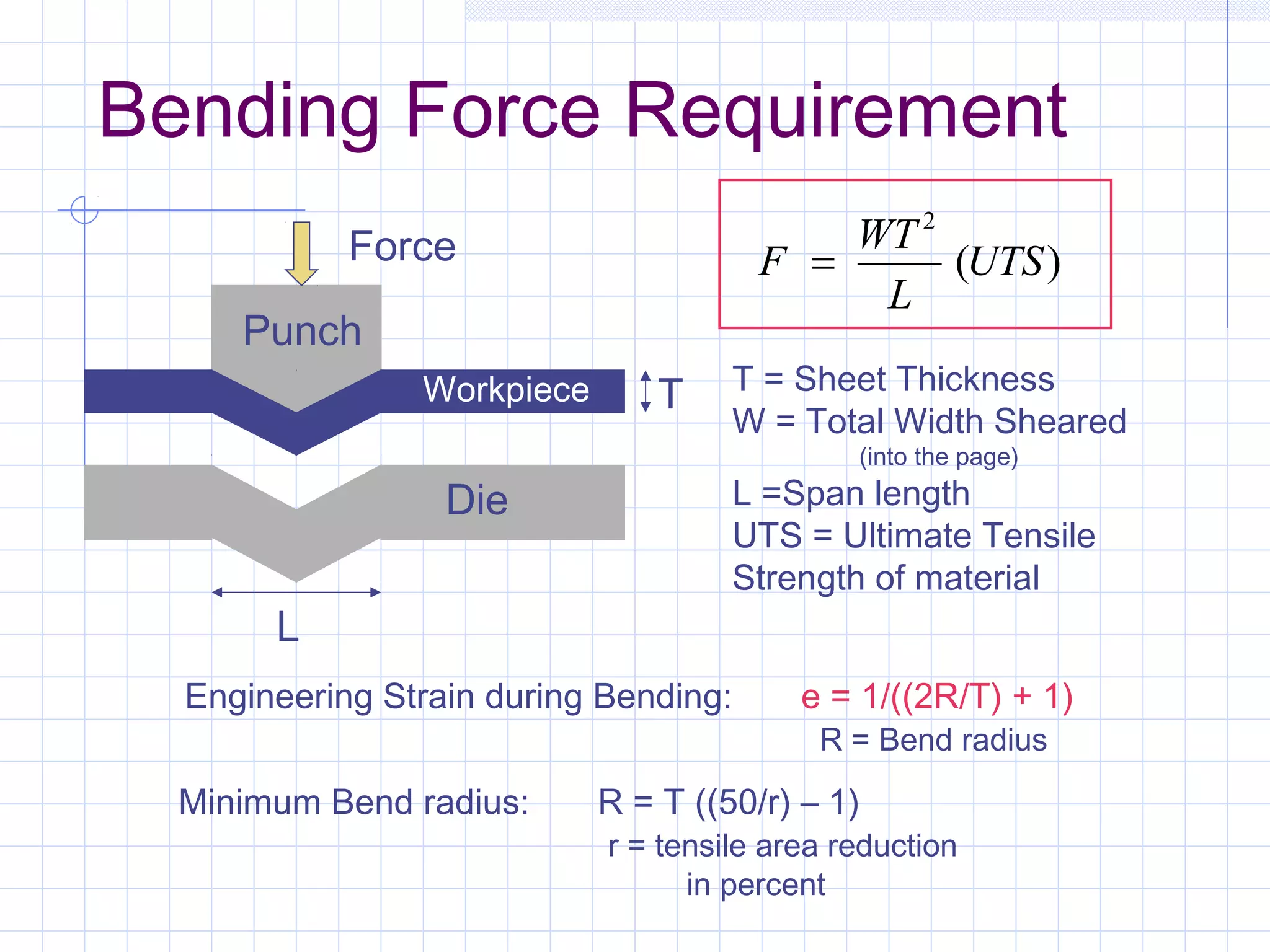
Bending Force Requirement
Punch
Workpiece T
Die
L
Force
T = Sheet Thickness
W = Total Width Sheared
(into the page)
L =Span length
UTS = Ultimate Tensile
Strength of material
Engineering Strain during Bending: e = 1/((2R/T) + 1)
R = Bend radius
Minimum Bend radius: R = T ((50/r) – 1)
r = tensile area reduction
in percent
)(
2
UTS
L
WT
F =
Stress distribution through the
thickness of the part
σ σ yY
Y
-Y
σ h
-Y
Y
Elastic Elastic-plastic Fully plastic
Springback
•Over-bend
•Bottom
•Stretch
tension
compression
Pure Bending
Bending & Stretching
Stretch Forming
Loading Pre-stretching
Wrapping Release
* source: http://www.cyrilbath.com/sheet_process.html
Stretch Forming
Stretch forming
Stretch Forming Force
Requirement
F = (YS + UTS)/2 * A
F = stretch forming force (lbs)
YS = material yield strength (psi)
UTS = ultimate tensile strength of the material (psi)
A = Cross-sectional area of the workpiece (in2
)
• Example of Force Calculation
Calculate the force required to stretch form a wing span having a cross-
sectional area of .50X120” made from 2219 aluminum alloy having a yield
strength of 36,000 psi and a UTS of 52,000 psi:
F = 88000/2 * 60 = 2,640,000 lbs = 1320 tons
Calculate the force required to shear a 10” diameter, 1/8” thick blank from
mild steel with a UTS of 45,000 psi:
F = 0.7 (.125)(π)(10) 45,000 = 62 tons
Auto body panels
10 - 11 panels
•3 to 5 dies each
• ~$0.5M each
• ~$20M investment
Tooling for Automotive Stamping
Machines
Material Selection
Material selection is critical in both product and process design.
Formability is the central material property.
This property must be balanced with other product and process
considerations such as strength, weight, cost, and corrosion
resistance.
Auto vs. Aerospace Example
Auto Body Panel Airplane Body Panel
Progressive stamping stretch forming
1010 Steel, cold-rolled 2024 Aluminum, T3 temper
.04” sheet, custom order .08” sheet, oversize
Double-sided Zinc clad mechanically polished
Cost ~ $.35-.45/lb Cost ~ $4.0/lb
UTS ~ 300 MPa UTS ~ 470 MPa
YS ~ 185 MPa YS ~ 325 MPa
Elongation ~ 42% Elongation ~ 20%
n = .26 n = .16
Comparison of representative
Parts: Aero and Auto
Auto Aero
Part Description Body Panel Body Panel
54"X54" 54"X54"
Forming Process Progressive Stamping Stretch Forming
MATERIAL
Material
1010 Steel, cold-rolled,
.04" sheet, custom order
double-sided Zinc clad
2024 Aluminum, T3
temper, .08" sheet,
oversize mechanically
polished
Scrap 40% 20%
Material Cost $0.45/lb $4.00/lb
Per part $15.75 $105.00
LABOR
Set-up Time 1.5hr 1.0hr
Parts/Run 2,000 30
Cycle Time 0.25 min 2.5 min
Total Labor 0.30 min 4.5 min
Labor Rate** $20.00/hr $20.00/hr
Stretch-Form Labor Cost $0.10 $1.50
FIXED
Equipment $5,000,000 $1,000,000
Tools/Dies $900,000 $45,000
(200 manhours labor)
TOTAL TRANSFER COST $25 $265
Parts
Received
Mylar Protection
Applied
‘Burr’ Edges
in tension
Stretch
Forming
Index to
Block
‘Burr’ Edges
and Inspect
Hand
Trim
Chemica
l Milling
Aerospace Stretch Forming Body Panel Process
Clad and
Prime
Surfaces
Process Flow for Automobile Door Stamping Operation
Raw
material
Blank material
starting dimensions
Drawing Pierce
FlangeRestrike
Design: Stretch Forming vs.
Stamping
Stretch Forming Advantages over Stamping
 Tighter tolerances are possible: as tight as .0005
inches on large aircraft parts
 Little problem with either wrinkling or spring back
 Large, gently contoured parts from thin sheets
Stretch forming Disadvantages over
Stamping
 Complex or sharply cornered shapes are difficult
or impossible to form
 Material removal – blanking, punching, or trimming
– requires secondary operations
 Requires special preparation of the free edges
prior to forming
Springback
Elastic Springback Analysis
L
x
y
h
b
1. Assume plane sections remain plane:
εy = - y/ρ (1)
2. Assume elastic-plastic behavior for material
M
ρ = 1/K
M
y
σ
ε
E
εy
σY
σ= E ε ε <ε 
σ= σY ε >ε
M
1/ρ
EI
1/ρY
MY
Loading
EI Unloading
1/R01/R1
3. We want to construct the following
Bending Moment “M” vs. curvature “1/ρ” curve
Springback is measured as 1/R0 – 1/R1 (2)
Permanent set is 1/R1
4. Stress distribution through the thickness of the beam
σ σ yY
Y
-Y
σ h
-Y
Y
Elastic Elastic-plastic Fully plastic
5. M = ∫A σ y dA
Elastic region
At the onset of plastic behavior
σ = - y/ρ E = - h/2ρ E = -Y (4) σ
Y
This occurs at
1/ρ = 2Y / hE = 1/ρY (5)
dσ
y
dA
b
h
dy
Substitution into eqn (3) gives us the moment at on-set of
yield, MY
MY = - EI/ρY = EI 2Y / hE = 2IY/h (6)
After this point, the M vs 1/r curve starts to “bend over.”
Note from M=0 to M=MY the curve is linear.
ρρ
σ
EI
dA
y
EydAM −=−== ∫ ∫
2
(3)
In the elastic – plastic region
σ yY
Y
Ybyy
h
Yb
y
b
y
Yy
Yb
Ybydy
y
y
YbydyybdyM
YY
y
Y
h
y
h
y
y
Y
Y
Y
Y
Y
22
2
0
32/2
2/
0
3
2
)
4
(
3
2
2
2
22
+−=
+=
+== ∫ ∫ ∫σ














−=
22
2/3
1
1
4 h
y
Y
bh
M Y
Note at yY=h/2, you get on-set at yield, M = MY
And at yY=0, you get fully plastic moment, M = 3/2 MY
(7)
To write this in terms of M vs 1/ρ rather than M vs yY, note
that the yield curvature (1/ρ)Y can be written as (see eqn (1))
2/
1
h
Y
Y
ε
ρ
= (8)
Where εY is the strain at yield. Also since the strain at yY is
-εY, we can write
Y
Y
y
ε
ρ
=
1
(9)
Combining (8) and (9) gives
ρ
ρ
1
)1(
2/
YY
h
y
= (10)
Substitution into (7) gives the result we seek:














−=
2
1
)1(
3
1
1
2
3
ρ
ρ Y
YMM (11)
M
1/ρ
EI
1/ρY
MY
Loading
EI Unloading
1/R01/R1
Eqn(11)
Elastic unloading curve 





−=
1
11
)1( R
M
M
Y
Y
ρρ
(12)
Now, eqn’s (12) and (13) intersect at 1/ρ = 1/R0
Hence,














−=





−
2
010 1
)1(
3
1
1
2
311
)1( R
M
RR
M Y
Y
Y
Y ρ
ρ
Rewriting and using 1/ρ = 2Y / hE, we get
3
2
0
10
43
11






−=





−
hE
Y
R
hE
Y
RR
(13)
New developments
Tailored blanks
Binder force control
Segmented dies
Quick exchange of dies
Alternative materials; cost issues
-
SHAPE
MEASUREMENT
SHAPE
CONTROLLER
WORKPIECE
desired
shape +
shape
error
finished
part
DISCRETEDIE
SURFACE
DISCRETE DIE
FORMING PRESS
CONTROLLER
TRACING CMM
Part Error
Die Shape
Change
New
Part
Shape
The Shape Control Concept
Conventional Tooling
Tool
Pallet
Parking Lot
60 Ton Matched Discrete Die
Press(Robinson et al, 1987)
Tool Setup
Actuators
Programmable
Tool
Passive
Tool
Press Motion
Cylindrical Part Error
Reduction
0
10
20
30
40
50
60
P1 P2 P3 P4
PART CYCLE
0
0.2
0.4
0.6
0.8
1
1.2
1.4
1.6
RMSError[x0.001in.]
MAX
RMS
SSYYSSTTEEMM EERRRROORR TTHHRREESSHHOOLLDD
MAXIMALSHAPEERROR
[x0.001in.]
Large Scale Tool
6 feet
Stretch Forming with Reconfigurable
Tool @ Northrop Grumman
Stamping and TPS:
Quick Exchange of Dies
Ref. Shigeo Shingo, “A Revolution in Manufacturing:
The SMED System” Productivity Press. 1985
•Simplify, Organize, Standardize,
•Eliminate Adjustments,
•Convert Internal to External Set-Ups
Standard fixtures
Alternative materials for auto
body panels
Comparison
Steel Vs SMC
$0.35/lb
0.03 thick
7.6 lb
40% scrap
$4.25 mat’l cost
400/hr
5 workers
$18.90/hr (Union)
$0.24 labor cost
$5,000,000 equipment
$900,000 tools
$7.71 unit cost at 100,000 units
$0.65/lb
.0.12 thick
7.0 lb
6% scrap
$4.84 mat’l cost
40/hr
$12.50/hr (non-Union)
$0.63 labor cost
$1,200,000 eqipment
$250,000 tools
$7.75 unit cost at 100,000 units
Ref John Busch
Cost comparison between sheet
steel and plastics and composites for
automotive panels ref John Busch
Environment
punching Vs machining
hydraulic fluids and lubricants
scrap
energy
painting, cleaning
Steel can production at Toyo Seikan
See Appendix D; http://itri.loyola.edu/ebm/
Summary
Note on Historical Development
Materials and Basic Mechanics
Aerospace and Automotive Forming
New Developments
Environmental Issues
Solidworks and Metal Forming your Chassis
Readings
1. “Sheet Metal Forming” Ch. 16 Kalpakjian (3rd
ed.)
2. “Economic Criteria for Sensible Selection of Body
Panel Materials” John Busch and Jeff Dieffenbach
3. Handout from Shigeo Shingo, The SMED System
4. “Steps to Building a Sheet Metal Chassis for your
2.810 Car Using Solidworks”, by Eddy Reif
5. “Design for Sheetmetal Working”, Ch. 9 Boothroyd,
Dewhurst and Knight

Sheet metal Forming Process

  • 1.
    Sheet Metal Forming 2.810Fall 2002 Professor Tim Gutowski Minoan gold pendant of bees encircling the Sun, showing the use of granulation, from a tomb at Mallia, 17th century BC. In the Archaeological Museum, Iráklion, Crete.
  • 2.
    Historical Note; Sheet metalstamping was developed as a mass production technology for the production of bicycles around the 1890’s. This technology played an important role in making the system of interchangeable parts economical (perhaps for the first time).
  • 3.
    Steps in makingHub Steps in Sprocket making
  • 4.
    Stress Strain diagram– materials selection
  • 5.
    Basic Sheet FormingProcesses (from http://www.menet.umn.edu/~klamecki/Forming/mainforming.html) Shearing Bending Drawing
  • 6.
  • 7.
  • 8.
  • 9.
    Shearing Operation Force Requirement Die Sheet PunchT D Part or slug F = 0.7 T L (UTS) T = Sheet Thickness L = Total length Sheared UTS = Ultimate Tensile Strength of material
  • 10.
    Yield Criteria σ τ Y Y/2 Tresca Mises τmax = (2/3)1/2 Yτ max = (1/2) Y
  • 11.
    Schematic of aBlanked Edge
  • 12.
    Bending Force Requirement Punch WorkpieceT Die L Force T = Sheet Thickness W = Total Width Sheared (into the page) L =Span length UTS = Ultimate Tensile Strength of material Engineering Strain during Bending: e = 1/((2R/T) + 1) R = Bend radius Minimum Bend radius: R = T ((50/r) – 1) r = tensile area reduction in percent )( 2 UTS L WT F =
  • 13.
    Stress distribution throughthe thickness of the part σ σ yY Y -Y σ h -Y Y Elastic Elastic-plastic Fully plastic
  • 14.
  • 15.
  • 16.
    Stretch Forming Loading Pre-stretching WrappingRelease * source: http://www.cyrilbath.com/sheet_process.html
  • 17.
  • 18.
  • 19.
    Stretch Forming Force Requirement F= (YS + UTS)/2 * A F = stretch forming force (lbs) YS = material yield strength (psi) UTS = ultimate tensile strength of the material (psi) A = Cross-sectional area of the workpiece (in2 ) • Example of Force Calculation Calculate the force required to stretch form a wing span having a cross- sectional area of .50X120” made from 2219 aluminum alloy having a yield strength of 36,000 psi and a UTS of 52,000 psi: F = 88000/2 * 60 = 2,640,000 lbs = 1320 tons Calculate the force required to shear a 10” diameter, 1/8” thick blank from mild steel with a UTS of 45,000 psi: F = 0.7 (.125)(π)(10) 45,000 = 62 tons
  • 20.
    Auto body panels 10- 11 panels •3 to 5 dies each • ~$0.5M each • ~$20M investment
  • 21.
  • 22.
  • 23.
    Material Selection Material selectionis critical in both product and process design. Formability is the central material property. This property must be balanced with other product and process considerations such as strength, weight, cost, and corrosion resistance. Auto vs. Aerospace Example Auto Body Panel Airplane Body Panel Progressive stamping stretch forming 1010 Steel, cold-rolled 2024 Aluminum, T3 temper .04” sheet, custom order .08” sheet, oversize Double-sided Zinc clad mechanically polished Cost ~ $.35-.45/lb Cost ~ $4.0/lb UTS ~ 300 MPa UTS ~ 470 MPa YS ~ 185 MPa YS ~ 325 MPa Elongation ~ 42% Elongation ~ 20% n = .26 n = .16
  • 24.
    Comparison of representative Parts:Aero and Auto Auto Aero Part Description Body Panel Body Panel 54"X54" 54"X54" Forming Process Progressive Stamping Stretch Forming MATERIAL Material 1010 Steel, cold-rolled, .04" sheet, custom order double-sided Zinc clad 2024 Aluminum, T3 temper, .08" sheet, oversize mechanically polished Scrap 40% 20% Material Cost $0.45/lb $4.00/lb Per part $15.75 $105.00 LABOR Set-up Time 1.5hr 1.0hr Parts/Run 2,000 30 Cycle Time 0.25 min 2.5 min Total Labor 0.30 min 4.5 min Labor Rate** $20.00/hr $20.00/hr Stretch-Form Labor Cost $0.10 $1.50 FIXED Equipment $5,000,000 $1,000,000 Tools/Dies $900,000 $45,000 (200 manhours labor) TOTAL TRANSFER COST $25 $265
  • 25.
    Parts Received Mylar Protection Applied ‘Burr’ Edges intension Stretch Forming Index to Block ‘Burr’ Edges and Inspect Hand Trim Chemica l Milling Aerospace Stretch Forming Body Panel Process Clad and Prime Surfaces Process Flow for Automobile Door Stamping Operation Raw material Blank material starting dimensions Drawing Pierce FlangeRestrike
  • 26.
    Design: Stretch Formingvs. Stamping Stretch Forming Advantages over Stamping  Tighter tolerances are possible: as tight as .0005 inches on large aircraft parts  Little problem with either wrinkling or spring back  Large, gently contoured parts from thin sheets Stretch forming Disadvantages over Stamping  Complex or sharply cornered shapes are difficult or impossible to form  Material removal – blanking, punching, or trimming – requires secondary operations  Requires special preparation of the free edges prior to forming
  • 27.
  • 28.
    Elastic Springback Analysis L x y h b 1.Assume plane sections remain plane: εy = - y/ρ (1) 2. Assume elastic-plastic behavior for material M ρ = 1/K M y σ ε E εy σY σ= E ε ε <ε  σ= σY ε >ε
  • 29.
    M 1/ρ EI 1/ρY MY Loading EI Unloading 1/R01/R1 3. Wewant to construct the following Bending Moment “M” vs. curvature “1/ρ” curve Springback is measured as 1/R0 – 1/R1 (2) Permanent set is 1/R1
  • 30.
    4. Stress distributionthrough the thickness of the beam σ σ yY Y -Y σ h -Y Y Elastic Elastic-plastic Fully plastic
  • 31.
    5. M =∫A σ y dA Elastic region At the onset of plastic behavior σ = - y/ρ E = - h/2ρ E = -Y (4) σ Y This occurs at 1/ρ = 2Y / hE = 1/ρY (5) dσ y dA b h dy Substitution into eqn (3) gives us the moment at on-set of yield, MY MY = - EI/ρY = EI 2Y / hE = 2IY/h (6) After this point, the M vs 1/r curve starts to “bend over.” Note from M=0 to M=MY the curve is linear. ρρ σ EI dA y EydAM −=−== ∫ ∫ 2 (3)
  • 32.
    In the elastic– plastic region σ yY Y Ybyy h Yb y b y Yy Yb Ybydy y y YbydyybdyM YY y Y h y h y y Y Y Y Y Y 22 2 0 32/2 2/ 0 3 2 ) 4 ( 3 2 2 2 22 +−= += +== ∫ ∫ ∫σ               −= 22 2/3 1 1 4 h y Y bh M Y Note at yY=h/2, you get on-set at yield, M = MY And at yY=0, you get fully plastic moment, M = 3/2 MY (7)
  • 33.
    To write thisin terms of M vs 1/ρ rather than M vs yY, note that the yield curvature (1/ρ)Y can be written as (see eqn (1)) 2/ 1 h Y Y ε ρ = (8) Where εY is the strain at yield. Also since the strain at yY is -εY, we can write Y Y y ε ρ = 1 (9) Combining (8) and (9) gives ρ ρ 1 )1( 2/ YY h y = (10)
  • 34.
    Substitution into (7)gives the result we seek:               −= 2 1 )1( 3 1 1 2 3 ρ ρ Y YMM (11) M 1/ρ EI 1/ρY MY Loading EI Unloading 1/R01/R1 Eqn(11) Elastic unloading curve       −= 1 11 )1( R M M Y Y ρρ (12)
  • 35.
    Now, eqn’s (12)and (13) intersect at 1/ρ = 1/R0 Hence,               −=      − 2 010 1 )1( 3 1 1 2 311 )1( R M RR M Y Y Y Y ρ ρ Rewriting and using 1/ρ = 2Y / hE, we get 3 2 0 10 43 11       −=      − hE Y R hE Y RR (13)
  • 37.
    New developments Tailored blanks Binderforce control Segmented dies Quick exchange of dies Alternative materials; cost issues
  • 38.
    - SHAPE MEASUREMENT SHAPE CONTROLLER WORKPIECE desired shape + shape error finished part DISCRETEDIE SURFACE DISCRETE DIE FORMINGPRESS CONTROLLER TRACING CMM Part Error Die Shape Change New Part Shape The Shape Control Concept
  • 39.
  • 40.
    60 Ton MatchedDiscrete Die Press(Robinson et al, 1987) Tool Setup Actuators Programmable Tool Passive Tool Press Motion
  • 41.
    Cylindrical Part Error Reduction 0 10 20 30 40 50 60 P1P2 P3 P4 PART CYCLE 0 0.2 0.4 0.6 0.8 1 1.2 1.4 1.6 RMSError[x0.001in.] MAX RMS SSYYSSTTEEMM EERRRROORR TTHHRREESSHHOOLLDD MAXIMALSHAPEERROR [x0.001in.]
  • 42.
  • 43.
    Stretch Forming withReconfigurable Tool @ Northrop Grumman
  • 44.
    Stamping and TPS: QuickExchange of Dies Ref. Shigeo Shingo, “A Revolution in Manufacturing: The SMED System” Productivity Press. 1985 •Simplify, Organize, Standardize, •Eliminate Adjustments, •Convert Internal to External Set-Ups
  • 45.
  • 46.
    Alternative materials forauto body panels
  • 47.
    Comparison Steel Vs SMC $0.35/lb 0.03thick 7.6 lb 40% scrap $4.25 mat’l cost 400/hr 5 workers $18.90/hr (Union) $0.24 labor cost $5,000,000 equipment $900,000 tools $7.71 unit cost at 100,000 units $0.65/lb .0.12 thick 7.0 lb 6% scrap $4.84 mat’l cost 40/hr $12.50/hr (non-Union) $0.63 labor cost $1,200,000 eqipment $250,000 tools $7.75 unit cost at 100,000 units Ref John Busch
  • 48.
    Cost comparison betweensheet steel and plastics and composites for automotive panels ref John Busch
  • 49.
    Environment punching Vs machining hydraulicfluids and lubricants scrap energy painting, cleaning
  • 50.
    Steel can productionat Toyo Seikan See Appendix D; http://itri.loyola.edu/ebm/
  • 51.
    Summary Note on HistoricalDevelopment Materials and Basic Mechanics Aerospace and Automotive Forming New Developments Environmental Issues Solidworks and Metal Forming your Chassis
  • 52.
    Readings 1. “Sheet MetalForming” Ch. 16 Kalpakjian (3rd ed.) 2. “Economic Criteria for Sensible Selection of Body Panel Materials” John Busch and Jeff Dieffenbach 3. Handout from Shigeo Shingo, The SMED System 4. “Steps to Building a Sheet Metal Chassis for your 2.810 Car Using Solidworks”, by Eddy Reif 5. “Design for Sheetmetal Working”, Ch. 9 Boothroyd, Dewhurst and Knight

Editor's Notes

  • #42 Max and RMS error results Nearly identical results were found for spherical and saddle shaped parts