Factors Affecting Tool Life In Machining
Processes
Factors Affecting Tool Life In Machining Processes
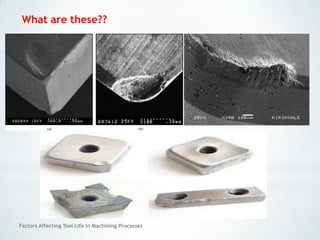
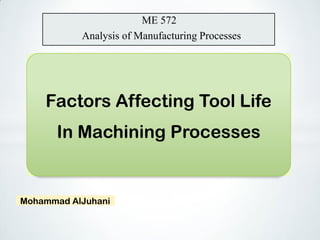
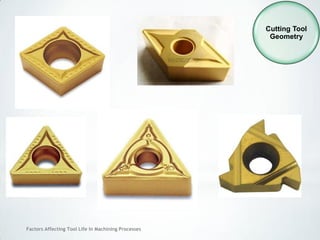
What are these??
Factors Affecting Tool Life
In Machining Processes
ME 572
Analysis of Manufacturing Processes
Mohammad AlJuhani
Factors Affecting Tool Life In Machining Processes
Introduction
Tool Life and Machinability
Tool Damage
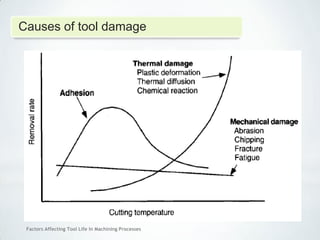
Causes of tool damage
Factors Affecting Tool Life in Machining Processes
Factors Affecting Tool Life In Machining Processes
• Cutting tool life is important consideration in metal cutting
processes.
• In machining operations, cutting conditions such as tool angles,
cutting speeds and feed rates are usually selected to give an
economical tool life.
• Conditions giving a short tool life are uneconomical because
tool grinding and tool replacement costs are high.
• Factors affecting tool life should be carefully monitored to
minimize their consequences.
Factors Affecting Tool Life In Machining Processes
• A tool that doesn’t perform the desired function can be declared as
failed, or reached the end of its useful life.
• At this point of time, the tool is not necessarily unable to cut the
workpiece but is merely unsatisfactory (may not give the desired
surface finish or dimensional tolerances) for the purpose required
• The tool life is defined as the length of cutting time that the tool
can be used.
Tool Life and Machinability
Factors Affecting Tool Life In Machining Processes
• Tool damage can be classified into two groups, wear and fracture by means of its scale
and how it progresses.
• Wear is loss of material on an asperity or micro-contact, or smaller scale, down to
molecular or atomic removal mechanisms. It usually progresses continuously.
• There are two main types of tool wear
• Flank wear
• Crater wear
• Fracture, on the other hand, is damage at a larger scale than wear and it occurs
suddenly.
Tool Damage
Factors Affecting Tool Life In Machining Processes
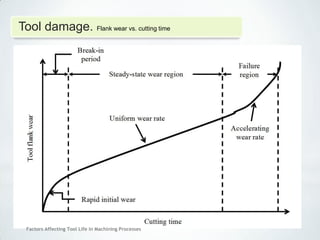
Tool damage. Flank wear vs. cutting time
Factors Affecting Tool Life In Machining Processes
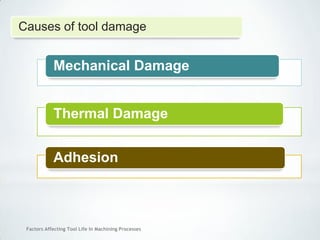
Mechanical Damage
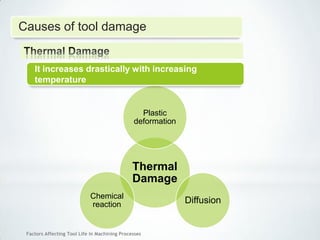
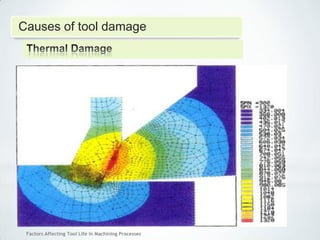
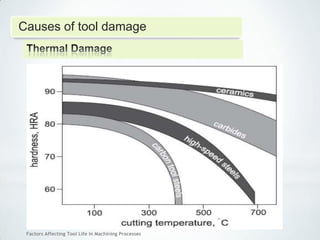
Thermal Damage
Adhesion
Causes of tool damage
Factors Affecting Tool Life In Machining Processes
Mechanical Damage
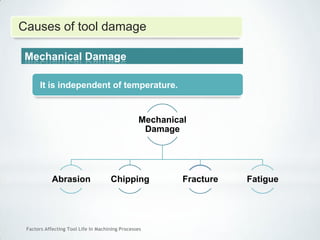
Mechanical
Damage
FractureChippingAbrasion Fatigue
It is independent of temperature.
Causes of tool damage
Factors Affecting Tool Life In Machining Processes
Causes of tool damage
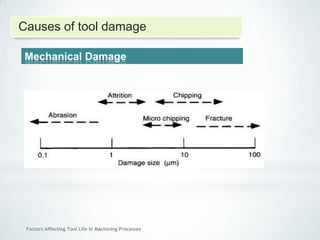
Mechanical Damage
Factors Affecting Tool Life In Machining Processes
Thermal
Damage
Plastic
deformation
DiffusionChemical
reaction
It increases drastically with increasing
temperature
Causes of tool damage
Factors Affecting Tool Life In Machining Processes
Causes of tool damage
Factors Affecting Tool Life In Machining Processes
Causes of tool damage
Factors Affecting Tool Life In Machining Processes
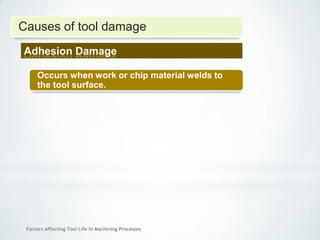
Occurs when work or chip material welds to
the tool surface.
Adhesion Damage
Causes of tool damage
Factors Affecting Tool Life In Machining Processes
Causes of tool damage
Factors Affecting Tool Life In Machining Processes
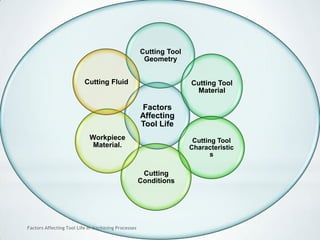
Factors
Affecting
Tool Life
Cutting Tool
Geometry
Cutting Tool
Material
Cutting Tool
Characteristic
s
Cutting
Conditions
Workpiece
Material.
Cutting Fluid
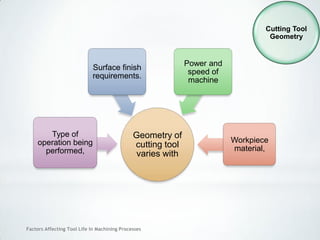
Geometry of
cutting tool
varies with
Type of
operation being
performed,
Surface finish
requirements.
Power and
speed of
machine
Workpiece
material,
Factors Affecting Tool Life In Machining Processes
Cutting Tool
Geometry
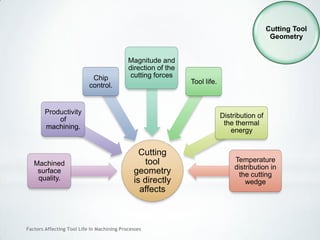
Cutting
tool
geometry
is directly
affects
Machined
surface
quality.
Productivity
of
machining.
Chip
control.
Magnitude and
direction of the
cutting forces
Tool life.
Distribution of
the thermal
energy
Temperature
distribution in
the cutting
wedge
Factors Affecting Tool Life In Machining Processes
Cutting Tool
Geometry
Factors Affecting Tool Life In Machining Processes
Cutting Tool
Geometry
Factors Affecting Tool Life In Machining Processes
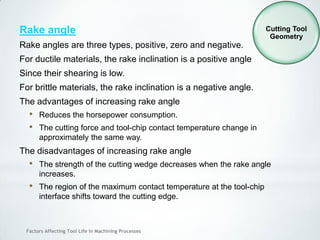
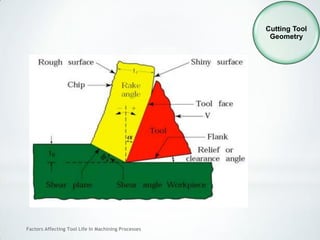
Rake angle
Rake angles are three types, positive, zero and negative.
For ductile materials, the rake inclination is a positive angle
Since their shearing is low.
For brittle materials, the rake inclination is a negative angle.
The advantages of increasing rake angle
• Reduces the horsepower consumption.
• The cutting force and tool-chip contact temperature change in
approximately the same way.
The disadvantages of increasing rake angle
• The strength of the cutting wedge decreases when the rake angle
increases.
• The region of the maximum contact temperature at the tool-chip
interface shifts toward the cutting edge.
Cutting Tool
Geometry
Factors Affecting Tool Life In Machining Processes
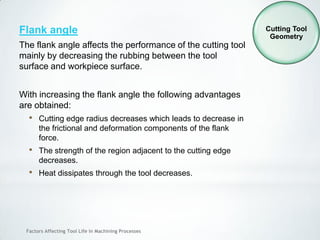
Flank angle
The flank angle affects the performance of the cutting tool
mainly by decreasing the rubbing between the tool
surface and workpiece surface.
With increasing the flank angle the following advantages
are obtained:
• Cutting edge radius decreases which leads to decrease in
the frictional and deformation components of the flank
force.
• The strength of the region adjacent to the cutting edge
decreases.
• Heat dissipates through the tool decreases.
Cutting Tool
Geometry
Factors Affecting Tool Life In Machining Processes
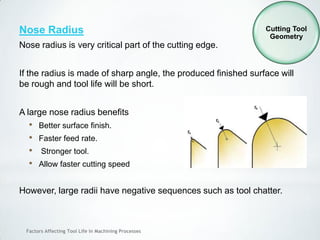
Nose Radius
Nose radius is very critical part of the cutting edge.
If the radius is made of sharp angle, the produced finished surface will
be rough and tool life will be short.
A large nose radius benefits
• Better surface finish.
• Faster feed rate.
• Stronger tool.
• Allow faster cutting speed
However, large radii have negative sequences such as tool chatter.
Cutting Tool
Geometry
Factors Affecting Tool Life In Machining Processes
Cutting Tool
Material
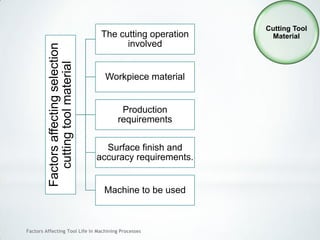
Factorsaffectingselection
cuttingtoolmaterial
The cutting operation
involved
Workpiece material
Production
requirements
Surface finish and
accuracy requirements.
Machine to be used
Factors Affecting Tool Life In Machining Processes
Cutting Tool
Material
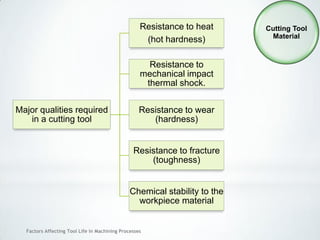
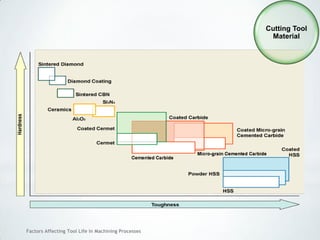
Major qualities required
in a cutting tool
Resistance to heat
(hot hardness)
Resistance to
mechanical impact
thermal shock.
Resistance to wear
(hardness)
Resistance to fracture
(toughness)
Chemical stability to the
workpiece material
Factors Affecting Tool Life In Machining Processes
Cutting Tool
Material
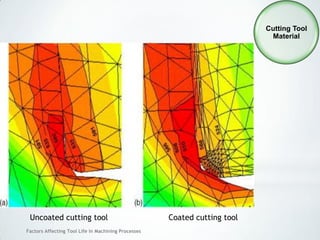
Factors Affecting Tool Life In Machining Processes
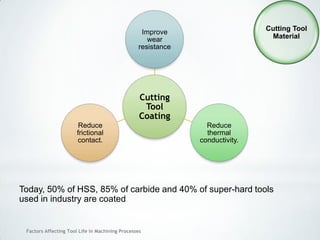
Today, 50% of HSS, 85% of carbide and 40% of super-hard tools
used in industry are coated
Cutting Tool
Material
Cutting
Tool
Coating
Improve
wear
resistance
Reduce
thermal
conductivity.
Reduce
frictional
contact.
Factors Affecting Tool Life In Machining Processes
Cutting Tool
Material
Uncoated cutting tool Coated cutting tool
Factors Affecting Tool Life In Machining
Processes
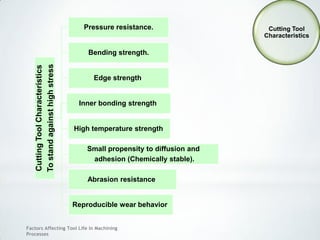
CuttingToolCharacteristics
Tostandagainsthighstress
Pressure resistance.
Bending strength.
Edge strength.
Inner bonding strength.
High temperature strength.
Small propensity to diffusion and
adhesion (Chemically stable).
Abrasion resistance.
Reproducible wear behavior.
Cutting Tool
Characteristics
Factors Affecting Tool Life In Machining Processes
Depth of cut
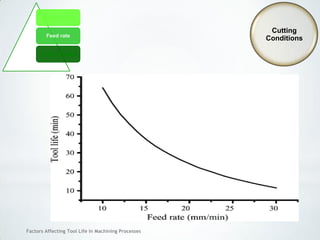
Feed rate
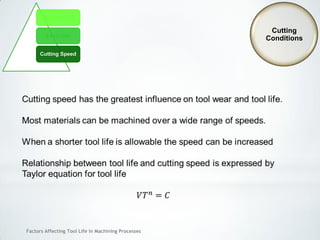
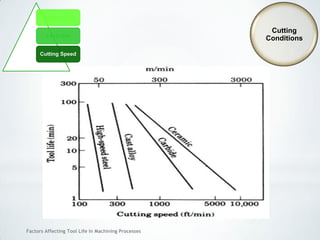
Cutting Speed
Cutting
Conditions
Factors Affecting Tool Life In Machining Processes
Cutting
Conditions
Depth of cut
Feed rate
Cutting Speed
Factors Affecting Tool Life In Machining Processes
Cutting
Conditions
Depth of cut
Feed rate
Cutting Speed
Factors Affecting Tool Life In Machining Processes
Depth of cut
Feed rate
Cutting Speed
Cutting
Conditions
Factors Affecting Tool Life In Machining Processes
Cutting
Conditions
Depth of cut
Feed rate
Cutting Speed
Factors Affecting Tool Life In Machining Processes
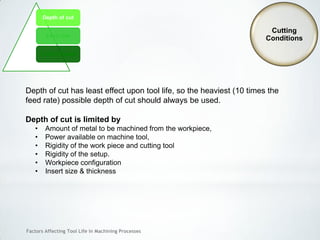
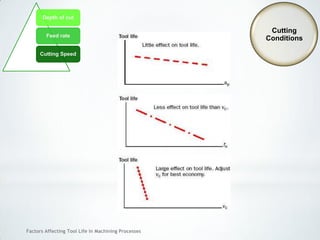
Depth of cut has least effect upon tool life, so the heaviest (10 times the
feed rate) possible depth of cut should always be used.

Depth of cut is limited by
• Amount of metal to be machined from the workpiece,
• Power available on machine tool,
• Rigidity of the work piece and cutting tool
• Rigidity of the setup.
• Workpiece configuration
• Insert size & thickness
Cutting
Conditions
Depth of cut
Feed rate
Cutting Speed
Factors Affecting Tool Life In Machining Processes
Cutting
Conditions
Depth of cut
Feed rate
Cutting Speed
Factors Affecting Tool Life In Machining Processes
Machinability
of workpiece
criteria
Tool life
Surface
roughness
Surface
integrity
Magnitude of
cutting
forces
Energy
(power)
consumption
Workpiece
Material.
Factors Affecting Tool Life In Machining Processes
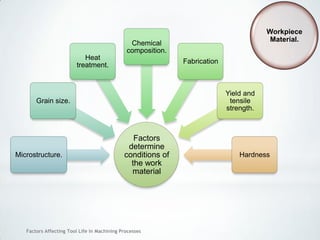
Factors
determine
conditions of
the work
material
Microstructure.
Grain size.
Heat
treatment.
Chemical
composition.
Fabrication
Yield and
tensile
strength.
Hardness
Workpiece
Material.
Factors Affecting Tool Life In Machining Processes
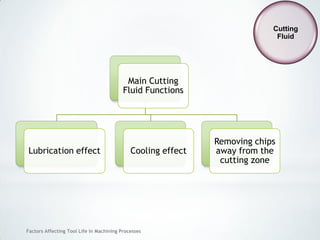
Main Cutting
Fluid Functions
Lubrication effect Cooling effect
Removing chips
away from the
cutting zone
Cutting
Fluid
Factors Affecting Tool Life In Machining Processes
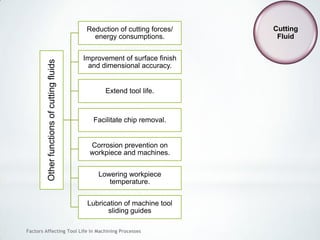
Otherfunctionsofcuttingfluids
Reduction of cutting forces/
energy consumptions.
Improvement of surface finish
and dimensional accuracy.
Extend tool life.
Facilitate chip removal.
Corrosion prevention on
workpiece and machines.
Lowering workpiece
temperature.
Lubrication of machine tool
sliding guides
Cutting
Fluid
Factors Affecting Tool Life In Machining Processes
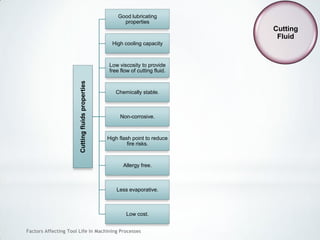
Cuttingfluidsproperties
Good lubricating
properties
High cooling capacity
Low viscosity to provide
free flow of cutting fluid.
Chemically stable.
Non-corrosive.
High flash point to reduce
fire risks.
Allergy free.
Less evaporative.
Low cost.
Cutting
Fluid
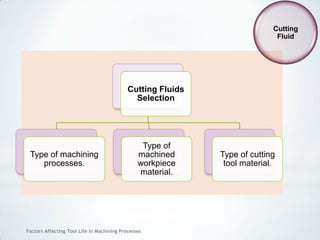
Cutting Fluids
Selection
Type of machining
processes.
Type of
machined
workpiece
material.
Type of cutting
tool material.
Factors Affecting Tool Life In Machining Processes
Cutting
Fluid
Factors Affecting Tool Life In Machining Processes
Cutting
Fluid
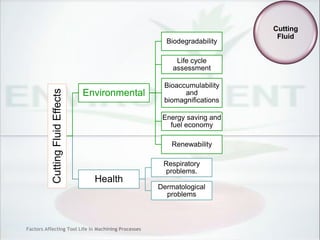
CuttingFluidEffects
Environmental
Biodegradability
Life cycle
assessment
Bioaccumulability
and
biomagnifications
Energy saving and
fuel economy
Renewability
Health
Respiratory
problems.
Dermatological
problems
Factors Affecting Tool Life In Machining Processes
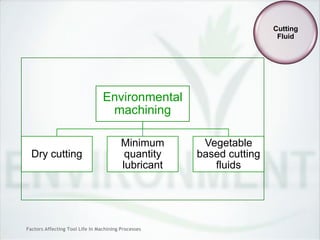
Environmental
machining
Dry cutting
Minimum
quantity
lubricant
Vegetable
based cutting
fluids
Cutting
Fluid
Factors Affecting Tool Life In Machining Processes
Factors Affecting Tool Life In Machining
Processes
Factors Affecting Tool Life In Machining Processes
Cutting Tool
Geometry

Factors affecting tool life in machining processes

  • 1.
    Factors Affecting ToolLife In Machining Processes
  • 2.
    Factors Affecting ToolLife In Machining Processes What are these??
  • 3.
    Factors Affecting ToolLife In Machining Processes ME 572 Analysis of Manufacturing Processes Mohammad AlJuhani
  • 4.
    Factors Affecting ToolLife In Machining Processes Introduction Tool Life and Machinability Tool Damage Causes of tool damage Factors Affecting Tool Life in Machining Processes
  • 5.
    Factors Affecting ToolLife In Machining Processes • Cutting tool life is important consideration in metal cutting processes. • In machining operations, cutting conditions such as tool angles, cutting speeds and feed rates are usually selected to give an economical tool life. • Conditions giving a short tool life are uneconomical because tool grinding and tool replacement costs are high. • Factors affecting tool life should be carefully monitored to minimize their consequences.
  • 6.
    Factors Affecting ToolLife In Machining Processes • A tool that doesn’t perform the desired function can be declared as failed, or reached the end of its useful life. • At this point of time, the tool is not necessarily unable to cut the workpiece but is merely unsatisfactory (may not give the desired surface finish or dimensional tolerances) for the purpose required • The tool life is defined as the length of cutting time that the tool can be used. Tool Life and Machinability
  • 7.
    Factors Affecting ToolLife In Machining Processes • Tool damage can be classified into two groups, wear and fracture by means of its scale and how it progresses. • Wear is loss of material on an asperity or micro-contact, or smaller scale, down to molecular or atomic removal mechanisms. It usually progresses continuously. • There are two main types of tool wear • Flank wear • Crater wear • Fracture, on the other hand, is damage at a larger scale than wear and it occurs suddenly. Tool Damage
  • 8.
    Factors Affecting ToolLife In Machining Processes Tool damage. Flank wear vs. cutting time
  • 9.
    Factors Affecting ToolLife In Machining Processes Mechanical Damage Thermal Damage Adhesion Causes of tool damage
  • 10.
    Factors Affecting ToolLife In Machining Processes Mechanical Damage Mechanical Damage FractureChippingAbrasion Fatigue It is independent of temperature. Causes of tool damage
  • 11.
    Factors Affecting ToolLife In Machining Processes Causes of tool damage Mechanical Damage
  • 12.
    Factors Affecting ToolLife In Machining Processes Thermal Damage Plastic deformation DiffusionChemical reaction It increases drastically with increasing temperature Causes of tool damage
  • 13.
    Factors Affecting ToolLife In Machining Processes Causes of tool damage
  • 14.
    Factors Affecting ToolLife In Machining Processes Causes of tool damage
  • 15.
    Factors Affecting ToolLife In Machining Processes Occurs when work or chip material welds to the tool surface. Adhesion Damage Causes of tool damage
  • 16.
    Factors Affecting ToolLife In Machining Processes Causes of tool damage
  • 17.
    Factors Affecting ToolLife In Machining Processes Factors Affecting Tool Life Cutting Tool Geometry Cutting Tool Material Cutting Tool Characteristic s Cutting Conditions Workpiece Material. Cutting Fluid
  • 18.
    Geometry of cutting tool varieswith Type of operation being performed, Surface finish requirements. Power and speed of machine Workpiece material, Factors Affecting Tool Life In Machining Processes Cutting Tool Geometry
  • 19.
    Cutting tool geometry is directly affects Machined surface quality. Productivity of machining. Chip control. Magnitude and directionof the cutting forces Tool life. Distribution of the thermal energy Temperature distribution in the cutting wedge Factors Affecting Tool Life In Machining Processes Cutting Tool Geometry
  • 20.
    Factors Affecting ToolLife In Machining Processes Cutting Tool Geometry
  • 21.
    Factors Affecting ToolLife In Machining Processes Rake angle Rake angles are three types, positive, zero and negative. For ductile materials, the rake inclination is a positive angle Since their shearing is low. For brittle materials, the rake inclination is a negative angle. The advantages of increasing rake angle • Reduces the horsepower consumption. • The cutting force and tool-chip contact temperature change in approximately the same way. The disadvantages of increasing rake angle • The strength of the cutting wedge decreases when the rake angle increases. • The region of the maximum contact temperature at the tool-chip interface shifts toward the cutting edge. Cutting Tool Geometry
  • 22.
    Factors Affecting ToolLife In Machining Processes Flank angle The flank angle affects the performance of the cutting tool mainly by decreasing the rubbing between the tool surface and workpiece surface. With increasing the flank angle the following advantages are obtained: • Cutting edge radius decreases which leads to decrease in the frictional and deformation components of the flank force. • The strength of the region adjacent to the cutting edge decreases. • Heat dissipates through the tool decreases. Cutting Tool Geometry
  • 23.
    Factors Affecting ToolLife In Machining Processes Nose Radius Nose radius is very critical part of the cutting edge. If the radius is made of sharp angle, the produced finished surface will be rough and tool life will be short. A large nose radius benefits • Better surface finish. • Faster feed rate. • Stronger tool. • Allow faster cutting speed However, large radii have negative sequences such as tool chatter. Cutting Tool Geometry
  • 24.
    Factors Affecting ToolLife In Machining Processes Cutting Tool Material Factorsaffectingselection cuttingtoolmaterial The cutting operation involved Workpiece material Production requirements Surface finish and accuracy requirements. Machine to be used
  • 25.
    Factors Affecting ToolLife In Machining Processes Cutting Tool Material Major qualities required in a cutting tool Resistance to heat (hot hardness) Resistance to mechanical impact thermal shock. Resistance to wear (hardness) Resistance to fracture (toughness) Chemical stability to the workpiece material
  • 26.
    Factors Affecting ToolLife In Machining Processes Cutting Tool Material
  • 27.
    Factors Affecting ToolLife In Machining Processes Today, 50% of HSS, 85% of carbide and 40% of super-hard tools used in industry are coated Cutting Tool Material Cutting Tool Coating Improve wear resistance Reduce thermal conductivity. Reduce frictional contact.
  • 28.
    Factors Affecting ToolLife In Machining Processes Cutting Tool Material Uncoated cutting tool Coated cutting tool
  • 29.
    Factors Affecting ToolLife In Machining Processes CuttingToolCharacteristics Tostandagainsthighstress Pressure resistance. Bending strength. Edge strength. Inner bonding strength. High temperature strength. Small propensity to diffusion and adhesion (Chemically stable). Abrasion resistance. Reproducible wear behavior. Cutting Tool Characteristics
  • 30.
    Factors Affecting ToolLife In Machining Processes Depth of cut Feed rate Cutting Speed Cutting Conditions
  • 31.
    Factors Affecting ToolLife In Machining Processes Cutting Conditions Depth of cut Feed rate Cutting Speed
  • 32.
    Factors Affecting ToolLife In Machining Processes Cutting Conditions Depth of cut Feed rate Cutting Speed
  • 33.
    Factors Affecting ToolLife In Machining Processes Depth of cut Feed rate Cutting Speed Cutting Conditions
  • 34.
    Factors Affecting ToolLife In Machining Processes Cutting Conditions Depth of cut Feed rate Cutting Speed
  • 35.
    Factors Affecting ToolLife In Machining Processes Depth of cut has least effect upon tool life, so the heaviest (10 times the feed rate) possible depth of cut should always be used. Depth of cut is limited by • Amount of metal to be machined from the workpiece, • Power available on machine tool, • Rigidity of the work piece and cutting tool • Rigidity of the setup. • Workpiece configuration • Insert size & thickness Cutting Conditions Depth of cut Feed rate Cutting Speed
  • 36.
    Factors Affecting ToolLife In Machining Processes Cutting Conditions Depth of cut Feed rate Cutting Speed
  • 37.
    Factors Affecting ToolLife In Machining Processes Machinability of workpiece criteria Tool life Surface roughness Surface integrity Magnitude of cutting forces Energy (power) consumption Workpiece Material.
  • 38.
    Factors Affecting ToolLife In Machining Processes Factors determine conditions of the work material Microstructure. Grain size. Heat treatment. Chemical composition. Fabrication Yield and tensile strength. Hardness Workpiece Material.
  • 39.
    Factors Affecting ToolLife In Machining Processes Main Cutting Fluid Functions Lubrication effect Cooling effect Removing chips away from the cutting zone Cutting Fluid
  • 40.
    Factors Affecting ToolLife In Machining Processes Otherfunctionsofcuttingfluids Reduction of cutting forces/ energy consumptions. Improvement of surface finish and dimensional accuracy. Extend tool life. Facilitate chip removal. Corrosion prevention on workpiece and machines. Lowering workpiece temperature. Lubrication of machine tool sliding guides Cutting Fluid
  • 41.
    Factors Affecting ToolLife In Machining Processes Cuttingfluidsproperties Good lubricating properties High cooling capacity Low viscosity to provide free flow of cutting fluid. Chemically stable. Non-corrosive. High flash point to reduce fire risks. Allergy free. Less evaporative. Low cost. Cutting Fluid
  • 42.
    Cutting Fluids Selection Type ofmachining processes. Type of machined workpiece material. Type of cutting tool material. Factors Affecting Tool Life In Machining Processes Cutting Fluid
  • 43.
    Factors Affecting ToolLife In Machining Processes Cutting Fluid CuttingFluidEffects Environmental Biodegradability Life cycle assessment Bioaccumulability and biomagnifications Energy saving and fuel economy Renewability Health Respiratory problems. Dermatological problems
  • 44.
    Factors Affecting ToolLife In Machining Processes Environmental machining Dry cutting Minimum quantity lubricant Vegetable based cutting fluids Cutting Fluid
  • 45.
    Factors Affecting ToolLife In Machining Processes
  • 46.
    Factors Affecting ToolLife In Machining Processes
  • 47.
    Factors Affecting ToolLife In Machining Processes Cutting Tool Geometry