MANUFACTURING TECHNOLOGY-II
1
Chip Formation
ME8451: MANUFACTURING TECHNOLOGY - II
PATTERNS
Presented by
S.Kannan
Assistant Professor
Department of Mechanical Engineering
Vel Tech Engineering College
Avadi-Chennai-62
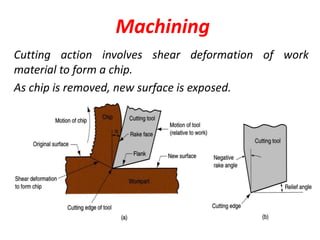
Cutting action involves shear deformation of work
material to form a chip.
As chip is removed, new surface is exposed.
Figure 21.2 (a) A cross-sectional view of the machining process, (b)
tool with negative rake angle; compare with positive rake angle in (a).
Machining
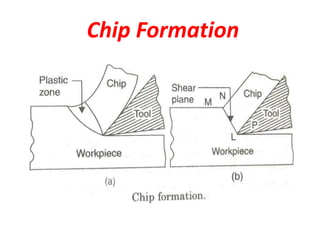
Chip Formation
Mechanism of Chip formation
The form of the chips is an important index of machining
because it directly or indirectly indicates :
 Nature and behavior of the work material under
machining condition
 Specific energy requirement (amount of energy required
to remove unit volume of work material) in machining
work
 Nature and degree of interaction at the chip-tool
interfaces.
4
Mechanism of Chip formation
The form of machined chips depend mainly upon :
 Work material
 Material and geometry of the cutting tool
 Levels of cutting velocity and feed and also to some extent on
depth of cut
 Machining environment or cutting fluid that affects
temperature and friction at the chip-tool and work-tool
interfaces.
Knowledge of basic mechanisms of chip formation helps to
understand the characteristics of chips and to attain
favourable chip forms.
5
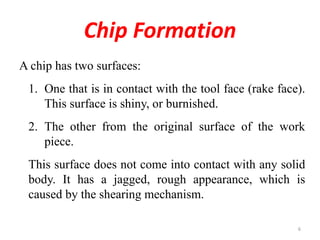
A chip has two surfaces:
1. One that is in contact with the tool face (rake face).
This surface is shiny, or burnished.
2. The other from the original surface of the work
piece.
This surface does not come into contact with any solid
body. It has a jagged, rough appearance, which is
caused by the shearing mechanism.
Chip Formation
6
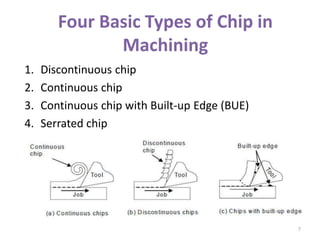
Four Basic Types of Chip in
Machining
1. Discontinuous chip
2. Continuous chip
3. Continuous chip with Built-up Edge (BUE)
4. Serrated chip
7
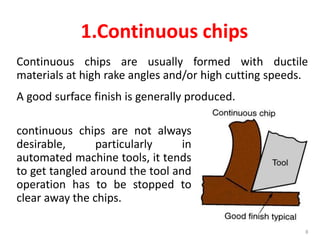
continuous chips are not always
desirable, particularly in
automated machine tools, it tends
to get tangled around the tool and
operation has to be stopped to
clear away the chips.
8
1.Continuous chips
Continuous chips are usually formed with ductile
materials at high rake angles and/or high cutting speeds.
A good surface finish is generally produced.
Continuous chips usually form under the following
conditions:
 Small chip thickness (fine feed)
 Small cutting edge
 Large rake angle
 High cutting speed
 Ductile work materials
 Less friction between chip tool interface through
efficient lubrication
9
Deformation of the material takes place along a
narrow shear zone, primary shear zone.
CCs may, because of friction, develop a secondary
shear zone at tool–chip interface. The secondary zone
becomes thicker as tool–chip friction increases.
In CCs, deformation may also take place along a wide
primary shear zone with curved boundaries.
10
2. Discontinuous chips
Discontinuous chips consist of segments that may be
firmly or loosely attached to each other.
These chips occur when machining hard brittle
materials such as cast iron.
Brittle failure takes place along the shear plane
before any tangible plastic flow occurs.
Discontinuous chips will form in brittle materials at
low rake angles (large depths of cut).
11
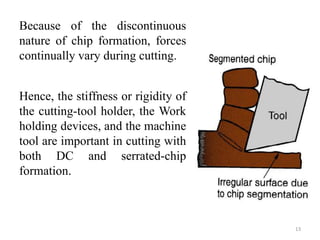
DCs usually form under the following conditions:
1. Brittle work piece materials
2. Work piece materials that contain hard inclusions and
impurities, or have structures such as the graphite
flakes in gray cast iron.
3. Very low or very high cutting speeds.
4. Large depths of cut.
5. Low rake angles.
6. Lack of an effective cutting fluid.
7. Low stiffness of the machine tool.
12
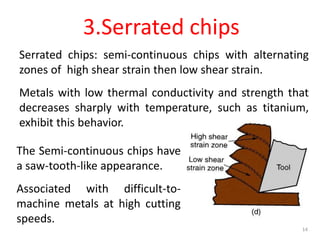
Because of the discontinuous
nature of chip formation, forces
continually vary during cutting.
Hence, the stiffness or rigidity of
the cutting-tool holder, the Work
holding devices, and the machine
tool are important in cutting with
both DC and serrated-chip
formation.
13
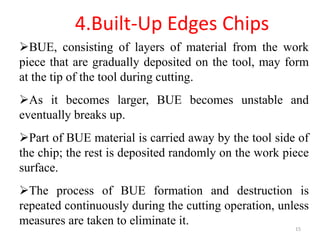
3.Serrated chips
Serrated chips: semi-continuous chips with alternating
zones of high shear strain then low shear strain.
Metals with low thermal conductivity and strength that
decreases sharply with temperature, such as titanium,
exhibit this behavior.
14
The Semi-continuous chips have
a saw-tooth-like appearance.
Associated with difficult-to-
machine metals at high cutting
speeds.
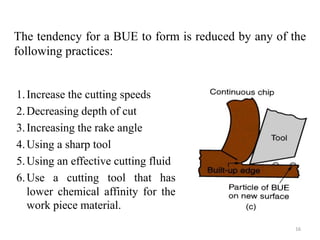
4.Built-Up Edges Chips
BUE, consisting of layers of material from the work
piece that are gradually deposited on the tool, may form
at the tip of the tool during cutting.
As it becomes larger, BUE becomes unstable and
eventually breaks up.
Part of BUE material is carried away by the tool side of
the chip; the rest is deposited randomly on the work piece
surface.
The process of BUE formation and destruction is
repeated continuously during the cutting operation, unless
measures are taken to eliminate it.
15
1.Increase the cutting speeds
2.Decreasing depth of cut
3.Increasing the rake angle
4.Using a sharp tool
5.Using an effective cutting fluid
6.Use a cutting tool that has
lower chemical affinity for the
work piece material.
16
The tendency for a BUE to form is reduced by any of the
following practices:
Because of work hardening and deposition of successive
layers of material. BUE hardness increases significantly.
BUE is generally undesirable as it results in poor surface
finish.
A thin, stable BUE is sometimes desirable because it
reduces wear by protecting the rake face of the tool.
As cutting speed increases the size of BUE decreases.
17
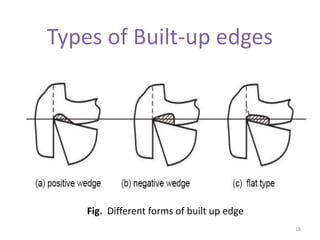
Types of Built-up edges
Fig. Different forms of built up edge
18
Effects of BUE formation
Formation of BUE causes several harmful effects, such
as:
 It unfavorably changes the rake angle at the tool tip causing
increase in cutting forces and power consumption
 Repeated formation and dislodgement of the BUE causes
fluctuation in cutting forces and thus induces vibration
which is harmful for the tool, job and the machine tool.
 Surface finish gets deteriorated
 May reduce tool life by accelerating tool-wear at its rake
surface by adhesion and flaking
 Occasionally, formation of thin flat type stable BUE may
reduce tool wear at the rake face.
19
THANK YOU
20

Chip formation and types

  • 1.
    MANUFACTURING TECHNOLOGY-II 1 Chip Formation ME8451:MANUFACTURING TECHNOLOGY - II PATTERNS Presented by S.Kannan Assistant Professor Department of Mechanical Engineering Vel Tech Engineering College Avadi-Chennai-62
  • 2.
    Cutting action involvesshear deformation of work material to form a chip. As chip is removed, new surface is exposed. Figure 21.2 (a) A cross-sectional view of the machining process, (b) tool with negative rake angle; compare with positive rake angle in (a). Machining
  • 3.
  • 4.
    Mechanism of Chipformation The form of the chips is an important index of machining because it directly or indirectly indicates :  Nature and behavior of the work material under machining condition  Specific energy requirement (amount of energy required to remove unit volume of work material) in machining work  Nature and degree of interaction at the chip-tool interfaces. 4
  • 5.
    Mechanism of Chipformation The form of machined chips depend mainly upon :  Work material  Material and geometry of the cutting tool  Levels of cutting velocity and feed and also to some extent on depth of cut  Machining environment or cutting fluid that affects temperature and friction at the chip-tool and work-tool interfaces. Knowledge of basic mechanisms of chip formation helps to understand the characteristics of chips and to attain favourable chip forms. 5
  • 6.
    A chip hastwo surfaces: 1. One that is in contact with the tool face (rake face). This surface is shiny, or burnished. 2. The other from the original surface of the work piece. This surface does not come into contact with any solid body. It has a jagged, rough appearance, which is caused by the shearing mechanism. Chip Formation 6
  • 7.
    Four Basic Typesof Chip in Machining 1. Discontinuous chip 2. Continuous chip 3. Continuous chip with Built-up Edge (BUE) 4. Serrated chip 7
  • 8.
    continuous chips arenot always desirable, particularly in automated machine tools, it tends to get tangled around the tool and operation has to be stopped to clear away the chips. 8 1.Continuous chips Continuous chips are usually formed with ductile materials at high rake angles and/or high cutting speeds. A good surface finish is generally produced.
  • 9.
    Continuous chips usuallyform under the following conditions:  Small chip thickness (fine feed)  Small cutting edge  Large rake angle  High cutting speed  Ductile work materials  Less friction between chip tool interface through efficient lubrication 9
  • 10.
    Deformation of thematerial takes place along a narrow shear zone, primary shear zone. CCs may, because of friction, develop a secondary shear zone at tool–chip interface. The secondary zone becomes thicker as tool–chip friction increases. In CCs, deformation may also take place along a wide primary shear zone with curved boundaries. 10
  • 11.
    2. Discontinuous chips Discontinuouschips consist of segments that may be firmly or loosely attached to each other. These chips occur when machining hard brittle materials such as cast iron. Brittle failure takes place along the shear plane before any tangible plastic flow occurs. Discontinuous chips will form in brittle materials at low rake angles (large depths of cut). 11
  • 12.
    DCs usually formunder the following conditions: 1. Brittle work piece materials 2. Work piece materials that contain hard inclusions and impurities, or have structures such as the graphite flakes in gray cast iron. 3. Very low or very high cutting speeds. 4. Large depths of cut. 5. Low rake angles. 6. Lack of an effective cutting fluid. 7. Low stiffness of the machine tool. 12
  • 13.
    Because of thediscontinuous nature of chip formation, forces continually vary during cutting. Hence, the stiffness or rigidity of the cutting-tool holder, the Work holding devices, and the machine tool are important in cutting with both DC and serrated-chip formation. 13
  • 14.
    3.Serrated chips Serrated chips:semi-continuous chips with alternating zones of high shear strain then low shear strain. Metals with low thermal conductivity and strength that decreases sharply with temperature, such as titanium, exhibit this behavior. 14 The Semi-continuous chips have a saw-tooth-like appearance. Associated with difficult-to- machine metals at high cutting speeds.
  • 15.
    4.Built-Up Edges Chips BUE,consisting of layers of material from the work piece that are gradually deposited on the tool, may form at the tip of the tool during cutting. As it becomes larger, BUE becomes unstable and eventually breaks up. Part of BUE material is carried away by the tool side of the chip; the rest is deposited randomly on the work piece surface. The process of BUE formation and destruction is repeated continuously during the cutting operation, unless measures are taken to eliminate it. 15
  • 16.
    1.Increase the cuttingspeeds 2.Decreasing depth of cut 3.Increasing the rake angle 4.Using a sharp tool 5.Using an effective cutting fluid 6.Use a cutting tool that has lower chemical affinity for the work piece material. 16 The tendency for a BUE to form is reduced by any of the following practices:
  • 17.
    Because of workhardening and deposition of successive layers of material. BUE hardness increases significantly. BUE is generally undesirable as it results in poor surface finish. A thin, stable BUE is sometimes desirable because it reduces wear by protecting the rake face of the tool. As cutting speed increases the size of BUE decreases. 17
  • 18.
    Types of Built-upedges Fig. Different forms of built up edge 18
  • 19.
    Effects of BUEformation Formation of BUE causes several harmful effects, such as:  It unfavorably changes the rake angle at the tool tip causing increase in cutting forces and power consumption  Repeated formation and dislodgement of the BUE causes fluctuation in cutting forces and thus induces vibration which is harmful for the tool, job and the machine tool.  Surface finish gets deteriorated  May reduce tool life by accelerating tool-wear at its rake surface by adhesion and flaking  Occasionally, formation of thin flat type stable BUE may reduce tool wear at the rake face. 19
  • 20.