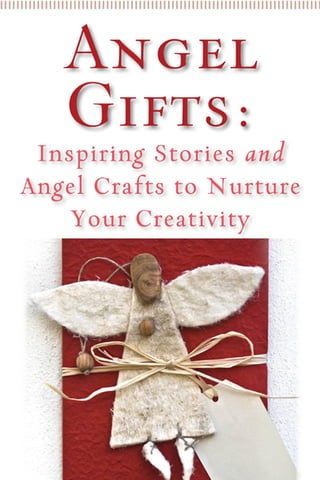
ANGEL GIFTS
e are never so close to our Creator as when we are
creating. We don’t have to be a Bach, Picasso or
I.M. Pei, a C.S. Lewis or even a J.K. Rowling. We can use
humble implements like needle and thread, yarn, fabric and
beads to immerse ourselves in the creative process. And
what better object to create than an angel!
In the following pages, you’ll be inspired by stories of
people who, through a quilt or crocheted snowflake,
“earned their wings.” Plus, you can invite angels into your
home by using the patterns in this booklet. So, go ahead, be
an angel. Create one for yourself, your friends and loved
ones.
W
CONTENTS
AN AMISH MIRACLE By Joan Liberato Coad
SNOWFLAKES FOR SISTER GRACE By Robert Hawkins
SEWING HOPE By Anita Hatfield
THE FORGIVING QUILT By Roberta Messner
CRAFT: GARLAND OF ANGELS
CRAFT: SASSY, SILKY BEAD ANGEL DANGLES
CRAFT: KAREN’S DARLING
AN AMISH MIRACLE
THE QUILT’S HANDIWORK WAS INCREDIBLE, BUT
COULD I BRING THEM THE PRICE THEY NEEDED?
By Joan Liberato Coad, Indiana, Pennsylvania
here was a feeling of mystery in the air as I dressed
warmly in navy sweatpants and a heavy beige jacket
in preparation for the drive to visit my friend Clara Byler
out in the country. I’m an antiques dealer, and Clara had
mended some antique quilts for me. But in her letter telling
me the quilts were ready, she mentioned she had something
special waiting for me. What could it be? Another bargain,
perhaps?
I never dreamed it might be just the opposite.
It’s only 15 miles from my house in town to Clara’s
home overlooking a farmer’s field, but for me it’s like a
journey back to the mid-19th century. Clara is Amish, and
her family and some other Amish settlers had moved to the
fertile hills in our area of western Pennsylvania in the
1960s and 1970s, bringing with them a simple, quiet, hard-
working lifestyle that was so different from my own frantic
pace of buying and selling.
So I was looking forward to the drive that snowy
morning in February 1990. Amish country helps to slow
me down, quieting my spirit as horse-drawn buggies pass
and men nod from beneath their broad-brimmed hats. Now
the sky was gray and snow was piled high in the pastures
T
1
that lined the curving road. I was grateful the township
snowplow had cleared the way.
At Clara’s white frame home, I climbed out of my Honda
sedan and braced myself against blowing snow as I walked
toward the back porch. Knowing the custom of using the
back door except for special occasions, I climbed the steps,
knocked and waited. There was no answer. From inside
came the sound of Clara’s canary, merrily singing as usual.
A mouthwatering aroma of curing pork drifted over from
the nearby smokehouse. But when I peeked in the window,
there was no sign of Clara. Puzzled, I turned to go.
Then I heard a voice eagerly calling from far away:
“Joan, come on up!”
Looking around, I spied the next house up the hill, where
Clara stood on the back porch, a black shawl wrapped
around her sturdy shoulders, the ties of her dark wool
bonnet whipping her chin. There were a dozen or so
buggies parked near the house, and horses speckled the
field. I plodded through knee-deep snow and finally
climbed the steps to greet Clara.
“This is my daughter-in-law’s house,” she explained.
“The ladies are having a quilting bee! That’s my surprise.”
She said the women were making an all-white quilt. They
wanted to sell it to pay off a $900 medical bill for a baby
who had had surgery.
When Clara opened the door, the Pennsylvania German
chatter used by the Amish suddenly hushed as I, an
“English,” stepped inside. A group of older women glanced
up from the frame on which they were stitching the all-
white quilt and nodded pleasantly. In the background were
children garbed in somber colors, and the younger women
2
looked up from stirring stew and rocking babies in the
spacious kitchen to smile at my arrival.
“Here’s Joan Coad,” Clara announced, brushing a stray
strand of white hair from her brow. “She’s going to sell our
quilt for us!”
I sucked in my breath, afraid to commit myself because I
knew they were expecting too much. The price was just too
high.
“May I look at it more closely?” I asked.
It was beautiful. Thousands of fine stitches covered the
single piece of white fabric, surrounding an intricate basket
of flowers with ribbons streaming from the handle.
n all-white quilt is the acme of the quilter’s art, I
knew, attempted by only the finest quilters. I was
certain these women were the community’s most
experienced stitchers. But panicky thoughts bounced inside
my head: Don’t these women know this is the hardest kind
of quilt to sell?
From experience I knew my customers wanted colorful
patchwork antique quilts—one-of-a-kind quilts that tell a
special story. When I find something to offer them, they
search the quilts for that one imperfect piece of fabric
deliberately inserted in the pattern to show no one is
perfect, no one but God.
But how can I say no? I thought. God, please help me.
As I looked around at the women, the trust in their eyes
drew me into their circle. They really think I can do this! I
thought in awe. And I found myself saying, “I’m sure I can
find you a happy customer,” amazed at a growing calmness
within me.
A
3
I agreed to return in two days when the project would be
complete, then left with Clara to pick up the mended quilts
at her house.
Afterward, as I pulled out into the country lane, I thought
again how impossible this all seemed. The trust placed in
me by those Amish women began to fight with the
practical side of my nature. February is the worst time of
year for antiques dealers. People in the hillside
communities of western Pennsylvania are too busy stoking
fires and paying heating bills to leave their cozy homes in
search of old-fashioned treasures.
Still, I couldn’t forget those trusting eyes. They reminded
me of my grandmother, the most important person in my
childhood years in a New Jersey ghetto. My father had left
before I was old enough to remember him. When my
mother remarried, my new dad moved us to a bungalow in
a safer neighborhood. But my mom continued to work as a
secretary in a factory, so Nana filled my hours, teaching me
patience and skills through little chores such as sewing
buttons on her $1 housedresses. Each night she rocked me
to sleep murmuring, “God loves you, Joanie, and I love
you, too.”
But after Nana moved out to make room for my new
baby sister, I decided to become more self-reliant. I wove
potholders on a red metal frame, and when my stepdad’s
factory closed I sold them door-to-door. At age 18 I came
upon a tag sale one Sunday after church and bought my
first antique, an 1860s commode. After that, I cherished
and collected things from the past, and became an antiques
dealer. So I had a good eye for value, and I knew that at
auction an all-white quilt would bring $450, tops.
At supper I mentioned my predicament to my husband,
4
Bob, who traveled throughout several counties as a
special-education administrator. “I’ll keep my eyes open
for a buyer,” he promised.
o my amazement, the next evening he handed me a
slip of paper with the name and phone number of a
professional acquaintance from Greensburg, about 35 miles
away. “Call him,” Bob said. “He’s interested in the quilt.”
“So quickly?” I wondered. But as soon as I cleared away
the supper dishes, I dialed the number. A man’s robust
voice answered.
“My wife’s dreamed of a white quilt for years,” Mike
Scatena said. “What’s the price?”
I swallowed hard and told him, adding that the Amish
women were trying to raise money for a medical bill.
“That will make Marlene love it all the more,” he said.
“let’s make it a surprise.”
Mr. Scatena asked me to wrap the quilt in red-and-white
paper, then to camouflage it in a plain brown wrapper so he
could hide it until Valentine’s Day. When I hung up the
phone, I again experienced the same peace washing over
me that I had felt in the presence of those Amish women.
That quilt had been their labor of love, and in the process it
had taken on a value all its own.
A few days later, after picking up the finished quilt, I met
my buyer and exchanged my package for a sealed envelope
of cash. With a new sense of trust, I didn’t even open it to
count the contents. Immediately I drove to Clara Byler’s
house. This time she answered my knock, and I slid the
envelope into her work-worn hands.
“I knew you could do it, Joan,” Clara said, smiling
T
5
warmly.
“Oh, but I didn’t do it, Clara,” I corrected. “God did.”
In her quiet Amish way, she nodded in agreement.
6
SNOWFLAKES FOR SISTER GRACE
A DETERMINED NUN SET HER SIGHTS ON CREATING
THE PERFECT CHRISTMAS TREE
By Robert Hawkins, St. Johns Island, South Carolina
n September last year Sister Grace began forming a
picture of a Christmas tree in her mind. As the director
of pastoral care at Charleston’s St. Francis Xavier hospital,
Sister Grace had been asked to decorate the tree that would
be placed in the lobby of the Omni hotel.
The tree would have angels on it and snowflakes—lots of
snowflakes, exquisite ones crocheted by hand. By
Thanksgiving Sister Grace had acquired the angels, but the
snowflakes were not to be found.
On the day before Thanksgiving, Doris Hartvig was
admitted to the hospital for tests. Doris detested idleness,
and she was soon busy at work with needles and yarn.
“Could you do a snowflake?” one of the nuns, Sister
Mary Joseph, asked her.
“I can,” Doris replied. In fact, not long ago she had
bought a book that described how to crochet snowflakes.
They weren’t easy to do, and each one required a lot of
time.
With renewed hope, Sister Grace went to see Doris. She
described in detail the Christmas tree she had her heart set
on: a blue bow on top, angels clinging to the branches and
lacy snowflakes hanging from the boughs.
I
7
“How many snowflakes do you need?” Doris finally
asked. “We should have 60,” Sister Grace replied, “but
there’s no time to make that many.”
Doris smiled. She reached under her bed and took out a
bag of needlework, and then drew out one beautiful
crocheted snowflake after another—40, 50, over 60 of
them! They were ironed, starched and ready to be hung.
In September, Doris Hartvig had felt a great urge to
crochet snowflakes. Now she knew why.
8
SEWING HOPE
ONE TEACHER’S INSPIRING STORY
OF HELPING TROUBLED BOYS
IN AN UNUSUAL WAY
By Anita Hatfield, Ione, California
hen I first started teaching at Preston Youth
Correctional Facility, I worried that I had gotten in
way over my head. Preston was the end of the line for
juvenile offenders—kids from tough backgrounds serving
time for equally tough crimes. Robbery, drug dealing, even
murder were just some of the reasons for ending up there.
Gang members carried their hatred for rival gangs with
them when they walked through Preston’s steel gates.
Threats and insults were often the only words that passed
between them.
Most of the kids could not have cared less about the
rudimentary science lessons I had been hired to give. About
the only thing they did seem willing to concentrate on were
small craft projects of their own invention. They spent
hours etching designs on plastic cups from the cafeteria,
and weaving tiny necklaces and crosses using threads
pulled from their jeans. It was tempting to hope that beneath
all the rage and frustration, a creative spark was hiding,
waiting to be kindled. But who could be sure?
“Lord,” I asked again and again, “please show me a way
to reach these kids.”
W
9
On tough days, I often stopped by to visit my Auntie Lo.
She always lent a sympathetic ear when I needed to talk
about the challenges of teaching at Preston. We also shared
a love of crocheting and sewing.
“I was hoping you’d come by today, Anita,” Auntie Lo
said one afternoon. “I’ve got something for you.” She
handed me an article about a volunteer organization that
made clothing for premature, or “preemie,” babies, and
donated them to local hospitals. The story was touching, but
I didn’t understand why my aunt had been so anxious for
me to read it.
“Don’t you get it, Anita? This is something your boys
could do.”
Gang members sewing baby clothes? It seemed unlikely
to say the least, and I said as much to my aunt. But over the
next few days, I couldn’t get the idea out of my head.
Finally, I prayed about it. “Okay, Lord. I asked you for help
with these kids. Is this your answer?”
I worked up my courage and spoke to my supervisor,
explaining that to get started I’d need a couple of sewing
machines and a place where I could lock them away when
not in use.
He looked at me in disbelief. “Anita, these boys are from
the streets. They wouldn’t be caught dead sitting at a
sewing machine.”
Over the next few months I kept bringing the project up
with the rest of the staff. Many were sympathetic with the
soft-hearted, soft-headed woman who wanted to teach
Preston’s population of juvenile robbers, drug dealers and
murderers to sew. They realized I meant well, but no one
took me seriously.
After a while, the lack of enthusiasm started to take its
10
toll. I guess they’re right, I thought. This project just
can’t work.
Then one day, a new boy named Jose approached my
desk after class. Jose was a strong-willed kid, whom the
others respected.
“Mrs. Hatfield,” he said, dropping his science textbook
on my desk, “I can’t do this book stuff. I never could in
school, and I sure can’t here.”
“Sure you can, Jose,” I said.
Jose bent closer to me. “No, you don’t understand. I
can’t.”
“Listen, Jose. Can’t isn’t a word that’s going to do you
any good in my class. you may not feel comfortable with
that textbook now, but you’re going to. I’ll help you every
step of the way.”
hen Jose left, my words to him lingered in my head.
If I expected my boys not to say “can’t,” why had I
started saying it to myself ?
The facility had recently hired a new principal, Dr.
Manuel Roman. He had never heard of my sewing idea. I
decided it was time to launch a fresh attack. I placed an
extra-small baby gown, a proposal for the project, and a
copy of Auntie Lo’s original clipping into a big Ziploc bag,
and walked over to Dr. Roman’s office.
“I have something here I’d like you to look at,” I said. I
handed him the bag and hurried off to my classroom.
Later that day, Dr. Roman called me to his office. He told
me he would support the project. “But there won’t be any
funding or special class time. And I don’t need to tell you
what will happen if a pair of scissors from the class finds its
way into a gang fight.”
W
11
“Sewing!” said Jose, his eyebrows going up. “I don’t
know, Mrs. Hatfield. That isn’t very…masculine.”
“I know, Jose. But listen: Remember how you thought it
was going to be impossible for you to do your science
work?”
“Yeah, I remember.”
“You’ve made great progress with that so far, haven’t
you?”
“I guess so.”
“Well, starting this project at Preston has been my dream,
and for a while I thought it was going to be impossible, but
at last they’ve told me I can give it a try. I know the other
boys respect you. I really need your help.”
“Okay, Mrs. Hatfield,” he finally said, shrugging. ‘Cause
it’s you asking, I’ll do it.”
When they first saw him hunched over a sewing machine
the other boys were merciless. But Jose kept at it. Before
long, a few more guys asked if they could get involved too.
Soon the sewing machines were humming constantly, and I
expanded the project to knitting, quilting and crocheting.
Letters started coming in from hospitals with photos of
preemies wearing our outfits. Many of the boys were
fathers already, and the sight of these babies hit home.
ne afternoon during a sewing class, I watched as a
particularly hard kid who had only gotten involved in
the project after failing to shame his friends into quitting,
got up and, with crochet hook in hand, walked toward a
group of boys crocheting in a corner.
These boys were from rival gangs. I tensed, ready for the
worst.
One fight could jeopardize the whole project. God, don’t
O
12
let this be the end, after all the hard work we’ve put in…
The boy sat down next to the others and started talking. A
moment later, he got up and went back to his seat.
When the bell rang and the boys started filing out, I took
the student aside and casually asked what he had been
talking to them about.
“Oh yeah, I know that probably looked strange. But they
had a pattern I needed.”
Who knew that Auntie Lo’s crazy idea would serve as the
thread to create a common bond for these boys.
13
THE FORGIVING QUILT
A STORY OF HOLIDAY HEALING
By Roberta Messner, Huntington, West Virginia
ulging red rubber tubs of decorations were scattered
around the living room of my log cabin as I prepared
for the holidays: Christmas lights and ornaments for the
tree, red and green candles for the windows, holly for the
fireplace. I’d wrestled the tree into its stand. Now I needed
a quilt to spread around the bottom for a skirt.
I went to the linen cupboard. One quilt immediately
caught my eye: a hand-stitched antique. Do I really want to
put this on display? I thought as I pulled it out. The one she
gave me?
“She” was Mrs. Messner, my ex-husband’s mother. In 25
years of marriage I never got comfortable enough with her
to use her first name. Our relationship was always tense, but
then she did something I could never forgive her for. Just
looking at the quilt—hand-stitched by Mrs. Messner’s
mother—made me furious all over again.
Twenty years ago I was scheduled for a medical
procedure that would take me away from home, and my
husband was coming with me. That meant we needed a
babysitter for our beloved dog, Muffin. “I’ve got a fenced-
in yard where she can play,” Mrs. Messner offered.
“You’re sure you’ll keep a close eye on her?” I asked.
“I promise,” she said.
B
14
She promised, I thought angrily, shaking out the quilt.
For all that was worth. Two days after we dropped Muffin
off, Mrs. Messner called to report that our dog had gone
missing. Apparently she hadn’t been at Mrs. Messner’s an
hour before she slipped out of the yard and ran away. She
wasn’t even wearing her collar because I’d neglected to put
it back on after giving her a bath. Of all the terrible times
for Muffin to have been without her collar!
I searched the neighborhood, going door-to-door with
pictures of Muffin. Mrs. Messner had put signs up: LOST
DOG $5 REWARD. Five dollars! That was all Muffin was
worth to her. It infuriated me all these years later.
Weeks went by with no sign of Muffin, and I had to
accept the fact that she was never coming back. “Could you
tell me what happened that day?” I asked Mrs. Messner.
“What was she doing when you last saw her? Do you have
any idea how she got out of the yard? Did you forget to
latch the gate?”
“Quit upsetting everybody about that dog, Roberta,” she
snapped. “You’ve got me so worked up I’m getting hives.
Just go out and get yourself another dog.” I was stunned.
Speechless. Another dog? That was her solution? How
could that woman be so cruel? Muffin didn’t mean anything
to her, and she didn’t care what Muffin meant to me. I got
down on my knees and yanked the quilt around the tree.
Mrs. Messner’s quilt was the perfect accent, but I
couldn’t appreciate it anymore. All I could think about
when I looked at it was my 20-year-old grudge. I didn’t
need that at Christmas. As I folded the quilt back up, a new
thought popped into my head. More like a command, really:
Give the quilt back to Mrs. Messner.
Where had such a crazy idea come from? I would have
15
laughed if I wasn’t so angry. Why should I give Mrs.
Messner anything? I stuck the quilt back in the linen
cupboard and chose another for the tree skirt.
he quilt’s a family heirloom. Surely she’d like to have
it back. I couldn’t quiet the voice in my head no matter
what I did. Since Mrs. Messner’s mother had died, I
supposed it made the quilt all the more special to those who
loved her. But giving it back would mean having to speak
to Mrs. Messner. I tried to imagine calling her. What would
I say? I stared at the phone.
Wish her a blessed Christmas. The voice was hard to
abide. So now I was not only supposed to do something
nice, but say something nice too? That was too much. I
vacuumed stray needles around the bottom of the tree. I
finished decorating and put away the empty tubs. Thoughts
of Mrs. Messner nagged at me. I went back to the cupboard
and took her quilt out again. The Christmas lights
illuminated the careful stitching, a perfect 12 to every inch.
A lot of love went into this quilt, I thought. When Muffin
disappeared, what hurt the most was thinking Mrs. Messner
didn’t care how much Muffin meant to me. Was I doing the
same thing with this quilt? It was made with a love Mrs.
Messner could appreciate far more than I could. And it was
Christmas, after all.
I picked up the phone and dialed. “Mrs. Messner?” I said
when she answered. “This is Roberta. I was just admiring
that lovely quilt your mother made. The one you gave me.”
I paused hopefully, but was met with silence on the other
end of the phone.
“What do you need?” Mrs. Messner said. Couldn’t a
single conversation with this woman be easy?
T
16
I took a deep breath and forged ahead. “I was
wondering,” I said, “since your mother has passed on, if
you would like to have the quilt back? The beautiful one
she made.”
Silence. What more could I say? I’d done what I had to
do. I braced myself for another curt reply. “Mrs. Messner,
are you still there?”
“You can’t know what this means to me, Roberta,” she
said. “I don’t own a single thing Mom made. I would so
love to have that quilt again.” Mrs. Messner’s voice had a
sweetness in it that I had never heard before.
“I’ll send it to you right away,” I said. I heard my own
voice softening too when I wished her a merry Christmas.
I hung up feeling lighter, as if a weight had been lifted
from my chest. For the first time in 20 years I thought about
Muffin without fuming over an unlatched gate, a paltry
reward and the dog collar I’d neglected to put back on.
Perhaps my bitterness at Mrs. Messner had been inflamed
by my own guilty conscience. I wrapped the quilt in tissue
paper and wrote on a holiday card: “Dear Mrs. Messner,
wishing you and your dear ones a blessed Christmas filled
with nothing but love, Roberta.”
I packaged up the quilt and tucked in the card. I’d chosen
one with an angel on it. Because that was not just any voice
in my head telling me to consider Mrs. Messner. That was a
Christmas angel speaking to my heart. And I would never
forget the gift she gave me. The gift of forgiveness.
17
BE AN ANGEL, CREATE AN ANGEL
What could be better than to grace your home with an angel or
give them as gifts. The following craft patterns devised by our
friends at Interweave, one of the nation’s largest art and craft
media companies, are simple to use. So get started! Bring an
angel into your life—or make one for a friend!
Garland of Angels
By Tiffany Warble
MATERIALS:
•Red Heart Shimmer (4) or any Mediumweight yarn – 1 skein
(A)
•Size 10 Royal Metallic Crochet Thread – Silver (B)
•Size E crochet hook (3.5 MM)
GLOSSARY:
ch – chain
st – stitch
sc – single crochet
sl st – slip stitch
18
dc – double crochet
INSTRUCTIONS:
HEAD: Chain 2, sl st in first chain to form ring.
ROW 1: Ch 1, 9 sc in ring, sl st in beg ch 1 to join. Do not turn.
ROW 2: Ch 1, sc in first st, 2 sc in each st across to last st, 1 sc
in last st, sl st in beg ch 1 to join. Do not turn.
ROW 3: Ch 3, 2 dc in same stitch, 2 dc in next st, 3 dc in next
st. Turn.
ROW 4: Ch 3, 2 dc in first chain, 2 dc in each st across, 3 dc in
top ch of ch 3. Turn.
ROW 5: Sl st in the top of next 6 st. Ch 3, 2 dc in same st, 1 dc
in next 5 stitches, 3 dc in next st. Turn.
ROW 6: Ch 3, dc in same st, 1 dc in each st across, 2 dc in top
ch of ch 3. Turn.
ROW 7: Ch 3, dc in same st, 1 dc in each st across, 2 dc in top
ch of ch 3, fasten off.
ROW 1: with B ch 17. Turn.
ROW 2: Sl st in second chain from hook and in each chain
across. Sl st to first chain to form ring. Fasten off leaving
enough of a tail to join to angel.
Repeat instructions for Head, Wings and Body, and Halo for
as many angels as you desire.
Attach the halo by knotting the loose ends around a loop at the
back of the head. Be sure to make tight knots, trim excess.
TO JOIN ANGELS:
*Start by holding two strands of B together. Join B to angel #1
with a sl st half way down the edge of a wing. Ch 20 (or until
desired distance between angels has been achieved), sl st
19
Wings and Body:
Halo:
Finishing:
through edge of wing of next angel. Fasten off. Repeat from *
until all angels have been attached.
ENDING CHAINS:
^Holding two strands of B together, join to opposite wing of
angel #1 with sl st half way down the edge of the wing. Ch 20.
Turn. Sl st in seventh ch from hook to create a loop. Fasten
off. Repeat from ^ for the other end of the string of angels.
Weave in all ends.
Copyright Interweave Press LLC. All rights reserved. Reprinted
in Angel Gifts: Inspiring Stories and Angel Crafts to Nurture
Your Creativity with permission. Not to be reprinted.
20
SASSY SILKY BEAD
ANGEL DANGLES
By Kristal Wick
MATERIALS:
•1 angel charm
•1 Sassy Silky bead
•2 red 8mm crystal bicones
•2 black 3mm jet crystal bicones
•2 silver spacers
•1 silver 3” eyepin
•1 cell phone loop
TOOLS
•Wire cutters
•Chain-nose pliers
•Round-nose pliers
21
RESOURCES:
All components from www.Artbeads.com
INSTRUCTIONS:
STEP 1: String onto eyepin: jet bicone, silver spacer, red
bicone, Sassy Silky bead, red bicone, silver spacer, jet
bicone.
STEP 2: Form a simple loop at the top of the eyepin.
STEP 3: Close loop.
STEP 4: Open bottom eyepin loop and add angel charm. Close
loop.
STEP 5: Attach top eyepin loop to cell phone loop, chain (for
necklace), or lobster clasp (for backpack dangle,
keychain, or dog collar clip).
Copyright Interweave Press LLC. All rights reserved. Reprinted
in Angel Gifts: Inspiring Stories and Angel Crafts to Nurture
Your Creativity with permission. Not to be reprinted.
22
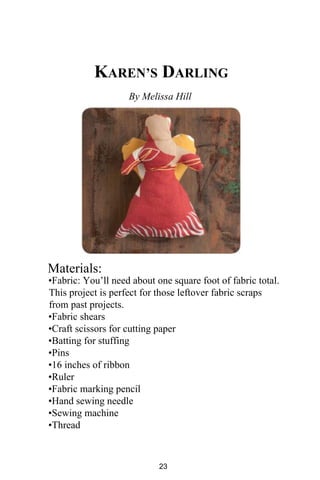
KAREN’S DARLING
By Melissa Hill
Materials:
•Fabric: You’ll need about one square foot of fabric total.
This project is perfect for those leftover fabric scraps
from past projects.
•Fabric shears
•Craft scissors for cutting paper
•Batting for stuffing
•Pins
•16 inches of ribbon
•Ruler
•Fabric marking pencil
•Hand sewing needle
•Sewing machine
•Thread
23
Finished Size: About 4” x 6”
Note: All seam allowances are ¼”.
Instructions:
Cut out the fabric: Cut two of the angel body template
and two of the wing template. The templates are located
on following pages.
Assembly: Sew the two angel body pieces with the right
sides together, while leaving the bottom of the angel body
open. Start along one side from the bottom corner and
sew around the arms and head and down the other side.
Carefully trim the fabric in the corners under the arms
and around the angel’s neck to make turning it right side
out easier. Just make sure you don’t clip the thread by
accident. Start turning the angel right side out. Push out
and shape the arms and head with a point turner or even a
dull pencil will work.
Once your angel is right side out, stuff the angel from
the bottom and make sure to get the stuffing into the head
and arms. Then use a hand sewing needle and thread to
stitch the bottom of the angel closed. Use a whipstitch
and iron the edges of the fabric in to help close the
bottom of the angel.
Then go through the same steps with the wings, with the
right sides together sew the wings around the edges and
leave the bottom open. Stuff the wings and use the
whipstitch technique to hand sew the bottom of the wings
together. With the ruler and fabric pencil draw a vertical
line down the middle of the wings. Carefully sew through
the middle of the wings on the vertical line. If you have a
walking foot, or duel feed foot for your sewing machine
24
this will help pull all three layers through together, but
this isn’t necessary if you don’t have one.
With your hand sewing needle and thread, sew the
wings onto the back of the angel. The top of the wings
should attach to the angel on the back about ¼” below
where the head and body meet. Then sew the middle of
the 16” ribbon to the top of the wings, also along the
vertical line. Tie the ends of the ribbon to make a bow.
Copyright Interweave Press LLC. All rights reserved.
Reprinted in Angel Gifts: Inspiring Stories and Angel Crafts
to Nurture Your Creativity with permission. Not to be
reprinted.
25
KAREN’S DARLING TEMPLATE
(FRONT)
Copyright Interweave Press LLC. All rights reserved.
Reprinted in Angel Gifts: Inspiring Stories and Angel Crafts
to Nurture Your Creativity with permission. Not to be
reprinted.
26
KAREN’S DARLING TEMPLATE
(BACK)
Copyright Interweave Press LLC. All rights reserved.
Reprinted in Angel Gifts: Inspiring Stories and Angel Crafts
to Nurture Your Creativity with permission. Not to be
reprinted.
27
ABOUT GUIDEPOSTS
oin us at Guideposts.org for inspiring and uplifting
content, free newsletters, giveaways, the latest news on
all our titles, book and author updates, original videos and
other exclusive content.
You’ll also find information about ShopGuideposts.org,
an online resource for books, magazines, greeting cards
and more to inspire, enlighten and entertain you.
J
28

angel_gifts_epdf_final

  • 2.
    ANGEL GIFTS e arenever so close to our Creator as when we are creating. We don’t have to be a Bach, Picasso or I.M. Pei, a C.S. Lewis or even a J.K. Rowling. We can use humble implements like needle and thread, yarn, fabric and beads to immerse ourselves in the creative process. And what better object to create than an angel! In the following pages, you’ll be inspired by stories of people who, through a quilt or crocheted snowflake, “earned their wings.” Plus, you can invite angels into your home by using the patterns in this booklet. So, go ahead, be an angel. Create one for yourself, your friends and loved ones. W
  • 3.
    CONTENTS AN AMISH MIRACLEBy Joan Liberato Coad SNOWFLAKES FOR SISTER GRACE By Robert Hawkins SEWING HOPE By Anita Hatfield THE FORGIVING QUILT By Roberta Messner CRAFT: GARLAND OF ANGELS CRAFT: SASSY, SILKY BEAD ANGEL DANGLES CRAFT: KAREN’S DARLING
  • 4.
    AN AMISH MIRACLE THEQUILT’S HANDIWORK WAS INCREDIBLE, BUT COULD I BRING THEM THE PRICE THEY NEEDED? By Joan Liberato Coad, Indiana, Pennsylvania here was a feeling of mystery in the air as I dressed warmly in navy sweatpants and a heavy beige jacket in preparation for the drive to visit my friend Clara Byler out in the country. I’m an antiques dealer, and Clara had mended some antique quilts for me. But in her letter telling me the quilts were ready, she mentioned she had something special waiting for me. What could it be? Another bargain, perhaps? I never dreamed it might be just the opposite. It’s only 15 miles from my house in town to Clara’s home overlooking a farmer’s field, but for me it’s like a journey back to the mid-19th century. Clara is Amish, and her family and some other Amish settlers had moved to the fertile hills in our area of western Pennsylvania in the 1960s and 1970s, bringing with them a simple, quiet, hard- working lifestyle that was so different from my own frantic pace of buying and selling. So I was looking forward to the drive that snowy morning in February 1990. Amish country helps to slow me down, quieting my spirit as horse-drawn buggies pass and men nod from beneath their broad-brimmed hats. Now the sky was gray and snow was piled high in the pastures T 1
  • 5.
    that lined thecurving road. I was grateful the township snowplow had cleared the way. At Clara’s white frame home, I climbed out of my Honda sedan and braced myself against blowing snow as I walked toward the back porch. Knowing the custom of using the back door except for special occasions, I climbed the steps, knocked and waited. There was no answer. From inside came the sound of Clara’s canary, merrily singing as usual. A mouthwatering aroma of curing pork drifted over from the nearby smokehouse. But when I peeked in the window, there was no sign of Clara. Puzzled, I turned to go. Then I heard a voice eagerly calling from far away: “Joan, come on up!” Looking around, I spied the next house up the hill, where Clara stood on the back porch, a black shawl wrapped around her sturdy shoulders, the ties of her dark wool bonnet whipping her chin. There were a dozen or so buggies parked near the house, and horses speckled the field. I plodded through knee-deep snow and finally climbed the steps to greet Clara. “This is my daughter-in-law’s house,” she explained. “The ladies are having a quilting bee! That’s my surprise.” She said the women were making an all-white quilt. They wanted to sell it to pay off a $900 medical bill for a baby who had had surgery. When Clara opened the door, the Pennsylvania German chatter used by the Amish suddenly hushed as I, an “English,” stepped inside. A group of older women glanced up from the frame on which they were stitching the all- white quilt and nodded pleasantly. In the background were children garbed in somber colors, and the younger women 2
  • 6.
    looked up fromstirring stew and rocking babies in the spacious kitchen to smile at my arrival. “Here’s Joan Coad,” Clara announced, brushing a stray strand of white hair from her brow. “She’s going to sell our quilt for us!” I sucked in my breath, afraid to commit myself because I knew they were expecting too much. The price was just too high. “May I look at it more closely?” I asked. It was beautiful. Thousands of fine stitches covered the single piece of white fabric, surrounding an intricate basket of flowers with ribbons streaming from the handle. n all-white quilt is the acme of the quilter’s art, I knew, attempted by only the finest quilters. I was certain these women were the community’s most experienced stitchers. But panicky thoughts bounced inside my head: Don’t these women know this is the hardest kind of quilt to sell? From experience I knew my customers wanted colorful patchwork antique quilts—one-of-a-kind quilts that tell a special story. When I find something to offer them, they search the quilts for that one imperfect piece of fabric deliberately inserted in the pattern to show no one is perfect, no one but God. But how can I say no? I thought. God, please help me. As I looked around at the women, the trust in their eyes drew me into their circle. They really think I can do this! I thought in awe. And I found myself saying, “I’m sure I can find you a happy customer,” amazed at a growing calmness within me. A 3
  • 7.
    I agreed toreturn in two days when the project would be complete, then left with Clara to pick up the mended quilts at her house. Afterward, as I pulled out into the country lane, I thought again how impossible this all seemed. The trust placed in me by those Amish women began to fight with the practical side of my nature. February is the worst time of year for antiques dealers. People in the hillside communities of western Pennsylvania are too busy stoking fires and paying heating bills to leave their cozy homes in search of old-fashioned treasures. Still, I couldn’t forget those trusting eyes. They reminded me of my grandmother, the most important person in my childhood years in a New Jersey ghetto. My father had left before I was old enough to remember him. When my mother remarried, my new dad moved us to a bungalow in a safer neighborhood. But my mom continued to work as a secretary in a factory, so Nana filled my hours, teaching me patience and skills through little chores such as sewing buttons on her $1 housedresses. Each night she rocked me to sleep murmuring, “God loves you, Joanie, and I love you, too.” But after Nana moved out to make room for my new baby sister, I decided to become more self-reliant. I wove potholders on a red metal frame, and when my stepdad’s factory closed I sold them door-to-door. At age 18 I came upon a tag sale one Sunday after church and bought my first antique, an 1860s commode. After that, I cherished and collected things from the past, and became an antiques dealer. So I had a good eye for value, and I knew that at auction an all-white quilt would bring $450, tops. At supper I mentioned my predicament to my husband, 4
  • 8.
    Bob, who traveledthroughout several counties as a special-education administrator. “I’ll keep my eyes open for a buyer,” he promised. o my amazement, the next evening he handed me a slip of paper with the name and phone number of a professional acquaintance from Greensburg, about 35 miles away. “Call him,” Bob said. “He’s interested in the quilt.” “So quickly?” I wondered. But as soon as I cleared away the supper dishes, I dialed the number. A man’s robust voice answered. “My wife’s dreamed of a white quilt for years,” Mike Scatena said. “What’s the price?” I swallowed hard and told him, adding that the Amish women were trying to raise money for a medical bill. “That will make Marlene love it all the more,” he said. “let’s make it a surprise.” Mr. Scatena asked me to wrap the quilt in red-and-white paper, then to camouflage it in a plain brown wrapper so he could hide it until Valentine’s Day. When I hung up the phone, I again experienced the same peace washing over me that I had felt in the presence of those Amish women. That quilt had been their labor of love, and in the process it had taken on a value all its own. A few days later, after picking up the finished quilt, I met my buyer and exchanged my package for a sealed envelope of cash. With a new sense of trust, I didn’t even open it to count the contents. Immediately I drove to Clara Byler’s house. This time she answered my knock, and I slid the envelope into her work-worn hands. “I knew you could do it, Joan,” Clara said, smiling T 5
  • 9.
    warmly. “Oh, but Ididn’t do it, Clara,” I corrected. “God did.” In her quiet Amish way, she nodded in agreement. 6
  • 10.
    SNOWFLAKES FOR SISTERGRACE A DETERMINED NUN SET HER SIGHTS ON CREATING THE PERFECT CHRISTMAS TREE By Robert Hawkins, St. Johns Island, South Carolina n September last year Sister Grace began forming a picture of a Christmas tree in her mind. As the director of pastoral care at Charleston’s St. Francis Xavier hospital, Sister Grace had been asked to decorate the tree that would be placed in the lobby of the Omni hotel. The tree would have angels on it and snowflakes—lots of snowflakes, exquisite ones crocheted by hand. By Thanksgiving Sister Grace had acquired the angels, but the snowflakes were not to be found. On the day before Thanksgiving, Doris Hartvig was admitted to the hospital for tests. Doris detested idleness, and she was soon busy at work with needles and yarn. “Could you do a snowflake?” one of the nuns, Sister Mary Joseph, asked her. “I can,” Doris replied. In fact, not long ago she had bought a book that described how to crochet snowflakes. They weren’t easy to do, and each one required a lot of time. With renewed hope, Sister Grace went to see Doris. She described in detail the Christmas tree she had her heart set on: a blue bow on top, angels clinging to the branches and lacy snowflakes hanging from the boughs. I 7
  • 11.
    “How many snowflakesdo you need?” Doris finally asked. “We should have 60,” Sister Grace replied, “but there’s no time to make that many.” Doris smiled. She reached under her bed and took out a bag of needlework, and then drew out one beautiful crocheted snowflake after another—40, 50, over 60 of them! They were ironed, starched and ready to be hung. In September, Doris Hartvig had felt a great urge to crochet snowflakes. Now she knew why. 8
  • 12.
    SEWING HOPE ONE TEACHER’SINSPIRING STORY OF HELPING TROUBLED BOYS IN AN UNUSUAL WAY By Anita Hatfield, Ione, California hen I first started teaching at Preston Youth Correctional Facility, I worried that I had gotten in way over my head. Preston was the end of the line for juvenile offenders—kids from tough backgrounds serving time for equally tough crimes. Robbery, drug dealing, even murder were just some of the reasons for ending up there. Gang members carried their hatred for rival gangs with them when they walked through Preston’s steel gates. Threats and insults were often the only words that passed between them. Most of the kids could not have cared less about the rudimentary science lessons I had been hired to give. About the only thing they did seem willing to concentrate on were small craft projects of their own invention. They spent hours etching designs on plastic cups from the cafeteria, and weaving tiny necklaces and crosses using threads pulled from their jeans. It was tempting to hope that beneath all the rage and frustration, a creative spark was hiding, waiting to be kindled. But who could be sure? “Lord,” I asked again and again, “please show me a way to reach these kids.” W 9
  • 13.
    On tough days,I often stopped by to visit my Auntie Lo. She always lent a sympathetic ear when I needed to talk about the challenges of teaching at Preston. We also shared a love of crocheting and sewing. “I was hoping you’d come by today, Anita,” Auntie Lo said one afternoon. “I’ve got something for you.” She handed me an article about a volunteer organization that made clothing for premature, or “preemie,” babies, and donated them to local hospitals. The story was touching, but I didn’t understand why my aunt had been so anxious for me to read it. “Don’t you get it, Anita? This is something your boys could do.” Gang members sewing baby clothes? It seemed unlikely to say the least, and I said as much to my aunt. But over the next few days, I couldn’t get the idea out of my head. Finally, I prayed about it. “Okay, Lord. I asked you for help with these kids. Is this your answer?” I worked up my courage and spoke to my supervisor, explaining that to get started I’d need a couple of sewing machines and a place where I could lock them away when not in use. He looked at me in disbelief. “Anita, these boys are from the streets. They wouldn’t be caught dead sitting at a sewing machine.” Over the next few months I kept bringing the project up with the rest of the staff. Many were sympathetic with the soft-hearted, soft-headed woman who wanted to teach Preston’s population of juvenile robbers, drug dealers and murderers to sew. They realized I meant well, but no one took me seriously. After a while, the lack of enthusiasm started to take its 10
  • 14.
    toll. I guessthey’re right, I thought. This project just can’t work. Then one day, a new boy named Jose approached my desk after class. Jose was a strong-willed kid, whom the others respected. “Mrs. Hatfield,” he said, dropping his science textbook on my desk, “I can’t do this book stuff. I never could in school, and I sure can’t here.” “Sure you can, Jose,” I said. Jose bent closer to me. “No, you don’t understand. I can’t.” “Listen, Jose. Can’t isn’t a word that’s going to do you any good in my class. you may not feel comfortable with that textbook now, but you’re going to. I’ll help you every step of the way.” hen Jose left, my words to him lingered in my head. If I expected my boys not to say “can’t,” why had I started saying it to myself ? The facility had recently hired a new principal, Dr. Manuel Roman. He had never heard of my sewing idea. I decided it was time to launch a fresh attack. I placed an extra-small baby gown, a proposal for the project, and a copy of Auntie Lo’s original clipping into a big Ziploc bag, and walked over to Dr. Roman’s office. “I have something here I’d like you to look at,” I said. I handed him the bag and hurried off to my classroom. Later that day, Dr. Roman called me to his office. He told me he would support the project. “But there won’t be any funding or special class time. And I don’t need to tell you what will happen if a pair of scissors from the class finds its way into a gang fight.” W 11
  • 15.
    “Sewing!” said Jose,his eyebrows going up. “I don’t know, Mrs. Hatfield. That isn’t very…masculine.” “I know, Jose. But listen: Remember how you thought it was going to be impossible for you to do your science work?” “Yeah, I remember.” “You’ve made great progress with that so far, haven’t you?” “I guess so.” “Well, starting this project at Preston has been my dream, and for a while I thought it was going to be impossible, but at last they’ve told me I can give it a try. I know the other boys respect you. I really need your help.” “Okay, Mrs. Hatfield,” he finally said, shrugging. ‘Cause it’s you asking, I’ll do it.” When they first saw him hunched over a sewing machine the other boys were merciless. But Jose kept at it. Before long, a few more guys asked if they could get involved too. Soon the sewing machines were humming constantly, and I expanded the project to knitting, quilting and crocheting. Letters started coming in from hospitals with photos of preemies wearing our outfits. Many of the boys were fathers already, and the sight of these babies hit home. ne afternoon during a sewing class, I watched as a particularly hard kid who had only gotten involved in the project after failing to shame his friends into quitting, got up and, with crochet hook in hand, walked toward a group of boys crocheting in a corner. These boys were from rival gangs. I tensed, ready for the worst. One fight could jeopardize the whole project. God, don’t O 12
  • 16.
    let this bethe end, after all the hard work we’ve put in… The boy sat down next to the others and started talking. A moment later, he got up and went back to his seat. When the bell rang and the boys started filing out, I took the student aside and casually asked what he had been talking to them about. “Oh yeah, I know that probably looked strange. But they had a pattern I needed.” Who knew that Auntie Lo’s crazy idea would serve as the thread to create a common bond for these boys. 13
  • 17.
    THE FORGIVING QUILT ASTORY OF HOLIDAY HEALING By Roberta Messner, Huntington, West Virginia ulging red rubber tubs of decorations were scattered around the living room of my log cabin as I prepared for the holidays: Christmas lights and ornaments for the tree, red and green candles for the windows, holly for the fireplace. I’d wrestled the tree into its stand. Now I needed a quilt to spread around the bottom for a skirt. I went to the linen cupboard. One quilt immediately caught my eye: a hand-stitched antique. Do I really want to put this on display? I thought as I pulled it out. The one she gave me? “She” was Mrs. Messner, my ex-husband’s mother. In 25 years of marriage I never got comfortable enough with her to use her first name. Our relationship was always tense, but then she did something I could never forgive her for. Just looking at the quilt—hand-stitched by Mrs. Messner’s mother—made me furious all over again. Twenty years ago I was scheduled for a medical procedure that would take me away from home, and my husband was coming with me. That meant we needed a babysitter for our beloved dog, Muffin. “I’ve got a fenced- in yard where she can play,” Mrs. Messner offered. “You’re sure you’ll keep a close eye on her?” I asked. “I promise,” she said. B 14
  • 18.
    She promised, Ithought angrily, shaking out the quilt. For all that was worth. Two days after we dropped Muffin off, Mrs. Messner called to report that our dog had gone missing. Apparently she hadn’t been at Mrs. Messner’s an hour before she slipped out of the yard and ran away. She wasn’t even wearing her collar because I’d neglected to put it back on after giving her a bath. Of all the terrible times for Muffin to have been without her collar! I searched the neighborhood, going door-to-door with pictures of Muffin. Mrs. Messner had put signs up: LOST DOG $5 REWARD. Five dollars! That was all Muffin was worth to her. It infuriated me all these years later. Weeks went by with no sign of Muffin, and I had to accept the fact that she was never coming back. “Could you tell me what happened that day?” I asked Mrs. Messner. “What was she doing when you last saw her? Do you have any idea how she got out of the yard? Did you forget to latch the gate?” “Quit upsetting everybody about that dog, Roberta,” she snapped. “You’ve got me so worked up I’m getting hives. Just go out and get yourself another dog.” I was stunned. Speechless. Another dog? That was her solution? How could that woman be so cruel? Muffin didn’t mean anything to her, and she didn’t care what Muffin meant to me. I got down on my knees and yanked the quilt around the tree. Mrs. Messner’s quilt was the perfect accent, but I couldn’t appreciate it anymore. All I could think about when I looked at it was my 20-year-old grudge. I didn’t need that at Christmas. As I folded the quilt back up, a new thought popped into my head. More like a command, really: Give the quilt back to Mrs. Messner. Where had such a crazy idea come from? I would have 15
  • 19.
    laughed if Iwasn’t so angry. Why should I give Mrs. Messner anything? I stuck the quilt back in the linen cupboard and chose another for the tree skirt. he quilt’s a family heirloom. Surely she’d like to have it back. I couldn’t quiet the voice in my head no matter what I did. Since Mrs. Messner’s mother had died, I supposed it made the quilt all the more special to those who loved her. But giving it back would mean having to speak to Mrs. Messner. I tried to imagine calling her. What would I say? I stared at the phone. Wish her a blessed Christmas. The voice was hard to abide. So now I was not only supposed to do something nice, but say something nice too? That was too much. I vacuumed stray needles around the bottom of the tree. I finished decorating and put away the empty tubs. Thoughts of Mrs. Messner nagged at me. I went back to the cupboard and took her quilt out again. The Christmas lights illuminated the careful stitching, a perfect 12 to every inch. A lot of love went into this quilt, I thought. When Muffin disappeared, what hurt the most was thinking Mrs. Messner didn’t care how much Muffin meant to me. Was I doing the same thing with this quilt? It was made with a love Mrs. Messner could appreciate far more than I could. And it was Christmas, after all. I picked up the phone and dialed. “Mrs. Messner?” I said when she answered. “This is Roberta. I was just admiring that lovely quilt your mother made. The one you gave me.” I paused hopefully, but was met with silence on the other end of the phone. “What do you need?” Mrs. Messner said. Couldn’t a single conversation with this woman be easy? T 16
  • 20.
    I took adeep breath and forged ahead. “I was wondering,” I said, “since your mother has passed on, if you would like to have the quilt back? The beautiful one she made.” Silence. What more could I say? I’d done what I had to do. I braced myself for another curt reply. “Mrs. Messner, are you still there?” “You can’t know what this means to me, Roberta,” she said. “I don’t own a single thing Mom made. I would so love to have that quilt again.” Mrs. Messner’s voice had a sweetness in it that I had never heard before. “I’ll send it to you right away,” I said. I heard my own voice softening too when I wished her a merry Christmas. I hung up feeling lighter, as if a weight had been lifted from my chest. For the first time in 20 years I thought about Muffin without fuming over an unlatched gate, a paltry reward and the dog collar I’d neglected to put back on. Perhaps my bitterness at Mrs. Messner had been inflamed by my own guilty conscience. I wrapped the quilt in tissue paper and wrote on a holiday card: “Dear Mrs. Messner, wishing you and your dear ones a blessed Christmas filled with nothing but love, Roberta.” I packaged up the quilt and tucked in the card. I’d chosen one with an angel on it. Because that was not just any voice in my head telling me to consider Mrs. Messner. That was a Christmas angel speaking to my heart. And I would never forget the gift she gave me. The gift of forgiveness. 17
  • 21.
    BE AN ANGEL,CREATE AN ANGEL What could be better than to grace your home with an angel or give them as gifts. The following craft patterns devised by our friends at Interweave, one of the nation’s largest art and craft media companies, are simple to use. So get started! Bring an angel into your life—or make one for a friend! Garland of Angels By Tiffany Warble MATERIALS: •Red Heart Shimmer (4) or any Mediumweight yarn – 1 skein (A) •Size 10 Royal Metallic Crochet Thread – Silver (B) •Size E crochet hook (3.5 MM) GLOSSARY: ch – chain st – stitch sc – single crochet sl st – slip stitch 18 dc – double crochet
  • 22.
    INSTRUCTIONS: HEAD: Chain 2,sl st in first chain to form ring. ROW 1: Ch 1, 9 sc in ring, sl st in beg ch 1 to join. Do not turn. ROW 2: Ch 1, sc in first st, 2 sc in each st across to last st, 1 sc in last st, sl st in beg ch 1 to join. Do not turn. ROW 3: Ch 3, 2 dc in same stitch, 2 dc in next st, 3 dc in next st. Turn. ROW 4: Ch 3, 2 dc in first chain, 2 dc in each st across, 3 dc in top ch of ch 3. Turn. ROW 5: Sl st in the top of next 6 st. Ch 3, 2 dc in same st, 1 dc in next 5 stitches, 3 dc in next st. Turn. ROW 6: Ch 3, dc in same st, 1 dc in each st across, 2 dc in top ch of ch 3. Turn. ROW 7: Ch 3, dc in same st, 1 dc in each st across, 2 dc in top ch of ch 3, fasten off. ROW 1: with B ch 17. Turn. ROW 2: Sl st in second chain from hook and in each chain across. Sl st to first chain to form ring. Fasten off leaving enough of a tail to join to angel. Repeat instructions for Head, Wings and Body, and Halo for as many angels as you desire. Attach the halo by knotting the loose ends around a loop at the back of the head. Be sure to make tight knots, trim excess. TO JOIN ANGELS: *Start by holding two strands of B together. Join B to angel #1 with a sl st half way down the edge of a wing. Ch 20 (or until desired distance between angels has been achieved), sl st 19 Wings and Body: Halo: Finishing: through edge of wing of next angel. Fasten off. Repeat from * until all angels have been attached.
  • 23.
    ENDING CHAINS: ^Holding twostrands of B together, join to opposite wing of angel #1 with sl st half way down the edge of the wing. Ch 20. Turn. Sl st in seventh ch from hook to create a loop. Fasten off. Repeat from ^ for the other end of the string of angels. Weave in all ends. Copyright Interweave Press LLC. All rights reserved. Reprinted in Angel Gifts: Inspiring Stories and Angel Crafts to Nurture Your Creativity with permission. Not to be reprinted. 20
  • 24.
    SASSY SILKY BEAD ANGELDANGLES By Kristal Wick MATERIALS: •1 angel charm •1 Sassy Silky bead •2 red 8mm crystal bicones •2 black 3mm jet crystal bicones •2 silver spacers •1 silver 3” eyepin •1 cell phone loop TOOLS •Wire cutters •Chain-nose pliers •Round-nose pliers 21
  • 25.
    RESOURCES: All components fromwww.Artbeads.com INSTRUCTIONS: STEP 1: String onto eyepin: jet bicone, silver spacer, red bicone, Sassy Silky bead, red bicone, silver spacer, jet bicone. STEP 2: Form a simple loop at the top of the eyepin. STEP 3: Close loop. STEP 4: Open bottom eyepin loop and add angel charm. Close loop. STEP 5: Attach top eyepin loop to cell phone loop, chain (for necklace), or lobster clasp (for backpack dangle, keychain, or dog collar clip). Copyright Interweave Press LLC. All rights reserved. Reprinted in Angel Gifts: Inspiring Stories and Angel Crafts to Nurture Your Creativity with permission. Not to be reprinted. 22
  • 26.
    KAREN’S DARLING By MelissaHill Materials: •Fabric: You’ll need about one square foot of fabric total. This project is perfect for those leftover fabric scraps from past projects. •Fabric shears •Craft scissors for cutting paper •Batting for stuffing •Pins •16 inches of ribbon •Ruler •Fabric marking pencil •Hand sewing needle •Sewing machine •Thread 23
  • 27.
    Finished Size: About4” x 6” Note: All seam allowances are ¼”. Instructions: Cut out the fabric: Cut two of the angel body template and two of the wing template. The templates are located on following pages. Assembly: Sew the two angel body pieces with the right sides together, while leaving the bottom of the angel body open. Start along one side from the bottom corner and sew around the arms and head and down the other side. Carefully trim the fabric in the corners under the arms and around the angel’s neck to make turning it right side out easier. Just make sure you don’t clip the thread by accident. Start turning the angel right side out. Push out and shape the arms and head with a point turner or even a dull pencil will work. Once your angel is right side out, stuff the angel from the bottom and make sure to get the stuffing into the head and arms. Then use a hand sewing needle and thread to stitch the bottom of the angel closed. Use a whipstitch and iron the edges of the fabric in to help close the bottom of the angel. Then go through the same steps with the wings, with the right sides together sew the wings around the edges and leave the bottom open. Stuff the wings and use the whipstitch technique to hand sew the bottom of the wings together. With the ruler and fabric pencil draw a vertical line down the middle of the wings. Carefully sew through the middle of the wings on the vertical line. If you have a walking foot, or duel feed foot for your sewing machine 24
  • 28.
    this will helppull all three layers through together, but this isn’t necessary if you don’t have one. With your hand sewing needle and thread, sew the wings onto the back of the angel. The top of the wings should attach to the angel on the back about ¼” below where the head and body meet. Then sew the middle of the 16” ribbon to the top of the wings, also along the vertical line. Tie the ends of the ribbon to make a bow. Copyright Interweave Press LLC. All rights reserved. Reprinted in Angel Gifts: Inspiring Stories and Angel Crafts to Nurture Your Creativity with permission. Not to be reprinted. 25
  • 29.
    KAREN’S DARLING TEMPLATE (FRONT) CopyrightInterweave Press LLC. All rights reserved. Reprinted in Angel Gifts: Inspiring Stories and Angel Crafts to Nurture Your Creativity with permission. Not to be reprinted. 26
  • 30.
    KAREN’S DARLING TEMPLATE (BACK) CopyrightInterweave Press LLC. All rights reserved. Reprinted in Angel Gifts: Inspiring Stories and Angel Crafts to Nurture Your Creativity with permission. Not to be reprinted. 27
  • 31.
    ABOUT GUIDEPOSTS oin usat Guideposts.org for inspiring and uplifting content, free newsletters, giveaways, the latest news on all our titles, book and author updates, original videos and other exclusive content. You’ll also find information about ShopGuideposts.org, an online resource for books, magazines, greeting cards and more to inspire, enlighten and entertain you. J 28