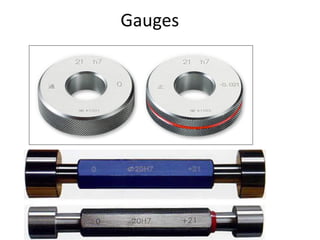
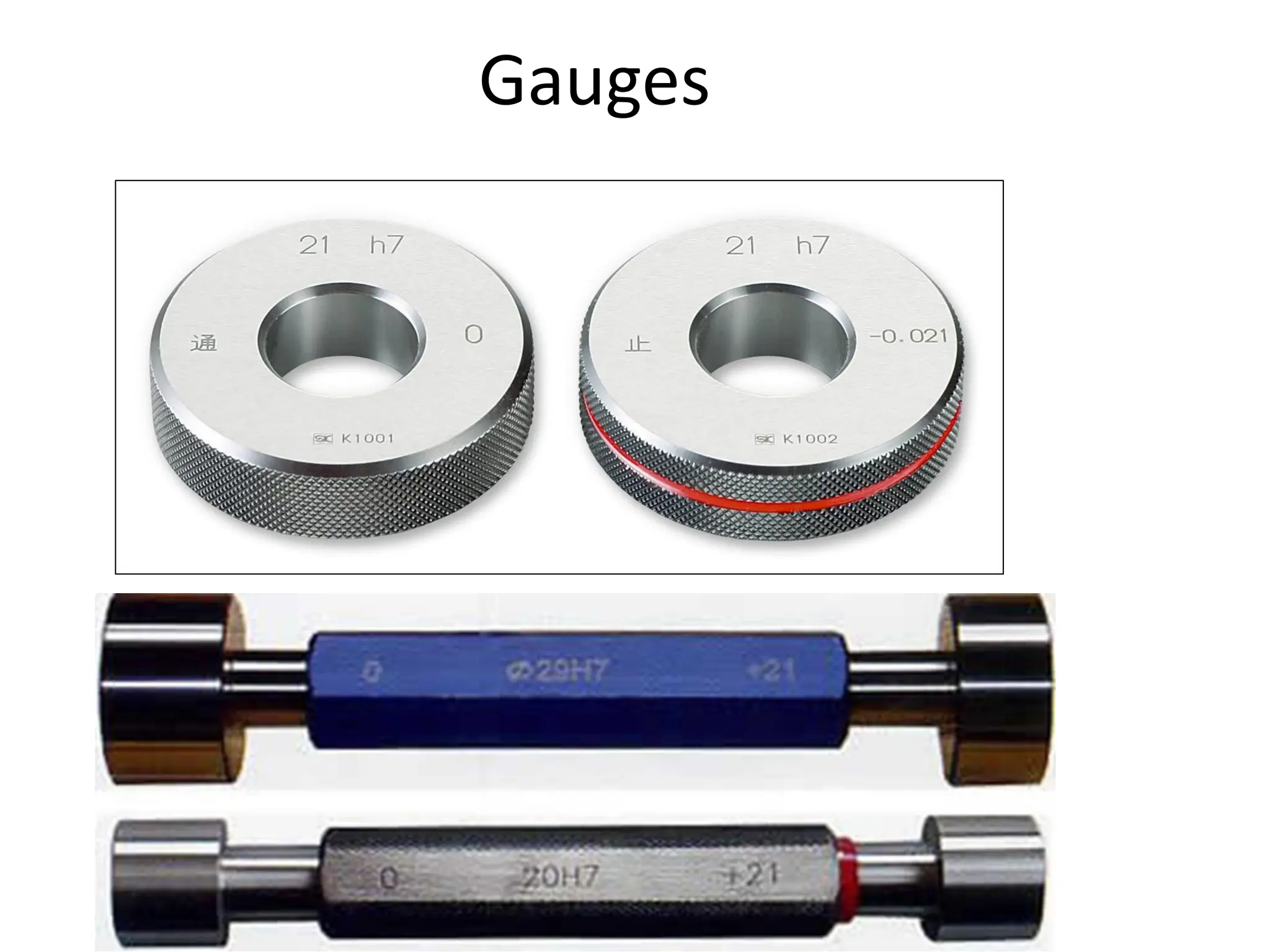
Gauges
GAUGES
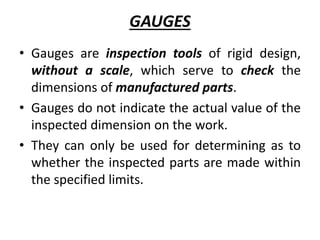
• Gauges are inspection tools of rigid design,
without a scale, which serve to check the
dimensions of manufactured parts.
• Gauges do not indicate the actual value of the
inspected dimension on the work.
• They can only be used for determining as to
whether the inspected parts are made within
the specified limits.
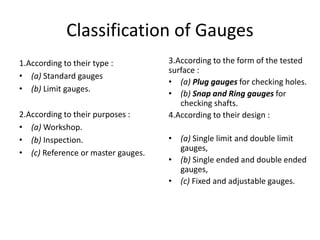
Classification of Gauges
1.According to their type :
• (a) Standard gauges
• (b) Limit gauges.
2.According to their purposes :
• (a) Workshop.
• (b) Inspection.
• (c) Reference or master gauges.
3.According to the form of the tested
surface :
• (a) Plug gauges for checking holes.
• (b) Snap and Ring gauges for
checking shafts.
4.According to their design :
• (a) Single limit and double limit
gauges,
• (b) Single ended and double ended
gauges,
• (c) Fixed and adjustable gauges.
Standard Gauges
• Standard gauges are made to the Basic Size of the part to be tested and
have the measuring member equal in size to the mean permissible
dimension of the part to be checked. A standard gauge should mate with
some snugness.
Limit Gauges
• These are also called “Go” and “No Go” gauges. These are made to the limit
sizes of the work to be measured. One of the sides or ends of the gauge is
made to correspond to maximum and the other end to the minimum
permissible size.
• The function of limit gauges is to determine whether the actual dimensions
of the work are within or outside the specified limits. A limit gauge may be
either double end or progressive. A double end gauge has the “Go”
member at one end and “No Go” member at the other end. The “Go”
member must pass into or over an acceptable piece but the “No Go”
member should not.
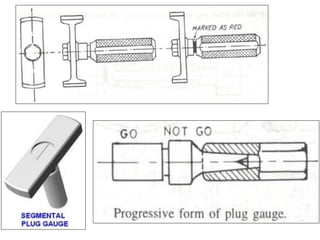
• The progressive gauge has “No Go” members next to each other and is
applied to a workpiece with one movement. Some gauges are fixed for only
one set of limits and are said to be solid gauges. Others are adjustable for
various ranges.
WORKING GAUGES, INSPECTION GAUGES AND REFERENCE
GAUGES
• To promote consistency in manufacturing and inspection,
gauges may be classified as working, inspection, and reference
or master gauges :
Working Gauges
• Working gauges are those used at the bench or machine in
gauging the work as it being made.
Inspection Gauges
• These gauges are used by the inspection personnel to inspect
manufactured parts when finished.
Reference Gauges
• These are also called master gauges. These are used only for
checking the size or condition of other gauges and represent as
exactly as possible the physical dimensions of the product.
GAUGE DESIGN
• To a greater or lesser extent, every gauge is a
copy of the part which mates with the part for
which the gauge is designed.
• If a gauge is designed as an exact copy of the
opposed part in so far as the dimension to be
checked is concerned, it is called a 'Standard
Gauge'.
• In design of a gauge, simplicity should be the
main aim as simple gauges can take
measurements continuously and accurately.
Important Points for Design.
1. The form of 'Go' gauges should exactly coincide
with the form of the opposed (mating) parts.
2. 'Go' gauges are complex gauges which enable
several related dimensions to be checked
simultaneously.
3. In inspection, 'Go' gauges must always be put into
conditions of maximum impassability.
4. 'No Go' gauges are gauges for checking a single
element of feature.
5. In inspection, 'No Go' gauges must always be put
into conditions of maximum passability.
Taylor's Principle.
(for the design of gauges)
It states,
1. That a “GO” gauge shall check all the
dimensions at a time in what is called the
“Maximum material condition”.
2. That a “NOTGO” gauge shall check only one
dimension at a time in what is called the
“Minimum material condition”.
Gauge maker's Tolerance
• Keeping all above main points for gauge design in
view there are three methods of giving tolerances
on gauges (snap and plug gauges).
Wear Allowance Consideration on Gauge Maker's
Tolerance.
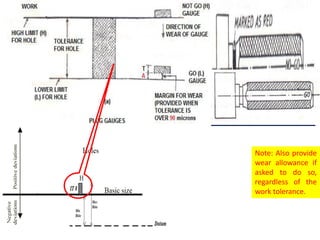
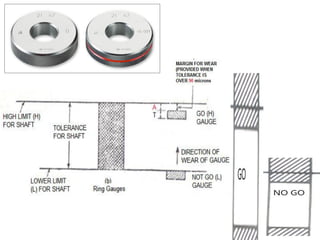
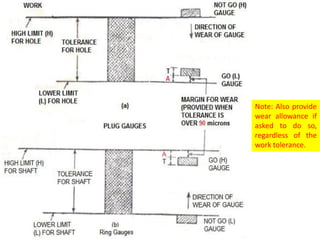
• Gauge Maker’s tolerance = 1/10 x Work tolerance
• Wear Allowance = 1/10 x GMT = 1/100 x Work
tolerance
Note: Also provide
wear allowance if
asked to do so,
regardless of the
work tolerance.
Note: Also provide
wear allowance if
asked to do so,
regardless of the
work tolerance.
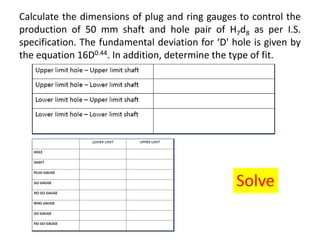
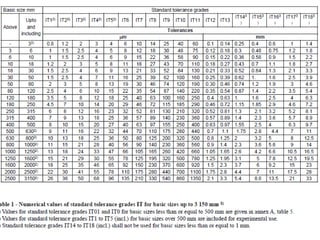
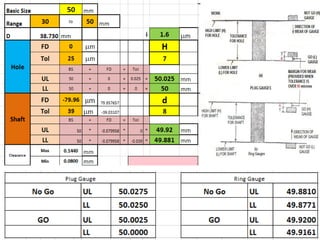
Calculate the dimensions of plug and ring gauges to control the
production of 50 mm shaft and hole pair of H7d8 as per I.S.
specification. The fundamental deviation for ‘D' hole is given by
the equation 16D0.44. In addition, determine the type of fit.
Solve
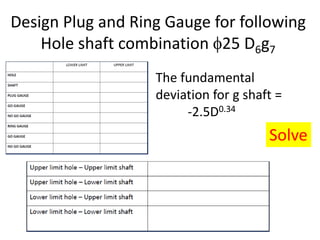
Design Plug and Ring Gauge for following
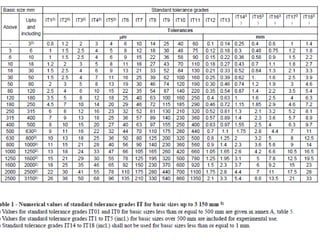
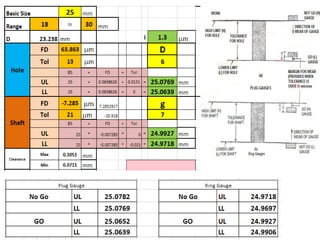
Hole shaft combination 25 D6g7
The fundamental
deviation for g shaft =
-2.5D0.34
Solve
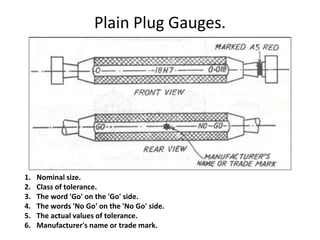
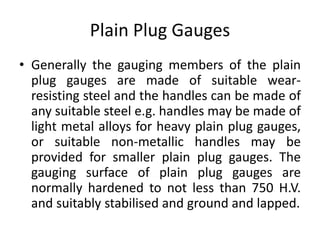
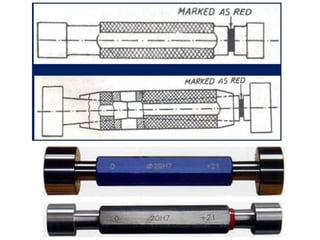
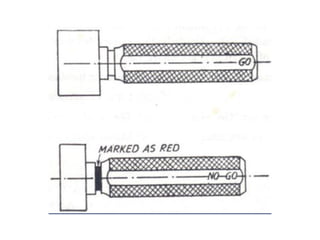
Plain Plug Gauges.
1. Nominal size.
2. Class of tolerance.
3. The word 'Go' on the 'Go' side.
4. The words 'No Go' on the 'No Go' side.
5. The actual values of tolerance.
6. Manufacturer's name or trade mark.
Plain Plug Gauges
• Generally the gauging members of the plain
plug gauges are made of suitable wear-
resisting steel and the handles can be made of
any suitable steel e.g. handles may be made of
light metal alloys for heavy plain plug gauges,
or suitable non-metallic handles may be
provided for smaller plain plug gauges. The
gauging surface of plain plug gauges are
normally hardened to not less than 750 H.V.
and suitably stabilised and ground and lapped.
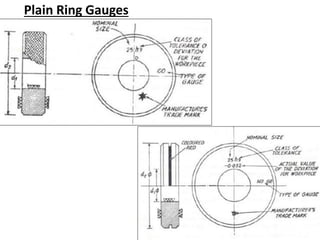
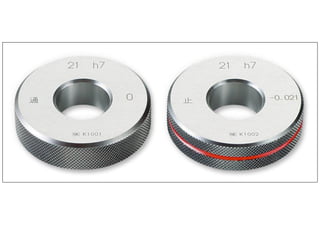
Plain Ring Gauges
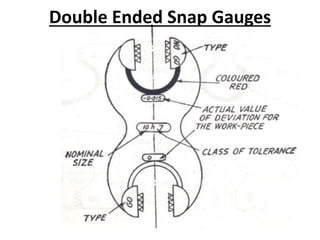
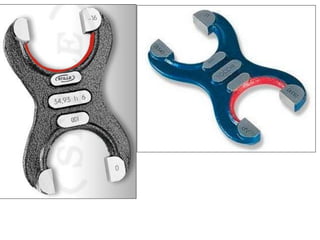
Double Ended Snap Gauges
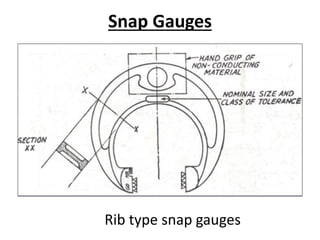
Snap Gauges
Rib type snap gauges
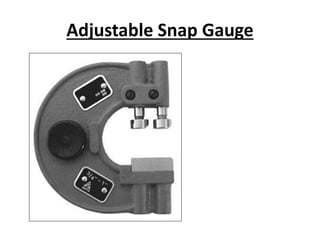
Adjustable Snap Gauge
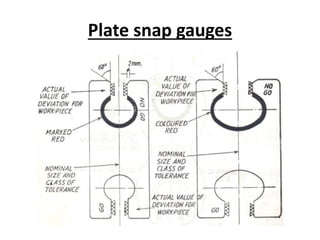
Plate snap gauges
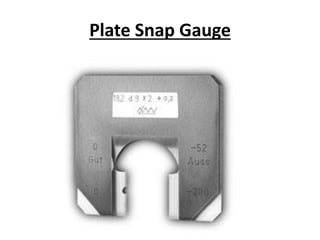
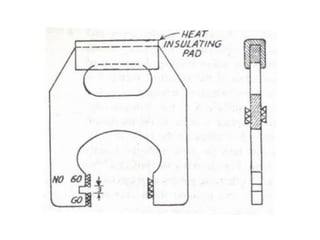
Plate Snap Gauge
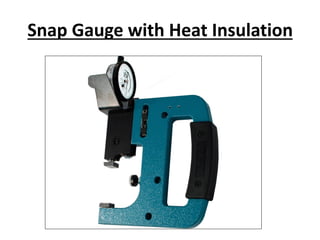
Snap Gauge with Heat Insulation
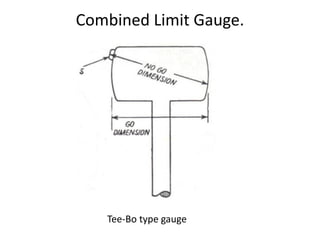
Combined Limit Gauge.
Tee-Bo type gauge
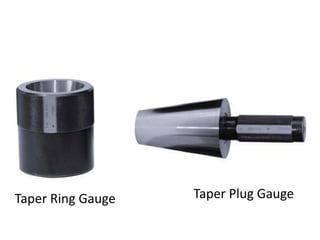
Taper Ring Gauge Taper Plug Gauge
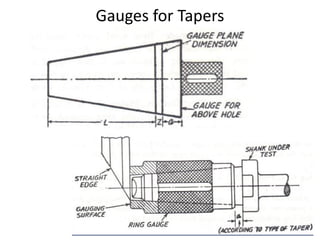
Gauges for Tapers
The procedures described so far have been based on the assumption that the hole or shaft
under consideration is a straight diameter with no contour. There are, however, instances
when a hole must either have internal contour , or a shaft external contour, such as threads or
tapers. First, let’s consider the taper of holes or shafts.
Obviously, the type of go/no-go gauge used for a straight hole or shaft could not be used to
check a taper. The taper plug gauge is therefore a single-ended instrument rather than a
double-ended instrument. The shaft of the taper plug gauge is ground and polished to a very
high accurate representation of a tapered shaft, with the diameter, taper & concentricity of
the large and small diameters of the taper all made exactly.
TAPER PLUG AND RING GAUGES
To accommodate the diametrical measurement, the gauge is etched with two lines (or
provided with two ground steps) at the large end of the taper.
When the instrument (plug gauge) is inserted in to the tapered hole, the large diameter line
should remain outside of the hole and the small diameter line should be within the hole.
Next to check for correct taper, the operator must gently try to wiggle the instrument in the
hole. If the instrument can move from side to side in any direction, the taper is incorrect.
Movement at the large end of the taper means the taper is too steep. Movement at the small
end of the taper means the taper is too shallow.
This procedure will not tell the operator if the taper is mis-shaped between the large and small
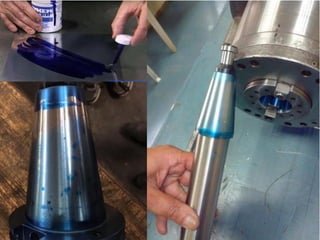
ends of the taper. To accomplish this, the gauge is coated with a light coat of bluing and given
a slight twist on the mating surface. When the instrument is extracted, it is checked for marks
in the bluing. If the rub marks are even and evenly distributed, the taper is properly shaped.
Conversely, if the bluing has rubbed off unevenly or sporadically, the taper is mis-shaped.
The taper ring gauge works in very much same, albeit, opposite manner as the taper plug
gauge. The exception to this rule is that the bluing application for checking the shape of the
taper will go on the part instead of the gauge. In other words bluing for checking the shape of
a taper with a gauge will always go on the shaft, regardless of whether this is the gauge or the
part.
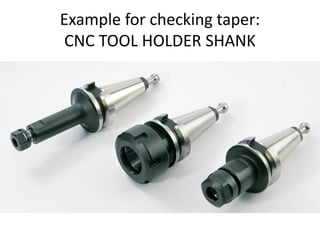
Example for checking taper:
CNC TOOL HOLDER SHANK
SLIP GAUGES
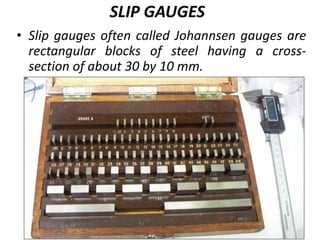
• Slip gauges often called Johannsen gauges are
rectangular blocks of steel having a cross-
section of about 30 by 10 mm.
• After being hardened, blocks are carefully finished on the
measuring faces to such a fine degree of finish, flatness and
accuracy that any two such faces when perfectly clean may be
“wrung” together.
• This is accomplished by pressing the faces into contact (keeping
them perpendicular) and then imparting a small twisting motion
whilst maintaining the pressure. The contact pressure is just
sufficient in order to hold the slip gauges in contact and no
additional intentional pressure.
• It is found that phenomenon of wringing occurs due to
molecular adhesion between a liquid film (whose thickness may
be between 6 to 7 X 10⁻⁶mm) and the mating surfaces.
• When two gauges are wrung together and the overall dimension
of a pile made of two or more blocks so joined is exactly the sum
of the constituent gauges.
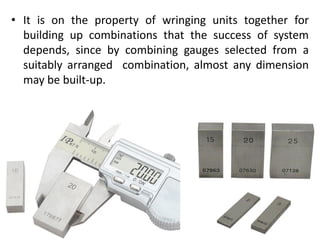
• It is on the property of wringing units together for
building up combinations that the success of system
depends, since by combining gauges selected from a
suitably arranged combination, almost any dimension
may be built-up.
Wringing and Enforced Adhesion
• The term 'wringing' refers to the conditions of intimate and
complete contact and of permanent adhesion between
measuring faces which is brought about by wringing
together the surfaces in question without application of
pressure, assuming that the surfaces have been thoroughly
cleaned and exhibit a good standard of flatness and
smoothness. The wrung gauge can be handled as a unit,
without the need for clamping all the pieces together.
• It is believed that the phenomenon of wringing is due to
molecular adhesion between a liquid film and the mating
surfaces of the flat surfaces. In fact, the success of precision
measurement by slip gauges depends on the phenomenon
of wringing.
Wringing
Demo
• It has been found that the gap between two wrung flat pieces is of
the order of 0.00635 microns from which it would be very clear that
the film thickness in two wrung flat pieces contributes no effect.
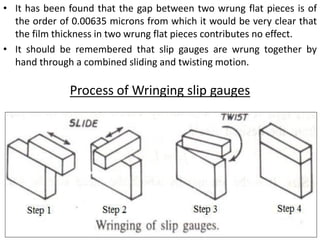
• It should be remembered that slip gauges are wrung together by
hand through a combined sliding and twisting motion.
Process of Wringing slip gauges
• If during wringing, there is slightest feeling of roughness the
process should be stopped and the surfaces examined for
contamination
• First the gauge is oscillated slightly with very light pressure
over other gauge so' as to detect presence of any foreign
particles between the surfaces.
• One gauge is then placed perpendicular to other using
standard gauging pressure and rotary motion is then applied
until the blocks are lined up.
• In this way air is expelled from between the gauge faces
causing the two blocks to adhere. This adherence is caused
partly by molecular attraction and partly by atmospheric
pressure
Enforced Adhesion
• The 'enforced adhesion' refers to the condition of contact over the
entire surface and of permanent adhesion, which, owing to the lack
of flatness or smoothness, can only be brought about by the
application of pressure.
• It may be noted that the use of any extraneous agent to promote
adhesion is not correct and it is sometimes specified that surfaces
which are to be wrung together should be absolutely dry. On the
other hand, a truly clean surface, though difficult to attain may not
wring satisfactorily.
• The usual practice is to use silicone or filtered kerosene as lubricant,
apply a thin coat of same and wipe it as thin as possible.
• The property of measuring faces of a gauge block of adhering, by
sliding or pressing the gauge against the measuring faces of other
gauge blocks or the reference faces of datum surfaces, without the
use of any extraneous means.
Wringing
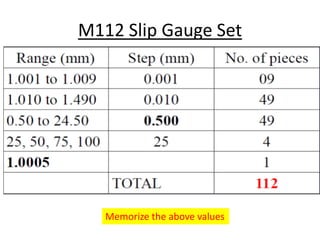
M112 Slip Gauge Set
Memorize the above values
Protector Blocks
• These are two additional 2 or 2.5 mm blocks
with a letter P on measuring faces and are
provided with high-grade sets of gauge blocks.
These are accommodated at each end of a
combination so that all the wear occurs on
them. These are made from tungsten carbide
or other suitable material and take all the
wear due to rubbing on surface plates.
Selecting slip gauges for required
dimension.
• Let us say that the dimension to be arranged is 58.975 mm.
• Always start with the last decimal place e.g.. here it is 0.005 mm
and for this 1.005 mm slip gauge is selected.
• Now dimension left is 58.975-1.005 =57.970mm.
• Take second decimal place ; and for it select 1.47 mm slip gauge.
• Therefore. the remainder is 57.970 - 1.47 =56.500 mm.
• [Note : One could have selected 1.07 mm piece also. but that way
we would have been left with 56.900 and for it we need another
1.4 mm piece. Our aim should be to choose minimum number of
slip gauges for a given dimension.]
• Next for 56.500 mm, we choose 6.500 mm piece and finally 50.000
mm piece.
• Thus, we have 50.000+6.550+ 1.47+1.005 =58.975mm.
• All these four slip gauges are wrung properly to get required
dimension.
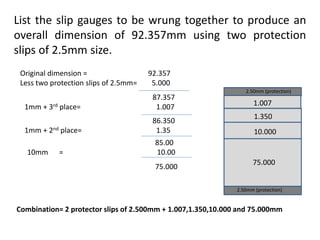
List the slip gauges to be wrung together to produce an
overall dimension of 92.357mm using two protection
slips of 2.5mm size.
Original dimension = 92.357
Less two protection slips of 2.5mm= 5.000
87.357
1mm + 3rd place= 1.007
86.350
1mm + 2nd place= 1.35
85.00
10mm = 10.00
75.000
2.50mm (protection)
2.50mm (protection)
1.007
1.350
10.000
75.000
Combination= 2 protector slips of 2.500mm + 1.007,1.350,10.000 and 75.000mm
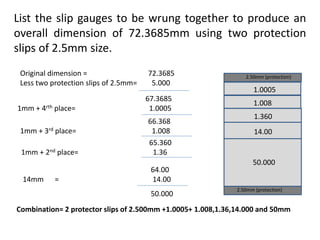
List the slip gauges to be wrung together to produce an
overall dimension of 72.3685mm using two protection
slips of 2.5mm size.
Original dimension = 72.3685
Less two protection slips of 2.5mm= 5.000
66.368
1mm + 3rd place= 1.008
65.360
1mm + 2nd place= 1.36
64.00
14mm = 14.00
50.000
2.50mm (protection)
2.50mm (protection)
1.008
1.360
14.00
50.000
Combination= 2 protector slips of 2.500mm +1.0005+ 1.008,1.36,14.000 and 50mm
67.3685
1mm + 4rth place= 1.0005
1.0005
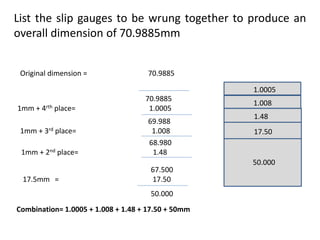
List the slip gauges to be wrung together to produce an
overall dimension of 70.9885mm
Original dimension = 70.9885
69.988
1mm + 3rd place= 1.008
68.980
1mm + 2nd place= 1.48
67.500
17.5mm = 17.50
50.000
1.008
1.48
17.50
50.000
Combination= 1.0005 + 1.008 + 1.48 + 17.50 + 50mm
70.9885
1mm + 4rth place= 1.0005
1.0005
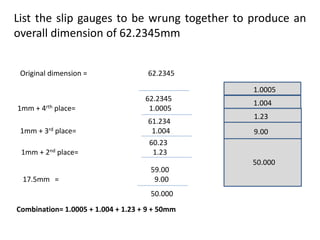
List the slip gauges to be wrung together to produce an
overall dimension of 62.2345mm
Original dimension = 62.2345
61.234
1mm + 3rd place= 1.004
60.23
1mm + 2nd place= 1.23
59.00
17.5mm = 9.00
50.000
1.004
1.23
9.00
50.000
Combination= 1.0005 + 1.004 + 1.23 + 9 + 50mm
62.2345
1mm + 4rth place= 1.0005
1.0005
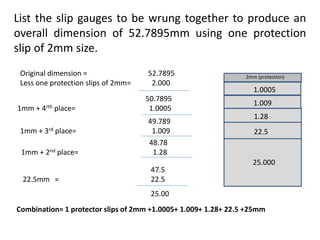
List the slip gauges to be wrung together to produce an
overall dimension of 52.7895mm using one protection
slip of 2mm size.
Original dimension = 52.7895
Less one protection slips of 2mm= 2.000
49.789
1mm + 3rd place= 1.009
48.78
1mm + 2nd place= 1.28
47.5
22.5mm = 22.5
25.00
2mm (protection)
1.009
1.28
22.5
25.000
Combination= 1 protector slips of 2mm +1.0005+ 1.009+ 1.28+ 22.5 +25mm
50.7895
1mm + 4rth place= 1.0005
1.0005
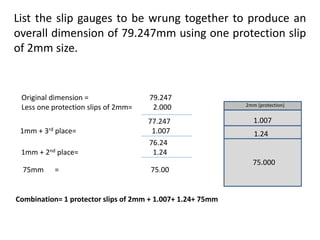
List the slip gauges to be wrung together to produce an
overall dimension of 79.247mm using one protection slip
of 2mm size.
Original dimension = 79.247
Less one protection slips of 2mm= 2.000
77.247
1mm + 3rd place= 1.007
76.24
1mm + 2nd place= 1.24
75mm = 75.00
2mm (protection)
1.007
1.24
75.000
Combination= 1 protector slips of 2mm + 1.007+ 1.24+ 75mm
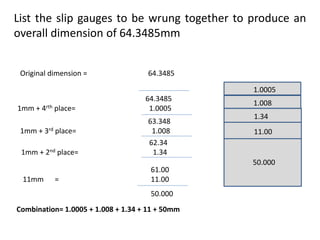
List the slip gauges to be wrung together to produce an
overall dimension of 64.3485mm
Original dimension = 64.3485
63.348
1mm + 3rd place= 1.008
62.34
1mm + 2nd place= 1.34
61.00
11mm = 11.00
50.000
1.008
1.34
11.00
50.000
Combination= 1.0005 + 1.008 + 1.34 + 11 + 50mm
64.3485
1mm + 4rth place= 1.0005
1.0005

Gauges ppt.pdf .

  • 1.
  • 2.
    GAUGES • Gauges areinspection tools of rigid design, without a scale, which serve to check the dimensions of manufactured parts. • Gauges do not indicate the actual value of the inspected dimension on the work. • They can only be used for determining as to whether the inspected parts are made within the specified limits.
  • 3.
    Classification of Gauges 1.Accordingto their type : • (a) Standard gauges • (b) Limit gauges. 2.According to their purposes : • (a) Workshop. • (b) Inspection. • (c) Reference or master gauges. 3.According to the form of the tested surface : • (a) Plug gauges for checking holes. • (b) Snap and Ring gauges for checking shafts. 4.According to their design : • (a) Single limit and double limit gauges, • (b) Single ended and double ended gauges, • (c) Fixed and adjustable gauges.
  • 4.
    Standard Gauges • Standardgauges are made to the Basic Size of the part to be tested and have the measuring member equal in size to the mean permissible dimension of the part to be checked. A standard gauge should mate with some snugness. Limit Gauges • These are also called “Go” and “No Go” gauges. These are made to the limit sizes of the work to be measured. One of the sides or ends of the gauge is made to correspond to maximum and the other end to the minimum permissible size. • The function of limit gauges is to determine whether the actual dimensions of the work are within or outside the specified limits. A limit gauge may be either double end or progressive. A double end gauge has the “Go” member at one end and “No Go” member at the other end. The “Go” member must pass into or over an acceptable piece but the “No Go” member should not. • The progressive gauge has “No Go” members next to each other and is applied to a workpiece with one movement. Some gauges are fixed for only one set of limits and are said to be solid gauges. Others are adjustable for various ranges.
  • 5.
    WORKING GAUGES, INSPECTIONGAUGES AND REFERENCE GAUGES • To promote consistency in manufacturing and inspection, gauges may be classified as working, inspection, and reference or master gauges : Working Gauges • Working gauges are those used at the bench or machine in gauging the work as it being made. Inspection Gauges • These gauges are used by the inspection personnel to inspect manufactured parts when finished. Reference Gauges • These are also called master gauges. These are used only for checking the size or condition of other gauges and represent as exactly as possible the physical dimensions of the product.
  • 6.
    GAUGE DESIGN • Toa greater or lesser extent, every gauge is a copy of the part which mates with the part for which the gauge is designed. • If a gauge is designed as an exact copy of the opposed part in so far as the dimension to be checked is concerned, it is called a 'Standard Gauge'. • In design of a gauge, simplicity should be the main aim as simple gauges can take measurements continuously and accurately.
  • 7.
    Important Points forDesign. 1. The form of 'Go' gauges should exactly coincide with the form of the opposed (mating) parts. 2. 'Go' gauges are complex gauges which enable several related dimensions to be checked simultaneously. 3. In inspection, 'Go' gauges must always be put into conditions of maximum impassability. 4. 'No Go' gauges are gauges for checking a single element of feature. 5. In inspection, 'No Go' gauges must always be put into conditions of maximum passability.
  • 9.
    Taylor's Principle. (for thedesign of gauges) It states, 1. That a “GO” gauge shall check all the dimensions at a time in what is called the “Maximum material condition”. 2. That a “NOTGO” gauge shall check only one dimension at a time in what is called the “Minimum material condition”.
  • 10.
    Gauge maker's Tolerance •Keeping all above main points for gauge design in view there are three methods of giving tolerances on gauges (snap and plug gauges). Wear Allowance Consideration on Gauge Maker's Tolerance. • Gauge Maker’s tolerance = 1/10 x Work tolerance • Wear Allowance = 1/10 x GMT = 1/100 x Work tolerance
  • 11.
    Note: Also provide wearallowance if asked to do so, regardless of the work tolerance.
  • 13.
    Note: Also provide wearallowance if asked to do so, regardless of the work tolerance.
  • 14.
    Calculate the dimensionsof plug and ring gauges to control the production of 50 mm shaft and hole pair of H7d8 as per I.S. specification. The fundamental deviation for ‘D' hole is given by the equation 16D0.44. In addition, determine the type of fit. Solve
  • 17.
    Design Plug andRing Gauge for following Hole shaft combination 25 D6g7 The fundamental deviation for g shaft = -2.5D0.34 Solve
  • 20.
    Plain Plug Gauges. 1.Nominal size. 2. Class of tolerance. 3. The word 'Go' on the 'Go' side. 4. The words 'No Go' on the 'No Go' side. 5. The actual values of tolerance. 6. Manufacturer's name or trade mark.
  • 21.
    Plain Plug Gauges •Generally the gauging members of the plain plug gauges are made of suitable wear- resisting steel and the handles can be made of any suitable steel e.g. handles may be made of light metal alloys for heavy plain plug gauges, or suitable non-metallic handles may be provided for smaller plain plug gauges. The gauging surface of plain plug gauges are normally hardened to not less than 750 H.V. and suitably stabilised and ground and lapped.
  • 25.
  • 27.
  • 29.
  • 30.
  • 31.
  • 32.
  • 34.
    Snap Gauge withHeat Insulation
  • 35.
  • 36.
    Taper Ring GaugeTaper Plug Gauge
  • 37.
  • 38.
    The procedures describedso far have been based on the assumption that the hole or shaft under consideration is a straight diameter with no contour. There are, however, instances when a hole must either have internal contour , or a shaft external contour, such as threads or tapers. First, let’s consider the taper of holes or shafts. Obviously, the type of go/no-go gauge used for a straight hole or shaft could not be used to check a taper. The taper plug gauge is therefore a single-ended instrument rather than a double-ended instrument. The shaft of the taper plug gauge is ground and polished to a very high accurate representation of a tapered shaft, with the diameter, taper & concentricity of the large and small diameters of the taper all made exactly. TAPER PLUG AND RING GAUGES To accommodate the diametrical measurement, the gauge is etched with two lines (or provided with two ground steps) at the large end of the taper. When the instrument (plug gauge) is inserted in to the tapered hole, the large diameter line should remain outside of the hole and the small diameter line should be within the hole.
  • 39.
    Next to checkfor correct taper, the operator must gently try to wiggle the instrument in the hole. If the instrument can move from side to side in any direction, the taper is incorrect. Movement at the large end of the taper means the taper is too steep. Movement at the small end of the taper means the taper is too shallow. This procedure will not tell the operator if the taper is mis-shaped between the large and small ends of the taper. To accomplish this, the gauge is coated with a light coat of bluing and given a slight twist on the mating surface. When the instrument is extracted, it is checked for marks in the bluing. If the rub marks are even and evenly distributed, the taper is properly shaped. Conversely, if the bluing has rubbed off unevenly or sporadically, the taper is mis-shaped. The taper ring gauge works in very much same, albeit, opposite manner as the taper plug gauge. The exception to this rule is that the bluing application for checking the shape of the taper will go on the part instead of the gauge. In other words bluing for checking the shape of a taper with a gauge will always go on the shaft, regardless of whether this is the gauge or the part.
  • 41.
    Example for checkingtaper: CNC TOOL HOLDER SHANK
  • 42.
    SLIP GAUGES • Slipgauges often called Johannsen gauges are rectangular blocks of steel having a cross- section of about 30 by 10 mm.
  • 43.
    • After beinghardened, blocks are carefully finished on the measuring faces to such a fine degree of finish, flatness and accuracy that any two such faces when perfectly clean may be “wrung” together. • This is accomplished by pressing the faces into contact (keeping them perpendicular) and then imparting a small twisting motion whilst maintaining the pressure. The contact pressure is just sufficient in order to hold the slip gauges in contact and no additional intentional pressure. • It is found that phenomenon of wringing occurs due to molecular adhesion between a liquid film (whose thickness may be between 6 to 7 X 10⁻⁶mm) and the mating surfaces. • When two gauges are wrung together and the overall dimension of a pile made of two or more blocks so joined is exactly the sum of the constituent gauges.
  • 44.
    • It ison the property of wringing units together for building up combinations that the success of system depends, since by combining gauges selected from a suitably arranged combination, almost any dimension may be built-up.
  • 45.
    Wringing and EnforcedAdhesion • The term 'wringing' refers to the conditions of intimate and complete contact and of permanent adhesion between measuring faces which is brought about by wringing together the surfaces in question without application of pressure, assuming that the surfaces have been thoroughly cleaned and exhibit a good standard of flatness and smoothness. The wrung gauge can be handled as a unit, without the need for clamping all the pieces together. • It is believed that the phenomenon of wringing is due to molecular adhesion between a liquid film and the mating surfaces of the flat surfaces. In fact, the success of precision measurement by slip gauges depends on the phenomenon of wringing.
  • 46.
  • 47.
    • It hasbeen found that the gap between two wrung flat pieces is of the order of 0.00635 microns from which it would be very clear that the film thickness in two wrung flat pieces contributes no effect. • It should be remembered that slip gauges are wrung together by hand through a combined sliding and twisting motion. Process of Wringing slip gauges
  • 48.
    • If duringwringing, there is slightest feeling of roughness the process should be stopped and the surfaces examined for contamination • First the gauge is oscillated slightly with very light pressure over other gauge so' as to detect presence of any foreign particles between the surfaces. • One gauge is then placed perpendicular to other using standard gauging pressure and rotary motion is then applied until the blocks are lined up. • In this way air is expelled from between the gauge faces causing the two blocks to adhere. This adherence is caused partly by molecular attraction and partly by atmospheric pressure
  • 49.
    Enforced Adhesion • The'enforced adhesion' refers to the condition of contact over the entire surface and of permanent adhesion, which, owing to the lack of flatness or smoothness, can only be brought about by the application of pressure. • It may be noted that the use of any extraneous agent to promote adhesion is not correct and it is sometimes specified that surfaces which are to be wrung together should be absolutely dry. On the other hand, a truly clean surface, though difficult to attain may not wring satisfactorily. • The usual practice is to use silicone or filtered kerosene as lubricant, apply a thin coat of same and wipe it as thin as possible. • The property of measuring faces of a gauge block of adhering, by sliding or pressing the gauge against the measuring faces of other gauge blocks or the reference faces of datum surfaces, without the use of any extraneous means. Wringing
  • 50.
    M112 Slip GaugeSet Memorize the above values
  • 51.
    Protector Blocks • Theseare two additional 2 or 2.5 mm blocks with a letter P on measuring faces and are provided with high-grade sets of gauge blocks. These are accommodated at each end of a combination so that all the wear occurs on them. These are made from tungsten carbide or other suitable material and take all the wear due to rubbing on surface plates.
  • 52.
    Selecting slip gaugesfor required dimension. • Let us say that the dimension to be arranged is 58.975 mm. • Always start with the last decimal place e.g.. here it is 0.005 mm and for this 1.005 mm slip gauge is selected. • Now dimension left is 58.975-1.005 =57.970mm. • Take second decimal place ; and for it select 1.47 mm slip gauge. • Therefore. the remainder is 57.970 - 1.47 =56.500 mm. • [Note : One could have selected 1.07 mm piece also. but that way we would have been left with 56.900 and for it we need another 1.4 mm piece. Our aim should be to choose minimum number of slip gauges for a given dimension.] • Next for 56.500 mm, we choose 6.500 mm piece and finally 50.000 mm piece. • Thus, we have 50.000+6.550+ 1.47+1.005 =58.975mm. • All these four slip gauges are wrung properly to get required dimension.
  • 53.
    List the slipgauges to be wrung together to produce an overall dimension of 92.357mm using two protection slips of 2.5mm size. Original dimension = 92.357 Less two protection slips of 2.5mm= 5.000 87.357 1mm + 3rd place= 1.007 86.350 1mm + 2nd place= 1.35 85.00 10mm = 10.00 75.000 2.50mm (protection) 2.50mm (protection) 1.007 1.350 10.000 75.000 Combination= 2 protector slips of 2.500mm + 1.007,1.350,10.000 and 75.000mm
  • 54.
    List the slipgauges to be wrung together to produce an overall dimension of 72.3685mm using two protection slips of 2.5mm size. Original dimension = 72.3685 Less two protection slips of 2.5mm= 5.000 66.368 1mm + 3rd place= 1.008 65.360 1mm + 2nd place= 1.36 64.00 14mm = 14.00 50.000 2.50mm (protection) 2.50mm (protection) 1.008 1.360 14.00 50.000 Combination= 2 protector slips of 2.500mm +1.0005+ 1.008,1.36,14.000 and 50mm 67.3685 1mm + 4rth place= 1.0005 1.0005
  • 55.
    List the slipgauges to be wrung together to produce an overall dimension of 70.9885mm Original dimension = 70.9885 69.988 1mm + 3rd place= 1.008 68.980 1mm + 2nd place= 1.48 67.500 17.5mm = 17.50 50.000 1.008 1.48 17.50 50.000 Combination= 1.0005 + 1.008 + 1.48 + 17.50 + 50mm 70.9885 1mm + 4rth place= 1.0005 1.0005
  • 56.
    List the slipgauges to be wrung together to produce an overall dimension of 62.2345mm Original dimension = 62.2345 61.234 1mm + 3rd place= 1.004 60.23 1mm + 2nd place= 1.23 59.00 17.5mm = 9.00 50.000 1.004 1.23 9.00 50.000 Combination= 1.0005 + 1.004 + 1.23 + 9 + 50mm 62.2345 1mm + 4rth place= 1.0005 1.0005
  • 57.
    List the slipgauges to be wrung together to produce an overall dimension of 52.7895mm using one protection slip of 2mm size. Original dimension = 52.7895 Less one protection slips of 2mm= 2.000 49.789 1mm + 3rd place= 1.009 48.78 1mm + 2nd place= 1.28 47.5 22.5mm = 22.5 25.00 2mm (protection) 1.009 1.28 22.5 25.000 Combination= 1 protector slips of 2mm +1.0005+ 1.009+ 1.28+ 22.5 +25mm 50.7895 1mm + 4rth place= 1.0005 1.0005
  • 58.
    List the slipgauges to be wrung together to produce an overall dimension of 79.247mm using one protection slip of 2mm size. Original dimension = 79.247 Less one protection slips of 2mm= 2.000 77.247 1mm + 3rd place= 1.007 76.24 1mm + 2nd place= 1.24 75mm = 75.00 2mm (protection) 1.007 1.24 75.000 Combination= 1 protector slips of 2mm + 1.007+ 1.24+ 75mm
  • 59.
    List the slipgauges to be wrung together to produce an overall dimension of 64.3485mm Original dimension = 64.3485 63.348 1mm + 3rd place= 1.008 62.34 1mm + 2nd place= 1.34 61.00 11mm = 11.00 50.000 1.008 1.34 11.00 50.000 Combination= 1.0005 + 1.008 + 1.34 + 11 + 50mm 64.3485 1mm + 4rth place= 1.0005 1.0005