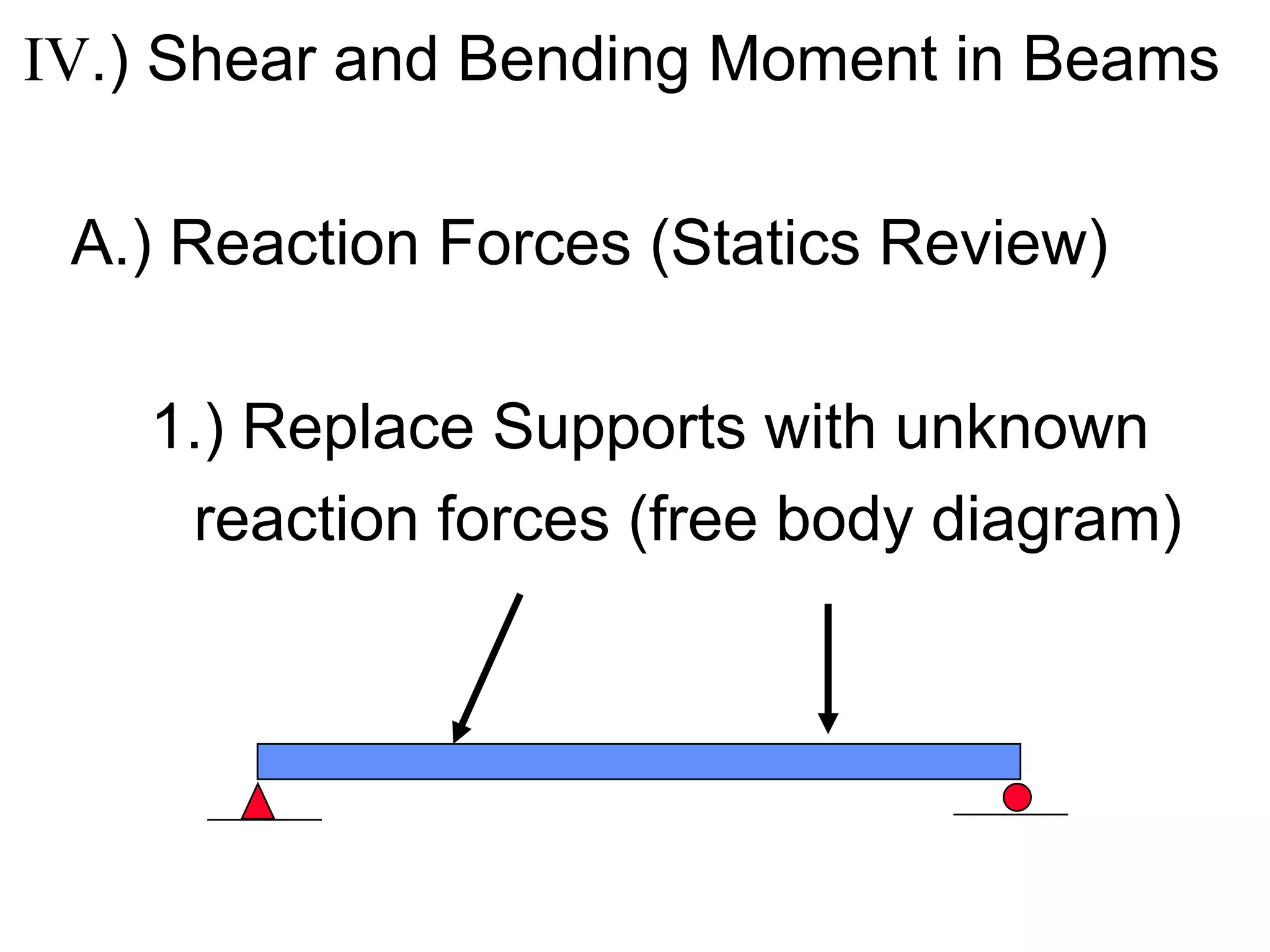
IV .) Shear and Bending Moment in Beams A.) Reaction Forces (Statics Review) 1.) Replace Supports with unknown    reaction forces (free body diagram)
a.) Roller - produces a reaction force  perpendicular to the support plane. R Y
b.) Pin (or Hinge) - produces a  vertical and horizontal reaction. R y R x
c.) Fixed - produces a reaction force in any direction and Moment. R y R x M
2.) Apply laws of equilibrium to find  R AX,  R AY,  R BY   F x  = 0   F y  = 0   M z  = 0 R AX R AY R BY
B.) Internal Shear 1.) Shear - find by cutting a section at the point of interest and   F y  = 0 on the FBD. R y R x F.B.D. V
B.) Internal Bending Moment 2.) Moment - find by cutting a section at the point of interest and   M  = 0 on the FBD. R y R x F.B.D. V M
If you were to find the internal shear and moment at several locations along the length of a beam, you could plot a graph shear vs. length and a graph of moment vs. length and find where the maximum shear and moment occur.
4’ 4’ 4’ 8’ 8’ 2k/ft 3k 4k A B V(k)
4’ 4’ 4’ 8’ 8’ 2k/ft 3k 4k A B M (k-ft)
C.) Shear Diagram - Simpler Way to Draw 1.)  Sketch the beam with loads and  supports shown (this is the LOAD  DIAGRAM). 2.)  Compute the reactions at the supports  and show them on the sketch.
3.)  Draw Shear Diagram baseline (shear = zero) below the load diagram a horizontal line. 4.)  Draw vertical lines down from the load  diagram to the shear diagram at: a.)  supports b.)  point loads c.)  each end of distributed loads
5.)  Working from  left  to  right , calculate  the shear on each side of each  support and point load and at each end of distributed loads: a.)  For portions of a beam that have no loading, the shear diagram is a horizontal line.
b.) Point loads (and reactions) cause   a vertical jump in the shear  diagram.  - The magnitude of the  jump is equal to the magnitude of the load (or reaction).  - Downward loads cause a negative    change in shear.
c.)  For portions of a beam under    distributed  loading: i.) the slope of the shear diagram is    equal to the intensity (magnitude) of    the uniformly distributed load (w). ii.) the change in shear between two    points is equal to the area under      the load diagram between those    two points.
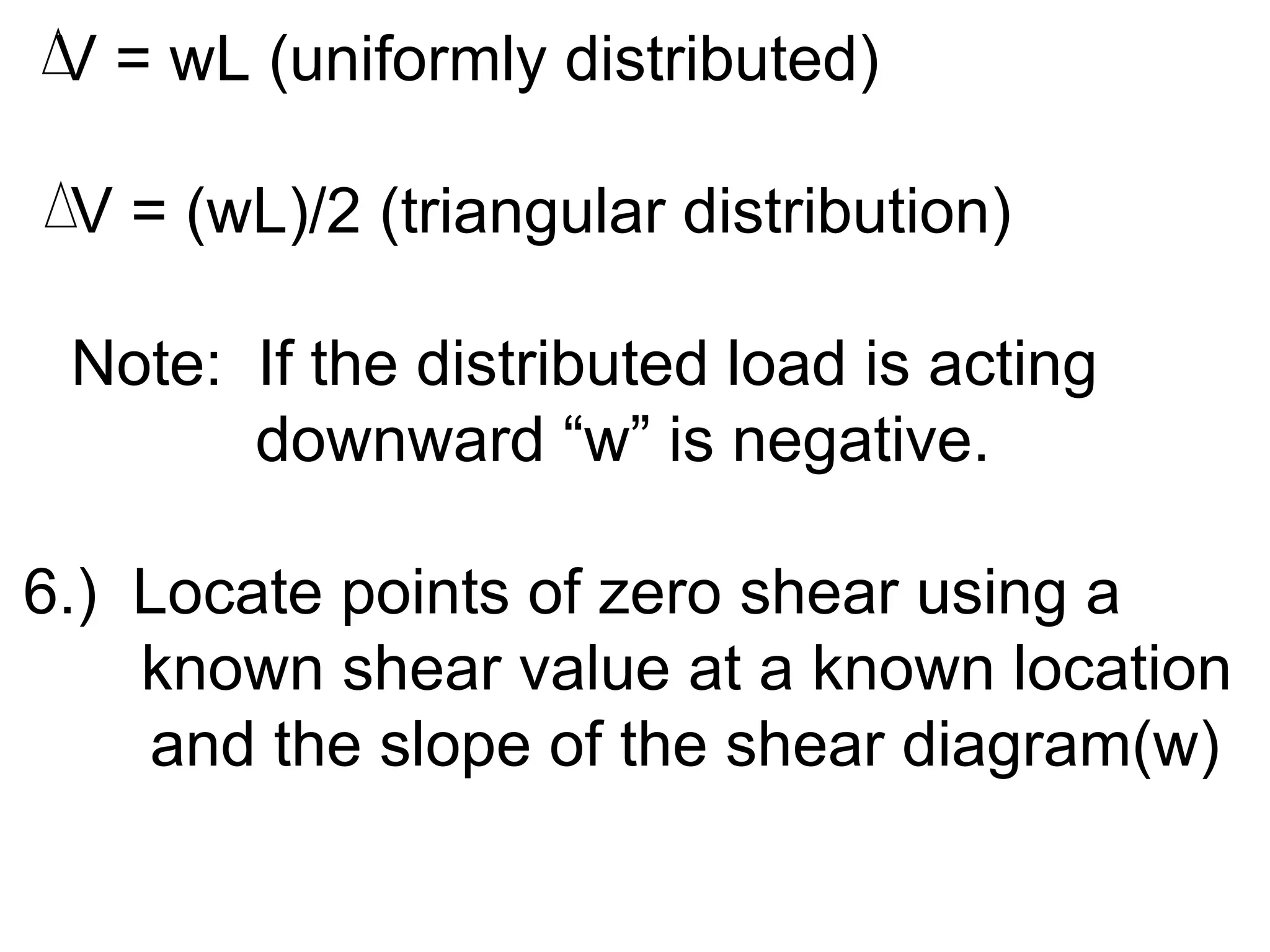
 V = wL (uniformly distributed) V = (wL)/2 (triangular distribution) Note:  If the distributed load is acting    downward “w” is negative. 6.)  Locate points of zero shear using a    known shear value at a known location and the slope of the shear diagram(w)
4’ 4’ 4’ 8’ 8’ 2k/ft 3k 4k A B
D.) Moment Diagram - Simpler Method 1.)  Moment = 0 at ends of simply    supported beams. 2.)  Peak Moments occur where the shear diagram crosses through zero.  There can be more than one peak moment on the diagram.
3.)  Extend the vertical lines below the shear diagram and draw the Moment Diagram baseline (moment = 0), a horizontal line.  Also, extend vertical lines down from points of zero shear. 4.)  Working left to right, calculate the  moment at each point the shear was calculated and at points of zero shear:
a.)  the change in moments between    two points is equal to the area under   the shear diagram between those   points. b.)  determine the slope of the moment   diagrams as follows:
i.)  if the shear is positive and constant,  the slope of the moment diagram is  positive and constant.   Negative, constant shear (-) (+) Positive, constant shear (+) 0 (-) V
Positive, constant slope Negative, constant slope (+) 0 (-) M
ii.)  if the shear is positive and increasing,  the slope of the moment diagram is   positive and increasing. Positive, decreasing shear Negative, decreasing shear (+) 0 (-) V
Positive, decreasing slope Negative,  decreasing slope (+) 0 (-) M
4’ 4’ 4’ 8’ 8’ 2k/ft 3k 4k A B
 

Shear and Bending Moment in Beams

  • 1.
    IV .) Shearand Bending Moment in Beams A.) Reaction Forces (Statics Review) 1.) Replace Supports with unknown reaction forces (free body diagram)
  • 2.
    a.) Roller -produces a reaction force perpendicular to the support plane. R Y
  • 3.
    b.) Pin (orHinge) - produces a vertical and horizontal reaction. R y R x
  • 4.
    c.) Fixed -produces a reaction force in any direction and Moment. R y R x M
  • 5.
    2.) Apply lawsof equilibrium to find R AX, R AY, R BY   F x = 0  F y = 0  M z = 0 R AX R AY R BY
  • 6.
    B.) Internal Shear1.) Shear - find by cutting a section at the point of interest and  F y = 0 on the FBD. R y R x F.B.D. V
  • 7.
    B.) Internal BendingMoment 2.) Moment - find by cutting a section at the point of interest and  M = 0 on the FBD. R y R x F.B.D. V M
  • 8.
    If you wereto find the internal shear and moment at several locations along the length of a beam, you could plot a graph shear vs. length and a graph of moment vs. length and find where the maximum shear and moment occur.
  • 9.
    4’ 4’ 4’8’ 8’ 2k/ft 3k 4k A B V(k)
  • 10.
    4’ 4’ 4’8’ 8’ 2k/ft 3k 4k A B M (k-ft)
  • 11.
    C.) Shear Diagram- Simpler Way to Draw 1.) Sketch the beam with loads and supports shown (this is the LOAD DIAGRAM). 2.) Compute the reactions at the supports and show them on the sketch.
  • 12.
    3.) DrawShear Diagram baseline (shear = zero) below the load diagram a horizontal line. 4.) Draw vertical lines down from the load diagram to the shear diagram at: a.) supports b.) point loads c.) each end of distributed loads
  • 13.
    5.) Workingfrom left to right , calculate the shear on each side of each support and point load and at each end of distributed loads: a.) For portions of a beam that have no loading, the shear diagram is a horizontal line.
  • 14.
    b.) Point loads(and reactions) cause a vertical jump in the shear diagram. - The magnitude of the jump is equal to the magnitude of the load (or reaction). - Downward loads cause a negative change in shear.
  • 15.
    c.) Forportions of a beam under distributed loading: i.) the slope of the shear diagram is equal to the intensity (magnitude) of the uniformly distributed load (w). ii.) the change in shear between two points is equal to the area under the load diagram between those two points.
  • 16.
     V =wL (uniformly distributed) V = (wL)/2 (triangular distribution) Note: If the distributed load is acting downward “w” is negative. 6.) Locate points of zero shear using a known shear value at a known location and the slope of the shear diagram(w)
  • 17.
    4’ 4’ 4’8’ 8’ 2k/ft 3k 4k A B
  • 18.
    D.) Moment Diagram- Simpler Method 1.) Moment = 0 at ends of simply supported beams. 2.) Peak Moments occur where the shear diagram crosses through zero. There can be more than one peak moment on the diagram.
  • 19.
    3.) Extendthe vertical lines below the shear diagram and draw the Moment Diagram baseline (moment = 0), a horizontal line. Also, extend vertical lines down from points of zero shear. 4.) Working left to right, calculate the moment at each point the shear was calculated and at points of zero shear:
  • 20.
    a.) thechange in moments between two points is equal to the area under the shear diagram between those points. b.) determine the slope of the moment diagrams as follows:
  • 21.
    i.) ifthe shear is positive and constant, the slope of the moment diagram is positive and constant. Negative, constant shear (-) (+) Positive, constant shear (+) 0 (-) V
  • 22.
    Positive, constant slopeNegative, constant slope (+) 0 (-) M
  • 23.
    ii.) ifthe shear is positive and increasing, the slope of the moment diagram is positive and increasing. Positive, decreasing shear Negative, decreasing shear (+) 0 (-) V
  • 24.
    Positive, decreasing slopeNegative, decreasing slope (+) 0 (-) M
  • 25.
    4’ 4’ 4’8’ 8’ 2k/ft 3k 4k A B
  • 26.