ECIV 320 Structural Analysis I Analysis of Statically Determinate Trusses
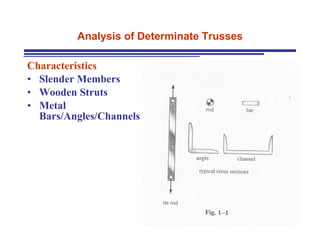
Analysis of Determinate Trusses Characteristics Slender Members Wooden Struts Metal Bars/Angles/Channels
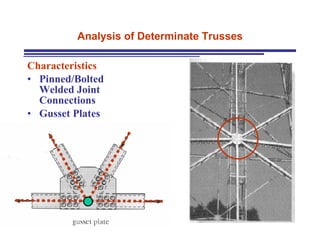
Analysis of Determinate Trusses Characteristics Pinned/Bolted Welded Joint Connections Gusset Plates
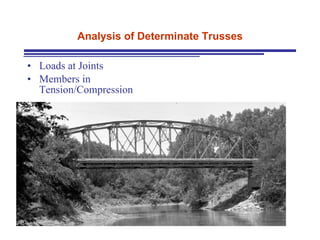
Analysis of Determinate Trusses Loads at Joints Members in Tension/Compression
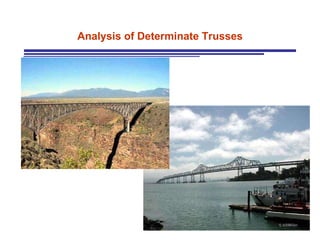
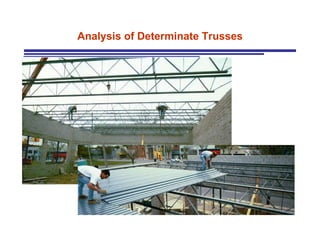
Analysis of Determinate Trusses
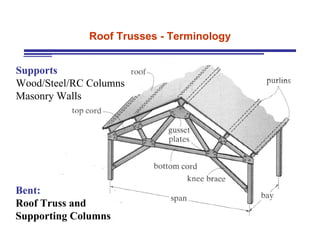
Roof Trusses - Terminology Supports Wood/Steel/RC Columns Masonry Walls Bent: Roof Truss and Supporting Columns
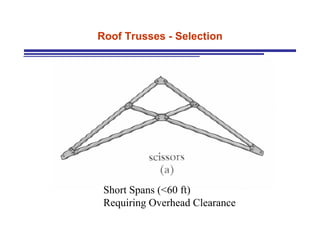
Roof Trusses - Selection Short Spans (<60 ft) Requiring Overhead Clearance
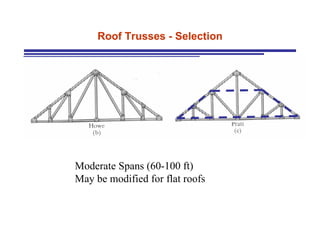
Roof Trusses - Selection Moderate Spans (60-100 ft) May be modified for flat roofs
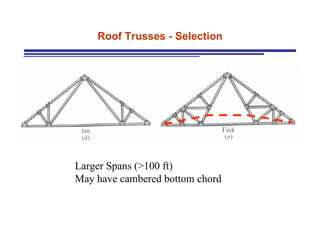
Roof Trusses - Selection Larger Spans (>100 ft) May have cambered bottom chord
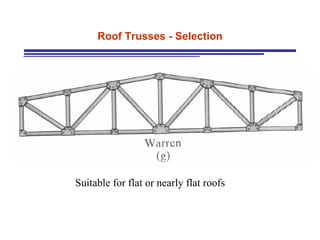
Roof Trusses - Selection Suitable for flat or nearly flat roofs
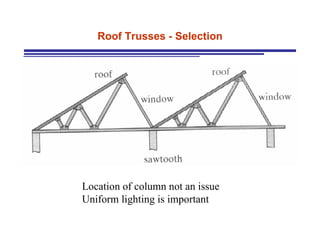
Roof Trusses - Selection Location of column not an issue Uniform lighting is important
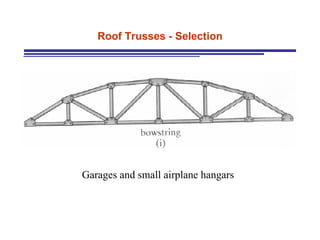
Roof Trusses - Selection Garages and small airplane hangars
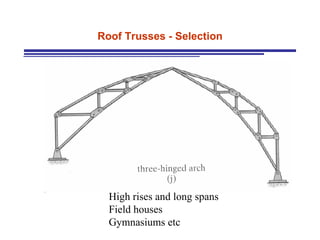
Roof Trusses - Selection High rises and long spans Field houses Gymnasiums etc
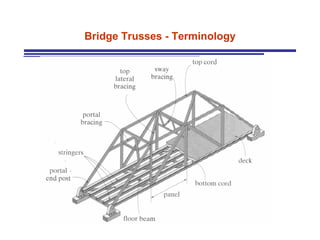
Bridge Trusses - Terminology
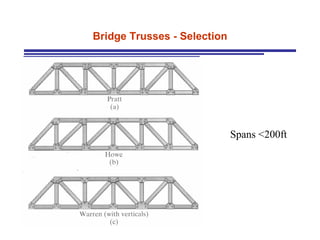
Bridge Trusses - Selection Spans <200ft
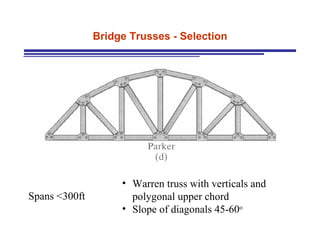
Bridge Trusses - Selection Spans <300ft Warren truss with verticals and polygonal upper chord Slope of diagonals 45-60 o
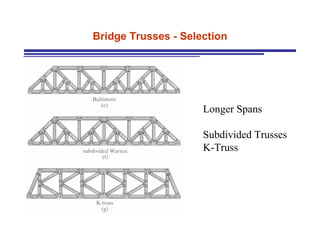
Bridge Trusses - Selection Longer Spans Subdivided Trusses K-Truss
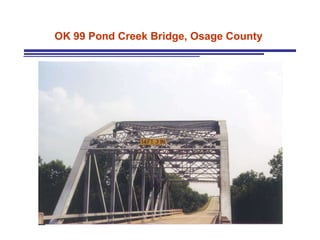
OK 99 Pond Creek Bridge, Osage County
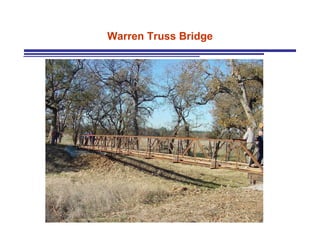
Warren Truss Bridge
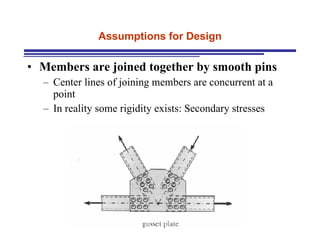
Assumptions for Design Members are joined together by smooth pins Center lines of joining members are concurrent at a point In reality some rigidity exists: Secondary stresses
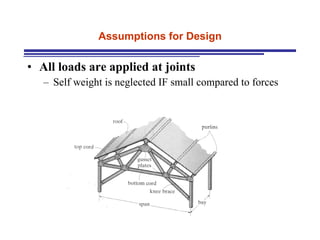
Assumptions for Design All loads are applied at joints Self weight is neglected IF small compared to forces
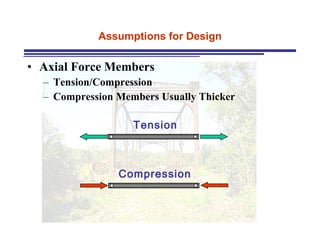
Assumptions for Design Axial Force Members Tension/Compression Compression Members Usually Thicker Tension Compression
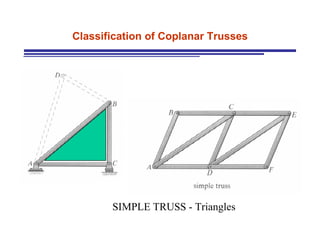
Classification of Coplanar Trusses SIMPLE TRUSS - Triangles
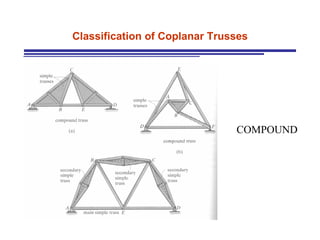
Classification of Coplanar Trusses COMPOUND
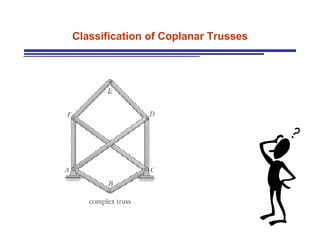
Classification of Coplanar Trusses
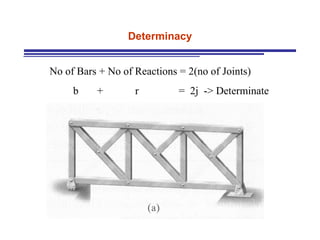
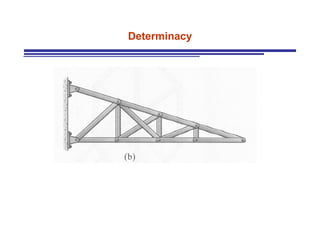
Determinacy No of Bars + No of Reactions = 2(no of Joints) b  +  r  =  2j  -> Determinate
Determinacy
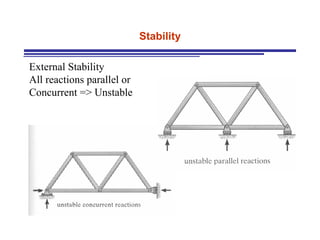
Stability External Stability All reactions parallel or  Concurrent => Unstable
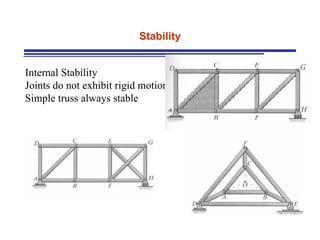
Stability Internal Stability Joints do not exhibit rigid motion Simple truss always stable
Analysis Methods Methods of Joints Method of Sections
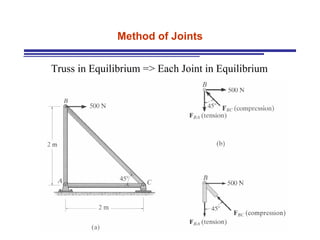
Method of Joints Truss in Equilibrium => Each Joint in Equilibrium
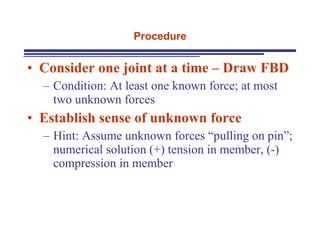
Procedure Consider one joint at a time – Draw FBD Condition: At least one known force; at most two unknown forces Establish sense of unknown force Hint: Assume unknown forces “pulling on pin”; numerical solution (+) tension in member, (-) compression in member
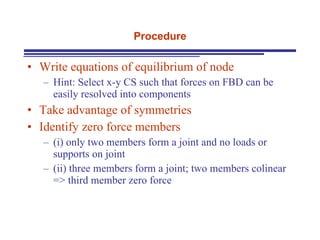
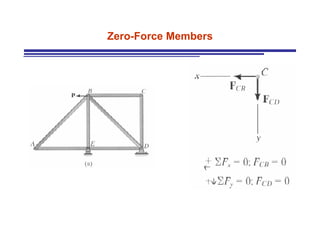
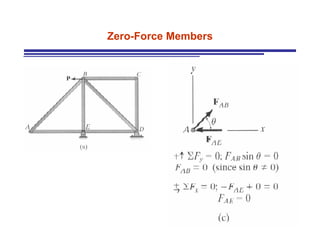
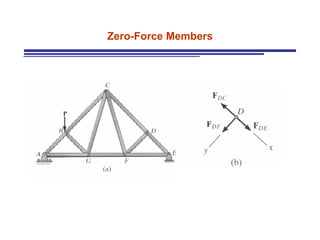
Procedure Write equations of equilibrium of node Hint: Select x-y CS such that forces on FBD can be easily resolved into components Take advantage of symmetries Identify zero force members (i) only two members form a joint and no loads or supports on joint (ii) three members form a joint; two members colinear => third member zero force
Zero-Force Members
Zero-Force Members
Zero-Force Members
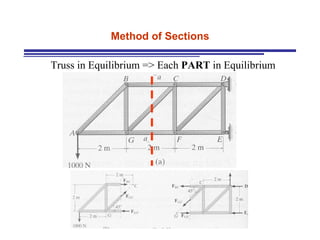
Method of Sections Truss in Equilibrium => Each  PART  in Equilibrium
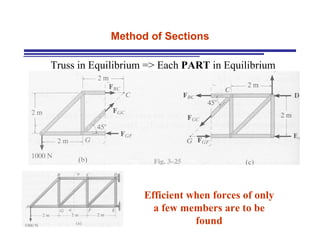
Method of Sections Truss in Equilibrium => Each  PART  in Equilibrium Efficient when forces of only a few members are to be found
Method of Sections - Procedure Free Body Diagram Determine external reactions of entire truss Decide how to section truss Hint: Three(3) unknown forces at the most
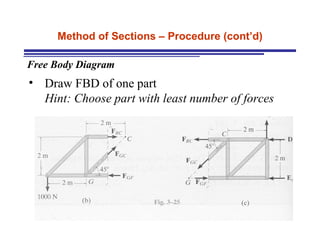
Method of Sections – Procedure (cont’d) Free Body Diagram Draw FBD of one part Hint: Choose part with least number of forces
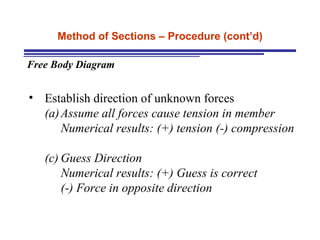
Method of Sections – Procedure (cont’d) Free Body Diagram Establish direction of unknown forces Assume all forces cause tension in member  Numerical results: (+) tension (-) compression Guess Direction Numerical results: (+) Guess is correct  (-) Force in opposite direction
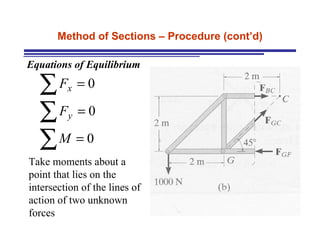
Method of Sections – Procedure (cont’d) Equations of Equilibrium Take moments about a point that lies on the intersection of the lines of action of two unknown forces

Trusses Analysis Of Statically Determinate