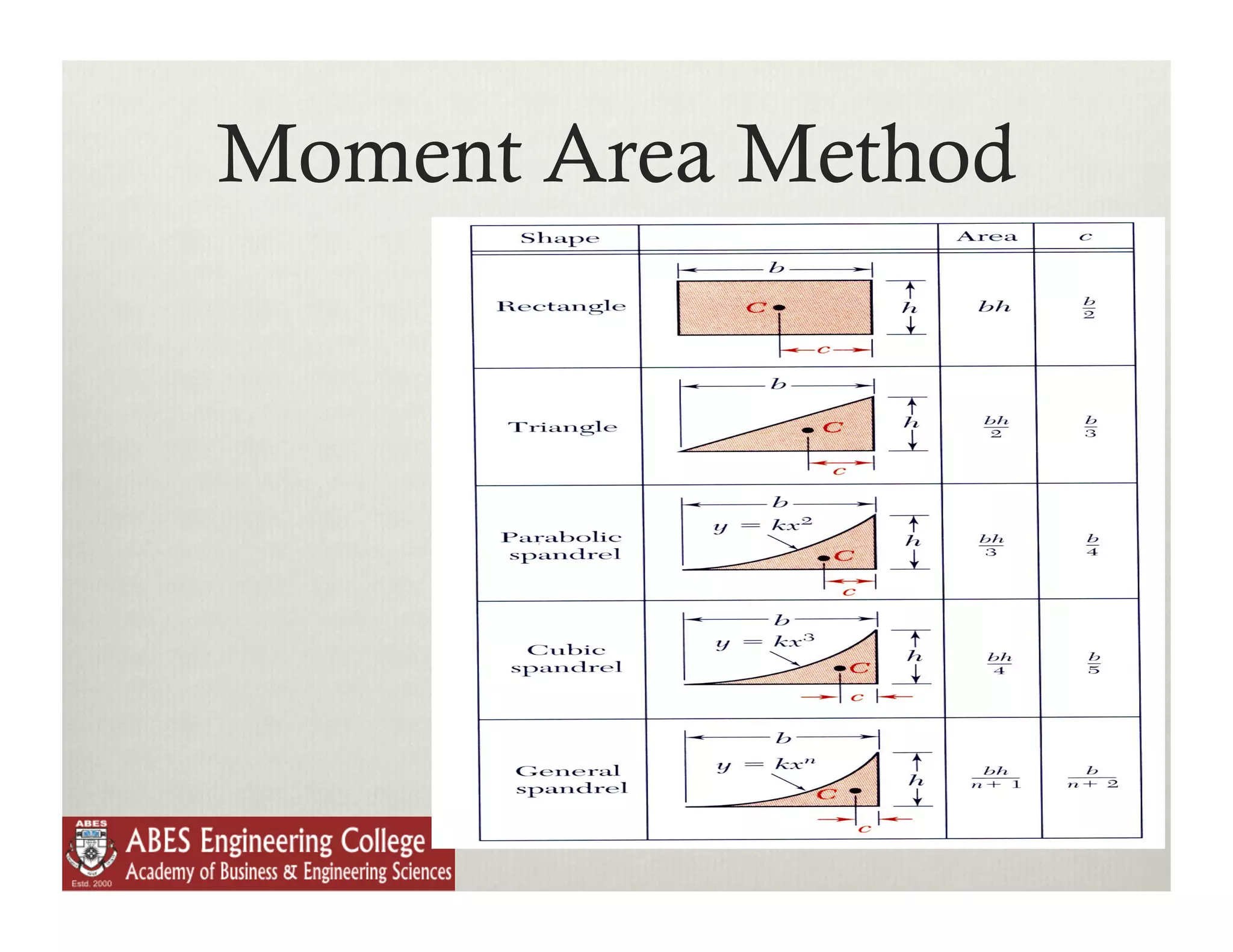
This document discusses stresses in beams and beam deflection. It covers several methods for analyzing bending stresses and deflection in beams, including: [1] the engineering beam theory relating moment, curvature, and stress; [2] double integration and moment area methods for calculating slope and deflection; and [3] Macaulay's method, which simplifies calculations for beams with eccentric loads. Formulas are provided relating bending moment, shear force, curvature, slope, and deflection. Moment-area theorems are also described for relating bending moment to slope and deflection.
In this document
Powered by AI
Introduction to Unit 2 covering shear force, bending moment diagrams, stresses and deflection in beams.
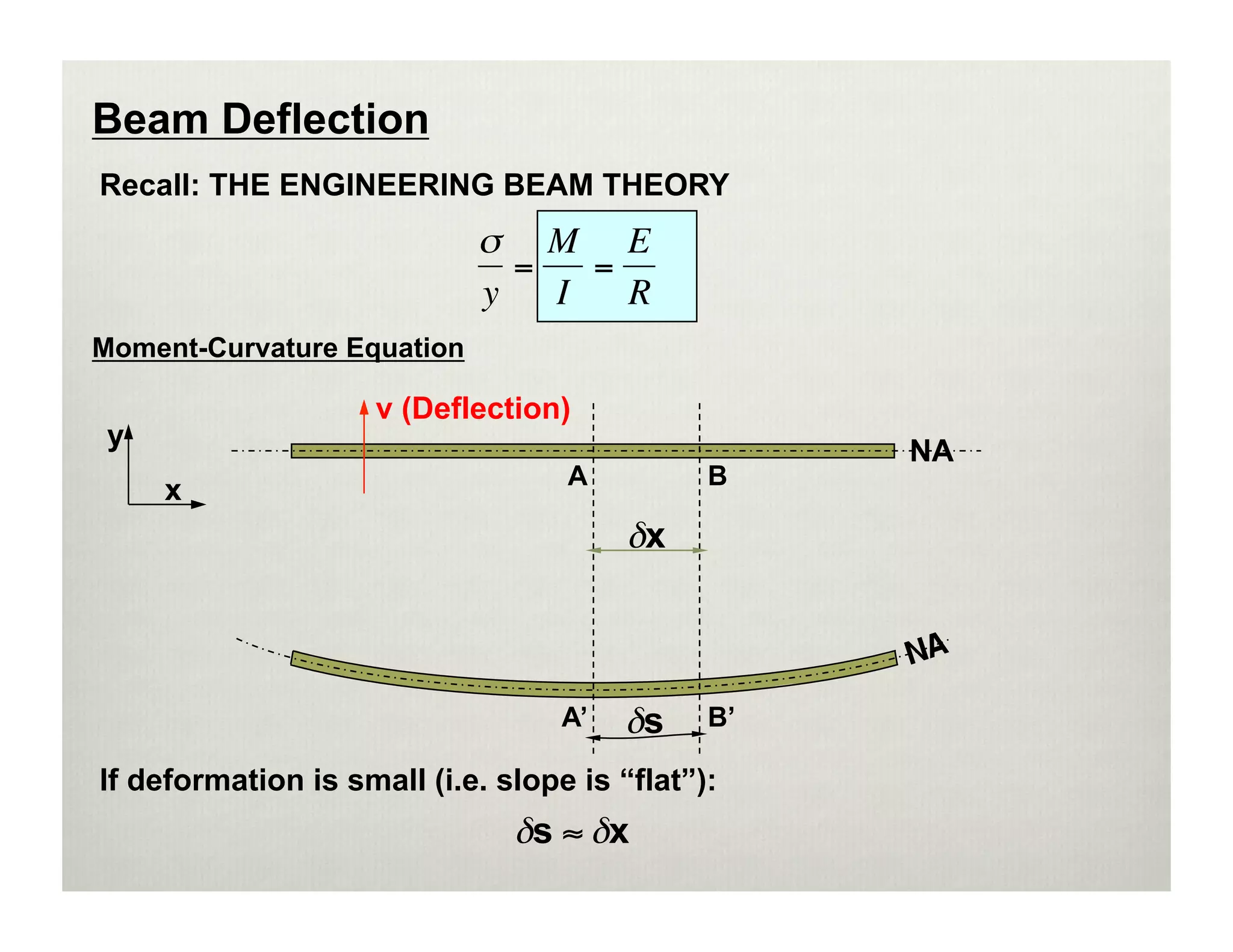
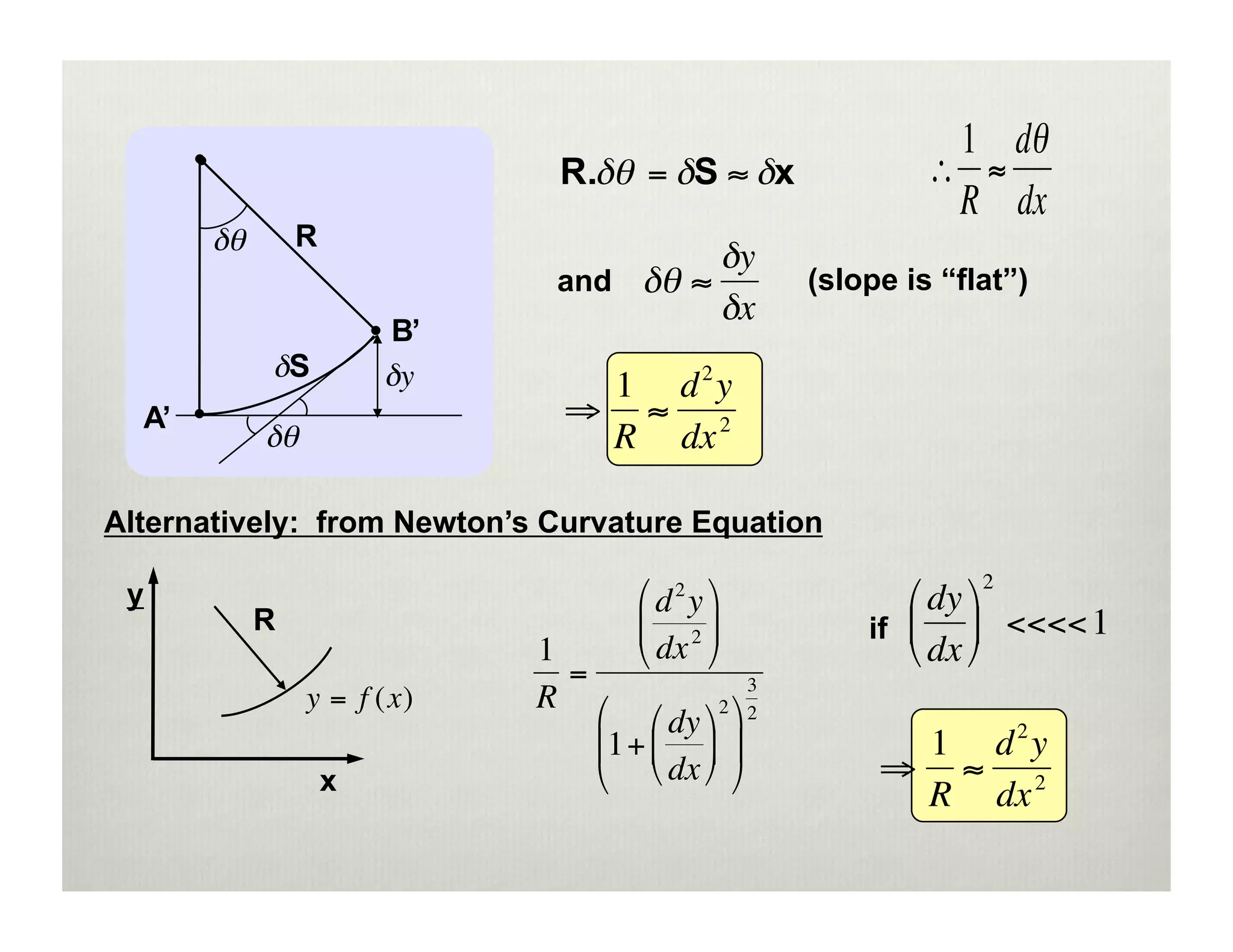
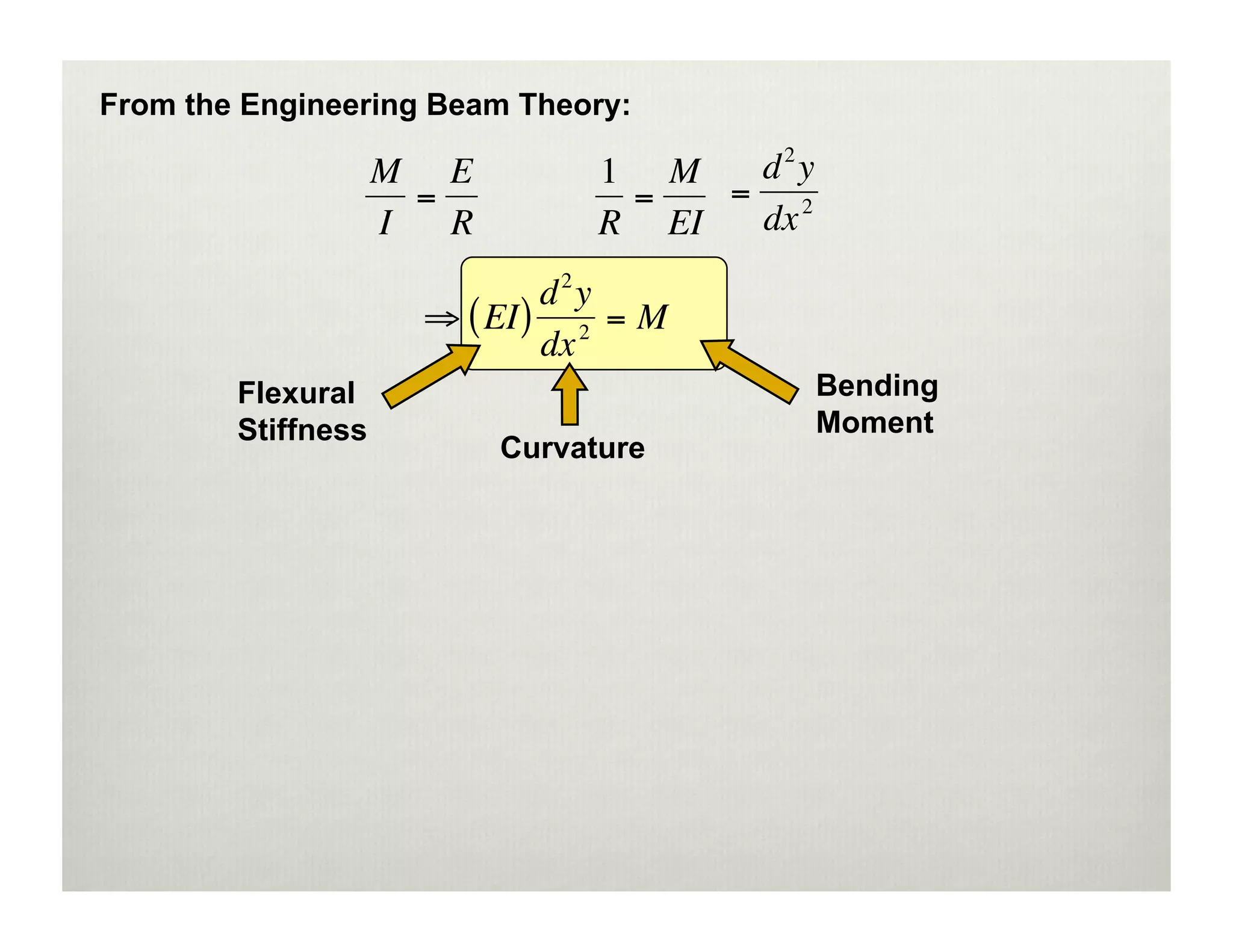
Discussion of beam deflection, engineering beam theory, moment-curvature relationship, and bending moment equation.
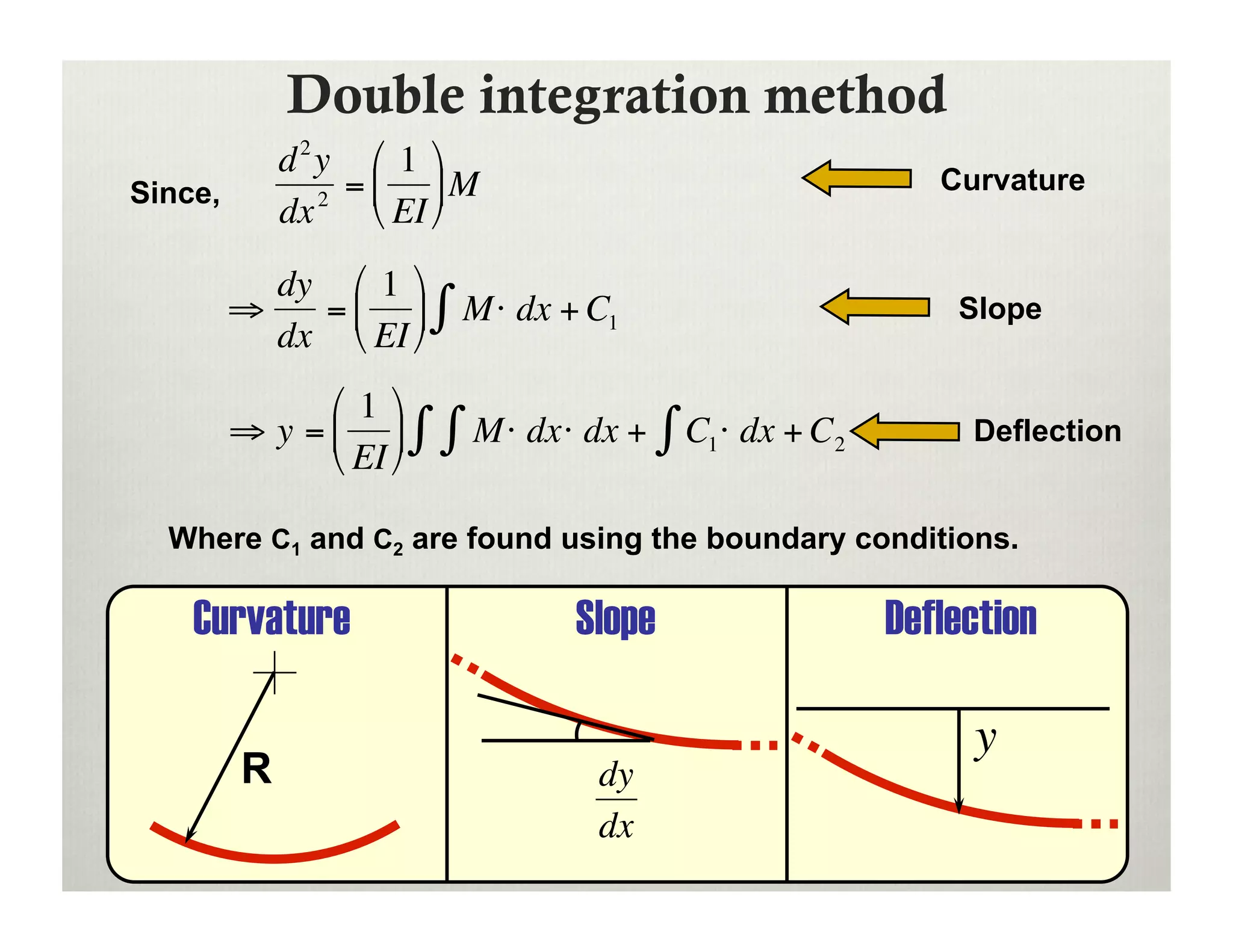
Presentation of methods for calculating slope and deflection including double integration and Macaulay’s method.
Introduction of Moment-Area Theorems to evaluate deflections using the area under the bending moment diagram.
Elaboration on the Moment Area Method for finding shear and deflection in beams.
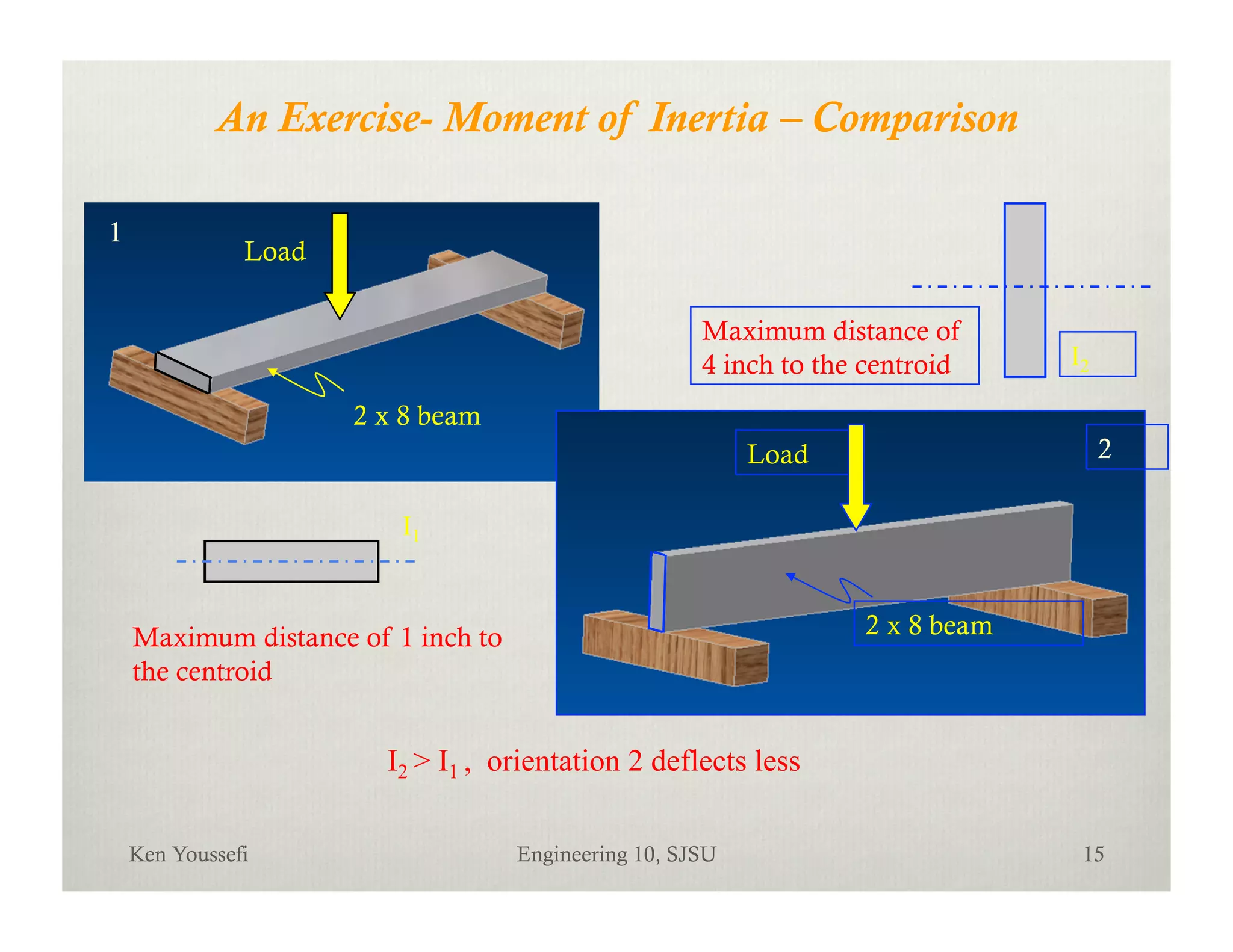
An exercise comparing the moment of inertia of beams and their deflection characteristics.
Unit 2- Stressesin Beams
Topics Covered
Lecture -1 – Review of shear force and bending
moment diagram
Lecture -2 – Bending stresses in beams
Lecture -3 – Shear stresses in beams
Lecture -4- Deflection in beams
Lecture -5 – Torsion in solid and hollow shafts.
3.
Beam Deflection
Recall: THEENGINEERING BEAM THEORY
σ M E
= =
y I R
Moment-Curvature Equation
v (Deflection)
y
€ NA
A B
x
A’ B’
If deformation is small (i.e. slope is “flat”):
4.
1 dθ
∴ ≈
R dx
R
δy
and δθ ≈ (slope is “flat”)
δx
B’
δy 1 d2y €
A’ ⇒ ≈ 2
R dx
€
€
Alternatively: from Newton’s Curvature Equation
y € ⎛ d 2 y ⎞ ⎛ dy ⎞ 2
R ⎜ 2 ⎟ if ⎜ ⎟ <<<< 1
1 ⎝ dx ⎠ ⎝ dx ⎠
= 3
y = f (x) R ⎛ 2 ⎞ 2
⎛ dy ⎞
⎜1+ ⎜ ⎟ ⎟ 1 d2y
x ⎝ ⎝ dx ⎠ ⎠ ⇒ ≈ 2
€ R dx
€
€
5.
From the EngineeringBeam Theory:
M E 1 M d2y
= = = 2
I R R EI dx
d2y
⇒ ( EI ) 2 = M
dx
€Flexural € € Bending
Stiffness Moment
Curvature
€
6.
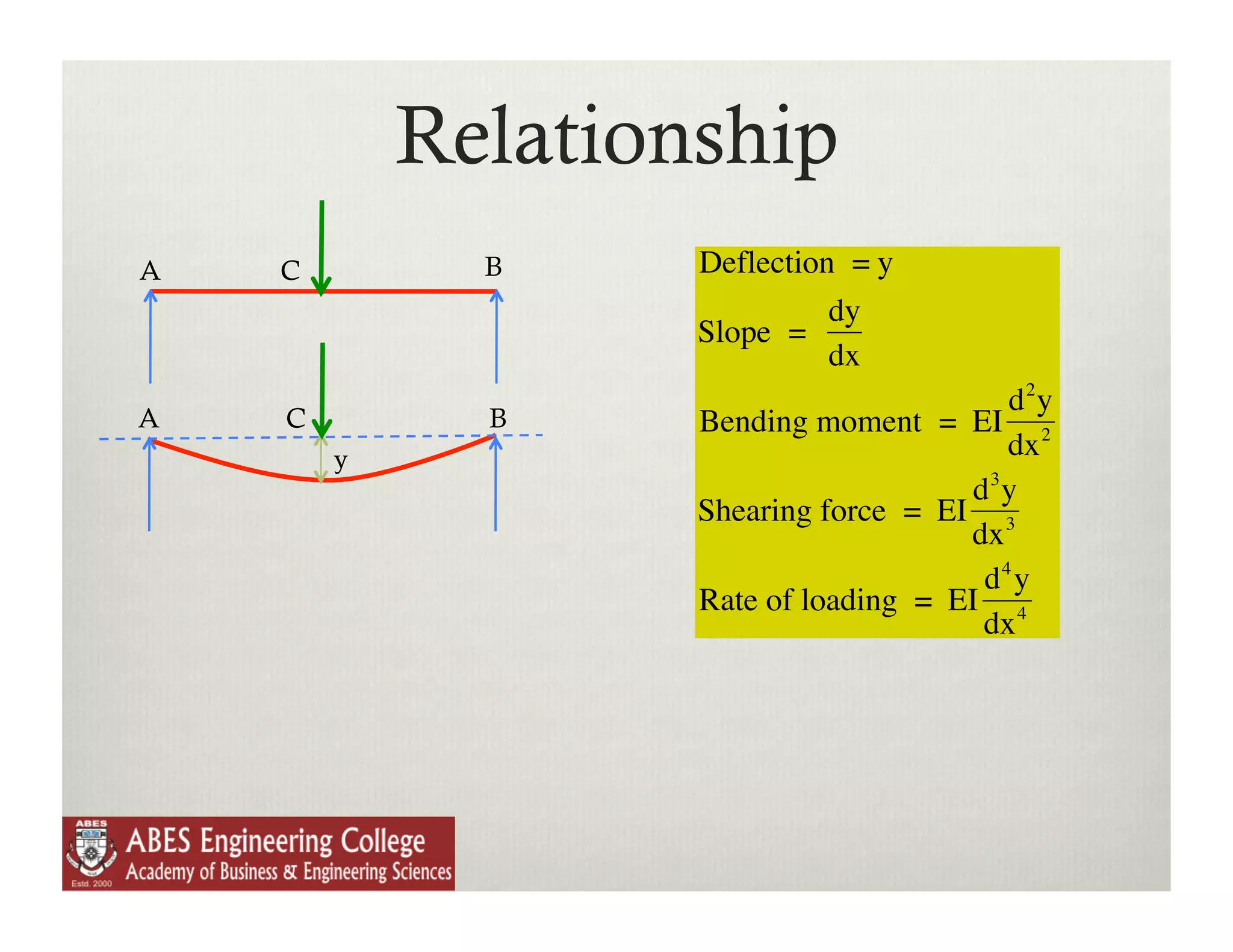
Relationship
A C B Deflection = y
dy
Slope =
dx
d2y
A C B Bending moment = EI 2
y dx
d3y
Shearing force = EI 3
dx
d4 y
Rate of loading = EI 4
dx
€
7.
Methods to findslope
and deflection
Double integration method
Moment area method
Macaulay’s method
8.
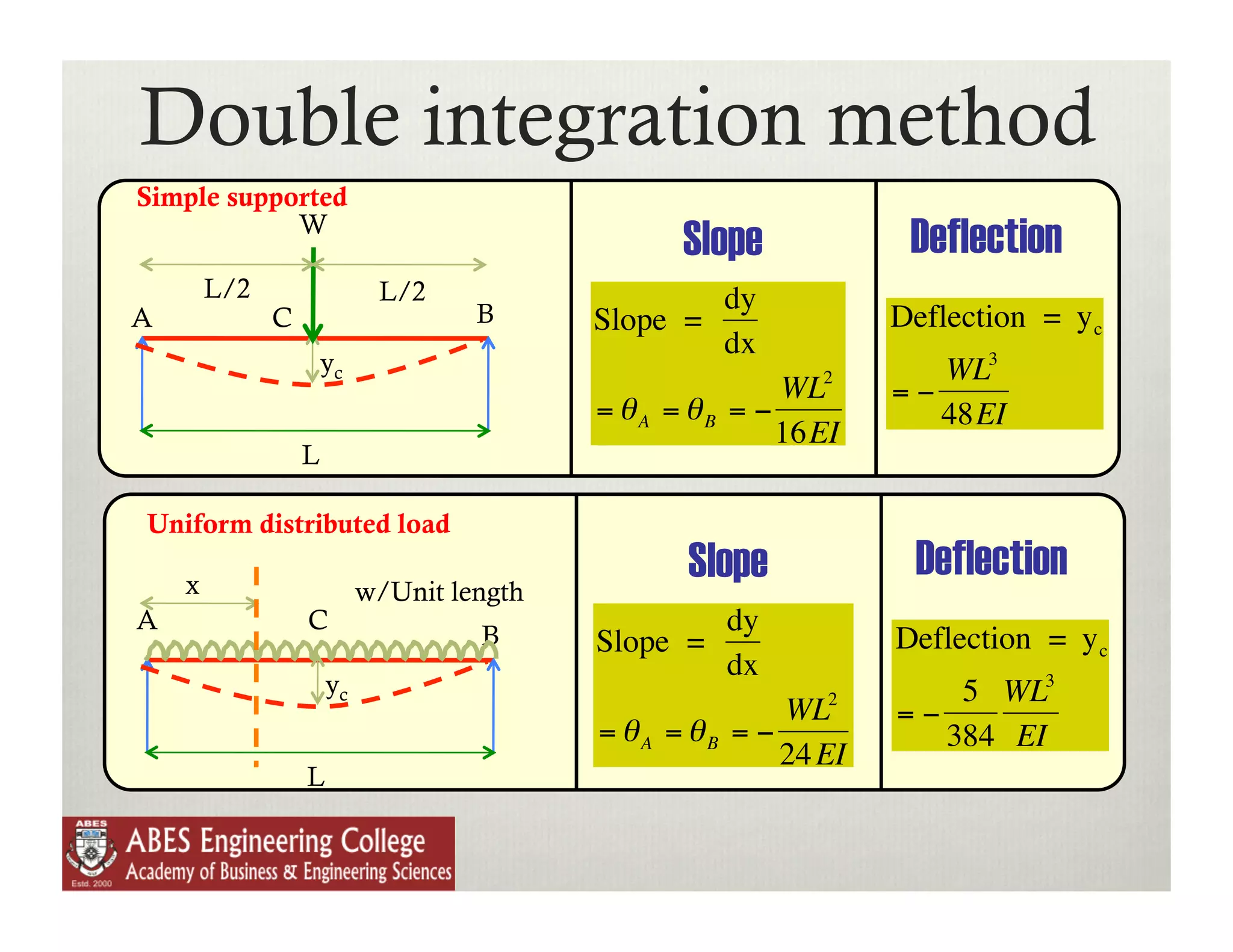
Double integration method
d 2 y ⎛ 1 ⎞
⎟ M Curvature
Since, 2 = ⎜
dx ⎝ EI ⎠
dy ⎛ 1 ⎞
⇒ = ⎜ ⎟ ∫ M ⋅ dx + C1 Slope
dx ⎝ EI ⎠
€
⎛ 1 ⎞
⇒ y = ⎜ ⎟ ∫ ∫ M ⋅ dx⋅ dx + ∫ C ⋅ dx + C
1 2 Deflection
⎝ EI ⎠
€
Where C1 and C2 are found using the boundary conditions.
€ Curvature Slope Deflection
y
R dy
dx
9.
Double integration method
Simplesupported
W
Slope Deflection
L/2 L/2 dy
A C B Slope = Deflection = y c
dx
yc 2 WL3
WL =−
= θA = θB = − 48EI
16EI
L
Uniform distributed load
x
€ Slope
€
Deflection
w/Unit length
A C dy
B Slope = Deflection = y c
dx
yc 2 5 WL3
WL =−
= θA = θB = − 384 EI
24 EI
L
€
€
10.
Macaulay’s method
Theprocedure of finding slope and deflection for
simply supported beam with an eccentric load is very
laborious.
Macaulay’s method helps to simplify the calculations
to find the deflection of beams subjected to point
loads.
11.
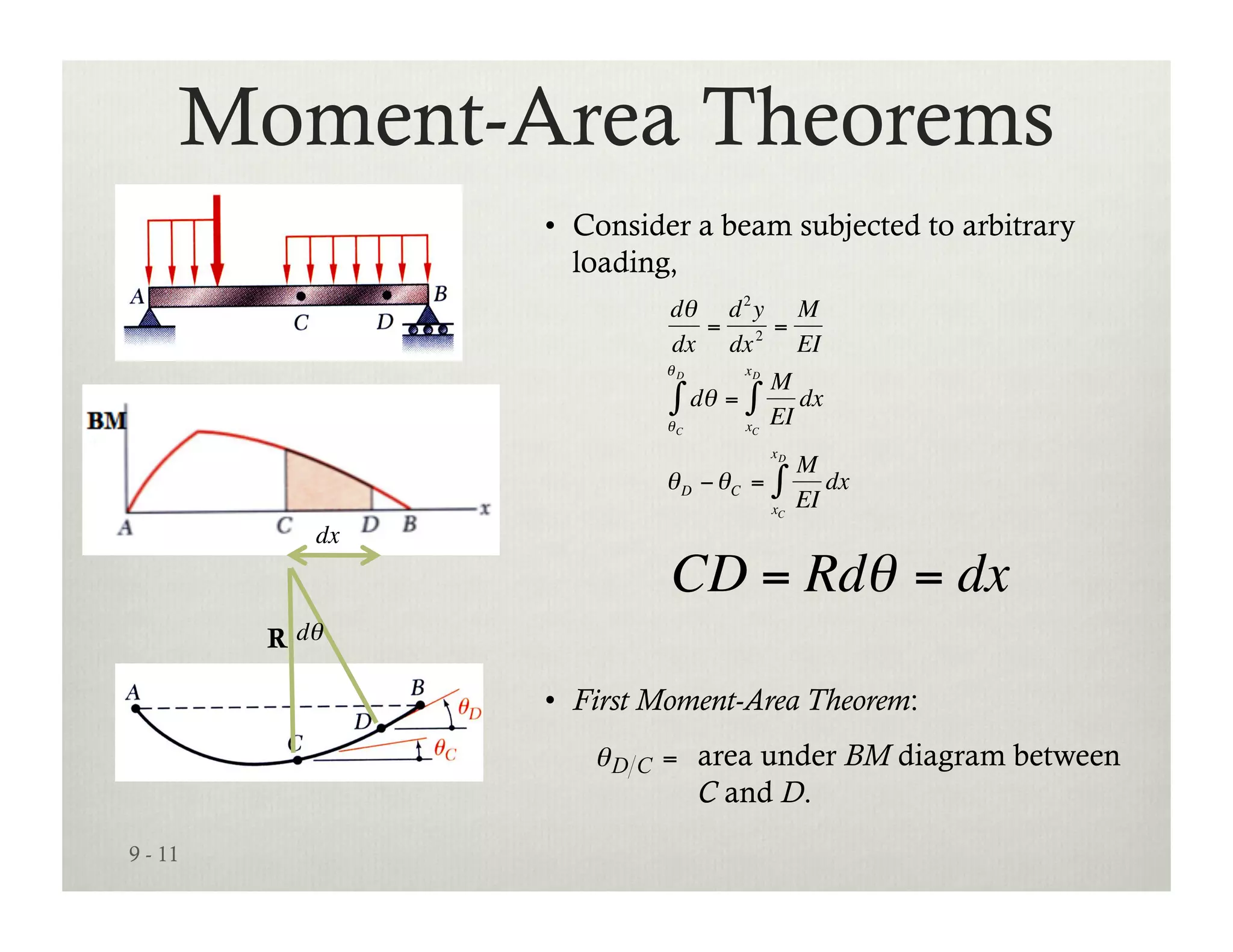
Moment-Area Theorems
• Consider a beam subjected to arbitrary
loading,
dθ d 2 y M
= =
dx dx 2 EI
θD xD
M
∫ dθ = ∫ EI dx
θC xC
xD
M
θ D − θC = ∫ EI
dx
xC
dx
CD = Rdθ = dx
€
€ R dθ
• First Moment-Area Theorem:
€
area under BM diagram between
€ C and D.
9 - 11
12.
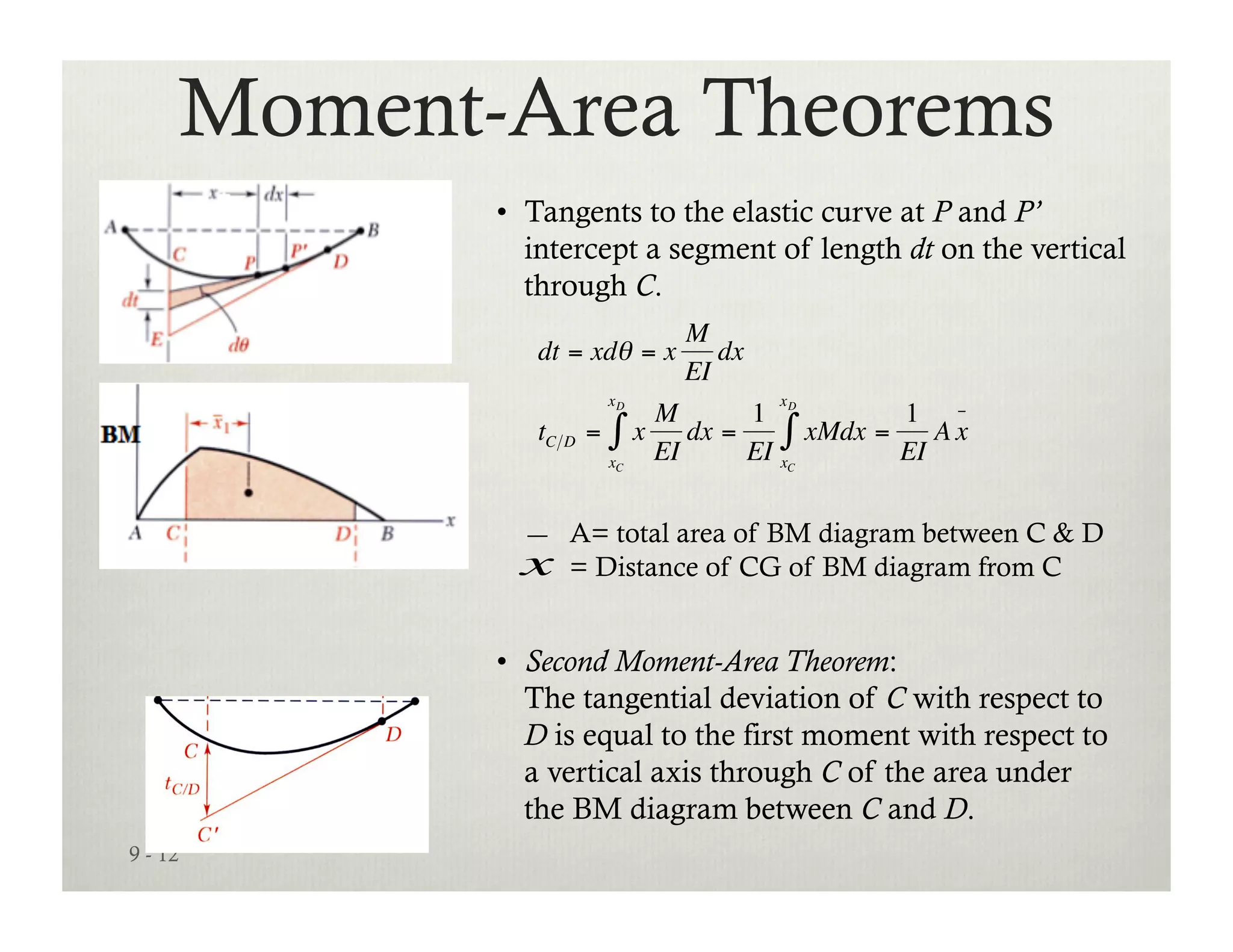
Moment-Area Theorems
• Tangents to the elastic curve at P and P’
intercept a segment of length dt on the vertical
through C.
M
dt = xdθ = x dx
EI
xD x
M 1 D 1 −
tC D = ∫ x
EI
dx = ∫ xMdx = EI A x
EI xC
xC
− A= total area of BM diagram between C & D
€ x = Distance of CG of BM diagram from C
• Second Moment-Area Theorem:
The tangential deviation of C with respect to
€ D is equal to the first moment with respect to
a vertical axis through C of the area under
the BM diagram between C and D.
9 - 12
An Exercise- Momentof Inertia – Comparison
1
Load
Maximum distance of
4 inch to the centroid I2
2 x 8 beam
Load 2
I1
Maximum distance of 1 inch to 2 x 8 beam
the centroid
I2 > I1 , orientation 2 deflects less
Ken Youssefi Engineering 10, SJSU 15