ES220 Statics Exam III Review Notes
Analysis of Structures Trusses Designed to support loads Consist entirely of two-force members Frames Designed to support loads Include one or more multi-force members Machines Designed to transmit and/or modify forces Include one or more multi-force members
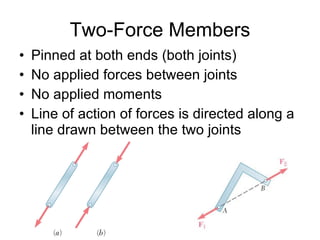
Two-Force Members Pinned at both ends (both joints) No applied forces between joints No applied moments Line of action of forces is directed along a line drawn between the two joints
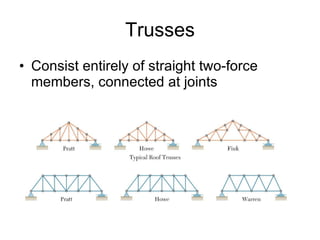
Trusses Consist entirely of straight two-force members, connected at joints
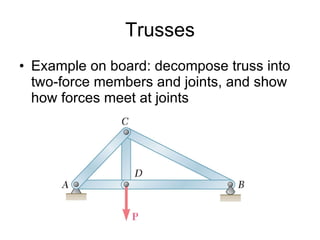
Trusses Example on board: decompose truss into two-force members and joints, and show how forces meet at joints
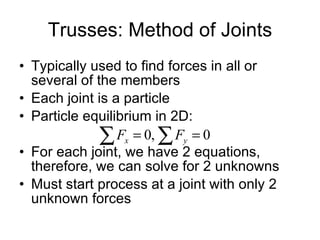
Trusses: Method of Joints Typically used to find forces in all or several of the members Each joint is a particle Particle equilibrium in 2D: For each joint, we have 2 equations, therefore, we can solve for 2 unknowns Must start process at a joint with only 2 unknown forces
Trusses: Method of Joints Find a joint with only two unknown forces First, may need to draw an FBD of the entire truss and find support reactions Draw FBD of selected joint Draw each force along the direction of the member Draw in tension (away from joint) Find angle of force from truss geometry Resolve angled forces into x, y components
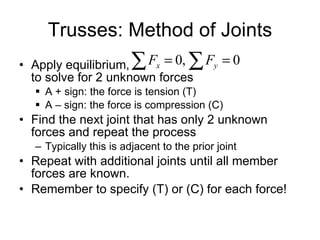
Trusses: Method of Joints Apply equilibrium,  to solve for 2 unknown forces A + sign: the force is tension (T) A – sign: the force is compression (C) Find the next joint that has only 2 unknown forces and repeat the process Typically this is adjacent to the prior joint Repeat with additional joints until all member forces are known. Remember to specify (T) or (C) for each force!
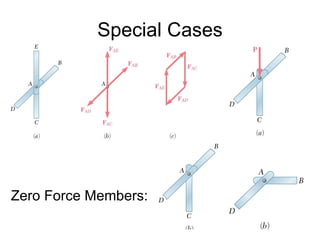
Special Cases Zero Force Members:
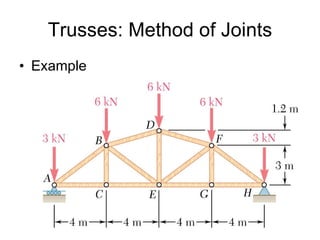
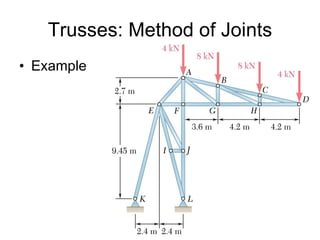
Trusses: Method of Joints Example
Trusses: Method of Sections Typically used when only 1 or a few member forces are needed Since a section consists of multiple joints and multiple members, it is a rigid body Rigid body equilibrium in 2D For each section, have 3 equations, therefore, can solve for 3 unknown forces
Trusses: Method of Sections Identify the member(s) for which we will determine the forces  Can determine up to 3 forces for each section Create a separable section by cutting through the member(s) May need to cut additional members to cut loose a section Decide which portion of the truss to keep
Trusses: Method of Sections Draw a free body diagram of the section Replace cut members with forces directed along the direction of the cut members Draw unknown forces in tension (pointed away from the joint) Include externally applied forces and support reactions First, you may need to draw an FBD of the entire truss to find support reactions Include dimensions needed to sum moments
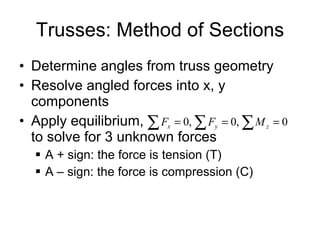
Trusses: Method of Sections Determine angles from truss geometry Resolve angled forces into x, y components Apply equilibrium, to solve for 3 unknown forces A + sign: the force is tension (T) A – sign: the force is compression (C)
Trusses: Method of Sections Cut the member for which you are finding the force If possible, choose the other cuts such that the extra unknown forces (but not the force you need) pass through a single joint Sum the moment about that joint Special Case: Finding only one force
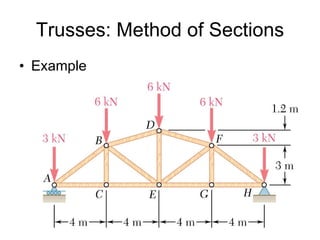
Trusses: Method of Sections Example
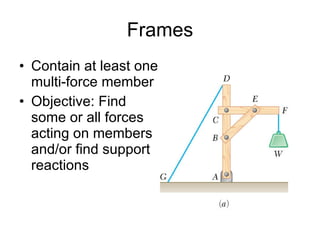
Frames Contain at least one multi-force member Objective: Find some or all forces acting on members and/or find support reactions
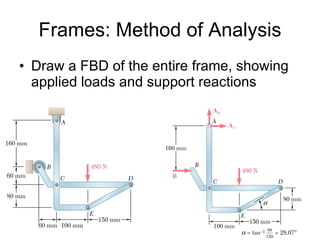
Frames: Method of Analysis Draw a FBD of the entire frame, showing applied loads and support reactions
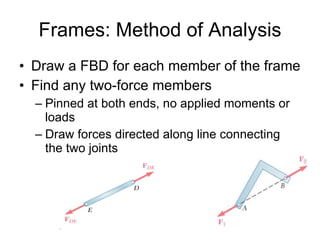
Frames: Method of Analysis Draw a FBD for each member of the frame Find any two-force members Pinned at both ends, no applied moments or loads Draw forces directed along line connecting the two joints
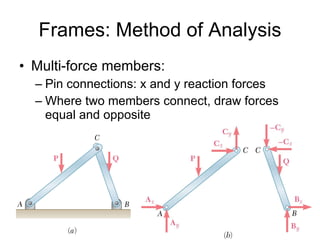
Frames: Method of Analysis Multi-force members: Pin connections: x and y reaction forces Where two members connect, draw forces equal and opposite
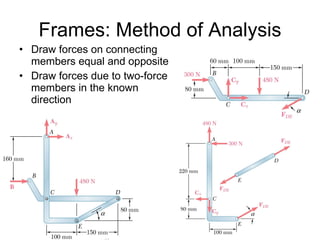
Frames: Method of Analysis Draw forces on connecting members equal and opposite Draw forces due to two-force members in the known direction
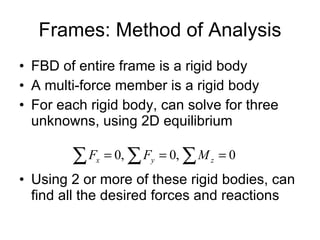
Frames: Method of Analysis FBD of entire frame is a rigid body A multi-force member is a rigid body For each rigid body, can solve for three unknowns, using 2D equilibrium Using 2 or more of these rigid bodies, can find all the desired forces and reactions
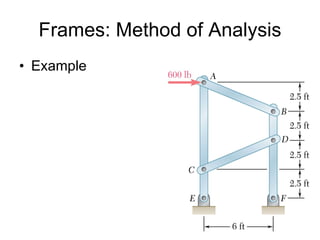
Frames: Method of Analysis Example
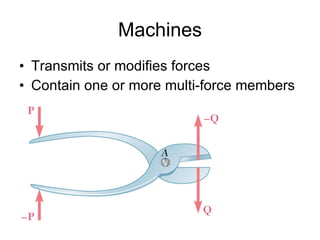
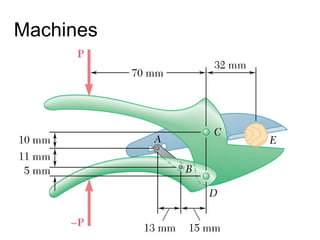
Machines Transmits or modifies forces Contain one or more multi-force members
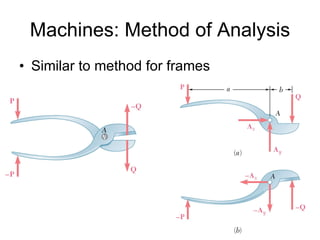
Machines: Method of Analysis Similar to method for frames
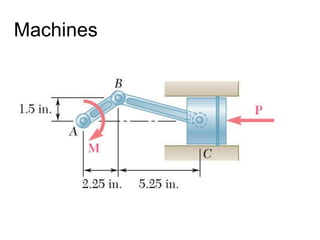
Machines
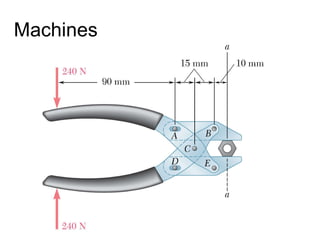
Machines
Machines
Machines

Trusses Frame Machines Analysis

  • 1.
    ES220 Statics ExamIII Review Notes
  • 2.
    Analysis of StructuresTrusses Designed to support loads Consist entirely of two-force members Frames Designed to support loads Include one or more multi-force members Machines Designed to transmit and/or modify forces Include one or more multi-force members
  • 3.
    Two-Force Members Pinnedat both ends (both joints) No applied forces between joints No applied moments Line of action of forces is directed along a line drawn between the two joints
  • 4.
    Trusses Consist entirelyof straight two-force members, connected at joints
  • 5.
    Trusses Example onboard: decompose truss into two-force members and joints, and show how forces meet at joints
  • 6.
    Trusses: Method ofJoints Typically used to find forces in all or several of the members Each joint is a particle Particle equilibrium in 2D: For each joint, we have 2 equations, therefore, we can solve for 2 unknowns Must start process at a joint with only 2 unknown forces
  • 7.
    Trusses: Method ofJoints Find a joint with only two unknown forces First, may need to draw an FBD of the entire truss and find support reactions Draw FBD of selected joint Draw each force along the direction of the member Draw in tension (away from joint) Find angle of force from truss geometry Resolve angled forces into x, y components
  • 8.
    Trusses: Method ofJoints Apply equilibrium, to solve for 2 unknown forces A + sign: the force is tension (T) A – sign: the force is compression (C) Find the next joint that has only 2 unknown forces and repeat the process Typically this is adjacent to the prior joint Repeat with additional joints until all member forces are known. Remember to specify (T) or (C) for each force!
  • 9.
    Special Cases ZeroForce Members:
  • 10.
    Trusses: Method ofJoints Example
  • 11.
    Trusses: Method ofJoints Example
  • 12.
    Trusses: Method ofSections Typically used when only 1 or a few member forces are needed Since a section consists of multiple joints and multiple members, it is a rigid body Rigid body equilibrium in 2D For each section, have 3 equations, therefore, can solve for 3 unknown forces
  • 13.
    Trusses: Method ofSections Identify the member(s) for which we will determine the forces Can determine up to 3 forces for each section Create a separable section by cutting through the member(s) May need to cut additional members to cut loose a section Decide which portion of the truss to keep
  • 14.
    Trusses: Method ofSections Draw a free body diagram of the section Replace cut members with forces directed along the direction of the cut members Draw unknown forces in tension (pointed away from the joint) Include externally applied forces and support reactions First, you may need to draw an FBD of the entire truss to find support reactions Include dimensions needed to sum moments
  • 15.
    Trusses: Method ofSections Determine angles from truss geometry Resolve angled forces into x, y components Apply equilibrium, to solve for 3 unknown forces A + sign: the force is tension (T) A – sign: the force is compression (C)
  • 16.
    Trusses: Method ofSections Cut the member for which you are finding the force If possible, choose the other cuts such that the extra unknown forces (but not the force you need) pass through a single joint Sum the moment about that joint Special Case: Finding only one force
  • 17.
    Trusses: Method ofSections Example
  • 18.
    Frames Contain atleast one multi-force member Objective: Find some or all forces acting on members and/or find support reactions
  • 19.
    Frames: Method ofAnalysis Draw a FBD of the entire frame, showing applied loads and support reactions
  • 20.
    Frames: Method ofAnalysis Draw a FBD for each member of the frame Find any two-force members Pinned at both ends, no applied moments or loads Draw forces directed along line connecting the two joints
  • 21.
    Frames: Method ofAnalysis Multi-force members: Pin connections: x and y reaction forces Where two members connect, draw forces equal and opposite
  • 22.
    Frames: Method ofAnalysis Draw forces on connecting members equal and opposite Draw forces due to two-force members in the known direction
  • 23.
    Frames: Method ofAnalysis FBD of entire frame is a rigid body A multi-force member is a rigid body For each rigid body, can solve for three unknowns, using 2D equilibrium Using 2 or more of these rigid bodies, can find all the desired forces and reactions
  • 24.
    Frames: Method ofAnalysis Example
  • 25.
    Machines Transmits ormodifies forces Contain one or more multi-force members
  • 26.
    Machines: Method ofAnalysis Similar to method for frames
  • 27.
  • 28.
  • 29.
  • 30.