Eng. 6002 Ship Structures 1
Hull Girder Response Analysis
Lecture 7: Review of Beam
Theory
Overview
 In this lecture we will review the elastic response
of beams and the relationship between load,
shear, bending, and deflection.
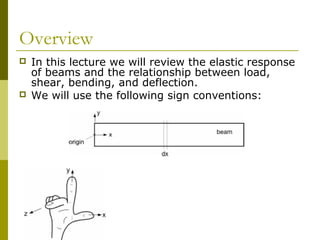
 We will use the following sign conventions:
Static Equilibrium Equations
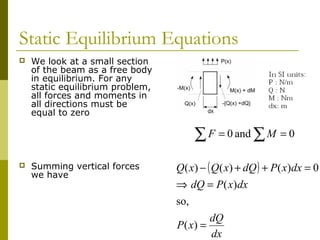
 We look at a small section
of the beam as a free body
in equilibrium. For any
static equilibrium problem,
all forces and moments in
all directions must be
equal to zero
 Summing vertical forces
we have
∑∑ == 0and0 MF
( )
dx
dQ
xP
dxxPdQ
dxxPdQxQxQ
=
=⇒
=++−
)(
so,
)(
0)()()(
Static Equilibrium Equations
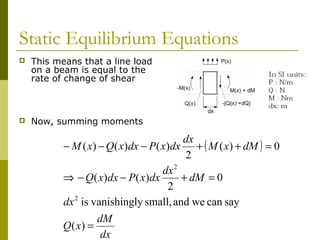
 This means that a line load
on a beam is equal to the
rate of change of shear
 Now, summing moments
( )
dx
dM
xQ
dx
dM
dx
dxxPdxxQ
dMxM
dx
dxxPdxxQxM
=
=+−−⇒
=++−−−
)(
saycanweandsmall,lyvanishingis
0
2
)()(
0)(
2
)()()(
2
2
Static Equilibrium Equations
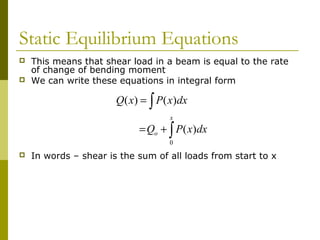
 This means that shear load in a beam is equal to the rate
of change of bending moment
 We can write these equations in integral form
 In words – shear is the sum of all loads from start to x
∫
∫
+=
=
x
o dxxPQ
dxxPxQ
0
)(
)()(
Shear and Moment Diagrams example
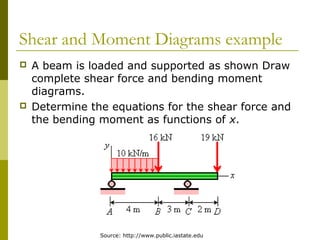
 A beam is loaded and supported as shown Draw
complete shear force and bending moment
diagrams.
 Determine the equations for the shear force and
the bending moment as functions of x.
Source: http://www.public.iastate.edu
Shear and Moment Diagrams example
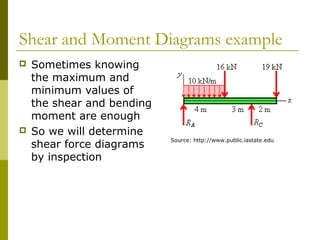
 We start by drawing a
free-body diagram of
the beam and
determining the
support reactions.
 Summing moments
about the left end of
the beam
 Summing vertical
forces
[ ] ( ) ( )
kNR
RcM
c
A
45
019916410427
=⇒
=−−⋅−=∑
Source: http://www.public.iastate.edu
( )
kNR
RRF
A
CA
30
01916104
=⇒
=−−⋅−+=∑
[ ] ( ) ( )
kNR
RcM
c
A
45
019916410427
=⇒
=−−⋅−=∑
Shear and Moment Diagrams example
 Sometimes knowing
the maximum and
minimum values of
the shear and bending
moment are enough
 So we will determine
shear force diagrams
by inspection
Source: http://www.public.iastate.edu
Shear and Moment Diagrams example
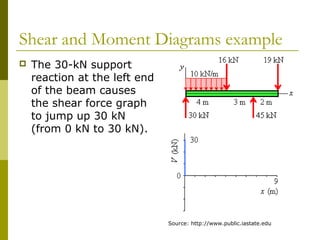
 The 30-kN support
reaction at the left end
of the beam causes
the shear force graph
to jump up 30 kN
(from 0 kN to 30 kN).
Source: http://www.public.iastate.edu
Shear and Moment Diagrams example
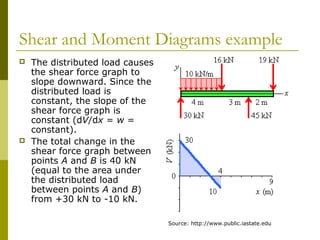
 The distributed load causes
the shear force graph to
slope downward. Since the
distributed load is
constant, the slope of the
shear force graph is
constant (dV/dx = w =
constant).
 The total change in the
shear force graph between
points A and B is 40 kN
(equal to the area under
the distributed load
between points A and B)
from +30 kN to -10 kN.
Source: http://www.public.iastate.edu
Shear and Moment Diagrams example
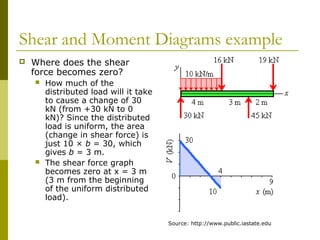
 Where does the shear
force becomes zero?
 How much of the
distributed load will it take
to cause a change of 30
kN (from +30 kN to 0
kN)? Since the distributed
load is uniform, the area
(change in shear force) is
just 10 × b = 30, which
gives b = 3 m.
 The shear force graph
becomes zero at x = 3 m
(3 m from the beginning
of the uniform distributed
load).
Source: http://www.public.iastate.edu
Shear and Moment Diagrams example
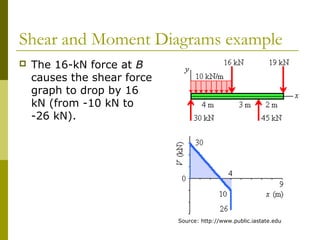
 The 16-kN force at B
causes the shear force
graph to drop by 16
kN (from -10 kN to
-26 kN).
Source: http://www.public.iastate.edu
Shear and Moment Diagrams example
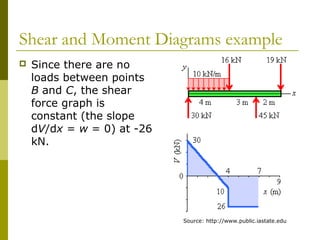
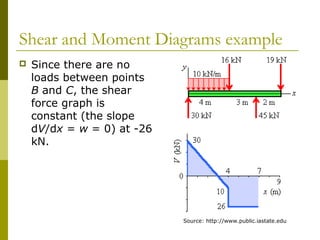
 Since there are no
loads between points
B and C, the shear
force graph is
constant (the slope
dV/dx = w = 0) at -26
kN.
Source: http://www.public.iastate.edu
Shear and Moment Diagrams example
 Since there are no
loads between points
B and C, the shear
force graph is
constant (the slope
dV/dx = w = 0) at -26
kN.
Source: http://www.public.iastate.edu
Shear and Moment Diagrams example
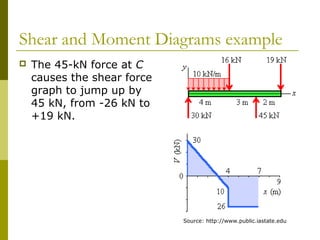
 The 45-kN force at C
causes the shear force
graph to jump up by
45 kN, from -26 kN to
+19 kN.
Source: http://www.public.iastate.edu
Shear and Moment Diagrams example
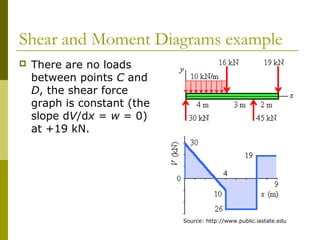
 There are no loads
between points C and
D, the shear force
graph is constant (the
slope dV/dx = w = 0)
at +19 kN.
Source: http://www.public.iastate.edu
Shear and Moment Diagrams example
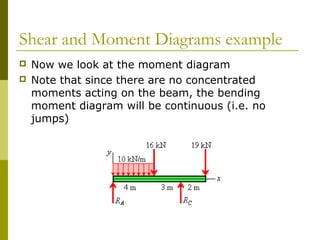
 Now we look at the moment diagram
 Note that since there are no concentrated
moments acting on the beam, the bending
moment diagram will be continuous (i.e. no
jumps)
Shear and Moment Diagrams example
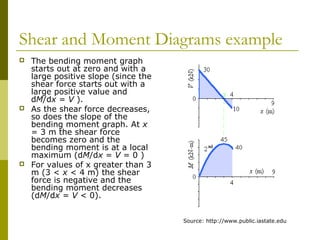
 The bending moment graph
starts out at zero and with a
large positive slope (since the
shear force starts out with a
large positive value and
dM/dx = V ).
 As the shear force decreases,
so does the slope of the
bending moment graph. At x
= 3 m the shear force
becomes zero and the
bending moment is at a local
maximum (dM/dx = V = 0 )
 For values of x greater than 3
m (3 < x < 4 m) the shear
force is negative and the
bending moment decreases
(dM/dx = V < 0).
Source: http://www.public.iastate.edu
Shear and Moment Diagrams example
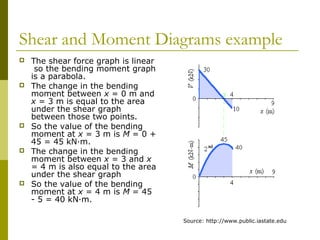
 The shear force graph is linear
so the bending moment graph
is a parabola.
 The change in the bending
moment between x = 0 m and
x = 3 m is equal to the area
under the shear graph
between those two points.
 So the value of the bending
moment at x = 3 m is M = 0 +
45 = 45 kN·m.
 The change in the bending
moment between x = 3 and x
= 4 m is also equal to the area
under the shear graph
 So the value of the bending
moment at x = 4 m is M = 45
- 5 = 40 kN·m.
Source: http://www.public.iastate.edu
Shear and Moment Diagrams example
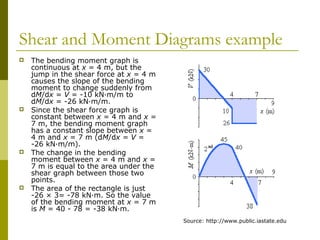
 The bending moment graph is
continuous at x = 4 m, but the
jump in the shear force at x = 4 m
causes the slope of the bending
moment to change suddenly from
dM/dx = V = -10 kN·m/m to
dM/dx = -26 kN·m/m.
 Since the shear force graph is
constant between x = 4 m and x =
7 m, the bending moment graph
has a constant slope between x =
4 m and x = 7 m (dM/dx = V =
-26 kN·m/m).
 The change in the bending
moment between x = 4 m and x =
7 m is equal to the area under the
shear graph between those two
points.
 The area of the rectangle is just
-26 × 3= -78 kN·m. So the value
of the bending moment at x = 7 m
is M = 40 - 78 = -38 kN·m.
Source: http://www.public.iastate.edu
Shear and Moment Diagrams example
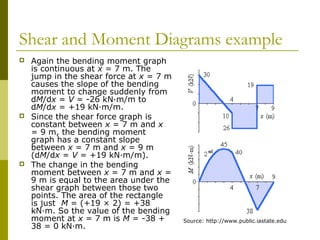
 Again the bending moment graph
is continuous at x = 7 m. The
jump in the shear force at x = 7 m
causes the slope of the bending
moment to change suddenly from
dM/dx = V = -26 kN·m/m to
dM/dx = +19 kN·m/m.
 Since the shear force graph is
constant between x = 7 m and x
= 9 m, the bending moment
graph has a constant slope
between x = 7 m and x = 9 m
(dM/dx = V = +19 kN·m/m).
 The change in the bending
moment between x = 7 m and x =
9 m is equal to the area under the
shear graph between those two
points. The area of the rectangle
is just M = (+19 × 2) = +38
kN·m. So the value of the bending
moment at x = 7 m is M = -38 +
38 = 0 kN·m.
Source: http://www.public.iastate.edu

6002 notes 07_l7

  • 1.
    Eng. 6002 ShipStructures 1 Hull Girder Response Analysis Lecture 7: Review of Beam Theory
  • 2.
    Overview  In thislecture we will review the elastic response of beams and the relationship between load, shear, bending, and deflection.  We will use the following sign conventions:
  • 3.
    Static Equilibrium Equations We look at a small section of the beam as a free body in equilibrium. For any static equilibrium problem, all forces and moments in all directions must be equal to zero  Summing vertical forces we have ∑∑ == 0and0 MF ( ) dx dQ xP dxxPdQ dxxPdQxQxQ = =⇒ =++− )( so, )( 0)()()(
  • 4.
    Static Equilibrium Equations This means that a line load on a beam is equal to the rate of change of shear  Now, summing moments ( ) dx dM xQ dx dM dx dxxPdxxQ dMxM dx dxxPdxxQxM = =+−−⇒ =++−−− )( saycanweandsmall,lyvanishingis 0 2 )()( 0)( 2 )()()( 2 2
  • 5.
    Static Equilibrium Equations This means that shear load in a beam is equal to the rate of change of bending moment  We can write these equations in integral form  In words – shear is the sum of all loads from start to x ∫ ∫ += = x o dxxPQ dxxPxQ 0 )( )()(
  • 6.
    Shear and MomentDiagrams example  A beam is loaded and supported as shown Draw complete shear force and bending moment diagrams.  Determine the equations for the shear force and the bending moment as functions of x. Source: http://www.public.iastate.edu
  • 7.
    Shear and MomentDiagrams example  We start by drawing a free-body diagram of the beam and determining the support reactions.  Summing moments about the left end of the beam  Summing vertical forces [ ] ( ) ( ) kNR RcM c A 45 019916410427 =⇒ =−−⋅−=∑ Source: http://www.public.iastate.edu ( ) kNR RRF A CA 30 01916104 =⇒ =−−⋅−+=∑ [ ] ( ) ( ) kNR RcM c A 45 019916410427 =⇒ =−−⋅−=∑
  • 8.
    Shear and MomentDiagrams example  Sometimes knowing the maximum and minimum values of the shear and bending moment are enough  So we will determine shear force diagrams by inspection Source: http://www.public.iastate.edu
  • 9.
    Shear and MomentDiagrams example  The 30-kN support reaction at the left end of the beam causes the shear force graph to jump up 30 kN (from 0 kN to 30 kN). Source: http://www.public.iastate.edu
  • 10.
    Shear and MomentDiagrams example  The distributed load causes the shear force graph to slope downward. Since the distributed load is constant, the slope of the shear force graph is constant (dV/dx = w = constant).  The total change in the shear force graph between points A and B is 40 kN (equal to the area under the distributed load between points A and B) from +30 kN to -10 kN. Source: http://www.public.iastate.edu
  • 11.
    Shear and MomentDiagrams example  Where does the shear force becomes zero?  How much of the distributed load will it take to cause a change of 30 kN (from +30 kN to 0 kN)? Since the distributed load is uniform, the area (change in shear force) is just 10 × b = 30, which gives b = 3 m.  The shear force graph becomes zero at x = 3 m (3 m from the beginning of the uniform distributed load). Source: http://www.public.iastate.edu
  • 12.
    Shear and MomentDiagrams example  The 16-kN force at B causes the shear force graph to drop by 16 kN (from -10 kN to -26 kN). Source: http://www.public.iastate.edu
  • 13.
    Shear and MomentDiagrams example  Since there are no loads between points B and C, the shear force graph is constant (the slope dV/dx = w = 0) at -26 kN. Source: http://www.public.iastate.edu
  • 14.
    Shear and MomentDiagrams example  Since there are no loads between points B and C, the shear force graph is constant (the slope dV/dx = w = 0) at -26 kN. Source: http://www.public.iastate.edu
  • 15.
    Shear and MomentDiagrams example  The 45-kN force at C causes the shear force graph to jump up by 45 kN, from -26 kN to +19 kN. Source: http://www.public.iastate.edu
  • 16.
    Shear and MomentDiagrams example  There are no loads between points C and D, the shear force graph is constant (the slope dV/dx = w = 0) at +19 kN. Source: http://www.public.iastate.edu
  • 17.
    Shear and MomentDiagrams example  Now we look at the moment diagram  Note that since there are no concentrated moments acting on the beam, the bending moment diagram will be continuous (i.e. no jumps)
  • 18.
    Shear and MomentDiagrams example  The bending moment graph starts out at zero and with a large positive slope (since the shear force starts out with a large positive value and dM/dx = V ).  As the shear force decreases, so does the slope of the bending moment graph. At x = 3 m the shear force becomes zero and the bending moment is at a local maximum (dM/dx = V = 0 )  For values of x greater than 3 m (3 < x < 4 m) the shear force is negative and the bending moment decreases (dM/dx = V < 0). Source: http://www.public.iastate.edu
  • 19.
    Shear and MomentDiagrams example  The shear force graph is linear so the bending moment graph is a parabola.  The change in the bending moment between x = 0 m and x = 3 m is equal to the area under the shear graph between those two points.  So the value of the bending moment at x = 3 m is M = 0 + 45 = 45 kN·m.  The change in the bending moment between x = 3 and x = 4 m is also equal to the area under the shear graph  So the value of the bending moment at x = 4 m is M = 45 - 5 = 40 kN·m. Source: http://www.public.iastate.edu
  • 20.
    Shear and MomentDiagrams example  The bending moment graph is continuous at x = 4 m, but the jump in the shear force at x = 4 m causes the slope of the bending moment to change suddenly from dM/dx = V = -10 kN·m/m to dM/dx = -26 kN·m/m.  Since the shear force graph is constant between x = 4 m and x = 7 m, the bending moment graph has a constant slope between x = 4 m and x = 7 m (dM/dx = V = -26 kN·m/m).  The change in the bending moment between x = 4 m and x = 7 m is equal to the area under the shear graph between those two points.  The area of the rectangle is just -26 × 3= -78 kN·m. So the value of the bending moment at x = 7 m is M = 40 - 78 = -38 kN·m. Source: http://www.public.iastate.edu
  • 21.
    Shear and MomentDiagrams example  Again the bending moment graph is continuous at x = 7 m. The jump in the shear force at x = 7 m causes the slope of the bending moment to change suddenly from dM/dx = V = -26 kN·m/m to dM/dx = +19 kN·m/m.  Since the shear force graph is constant between x = 7 m and x = 9 m, the bending moment graph has a constant slope between x = 7 m and x = 9 m (dM/dx = V = +19 kN·m/m).  The change in the bending moment between x = 7 m and x = 9 m is equal to the area under the shear graph between those two points. The area of the rectangle is just M = (+19 × 2) = +38 kN·m. So the value of the bending moment at x = 7 m is M = -38 + 38 = 0 kN·m. Source: http://www.public.iastate.edu