Analysis of Structures
Contents Introduction Definition of a Truss Simple Trusses Analysis of Trusses by the Method of Joints Joints Under Special Loading  Conditions Space Trusses Sample Problem 6.1 Analysis of Trusses by the Method of Sections Trusses Made of Several Simple Trusses Sample Problem 6.3 Analysis of Frames Frames Which Cease to be Rigid When Detached From Their Supports Sample Problem 6.4 Machines
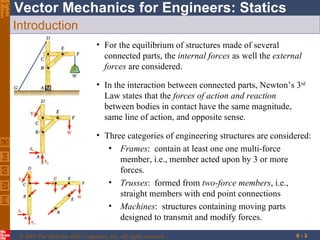
Introduction For the equilibrium of structures made of several connected parts, the  internal forces  as well the  external forces  are considered. In the interaction between connected parts, Newton’s 3 rd  Law states that the  forces of action and reaction  between bodies in contact have the same magnitude, same line of action, and opposite sense. Three categories of engineering structures are considered: Frames :  contain at least one one multi-force member, i.e., member acted upon by 3 or more forces. Trusses :  formed from  two-force members , i.e., straight members with end point connections Machines :  structures containing moving parts designed to transmit and modify forces.
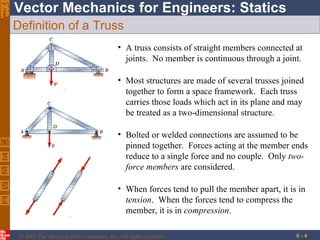
Definition of a Truss A truss consists of straight members connected at joints.  No member is continuous through a joint. Bolted or welded connections are assumed to be pinned together.  Forces acting at the member ends reduce to a single force and no couple.  Only  two-force members  are considered. Most structures are made of several trusses joined together to form a space framework.  Each truss carries those loads which act in its plane and may be treated as a two-dimensional structure. When forces tend to pull the member apart, it is in  tension .  When the forces tend to compress the member, it is in  compression .
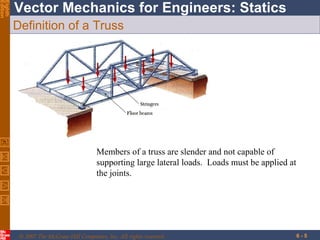
Definition of a Truss Members of a truss are slender and not capable of supporting large lateral loads.  Loads must be applied at the joints.
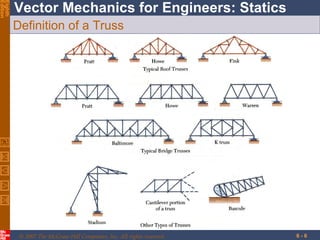
Definition of a Truss
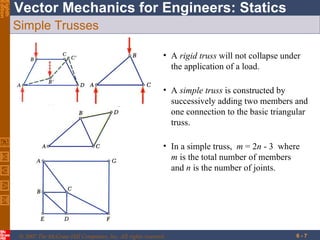
Simple Trusses In a simple truss,  m  = 2 n  - 3  where  m  is the total number of members and  n  is the number of joints. A  rigid truss  will not collapse under the application of a load. A  simple truss  is constructed by successively adding two members and one connection to the basic triangular truss.
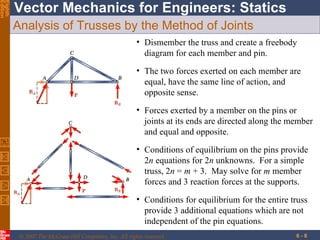
Analysis of Trusses by the Method of Joints Dismember the truss and create a freebody diagram for each member and pin. The two forces exerted on each member are equal, have the same line of action, and opposite sense. Forces exerted by a member on the pins or joints at its ends are directed along the member and equal and opposite. Conditions of equilibrium on the pins provide 2 n  equations for 2 n  unknowns.  For a simple truss, 2 n  =  m  + 3.  May solve for  m  member forces and 3 reaction forces at the supports. Conditions for equilibrium for the entire truss provide 3 additional equations which are not independent of the pin equations.
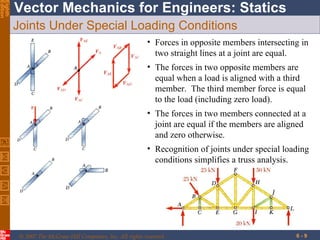
Joints Under Special Loading Conditions Forces in opposite members intersecting in two straight lines at a joint are equal. The forces in two opposite members are equal when a load is aligned with a third member.  The third member force is equal to the load (including zero load). The forces in two members connected at a joint are equal if the members are aligned and zero otherwise. Recognition of joints under special loading conditions simplifies a truss analysis.
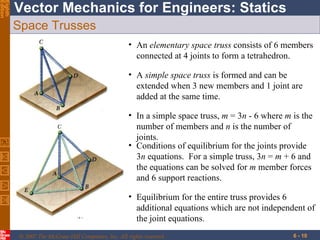
Space Trusses An  elementary space truss  consists of 6 members connected at 4 joints to form a tetrahedron. A  simple space truss  is formed and can be extended when 3 new members and 1 joint are added at the same time.  Equilibrium for the entire truss provides 6 additional equations which are not independent of the joint equations. In a simple space truss,  m  = 3 n  - 6 where  m  is the number of members and  n  is the number of joints. Conditions of equilibrium for the joints provide 3 n  equations.  For a simple truss, 3 n  =  m  + 6 and the equations can be solved for  m  member forces and 6 support reactions.
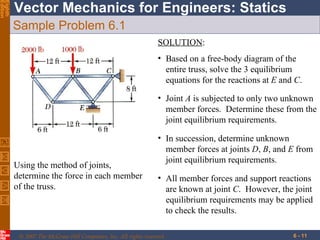
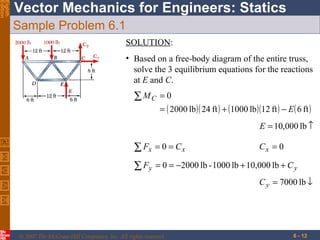
Sample Problem 6.1 Using the method of joints, determine the force in each member of the truss. SOLUTION : Based on a free-body diagram of the entire truss, solve the 3 equilibrium equations for the reactions at  E  and  C . Joint  A  is subjected to only two unknown member forces.  Determine these from the joint equilibrium requirements. In succession, determine unknown member forces at joints  D ,  B , and  E  from joint equilibrium requirements. All member forces and support reactions are known at joint  C .  However, the joint equilibrium requirements may be applied to check the results.
Sample Problem 6.1 SOLUTION : Based on a free-body diagram of the entire truss, solve the 3 equilibrium equations for the reactions at  E  and  C .
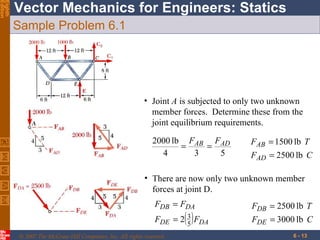
Sample Problem 6.1 Joint  A  is subjected to only two unknown member forces.  Determine these from the joint equilibrium requirements. There are now only two unknown member forces at joint D.
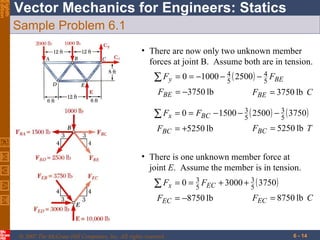
Sample Problem 6.1 There are now only two unknown member forces at joint B.  Assume both are in tension. There is one unknown member force at joint  E .  Assume the member is in tension.
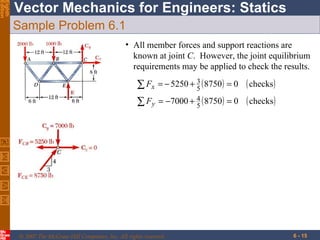
Sample Problem 6.1 All member forces and support reactions are known at joint  C .  However, the joint equilibrium requirements may be applied to check the results.
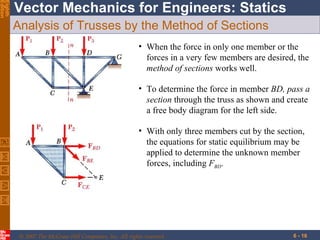
Analysis of Trusses by the Method of Sections When the force in only one member or the forces in a very few members are desired, the  method of sections  works well. With only three members cut by the section, the equations for static equilibrium may be applied to determine the unknown member forces, including  F BD . To determine the force in member  BD, pass a section  through the truss as shown and create a free body diagram for the left side.
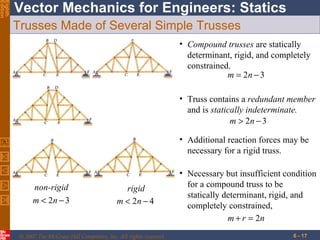
Trusses Made of Several Simple Trusses Compound trusses  are statically determinant, rigid, and completely constrained. Truss contains a  redundant member  and is  statically indeterminate.   Necessary but insufficient condition for a compound truss to be statically determinant, rigid, and completely constrained, non-rigid rigid Additional reaction forces may be necessary for a rigid truss.
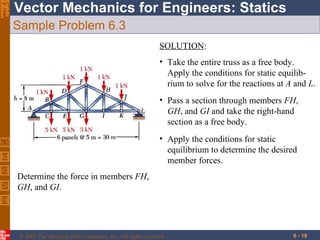
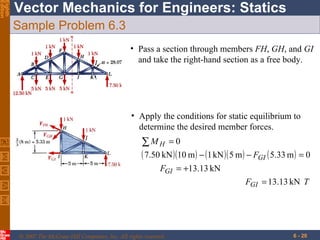
Sample Problem 6.3 Determine the force in members  FH ,  GH , and  GI . SOLUTION : Take the entire truss as a free body.  Apply the conditions for static equilib-rium to solve for the reactions at  A  and  L . Pass a section through members  FH ,  GH , and  GI  and take the right-hand section as a free body. Apply the conditions for static equilibrium to determine the desired member forces.
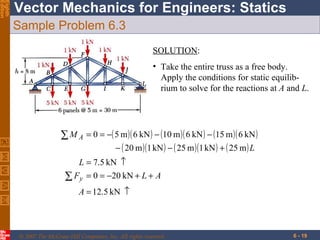
Sample Problem 6.3 SOLUTION : Take the entire truss as a free body.  Apply the conditions for static equilib-rium to solve for the reactions at  A  and  L .
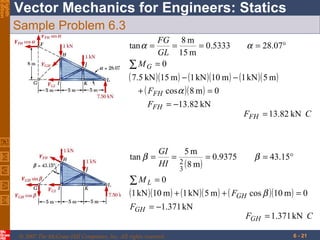
Sample Problem 6.3 Pass a section through members  FH ,  GH , and  GI  and take the right-hand section as a free body. Apply the conditions for static equilibrium to determine the desired member forces.
Sample Problem 6.3
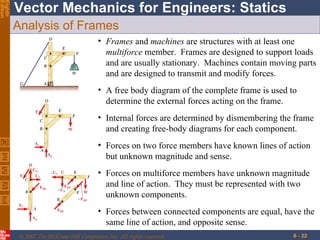
Analysis of Frames Forces between connected components are equal, have the same line of action, and opposite sense. Forces on two force members have known lines of action but unknown magnitude and sense. Forces on multiforce members have unknown magnitude and line of action.  They must be represented with two unknown components. Frames  and  machines  are structures with at least one  multiforce  member.  Frames are designed to support loads and are usually stationary.  Machines contain moving parts and are designed to transmit and modify forces. A free body diagram of the complete frame is used to determine the external forces acting on the frame. Internal forces are determined by dismembering the frame and creating free-body diagrams for each component.
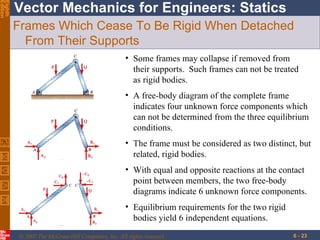
Frames Which Cease To Be Rigid When Detached From Their Supports With equal and opposite reactions at the contact point between members, the two free-body diagrams indicate 6 unknown force components. Equilibrium requirements for the two rigid bodies yield 6 independent equations. Some frames may collapse if removed from their supports.  Such frames can not be treated as rigid bodies. A free-body diagram of the complete frame indicates four unknown force components which can not be determined from the three equilibrium conditions.  The frame must be considered as two distinct, but related, rigid bodies.
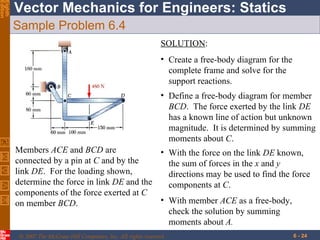
Sample Problem 6.4 Members  ACE  and  BCD  are connected by a pin at  C  and by the link  DE .  For the loading shown, determine the force in link  DE  and the components of the force exerted at  C  on member  BCD . SOLUTION : Create a free-body diagram for the complete frame and solve for the support reactions. Define a free-body diagram for member  BCD .  The force exerted by the link  DE  has a known line of action but unknown magnitude.  It is determined by summing moments about  C . With the force on the link  DE  known, the sum of forces in the  x  and  y  directions may be used to find the force  components at  C . With member  ACE  as a free-body, check the solution by summing moments about  A.
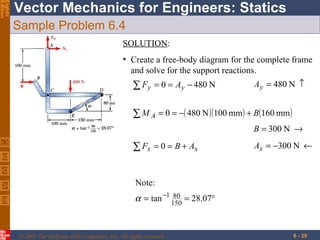
Sample Problem 6.4 SOLUTION : Create a free-body diagram for the complete frame and solve for the support reactions. Note:
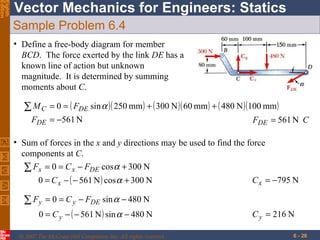
Sample Problem 6.4 Define a free-body diagram for member  BCD .  The force exerted by the link  DE  has a known line of action but unknown magnitude.  It is determined by summing moments about  C . Sum of forces in the  x  and  y  directions may be used to find the force  components at  C .
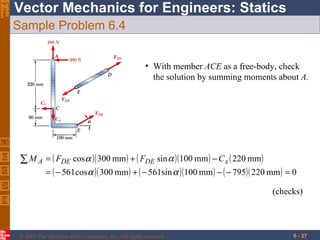
Sample Problem 6.4 With member  ACE  as a free-body, check the solution by summing moments about  A. (checks)
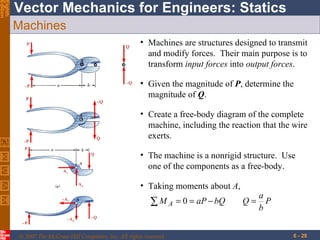
Machines Given the magnitude of  P , determine the magnitude of  Q .  Machines are structures designed to transmit and modify forces.  Their main purpose is to transform  input forces  into  output forces . Create a free-body diagram of the complete machine, including the reaction that the wire exerts. The machine is a nonrigid structure.  Use one of the components as a free-body. Taking moments about  A ,

Trusses

  • 1.
  • 2.
    Contents Introduction Definitionof a Truss Simple Trusses Analysis of Trusses by the Method of Joints Joints Under Special Loading Conditions Space Trusses Sample Problem 6.1 Analysis of Trusses by the Method of Sections Trusses Made of Several Simple Trusses Sample Problem 6.3 Analysis of Frames Frames Which Cease to be Rigid When Detached From Their Supports Sample Problem 6.4 Machines
  • 3.
    Introduction For theequilibrium of structures made of several connected parts, the internal forces as well the external forces are considered. In the interaction between connected parts, Newton’s 3 rd Law states that the forces of action and reaction between bodies in contact have the same magnitude, same line of action, and opposite sense. Three categories of engineering structures are considered: Frames : contain at least one one multi-force member, i.e., member acted upon by 3 or more forces. Trusses : formed from two-force members , i.e., straight members with end point connections Machines : structures containing moving parts designed to transmit and modify forces.
  • 4.
    Definition of aTruss A truss consists of straight members connected at joints. No member is continuous through a joint. Bolted or welded connections are assumed to be pinned together. Forces acting at the member ends reduce to a single force and no couple. Only two-force members are considered. Most structures are made of several trusses joined together to form a space framework. Each truss carries those loads which act in its plane and may be treated as a two-dimensional structure. When forces tend to pull the member apart, it is in tension . When the forces tend to compress the member, it is in compression .
  • 5.
    Definition of aTruss Members of a truss are slender and not capable of supporting large lateral loads. Loads must be applied at the joints.
  • 6.
  • 7.
    Simple Trusses Ina simple truss, m = 2 n - 3 where m is the total number of members and n is the number of joints. A rigid truss will not collapse under the application of a load. A simple truss is constructed by successively adding two members and one connection to the basic triangular truss.
  • 8.
    Analysis of Trussesby the Method of Joints Dismember the truss and create a freebody diagram for each member and pin. The two forces exerted on each member are equal, have the same line of action, and opposite sense. Forces exerted by a member on the pins or joints at its ends are directed along the member and equal and opposite. Conditions of equilibrium on the pins provide 2 n equations for 2 n unknowns. For a simple truss, 2 n = m + 3. May solve for m member forces and 3 reaction forces at the supports. Conditions for equilibrium for the entire truss provide 3 additional equations which are not independent of the pin equations.
  • 9.
    Joints Under SpecialLoading Conditions Forces in opposite members intersecting in two straight lines at a joint are equal. The forces in two opposite members are equal when a load is aligned with a third member. The third member force is equal to the load (including zero load). The forces in two members connected at a joint are equal if the members are aligned and zero otherwise. Recognition of joints under special loading conditions simplifies a truss analysis.
  • 10.
    Space Trusses An elementary space truss consists of 6 members connected at 4 joints to form a tetrahedron. A simple space truss is formed and can be extended when 3 new members and 1 joint are added at the same time. Equilibrium for the entire truss provides 6 additional equations which are not independent of the joint equations. In a simple space truss, m = 3 n - 6 where m is the number of members and n is the number of joints. Conditions of equilibrium for the joints provide 3 n equations. For a simple truss, 3 n = m + 6 and the equations can be solved for m member forces and 6 support reactions.
  • 11.
    Sample Problem 6.1Using the method of joints, determine the force in each member of the truss. SOLUTION : Based on a free-body diagram of the entire truss, solve the 3 equilibrium equations for the reactions at E and C . Joint A is subjected to only two unknown member forces. Determine these from the joint equilibrium requirements. In succession, determine unknown member forces at joints D , B , and E from joint equilibrium requirements. All member forces and support reactions are known at joint C . However, the joint equilibrium requirements may be applied to check the results.
  • 12.
    Sample Problem 6.1SOLUTION : Based on a free-body diagram of the entire truss, solve the 3 equilibrium equations for the reactions at E and C .
  • 13.
    Sample Problem 6.1Joint A is subjected to only two unknown member forces. Determine these from the joint equilibrium requirements. There are now only two unknown member forces at joint D.
  • 14.
    Sample Problem 6.1There are now only two unknown member forces at joint B. Assume both are in tension. There is one unknown member force at joint E . Assume the member is in tension.
  • 15.
    Sample Problem 6.1All member forces and support reactions are known at joint C . However, the joint equilibrium requirements may be applied to check the results.
  • 16.
    Analysis of Trussesby the Method of Sections When the force in only one member or the forces in a very few members are desired, the method of sections works well. With only three members cut by the section, the equations for static equilibrium may be applied to determine the unknown member forces, including F BD . To determine the force in member BD, pass a section through the truss as shown and create a free body diagram for the left side.
  • 17.
    Trusses Made ofSeveral Simple Trusses Compound trusses are statically determinant, rigid, and completely constrained. Truss contains a redundant member and is statically indeterminate. Necessary but insufficient condition for a compound truss to be statically determinant, rigid, and completely constrained, non-rigid rigid Additional reaction forces may be necessary for a rigid truss.
  • 18.
    Sample Problem 6.3Determine the force in members FH , GH , and GI . SOLUTION : Take the entire truss as a free body. Apply the conditions for static equilib-rium to solve for the reactions at A and L . Pass a section through members FH , GH , and GI and take the right-hand section as a free body. Apply the conditions for static equilibrium to determine the desired member forces.
  • 19.
    Sample Problem 6.3SOLUTION : Take the entire truss as a free body. Apply the conditions for static equilib-rium to solve for the reactions at A and L .
  • 20.
    Sample Problem 6.3Pass a section through members FH , GH , and GI and take the right-hand section as a free body. Apply the conditions for static equilibrium to determine the desired member forces.
  • 21.
  • 22.
    Analysis of FramesForces between connected components are equal, have the same line of action, and opposite sense. Forces on two force members have known lines of action but unknown magnitude and sense. Forces on multiforce members have unknown magnitude and line of action. They must be represented with two unknown components. Frames and machines are structures with at least one multiforce member. Frames are designed to support loads and are usually stationary. Machines contain moving parts and are designed to transmit and modify forces. A free body diagram of the complete frame is used to determine the external forces acting on the frame. Internal forces are determined by dismembering the frame and creating free-body diagrams for each component.
  • 23.
    Frames Which CeaseTo Be Rigid When Detached From Their Supports With equal and opposite reactions at the contact point between members, the two free-body diagrams indicate 6 unknown force components. Equilibrium requirements for the two rigid bodies yield 6 independent equations. Some frames may collapse if removed from their supports. Such frames can not be treated as rigid bodies. A free-body diagram of the complete frame indicates four unknown force components which can not be determined from the three equilibrium conditions. The frame must be considered as two distinct, but related, rigid bodies.
  • 24.
    Sample Problem 6.4Members ACE and BCD are connected by a pin at C and by the link DE . For the loading shown, determine the force in link DE and the components of the force exerted at C on member BCD . SOLUTION : Create a free-body diagram for the complete frame and solve for the support reactions. Define a free-body diagram for member BCD . The force exerted by the link DE has a known line of action but unknown magnitude. It is determined by summing moments about C . With the force on the link DE known, the sum of forces in the x and y directions may be used to find the force components at C . With member ACE as a free-body, check the solution by summing moments about A.
  • 25.
    Sample Problem 6.4SOLUTION : Create a free-body diagram for the complete frame and solve for the support reactions. Note:
  • 26.
    Sample Problem 6.4Define a free-body diagram for member BCD . The force exerted by the link DE has a known line of action but unknown magnitude. It is determined by summing moments about C . Sum of forces in the x and y directions may be used to find the force components at C .
  • 27.
    Sample Problem 6.4With member ACE as a free-body, check the solution by summing moments about A. (checks)
  • 28.
    Machines Given themagnitude of P , determine the magnitude of Q . Machines are structures designed to transmit and modify forces. Their main purpose is to transform input forces into output forces . Create a free-body diagram of the complete machine, including the reaction that the wire exerts. The machine is a nonrigid structure. Use one of the components as a free-body. Taking moments about A ,