Physical properties of chemicals
& separation and purification
methods
SHARDA PUBLIC SCHOOL, ALMORA
Presentation by:
Dr. Tanuja Nautiyal
Department of Chemistry
Sharda Public School
Almora
SHARDA PUBLIC SCHOOL,
ALMORA
Physical Properties
 Each organic compound has certain physical and chemical
properties.
 some of the important physical properties of organic
compounds are:
 Melting point,
 Boiling point,
 Density,
 Solubility
SHARDA PUBLIC SCHOOL,
ALMORA
Melting Point
Melting point for an organic substance is the
temperature, at which it changes from solid state to
liquid state.
This temperature is also referred to as freezing point at
which a compound changes its state from liquid to
solid.
SHARDA PUBLIC SCHOOL,
ALMORA
Melting Point
Melting point determinations have importance in various
applications. Such as:
 Making a comparison with the literature data to observe the
same temperature.
 Having a very rough idea on the purity of a substance (there
are much more available and accurate methods applied to
decide it).
SHARDA PUBLIC SCHOOL,
ALMORA
There are lots of factors that affect the melting point. The
chemical structure is the main factor.
 Melting points are higher for higher molecular weight
compounds.
 Impurities decrease the melting point. ice-salt mixtures , Salt
and soil , Ethylene glycol.
 Intramolecular and, in particular intermolecular forces, such as
H-bonds, dipole-dipole interactions increase the melting point.
Factors affect the Melting Point
SHARDA PUBLIC SCHOOL,
ALMORA
 Loosing symmetry decreases the chance of intermolecular
interactions. Solid state formation is deeply affected through
the possibility of interaction among molecules.
 Therefore, loosing symmetry, in particular through branching
lowers the melting point.
 Trans isomers are more stable than cis isomers, therefore they
have higher melting points.
Factors affect the Melting Point
SHARDA PUBLIC SCHOOL,
ALMORA
Measuring the Melting Point
Old Fashion Model SHARDA PUBLIC SCHOOL,
ALMORA
New fashion model
Measuring the Melting Point
SHARDA PUBLIC SCHOOL,
ALMORA
Boiling Point
 Boiling point for an organic substance is the
temperature at which it changes from liquid state to
gas (vapor) state. The vapor pressure of a liquid is
also equal to the pressure of the current environment
at its boiling point temperature.
SHARDA PUBLIC SCHOOL,
ALMORA
Factors affecting the Boiling Point
 The lower atmospheric pressure: the lower the
boiling point
 There are structural aspects having effect on boiling
point:
 Higher molecular weight ---higher boiling point
 Intermolecular and intra-molecular interaction
 Hydrogen bonding, Dipole-dipole interaction, Vander
wals forces, Impurities, Branching; increase boiling
point
SHARDA PUBLIC SCHOOL,
ALMORA
Density
 A density of a substance is calculated by dividing its
weight to its volume.
 The unit generally employed for density is gm/mL or
gm/cm3.
SHARDA PUBLIC SCHOOL,
ALMORA
 Pressure
 Temperature
 Polar groups
 Molecular weight
 Branching
 Double and triple bonds
Factors affecting the Density
SHARDA PUBLIC SCHOOL,
ALMORA
Measurement of Density
 By using Pycnometers
SHARDA PUBLIC SCHOOL,
ALMORA
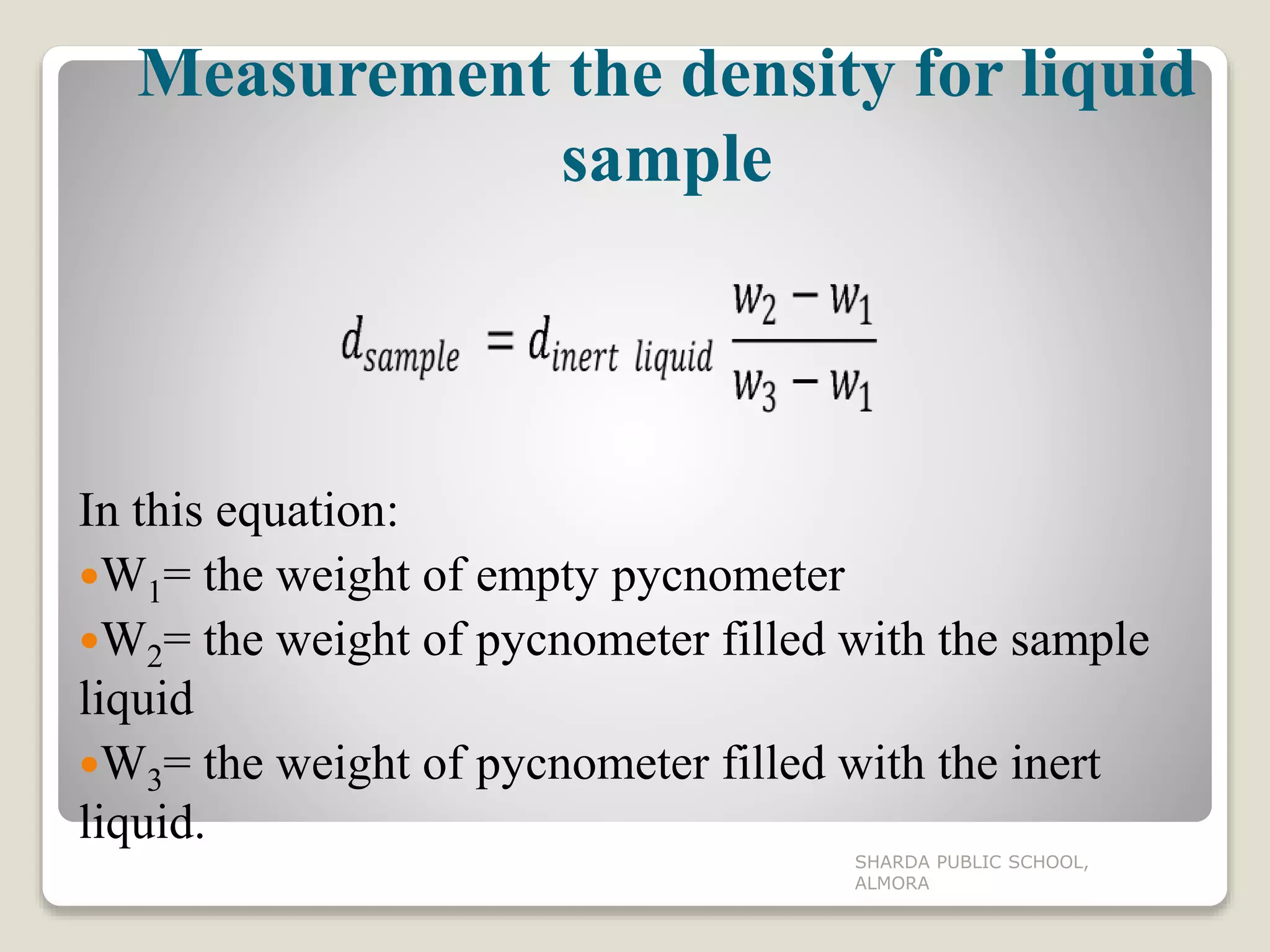
In this equation:
W1= the weight of empty pycnometer
W2= the weight of pycnometer filled with the sample
liquid
W3= the weight of pycnometer filled with the inert
liquid.
Measurement the density for liquid
sample
SHARDA PUBLIC SCHOOL,
ALMORA
Measuring the density for solid sample
In this equation;
w1 = the weight of pycnometer filled with the inert
liquid.
w2 = the weight of empty pycnometer.
w3 = the weight of pycnometer added a little
amount of solid sample.
w4 = the weight of inert liquid filled w3.SHARDA PUBLIC SCHOOL,
ALMORA
Solubility
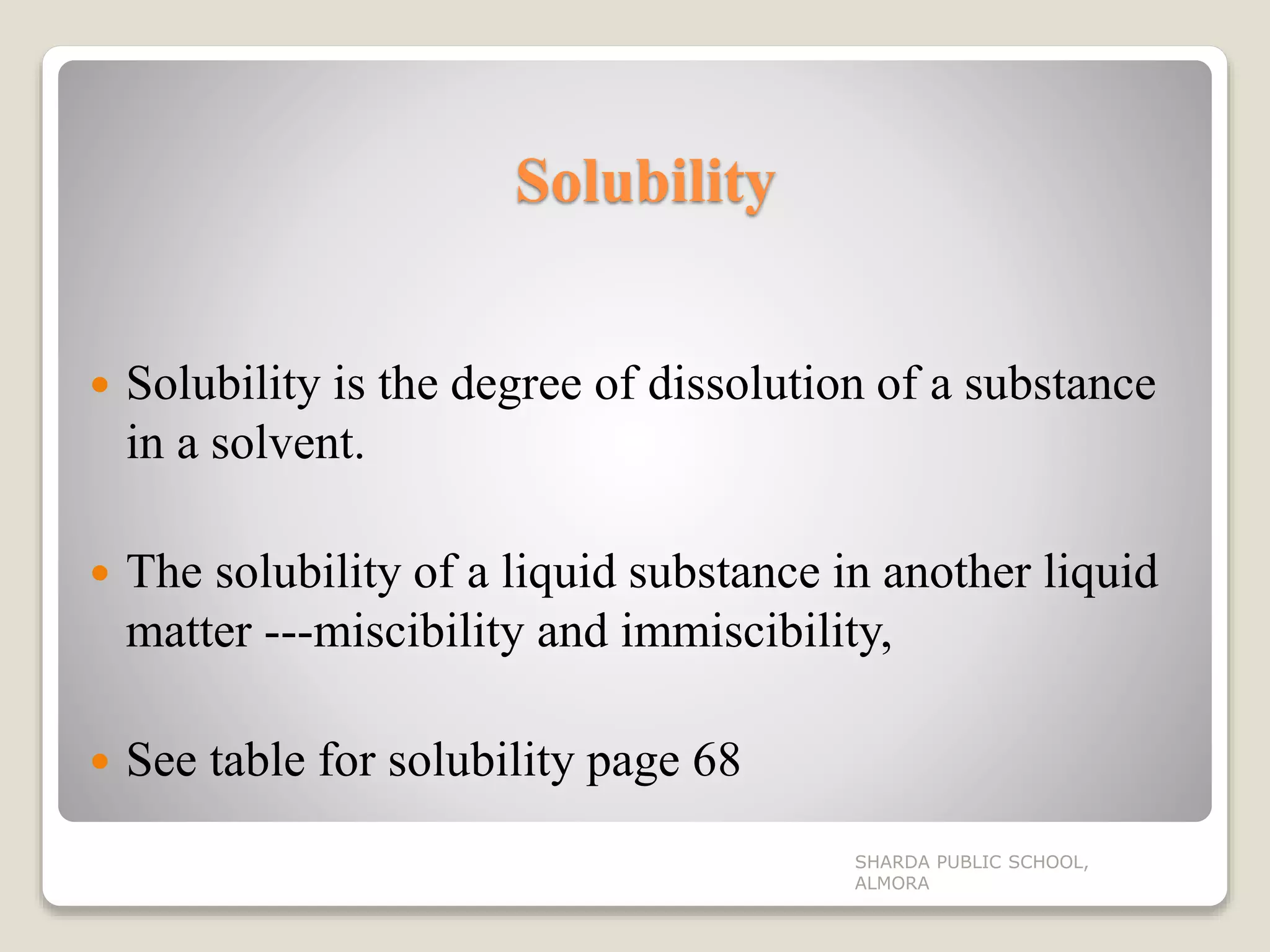
 Solubility is the degree of dissolution of a substance
in a solvent.
 The solubility of a liquid substance in another liquid
matter ---miscibility and immiscibility,
 See table for solubility page 68
SHARDA PUBLIC SCHOOL,
ALMORA
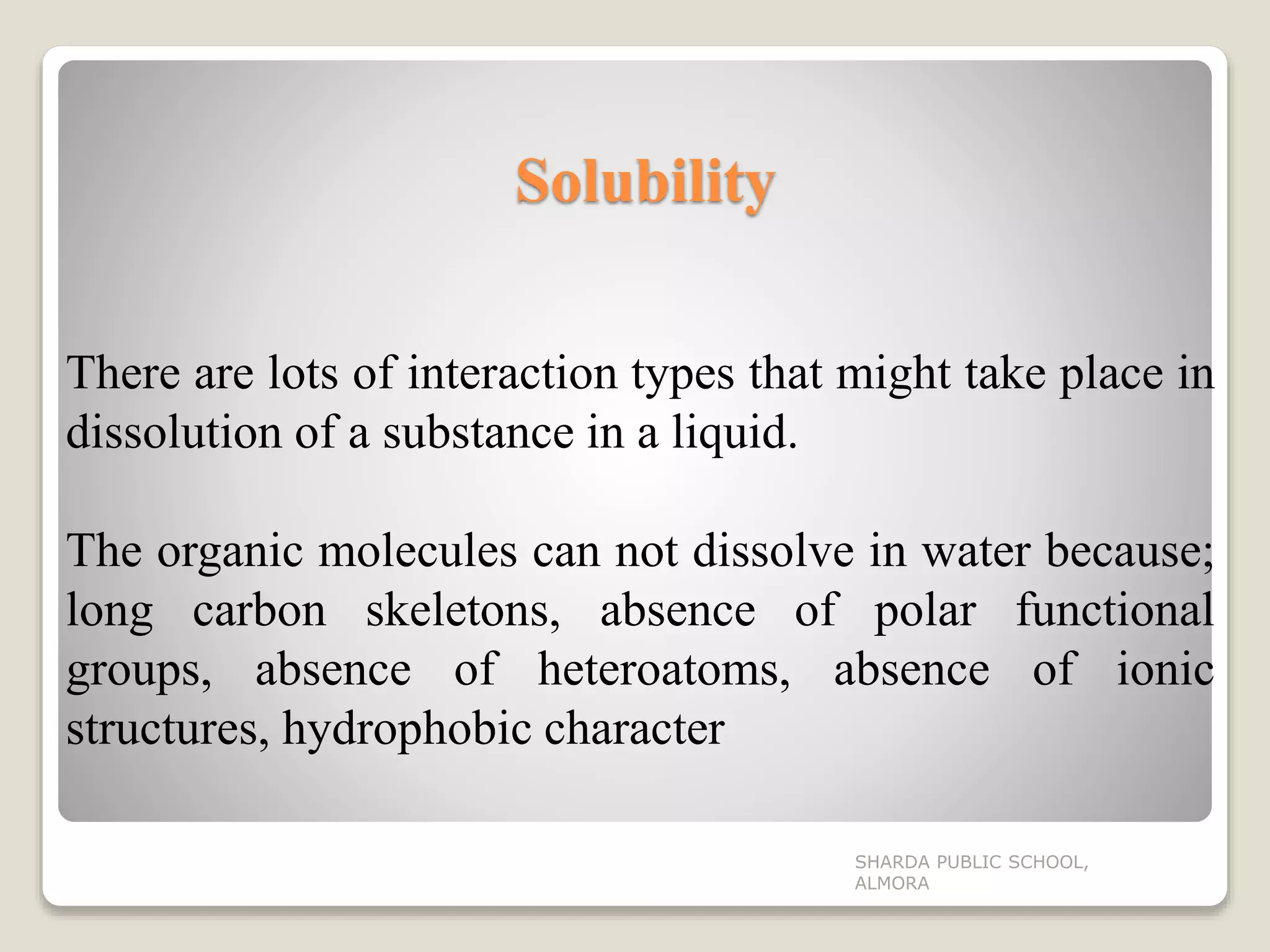
There are lots of interaction types that might take place in
dissolution of a substance in a liquid.
The organic molecules can not dissolve in water because;
long carbon skeletons, absence of polar functional
groups, absence of heteroatoms, absence of ionic
structures, hydrophobic character
Solubility
SHARDA PUBLIC SCHOOL,
ALMORA
like dissolves like
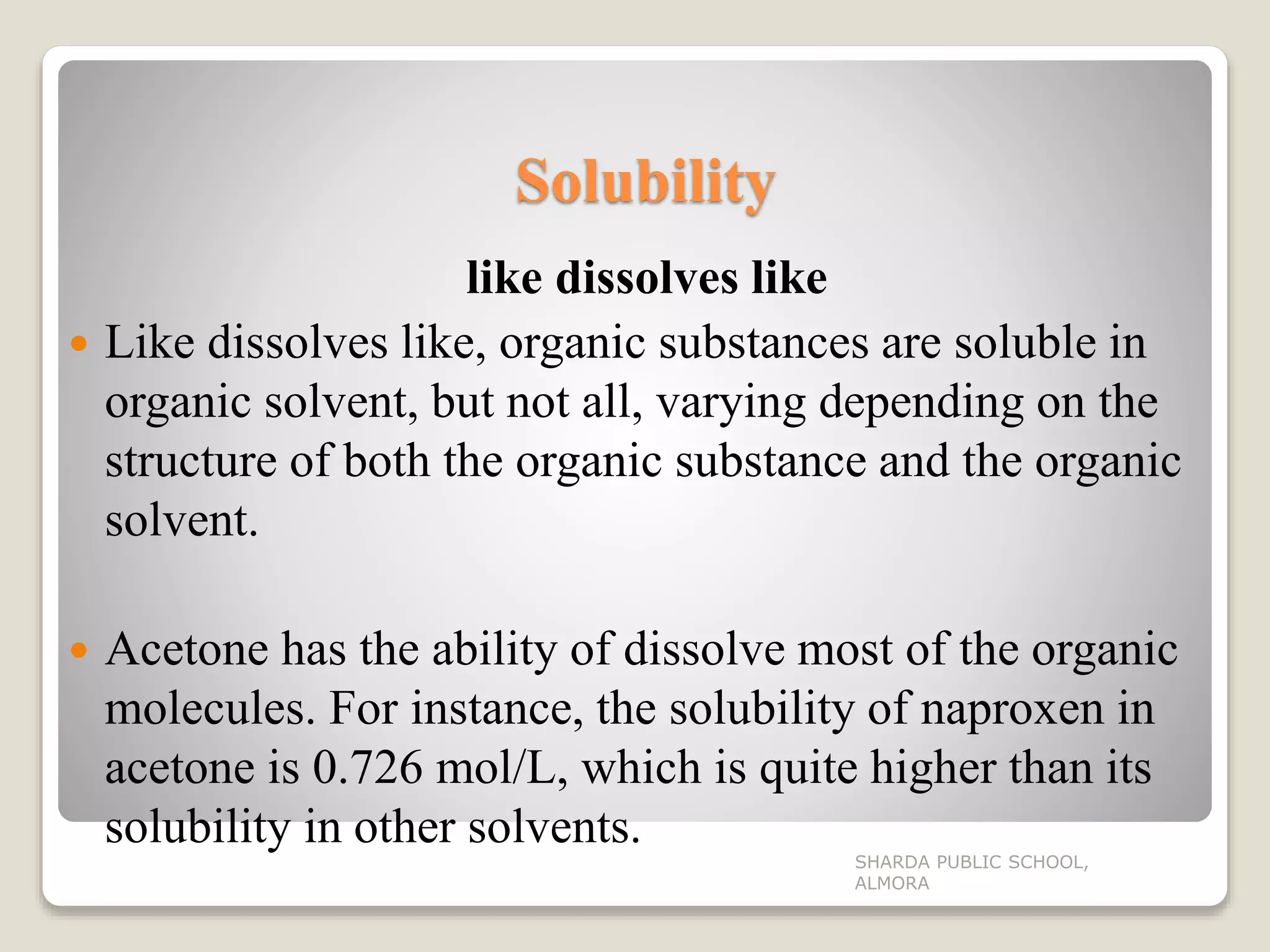
 Like dissolves like, organic substances are soluble in
organic solvent, but not all, varying depending on the
structure of both the organic substance and the organic
solvent.
 Acetone has the ability of dissolve most of the organic
molecules. For instance, the solubility of naproxen in
acetone is 0.726 mol/L, which is quite higher than its
solubility in other solvents.
Solubility
SHARDA PUBLIC SCHOOL,
ALMORA
 The acidic or basic property of substances is
measured in terms of pH.
 It is a measurement of the hydrogen ion
concentration.
 pH is defined as the negative logarithm
(base 10) of hydrogen ion concentration.
pH of a Solution
SHARDA PUBLIC SCHOOL,
ALMORA
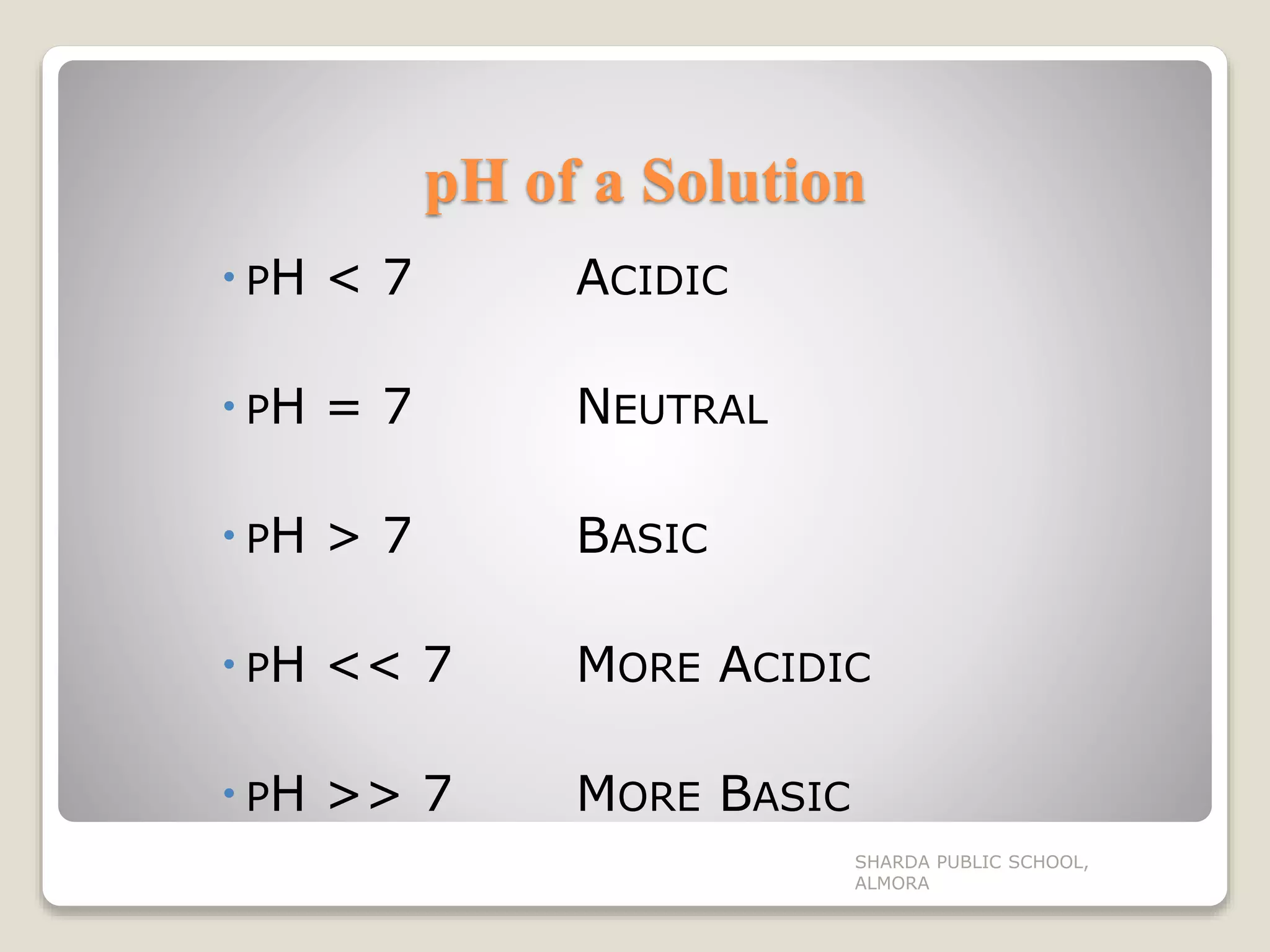
 PH < 7 ACIDIC
 PH = 7 NEUTRAL
 PH > 7 BASIC
 PH << 7 MORE ACIDIC
 PH >> 7 MORE BASIC
pH of a Solution
SHARDA PUBLIC SCHOOL,
ALMORA
pH
Henderson-Hasselbach equation:
pH = pKa + log ([A-] / [HA])
•pH = pka; the concentration of ionized and non-ionized forms are
equal
•pH > pKa---the concentration of ionized >non-ionized forms
•pH < pKa---the concentration of ionized <non-ionized forms
Carboxylic acid ---pKa=4-5
HA, PH=7 more than 99 % A-
If an organic molecule is insoluble in a liquid, it precipitates.
precipitation and dissolution might be evaluated as opposite actionsSHARDA PUBLIC SCHOOL,
ALMORA
Miscibility
 Miscibility of organic solvents is quite important.
 For instance; Some reactions utilize more than one organic
solvent to conduct a reaction as reagents or to increase the
solubility.
 Some work-up and purification studies also require the
employment of more than one solvent.
SHARDA PUBLIC SCHOOL,
ALMORA
Partition Coefficient
Organic compound has different solubility in different organic
solvents have applications in various experiments.
Partition coefficient is the ratio of concentration of an organic
molecule in two immiscible organic solvents. The organic
compound must be at unionized (neutral). It is important to adjust
the pH that guarantees the non-ionized state of a molecule.
SHARDA PUBLIC SCHOOL,
ALMORA
Partition Coefficient
SHARDA PUBLIC SCHOOL,
ALMORA
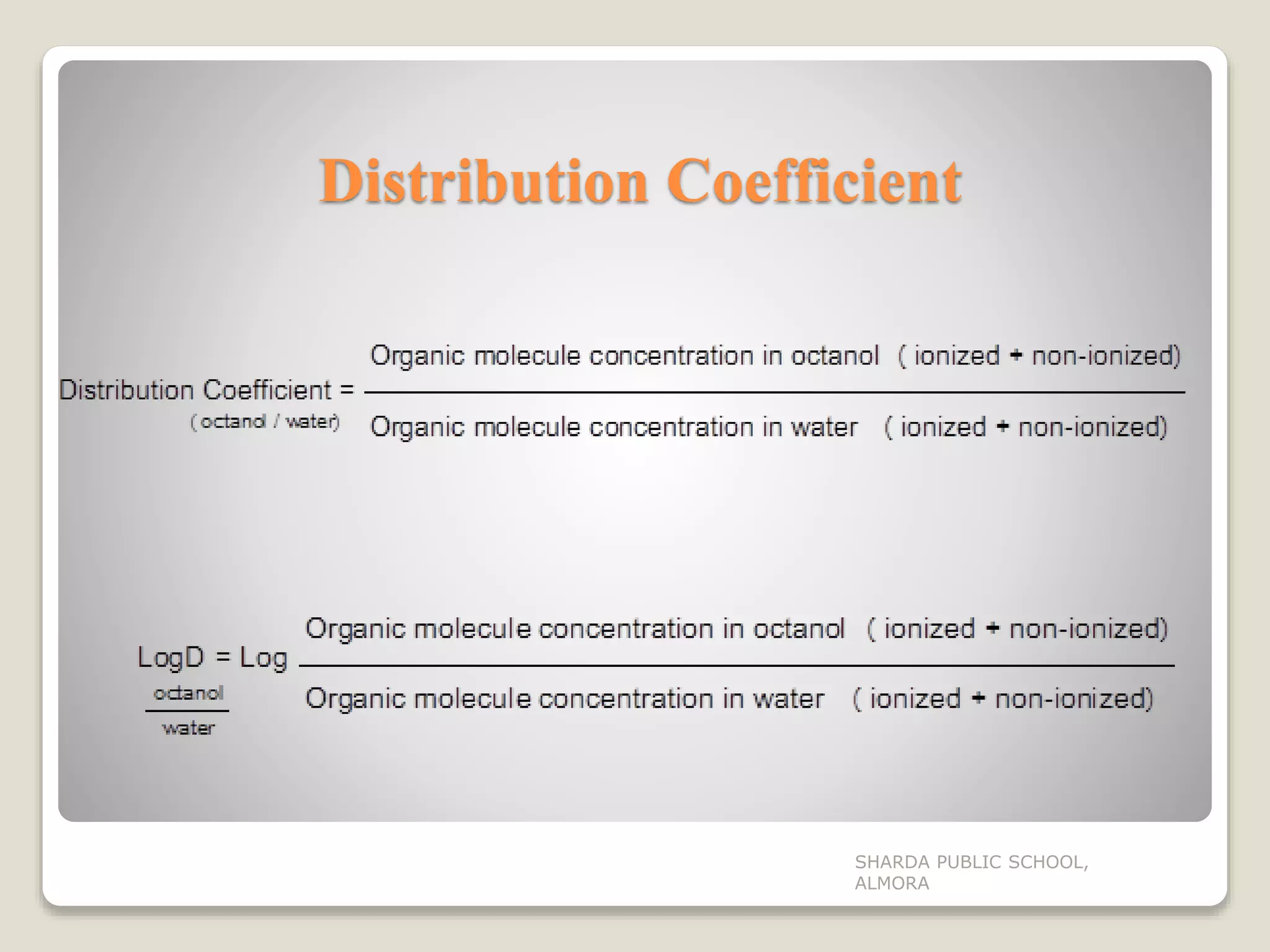
Distribution Coefficient
SHARDA PUBLIC SCHOOL,
ALMORA
Application of Distribution Coefficient
Solubility in water and lipid systems are both required for a
drug molecule to pass through different biological fluid systems
to reach to its active site.
In general, a Log(Partition coefficient) value in 3-5 range is one of
those drug-likely parameters that shows a good criteria for a
drug candidate molecule. Chloroform is sometimes used as an
alternative to n-octanol.
SHARDA PUBLIC SCHOOL,
ALMORA
Polar groups, groups tend to make Hydrogen bonds,
ionic bonds definitely trigger solubility in aqueous
systems, therefore resulting in low Log(Partition coefficient)
values relatively.
In contrast, lacking of those structural features and
abundance of hydrophobic groups creating london -
london forces positively affect lipophilicity and high
Log(Partition coefficient) values.
Application of Distribution Coefficient
SHARDA PUBLIC SCHOOL,
ALMORA
Methods of Purification
Extraction
Filtration
Distillation
Crystallization
SHARDA PUBLIC SCHOOL,
ALMORA
Extraction
Extraction is a separation technique.
Types of Extraction:
• Solid-liquid Extractions:
Solid liquid extractions simple aims to extract the
material from a solid mixture into a liquid.
• Liquid-liquid Extractions:
Liquid-liquid extractions employ the solubility
difference of an organic compound in two
immiscible liquids.
SHARDA PUBLIC SCHOOL,
ALMORA
Extraction depends on several factors:
• Solubility in two immiscible solvents
• Temperature
• The amount of each solvent used
Factors affect the Extraction
SHARDA PUBLIC SCHOOL,
ALMORA
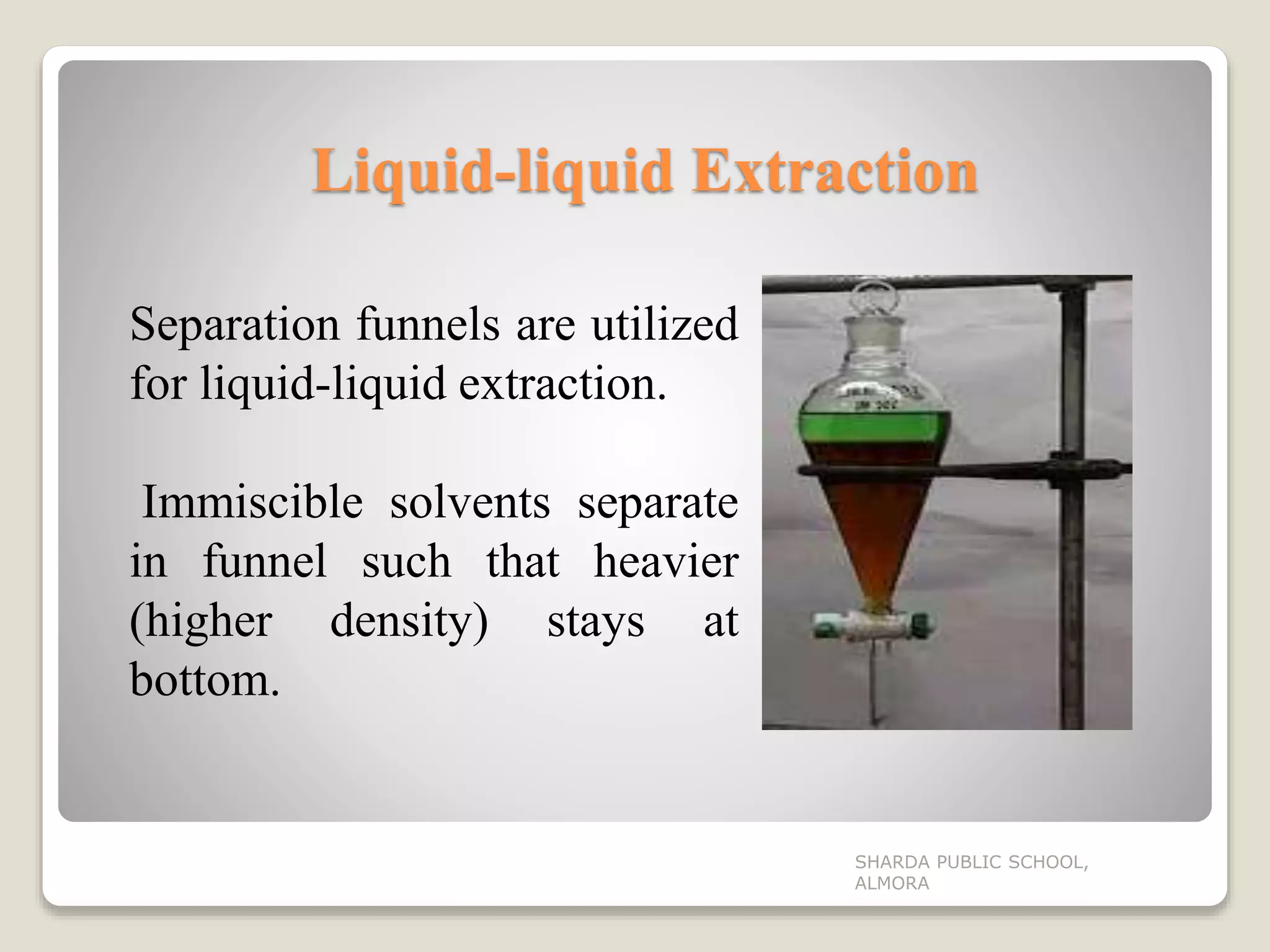
Separation funnels are utilized
for liquid-liquid extraction.
Immiscible solvents separate
in funnel such that heavier
(higher density) stays at
bottom.
Liquid-liquid Extraction
SHARDA PUBLIC SCHOOL,
ALMORA
Liquid-liquid Extraction
SHARDA PUBLIC SCHOOL,
ALMORA
After the extraction process, in general, the organic
phase is evaporated to gain the organic compound.
In practice, most of the organic solvents have the ability
to dissolve some amount of water as well. The amount
of water transferred into organic phase changes
depending on the organic solvent used. Anhydrous
sodium sulfate, and anhydrous magnesium sulfate,
anhydrous calcium chloride, anhydrous cupper sulfate,
and anhydrous calcium sulfate
Drying of liquid
SHARDA PUBLIC SCHOOL,
ALMORA
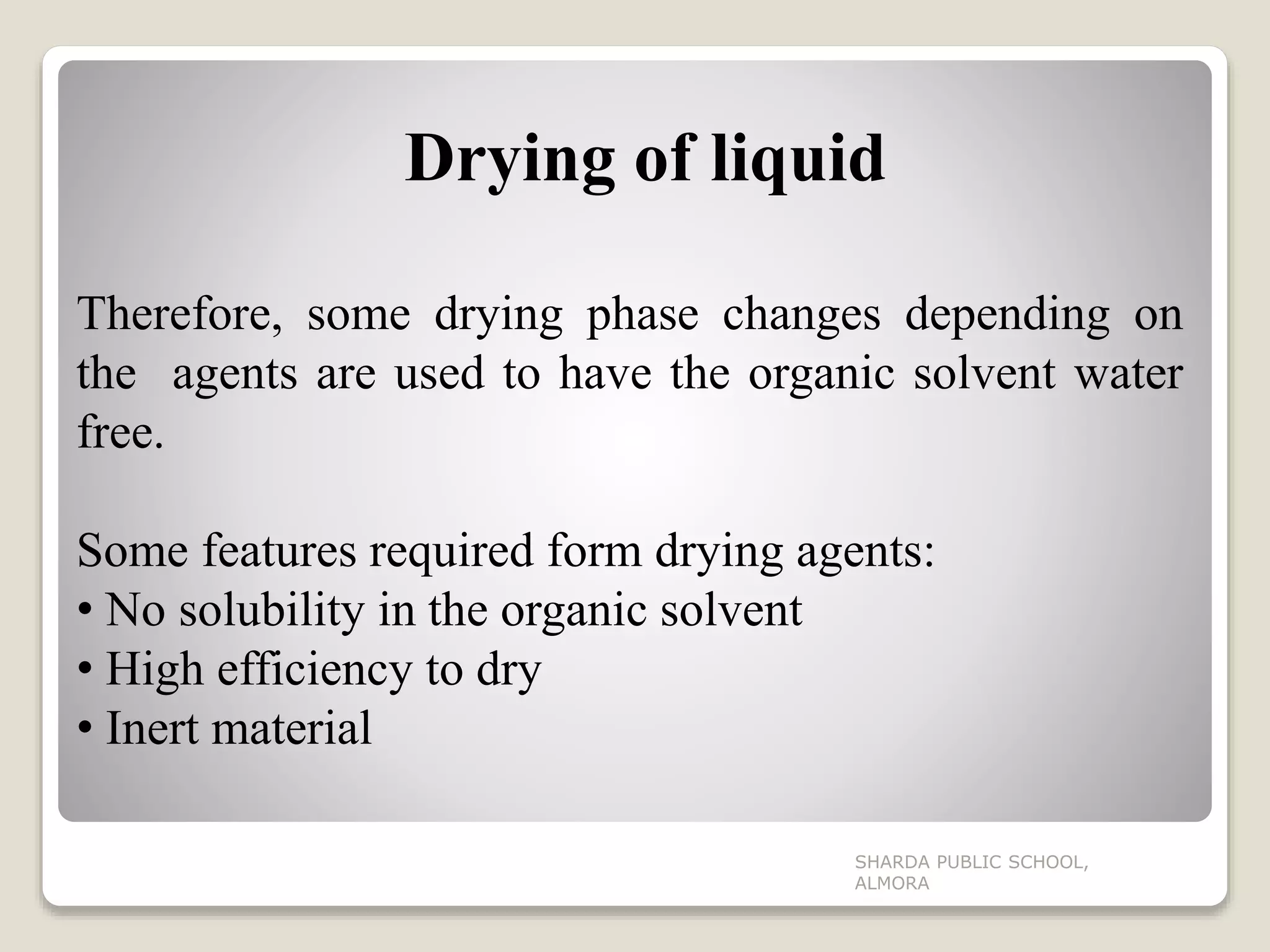
Therefore, some drying phase changes depending on
the agents are used to have the organic solvent water
free.
Some features required form drying agents:
• No solubility in the organic solvent
• High efficiency to dry
• Inert material
Drying of liquid
SHARDA PUBLIC SCHOOL,
ALMORA
Filtration
Filtration is one of the most applied processes in
organic and pharmaceutical chemistry practices.
In general, filtration is categorized into two groups;
1. Gravity filtration
2. Vacuum filtration
SHARDA PUBLIC SCHOOL,
ALMORA
Gravity Filtration Method
Gravity filtration is the
simple form of
filtration.
Requirement: Funnel,
Filtration paper and a
Erlenmeyer..
SHARDA PUBLIC SCHOOL,
ALMORA
Vacuum Filtration
Vacuum filtration is much faster than gravity
filtration. The only difference is the employing of
vacuum as a deriving force for filtration.
SHARDA PUBLIC SCHOOL,
ALMORA
Distillation
Distillation is an old-known separation and purification
technique, particularly applied for liquids.
It is based on a system consisting of both heating and
cooling units.
SHARDA PUBLIC SCHOOL,
ALMORA
Distillation
SHARDA PUBLIC SCHOOL,
ALMORA
Fractional Distillation
Liquids that have different boiling points and do not
make azeotrope mixtures can be separated
employing the fractional distillation technique. The
difference of fractional distillation from the simple
distillation is the employment of fractional
condenser.
SHARDA PUBLIC SCHOOL,
ALMORA
Fractional Distillation
SHARDA PUBLIC SCHOOL,
ALMORA
During the separation, some liquids can form
azeotropes. The boiling point of the azeotropes might
be lower or higher than the boiling point of each
components of the azeotrope mixture.
For example: For instance, 96% ethanol boils at around
78.3 ºC which is lower than the boiling points of water
and ethanol, 100 ºC, and 78.8 ºC, respectively. Due to
the formation of azeotrope, technically it is not possible
to separate ethanol-water mixture employing fractional
distillation. In such a case, another solvent is added to
break down the azeotrope, such as benzene addition to
ethanol-water mixture.
Azeotropes
SHARDA PUBLIC SCHOOL,
ALMORA
Steam Distillation
This type of distillation is especially for those liquids,
that have high boiling points and decompose at high
temperatures less than their boiling point.
The steam distillation system applies the in-situ
generation of steam and applying it directly onto the
material to activate it for distillation.
SHARDA PUBLIC SCHOOL,
ALMORA
Steam Distillation
SHARDA PUBLIC SCHOOL,
ALMORA
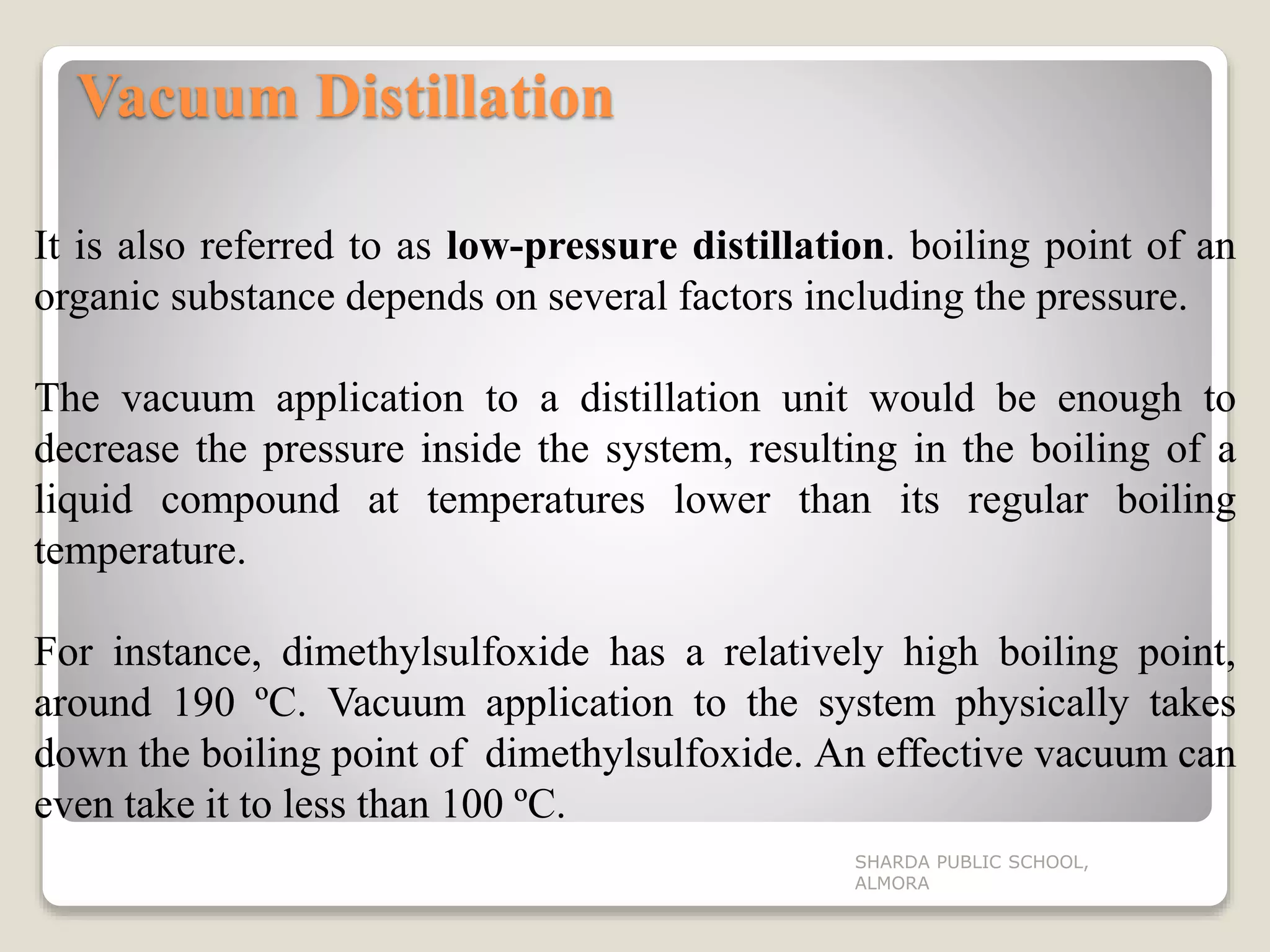
Vacuum Distillation
It is also referred to as low-pressure distillation. boiling point of an
organic substance depends on several factors including the pressure.
The vacuum application to a distillation unit would be enough to
decrease the pressure inside the system, resulting in the boiling of a
liquid compound at temperatures lower than its regular boiling
temperature.
For instance, dimethylsulfoxide has a relatively high boiling point,
around 190 ºC. Vacuum application to the system physically takes
down the boiling point of dimethylsulfoxide. An effective vacuum can
even take it to less than 100 ºC.
SHARDA PUBLIC SCHOOL,
ALMORA
Low-pressure Distillation
SHARDA PUBLIC SCHOOL,
ALMORA
Crystallization
Crystallization is one of the oldest purification
techniques applied for solid organic compounds. It has
these stages of a continuous process summarized below:
• Dissolution
• Hot filtration
• Crystallization
• Filtration of crystal
• Drying of crystal SHARDA PUBLIC SCHOOL,
ALMORA
Steps of Crystallization
SHARDA PUBLIC SCHOOL,
ALMORA
Crystallization
•The overall technique simply relies on the dissolution of
an organic compound in the presence of impurities in a
hot organic solvent concomitant with its crystallization in
the same solvent during the cooling down of the organic
solvent.
•A crystal lattice is perfectly ordered for the same type of
molecules. Therefore, crystals physically chemically
tends to form between the same type of molecules. This
also means that impurities are excluded from the crystal
lattice. SHARDA PUBLIC SCHOOL,
ALMORA
Crystallization
Salt Chemical formula Shapes of crystals
Potash alum K2SO4.Al2(SO4)3.24H2O Octahedral
Blue vitriol CuSO4.5H2O Triclinic
Green vitriol FeSO4. 7H2O Monoclinic
Sodium chloride NaCl Cubic
Potassium nitrate KNO3 Rhombic
Washing soda Na2CO3.10H2O Monoclinic
SHARDA PUBLIC SCHOOL,
ALMORA
Dr. Tanuja Nautiyal
Department of Chemistry
Sharda Public School
SHARDA PUBLIC SCHOOL,
ALMORA

Separation and Purification of organic compounds

  • 1.
    Physical properties ofchemicals & separation and purification methods SHARDA PUBLIC SCHOOL, ALMORA
  • 2.
    Presentation by: Dr. TanujaNautiyal Department of Chemistry Sharda Public School Almora SHARDA PUBLIC SCHOOL, ALMORA
  • 3.
    Physical Properties  Eachorganic compound has certain physical and chemical properties.  some of the important physical properties of organic compounds are:  Melting point,  Boiling point,  Density,  Solubility SHARDA PUBLIC SCHOOL, ALMORA
  • 4.
    Melting Point Melting pointfor an organic substance is the temperature, at which it changes from solid state to liquid state. This temperature is also referred to as freezing point at which a compound changes its state from liquid to solid. SHARDA PUBLIC SCHOOL, ALMORA
  • 5.
    Melting Point Melting pointdeterminations have importance in various applications. Such as:  Making a comparison with the literature data to observe the same temperature.  Having a very rough idea on the purity of a substance (there are much more available and accurate methods applied to decide it). SHARDA PUBLIC SCHOOL, ALMORA
  • 6.
    There are lotsof factors that affect the melting point. The chemical structure is the main factor.  Melting points are higher for higher molecular weight compounds.  Impurities decrease the melting point. ice-salt mixtures , Salt and soil , Ethylene glycol.  Intramolecular and, in particular intermolecular forces, such as H-bonds, dipole-dipole interactions increase the melting point. Factors affect the Melting Point SHARDA PUBLIC SCHOOL, ALMORA
  • 7.
     Loosing symmetrydecreases the chance of intermolecular interactions. Solid state formation is deeply affected through the possibility of interaction among molecules.  Therefore, loosing symmetry, in particular through branching lowers the melting point.  Trans isomers are more stable than cis isomers, therefore they have higher melting points. Factors affect the Melting Point SHARDA PUBLIC SCHOOL, ALMORA
  • 8.
    Measuring the MeltingPoint Old Fashion Model SHARDA PUBLIC SCHOOL, ALMORA
  • 9.
    New fashion model Measuringthe Melting Point SHARDA PUBLIC SCHOOL, ALMORA
  • 10.
    Boiling Point  Boilingpoint for an organic substance is the temperature at which it changes from liquid state to gas (vapor) state. The vapor pressure of a liquid is also equal to the pressure of the current environment at its boiling point temperature. SHARDA PUBLIC SCHOOL, ALMORA
  • 11.
    Factors affecting theBoiling Point  The lower atmospheric pressure: the lower the boiling point  There are structural aspects having effect on boiling point:  Higher molecular weight ---higher boiling point  Intermolecular and intra-molecular interaction  Hydrogen bonding, Dipole-dipole interaction, Vander wals forces, Impurities, Branching; increase boiling point SHARDA PUBLIC SCHOOL, ALMORA
  • 12.
    Density  A densityof a substance is calculated by dividing its weight to its volume.  The unit generally employed for density is gm/mL or gm/cm3. SHARDA PUBLIC SCHOOL, ALMORA
  • 13.
     Pressure  Temperature Polar groups  Molecular weight  Branching  Double and triple bonds Factors affecting the Density SHARDA PUBLIC SCHOOL, ALMORA
  • 14.
    Measurement of Density By using Pycnometers SHARDA PUBLIC SCHOOL, ALMORA
  • 15.
    In this equation: W1=the weight of empty pycnometer W2= the weight of pycnometer filled with the sample liquid W3= the weight of pycnometer filled with the inert liquid. Measurement the density for liquid sample SHARDA PUBLIC SCHOOL, ALMORA
  • 16.
    Measuring the densityfor solid sample In this equation; w1 = the weight of pycnometer filled with the inert liquid. w2 = the weight of empty pycnometer. w3 = the weight of pycnometer added a little amount of solid sample. w4 = the weight of inert liquid filled w3.SHARDA PUBLIC SCHOOL, ALMORA
  • 17.
    Solubility  Solubility isthe degree of dissolution of a substance in a solvent.  The solubility of a liquid substance in another liquid matter ---miscibility and immiscibility,  See table for solubility page 68 SHARDA PUBLIC SCHOOL, ALMORA
  • 18.
    There are lotsof interaction types that might take place in dissolution of a substance in a liquid. The organic molecules can not dissolve in water because; long carbon skeletons, absence of polar functional groups, absence of heteroatoms, absence of ionic structures, hydrophobic character Solubility SHARDA PUBLIC SCHOOL, ALMORA
  • 19.
    like dissolves like Like dissolves like, organic substances are soluble in organic solvent, but not all, varying depending on the structure of both the organic substance and the organic solvent.  Acetone has the ability of dissolve most of the organic molecules. For instance, the solubility of naproxen in acetone is 0.726 mol/L, which is quite higher than its solubility in other solvents. Solubility SHARDA PUBLIC SCHOOL, ALMORA
  • 20.
     The acidicor basic property of substances is measured in terms of pH.  It is a measurement of the hydrogen ion concentration.  pH is defined as the negative logarithm (base 10) of hydrogen ion concentration. pH of a Solution SHARDA PUBLIC SCHOOL, ALMORA
  • 21.
     PH <7 ACIDIC  PH = 7 NEUTRAL  PH > 7 BASIC  PH << 7 MORE ACIDIC  PH >> 7 MORE BASIC pH of a Solution SHARDA PUBLIC SCHOOL, ALMORA
  • 22.
    pH Henderson-Hasselbach equation: pH =pKa + log ([A-] / [HA]) •pH = pka; the concentration of ionized and non-ionized forms are equal •pH > pKa---the concentration of ionized >non-ionized forms •pH < pKa---the concentration of ionized <non-ionized forms Carboxylic acid ---pKa=4-5 HA, PH=7 more than 99 % A- If an organic molecule is insoluble in a liquid, it precipitates. precipitation and dissolution might be evaluated as opposite actionsSHARDA PUBLIC SCHOOL, ALMORA
  • 23.
    Miscibility  Miscibility oforganic solvents is quite important.  For instance; Some reactions utilize more than one organic solvent to conduct a reaction as reagents or to increase the solubility.  Some work-up and purification studies also require the employment of more than one solvent. SHARDA PUBLIC SCHOOL, ALMORA
  • 24.
    Partition Coefficient Organic compoundhas different solubility in different organic solvents have applications in various experiments. Partition coefficient is the ratio of concentration of an organic molecule in two immiscible organic solvents. The organic compound must be at unionized (neutral). It is important to adjust the pH that guarantees the non-ionized state of a molecule. SHARDA PUBLIC SCHOOL, ALMORA
  • 25.
  • 26.
  • 27.
    Application of DistributionCoefficient Solubility in water and lipid systems are both required for a drug molecule to pass through different biological fluid systems to reach to its active site. In general, a Log(Partition coefficient) value in 3-5 range is one of those drug-likely parameters that shows a good criteria for a drug candidate molecule. Chloroform is sometimes used as an alternative to n-octanol. SHARDA PUBLIC SCHOOL, ALMORA
  • 28.
    Polar groups, groupstend to make Hydrogen bonds, ionic bonds definitely trigger solubility in aqueous systems, therefore resulting in low Log(Partition coefficient) values relatively. In contrast, lacking of those structural features and abundance of hydrophobic groups creating london - london forces positively affect lipophilicity and high Log(Partition coefficient) values. Application of Distribution Coefficient SHARDA PUBLIC SCHOOL, ALMORA
  • 29.
  • 30.
    Extraction Extraction is aseparation technique. Types of Extraction: • Solid-liquid Extractions: Solid liquid extractions simple aims to extract the material from a solid mixture into a liquid. • Liquid-liquid Extractions: Liquid-liquid extractions employ the solubility difference of an organic compound in two immiscible liquids. SHARDA PUBLIC SCHOOL, ALMORA
  • 31.
    Extraction depends onseveral factors: • Solubility in two immiscible solvents • Temperature • The amount of each solvent used Factors affect the Extraction SHARDA PUBLIC SCHOOL, ALMORA
  • 32.
    Separation funnels areutilized for liquid-liquid extraction. Immiscible solvents separate in funnel such that heavier (higher density) stays at bottom. Liquid-liquid Extraction SHARDA PUBLIC SCHOOL, ALMORA
  • 33.
  • 34.
    After the extractionprocess, in general, the organic phase is evaporated to gain the organic compound. In practice, most of the organic solvents have the ability to dissolve some amount of water as well. The amount of water transferred into organic phase changes depending on the organic solvent used. Anhydrous sodium sulfate, and anhydrous magnesium sulfate, anhydrous calcium chloride, anhydrous cupper sulfate, and anhydrous calcium sulfate Drying of liquid SHARDA PUBLIC SCHOOL, ALMORA
  • 35.
    Therefore, some dryingphase changes depending on the agents are used to have the organic solvent water free. Some features required form drying agents: • No solubility in the organic solvent • High efficiency to dry • Inert material Drying of liquid SHARDA PUBLIC SCHOOL, ALMORA
  • 36.
    Filtration Filtration is oneof the most applied processes in organic and pharmaceutical chemistry practices. In general, filtration is categorized into two groups; 1. Gravity filtration 2. Vacuum filtration SHARDA PUBLIC SCHOOL, ALMORA
  • 37.
    Gravity Filtration Method Gravityfiltration is the simple form of filtration. Requirement: Funnel, Filtration paper and a Erlenmeyer.. SHARDA PUBLIC SCHOOL, ALMORA
  • 38.
    Vacuum Filtration Vacuum filtrationis much faster than gravity filtration. The only difference is the employing of vacuum as a deriving force for filtration. SHARDA PUBLIC SCHOOL, ALMORA
  • 39.
    Distillation Distillation is anold-known separation and purification technique, particularly applied for liquids. It is based on a system consisting of both heating and cooling units. SHARDA PUBLIC SCHOOL, ALMORA
  • 40.
  • 41.
    Fractional Distillation Liquids thathave different boiling points and do not make azeotrope mixtures can be separated employing the fractional distillation technique. The difference of fractional distillation from the simple distillation is the employment of fractional condenser. SHARDA PUBLIC SCHOOL, ALMORA
  • 42.
  • 43.
    During the separation,some liquids can form azeotropes. The boiling point of the azeotropes might be lower or higher than the boiling point of each components of the azeotrope mixture. For example: For instance, 96% ethanol boils at around 78.3 ºC which is lower than the boiling points of water and ethanol, 100 ºC, and 78.8 ºC, respectively. Due to the formation of azeotrope, technically it is not possible to separate ethanol-water mixture employing fractional distillation. In such a case, another solvent is added to break down the azeotrope, such as benzene addition to ethanol-water mixture. Azeotropes SHARDA PUBLIC SCHOOL, ALMORA
  • 44.
    Steam Distillation This typeof distillation is especially for those liquids, that have high boiling points and decompose at high temperatures less than their boiling point. The steam distillation system applies the in-situ generation of steam and applying it directly onto the material to activate it for distillation. SHARDA PUBLIC SCHOOL, ALMORA
  • 45.
  • 46.
    Vacuum Distillation It isalso referred to as low-pressure distillation. boiling point of an organic substance depends on several factors including the pressure. The vacuum application to a distillation unit would be enough to decrease the pressure inside the system, resulting in the boiling of a liquid compound at temperatures lower than its regular boiling temperature. For instance, dimethylsulfoxide has a relatively high boiling point, around 190 ºC. Vacuum application to the system physically takes down the boiling point of dimethylsulfoxide. An effective vacuum can even take it to less than 100 ºC. SHARDA PUBLIC SCHOOL, ALMORA
  • 47.
  • 48.
    Crystallization Crystallization is oneof the oldest purification techniques applied for solid organic compounds. It has these stages of a continuous process summarized below: • Dissolution • Hot filtration • Crystallization • Filtration of crystal • Drying of crystal SHARDA PUBLIC SCHOOL, ALMORA
  • 49.
    Steps of Crystallization SHARDAPUBLIC SCHOOL, ALMORA
  • 50.
    Crystallization •The overall techniquesimply relies on the dissolution of an organic compound in the presence of impurities in a hot organic solvent concomitant with its crystallization in the same solvent during the cooling down of the organic solvent. •A crystal lattice is perfectly ordered for the same type of molecules. Therefore, crystals physically chemically tends to form between the same type of molecules. This also means that impurities are excluded from the crystal lattice. SHARDA PUBLIC SCHOOL, ALMORA
  • 51.
    Crystallization Salt Chemical formulaShapes of crystals Potash alum K2SO4.Al2(SO4)3.24H2O Octahedral Blue vitriol CuSO4.5H2O Triclinic Green vitriol FeSO4. 7H2O Monoclinic Sodium chloride NaCl Cubic Potassium nitrate KNO3 Rhombic Washing soda Na2CO3.10H2O Monoclinic SHARDA PUBLIC SCHOOL, ALMORA
  • 52.
    Dr. Tanuja Nautiyal Departmentof Chemistry Sharda Public School SHARDA PUBLIC SCHOOL, ALMORA

Editor's Notes

  • #13 For instance, the density of water slightly starts to go down at temperatures higher or lower than 4°C. However, the reference density data available through various web sources for chemicals indicate the density points measured at 20°C.
  • #14 For instance, the density of water slightly starts to go down at temperatures higher or lower than 4°C. However, the reference density data available through various web sources for chemicals indicate the density points measured at 20°C.
  • #15 The Pycnometer used must be clean and dried effectively. If the sample is a solid, the liquid employed with a known density must be inert. What that means is that there should not be any reaction between the sample and the known liquid. In addition, the sample should not be dissolved in the inert liquid.
  • #18 organic molecules are not soluble in water. The simple reason is the hydrophobic character. Long Carbon skeletons, absence of polar functional groups, absence of heteroatoms, and in particular absence of ionic structure
  • #25 Liophilicity, liophobic, hydrophilicity, hydrophobisity
  • #26 Liophilicity, liophobic, hydrophilicity, hydrophobisity
  • #27 LogD=Log
  • #28 LogD=Log
  • #31 In general, an aqueous and a water immiscible organic solvent, quenching of most of the organic reactions through addition of water
  • #37 If the liquid is required after filtration process, it is important to fold the circular filtration paper for 6-7 times. The aim is to increase the filtration surface area on the filtration paper. On the other hand, just folding the circular filtration paper for 2 times would be enough if the solid is required following the filtration process
  • #38 If the liquid is required after filtration process, it is important to fold the circular filtration paper for 6-7 times. The aim is to increase the filtration surface area on the filtration paper. On the other hand, just folding the circular filtration paper for 2 times would be enough if the solid is required following the filtration process
  • #42 the fractionating column allows high boiling point liquid condense in this segment and return back to the round-bottom flask, whereas the low boiling point liquid can reach up to the condenser.
  • #43 the fractionating column allows high boiling point liquid condense in this segment and return back to the round-bottom flask, whereas the low boiling point liquid can reach up to the condenser.
  • #45 Physically, a compound, exposed to steam, boils at temperatures lower than its regular boiling point. This occurs due to the cumulative effect of steam coming from the generated steam and the steam of the material itself. A final condenser is also added to the system to collect the condensed material in mixture with the liquid form of the in-situ generated steam. In general, water is used to generate the in-situ steam.
  • #46 Physically, a compound, exposed to steam, boils at temperatures lower than its regular boiling point. This occurs due to the cumulative effect of steam coming from the generated steam and the steam of the material itself. A final condenser is also added to the system to collect the condensed material in mixture with the liquid form of the in-situ generated steam. In general, water is used to generate the in-situ steam.