Biogeochemical
Cycles
MADE BY: DEEPANSHU & HARIKANT
PROJECT GUIDE: DR. TANUJA NAUTIYAL
DEPT OF CHEMISTRY
NORTHERN INDIA ENGINEERING
COLLEGE
Biogeochemical Cycles
Describe The Flow Of
Essential Elements From
The Environment Through
Living Organisms And
Back Into The
Environment.
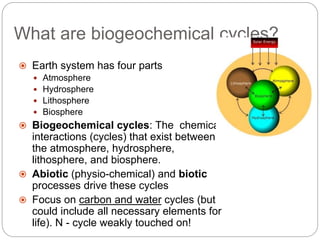
What are biogeochemical cycles?
 Earth system has four parts
 Atmosphere
 Hydrosphere
 Lithosphere
 Biosphere
 Biogeochemical cycles: The chemical
interactions (cycles) that exist between
the atmosphere, hydrosphere,
lithosphere, and biosphere.
 Abiotic (physio-chemical) and biotic
processes drive these cycles
 Focus on carbon and water cycles (but
could include all necessary elements for
life). N - cycle weakly touched on!
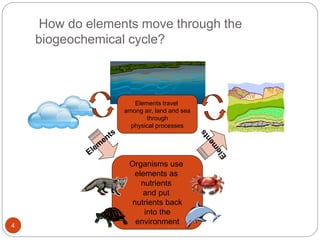
How do elements move through the
biogeochemical cycle?
4
Organisms use
elements as
nutrients
and put
nutrients back
into the
environment
Elements travel
among air, land and sea
through
physical processes
Types Of Biogeochemical Cycles
Different types of
biogeochemical cycles are as
follows :
Hydrological cycle
Carbon cycle
Nitrogen cycle
Phosphorus cycle
Transformations
Examples of Transformations
1. Carbon cycle: Organic compounds to CO2
(processes: respiration, decomposition, or fire)
2. Carbon cycle: CO2 to organic compounds (process:
photosynthesis)
3. Nitrogen cycle: N2 to NO3 (atmospheric nitrogen to
plant utilizable nitrate) (process: N-fixation)
4. Nitrogen cycle: N2 to NH3 (plant utilizable ammonia)
(process: Haber-Bosch Industrial N-fixation)
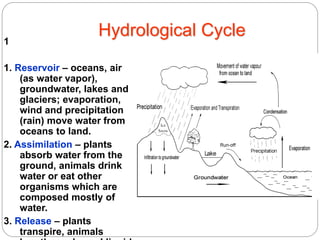
5. Water cycle: Liquid water to water vapor (process:
evaporation and evapo-transpiration)
6. Water cycle: Water vapor to liquid water (process:
condensation)
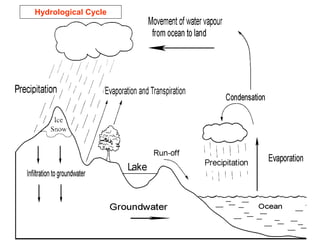
Hydrological Cycle
Hydrological Cycle1
1. Reservoir – oceans, air
(as water vapor),
groundwater, lakes and
glaciers; evaporation,
wind and precipitation
(rain) move water from
oceans to land.
2. Assimilation – plants
absorb water from the
ground, animals drink
water or eat other
organisms which are
composed mostly of
water.
3. Release – plants
transpire, animals
Carbon Cycle
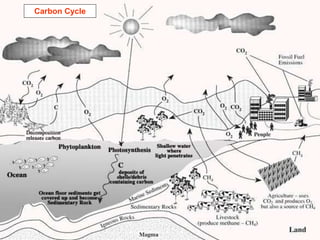
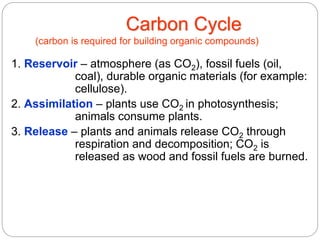
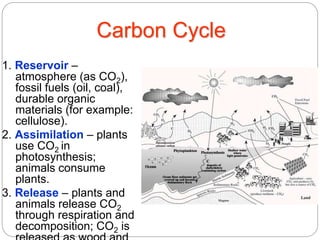
Carbon Cycle
(carbon is required for building organic compounds)
1. Reservoir – atmosphere (as CO2), fossil fuels (oil,
coal), durable organic materials (for example:
cellulose).
2. Assimilation – plants use CO2 in photosynthesis;
animals consume plants.
3. Release – plants and animals release CO2 through
respiration and decomposition; CO2 is
released as wood and fossil fuels are burned.
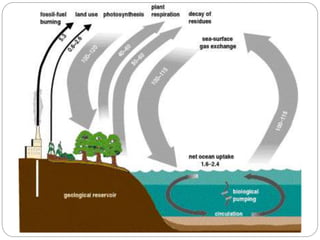
Carbon Cycle
1. Reservoir –
atmosphere (as CO2),
fossil fuels (oil, coal),
durable organic
materials (for example:
cellulose).
2. Assimilation – plants
use CO2 in
photosynthesis;
animals consume
plants.
3. Release – plants and
animals release CO2
through respiration and
decomposition; CO2 is
Carbon Cycle : Key
Points
 Carbon is the skeleton of all life.
 Carbon dioxide is a critical gas:
 Taken up by plants in photosynthesis
 Released by plants and animals in respiration
 Released during decomposition (and fires)
 Greenhouse gas (greenhouse effect - your car in the
sun)
Nitrogen Cycle
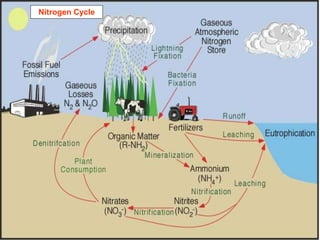
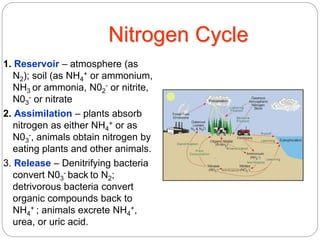
Nitrogen Cycle
1. Reservoir – atmosphere (as
N2); soil (as NH4
+ or ammonium,
NH3 or ammonia, N02
- or nitrite,
N03
- or nitrate
2. Assimilation – plants absorb
nitrogen as either NH4
+ or as
N03
-, animals obtain nitrogen by
eating plants and other animals.
3. Release – Denitrifying bacteria
convert N03
- back to N2;
detrivorous bacteria convert
organic compounds back to
NH4
+ ; animals excrete NH4
+,
urea, or uric acid.
Nitrogen Cycle: Key Points
 Nitrogen is in the atmosphere as N2 (78%)
 N2 is an inert gas and cannot be used by plants or
animals
 N2 can be converted to a usable form via
 Lightening
 N-fixing plants and cyanobacteria
 Industrial process (energy intensive)
 Nitrogen limits plant growth
 Nitrogen is easily lost from biological systems
Phosphorus Cycle
Phosphorus Cycle
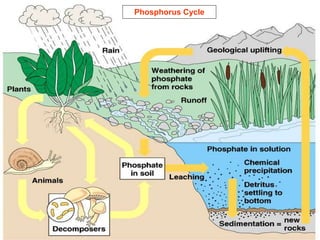
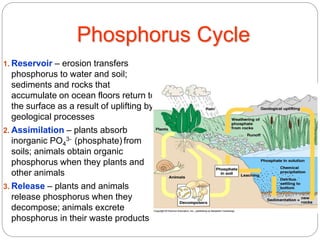
1. Reservoir – erosion transfers
phosphorus to water and soil;
sediments and rocks that
accumulate on ocean floors return to
the surface as a result of uplifting by
geological processes
2. Assimilation – plants absorb
inorganic PO4
3- (phosphate) from
soils; animals obtain organic
phosphorus when they plants and
other animals
3. Release – plants and animals
release phosphorus when they
decompose; animals excrete
phosphorus in their waste products

Biogeochemical cycles

  • 1.
    Biogeochemical Cycles MADE BY: DEEPANSHU& HARIKANT PROJECT GUIDE: DR. TANUJA NAUTIYAL DEPT OF CHEMISTRY NORTHERN INDIA ENGINEERING COLLEGE
  • 2.
    Biogeochemical Cycles Biogeochemical Cycles DescribeThe Flow Of Essential Elements From The Environment Through Living Organisms And Back Into The Environment.
  • 3.
    What are biogeochemicalcycles?  Earth system has four parts  Atmosphere  Hydrosphere  Lithosphere  Biosphere  Biogeochemical cycles: The chemical interactions (cycles) that exist between the atmosphere, hydrosphere, lithosphere, and biosphere.  Abiotic (physio-chemical) and biotic processes drive these cycles  Focus on carbon and water cycles (but could include all necessary elements for life). N - cycle weakly touched on!
  • 4.
    How do elementsmove through the biogeochemical cycle? 4 Organisms use elements as nutrients and put nutrients back into the environment Elements travel among air, land and sea through physical processes
  • 5.
    Types Of BiogeochemicalCycles Different types of biogeochemical cycles are as follows : Hydrological cycle Carbon cycle Nitrogen cycle Phosphorus cycle
  • 6.
    Transformations Examples of Transformations 1.Carbon cycle: Organic compounds to CO2 (processes: respiration, decomposition, or fire) 2. Carbon cycle: CO2 to organic compounds (process: photosynthesis) 3. Nitrogen cycle: N2 to NO3 (atmospheric nitrogen to plant utilizable nitrate) (process: N-fixation) 4. Nitrogen cycle: N2 to NH3 (plant utilizable ammonia) (process: Haber-Bosch Industrial N-fixation) 5. Water cycle: Liquid water to water vapor (process: evaporation and evapo-transpiration) 6. Water cycle: Water vapor to liquid water (process: condensation)
  • 7.
  • 8.
    Hydrological Cycle1 1. Reservoir– oceans, air (as water vapor), groundwater, lakes and glaciers; evaporation, wind and precipitation (rain) move water from oceans to land. 2. Assimilation – plants absorb water from the ground, animals drink water or eat other organisms which are composed mostly of water. 3. Release – plants transpire, animals
  • 9.
  • 10.
    Carbon Cycle (carbon isrequired for building organic compounds) 1. Reservoir – atmosphere (as CO2), fossil fuels (oil, coal), durable organic materials (for example: cellulose). 2. Assimilation – plants use CO2 in photosynthesis; animals consume plants. 3. Release – plants and animals release CO2 through respiration and decomposition; CO2 is released as wood and fossil fuels are burned.
  • 12.
    Carbon Cycle 1. Reservoir– atmosphere (as CO2), fossil fuels (oil, coal), durable organic materials (for example: cellulose). 2. Assimilation – plants use CO2 in photosynthesis; animals consume plants. 3. Release – plants and animals release CO2 through respiration and decomposition; CO2 is
  • 13.
    Carbon Cycle :Key Points  Carbon is the skeleton of all life.  Carbon dioxide is a critical gas:  Taken up by plants in photosynthesis  Released by plants and animals in respiration  Released during decomposition (and fires)  Greenhouse gas (greenhouse effect - your car in the sun)
  • 14.
  • 15.
    Nitrogen Cycle 1. Reservoir– atmosphere (as N2); soil (as NH4 + or ammonium, NH3 or ammonia, N02 - or nitrite, N03 - or nitrate 2. Assimilation – plants absorb nitrogen as either NH4 + or as N03 -, animals obtain nitrogen by eating plants and other animals. 3. Release – Denitrifying bacteria convert N03 - back to N2; detrivorous bacteria convert organic compounds back to NH4 + ; animals excrete NH4 +, urea, or uric acid.
  • 16.
    Nitrogen Cycle: KeyPoints  Nitrogen is in the atmosphere as N2 (78%)  N2 is an inert gas and cannot be used by plants or animals  N2 can be converted to a usable form via  Lightening  N-fixing plants and cyanobacteria  Industrial process (energy intensive)  Nitrogen limits plant growth  Nitrogen is easily lost from biological systems
  • 17.
  • 18.
    Phosphorus Cycle 1. Reservoir– erosion transfers phosphorus to water and soil; sediments and rocks that accumulate on ocean floors return to the surface as a result of uplifting by geological processes 2. Assimilation – plants absorb inorganic PO4 3- (phosphate) from soils; animals obtain organic phosphorus when they plants and other animals 3. Release – plants and animals release phosphorus when they decompose; animals excrete phosphorus in their waste products