



Environmental impact assessment
Submitted by:
SHUBHAM SONI, YASHVI GERA, TANMAY GAUTAM,
SIDAK (EEE Branch)
Project Guide: Dr. Tanuja Nautiyal
Department Of Chemistry
Northern India Engineering College
New Delhi
Environmental impact assessment
Environmental assessment (EA) is the
assessment of the environmental
consequences (positive and negative)
of a plan, policy, program, or concrete
projects prior to the decision to move
forward with the proposed action.
Core values of EIA
• Integrity: the EIA process should be
fair, objective, unbiased and balanced.
• Utility: the EIA process should provide
balanced, credible information for
decision making.
• Sustainability: the EIA process should
result in Environmental Safeguard.
Environmental Assessment has many
benefits:
•Protection of Environment
•Optimum utilization of resources
•Saves overall time and cost of the project •Promotes
community participation
•Informs decision makers
•Lays base for environmentally sound projects. History
& Evolution of EIA
Environmental Impact Assessment started as
a mandatory regulatory procedure originated
in the early 1970’s with the implementation of
the National Environmental Policy act (NEPA)
1969 in the US.
EIA process took off after the mid 1980’s, after
World Bank adopted EIA for major
development projects, in which borrower
country had to undertake the EIA under the
Bank’s supervision.
Now EIA is a formal process in more than 100
countries.
Environmental Clearance from central
government is required for 32 categories of
development projects – under industrial
sectors:
• Mining
• Thermal power plants
• River valley
• Infrastructure (road, highways, ports,
harbors, and airports)
• Industries including very small electroplating
in foundry units.
EIA Cycles & Procedures Environmental Impact
Assessment – Cycle & Procedure
The EIA process in India is made of the following
phases :-
• Screening
• Scoping & consideration of alternatives
• Baseline data collection
• Impact Analysis
• Mitigation and Environmental Impact statement
• Public hearing
• Environmental Management Plan
• Decision Making
• Monitoring the Clearance Condition
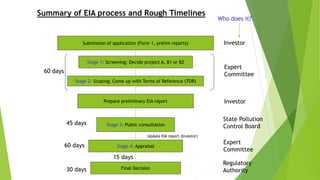
Summary of EIA process and Rough Timelines
Stage 1: Screening; Decide project A, B1 or B2
Stage 2: Scoping; Come up with Terms of Reference (TOR)
Prepare preliminary EIA report
Stage 3: Public consultation
Stage 4: Appraisal
Final Decision
Submission of application (Form 1, prelim reports)
Who does it?
Investor
Expert
Committee
Investor
State Pollution
Control Board
Expert
Committee
Regulatory
Authority
60 days
45 days
60 days
30 days
Update EIA report (Investor)
15 days
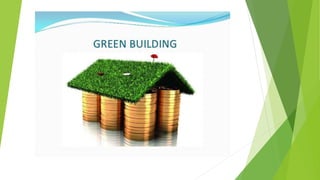
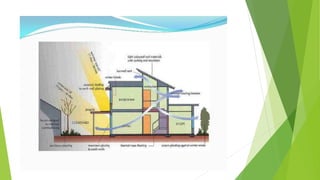
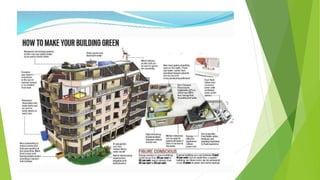
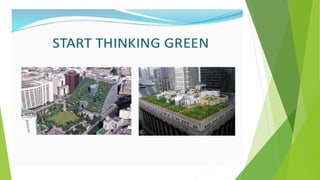
GREEN BUILDING
Refers to a structure and using process that
is environmentally responsible and resource
efficient throughout a building’s life cycle :
from sitting to design, construction,
operation, maintenance, re novation, and
demolition.
Green building – also known as sustainable
or high performance building increases the
efficiency with which buildings and their sites
use and harvest energy, water, and materials
GREEN BUILDING CONCEPT
The ‘GREEN BUILDING’ concept is gaining
importance in various countries, including
India. These are buildings that ensure waste
is minimized at every stage during the
construction and operation of the building,
resulting in low costs, according to experts in
technology.
A Green building is a structure that is
environmentally responsible and resource
efficient throughout it’s life cycle.
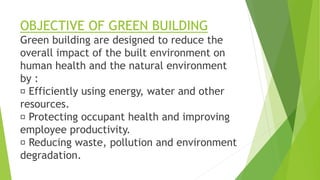
OBJECTIVE OF GREEN BUILDING
Green building are designed to reduce the
overall impact of the built environment on
human health and the natural environment
by :
Efficiently using energy, water and other
resources.
Protecting occupant health and improving
employee productivity.
Reducing waste, pollution and environment
degradation.
• Environmental friendly technology
• Conserve natural resources and the
environment – Sustainable
development
• Radical thinking to change
• Innovative technology
GOALS OF GREEN TECHNOLOGY
• Rethinking
• Recycling
• Renewing
• Reducing
• Responsibility
TYPES OF GREEN TECHNOLOGY
• GREEN ENERGY
• GREEN BUILDING
• GREEN PURCHASING
• GREEN CHEMISTRY
• GREEN NANOTECHNOLOGY
GREEN ENERGY
Reasons for the Need of Green Energy
Natural resources used in the energy
generation process is on the decline
Increasing pollution caused by the non
renewable sources
GREEN BUILDING
Hindrances
High initial cost of setting up the projects
Emerging technology, so risks involved
Doesn’t cater to the promoter’s short term
interest of profit making
Advantages
Reduces cost of operation in the long term
Consumers now more environment
conscious
GREEN NANOTECHNOLOGY
Aims to minimize potential environmental
and human health risks associated with the
manufacture and use of nanotechnology
products, and to encourage replacement of
existing products with new nano- products
that are more environmentally friendly
throughout their lifecycle.
APPLICATIONS
The use of green technology can reduce the
amount of waste and pollution and provide
early warming message that is created during
production, consumption, and impact of
natural disaster.
This special issue provides an international
forum for scientists, engineers, researchers,
technocrats, and academicians for
consolidating research activities.
WHAT CAN WE DO?
• Responsibility for the environment
• Rethinking the way we live
• Reducing Exhaustion
• Recycling Waste
• Renewing Energy
REFERENCE:-
1. Environmental Sustainability Using Green
Technologies (book by V. Sivasubramanian).
2.The Times of India articles
3.Treehugger(website)
4.Planetarc(website)
5.worldchanging(website)
6.wikipedia
THANK YOU

Environment ppt copy

  • 1.
    Environmental impact assessment Submittedby: SHUBHAM SONI, YASHVI GERA, TANMAY GAUTAM, SIDAK (EEE Branch) Project Guide: Dr. Tanuja Nautiyal Department Of Chemistry Northern India Engineering College New Delhi
  • 3.
    Environmental impact assessment Environmentalassessment (EA) is the assessment of the environmental consequences (positive and negative) of a plan, policy, program, or concrete projects prior to the decision to move forward with the proposed action.
  • 4.
    Core values ofEIA • Integrity: the EIA process should be fair, objective, unbiased and balanced. • Utility: the EIA process should provide balanced, credible information for decision making. • Sustainability: the EIA process should result in Environmental Safeguard.
  • 5.
    Environmental Assessment hasmany benefits: •Protection of Environment •Optimum utilization of resources •Saves overall time and cost of the project •Promotes community participation •Informs decision makers •Lays base for environmentally sound projects. History & Evolution of EIA
  • 6.
    Environmental Impact Assessmentstarted as a mandatory regulatory procedure originated in the early 1970’s with the implementation of the National Environmental Policy act (NEPA) 1969 in the US. EIA process took off after the mid 1980’s, after World Bank adopted EIA for major development projects, in which borrower country had to undertake the EIA under the Bank’s supervision. Now EIA is a formal process in more than 100 countries.
  • 7.
    Environmental Clearance fromcentral government is required for 32 categories of development projects – under industrial sectors: • Mining • Thermal power plants • River valley • Infrastructure (road, highways, ports, harbors, and airports) • Industries including very small electroplating in foundry units.
  • 8.
    EIA Cycles &Procedures Environmental Impact Assessment – Cycle & Procedure The EIA process in India is made of the following phases :- • Screening • Scoping & consideration of alternatives • Baseline data collection • Impact Analysis • Mitigation and Environmental Impact statement • Public hearing • Environmental Management Plan • Decision Making • Monitoring the Clearance Condition
  • 9.
    Summary of EIAprocess and Rough Timelines Stage 1: Screening; Decide project A, B1 or B2 Stage 2: Scoping; Come up with Terms of Reference (TOR) Prepare preliminary EIA report Stage 3: Public consultation Stage 4: Appraisal Final Decision Submission of application (Form 1, prelim reports) Who does it? Investor Expert Committee Investor State Pollution Control Board Expert Committee Regulatory Authority 60 days 45 days 60 days 30 days Update EIA report (Investor) 15 days
  • 11.
    GREEN BUILDING Refers toa structure and using process that is environmentally responsible and resource efficient throughout a building’s life cycle : from sitting to design, construction, operation, maintenance, re novation, and demolition. Green building – also known as sustainable or high performance building increases the efficiency with which buildings and their sites use and harvest energy, water, and materials
  • 12.
    GREEN BUILDING CONCEPT The‘GREEN BUILDING’ concept is gaining importance in various countries, including India. These are buildings that ensure waste is minimized at every stage during the construction and operation of the building, resulting in low costs, according to experts in technology. A Green building is a structure that is environmentally responsible and resource efficient throughout it’s life cycle.
  • 13.
    OBJECTIVE OF GREENBUILDING Green building are designed to reduce the overall impact of the built environment on human health and the natural environment by : Efficiently using energy, water and other resources. Protecting occupant health and improving employee productivity. Reducing waste, pollution and environment degradation.
  • 20.
    • Environmental friendlytechnology • Conserve natural resources and the environment – Sustainable development • Radical thinking to change • Innovative technology
  • 21.
    GOALS OF GREENTECHNOLOGY • Rethinking • Recycling • Renewing • Reducing • Responsibility
  • 22.
    TYPES OF GREENTECHNOLOGY • GREEN ENERGY • GREEN BUILDING • GREEN PURCHASING • GREEN CHEMISTRY • GREEN NANOTECHNOLOGY
  • 23.
    GREEN ENERGY Reasons forthe Need of Green Energy Natural resources used in the energy generation process is on the decline Increasing pollution caused by the non renewable sources
  • 24.
    GREEN BUILDING Hindrances High initialcost of setting up the projects Emerging technology, so risks involved Doesn’t cater to the promoter’s short term interest of profit making Advantages Reduces cost of operation in the long term Consumers now more environment conscious
  • 27.
    GREEN NANOTECHNOLOGY Aims tominimize potential environmental and human health risks associated with the manufacture and use of nanotechnology products, and to encourage replacement of existing products with new nano- products that are more environmentally friendly throughout their lifecycle.
  • 28.
    APPLICATIONS The use ofgreen technology can reduce the amount of waste and pollution and provide early warming message that is created during production, consumption, and impact of natural disaster. This special issue provides an international forum for scientists, engineers, researchers, technocrats, and academicians for consolidating research activities.
  • 29.
    WHAT CAN WEDO? • Responsibility for the environment • Rethinking the way we live • Reducing Exhaustion • Recycling Waste • Renewing Energy
  • 30.
    REFERENCE:- 1. Environmental SustainabilityUsing Green Technologies (book by V. Sivasubramanian). 2.The Times of India articles 3.Treehugger(website) 4.Planetarc(website) 5.worldchanging(website) 6.wikipedia
  • 31.