M.Brindha Matharasi
Topics to be dealt
 Chromatography
 TLC
 HPTLC
 HPLC
Introduction
 Separation of mixture  passed through medium  components
move at different rates
 Physico-chemical method
colour to write
 Mobile phase  mixture to be seperated
 Stationary phase  the material on which the separation takes
place can be solid, gel, or liquid
Chroma Graphein
Principle
 Various constituents of mixture  travel at different speeds 
seperates  basis  differential partitioning  M.P and S.P
 Seperation  formation of bands on S.P
 M.P  liquid or gas
 S.P  solid or liquid
History Of Chromatography
 important technique  2 Nobel prize
 Archer John Porter Martin and Richard Laurence Millington
Synge 1952  Partition Chromatography
 1906  Michael Tsvett  Russian Botanist  concept of liquid
chromatography  to purify chlorophylls from plant extracts.
FATHER OF CHROMATOGRAPHY
Plant pigments like xanthophyll, chlorophyll, carotenes.
CHROMATOGRAPHY or COLOUR WRITING
 1931  Richard Kuhn  use of this method in biologically
important materials.
 1941  British Chemists  Archer.J.P.Martin and
Richard.L.M.Synge
PARTITION CHROMATOGRAPHY
one liquid firmly attached to the granulated solid packed in a glass
tube and second immiscible with the first.
 Martin and Anthony .J.James  gas liquid partition
chromatography  moving phase could be gas.
 1940s lack of uniformity , lack of reproducibility in silica gel 
sheet of filter paper is used.
 PAPER CHROMATOGRAPHY wide application in the analysis of
biologically important compunds such as amino acids, steroids,
carbohydrates and bile pigments.
 1956  Nikolay.A.Imaylor and Maria.S.Shrayber  thin film on
the glass plate
THIN LAYER CHROMATOGRAPHY
 1944  Erika Cremer  compressed gas been used
GAS CHROMATOGRAPHY
Types of Chromatography
1) Based on physical state of both phases
homogenous  same S.P and M.P
heterogenous  different S.P and M.P
2) Based on the principle of separation used
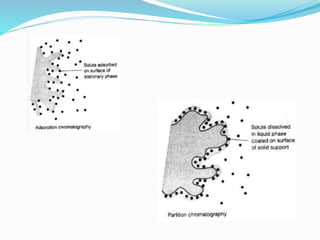
adsorption  sample gets separated due to greater
affinity to adsorb
partition  get separated due to relative differences
of dissolution and partition into different layers.
3) Based on the chemical nature of stationary phase and mobile phase
normal phase chromatography  S.P polar and M.P is non-
polar in nature.
Used in column chromatographic technique.
reverse chromatography  S.P is non-polar and M.P is polar
in nature.
Used in routine analysis as most of these substances
like drugs etc.
4) Based on shape of stationary phase
column chromatography  S.P is column in shape
widely used in HPLC, GC
planar chromatography  S.P is flat. TLC
5) Based on the purpose of chromatography experiment
preparative chromatography  injected sample is very small 
pure sample is collected.
analytical chromatography  injected sample is very small 
aimed to identify the components in the sample and individual
concentrations in the sample
6) Based on the physical or chemical characters of the S.P
size exclusion C  S.P has pores . molecules are allowed to
pass  through large to small path  under mobile phase
influence and pass through the column
ion exchange C  S.P has definite charged ions.
passed sample  retains molecules with
opposite charge  leaves molecules of same charge.
to elute  it need to pass through another
phase with similar charge to S.P is passed to recover the bond
molecules
Applications of Chromatography
1. Widely – chemical industry
2. Environmental testing – trace quantities – pesticides as DDT in
ground water.
3. Growing use of pharmaceutical industry
4. Quality control – food industry – analying additives, vitamins,
preservative, proteins, aminoacids.
5. Can – separate and detect contaminants
6. Finding drugs in urine or other body fluids – traces of flammable
chemicals in burned material
Overall available techniques for regular analysis
include
1. Column chromatography
2. HPLC
3. GC
4. Ion exchange
chromatography
5. Size exclusion
chromatography
6. TLC
7. HPTLC
8. Paper chromatography
9. Affinity chromatography
8. Paper chromatography
9. Affinity chromatography
10. LC-MS (Liquid
Chromatography with Mass
Spectroscopy)
11. GC-MS ( Gas
Chromatography with Mass
Spectroscopy)
12. Ultra High Performance
Chromatography
Thin Layer Chromatography
Introduction
− type of planar chromatography
− Used by researchers – field of phytochemicals, biochemistry –
identify components – compound mixture – alkaloids,
phospholipids, aminoacids.
− Determine – no. of components in mixture – Identity – purity
of a compound.
− Semi quantitative method
− Sophisticated version - HPTLC
Principle
 Based on the principle of separation
 Separation – relative affinity of cpds towards S.P and M.P
 Cpds under the influence of M.P  travel over the surface of S.P
 During this  cpds with higher affinity to S.P travel slowly 
while others travel faster.
 Separation of mixture  achieved
 Separation completed  cmpnts visualized as spots – at
respective level on the plates.
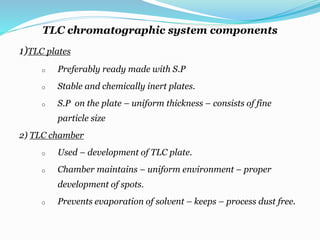
TLC chromatographic system components
1)TLC plates
o Preferably ready made with S.P
o Stable and chemically inert plates.
o S.P on the plate – uniform thickness – consists of fine
particle size
2) TLC chamber
o Used – development of TLC plate.
o Chamber maintains – uniform environment – proper
development of spots.
o Prevents evaporation of solvent – keeps – process dust free.
3) Mobile phase
o Comprises of solvent or solvent mixture
o M.P – should be particulate free - & highest priority for
proper development of TLC spots.
o Solvents – chemically inert with the sample.
4) Filter paper
o moistened in the M.P – by placing inside the chamber.
o Helps uniform rise in M.P – over the length of S.P.
TLC procedure
 S.P  applied onto the plate uniformly  allowed to dry and
stabilize.
 Readymade plates  preferred now-a-days.
 thin mark  made at the bottom of the plate pencil  sample
spots.
 samples solutions are applied on the spots marked on the line at
equal distances.
 M.P  poured  TLC chamber  few centimeters above the
chamber bottom.
 filter paper moistened in M.P  placed on the inner wall of the
chamber  maintain equal humidity in the entire chamber
avoid edge effect.
 plate prepared with sample spotting placed in TLC chamber
 side of the plate with sample line  towards the mobile phase.
 chamber  closed with a lid.
 Plate is immersed  such a way  sample spots  above the level
of M.P
 Sufficient time  given  spot development
 Plates removed  allowed to dry
 Sample spots  visualized  UV chamber or any recommended
methods.
Advantages of TLC
1. simple process with short development time.
2. Separate compound spots visualized easily
3. identify the individual compounds.
4. Helps  isolating  most of the compounds.
5. Separation process  faster, selectivity of compounds  higher
6. Purity  sample  assessed easily
7. cheaper
Applications of Thin layer chromatography
 check purity of given samples.
 Identification of compounds like acids, alcohols, proteins,
alkaloids, amines, antibiotics etc.
 purify samples i.e for purification process.
 keep a check  on the performance of other separation
processes.
High Performance Thin layer Chromatography
Introduction
 HPTLC  High Performance Thin layer Chromatography / High
Pressure Thin Layer Chromatography.
 sophisticated advancement  TLC
 Advantages better resolution, faster development of spots ,easy
detection and quantification of separated compounds.
 Advancement  due to
 Use of ready made HPTLC plates  optimized absorbent
layers  smaller particles size with uniform particle size
distribution as the stationary phase.
 use of pressure  enables for faster development of
chromatograms even complex mixtures
 The HPTLC systemautomated to a greater extent
 Auto sampling
 Online mixing of solvents
 Auto detection of compounds
 Recording and storage of data
Advantages of HPTLC over TLC:
 Samples in minute quantities like in nano-gram range can be detected
using HPTLC.
 Handling and human errors are minimum due to automation.
 Better accuracy and sensitivity than TLC.
Disadvantages
 many folds expensive than TLC.
 Bulky instrumentation  large space requirement.
 Requires stringent condition of operation ( dust free environment
and temperature controlled conditions.)
 Technically skilled person is required
Procedure
i. preparation of test solution
ii. Preparation of standard solutions
iii. Sample application and plate layout
iv. Preconditioning of the plate
v. Preparation of the developing chamber and development of plate
vi. Derivatization procedure
vii. Visualization
viii. system suitability
ix. Evaluation and acceptance criteria
x. Documentation
Preparation Of Test Solution
100mg of powdered bacterial ingredient / 10mg of dry extract
Sonicated for 15 min with 1ml of ethanol
centrifuged
Filtrate or supernatant is used
SAMPLE SOLUTION
Preparation Of Standard Solution
Reference standard
shaken
Sonicated in methanol  conc. of 10mg/ml
Essential oils
R.M (reference material) dissolved in toluene conc. of 50µL/mL
Sample Application And Plate Layout
Samples applied at narrow bands
8.0±0.5mm L & D 8.0±0.5mm from
the lower edge of the plate
Distance between tracks
Marked with pencil close to one of the edges of the plate before
development
Preconditioning Of The Plate
Following sample application
Plate is conditioned
at
Relative humidity of 33%
Min of 10min
Preparation Of Developing Chamber And Development Of
Plate
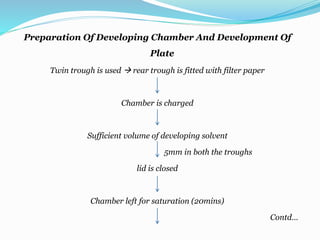
Twin trough is used  rear trough is fitted with filter paper
Chamber is charged
Sufficient volume of developing solvent
5mm in both the troughs
lid is closed
Chamber left for saturation (20mins)
Contd…
Contd…
Plate introduced in vertical position
Into
Front trough of the chamber
So that
Coating layer faces the filter paper
When
Coating layer reaches the distance of 6cm(development path)
Plate is removed from the chamber
&
Dried in vertical position in the stream of cold air
Derivatization Procedure
Where Derivatization reagents are used
Defined volumes of reagents in soln., (1-2mL)
are
Homogenously sprayed onto the plate
Or
The plate is immersed into the reagent solution
Defined speed for defined time
speed=50mm/s, time 1s
Visualization
Observation and evaluation
May be
Performed under UV 254nm, UV 366nm or white
Light prior to and after derivatization
System Suitability
2/more reference substances are selected
Similar but just seperable RF values under the chromatographic
conditions to be used
eg:- chlorogenic (blue) & hyperoside
(yellow) used for flavonoids
S.S for reference stds may be provided
or
Substances designated to check system suitability for resolution, position and
colors of the bands included in the ref. std
Contd…
Contd…
Description of the resolution, position and colors for the key bands
Of the reference material fingerprint
should
Match the description in the MONOGRAPH within a
specified tolerance range
S.S requirements in an individual monograph
satisfied
When the results obtained comply with those specified in the monograph
Evaluation And Acceptance Criteria
Chromatograms (sample solution & standard solution)
compared
Against the description on the Acceptance Criteria
Of the monograph
With respect to one position, zone separation, color and relative
intensity
Documentation
Documentation is necessary to record the results
In
Auditable manner to comply with current good manufacturing practices
Proper documentation tools should be employed
Application of HPTLC
 For detection and analysis of components of phytochemsitry,
medicinal chemistry & organic chemistry.
 Complex and scarce compounds  can be analysed.
HPLC
 High pressure liquid chromatography HPLC high
pressure used in the principle of its operation.
 due to its efficiency in analysis of compounds regarded  High
performance liquid chromatography.
 Also called High patience liquid chromatography due to
long human time requirement and patience
 widely used in the fields of clinical research, biochemical research,
industrial quality control etc.
Principle
 separation of compounds in a mixture more efficiently and also
quickly  than Column Chromatography
 The separation of compounds  due to their relative differences in
travel through the column on application of pressure exerted
through mobile phase or carrying liquid.
 The compounds of the mixture travel with different rates due to
their relative affinities with the solvent and stationary phase.
 Compound with higher affinity towards stationary phase of the
column travels slowly and vice-versa.
 The separation is more effective  greater surface area  very
small particle size  stationary phase  than used in column
chromatography.
 decrease in particle size  increases the disadvantage  i.e., it
proportionately enhances the flow time and run time due to
increased surface area.
 minimize this obstacle the high pressure is applied to the flow of
hplc mobile phase through the column by use of pumps.
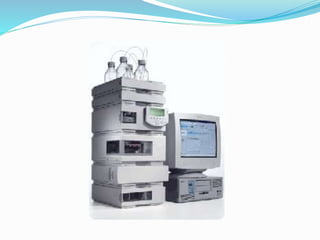
The HPLC method or process steps include
 mixture injected into a stream of mobile phase  flowing at a
defined pressure.
 The injected mixture now  flow over the stationary phase inside
the columnunder the influence of pressurealong with the mobile
phase.
 During this flow based on the affinity of individual compounds
 mixture towards stationary and mobile phase, some
compounds get eluted first out of the column  others later.
 Outside the column  sent into a detector  & individual
compounds are detected  recorded in a computer
chromatography software  installed.
 The recordings  compared  standard compound's HPLC values
and the individual compounds are identified.
 over all theory of HPLC  relative separation and detection of
compounds.
Types of HPLC
HPLC analysis is of differentiated based on
a) The stationary phase in the column used
b) Based on purpose of use
The stationary phase in the column used:
Based on the nature of stationary phase used it can be
either normal phase or reverse phase hplc.
 Normal phase chromatography:
 column stationary phase is made of polar compounds like
silica gel, alumina etc..
 The polar compounds or molecules  sample under analysis
 higher affinity to the stationary phase  they are retained
longer in the column than non-polar ones.
 non-polar compounds are eluted first  under the affinity to
non-polar mobile phase  polar ones are eluted later.
Reverse phase hplc:
 exactly the opposite of normal phase happens.
 The stationary phase is made of non-polar compounds like
C18, C8 type of organic compounds.
 The mobile phase used is polar.
 compounds of high polarity or eluted first  those of low
polarity or no-polarity are eluted last.
 Most of the applications in HPLC require
 evaluation of drugs
 biochemical molecules and other substances used by humans
 they are polar (water soluble) in nature.
So, reverse phase hplc is widely used.
Based on purpose of use:
Here HPLC is used for either
 Analysis mode:
done to estimate different types of molecules  their
individual quantities in the mixture  help of a detector.
 Preparative mode: intention of process  separate large amounts
of specific molecule from a mixture. The molecule or substance
eluted  highest purity. The column size, sample size is
comparatively large than that of analytical mode.
Advantages
1. Includes aspects of analysis (quantitative or qualitative).
2. Evaluates  all the molecules  same family.
3. Substances  low concentration  nano and picograms 
detected  sensitivity of HPLC detector.
4. Due  high seperation efficiency  quality  high purity
Disadvantages
 expensive technique
 requires heavy processing (mixing, homogenization, filtration,
degassing, derivatization etc)
 time consuming  must have good amount of patience.
 systems operation requires prior hplc training and effective hplc
troubleshooting skills.
Applications
1. Detection
2. Analysis determination
3. Quantification
4. Derivation of molecules  plant and medical importance
TERMS
Absorption;
Process of retention in which the solute partitions into a liquid like
coating
Active site;
A reactive or strongly attracting site on the surface of a
chromatographic packing that may bind analytes or cause peak tailing.
Adsorbent;
Packing used in adsorption chromatography. Silica gel and alumina
are the most frequently used absorbents in chromatography and sample
preparation
Contd…
Contd…
Adsorption;
Process of retention in which the interactions between the solute and
the surface of an adsorbent dominate
Band;
Refers to the chromatographic peak as it moves along and is eluted
from the column
Chromatogram;
A plot of detector signal output versus time or elution time during the
chromatographic process
Contd…
Contd…
Chromatograph;
Device used to implement chromatographic separation
Column;
Tube and stationary phase through which mobile phase flows
resulting in the chromatographic separation
Effluent;
mobile phase that exits the column
Eluate;
Solute mobile phase mixture
Eluent;
Another word for mobile phase.
Elution;
process of passing of mobile phase throught he chromatographic bed
to transport solution.
Chromatography

Chromatography

  • 1.
  • 2.
    Topics to bedealt  Chromatography  TLC  HPTLC  HPLC
  • 3.
    Introduction  Separation ofmixture  passed through medium  components move at different rates  Physico-chemical method colour to write  Mobile phase  mixture to be seperated  Stationary phase  the material on which the separation takes place can be solid, gel, or liquid Chroma Graphein
  • 4.
    Principle  Various constituentsof mixture  travel at different speeds  seperates  basis  differential partitioning  M.P and S.P  Seperation  formation of bands on S.P  M.P  liquid or gas  S.P  solid or liquid
  • 5.
    History Of Chromatography important technique  2 Nobel prize  Archer John Porter Martin and Richard Laurence Millington Synge 1952  Partition Chromatography  1906  Michael Tsvett  Russian Botanist  concept of liquid chromatography  to purify chlorophylls from plant extracts. FATHER OF CHROMATOGRAPHY Plant pigments like xanthophyll, chlorophyll, carotenes. CHROMATOGRAPHY or COLOUR WRITING
  • 6.
     1931 Richard Kuhn  use of this method in biologically important materials.  1941  British Chemists  Archer.J.P.Martin and Richard.L.M.Synge PARTITION CHROMATOGRAPHY one liquid firmly attached to the granulated solid packed in a glass tube and second immiscible with the first.  Martin and Anthony .J.James  gas liquid partition chromatography  moving phase could be gas.
  • 7.
     1940s lackof uniformity , lack of reproducibility in silica gel  sheet of filter paper is used.  PAPER CHROMATOGRAPHY wide application in the analysis of biologically important compunds such as amino acids, steroids, carbohydrates and bile pigments.  1956  Nikolay.A.Imaylor and Maria.S.Shrayber  thin film on the glass plate THIN LAYER CHROMATOGRAPHY  1944  Erika Cremer  compressed gas been used GAS CHROMATOGRAPHY
  • 8.
    Types of Chromatography 1)Based on physical state of both phases homogenous  same S.P and M.P heterogenous  different S.P and M.P 2) Based on the principle of separation used adsorption  sample gets separated due to greater affinity to adsorb partition  get separated due to relative differences of dissolution and partition into different layers.
  • 10.
    3) Based onthe chemical nature of stationary phase and mobile phase normal phase chromatography  S.P polar and M.P is non- polar in nature. Used in column chromatographic technique. reverse chromatography  S.P is non-polar and M.P is polar in nature. Used in routine analysis as most of these substances like drugs etc.
  • 11.
    4) Based onshape of stationary phase column chromatography  S.P is column in shape widely used in HPLC, GC planar chromatography  S.P is flat. TLC 5) Based on the purpose of chromatography experiment preparative chromatography  injected sample is very small  pure sample is collected. analytical chromatography  injected sample is very small  aimed to identify the components in the sample and individual concentrations in the sample
  • 13.
    6) Based onthe physical or chemical characters of the S.P size exclusion C  S.P has pores . molecules are allowed to pass  through large to small path  under mobile phase influence and pass through the column ion exchange C  S.P has definite charged ions. passed sample  retains molecules with opposite charge  leaves molecules of same charge. to elute  it need to pass through another phase with similar charge to S.P is passed to recover the bond molecules
  • 14.
    Applications of Chromatography 1.Widely – chemical industry 2. Environmental testing – trace quantities – pesticides as DDT in ground water. 3. Growing use of pharmaceutical industry 4. Quality control – food industry – analying additives, vitamins, preservative, proteins, aminoacids. 5. Can – separate and detect contaminants 6. Finding drugs in urine or other body fluids – traces of flammable chemicals in burned material
  • 15.
    Overall available techniquesfor regular analysis include 1. Column chromatography 2. HPLC 3. GC 4. Ion exchange chromatography 5. Size exclusion chromatography 6. TLC 7. HPTLC 8. Paper chromatography 9. Affinity chromatography 8. Paper chromatography 9. Affinity chromatography 10. LC-MS (Liquid Chromatography with Mass Spectroscopy) 11. GC-MS ( Gas Chromatography with Mass Spectroscopy) 12. Ultra High Performance Chromatography
  • 16.
    Thin Layer Chromatography Introduction −type of planar chromatography − Used by researchers – field of phytochemicals, biochemistry – identify components – compound mixture – alkaloids, phospholipids, aminoacids. − Determine – no. of components in mixture – Identity – purity of a compound. − Semi quantitative method − Sophisticated version - HPTLC
  • 17.
    Principle  Based onthe principle of separation  Separation – relative affinity of cpds towards S.P and M.P  Cpds under the influence of M.P  travel over the surface of S.P  During this  cpds with higher affinity to S.P travel slowly  while others travel faster.  Separation of mixture  achieved  Separation completed  cmpnts visualized as spots – at respective level on the plates.
  • 18.
    TLC chromatographic systemcomponents 1)TLC plates o Preferably ready made with S.P o Stable and chemically inert plates. o S.P on the plate – uniform thickness – consists of fine particle size 2) TLC chamber o Used – development of TLC plate. o Chamber maintains – uniform environment – proper development of spots. o Prevents evaporation of solvent – keeps – process dust free.
  • 19.
    3) Mobile phase oComprises of solvent or solvent mixture o M.P – should be particulate free - & highest priority for proper development of TLC spots. o Solvents – chemically inert with the sample. 4) Filter paper o moistened in the M.P – by placing inside the chamber. o Helps uniform rise in M.P – over the length of S.P.
  • 22.
    TLC procedure  S.P applied onto the plate uniformly  allowed to dry and stabilize.  Readymade plates  preferred now-a-days.  thin mark  made at the bottom of the plate pencil  sample spots.  samples solutions are applied on the spots marked on the line at equal distances.  M.P  poured  TLC chamber  few centimeters above the chamber bottom.
  • 23.
     filter papermoistened in M.P  placed on the inner wall of the chamber  maintain equal humidity in the entire chamber avoid edge effect.  plate prepared with sample spotting placed in TLC chamber  side of the plate with sample line  towards the mobile phase.  chamber  closed with a lid.  Plate is immersed  such a way  sample spots  above the level of M.P  Sufficient time  given  spot development  Plates removed  allowed to dry  Sample spots  visualized  UV chamber or any recommended methods.
  • 24.
    Advantages of TLC 1.simple process with short development time. 2. Separate compound spots visualized easily 3. identify the individual compounds. 4. Helps  isolating  most of the compounds. 5. Separation process  faster, selectivity of compounds  higher 6. Purity  sample  assessed easily 7. cheaper
  • 25.
    Applications of Thinlayer chromatography  check purity of given samples.  Identification of compounds like acids, alcohols, proteins, alkaloids, amines, antibiotics etc.  purify samples i.e for purification process.  keep a check  on the performance of other separation processes.
  • 26.
    High Performance Thinlayer Chromatography Introduction  HPTLC  High Performance Thin layer Chromatography / High Pressure Thin Layer Chromatography.  sophisticated advancement  TLC  Advantages better resolution, faster development of spots ,easy detection and quantification of separated compounds.
  • 27.
     Advancement due to  Use of ready made HPTLC plates  optimized absorbent layers  smaller particles size with uniform particle size distribution as the stationary phase.  use of pressure  enables for faster development of chromatograms even complex mixtures  The HPTLC systemautomated to a greater extent  Auto sampling  Online mixing of solvents  Auto detection of compounds  Recording and storage of data
  • 28.
    Advantages of HPTLCover TLC:  Samples in minute quantities like in nano-gram range can be detected using HPTLC.  Handling and human errors are minimum due to automation.  Better accuracy and sensitivity than TLC. Disadvantages  many folds expensive than TLC.  Bulky instrumentation  large space requirement.  Requires stringent condition of operation ( dust free environment and temperature controlled conditions.)  Technically skilled person is required
  • 30.
    Procedure i. preparation oftest solution ii. Preparation of standard solutions iii. Sample application and plate layout iv. Preconditioning of the plate v. Preparation of the developing chamber and development of plate vi. Derivatization procedure vii. Visualization viii. system suitability ix. Evaluation and acceptance criteria x. Documentation
  • 31.
    Preparation Of TestSolution 100mg of powdered bacterial ingredient / 10mg of dry extract Sonicated for 15 min with 1ml of ethanol centrifuged Filtrate or supernatant is used SAMPLE SOLUTION
  • 32.
    Preparation Of StandardSolution Reference standard shaken Sonicated in methanol  conc. of 10mg/ml Essential oils R.M (reference material) dissolved in toluene conc. of 50µL/mL
  • 33.
    Sample Application AndPlate Layout Samples applied at narrow bands 8.0±0.5mm L & D 8.0±0.5mm from the lower edge of the plate Distance between tracks Marked with pencil close to one of the edges of the plate before development
  • 34.
    Preconditioning Of ThePlate Following sample application Plate is conditioned at Relative humidity of 33% Min of 10min
  • 35.
    Preparation Of DevelopingChamber And Development Of Plate Twin trough is used  rear trough is fitted with filter paper Chamber is charged Sufficient volume of developing solvent 5mm in both the troughs lid is closed Chamber left for saturation (20mins) Contd…
  • 36.
    Contd… Plate introduced invertical position Into Front trough of the chamber So that Coating layer faces the filter paper When Coating layer reaches the distance of 6cm(development path) Plate is removed from the chamber & Dried in vertical position in the stream of cold air
  • 37.
    Derivatization Procedure Where Derivatizationreagents are used Defined volumes of reagents in soln., (1-2mL) are Homogenously sprayed onto the plate Or The plate is immersed into the reagent solution Defined speed for defined time speed=50mm/s, time 1s
  • 38.
    Visualization Observation and evaluation Maybe Performed under UV 254nm, UV 366nm or white Light prior to and after derivatization
  • 39.
    System Suitability 2/more referencesubstances are selected Similar but just seperable RF values under the chromatographic conditions to be used eg:- chlorogenic (blue) & hyperoside (yellow) used for flavonoids S.S for reference stds may be provided or Substances designated to check system suitability for resolution, position and colors of the bands included in the ref. std Contd…
  • 40.
    Contd… Description of theresolution, position and colors for the key bands Of the reference material fingerprint should Match the description in the MONOGRAPH within a specified tolerance range S.S requirements in an individual monograph satisfied When the results obtained comply with those specified in the monograph
  • 41.
    Evaluation And AcceptanceCriteria Chromatograms (sample solution & standard solution) compared Against the description on the Acceptance Criteria Of the monograph With respect to one position, zone separation, color and relative intensity
  • 42.
    Documentation Documentation is necessaryto record the results In Auditable manner to comply with current good manufacturing practices Proper documentation tools should be employed
  • 43.
    Application of HPTLC For detection and analysis of components of phytochemsitry, medicinal chemistry & organic chemistry.  Complex and scarce compounds  can be analysed.
  • 44.
    HPLC  High pressureliquid chromatography HPLC high pressure used in the principle of its operation.  due to its efficiency in analysis of compounds regarded  High performance liquid chromatography.  Also called High patience liquid chromatography due to long human time requirement and patience  widely used in the fields of clinical research, biochemical research, industrial quality control etc.
  • 46.
    Principle  separation ofcompounds in a mixture more efficiently and also quickly  than Column Chromatography  The separation of compounds  due to their relative differences in travel through the column on application of pressure exerted through mobile phase or carrying liquid.  The compounds of the mixture travel with different rates due to their relative affinities with the solvent and stationary phase.
  • 47.
     Compound withhigher affinity towards stationary phase of the column travels slowly and vice-versa.  The separation is more effective  greater surface area  very small particle size  stationary phase  than used in column chromatography.  decrease in particle size  increases the disadvantage  i.e., it proportionately enhances the flow time and run time due to increased surface area.  minimize this obstacle the high pressure is applied to the flow of hplc mobile phase through the column by use of pumps.
  • 48.
    The HPLC methodor process steps include  mixture injected into a stream of mobile phase  flowing at a defined pressure.  The injected mixture now  flow over the stationary phase inside the columnunder the influence of pressurealong with the mobile phase.  During this flow based on the affinity of individual compounds  mixture towards stationary and mobile phase, some compounds get eluted first out of the column  others later.
  • 49.
     Outside thecolumn  sent into a detector  & individual compounds are detected  recorded in a computer chromatography software  installed.  The recordings  compared  standard compound's HPLC values and the individual compounds are identified.  over all theory of HPLC  relative separation and detection of compounds.
  • 50.
    Types of HPLC HPLCanalysis is of differentiated based on a) The stationary phase in the column used b) Based on purpose of use
  • 51.
    The stationary phasein the column used: Based on the nature of stationary phase used it can be either normal phase or reverse phase hplc.
  • 52.
     Normal phasechromatography:  column stationary phase is made of polar compounds like silica gel, alumina etc..  The polar compounds or molecules  sample under analysis  higher affinity to the stationary phase  they are retained longer in the column than non-polar ones.  non-polar compounds are eluted first  under the affinity to non-polar mobile phase  polar ones are eluted later.
  • 53.
    Reverse phase hplc: exactly the opposite of normal phase happens.  The stationary phase is made of non-polar compounds like C18, C8 type of organic compounds.  The mobile phase used is polar.  compounds of high polarity or eluted first  those of low polarity or no-polarity are eluted last.
  • 54.
     Most ofthe applications in HPLC require  evaluation of drugs  biochemical molecules and other substances used by humans  they are polar (water soluble) in nature. So, reverse phase hplc is widely used.
  • 55.
    Based on purposeof use: Here HPLC is used for either  Analysis mode: done to estimate different types of molecules  their individual quantities in the mixture  help of a detector.  Preparative mode: intention of process  separate large amounts of specific molecule from a mixture. The molecule or substance eluted  highest purity. The column size, sample size is comparatively large than that of analytical mode.
  • 56.
    Advantages 1. Includes aspectsof analysis (quantitative or qualitative). 2. Evaluates  all the molecules  same family. 3. Substances  low concentration  nano and picograms  detected  sensitivity of HPLC detector. 4. Due  high seperation efficiency  quality  high purity
  • 57.
    Disadvantages  expensive technique requires heavy processing (mixing, homogenization, filtration, degassing, derivatization etc)  time consuming  must have good amount of patience.  systems operation requires prior hplc training and effective hplc troubleshooting skills.
  • 58.
    Applications 1. Detection 2. Analysisdetermination 3. Quantification 4. Derivation of molecules  plant and medical importance
  • 59.
    TERMS Absorption; Process of retentionin which the solute partitions into a liquid like coating Active site; A reactive or strongly attracting site on the surface of a chromatographic packing that may bind analytes or cause peak tailing. Adsorbent; Packing used in adsorption chromatography. Silica gel and alumina are the most frequently used absorbents in chromatography and sample preparation Contd…
  • 60.
    Contd… Adsorption; Process of retentionin which the interactions between the solute and the surface of an adsorbent dominate Band; Refers to the chromatographic peak as it moves along and is eluted from the column Chromatogram; A plot of detector signal output versus time or elution time during the chromatographic process Contd…
  • 61.
    Contd… Chromatograph; Device used toimplement chromatographic separation Column; Tube and stationary phase through which mobile phase flows resulting in the chromatographic separation Effluent; mobile phase that exits the column Eluate; Solute mobile phase mixture
  • 62.
    Eluent; Another word formobile phase. Elution; process of passing of mobile phase throught he chromatographic bed to transport solution.