Tuesday, 14 February 2017
 Concentration
 The higher the level of concentration (or pressure in
gases) the faster the reaction.
 This is due to increased collisions between reacting
particles.
Factors affecting reaction rates
 Surface area in solids
 The larger the surface area of a solid the faster the
reaction. Finely divided substances have much larger
surface areas than large chunks of a solid.
 This is due to increased collisions between reacting
particles.
Factors affecting reaction rates
 Temperature
 The higher the temperature the faster the reaction.
 This is due to increased and more energetic collisions
between reacting particles.
 A 10oC rise in temperature often results in a doubling
of the reaction rate.
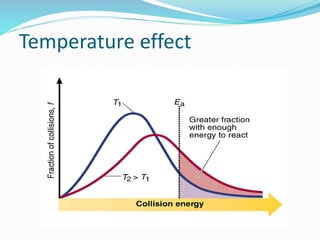
 Key point: at a higher temperature more
molecules have energy greater than the activation
energy.
Factors affecting reaction rates
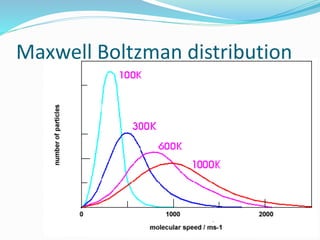
Maxwell Boltzman distribution
Temperature effect
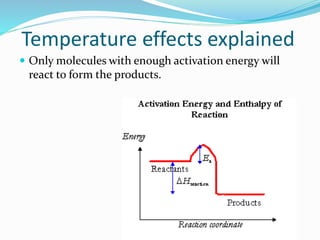
 Only molecules with enough activation energy will
react to form the products.
Temperature effects explained
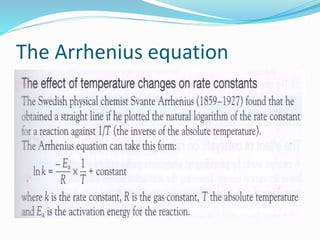
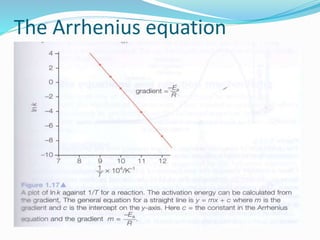
The Arrhenius equation
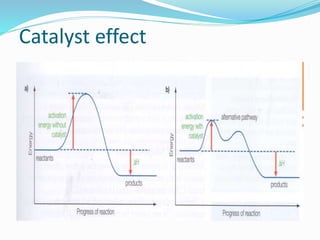
 Catalysts
 Catalysts increase the rates of chemical reactions.
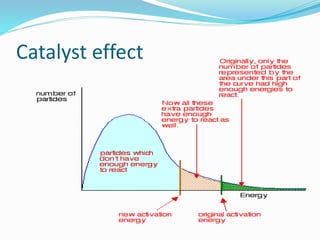
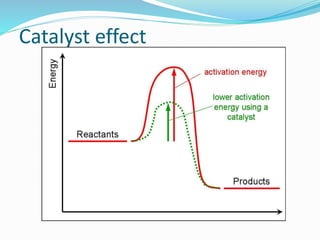
 This is due a lowering of the activation energy for the
reaction.
 Catalysts are not consumed in the reaction so in
theory they can be used over and over again. In
practice they are often contaminated and/or some is
lost in a process.
Factors affecting reaction rates
Catalyst effect
Catalyst effect
Catalyst effect
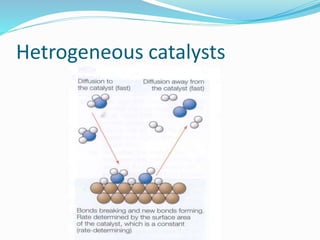
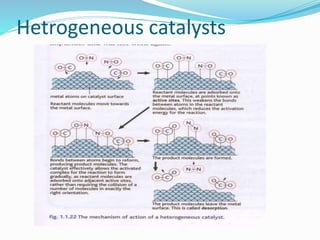
Hetrogeneous catalysts
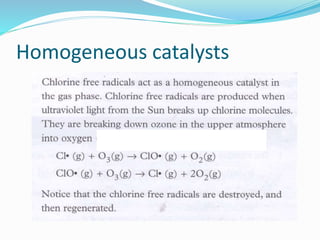
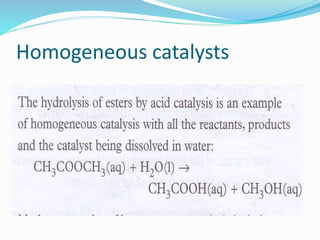
Homogeneous catalysts
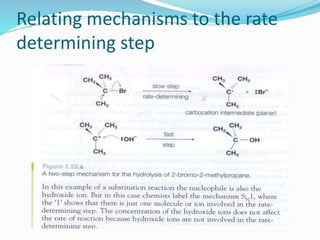
Relating mechanisms to the rate
determining step
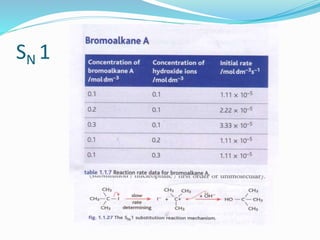
SN 1
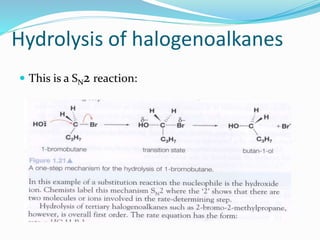
Hydrolysis of halogenoalkanes
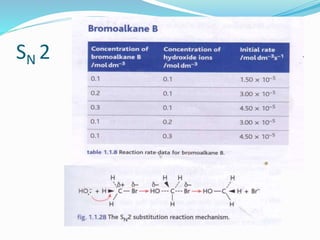
 This is a SN2 reaction:
SN 2
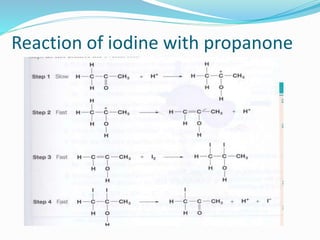
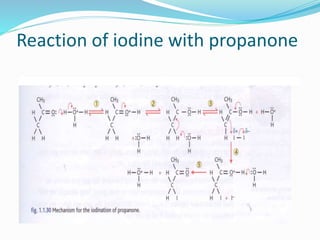
Reaction of iodine with propanone

Factors affecting reaction rates