OXYGEN THERAPY
SET BY: 1) KEDIJA KEDIR
2) GADISE HAILU
3) TALEMA WORKINEH
OUTLINES
Introduction Oxygen Therapy
Purpose Oxygen Therapy
Indications Oxygen Therapy
Nursing Responsibilities
Sources of O2
Methods of Oxygen Therapy
Low Flow Delivery System
High Flow Delivery System
Side Effects of Oxygen Therapy
Hazards of O2 Therapy
Reference
INTRODUCTION TO OXYGEN THERAPY
Definition
Oxygen : Is a colorless, odorless,
tasteless gas that is essential for the body
to function properly and to survive.
Oxygen therapy : Is the administration of
oxygen at a concentration pressure greater
than that found in the environmental
atmosphere.
INTRODUCTION…
Is a key treatment in respiratory care.
Is the method by which oxygen is
supplemented at higher percentages than
what is available in atmospheric air.
Oxygen is administered as a corrective
treatment for conditions resulting in hypoxia.
The air that we breathe contain approximately
21% oxygen.
INTRODUCTION…
 The normal amount of oxygen in the arterial
blood should be in the range of 80 to 100
mmHg.
If it falls below 60 mm of Hg; irreversible
physiologic effects may occur.
The oxygen administration treats the effects
of oxygen deficiency but it does not correct
the underlying causes.
PURPOSE
• The body is constantly taking in oxygen and
releasing carbon dioxide.
• If this process is inadequate, oxygen levels in
the blood decrease, and the patient may need
supplemental oxygen.
• The purpose is to increase oxygen saturation
in tissues where the saturation levels are too
low due to illness or injury.
PURPOSE…
• To relieve dyspnea.
• To reduce or prevent hypoxemia and hypoxia.
NB
• Hypoxemia: Is low level of O2 in blood.
• Hypoxia: Is low level of O2 in cells.
INDICATIONS
 Severe respiratory distress ( e.g. acute
asthma & pneumonia)
 Acute myocardial infraction (heart attack)
 Cardiac failure
 Severe trauma
 Shock
 Hypoxia and hypoxemia
 Hypermetabolic state induced by trauma,
burns or sepsis
INDICATIONS…
 Anemia
 During CPR
 During anesthesia for surgery
Oxygen is a prescribed drug.
 Must be written legibly by the doctor.
 Prescription should be dated by the doctor.
 Doctor must indicate duration of oxygen therapy
 The oxygen conc. must be prescribed.
 The flow rate must be prescribed.
PAO2 AS AN INDICATOR FOR OXYGEN
THERAPY
o PaO2 : 80 – 100 mm Hg : Normal
o 60 – 80 mm Hg : cold, clammy extremities
o < 60 mm Hg : cyanosis
o < 40 mm Hg : mental deficiency, memory loss
o < 30 mm Hg : bradycardia, cardiac arrest
o PaO2 < 60 mm Hg is a strong indicator for oxygen
therapy
NURSING RESPONSIBILITIES
• Oxygen must only be administered at the rate
and percentage prescribed.
• Explain to the client the dangers of lighting
matches or smoking cigarettes, cigars.
Be sure the client has no matches, cigarettes,
or smoking materials in the bedside table.
• Make sure that warning signs (OXYGEN - NO
SMOKING) are posted on the client’s door
and above the client’s bed.
NURSING…
• Do not use oil on oxygen equipment.
• With all oxygen delivery systems, the oxygen is
turned on before the mask is applied to
the client.
• Make sure the tubing is patent at all times
and that the equipment is working properly.
• Watch for respiratory distress.
• Encourage or assist the client to move about
in bed.
NURSING…
• Provide frequent mouth care. Make sure the
oxygen contains proper humidification.
• Discontinue oxygen only after a physician has
evaluated the client.
• Generally, you should not abruptly discontinue
oxygen given in medium-to-high
concentrations( above 30%). Gradually
decrease it in stages, and monitor the client’s
arterial blood gases or oxygen saturation level.
NURSING…
• Always be careful when you give high levels of
oxygen to a client with COPD. The elevated
levels of oxygen in the patient’s body can
depress their stimulus to breathe.
• Wear gloves any time you might come into
contact with the client’s respiratory
secretions.
• Mark oxygen cylinder to indicate whether full
or empty.
NURSING…
• Use only carriers with wheel to transport
oxygen cylinder,do not roll the oxygen
cylinder.
• Oxygen must only be administered at the rate
and percentage prescribed.
• Do not adjust flow meter until instructed.
• Encourage or assist patient to move about in
bed to prevent circulatory difficulties.
Sources of O2
Therapeutic oxygen is available from two
sources:
1. Oxygen cylinders
o Stationary
o Portable, mobile or ambulatory.
2. Wall Outlets( Central supply)
1. Oxygen cylinders
• Oxygen cylinder is delivered with a protective
cap to prevent accidental force against the
cylinder outlet.
• To release oxygen safety and at a desirable
rate , a regulator is used.
• A reduction gauge that shows the amount of
oxygen in the tank.
• A flow meter that regulates the control of
oxygen in liters per minutes.
1. Oxygen cylinders…
• Oxygen is moistened by passing it through a
humidifier to prevent the mucous membranes
of the respiratory tree from becoming dry.
2. Wall Outlets( Central supply)
• The oxygen is supplied from a central source
through a pipeline.
• Only flow meter and a humidifier are
required.
Oxygen cylinders
METHODS OF OXYGEN ADMINISTRATION
A. Low flow delivery system
B. High flow delivery system
A. Low Flow Delivery System
1. AMBU BAG
 AMBU- Artificial Manual Breathing Unit or
 Bag Valve Mask Ventilation
 Is a hand- held device commonly used to
provide positive pressure ventilation to
patients who are not breathing or not
breathing adequately.
2. NASAL CANNULA ( Prongs)
• Is a disposable, plastic devise with two
protruding prongs for insertion into the
nostrils, connected to an oxygen source.
• Used for low- medium concentrations of
oxygen ( 24-44 %).
Amount of Delivered FIO2
Low flow, Up to 5 liter of oxygen can provide
through nasal cannula.
Low flow- ( 24-44%).
• 1L/min = 24%
• 2L/min = 28%
• 3L/min = 32%
• 4L/min = 36%
• 5 L/min = 40%
• 6L/min = 44%
2. NASAL CANNULA…
ADVANTAGES
• Safe and simple
• Easily used in home setting
• Patients are able to talk, eat
and drink with oxygen in place.
• Patients can vomit and let oral
secretion out easily without
any interruption in oxygen
delivery.
• Delivers low concentration of
oxygen.
DISADVANTAGES
o It can easily dislodge from
patient nostrils.
o It causes irritation in the
nostrils.
o It causes dryness in the
nostrils
o Not good for mouth breathers
o Pt’s breathing pattern affects
exact FIO2
o Unable to use with nasal
obstruction
3. FACE MASK
o Made up of clear, flexible, plastic or rubber
that can be molded to fit the face.
o Held to the head with elastic bands.
o Some are a metal clip that can be bent over
the bridge of the nose for a comfortable fit.
o Delivers 35% -60% of oxygen.
o A flow rate of 6-10 L/min.
3. FACE MASK…
o Has vents on its sides which allow room air to
leak in at many places , thereby diluting the
source oxygen.
o Often used when an increased delivery of
oxygen is needed for short periods ( less than
12 hours).
3. FACE MASK…
• Delivers high concentration
of oxygen in short period of
time.
• Quick and easy to apply
Disadvantages
o Must be removed while talking,
eating, vomiting and drinking
o Obstruct coughing
o Blocks vomitus in unconscious
patients
o CO2 may build up in the
mask
o Causes skin irritation
o Aspiration of vomitus is likely
when
mask is in place.
Advantages
4. Nasal Catheter
o Inserted into the nostrils reaching up to the
uvula & is held by adhesive tapes.
o The catheter does not interfere with the
patients freedom to eat , to talk & to move in
bed.
o Flow of 1 to 4 liters of oxygen will be sufficient
to maintain the concentration of 22 to 30 %
oxygen.
4. Nasal Catheter…
5. Oxygen Hood
An oxygen hood is used for babies who can
breath on their own but still need extra
oxygen.
A hood is a plastic dome or box with warm,
moist oxygen inside.
The hood is placed over the baby’s head.
5. Oxygen Hood…
• Special for babies.
6.Oxygen Tent
 An oxygen tent consists of a canopy placed over
the head and shoulders or the entire body of a
patient to provide oxygen at a higher level than
normal.
 A patient with a facial injury or for any other
reason cannot tolerate an oxygen mask , then
this method can be used.
6.Oxygen Tent…
Oxygen tent provides an environment for the
pt.
6.Oxygen Tent…
Advantages
 Provides an environment
for patient with controlled
oxygen concentration ,
temperature regulation &
humidity control
 Allows freedom for free
movement in bed
Disadvantages
o Create feeling of isolation
o Requires high volume of
oxygen -10 to 12 liter/
minute
o There is increased chances
of fire
o Requires much time & effort
to clean & maintain a tent
7. The Partial Re-Breather Mask
• Used to deliver O2 concentration up to 80%.
• The oxygen flow rate must be maintained
at a minimum of 6 L/min.
• The mask has a reservoir bag that must remain
inflated during both inspiration & expiration.
• Collects the first parts of the patients' exhaled air.
7. The Partial Re-Breather Mask…
• The oxygen flow rate must be maintained at a
minimum of 6 L/min to ensure that the
patient does not re-breath large amounts of
exhaled air.
• The remaining exhaled air exits through vents.
• Oxygen is directed into the reservoir, during
inspiration the gas is drawn from the bag
mixing with room air.
7. The Partial Re-Breather Mask…
• Expiration- First 1/3 of exhaled gas goes into
bag ( dead space).
• Dead space mixes with new oxygen going into
bag.
• Oxygen flow rate at 6-10L/min, FIO2= 60%-
80%.
• Client can inhale, gas from mask, bag, and
exhalation ports.
7. The Partial Re-Breather Mask…
Advantages
• Client can inhale
room air through
openings in mask if
oxygen supply is
briefly interrupted.
• Delivers moderate
oxygen
concentration.
Disadvantages
• Requires tight seal
• Eating and talk
difficult,
uncomfortable
8. The Non Re-Breather Mask
• This mask provides the highest concentration
of oxygen ( 80%- 100%) at a flow rate 6-15 L/min.
• Similar to the partial reb-reather mask except that
two one way valves are present to conserve the
exhaled air.
• The bag is an oxygen reservoir.
• When the patient exhales, the one way valve closes
and all the exhaled air is vent out and the patient
does not re breath any of the exhaled air.
8. The Non Re-Breather Mask…
Advantages
Delivers the highest
possible oxygen
concentration.
Disadvantages
Impractical for the
long term therapy
Suffocation
Expensive
Uncomfortable
Partial Re-breathing Vs Non Re-breathing Reservoir
Oxygen Mask
Partial re-breathing
reservoir O2 mask
 Provide FIO2 60%-80%
at a flow 6 - 10L/min.
 Flow rate must be
6L/min to ensure that
patient does not re-
breath exhaled air.
Non re-breathing
reservoir O2 mask
 Provide FiO2 60 -100% at
a flow 4 to10L/min
 Flow rate should be set
high to prevent deflation
of reservoir
bag usually about
15L/min.
One way valve present
for inspired and expired
gases.
B. High Flow Delivery System
1. Venturi Mask
It is a high flow oxygen delivery device.
Oxygen from 40-50% at litters flow of 4 to 15
L/ min.
The mask is constructed in a way that there
is a constant flow of room air blended with a
fixed concentration of oxygen.
1. Venturi Mask…
COLOR FIO2 O2 Flow
Blue 24% 2 L/min
White 28% 4 L/min
Orange 31% 6 L/min
Yellow 35% 8 L/min
Red 40% 10 L/min
Green 60% 15 L/min
1. Venturi Mask…
1. Venturi Mask…
About tube & color
 Designed with wide- bore
tubing and various color-
coded jet adapters.
 Each color code corresponds
to a precise oxygen
concentration and a specific
liter flow.
 It is used primarily for pts
with COPD.
Venturi mask illustration
1. Venturi Mask…
Advantages
Delivers most
precise
oxygen
concentration
Does not dry
mucous
membranes
Disadvantages
Uncomfortable
Risk for skin irritation
Produce respiratory
depression in COPD
patient with high
concentration of oxygen
50%
2. Tracheostomy Collar
Inserted directly into the trachea.
Indicated for chronic oxygen therapy need.
Provide accurate FIO2.
The oxygen flow rate is 8- 10 L/min.
Provide good humidity.
It is comfortable and more efficient.
2. Tracheostomy Collar…
Advantages
 Deliver high
concentration of oxygen
 Maintain saturation
level
 Stable and not moved
 Good humidity
Disadvantages
o Heavy with tubing
o Regular cleaning
o Chance for infection
3.T- Piece
o T- Piece adaptor is used on end of
endotracheal tube to provide humidification
and oxygen therapy.
o The oxygen flow rate is 8 – 10 L/min and 30%
- 100% oxygen can be given.
o Provide accurate FIO2.
o Provide good humidity.
3.T- Piece…
4. Transtracheal Therapy
Trans tracheal catheter is used to deliver
oxygen directly into the lungs.
A small plastic catheter is surgically placed in
your neck and sits in the windpipe.
Here the flow rate is 1-4 L/min and the
oxygen 60% - 100%.
4. Transtracheal Therapy…
Advantages
Lower O2 use
Eliminates nasal and
skin
irritation
Increased mobility
Disadvantages
High cost
Surgical
complications
 Infections
Frequent regular
cleaning
Side Effects of Oxygen Therapy
 Oxygen toxicity
 Drying of the mucus membrane
 Infection
 Retrolental fibroplasia
 Absorption atelectasis
 Fire hazard
NB Oxygen concentration greater than 50% over 24 to
48 hours can cause pathological changes in the
lungs.
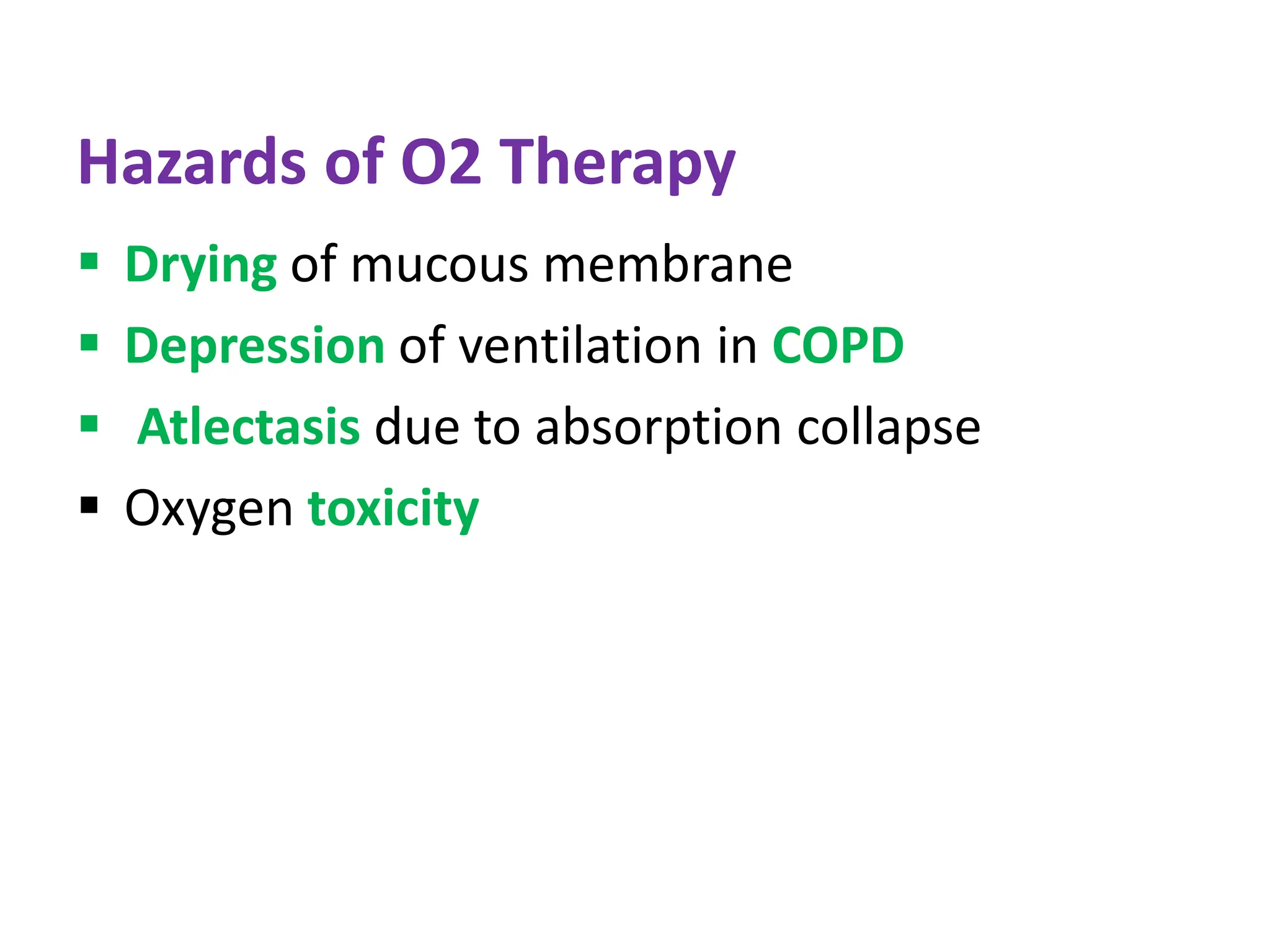
Hazards of O2 Therapy
 Drying of mucous membrane
 Depression of ventilation in COPD
 Atlectasis due to absorption collapse
 Oxygen toxicity
How much O2 is safe?
100% - not more than 12hrs
 80% - not more than 24hrs
60% - not more than 36hrs
The goal should be to use lowest possible
FIO2 compatible with adequate tissue
oxygenation.
Reference
1. COPD Nice Clinical Guideline 101,2010.
Google Scholar
2. UK Ambulance Services Clinical Practice
Guidelines 2013. Google Scholar
3. British Thoracic Society guidelines for home
oxygen use in adults. Free Full Text Google
Scholar
4. All are through Google Chrome Search
THANKS!!!!!

Seminar Presentation on Oxygen Administration.pptx

  • 1.
    OXYGEN THERAPY SET BY:1) KEDIJA KEDIR 2) GADISE HAILU 3) TALEMA WORKINEH
  • 2.
    OUTLINES Introduction Oxygen Therapy PurposeOxygen Therapy Indications Oxygen Therapy Nursing Responsibilities Sources of O2 Methods of Oxygen Therapy Low Flow Delivery System High Flow Delivery System Side Effects of Oxygen Therapy Hazards of O2 Therapy Reference
  • 3.
    INTRODUCTION TO OXYGENTHERAPY Definition Oxygen : Is a colorless, odorless, tasteless gas that is essential for the body to function properly and to survive. Oxygen therapy : Is the administration of oxygen at a concentration pressure greater than that found in the environmental atmosphere.
  • 4.
    INTRODUCTION… Is a keytreatment in respiratory care. Is the method by which oxygen is supplemented at higher percentages than what is available in atmospheric air. Oxygen is administered as a corrective treatment for conditions resulting in hypoxia. The air that we breathe contain approximately 21% oxygen.
  • 5.
    INTRODUCTION…  The normalamount of oxygen in the arterial blood should be in the range of 80 to 100 mmHg. If it falls below 60 mm of Hg; irreversible physiologic effects may occur. The oxygen administration treats the effects of oxygen deficiency but it does not correct the underlying causes.
  • 6.
    PURPOSE • The bodyis constantly taking in oxygen and releasing carbon dioxide. • If this process is inadequate, oxygen levels in the blood decrease, and the patient may need supplemental oxygen. • The purpose is to increase oxygen saturation in tissues where the saturation levels are too low due to illness or injury.
  • 7.
    PURPOSE… • To relievedyspnea. • To reduce or prevent hypoxemia and hypoxia. NB • Hypoxemia: Is low level of O2 in blood. • Hypoxia: Is low level of O2 in cells.
  • 8.
    INDICATIONS  Severe respiratorydistress ( e.g. acute asthma & pneumonia)  Acute myocardial infraction (heart attack)  Cardiac failure  Severe trauma  Shock  Hypoxia and hypoxemia  Hypermetabolic state induced by trauma, burns or sepsis
  • 9.
    INDICATIONS…  Anemia  DuringCPR  During anesthesia for surgery Oxygen is a prescribed drug.  Must be written legibly by the doctor.  Prescription should be dated by the doctor.  Doctor must indicate duration of oxygen therapy  The oxygen conc. must be prescribed.  The flow rate must be prescribed.
  • 10.
    PAO2 AS ANINDICATOR FOR OXYGEN THERAPY o PaO2 : 80 – 100 mm Hg : Normal o 60 – 80 mm Hg : cold, clammy extremities o < 60 mm Hg : cyanosis o < 40 mm Hg : mental deficiency, memory loss o < 30 mm Hg : bradycardia, cardiac arrest o PaO2 < 60 mm Hg is a strong indicator for oxygen therapy
  • 11.
    NURSING RESPONSIBILITIES • Oxygenmust only be administered at the rate and percentage prescribed. • Explain to the client the dangers of lighting matches or smoking cigarettes, cigars. Be sure the client has no matches, cigarettes, or smoking materials in the bedside table. • Make sure that warning signs (OXYGEN - NO SMOKING) are posted on the client’s door and above the client’s bed.
  • 12.
    NURSING… • Do notuse oil on oxygen equipment. • With all oxygen delivery systems, the oxygen is turned on before the mask is applied to the client. • Make sure the tubing is patent at all times and that the equipment is working properly. • Watch for respiratory distress. • Encourage or assist the client to move about in bed.
  • 13.
    NURSING… • Provide frequentmouth care. Make sure the oxygen contains proper humidification. • Discontinue oxygen only after a physician has evaluated the client. • Generally, you should not abruptly discontinue oxygen given in medium-to-high concentrations( above 30%). Gradually decrease it in stages, and monitor the client’s arterial blood gases or oxygen saturation level.
  • 14.
    NURSING… • Always becareful when you give high levels of oxygen to a client with COPD. The elevated levels of oxygen in the patient’s body can depress their stimulus to breathe. • Wear gloves any time you might come into contact with the client’s respiratory secretions. • Mark oxygen cylinder to indicate whether full or empty.
  • 15.
    NURSING… • Use onlycarriers with wheel to transport oxygen cylinder,do not roll the oxygen cylinder. • Oxygen must only be administered at the rate and percentage prescribed. • Do not adjust flow meter until instructed. • Encourage or assist patient to move about in bed to prevent circulatory difficulties.
  • 16.
    Sources of O2 Therapeuticoxygen is available from two sources: 1. Oxygen cylinders o Stationary o Portable, mobile or ambulatory. 2. Wall Outlets( Central supply)
  • 17.
    1. Oxygen cylinders •Oxygen cylinder is delivered with a protective cap to prevent accidental force against the cylinder outlet. • To release oxygen safety and at a desirable rate , a regulator is used. • A reduction gauge that shows the amount of oxygen in the tank. • A flow meter that regulates the control of oxygen in liters per minutes.
  • 18.
    1. Oxygen cylinders… •Oxygen is moistened by passing it through a humidifier to prevent the mucous membranes of the respiratory tree from becoming dry. 2. Wall Outlets( Central supply) • The oxygen is supplied from a central source through a pipeline. • Only flow meter and a humidifier are required.
  • 19.
  • 20.
    METHODS OF OXYGENADMINISTRATION A. Low flow delivery system B. High flow delivery system
  • 21.
    A. Low FlowDelivery System 1. AMBU BAG  AMBU- Artificial Manual Breathing Unit or  Bag Valve Mask Ventilation  Is a hand- held device commonly used to provide positive pressure ventilation to patients who are not breathing or not breathing adequately.
  • 22.
    2. NASAL CANNULA( Prongs) • Is a disposable, plastic devise with two protruding prongs for insertion into the nostrils, connected to an oxygen source. • Used for low- medium concentrations of oxygen ( 24-44 %).
  • 23.
    Amount of DeliveredFIO2 Low flow, Up to 5 liter of oxygen can provide through nasal cannula. Low flow- ( 24-44%). • 1L/min = 24% • 2L/min = 28% • 3L/min = 32% • 4L/min = 36% • 5 L/min = 40% • 6L/min = 44%
  • 24.
    2. NASAL CANNULA… ADVANTAGES •Safe and simple • Easily used in home setting • Patients are able to talk, eat and drink with oxygen in place. • Patients can vomit and let oral secretion out easily without any interruption in oxygen delivery. • Delivers low concentration of oxygen. DISADVANTAGES o It can easily dislodge from patient nostrils. o It causes irritation in the nostrils. o It causes dryness in the nostrils o Not good for mouth breathers o Pt’s breathing pattern affects exact FIO2 o Unable to use with nasal obstruction
  • 25.
    3. FACE MASK oMade up of clear, flexible, plastic or rubber that can be molded to fit the face. o Held to the head with elastic bands. o Some are a metal clip that can be bent over the bridge of the nose for a comfortable fit. o Delivers 35% -60% of oxygen. o A flow rate of 6-10 L/min.
  • 26.
    3. FACE MASK… oHas vents on its sides which allow room air to leak in at many places , thereby diluting the source oxygen. o Often used when an increased delivery of oxygen is needed for short periods ( less than 12 hours).
  • 27.
    3. FACE MASK… •Delivers high concentration of oxygen in short period of time. • Quick and easy to apply Disadvantages o Must be removed while talking, eating, vomiting and drinking o Obstruct coughing o Blocks vomitus in unconscious patients o CO2 may build up in the mask o Causes skin irritation o Aspiration of vomitus is likely when mask is in place. Advantages
  • 28.
    4. Nasal Catheter oInserted into the nostrils reaching up to the uvula & is held by adhesive tapes. o The catheter does not interfere with the patients freedom to eat , to talk & to move in bed. o Flow of 1 to 4 liters of oxygen will be sufficient to maintain the concentration of 22 to 30 % oxygen.
  • 29.
  • 30.
    5. Oxygen Hood Anoxygen hood is used for babies who can breath on their own but still need extra oxygen. A hood is a plastic dome or box with warm, moist oxygen inside. The hood is placed over the baby’s head.
  • 31.
    5. Oxygen Hood… •Special for babies.
  • 32.
    6.Oxygen Tent  Anoxygen tent consists of a canopy placed over the head and shoulders or the entire body of a patient to provide oxygen at a higher level than normal.  A patient with a facial injury or for any other reason cannot tolerate an oxygen mask , then this method can be used.
  • 33.
    6.Oxygen Tent… Oxygen tentprovides an environment for the pt.
  • 34.
    6.Oxygen Tent… Advantages  Providesan environment for patient with controlled oxygen concentration , temperature regulation & humidity control  Allows freedom for free movement in bed Disadvantages o Create feeling of isolation o Requires high volume of oxygen -10 to 12 liter/ minute o There is increased chances of fire o Requires much time & effort to clean & maintain a tent
  • 35.
    7. The PartialRe-Breather Mask • Used to deliver O2 concentration up to 80%. • The oxygen flow rate must be maintained at a minimum of 6 L/min. • The mask has a reservoir bag that must remain inflated during both inspiration & expiration. • Collects the first parts of the patients' exhaled air.
  • 36.
    7. The PartialRe-Breather Mask… • The oxygen flow rate must be maintained at a minimum of 6 L/min to ensure that the patient does not re-breath large amounts of exhaled air. • The remaining exhaled air exits through vents. • Oxygen is directed into the reservoir, during inspiration the gas is drawn from the bag mixing with room air.
  • 37.
    7. The PartialRe-Breather Mask… • Expiration- First 1/3 of exhaled gas goes into bag ( dead space). • Dead space mixes with new oxygen going into bag. • Oxygen flow rate at 6-10L/min, FIO2= 60%- 80%. • Client can inhale, gas from mask, bag, and exhalation ports.
  • 38.
    7. The PartialRe-Breather Mask… Advantages • Client can inhale room air through openings in mask if oxygen supply is briefly interrupted. • Delivers moderate oxygen concentration. Disadvantages • Requires tight seal • Eating and talk difficult, uncomfortable
  • 39.
    8. The NonRe-Breather Mask • This mask provides the highest concentration of oxygen ( 80%- 100%) at a flow rate 6-15 L/min. • Similar to the partial reb-reather mask except that two one way valves are present to conserve the exhaled air. • The bag is an oxygen reservoir. • When the patient exhales, the one way valve closes and all the exhaled air is vent out and the patient does not re breath any of the exhaled air.
  • 41.
    8. The NonRe-Breather Mask… Advantages Delivers the highest possible oxygen concentration. Disadvantages Impractical for the long term therapy Suffocation Expensive Uncomfortable
  • 42.
    Partial Re-breathing VsNon Re-breathing Reservoir Oxygen Mask Partial re-breathing reservoir O2 mask  Provide FIO2 60%-80% at a flow 6 - 10L/min.  Flow rate must be 6L/min to ensure that patient does not re- breath exhaled air. Non re-breathing reservoir O2 mask  Provide FiO2 60 -100% at a flow 4 to10L/min  Flow rate should be set high to prevent deflation of reservoir bag usually about 15L/min. One way valve present for inspired and expired gases.
  • 43.
    B. High FlowDelivery System 1. Venturi Mask It is a high flow oxygen delivery device. Oxygen from 40-50% at litters flow of 4 to 15 L/ min. The mask is constructed in a way that there is a constant flow of room air blended with a fixed concentration of oxygen.
  • 44.
    1. Venturi Mask… COLORFIO2 O2 Flow Blue 24% 2 L/min White 28% 4 L/min Orange 31% 6 L/min Yellow 35% 8 L/min Red 40% 10 L/min Green 60% 15 L/min
  • 45.
  • 46.
    1. Venturi Mask… Abouttube & color  Designed with wide- bore tubing and various color- coded jet adapters.  Each color code corresponds to a precise oxygen concentration and a specific liter flow.  It is used primarily for pts with COPD. Venturi mask illustration
  • 47.
    1. Venturi Mask… Advantages Deliversmost precise oxygen concentration Does not dry mucous membranes Disadvantages Uncomfortable Risk for skin irritation Produce respiratory depression in COPD patient with high concentration of oxygen 50%
  • 48.
    2. Tracheostomy Collar Inserteddirectly into the trachea. Indicated for chronic oxygen therapy need. Provide accurate FIO2. The oxygen flow rate is 8- 10 L/min. Provide good humidity. It is comfortable and more efficient.
  • 49.
  • 50.
    2. Tracheostomy Collar… Advantages Deliver high concentration of oxygen  Maintain saturation level  Stable and not moved  Good humidity Disadvantages o Heavy with tubing o Regular cleaning o Chance for infection
  • 51.
    3.T- Piece o T-Piece adaptor is used on end of endotracheal tube to provide humidification and oxygen therapy. o The oxygen flow rate is 8 – 10 L/min and 30% - 100% oxygen can be given. o Provide accurate FIO2. o Provide good humidity.
  • 52.
  • 53.
    4. Transtracheal Therapy Transtracheal catheter is used to deliver oxygen directly into the lungs. A small plastic catheter is surgically placed in your neck and sits in the windpipe. Here the flow rate is 1-4 L/min and the oxygen 60% - 100%.
  • 54.
  • 55.
    4. Transtracheal Therapy… Advantages LowerO2 use Eliminates nasal and skin irritation Increased mobility Disadvantages High cost Surgical complications  Infections Frequent regular cleaning
  • 56.
    Side Effects ofOxygen Therapy  Oxygen toxicity  Drying of the mucus membrane  Infection  Retrolental fibroplasia  Absorption atelectasis  Fire hazard NB Oxygen concentration greater than 50% over 24 to 48 hours can cause pathological changes in the lungs.
  • 57.
    Hazards of O2Therapy  Drying of mucous membrane  Depression of ventilation in COPD  Atlectasis due to absorption collapse  Oxygen toxicity
  • 58.
    How much O2is safe? 100% - not more than 12hrs  80% - not more than 24hrs 60% - not more than 36hrs The goal should be to use lowest possible FIO2 compatible with adequate tissue oxygenation.
  • 59.
    Reference 1. COPD NiceClinical Guideline 101,2010. Google Scholar 2. UK Ambulance Services Clinical Practice Guidelines 2013. Google Scholar 3. British Thoracic Society guidelines for home oxygen use in adults. Free Full Text Google Scholar 4. All are through Google Chrome Search
  • 60.