INFUSION PUMP
MS. SONAM SHARMA
ASST. PROFESSOR
INTRODUCTION
An infusion pump is a medical device that delivers fluids, such as
nutrients and medications, into a patient's body in controlled
amounts. Infusion pumps are commonly used in clinical settings
such as hospitals, nursing homes, and in the home. They are used to
administer a variety of fluids, including intravenous (IV)
medications, blood transfusions, and total parenteral nutrition
(TPN). Infusion pumps can deliver fluids at precisely programmed
rates and volumes, which is critical for therapies that require
accurate dosing over specific time periods.
DEFINITION
Infusion pumps are devices that are used to deliver
therapeutic fluids which can be either medication or
nutrients at a predetermined rate.
PURPOSE
• Accurate Medication Delivery
• Administration of Nutritional Support
• Continuous Pain Management
• Chemotherapy
• Hormone Therapy
• Antibiotic and Antiviral Therapy
• Cardiovascular Support
USES OF INFUSION PUMP
 Chemotherapy
 Pain management
 Total parental nutrition
 Anesthesia/sedation
TYPES OF INFUSION PUMPS
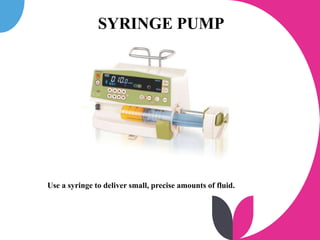
SYRINGE PUMP
Use a syringe to deliver small, precise amounts of fluid.
VOLUMETRIC PUMP
Designed to deliver large volumes of fluid.
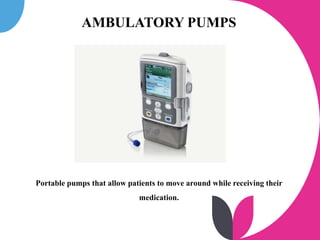
AMBULATORY PUMPS
Portable pumps that allow patients to move around while receiving their
medication.
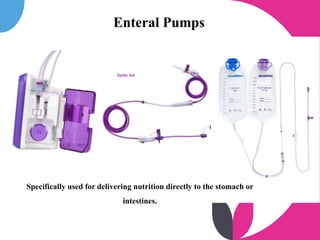
Enteral Pumps
Specifically used for delivering nutrition directly to the stomach or
intestines.
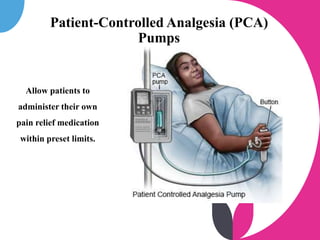
Patient-Controlled Analgesia (PCA)
Pumps
Allow patients to
administer their own
pain relief medication
within preset limits.
Preparation of a Patient for
Infusion Pump
Steps for Preparation
• Patient Assessment:
• Review the patient’s medical history and current
condition.
• Verify the prescription, including the type of medication,
dosage, and infusion rate.
• Equipment Preparation:
• Select the appropriate infusion pump based on the
medication and required infusion rate.
• Ensure the pump is functioning correctly and has been
properly calibrated.
• Prepare the medication as per the prescription, ensuring it
is at the correct temperature and properly mixed if
required.
• Load the medication into the pump, following the
manufacturer’s instructions.
• Site Selection and Preparation:
• Choose an appropriate infusion site, typically a vein in the
arm or a central line for long-term use.
• Clean the infusion site with an antiseptic solution to
reduce the risk of infection.
• Allow the antiseptic to dry completely before proceeding.
• Patient Preparation:
• Explain the procedure to the patient, addressing any
questions or concerns they may have.
• Ensure the patient is in a comfortable position and has
access to a call bell or other communication device.
• Apply a tourniquet above the selected infusion site if a
peripheral vein is being used.
• Insert the intravenous (IV) catheter or access the central
line, following standard sterile techniques.
• Secure the catheter in place with sterile adhesive tape or a
securement device.
• Infusion Pump Setup:
• Connect the IV tubing from the pump to the patient's IV
catheter.
• Prime the tubing to remove any air bubbles, which can
prevent air embolism.
• Set the infusion pump to the prescribed rate and volume,
double-checking all settings for accuracy.
• Start the infusion and observe the initial flow to ensure
there are no blockages or leaks.
• Monitoring and Documentation:
• Monitor the patient’s vital signs and the infusion site
regularly for signs of complications, such as infection,
infiltration, or phlebitis.
• Document the start time, medication details, infusion rate,
and any observations in the patient’s medical record.
• Educate the patient on signs and symptoms of potential
complications and when to alert the healthcare team.
• Ongoing Care:
• Regularly check the infusion pump to ensure it is
operating correctly and the medication is being delivered
as prescribed.
• Reassess the patient periodically and adjust the infusion
rate if needed, based on their response and medical orders.
• Change the infusion site as per protocol or if signs of
complications are detected.
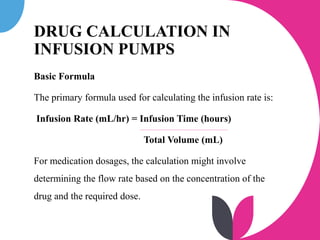
DRUG CALCULATION IN
INFUSION PUMPS
Basic Formula
The primary formula used for calculating the infusion rate is:
Infusion Rate (mL/hr) = Infusion Time (hours)
Total Volume (mL)​
For medication dosages, the calculation might involve
determining the flow rate based on the concentration of the
drug and the required dose.
Steps for Drug Calculation
1. Determine the Dosage Requirement:
• Prescribed Dose: Understand the prescribed dose from the healthcare
provider, typically given in mg/kg/hr, mcg/min, units/hr, etc.
• Patient's Weight: For weight-based dosing, ensure the patient's weight
is current and accurate.
2. Convert the Dosage:
• Units Consistency: Ensure all units are consistent (e.g., mg to mcg,
hours to minutes).
• Volume to be Infused: Calculate the total volume of medication to be
infused over a specific time.
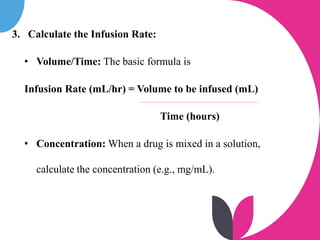
3. Calculate the Infusion Rate:
• Volume/Time: The basic formula is
Infusion Rate (mL/hr) = Volume to be infused (mL)
Time (hours)
• Concentration: When a drug is mixed in a solution,
calculate the concentration (e.g., mg/mL).
4. Dosage per Minute or Hour:
• Flow Rate Conversion: Convert the prescribed dose to the required
flow rate.
• Formula for Infusion Rate:
• For a dose prescribed in mg/kg/min:
Infusion Rate (mL/hr) = Dose (mg/kg/min)×Weight (kg)×60 (min/h)
Concentration (mg/mL)
• For a dose prescribed in mcg/kg/min:
Infusion Rate (mL/hr) = Dose (mcg/kg/min)×Weight (kg)×60 (min/hr)
Concentration (mcg/mL)
• For a dose prescribed in units/hr:
Infusion Rate (mL/hr)= Dose (units/hr)
Concentration (units/mL)
Example Calculations
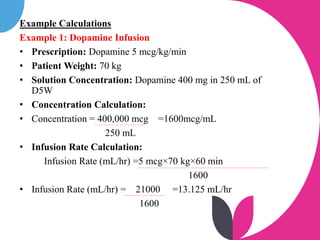
Example 1: Dopamine Infusion
• Prescription: Dopamine 5 mcg/kg/min
• Patient Weight: 70 kg
• Solution Concentration: Dopamine 400 mg in 250 mL of
D5W
• Concentration Calculation:
• Concentration = 400,000 mcg =1600mcg/mL
250 mL
• Infusion Rate Calculation:
Infusion Rate (mL/hr) =5 mcg×70 kg×60 min
1600
• Infusion Rate (mL/hr) = 21000 =13.125 mL/hr
1600
Example 2: Heparin Infusion
• Prescription: Heparin 1000 units/hr
• Solution Concentration: Heparin 25,000 units in 500 mL
of NS
• Concentration Calculation:
Concentration = 25000 units​ =50 units/mL
500 mL
• Infusion Rate Calculation:
Infusion Rate (mL/hr) = 1000 units/hr = 20 mL/hr
50 units/mL
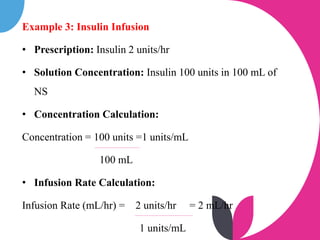
Example 3: Insulin Infusion
• Prescription: Insulin 2 units/hr
• Solution Concentration: Insulin 100 units in 100 mL of
NS
• Concentration Calculation:
Concentration = 100 units​ =1 units/mL
100 mL
• Infusion Rate Calculation:
Infusion Rate (mL/hr) = 2 units/hr​ = 2 mL/hr
1 units/mL
INFUSION PUMP.pptx

INFUSION PUMP.pptx

  • 1.
    INFUSION PUMP MS. SONAMSHARMA ASST. PROFESSOR
  • 2.
    INTRODUCTION An infusion pumpis a medical device that delivers fluids, such as nutrients and medications, into a patient's body in controlled amounts. Infusion pumps are commonly used in clinical settings such as hospitals, nursing homes, and in the home. They are used to administer a variety of fluids, including intravenous (IV) medications, blood transfusions, and total parenteral nutrition (TPN). Infusion pumps can deliver fluids at precisely programmed rates and volumes, which is critical for therapies that require accurate dosing over specific time periods.
  • 3.
    DEFINITION Infusion pumps aredevices that are used to deliver therapeutic fluids which can be either medication or nutrients at a predetermined rate.
  • 4.
    PURPOSE • Accurate MedicationDelivery • Administration of Nutritional Support • Continuous Pain Management • Chemotherapy • Hormone Therapy • Antibiotic and Antiviral Therapy • Cardiovascular Support
  • 5.
    USES OF INFUSIONPUMP  Chemotherapy  Pain management  Total parental nutrition  Anesthesia/sedation
  • 6.
  • 7.
    SYRINGE PUMP Use asyringe to deliver small, precise amounts of fluid.
  • 8.
    VOLUMETRIC PUMP Designed todeliver large volumes of fluid.
  • 9.
    AMBULATORY PUMPS Portable pumpsthat allow patients to move around while receiving their medication.
  • 10.
    Enteral Pumps Specifically usedfor delivering nutrition directly to the stomach or intestines.
  • 11.
    Patient-Controlled Analgesia (PCA) Pumps Allowpatients to administer their own pain relief medication within preset limits.
  • 13.
    Preparation of aPatient for Infusion Pump Steps for Preparation • Patient Assessment: • Review the patient’s medical history and current condition. • Verify the prescription, including the type of medication, dosage, and infusion rate.
  • 14.
    • Equipment Preparation: •Select the appropriate infusion pump based on the medication and required infusion rate. • Ensure the pump is functioning correctly and has been properly calibrated. • Prepare the medication as per the prescription, ensuring it is at the correct temperature and properly mixed if required. • Load the medication into the pump, following the manufacturer’s instructions.
  • 15.
    • Site Selectionand Preparation: • Choose an appropriate infusion site, typically a vein in the arm or a central line for long-term use. • Clean the infusion site with an antiseptic solution to reduce the risk of infection. • Allow the antiseptic to dry completely before proceeding.
  • 16.
    • Patient Preparation: •Explain the procedure to the patient, addressing any questions or concerns they may have. • Ensure the patient is in a comfortable position and has access to a call bell or other communication device. • Apply a tourniquet above the selected infusion site if a peripheral vein is being used. • Insert the intravenous (IV) catheter or access the central line, following standard sterile techniques. • Secure the catheter in place with sterile adhesive tape or a securement device.
  • 17.
    • Infusion PumpSetup: • Connect the IV tubing from the pump to the patient's IV catheter. • Prime the tubing to remove any air bubbles, which can prevent air embolism. • Set the infusion pump to the prescribed rate and volume, double-checking all settings for accuracy. • Start the infusion and observe the initial flow to ensure there are no blockages or leaks.
  • 18.
    • Monitoring andDocumentation: • Monitor the patient’s vital signs and the infusion site regularly for signs of complications, such as infection, infiltration, or phlebitis. • Document the start time, medication details, infusion rate, and any observations in the patient’s medical record. • Educate the patient on signs and symptoms of potential complications and when to alert the healthcare team.
  • 19.
    • Ongoing Care: •Regularly check the infusion pump to ensure it is operating correctly and the medication is being delivered as prescribed. • Reassess the patient periodically and adjust the infusion rate if needed, based on their response and medical orders. • Change the infusion site as per protocol or if signs of complications are detected.
  • 20.
    DRUG CALCULATION IN INFUSIONPUMPS Basic Formula The primary formula used for calculating the infusion rate is: Infusion Rate (mL/hr) = Infusion Time (hours) Total Volume (mL)​ For medication dosages, the calculation might involve determining the flow rate based on the concentration of the drug and the required dose.
  • 21.
    Steps for DrugCalculation 1. Determine the Dosage Requirement: • Prescribed Dose: Understand the prescribed dose from the healthcare provider, typically given in mg/kg/hr, mcg/min, units/hr, etc. • Patient's Weight: For weight-based dosing, ensure the patient's weight is current and accurate. 2. Convert the Dosage: • Units Consistency: Ensure all units are consistent (e.g., mg to mcg, hours to minutes). • Volume to be Infused: Calculate the total volume of medication to be infused over a specific time.
  • 22.
    3. Calculate theInfusion Rate: • Volume/Time: The basic formula is Infusion Rate (mL/hr) = Volume to be infused (mL) Time (hours) • Concentration: When a drug is mixed in a solution, calculate the concentration (e.g., mg/mL).
  • 23.
    4. Dosage perMinute or Hour: • Flow Rate Conversion: Convert the prescribed dose to the required flow rate. • Formula for Infusion Rate: • For a dose prescribed in mg/kg/min: Infusion Rate (mL/hr) = Dose (mg/kg/min)×Weight (kg)×60 (min/h) Concentration (mg/mL) • For a dose prescribed in mcg/kg/min: Infusion Rate (mL/hr) = Dose (mcg/kg/min)×Weight (kg)×60 (min/hr) Concentration (mcg/mL) • For a dose prescribed in units/hr: Infusion Rate (mL/hr)= Dose (units/hr) Concentration (units/mL)
  • 24.
    Example Calculations Example 1:Dopamine Infusion • Prescription: Dopamine 5 mcg/kg/min • Patient Weight: 70 kg • Solution Concentration: Dopamine 400 mg in 250 mL of D5W • Concentration Calculation: • Concentration = 400,000 mcg =1600mcg/mL 250 mL • Infusion Rate Calculation: Infusion Rate (mL/hr) =5 mcg×70 kg×60 min 1600 • Infusion Rate (mL/hr) = 21000 =13.125 mL/hr 1600
  • 25.
    Example 2: HeparinInfusion • Prescription: Heparin 1000 units/hr • Solution Concentration: Heparin 25,000 units in 500 mL of NS • Concentration Calculation: Concentration = 25000 units​ =50 units/mL 500 mL • Infusion Rate Calculation: Infusion Rate (mL/hr) = 1000 units/hr = 20 mL/hr 50 units/mL
  • 26.
    Example 3: InsulinInfusion • Prescription: Insulin 2 units/hr • Solution Concentration: Insulin 100 units in 100 mL of NS • Concentration Calculation: Concentration = 100 units​ =1 units/mL 100 mL • Infusion Rate Calculation: Infusion Rate (mL/hr) = 2 units/hr​ = 2 mL/hr 1 units/mL