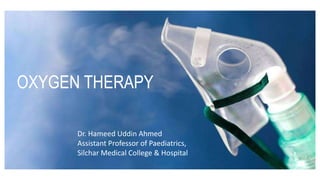
OXYGEN THERAPY
Dr. Hameed Uddin Ahmed
Assistant Professor of Paediatrics,
Silchar Medical College & Hospital
OXYGEN
▪ 8TH Element on the Periodic table
▪ O2
▪ 20.9% of air by volume
▪ 50% of earth’s crust by weight
▪ Oxidizer
▪ Non-flammable
▪ OXYGEN THERAPY IS USUALLY DEFINED AS
THE ADMINISTRATION OF OXYGEN AT
CONCENTRATIONS GREATER THAN THOSE
FOUND IN AMBIENT AIR.
GOALS
HYPOXIA- a condition where the amount of oxygen available to the cells is not adequate to
meet the metabolic need. It can exist even though hypoxemia has been corrected with oxygen
therapy.
(high altitudes,reduced hct,CO poisoning,shock,cyanide poisoning etc)
HYPOXEMIA- decrease in the partial pressure of Oxygen - < 55mmHg.
( high alt,copd,cardiac shunts,atelectasis,ILD, Hb def)
TO PREVENT OR TREAT HYPOXEMIA, THEREBY PREVENTING TISSUE HYPOXIA,
WHICH IF NOT TREATED OR PREVENTED MAY LEAD TO TISSUE INJURY OR EVEN
CELL DEATH.
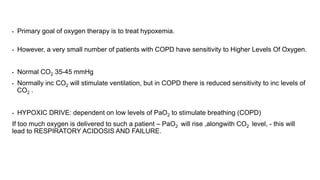
▪ Primary goal of oxygen therapy is to treat hypoxemia.
▪ However, a very small number of patients with COPD have sensitivity to Higher Levels Of Oxygen.
▪ Normal CO2 35-45 mmHg
▪ Normally inc CO2 will stimulate ventilation, but in COPD there is reduced sensitivity to inc levels of
CO2 .
▪ HYPOXIC DRIVE: dependent on low levels of PaO2 to stimulate breathing (COPD)
If too much oxygen is delivered to such a patient – PaO2 will rise ,alongwith CO2 level, - this will
lead to RESPIRATORY ACIDOSIS AND FAILURE.
EFFECTS OF HYPOXIA
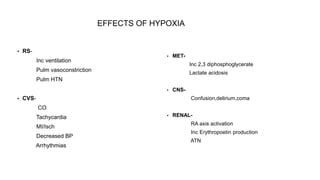
▪ RS-
Inc ventilation
Pulm vasoconstriction
Pulm HTN
▪ CVS-
CO
Tachycardia
MI/Isch
Decreased BP
Arrhythmias
▪ MET-
Inc 2,3 diphosphoglycerate
Lactate acidosis
▪ CNS-
Confusion,delirium,coma
▪ RENAL-
RA axis activation
Inc Erythropoetin production
ATN
QUICK GLANCE AT OXYGEN TRANSPORT
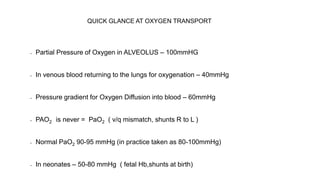
▪ Partial Pressure of Oxygen in ALVEOLUS – 100mmHG
▪ In venous blood returning to the lungs for oxygenation – 40mmHg
▪ Pressure gradient for Oxygen Diffusion into blood – 60mmHg
▪ PAO2 is never = PaO2 ( v/q mismatch, shunts R to L )
▪ Normal PaO2 90-95 mmHg (in practice taken as 80-100mmHg)
▪ In neonates – 50-80 mmHg ( fetal Hb,shunts at birth)
GUIDING PRINCIPLES
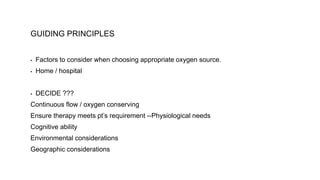
▪ Factors to consider when choosing appropriate oxygen source.
▪ Home / hospital
▪ DECIDE ???
Continuous flow / oxygen conserving
Ensure therapy meets pt’s requirement --Physiological needs
Cognitive ability
Environmental considerations
Geographic considerations
INDICATIONS
▪ Respiratory failure
▪ MI
▪ Cardiac failure
▪ Shock
▪ Anaemia
▪ Trauma, burns, sepsis – hypermetabolic state
▪ CO/Cyanide poisoning
▪ CPR
▪ Recovery from anaesthesia
▪ Respiratory Failure
Type I – resp system cannot adequately provide oxygen to the body =
HYPOXEMIA
Cardiogenic/non cardiogenic PE, ARDS, COVID 19, pneumonia
Type II – resp system cannot sufficiently remove carbon dioxide = HYPERCAPNIA
COPD, RESP MUSCLE WEAKNESS, chest wall deformities, CNS depression
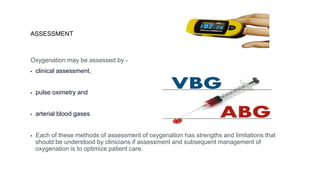
ASSESSMENT
Oxygenation may be assessed by -
▪ clinical assessment,
▪ pulse oximetry and
▪ arterial blood gases.
▪ Each of these methods of assessment of oxygenation has strengths and limitations that
should be understood by clinicians if assessment and subsequent management of
oxygenation is to optimize patient care.
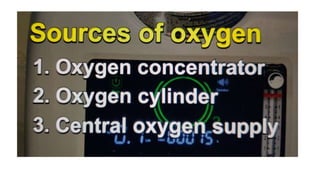
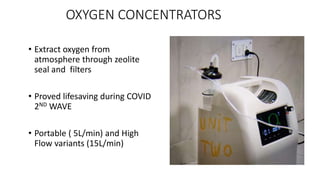
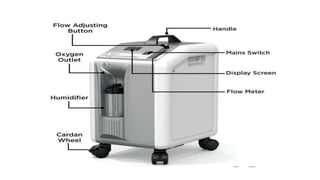
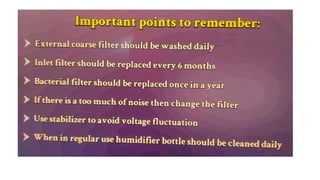
OXYGEN CONCENTRATORS
• Extract oxygen from
atmosphere through zeolite
seal and filters
• Proved lifesaving during COVID
2ND WAVE
• Portable ( 5L/min) and High
Flow variants (15L/min)
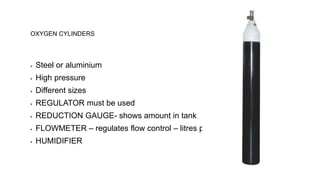
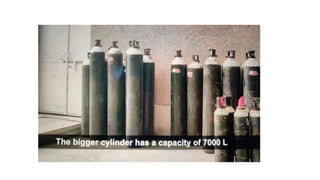
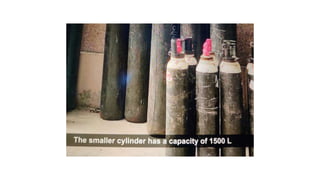
OXYGEN CYLINDERS
▪ Steel or aluminium
▪ High pressure
▪ Different sizes
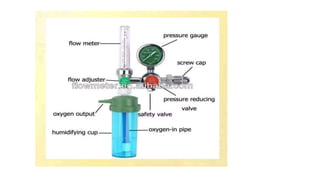
▪ REGULATOR must be used
▪ REDUCTION GAUGE- shows amount in tank
▪ FLOWMETER – regulates flow control – litres per minute
▪ HUMIDIFIER
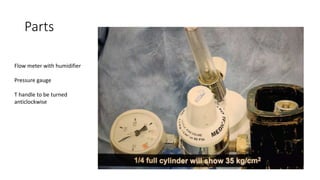
Parts
Flow meter with humidifier
Pressure gauge
T handle to be turned
anticlockwise
This Photo by Unknown Author is licensed under
CC BY
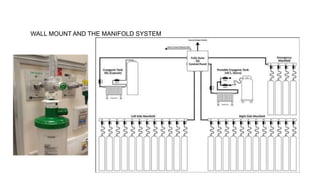
WALL MOUNT AND THE MANIFOLD SYSTEM
METHODS OF ADMINISTRATION
This Photo by
Unknown Author is
licensed under CC
BY
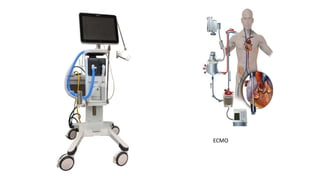
ECMO
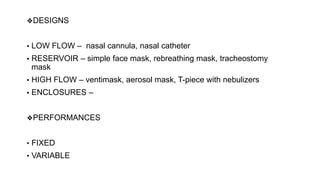
❖DESIGNS
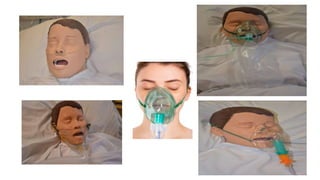
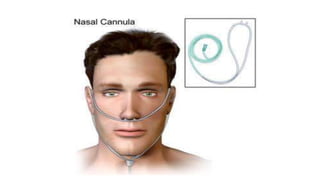
▪ LOW FLOW – nasal cannula, nasal catheter
▪ RESERVOIR – simple face mask, rebreathing mask, tracheostomy
mask
▪ HIGH FLOW – ventimask, aerosol mask, T-piece with nebulizers
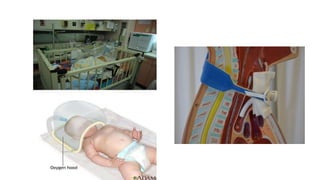
▪ ENCLOSURES –
❖PERFORMANCES
• FIXED
• VARIABLE
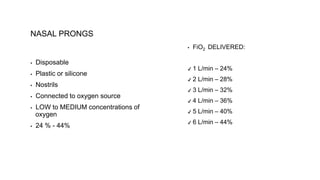
NASAL PRONGS
▪ Disposable
▪ Plastic or silicone
▪ Nostrils
▪ Connected to oxygen source
▪ LOW to MEDIUM concentrations of
oxygen
▪ 24 % - 44%
▪ FiO2 DELIVERED:
✔ 1 L/min – 24%
✔ 2 L/min – 28%
✔ 3 L/min – 32%
✔ 4 L/min – 36%
✔ 5 L/min – 40%
✔ 6 L/min – 44%
ADVANTAGES OF NASAL PRONGS
▪ Can talk and communicate
▪ Easy to use ( home/hospital )
▪ Safe and simple
▪ Easily tolerated
DISADVANTAGES OF NASAL PRONGS
▪ Nasal obstruction – no use
▪ Easily dislodged
▪ Habitual mouth breathers – no use
▪ Drying of mucous membranes ..
> 4 L/min , humidify
▪ Breathing pattern affects FiO2
FACE MASK (SIMPLE)
▪ Clear, flexible,molded plastic to fit the
face
▪ Held with elastic bands
▪ Metal clip over nasal bridge area for
closer comfortable fit
▪ Exhalation ports
▪ 35% - 60%
▪ 6 to 10 L/min
▪ Can be used when increased oxygen
delivery is needed for periods of < 12
hrs.
DISADVANTAGES:
. Tight seal required
. Difficult to maintain position
. Skin affected – pressure / moisture
. Eating / talking hampered
. Costs more than nasal prongs
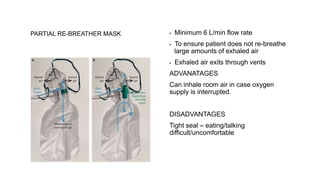
PARTIAL RE-BREATHER MASK ▪ Minimum 6 L/min flow rate
▪ To ensure patient does not re-breathe
large amounts of exhaled air
▪ Exhaled air exits through vents
ADVANATAGES
Can inhale room air in case oxygen
supply is interrupted.
DISADVANTAGES
Tight seal – eating/talking
difficult/uncomfortable
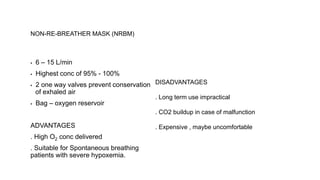
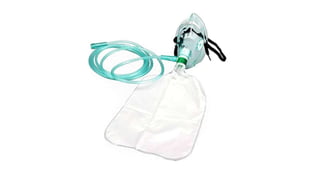
NON-RE-BREATHER MASK (NRBM)
▪ 6 – 15 L/min
▪ Highest conc of 95% - 100%
▪ 2 one way valves prevent conservation
of exhaled air
▪ Bag – oxygen reservoir
ADVANTAGES
. High O2 conc delivered
. Suitable for Spontaneous breathing
patients with severe hypoxemia.
DISADVANTAGES
. Long term use impractical
. CO2 buildup in case of malfunction
. Expensive , maybe uncomfortable
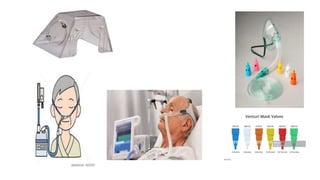
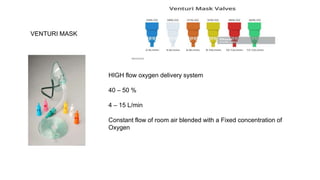
VENTURI MASK
HIGH flow oxygen delivery system
40 – 50 %
4 – 15 L/min
Constant flow of room air blended with a Fixed concentration of
Oxygen
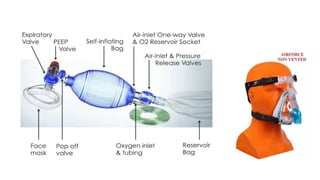
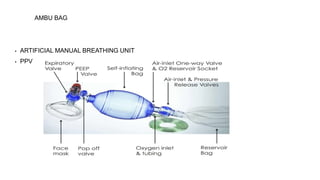
AMBU BAG
▪ ARTIFICIAL MANUAL BREATHING UNIT
▪ PPV
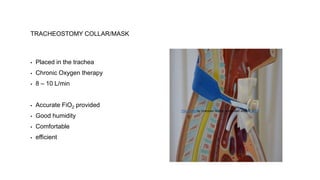
TRACHEOSTOMY COLLAR/MASK
▪ Placed in the trachea
▪ Chronic Oxygen therapy
▪ 8 – 10 L/min
▪ Accurate FiO2 provided
▪ Good humidity
▪ Comfortable
▪ efficient
This Photo by Unknown Author is licensed under CC BY
CPAP / BIPAP
INDICATIONS:
COPD / Ac BRONCHITIS / PNEUMONIA / FLAIL CHEST / OBESITY / OSA / CHF
▪ BIPAP / Bi-Level PAP –
. inspiratory PAP and expiratory PAP
. Ramp Time – period during which the therapy pressure increases from a low
start pressure to the prescribed treatment pressure.
. pressure range – 4 to 30 cmH2O
. initial settings –
8 to 10 cmH2O ( upto 24 cmH2O ) INHALATION
2 TO 4 cmH2O (upto 20 cmH2O ) EXHALATION
▪ CPAP
.Continuous Positive Airway Pressure
. 4 to 20 cmH2O – pressure range
. Avg pressure for OSA – 9 cmH2O
. Continuous positive pressure to keep the
airways open
CONTRAINDICATIONS:
Inability to protect airway
Secretion clearance is poor
Depressed sensorium
GI bleed with intractacble emesis
Status epilepticus
Patients on pressor support
SIDE EFFECTS / COMPLICATIONS OF OXYGEN THERAPY
▪ Toxicity
▪ Retrolental fibroplasia
▪ atelectasis
▪ To avoid oxygen toxicity FiO2 is typically
maintained below 50% even with
mechanical ventilation, but sometimes we
have to use 100% .
OXYGEN TOXICITY
▪ Due to high conc of oxygen inspired over a prolonged period of time
▪ Oxygen Conc > 50% over 24 – 48 hrs – pathological changes in the lung
▪ Oxidative damage to cell membranes leading to collapse of lungs
Muscle twitching
Vision loss, near sightedness, cataract formation,bleeding,fibrosis,
Seizures
Jerky breathing,irritation,coughing,pain,SOB, tracheobronchitis, ARDS
RETROLENTAL FIBROPLASIA
▪ Vasoconstriction and ischemia – blindness
▪ Premature infants
ABSORPTION ATELECTASIS
▪ 100% oxygen = washing out of Nitrogen in alveoli = oxygen entirely fills up the alveoli
▪ Oxygen diffuses faster than Nitrogen into blood in the pulmonary vasculature
=
decreased amount of gas in the alveoli to maintain patency of the alveoli
=
alveolar collapse
Oxygen therapy -Devices and Guidelines.pptx

Oxygen therapy -Devices and Guidelines.pptx

  • 1.
    OXYGEN THERAPY Dr. HameedUddin Ahmed Assistant Professor of Paediatrics, Silchar Medical College & Hospital
  • 2.
    OXYGEN ▪ 8TH Elementon the Periodic table ▪ O2 ▪ 20.9% of air by volume ▪ 50% of earth’s crust by weight ▪ Oxidizer ▪ Non-flammable
  • 3.
    ▪ OXYGEN THERAPYIS USUALLY DEFINED AS THE ADMINISTRATION OF OXYGEN AT CONCENTRATIONS GREATER THAN THOSE FOUND IN AMBIENT AIR.
  • 4.
    GOALS HYPOXIA- a conditionwhere the amount of oxygen available to the cells is not adequate to meet the metabolic need. It can exist even though hypoxemia has been corrected with oxygen therapy. (high altitudes,reduced hct,CO poisoning,shock,cyanide poisoning etc) HYPOXEMIA- decrease in the partial pressure of Oxygen - < 55mmHg. ( high alt,copd,cardiac shunts,atelectasis,ILD, Hb def) TO PREVENT OR TREAT HYPOXEMIA, THEREBY PREVENTING TISSUE HYPOXIA, WHICH IF NOT TREATED OR PREVENTED MAY LEAD TO TISSUE INJURY OR EVEN CELL DEATH.
  • 5.
    ▪ Primary goalof oxygen therapy is to treat hypoxemia. ▪ However, a very small number of patients with COPD have sensitivity to Higher Levels Of Oxygen. ▪ Normal CO2 35-45 mmHg ▪ Normally inc CO2 will stimulate ventilation, but in COPD there is reduced sensitivity to inc levels of CO2 . ▪ HYPOXIC DRIVE: dependent on low levels of PaO2 to stimulate breathing (COPD) If too much oxygen is delivered to such a patient – PaO2 will rise ,alongwith CO2 level, - this will lead to RESPIRATORY ACIDOSIS AND FAILURE.
  • 6.
    EFFECTS OF HYPOXIA ▪RS- Inc ventilation Pulm vasoconstriction Pulm HTN ▪ CVS- CO Tachycardia MI/Isch Decreased BP Arrhythmias ▪ MET- Inc 2,3 diphosphoglycerate Lactate acidosis ▪ CNS- Confusion,delirium,coma ▪ RENAL- RA axis activation Inc Erythropoetin production ATN
  • 7.
    QUICK GLANCE ATOXYGEN TRANSPORT ▪ Partial Pressure of Oxygen in ALVEOLUS – 100mmHG ▪ In venous blood returning to the lungs for oxygenation – 40mmHg ▪ Pressure gradient for Oxygen Diffusion into blood – 60mmHg ▪ PAO2 is never = PaO2 ( v/q mismatch, shunts R to L ) ▪ Normal PaO2 90-95 mmHg (in practice taken as 80-100mmHg) ▪ In neonates – 50-80 mmHg ( fetal Hb,shunts at birth)
  • 8.
    GUIDING PRINCIPLES ▪ Factorsto consider when choosing appropriate oxygen source. ▪ Home / hospital ▪ DECIDE ??? Continuous flow / oxygen conserving Ensure therapy meets pt’s requirement --Physiological needs Cognitive ability Environmental considerations Geographic considerations
  • 9.
    INDICATIONS ▪ Respiratory failure ▪MI ▪ Cardiac failure ▪ Shock ▪ Anaemia ▪ Trauma, burns, sepsis – hypermetabolic state ▪ CO/Cyanide poisoning ▪ CPR ▪ Recovery from anaesthesia
  • 10.
    ▪ Respiratory Failure TypeI – resp system cannot adequately provide oxygen to the body = HYPOXEMIA Cardiogenic/non cardiogenic PE, ARDS, COVID 19, pneumonia Type II – resp system cannot sufficiently remove carbon dioxide = HYPERCAPNIA COPD, RESP MUSCLE WEAKNESS, chest wall deformities, CNS depression
  • 11.
    ASSESSMENT Oxygenation may beassessed by - ▪ clinical assessment, ▪ pulse oximetry and ▪ arterial blood gases. ▪ Each of these methods of assessment of oxygenation has strengths and limitations that should be understood by clinicians if assessment and subsequent management of oxygenation is to optimize patient care.
  • 13.
    OXYGEN CONCENTRATORS • Extractoxygen from atmosphere through zeolite seal and filters • Proved lifesaving during COVID 2ND WAVE • Portable ( 5L/min) and High Flow variants (15L/min)
  • 16.
    OXYGEN CYLINDERS ▪ Steelor aluminium ▪ High pressure ▪ Different sizes ▪ REGULATOR must be used ▪ REDUCTION GAUGE- shows amount in tank ▪ FLOWMETER – regulates flow control – litres per minute ▪ HUMIDIFIER
  • 20.
    Parts Flow meter withhumidifier Pressure gauge T handle to be turned anticlockwise
  • 23.
    This Photo byUnknown Author is licensed under CC BY WALL MOUNT AND THE MANIFOLD SYSTEM
  • 25.
  • 26.
    This Photo by UnknownAuthor is licensed under CC BY
  • 30.
  • 31.
    ❖DESIGNS ▪ LOW FLOW– nasal cannula, nasal catheter ▪ RESERVOIR – simple face mask, rebreathing mask, tracheostomy mask ▪ HIGH FLOW – ventimask, aerosol mask, T-piece with nebulizers ▪ ENCLOSURES – ❖PERFORMANCES • FIXED • VARIABLE
  • 32.
    NASAL PRONGS ▪ Disposable ▪Plastic or silicone ▪ Nostrils ▪ Connected to oxygen source ▪ LOW to MEDIUM concentrations of oxygen ▪ 24 % - 44% ▪ FiO2 DELIVERED: ✔ 1 L/min – 24% ✔ 2 L/min – 28% ✔ 3 L/min – 32% ✔ 4 L/min – 36% ✔ 5 L/min – 40% ✔ 6 L/min – 44%
  • 34.
    ADVANTAGES OF NASALPRONGS ▪ Can talk and communicate ▪ Easy to use ( home/hospital ) ▪ Safe and simple ▪ Easily tolerated DISADVANTAGES OF NASAL PRONGS ▪ Nasal obstruction – no use ▪ Easily dislodged ▪ Habitual mouth breathers – no use ▪ Drying of mucous membranes .. > 4 L/min , humidify ▪ Breathing pattern affects FiO2
  • 35.
    FACE MASK (SIMPLE) ▪Clear, flexible,molded plastic to fit the face ▪ Held with elastic bands ▪ Metal clip over nasal bridge area for closer comfortable fit ▪ Exhalation ports ▪ 35% - 60% ▪ 6 to 10 L/min ▪ Can be used when increased oxygen delivery is needed for periods of < 12 hrs. DISADVANTAGES: . Tight seal required . Difficult to maintain position . Skin affected – pressure / moisture . Eating / talking hampered . Costs more than nasal prongs
  • 36.
    PARTIAL RE-BREATHER MASK▪ Minimum 6 L/min flow rate ▪ To ensure patient does not re-breathe large amounts of exhaled air ▪ Exhaled air exits through vents ADVANATAGES Can inhale room air in case oxygen supply is interrupted. DISADVANTAGES Tight seal – eating/talking difficult/uncomfortable
  • 37.
    NON-RE-BREATHER MASK (NRBM) ▪6 – 15 L/min ▪ Highest conc of 95% - 100% ▪ 2 one way valves prevent conservation of exhaled air ▪ Bag – oxygen reservoir ADVANTAGES . High O2 conc delivered . Suitable for Spontaneous breathing patients with severe hypoxemia. DISADVANTAGES . Long term use impractical . CO2 buildup in case of malfunction . Expensive , maybe uncomfortable
  • 39.
    VENTURI MASK HIGH flowoxygen delivery system 40 – 50 % 4 – 15 L/min Constant flow of room air blended with a Fixed concentration of Oxygen
  • 40.
    AMBU BAG ▪ ARTIFICIALMANUAL BREATHING UNIT ▪ PPV
  • 41.
    TRACHEOSTOMY COLLAR/MASK ▪ Placedin the trachea ▪ Chronic Oxygen therapy ▪ 8 – 10 L/min ▪ Accurate FiO2 provided ▪ Good humidity ▪ Comfortable ▪ efficient This Photo by Unknown Author is licensed under CC BY
  • 42.
    CPAP / BIPAP INDICATIONS: COPD/ Ac BRONCHITIS / PNEUMONIA / FLAIL CHEST / OBESITY / OSA / CHF ▪ BIPAP / Bi-Level PAP – . inspiratory PAP and expiratory PAP . Ramp Time – period during which the therapy pressure increases from a low start pressure to the prescribed treatment pressure. . pressure range – 4 to 30 cmH2O . initial settings – 8 to 10 cmH2O ( upto 24 cmH2O ) INHALATION 2 TO 4 cmH2O (upto 20 cmH2O ) EXHALATION
  • 43.
    ▪ CPAP .Continuous PositiveAirway Pressure . 4 to 20 cmH2O – pressure range . Avg pressure for OSA – 9 cmH2O . Continuous positive pressure to keep the airways open CONTRAINDICATIONS: Inability to protect airway Secretion clearance is poor Depressed sensorium GI bleed with intractacble emesis Status epilepticus Patients on pressor support
  • 44.
    SIDE EFFECTS /COMPLICATIONS OF OXYGEN THERAPY ▪ Toxicity ▪ Retrolental fibroplasia ▪ atelectasis ▪ To avoid oxygen toxicity FiO2 is typically maintained below 50% even with mechanical ventilation, but sometimes we have to use 100% .
  • 45.
    OXYGEN TOXICITY ▪ Dueto high conc of oxygen inspired over a prolonged period of time ▪ Oxygen Conc > 50% over 24 – 48 hrs – pathological changes in the lung ▪ Oxidative damage to cell membranes leading to collapse of lungs Muscle twitching Vision loss, near sightedness, cataract formation,bleeding,fibrosis, Seizures Jerky breathing,irritation,coughing,pain,SOB, tracheobronchitis, ARDS
  • 46.
    RETROLENTAL FIBROPLASIA ▪ Vasoconstrictionand ischemia – blindness ▪ Premature infants
  • 47.
    ABSORPTION ATELECTASIS ▪ 100%oxygen = washing out of Nitrogen in alveoli = oxygen entirely fills up the alveoli ▪ Oxygen diffuses faster than Nitrogen into blood in the pulmonary vasculature = decreased amount of gas in the alveoli to maintain patency of the alveoli = alveolar collapse