Dr Sushma Saroa
Dr Vani Bhageria
OXYGEN THERAPY IS “THE
ADMINISTRATION OF OXYGEN AT
CONCENTRATIONS GREATER THAN THAT IN
AMBIENT AIR , WITH THE INTENT OF
TREATING OR PREVENTING THE SYMPTOM &
MANIFESTATION OF HYPOXIA.”
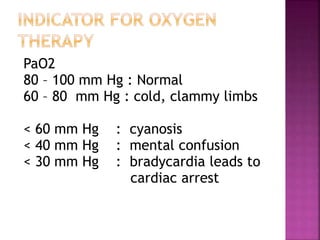
PaO2
80 – 100 mm Hg : Normal
60 – 80 mm Hg : cold, clammy limbs
< 60 mm Hg : cyanosis
< 40 mm Hg : mental confusion
< 30 mm Hg : bradycardia leads to
cardiac arrest
To maintain adequate
tissue oxygenation
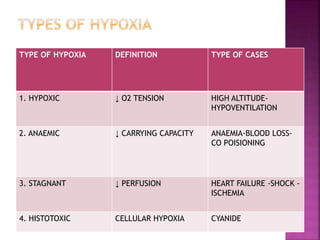
HYPOXIA
TYPE OF HYPOXIA DEFINITION TYPE OF CASES
1. HYPOXIC ↓ O2 TENSION HIGH ALTITUDE-
HYPOVENTILATION
2. ANAEMIC ↓ CARRYING CAPACITY ANAEMIA-BLOOD LOSS-
CO POISIONING
3. STAGNANT ↓ PERFUSION HEART FAILURE -SHOCK -
ISCHEMIA
4. HISTOTOXIC CELLULAR HYPOXIA CYANIDE
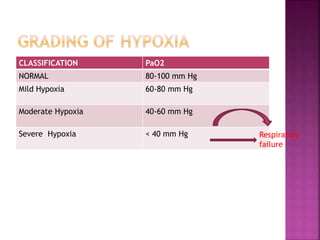
CLASSIFICATION PaO2
NORMAL 80-100 mm Hg
Mild Hypoxia 60-80 mm Hg
Moderate Hypoxia 40-60 mm Hg
Severe Hypoxia < 40 mm Hg Respiratory
failure
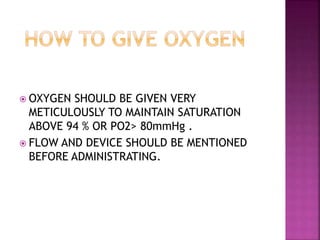
 OXYGEN SHOULD BE GIVEN VERY
METICULOUSLY TO MAINTAIN SATURATION
ABOVE 94 % OR PO2> 80mmHg .
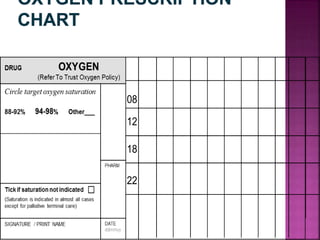
 FLOW AND DEVICE SHOULD BE MENTIONED
BEFORE ADMINISTRATING.
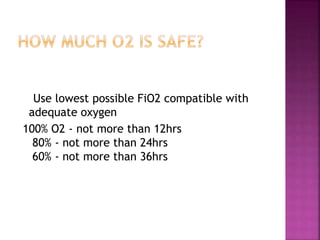
Use lowest possible FiO2 compatible with
adequate oxygen
100% O2 - not more than 12hrs
80% - not more than 24hrs
60% - not more than 36hrs
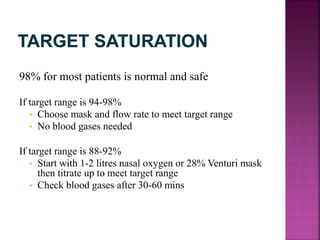
98% for most patients is normal and safe
If target range is 94-98%
• Choose mask and flow rate to meet target range
• No blood gases needed
If target range is 88-92%
• Start with 1-2 litres nasal oxygen or 28% Venturi mask
then titrate up to meet target range
• Check blood gases after 30-60 mins
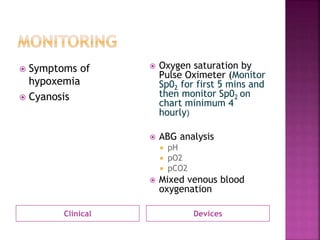
Clinical Devices
 Symptoms of
hypoxemia
 Cyanosis
 Oxygen saturation by
Pulse Oximeter (Monitor
Sp02 for first 5 mins and
then monitor Sp02 on
chart minimum 4
hourly)
 ABG analysis
 pH
 pO2
 pCO2
 Mixed venous blood
oxygenation
NO CONTRAINDICATIONS TO OXYGEN
HIGH CONCENTRATION HAVE DELETIRIOUS
EFFECTS
.
 NON PRODUCTIVE COUGH
 NAUSEA & VOMITING
 SUBSTERNAL CHEST PAIN
 FATIGUE
 NASAL STUFFINESS
 HEADACHE
 SORE THROAT
 HYPOVENTILATION
 NASAL CONGESTION
 DYSPNEA
 INSPIRATION PAIN
1. Fire hazard
2. Oxygen toxicity (Primarily affects lung and
CNS.)
3. Depression of ventilation
4. Retinopathy of Prematurity in new born
5. Absorption atelectasis
when the patient is clinically stable and has
maintained target SpO2 on low dose 02
therapy for 2 sets of observations
o Low flow (Variable performance devices )
 Nasal cannula
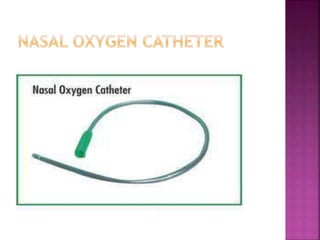
 Nasal catheter
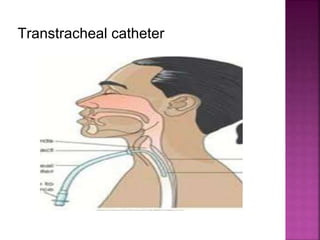
 Transtracheal catheter
o Reservoir system (Variable performance device)
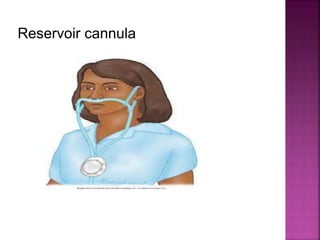
 Reservoir cannula
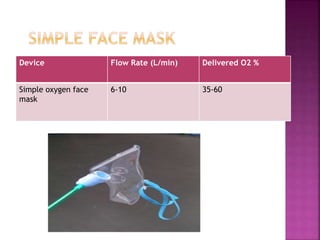
 Simple face mask
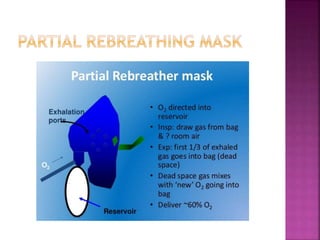
 Partial rebreathing mask
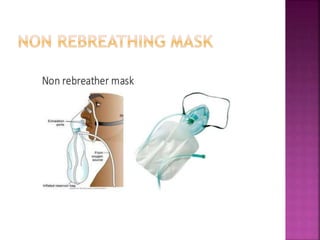
 Non rebreathing mask
 Tracheostomy mask
o High flow (Fixed performance devices)
 Ventimask (HAFOE)
 Aerosol mask and T-piece with nebulisers
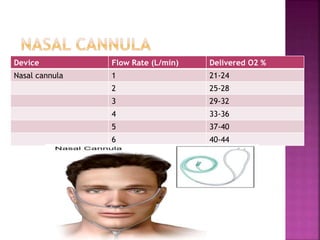
Device Flow Rate (L/min) Delivered O2 %
Nasal cannula 1 21-24
2 25-28
3 29-32
4 33-36
5 37-40
6 40-44
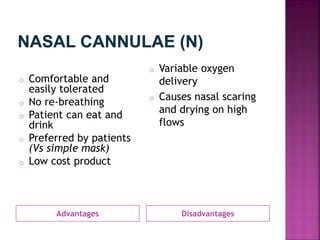
Advantages Disadvantages
o Comfortable and
easily tolerated
o No re-breathing
o Patient can eat and
drink
o Preferred by patients
(Vs simple mask)
o Low cost product
o Variable oxygen
delivery
o Causes nasal scaring
and drying on high
flows
Transtracheal catheter
Reservoir cannula
Device Flow Rate (L/min) Delivered O2 %
Simple oxygen face
mask
6-10 35-60
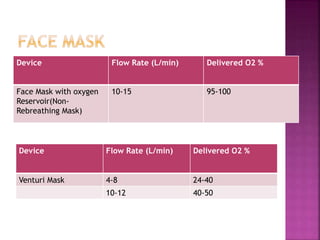
Device Flow Rate (L/min) Delivered O2 %
Venturi Mask 4-8 24-40
10-12 40-50
Device Flow Rate (L/min) Delivered O2 %
Face Mask with oxygen
Reservoir(Non-
Rebreathing Mask)
10-15 95-100
Advantages Disadvantages
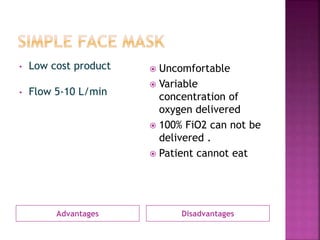
• Low cost product
• Flow 5-10 L/min
 Uncomfortable
 Variable
concentration of
oxygen delivered
 100% FiO2 can not be
delivered .
 Patient cannot eat
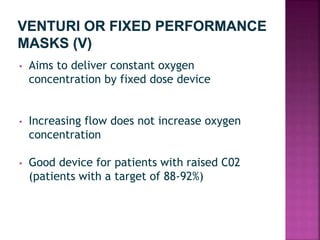
• Aims to deliver constant oxygen
concentration by fixed dose device
• Increasing flow does not increase oxygen
concentration
• Good device for patients with raised C02
(patients with a target of 88-92%)
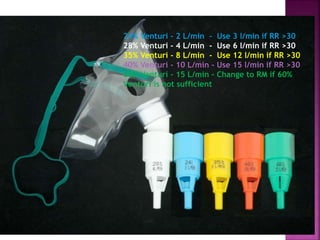
24% Venturi - 2 L/min - Use 3 l/min if RR >30
28% Venturi - 4 L/min - Use 6 l/min if RR >30
35% Venturi - 8 L/min - Use 12 l/min if RR >30
40% Venturi - 10 L/min - Use 15 l/min if RR >30
60% Venturi - 15 L/min - Change to RM if 60%
Venturi is not sufficient
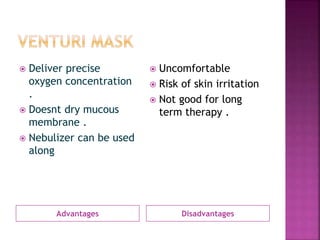
Advantages Disadvantages
 Deliver precise
oxygen concentration
.
 Doesnt dry mucous
membrane .
 Nebulizer can be used
along
 Uncomfortable
 Risk of skin irritation
 Not good for long
term therapy .
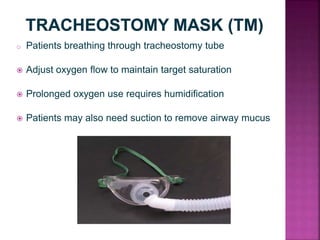
o Patients breathing through tracheostomy tube
 Adjust oxygen flow to maintain target saturation
 Prolonged oxygen use requires humidification
 Patients may also need suction to remove airway mucus
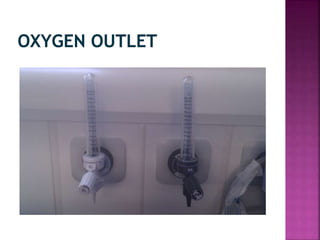
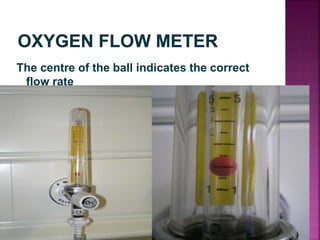
The centre of the ball indicates the correct
flow rate
THANK YOU

Oxygen therapy

  • 1.
    Dr Sushma Saroa DrVani Bhageria
  • 2.
    OXYGEN THERAPY IS“THE ADMINISTRATION OF OXYGEN AT CONCENTRATIONS GREATER THAN THAT IN AMBIENT AIR , WITH THE INTENT OF TREATING OR PREVENTING THE SYMPTOM & MANIFESTATION OF HYPOXIA.”
  • 3.
    PaO2 80 – 100mm Hg : Normal 60 – 80 mm Hg : cold, clammy limbs < 60 mm Hg : cyanosis < 40 mm Hg : mental confusion < 30 mm Hg : bradycardia leads to cardiac arrest
  • 4.
  • 5.
  • 6.
    TYPE OF HYPOXIADEFINITION TYPE OF CASES 1. HYPOXIC ↓ O2 TENSION HIGH ALTITUDE- HYPOVENTILATION 2. ANAEMIC ↓ CARRYING CAPACITY ANAEMIA-BLOOD LOSS- CO POISIONING 3. STAGNANT ↓ PERFUSION HEART FAILURE -SHOCK - ISCHEMIA 4. HISTOTOXIC CELLULAR HYPOXIA CYANIDE
  • 7.
    CLASSIFICATION PaO2 NORMAL 80-100mm Hg Mild Hypoxia 60-80 mm Hg Moderate Hypoxia 40-60 mm Hg Severe Hypoxia < 40 mm Hg Respiratory failure
  • 8.
     OXYGEN SHOULDBE GIVEN VERY METICULOUSLY TO MAINTAIN SATURATION ABOVE 94 % OR PO2> 80mmHg .  FLOW AND DEVICE SHOULD BE MENTIONED BEFORE ADMINISTRATING.
  • 9.
    Use lowest possibleFiO2 compatible with adequate oxygen 100% O2 - not more than 12hrs 80% - not more than 24hrs 60% - not more than 36hrs
  • 10.
    98% for mostpatients is normal and safe If target range is 94-98% • Choose mask and flow rate to meet target range • No blood gases needed If target range is 88-92% • Start with 1-2 litres nasal oxygen or 28% Venturi mask then titrate up to meet target range • Check blood gases after 30-60 mins
  • 11.
    Clinical Devices  Symptomsof hypoxemia  Cyanosis  Oxygen saturation by Pulse Oximeter (Monitor Sp02 for first 5 mins and then monitor Sp02 on chart minimum 4 hourly)  ABG analysis  pH  pO2  pCO2  Mixed venous blood oxygenation
  • 13.
    NO CONTRAINDICATIONS TOOXYGEN HIGH CONCENTRATION HAVE DELETIRIOUS EFFECTS .
  • 14.
     NON PRODUCTIVECOUGH  NAUSEA & VOMITING  SUBSTERNAL CHEST PAIN  FATIGUE  NASAL STUFFINESS  HEADACHE  SORE THROAT  HYPOVENTILATION  NASAL CONGESTION  DYSPNEA  INSPIRATION PAIN
  • 15.
    1. Fire hazard 2.Oxygen toxicity (Primarily affects lung and CNS.) 3. Depression of ventilation 4. Retinopathy of Prematurity in new born 5. Absorption atelectasis
  • 16.
    when the patientis clinically stable and has maintained target SpO2 on low dose 02 therapy for 2 sets of observations
  • 17.
    o Low flow(Variable performance devices )  Nasal cannula  Nasal catheter  Transtracheal catheter o Reservoir system (Variable performance device)  Reservoir cannula  Simple face mask  Partial rebreathing mask  Non rebreathing mask  Tracheostomy mask o High flow (Fixed performance devices)  Ventimask (HAFOE)  Aerosol mask and T-piece with nebulisers
  • 18.
    Device Flow Rate(L/min) Delivered O2 % Nasal cannula 1 21-24 2 25-28 3 29-32 4 33-36 5 37-40 6 40-44
  • 19.
    Advantages Disadvantages o Comfortableand easily tolerated o No re-breathing o Patient can eat and drink o Preferred by patients (Vs simple mask) o Low cost product o Variable oxygen delivery o Causes nasal scaring and drying on high flows
  • 21.
  • 22.
  • 23.
    Device Flow Rate(L/min) Delivered O2 % Simple oxygen face mask 6-10 35-60
  • 24.
    Device Flow Rate(L/min) Delivered O2 % Venturi Mask 4-8 24-40 10-12 40-50 Device Flow Rate (L/min) Delivered O2 % Face Mask with oxygen Reservoir(Non- Rebreathing Mask) 10-15 95-100
  • 25.
    Advantages Disadvantages • Lowcost product • Flow 5-10 L/min  Uncomfortable  Variable concentration of oxygen delivered  100% FiO2 can not be delivered .  Patient cannot eat
  • 28.
    • Aims todeliver constant oxygen concentration by fixed dose device • Increasing flow does not increase oxygen concentration • Good device for patients with raised C02 (patients with a target of 88-92%)
  • 29.
    24% Venturi -2 L/min - Use 3 l/min if RR >30 28% Venturi - 4 L/min - Use 6 l/min if RR >30 35% Venturi - 8 L/min - Use 12 l/min if RR >30 40% Venturi - 10 L/min - Use 15 l/min if RR >30 60% Venturi - 15 L/min - Change to RM if 60% Venturi is not sufficient
  • 30.
    Advantages Disadvantages  Deliverprecise oxygen concentration .  Doesnt dry mucous membrane .  Nebulizer can be used along  Uncomfortable  Risk of skin irritation  Not good for long term therapy .
  • 31.
    o Patients breathingthrough tracheostomy tube  Adjust oxygen flow to maintain target saturation  Prolonged oxygen use requires humidification  Patients may also need suction to remove airway mucus
  • 33.
    The centre ofthe ball indicates the correct flow rate
  • 34.