(1)
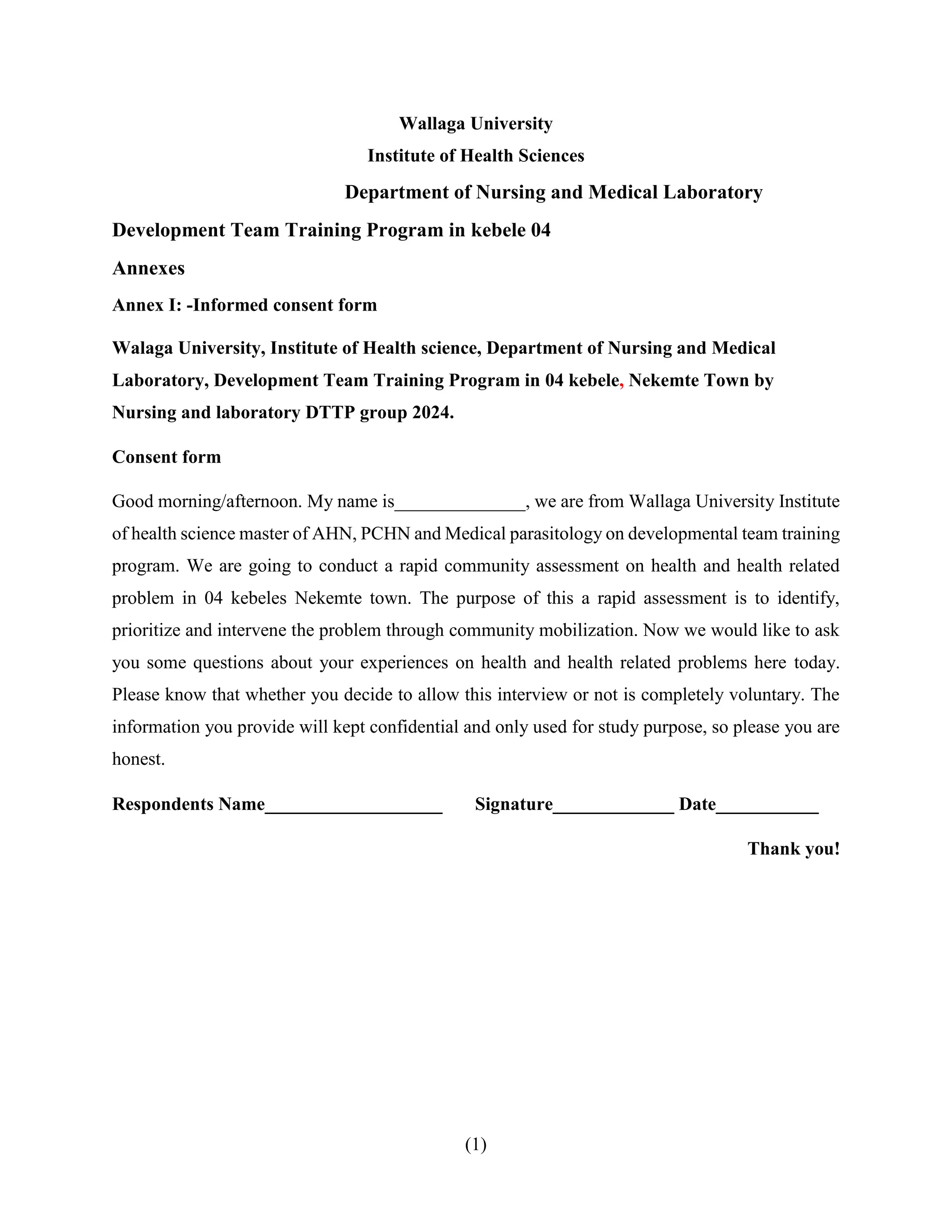
Wallaga University
Institute of Health Sciences
Department of Nursing and Medical Laboratory
Development Team Training Program in kebele 04
Annexes
Annex I: -Informed consent form
Walaga University, Institute of Health science, Department of Nursing and Medical
Laboratory, Development Team Training Program in 04 kebele, Nekemte Town by
Nursing and laboratory DTTP group 2024.
Consent form
Good morning/afternoon. My name is______________, we are from Wallaga University Institute
of health science master of AHN, PCHN and Medical parasitology on developmental team training
program. We are going to conduct a rapid community assessment on health and health related
problem in 04 kebeles Nekemte town. The purpose of this a rapid assessment is to identify,
prioritize and intervene the problem through community mobilization. Now we would like to ask
you some questions about your experiences on health and health related problems here today.
Please know that whether you decide to allow this interview or not is completely voluntary. The
information you provide will kept confidential and only used for study purpose, so please you are
honest.
Respondents Name___________________ Signature_____________ Date___________
Thank you!
(2)
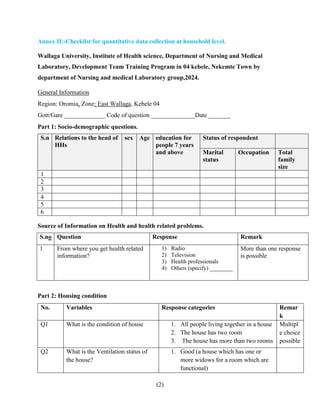
Annex II:-Checklist for quantitative data collection at household level.
Wallaga University, Institute of Health science, Department of Nursing and Medical
Laboratory, Development Team Training Program in 04 kebele, Nekemte Town by
department of Nursing and medical Laboratory group,2024.
General Information
Region: Oromia, Zone: East Wallaga, Kebele 04
Gott/Gare _____________ Code of question ______________Date _______
Part 1: Socio-demographic questions.
S.n Relations to the head of
HHs
sex Age education for
people 7 years
and above
Status of respondent
Marital
status
Occupation Total
family
size
1
2
3
4
5
6
Source of Information on Health and health related problems.
S.no Question Response Remark
1 From where you get health related
information?
1) Radio
2) Television
3) Health professionals
4) Others (specify) ________
More than one response
is possible
Part 2: Housing condition
No. Variables Response categories Remar
k
Q1 What is the condition of house 1. All people living together in a house
2. The house has two room
3. The house has more than two rooms
Multipl
e choice
possible
Q2 What is the Ventilation status of
the house?
1. Good (a house which has one or
more widows for a room which are
functional)
(3)
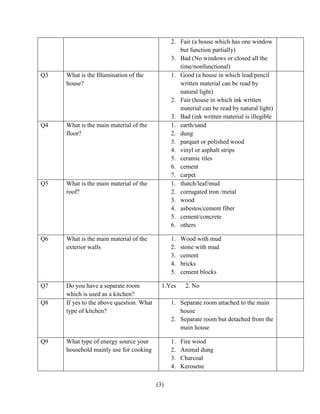
2. Fair (a house which has one window
but function partially)
3. Bad (No windows or closed all the
time/nonfunctional)
Q3 What is the Illumination of the
house?
1. Good (a house in which lead/pencil
written material can be read by
natural light)
2. Fair (house in which ink written
material can be read by natural light)
3. Bad (ink written material is illegible
Q4 What is the main material of the
floor?
1. earth/sand
2. dung
3. parquet or polished wood
4. vinyl or asphalt strips
5. ceramic tiles
6. cement
7. carpet
Q5 What is the main material of the
roof?
1. thatch/leaf/mud
2. corrugated iron /metal
3. wood
4. asbestos/cement fiber
5. cement/concrete
6. others
Q6 What is the main material of the
exterior walls
1. Wood with mud
2. stone with mud
3. cement
4. bricks
5. cement blocks
Q7 Do you have a separate room
which is used as a kitchen?
1.Yes 2. No
Q8 If yes to the above question. What
type of kitchen?
1. Separate room attached to the main
house
2. Separate room but detached from the
main house
Q9 What type of energy source your
household mainly use for cooking
1. Fire wood
2. Animal dung
3. Charcoal
4. Kerosene
(4)
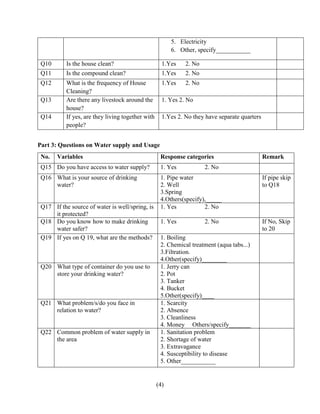
5. Electricity
6. Other, specify___________
Q10 Is the house clean? 1.Yes 2. No
Q11 Is the compound clean? 1.Yes 2. No
Q12 What is the frequency of House
Cleaning?
1.Yes 2. No
Q13 Are there any livestock around the
house?
1. Yes 2. No
Q14 If yes, are they living together with
people?
1.Yes 2. No they have separate quarters
Part 3: Questions on Water supply and Usage
No. Variables Response categories Remark
Q15 Do you have access to water supply? 1. Yes 2. No
Q16 What is your source of drinking
water?
1. Pipe water
2. Well
3.Spring
4.Others(specify),_____
If pipe skip
to Q18
Q17 If the source of water is well/spring, is
it protected?
1. Yes 2. No
Q18 Do you know how to make drinking
water safer?
1. Yes 2. No If No, Skip
to 20
Q19 If yes on Q 19, what are the methods? 1. Boiling
2. Chemical treatment (aqua tabs...)
3.Filtration.
4.Other(specify)________
Q20 What type of container do you use to
store your drinking water?
1. Jerry can
2. Pot
3. Tanker
4. Bucket
5.Other(specify)____
Q21 What problem/s/do you face in
relation to water?
1. Scarcity
2. Absence
3. Cleanliness
4. Money Others/specify_______
Q22 Common problem of water supply in
the area
1. Sanitation problem
2. Shortage of water
3. Extravagance
4. Susceptibility to disease
5. Other___________
(5)
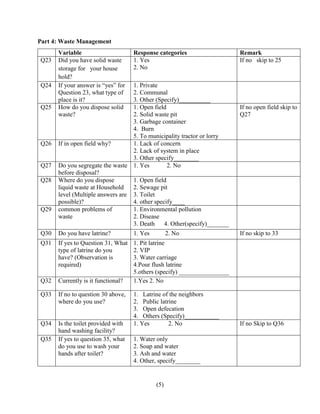
Part 4: Waste Management
Variable Response categories Remark
Q23 Did you have solid waste
storage for your house
hold?
1. Yes
2. No
If no skip to 25
Q24 If your answer is “yes” for
Question 23, what type of
place is it?
1. Private
2. Communal
3. Other (Specify)__________
Q25 How do you dispose solid
waste?
1. Open field
2. Solid waste pit
3. Garbage container
4. Burn
5. To municipality tractor or lorry
If no open field skip to
Q27
Q26 If in open field why? 1. Lack of concern
2. Lack of system in place
3. Other specify________
Q27 Do you segregate the waste
before disposal?
1. Yes 2. No
Q28 Where do you dispose
liquid waste at Household
level (Multiple answers are
possible)?
1. Open field
2. Sewage pit
3. Toilet
4. other specify____
Q29 common problems of
waste
1. Environmental pollution
2. Disease
3. Death 4. Other(specify)_______
Q30 Do you have latrine? 1. Yes 2. No If no skip to 33
Q31 If yes to Question 31, What
type of latrine do you
have? (Observation is
required)
1. Pit latrine
2. VIP
3. Water carriage
4.Pour flush latrine
5.others (specify) ________________
Q32 Currently is it functional? 1.Yes 2. No
Q33 If no to question 30 above,
where do you use?
1. Latrine of the neighbors
2. Public latrine
3. Open defecation
4. Others (Specify)___________
Q34 Is the toilet provided with
hand washing facility?
1. Yes 2. No If no Skip to Q36
Q35 If yes to question 35, what
do you use to wash your
hands after toilet?
1. Water only
2. Soap and water
3. Ash and water
4. Other, specify________
(6)
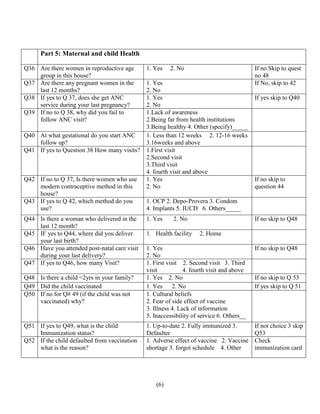
Part 5: Maternal and child Health
Q36 Are there women in reproductive age
group in this house?
1. Yes 2. No If no Skip to quest
no 48
Q37 Are there any pregnant women in the
last 12 months?
1. Yes
2. No
If No, skip to 42
Q38 If yes to Q 37, does she get ANC
service during your last pregnancy?
1. Yes
2. No
If yes skip to Q40
Q39 If no to Q 38, why did you fail to
follow ANC visit?
1.Lack of awareness
2.Being far from health institutions
3.Being healthy 4. Other (specify)_____
Q40 At what gestational do you start ANC
follow up?
1. Less than 12 weeks 2. 12-16 weeks
3.16weeks and above
Q41 If yes to Question 38 How many visits? 1.First visit
2.Second visit
3.Third visit
4. fourth visit and above
Q42 If no to Q 37, Is there women who use
modern contraceptive method in this
house?
1. Yes
2. No
If no skip to
question 44
Q43 If yes to Q 42, which method do you
use?
1. OCP 2. Depo-Provera 3. Condom
4. Implants 5. IUCD 6. Others_____
Q44 Is there a woman who delivered in the
last 12 month?
1. Yes 2. No If no skip to Q48
Q45 IF yes to Q44, where did you deliver
your last birth?
1. Health facility 2. Home
Q46 Have you attended post-natal care visit
during your last delivery?
1. Yes
2. No
If no skip to Q48
Q47 If yes to Q46, how many Visit? 1. First visit 2. Second visit 3. Third
visit 4. fourth visit and above
Q48 Is there a child <2yrs in your family? 1. Yes 2. No If no skip to Q 53
Q49 Did the child vaccinated 1. Yes 2. No If yes skip to Q 51
Q50 If no for Q# 49 (if the child was not
vaccinated) why?
1. Cultural beliefs
2. Fear of side effect of vaccine
3. Illness 4. Lack of information
5. Inaccessibility of service 6. Others__
Q51 If yes to Q49, what is the child
Immunization status?
1. Up-to-date 2. Fully immunized 3.
Defaulter
If not choice 3 skip
Q53
Q52 If the child defaulted from vaccination
what is the reason?
1. Adverse effect of vaccine 2. Vaccine
shortage 3. forgot schedule 4. Other
Check
immunization card
(7)
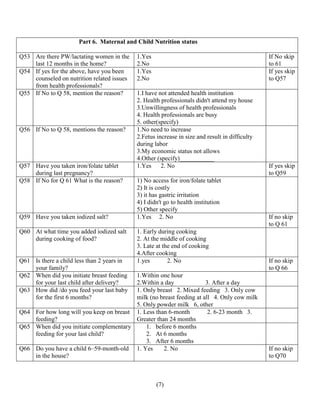
Part 6. Maternal and Child Nutrition status
Q53 Are there PW/lactating women in the
last 12 months in the home?
1.Yes
2.No
If No skip
to 61
Q54 If yes for the above, have you been
counseled on nutrition related issues
from health professionals?
1.Yes
2.No
If yes skip
to Q57
Q55 If No to Q 58, mention the reason? 1.I have not attended health institution
2. Health professionals didn't attend my house
3.Unwillingness of health professionals
4. Health professionals are busy
5. other(specify)
Q56 If No to Q 58, mentions the reason? 1.No need to increase
2.Fetus increase in size and result in difficulty
during labor
3.My economic status not allows
4.Other (specify)___________
Q57 Have you taken iron/folate tablet
during last pregnancy?
1.Yes 2. No If yes skip
to Q59
Q58 If No for Q 61 What is the reason? 1) No access for iron/folate tablet
2) It is costly
3) it has gastric irritation
4) I didn't go to health institution
5) Other specify
Q59 Have you taken iodized salt? 1.Yes 2. No If no skip
to Q 61
Q60 At what time you added iodized salt
during cooking of food?
1. Early during cooking
2. At the middle of cooking
3. Late at the end of cooking
4.After cooking
Q61 Is there a child less than 2 years in
your family?
1.yes 2. No If no skip
to Q 66
Q62 When did you initiate breast feeding
for your last child after delivery?
1.Within one hour
2.Within a day 3. After a day
Q63 How did /do you feed your last baby
for the first 6 months?
1. Only breast 2. Mixed feeding 3. Only cow
milk (no breast feeding at all 4. Only cow milk
5. Only powder milk 6, other
Q64 For how long will you keep on breast
feeding?
1. Less than 6-month 2. 6-23 month 3.
Greater than 24 months
Q65 When did you initiate complementary
feeding for your last child?
1. before 6 months
2. At 6 months
3. After 6 months
Q66 Do you have a child 6–59-month-old
in the house?
1. Yes 2. No If no skip
to Q70
(8)
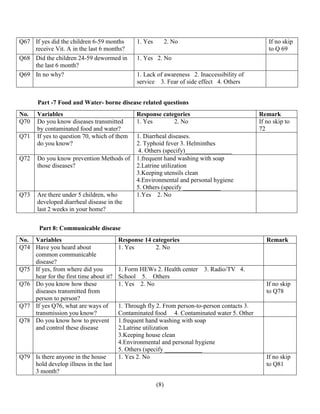
Q67 If yes did the children 6-59 months
receive Vit. A in the last 6 months?
1. Yes 2. No If no skip
to Q 69
Q68 Did the children 24-59 dewormed in
the last 6 month?
1. Yes 2. No
Q69 In no why? 1. Lack of awareness 2. Inaccessibility of
service 3. Fear of side effect 4. Others
Part -7 Food and Water- borne disease related questions
No. Variables Response categories Remark
Q70 Do you know diseases transmitted
by contaminated food and water?
1. Yes 2. No If no skip to
72
Q71 If yes to question 70, which of them
do you know?
1. Diarrheal diseases.
2. Typhoid fever 3. Helminthes
4. Others (specify)_______________
Q72 Do you know prevention Methods of
those diseases?
1.frequent hand washing with soap
2.Latrine utilization
3.Keeping utensils clean
4.Environmental and personal hygiene
5. Others (specify ____________
Q73 Are there under 5 children, who
developed diarrheal disease in the
last 2 weeks in your home?
1.Yes 2. No
Part 8: Communicable disease
No. Variables Response 14 categories Remark
Q74 Have you heard about
common communicable
disease?
1. Yes 2. No
Q75 If yes, from where did you
hear for the first time about it?
1. Form HEWs 2. Health center 3. Radio/TV 4.
School 5. Others
Q76 Do you know how these
diseases transmitted from
person to person?
1. Yes 2. No If no skip
to Q78
Q77 If yes Q76, what are ways of
transmission you know?
1. Through fly 2. From person-to-person contacts 3.
Contaminated food 4. Contaminated water 5. Other
Q78 Do you know how to prevent
and control these disease
1.frequent hand washing with soap
2.Latrine utilization
3.Keeping house clean
4.Environmental and personal hygiene
5. Others (specify ____________
Q79 Is there anyone in the house
hold develop illness in the last
3 month?
1. Yes 2. No If no skip
to Q81
(9)
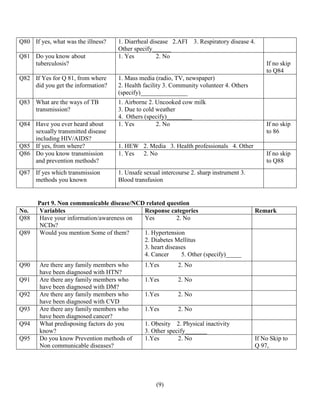
Q80 If yes, what was the illness? 1. Diarrheal disease 2.AFI 3. Respiratory disease 4.
Other specify______
Q81 Do you know about
tuberculosis?
1. Yes 2. No
If no skip
to Q84
Q82 If Yes for Q 81, from where
did you get the information?
1. Mass media (radio, TV, newspaper)
2. Health facility 3. Community volunteer 4. Others
(specify)_______________
Q83 What are the ways of TB
transmission?
1. Airborne 2. Uncooked cow milk
3. Due to cold weather
4. Others (specify)________
Q84 Have you ever heard about
sexually transmitted disease
including HIV/AIDS?
1. Yes 2. No If no skip
to 86
Q85 If yes, from where? 1. HEW 2. Media 3. Health professionals 4. Other
Q86 Do you know transmission
and prevention methods?
1. Yes 2. No If no skip
to Q88
Q87 If yes which transmission
methods you known
1. Unsafe sexual intercourse 2. sharp instrument 3.
Blood transfusion
Part 9. Non communicable disease/NCD related question
No. Variables Response categories Remark
Q88 Have your information/awareness on
NCDs?
Yes 2. No
Q89 Would you mention Some of them? 1. Hypertension
2. Diabetes Mellitus
3. heart diseases
4. Cancer 5. Other (specify)_____
Q90 Are there any family members who
have been diagnosed with HTN?
1.Yes 2. No
Q91 Are there any family members who
have been diagnosed with DM?
1.Yes 2. No
Q92 Are there any family members who
have been diagnosed with CVD
1.Yes 2. No
Q93 Are there any family members who
have been diagnosed cancer?
1.Yes 2. No
Q94 What predisposing factors do you
know?
1. Obesity 2. Physical inactivity
3. Other specify_______
Q95 Do you know Prevention methods of
Non communicable diseases?
1.Yes 2. No If No Skip to
Q 97,
(10)
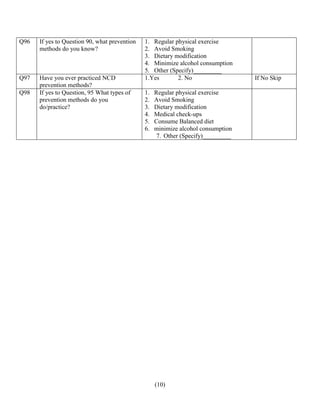
Q96 If yes to Question 90, what prevention
methods do you know?
1. Regular physical exercise
2. Avoid Smoking
3. Dietary modification
4. Minimize alcohol consumption
5. Other (Specify)_________
Q97 Have you ever practiced NCD
prevention methods?
1.Yes 2. No If No Skip
Q98 If yes to Question, 95 What types of
prevention methods do you
do/practice?
1. Regular physical exercise
2. Avoid Smoking
3. Dietary modification
4. Medical check-ups
5. Consume Balanced diet
6. minimize alcohol consumption
7. Other (Specify)_________
(11)
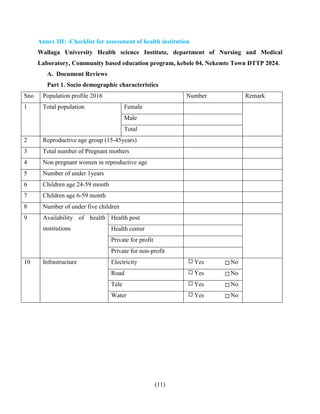
Annex III: -Checklist for assessment of health institution
Wallaga University Health science Institute, department of Nursing and Medical
Laboratory, Community based education program, kebele 04, Nekemte Town DTTP 2024.
A. Document Reviews
Part 1. Socio demographic characteristics
Sno Population profile 2016 Number Remark
1 Total population Female
Male
Total
2 Reproductive age group (15-45years)
3 Total number of Pregnant mothers
4 Non pregnant women in reproductive age
5 Number of under 1years
6 Children age 24-59 month
7 Children age 6-59 month
8 Number of under five children
9 Availability of health
institutions
Health post
Health center
Private for profit
Private for non-profit
10 Infrastructure Electricity Yes No
Road Yes No
Tele Yes No
Water Yes No
(12)
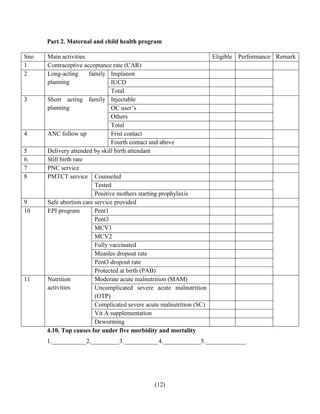
Part 2. Maternal and child health program
Sno Main activities Eligible Performance Remark
1 Contraceptive acceptance rate (CAR)
2 Long-acting family
planning
Implanon
IUCD
Total
3 Short acting family
planning
Injectable
OC user’s
Others
Total
4 ANC follow up Frist contact
Fourth contact and above
5 Delivery attended by skill birth attendant
6. Still birth rate
7 PNC service
8 PMTCT service Counseled
Tested
Positive mothers starting prophylaxis
9 Safe abortion care service provided
10 EPI program Pent1
Pent3
MCV1
MCV2
Fully vaccinated
Measles dropout rate
Pent3 dropout rate
Protected at birth (PAB)
11 Nutrition
activities
Moderate acute malnutrition (MAM)
Uncomplicated severe acute malnutrition
(OTP)
Complicated severe acute malnutrition (SC)
Vit A supplementation
Deworming
4.10. Top causes for under five morbidity and mortality
1.___________2._________3.___________4.____________5._____________
(13)
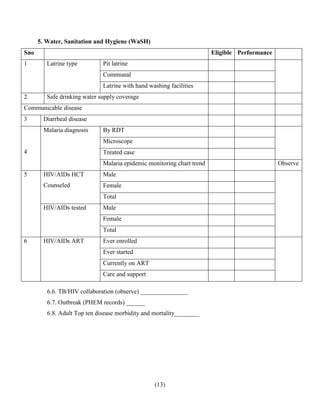
5. Water, Sanitation and Hygiene (WaSH)
Sno Eligible Performance
1 Latrine type Pit latrine
Communal
Latrine with hand washing facilities
2 Safe drinking water supply coverage
Communicable disease
3 Diarrheal disease
4
Malaria diagnosis By RDT
Microscope
Treated case
Malaria epidemic monitoring chart trend Observe
5 HIV/AIDs HCT
Counseled
Male
Female
Total
HIV/AIDs tested Male
Female
Total
6 HIV/AIDs ART Ever enrolled
Ever started
Currently on ART
Care and support
6.6. TB/HIV collaboration (observe) _______________
6.7. Outbreak (PHEM records) ______
6.8. Adult Top ten disease morbidity and mortality________
(14)
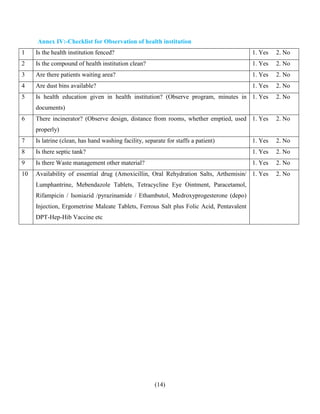
Annex IV:-Checklist for Observation of health institution
1 Is the health institution fenced? 1. Yes 2. No
2 Is the compound of health institution clean? 1. Yes 2. No
3 Are there patients waiting area? 1. Yes 2. No
4 Are dust bins available? 1. Yes 2. No
5 Is health education given in health institution? (Observe program, minutes in
documents)
1. Yes 2. No
6 There incinerator? (Observe design, distance from rooms, whether emptied, used
properly)
1. Yes 2. No
7 Is latrine (clean, has hand washing facility, separate for staffs a patient) 1. Yes 2. No
8 Is there septic tank? 1. Yes 2. No
9 Is there Waste management other material? 1. Yes 2. No
10 Availability of essential drug (Amoxicillin, Oral Rehydration Salts, Arthemisin/
Lumphantrine, Mebendazole Tablets, Tetracycline Eye Ointment, Paracetamol,
Rifampicin / Isoniazid /pyrazinamide / Ethambutol, Medroxyprogesterone (depo)
Injection, Ergometrine Maleate Tablets, Ferrous Salt plus Folic Acid, Pentavalent
DPT-Hep-Hib Vaccine etc
1. Yes 2. No
(15)
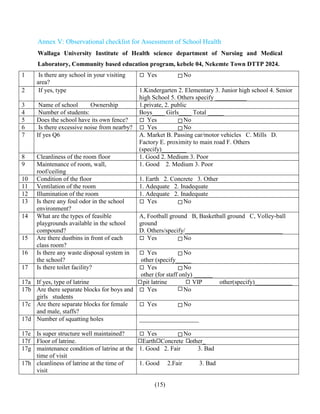
Annex V: Observational checklist for Assessment of School Health
Wallaga University Institute of Health science department of Nursing and Medical
Laboratory, Community based education program, kebele 04, Nekemte Town DTTP 2024.
1 Is there any school in your visiting
area?
Yes No
2 If yes, type 1.Kindergarten 2. Elementary 3. Junior high school 4. Senior
high School 5. Others specify __________
3 Name of school Ownership 1.private, 2. public
4 Number of students: Boys____ Girls____ Total _____
5 Does the school have its own fence? Yes No
6 Is there excessive noise from nearby? Yes No
7 If yes Q6 A. Market B. Passing car/motor vehicles C. Mills D.
Factory E. proximity to main road F. Others
(specify)________
8 Cleanliness of the room floor 1. Good 2. Medium 3. Poor
9 Maintenance of room, wall,
roof/ceiling
1. Good 2. Medium 3. Poor
10 Condition of the floor 1. Earth 2. Concrete 3. Other
11 Ventilation of the room 1. Adequate 2. Inadequate
12 Illumination of the room 1. Adequate 2. Inadequate
13 Is there any foul odor in the school
environment?
Yes No
14 What are the types of feasible
playgrounds available in the school
compound?
A, Football ground B, Basketball ground C, Volley-ball
ground
D. Others/specify/_______________________________
15 Are there dustbins in front of each
class room?
Yes No
16 Is there any waste disposal system in
the school?
Yes No
other (specify_____
17 Is there toilet facility? Yes No
other (for staff only) ______
17a If yes, type of latrine pit latrine VIP other(specify)____________
17b Are there separate blocks for boys and
girls students
Yes No
17c Are there separate blocks for female
and male, staffs?
Yes No
17d Number of squatting holes ___________________
17e Is super structure well maintained? Yes No
17f Floor of latrine. Earth Concrete other_
17g maintenance condition of latrine at the
time of visit
1. Good 2. Fair 3. Bad
17h cleanliness of latrine at the time of
visit
1. Good 2.Fair 3. Bad
(16)
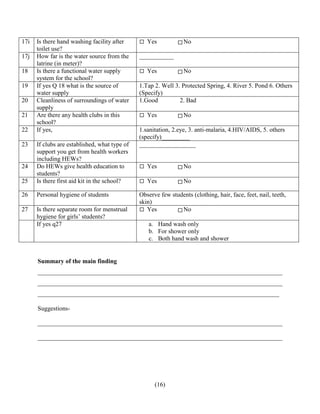
17i Is there hand washing facility after
toilet use?
Yes No
17j How far is the water source from the
latrine (in meter)?
___________
18 Is there a functional water supply
system for the school?
Yes No
19 If yes Q 18 what is the source of
water supply
1.Tap 2. Well 3. Protected Spring, 4. River 5. Pond 6. Others
(Specify)
20 Cleanliness of surroundings of water
supply
1.Good 2. Bad
21 Are there any health clubs in this
school?
Yes No
22 If yes, 1.sanitation, 2.eye, 3. anti-malaria, 4.HIV/AIDS, 5. others
(specify)_________
23 If clubs are established, what type of
support you get from health workers
including HEWs?
__________________
24 Do HEWs give health education to
students?
Yes No
25 Is there first aid kit in the school? Yes No
26 Personal hygiene of students Observe few students (clothing, hair, face, feet, nail, teeth,
skin)
27 Is there separate room for menstrual
hygiene for girls’ students?
Yes No
If yes q27 a. Hand wash only
b. For shower only
c. Both hand wash and shower
Summary of the main finding
______________________________________________________________________________
______________________________________________________________________________
_____________________________________________________________________________
Suggestions-
______________________________________________________________________________
______________________________________________________________________________
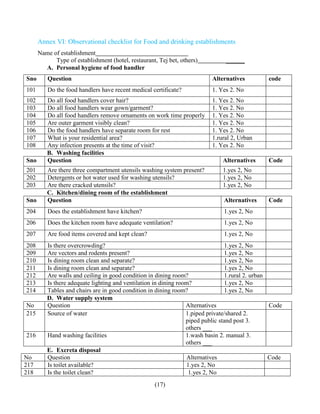
(17)
Annex VI: Observational checklist for Food and drinking establishments
Name of establishment
Type of establishment (hotel, restaurant, Tej bet, others) ______
A. Personal hygiene of food handler
Sno Question Alternatives code
101 Do the food handlers have recent medical certificate? 1. Yes 2. No
102 Do all food handlers cover hair? 1. Yes 2. No
103 Do all food handlers wear gown/garment? 1. Yes 2. No
104 Do all food handlers remove ornaments on work time properly 1. Yes 2. No
105 Are outer garment visibly clean? 1. Yes 2. No
106 Do the food handlers have separate room for rest 1. Yes 2. No
107 What is your residential area? 1.rural 2, Urban
108 Any infection presents at the time of visit? 1. Yes 2. No
B. Washing facilities
Sno Question Alternatives Code
201 Are there three compartment utensils washing system present? 1.yes 2, No
202 Detergents or hot water used for washing utensils? 1.yes 2, No
203 Are there cracked utensils? 1.yes 2, No
C. Kitchen/dining room of the establishment
Sno Question Alternatives Code
204 Does the establishment have kitchen? 1.yes 2, No
206 Does the kitchen room have adequate ventilation? 1.yes 2, No
207 Are food items covered and kept clean? 1.yes 2, No
208 Is there overcrowding? 1.yes 2, No
209 Are vectors and rodents present? 1.yes 2, No
210 Is dining room clean and separate? 1.yes 2, No
211 Is dining room clean and separate? 1.yes 2, No
212 Are walls and ceiling in good condition in dining room? 1.rural 2. urban
213 Is there adequate lighting and ventilation in dining room? 1.yes 2, No
214 Tables and chairs are in good condition in dining room? 1.yes 2, No
D. Water supply system
No Question Alternatives Code
215 Source of water 1.piped private/shared 2.
piped public stand post 3.
others ___
216 Hand washing facilities 1.wash basin 2. manual 3.
others ___
E. Excreta disposal
No Question Alternatives Code
217 Is toilet available? 1.yes 2, No
218 Is the toilet clean? 1.yes 2, No
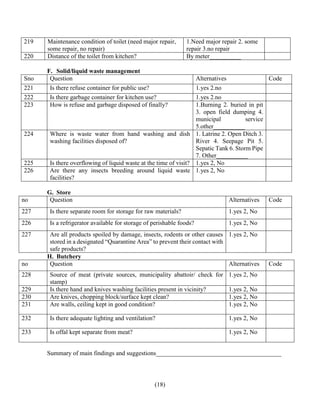
(18)
219 Maintenance condition of toilet (need major repair,
some repair, no repair)
1.Need major repair 2. some
repair 3.no repair
220 Distance of the toilet from kitchen? By meter__________
F. Solid/liquid waste management
Sno Question Alternatives Code
221 Is there refuse container for public use? 1.yes 2.no
222 Is there garbage container for kitchen use? 1.yes 2.no
223 How is refuse and garbage disposed of finally? 1.Burning 2. buried in pit
3. open field dumping 4.
municipal service
5.other__________
224 Where is waste water from hand washing and dish
washing facilities disposed of?
1. Latrine 2. Open Ditch 3.
River 4. Seepage Pit 5.
Sepatic Tank 6. Storm Pipe
7. Other__________
225 Is there overflowing of liquid waste at the time of visit? 1.yes 2, No
226 Are there any insects breeding around liquid waste
facilities?
1.yes 2, No
G. Store
no Question Alternatives Code
227 Is there separate room for storage for raw materials? 1.yes 2, No
226 Is a refrigerator available for storage of perishable foods? 1.yes 2, No
227 Are all products spoiled by damage, insects, rodents or other causes
stored in a designated “Quarantine Area” to prevent their contact with
safe products?
1.yes 2, No
H. Butchery
no Question Alternatives Code
228 Source of meat (private sources, municipality abattoir/ check for
stamp)
1.yes 2, No
229 Is there hand and knives washing facilities present in vicinity? 1.yes 2, No
230 Are knives, chopping block/surface kept clean? 1.yes 2, No
231 Are walls, ceiling kept in good condition? 1.yes 2, No
232 Is there adequate lighting and ventilation? 1.yes 2, No
233 Is offal kept separate from meat? 1.yes 2, No
Summary of main findings and suggestions________________________________________
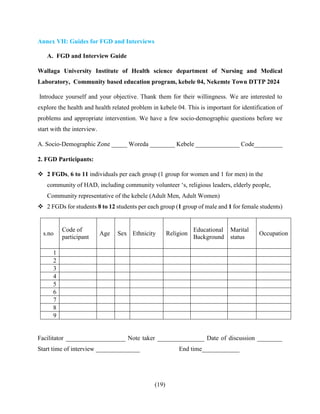
(19)
Annex VII: Guides for FGD and Interviews
A. FGD and Interview Guide
Wallaga University Institute of Health science department of Nursing and Medical
Laboratory, Community based education program, kebele 04, Nekemte Town DTTP 2024
Introduce yourself and your objective. Thank them for their willingness. We are interested to
explore the health and health related problem in kebele 04. This is important for identification of
problems and appropriate intervention. We have a few socio-demographic questions before we
start with the interview.
A. Socio-Demographic Zone _____ Woreda ________ Kebele ______________ Code_________
2. FGD Participants:
 2 FGDs, 6 to 11 individuals per each group (1 group for women and 1 for men) in the
community of HAD, including community volunteer ‘s, religious leaders, elderly people,
Community representative of the kebele (Adult Men, Adult Women)
 2 FGDs for students 8 to 12 students per each group (1 group of male and 1 for female students)
s.no
Code of
participant
Age Sex Ethnicity Religion
Educational
Background
Marital
status
Occupation
1
2
3
4
5
6
7
8
9
Facilitator ___________________ Note taker _______________ Date of discussion ________
Start time of interview ______________ End time____________
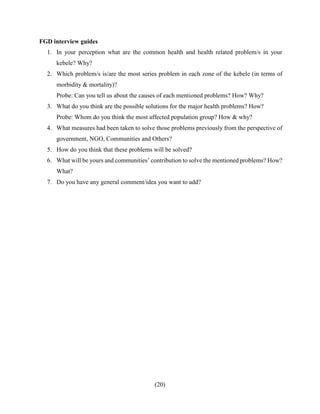
(20)
FGD interview guides
1. In your perception what are the common health and health related problem/s in your
kebele? Why?
2. Which problem/s is/are the most series problem in each zone of the kebele (in terms of
morbidity & mortality)?
Probe: Can you tell us about the causes of each mentioned problems? How? Why?
3. What do you think are the possible solutions for the major health problems? How?
Probe: Whom do you think the most affected population group? How & why?
4. What measures had been taken to solve those problems previously from the perspective of
government, NGO, Communities and Others?
5. How do you think that these problems will be solved?
6. What will be yours and communities’ contribution to solve the mentioned problems? How?
What?
7. Do you have any general comment/idea you want to add?
(21)
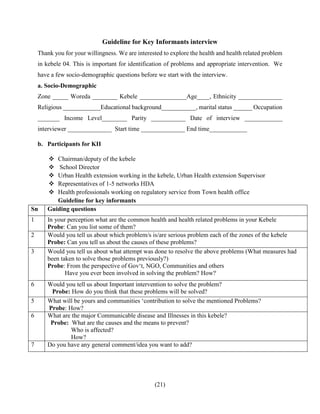
Guideline for Key Informants interview
Thank you for your willingness. We are interested to explore the health and health related problem
in kebele 04. This is important for identification of problems and appropriate intervention. We
have a few socio-demographic questions before we start with the interview.
a. Socio-Demographic
Zone _____ Woreda ________ Kebele _______________Age____, Ethnicity ______________
Religious ____________Educational background___________, marital status ______ Occupation
_______ Income Level________ Parity ___________ Date of interview ____________
interviewer ______________ Start time ______________ End time____________
b. Participants for KII
 Chairman/deputy of the kebele
 School Director
 Urban Health extension working in the kebele, Urban Health extension Supervisor
 Representatives of 1-5 networks HDA
 Health professionals working on regulatory service from Town health office
Guideline for key informants
Sn Guiding questions
1 In your perception what are the common health and health related problems in your Kebele
Probe: Can you list some of them?
2 Would you tell us about which problem/s is/are serious problem each of the zones of the kebele
Probe: Can you tell us about the causes of these problems?
3 Would you tell us about what attempt was done to resolve the above problems (What measures had
been taken to solve those problems previously?)
Probe: From the perspective of Gov‘t, NGO, Communities and others
Have you ever been involved in solving the problem? How?
6 Would you tell us about Important intervention to solve the problem?
Probe: How do you think that these problems will be solved?
5 What will be yours and communities ‘contribution to solve the mentioned Problems?
Probe: How?
6 What are the major Communicable disease and Illnesses in this kebele?
Probe: What are the causes and the means to prevent?
Who is affected?
How?
7 Do you have any general comment/idea you want to add?
(22)
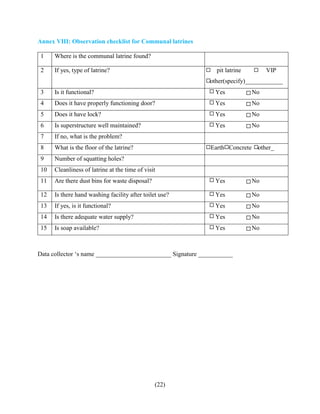
Annex VIII: Observation checklist for Communal latrines
1 Where is the communal latrine found?
2 If yes, type of latrine? pit latrine VIP
other(specify)____________
3 Is it functional? Yes No
4 Does it have properly functioning door? Yes No
5 Does it have lock? Yes No
6 Is superstructure well maintained? Yes No
7 If no, what is the problem?
8 What is the floor of the latrine? Earth Concrete other_
9 Number of squatting holes?
10 Cleanliness of latrine at the time of visit
11 Are there dust bins for waste disposal? Yes No
12 Is there hand washing facility after toilet use? Yes No
13 If yes, is it functional? Yes No
14 Is there adequate water supply? Yes No
15 Is soap available? Yes No
Data collector ‘s name ________________________ Signature ___________

2024 DTTP Questionnaries by DTTP student.docx

  • 1.
    (1) Wallaga University Institute ofHealth Sciences Department of Nursing and Medical Laboratory Development Team Training Program in kebele 04 Annexes Annex I: -Informed consent form Walaga University, Institute of Health science, Department of Nursing and Medical Laboratory, Development Team Training Program in 04 kebele, Nekemte Town by Nursing and laboratory DTTP group 2024. Consent form Good morning/afternoon. My name is______________, we are from Wallaga University Institute of health science master of AHN, PCHN and Medical parasitology on developmental team training program. We are going to conduct a rapid community assessment on health and health related problem in 04 kebeles Nekemte town. The purpose of this a rapid assessment is to identify, prioritize and intervene the problem through community mobilization. Now we would like to ask you some questions about your experiences on health and health related problems here today. Please know that whether you decide to allow this interview or not is completely voluntary. The information you provide will kept confidential and only used for study purpose, so please you are honest. Respondents Name___________________ Signature_____________ Date___________ Thank you!
  • 2.
    (2) Annex II:-Checklist forquantitative data collection at household level. Wallaga University, Institute of Health science, Department of Nursing and Medical Laboratory, Development Team Training Program in 04 kebele, Nekemte Town by department of Nursing and medical Laboratory group,2024. General Information Region: Oromia, Zone: East Wallaga, Kebele 04 Gott/Gare _____________ Code of question ______________Date _______ Part 1: Socio-demographic questions. S.n Relations to the head of HHs sex Age education for people 7 years and above Status of respondent Marital status Occupation Total family size 1 2 3 4 5 6 Source of Information on Health and health related problems. S.no Question Response Remark 1 From where you get health related information? 1) Radio 2) Television 3) Health professionals 4) Others (specify) ________ More than one response is possible Part 2: Housing condition No. Variables Response categories Remar k Q1 What is the condition of house 1. All people living together in a house 2. The house has two room 3. The house has more than two rooms Multipl e choice possible Q2 What is the Ventilation status of the house? 1. Good (a house which has one or more widows for a room which are functional)
  • 3.
    (3) 2. Fair (ahouse which has one window but function partially) 3. Bad (No windows or closed all the time/nonfunctional) Q3 What is the Illumination of the house? 1. Good (a house in which lead/pencil written material can be read by natural light) 2. Fair (house in which ink written material can be read by natural light) 3. Bad (ink written material is illegible Q4 What is the main material of the floor? 1. earth/sand 2. dung 3. parquet or polished wood 4. vinyl or asphalt strips 5. ceramic tiles 6. cement 7. carpet Q5 What is the main material of the roof? 1. thatch/leaf/mud 2. corrugated iron /metal 3. wood 4. asbestos/cement fiber 5. cement/concrete 6. others Q6 What is the main material of the exterior walls 1. Wood with mud 2. stone with mud 3. cement 4. bricks 5. cement blocks Q7 Do you have a separate room which is used as a kitchen? 1.Yes 2. No Q8 If yes to the above question. What type of kitchen? 1. Separate room attached to the main house 2. Separate room but detached from the main house Q9 What type of energy source your household mainly use for cooking 1. Fire wood 2. Animal dung 3. Charcoal 4. Kerosene
  • 4.
    (4) 5. Electricity 6. Other,specify___________ Q10 Is the house clean? 1.Yes 2. No Q11 Is the compound clean? 1.Yes 2. No Q12 What is the frequency of House Cleaning? 1.Yes 2. No Q13 Are there any livestock around the house? 1. Yes 2. No Q14 If yes, are they living together with people? 1.Yes 2. No they have separate quarters Part 3: Questions on Water supply and Usage No. Variables Response categories Remark Q15 Do you have access to water supply? 1. Yes 2. No Q16 What is your source of drinking water? 1. Pipe water 2. Well 3.Spring 4.Others(specify),_____ If pipe skip to Q18 Q17 If the source of water is well/spring, is it protected? 1. Yes 2. No Q18 Do you know how to make drinking water safer? 1. Yes 2. No If No, Skip to 20 Q19 If yes on Q 19, what are the methods? 1. Boiling 2. Chemical treatment (aqua tabs...) 3.Filtration. 4.Other(specify)________ Q20 What type of container do you use to store your drinking water? 1. Jerry can 2. Pot 3. Tanker 4. Bucket 5.Other(specify)____ Q21 What problem/s/do you face in relation to water? 1. Scarcity 2. Absence 3. Cleanliness 4. Money Others/specify_______ Q22 Common problem of water supply in the area 1. Sanitation problem 2. Shortage of water 3. Extravagance 4. Susceptibility to disease 5. Other___________
  • 5.
    (5) Part 4: WasteManagement Variable Response categories Remark Q23 Did you have solid waste storage for your house hold? 1. Yes 2. No If no skip to 25 Q24 If your answer is “yes” for Question 23, what type of place is it? 1. Private 2. Communal 3. Other (Specify)__________ Q25 How do you dispose solid waste? 1. Open field 2. Solid waste pit 3. Garbage container 4. Burn 5. To municipality tractor or lorry If no open field skip to Q27 Q26 If in open field why? 1. Lack of concern 2. Lack of system in place 3. Other specify________ Q27 Do you segregate the waste before disposal? 1. Yes 2. No Q28 Where do you dispose liquid waste at Household level (Multiple answers are possible)? 1. Open field 2. Sewage pit 3. Toilet 4. other specify____ Q29 common problems of waste 1. Environmental pollution 2. Disease 3. Death 4. Other(specify)_______ Q30 Do you have latrine? 1. Yes 2. No If no skip to 33 Q31 If yes to Question 31, What type of latrine do you have? (Observation is required) 1. Pit latrine 2. VIP 3. Water carriage 4.Pour flush latrine 5.others (specify) ________________ Q32 Currently is it functional? 1.Yes 2. No Q33 If no to question 30 above, where do you use? 1. Latrine of the neighbors 2. Public latrine 3. Open defecation 4. Others (Specify)___________ Q34 Is the toilet provided with hand washing facility? 1. Yes 2. No If no Skip to Q36 Q35 If yes to question 35, what do you use to wash your hands after toilet? 1. Water only 2. Soap and water 3. Ash and water 4. Other, specify________
  • 6.
    (6) Part 5: Maternaland child Health Q36 Are there women in reproductive age group in this house? 1. Yes 2. No If no Skip to quest no 48 Q37 Are there any pregnant women in the last 12 months? 1. Yes 2. No If No, skip to 42 Q38 If yes to Q 37, does she get ANC service during your last pregnancy? 1. Yes 2. No If yes skip to Q40 Q39 If no to Q 38, why did you fail to follow ANC visit? 1.Lack of awareness 2.Being far from health institutions 3.Being healthy 4. Other (specify)_____ Q40 At what gestational do you start ANC follow up? 1. Less than 12 weeks 2. 12-16 weeks 3.16weeks and above Q41 If yes to Question 38 How many visits? 1.First visit 2.Second visit 3.Third visit 4. fourth visit and above Q42 If no to Q 37, Is there women who use modern contraceptive method in this house? 1. Yes 2. No If no skip to question 44 Q43 If yes to Q 42, which method do you use? 1. OCP 2. Depo-Provera 3. Condom 4. Implants 5. IUCD 6. Others_____ Q44 Is there a woman who delivered in the last 12 month? 1. Yes 2. No If no skip to Q48 Q45 IF yes to Q44, where did you deliver your last birth? 1. Health facility 2. Home Q46 Have you attended post-natal care visit during your last delivery? 1. Yes 2. No If no skip to Q48 Q47 If yes to Q46, how many Visit? 1. First visit 2. Second visit 3. Third visit 4. fourth visit and above Q48 Is there a child <2yrs in your family? 1. Yes 2. No If no skip to Q 53 Q49 Did the child vaccinated 1. Yes 2. No If yes skip to Q 51 Q50 If no for Q# 49 (if the child was not vaccinated) why? 1. Cultural beliefs 2. Fear of side effect of vaccine 3. Illness 4. Lack of information 5. Inaccessibility of service 6. Others__ Q51 If yes to Q49, what is the child Immunization status? 1. Up-to-date 2. Fully immunized 3. Defaulter If not choice 3 skip Q53 Q52 If the child defaulted from vaccination what is the reason? 1. Adverse effect of vaccine 2. Vaccine shortage 3. forgot schedule 4. Other Check immunization card
  • 7.
    (7) Part 6. Maternaland Child Nutrition status Q53 Are there PW/lactating women in the last 12 months in the home? 1.Yes 2.No If No skip to 61 Q54 If yes for the above, have you been counseled on nutrition related issues from health professionals? 1.Yes 2.No If yes skip to Q57 Q55 If No to Q 58, mention the reason? 1.I have not attended health institution 2. Health professionals didn't attend my house 3.Unwillingness of health professionals 4. Health professionals are busy 5. other(specify) Q56 If No to Q 58, mentions the reason? 1.No need to increase 2.Fetus increase in size and result in difficulty during labor 3.My economic status not allows 4.Other (specify)___________ Q57 Have you taken iron/folate tablet during last pregnancy? 1.Yes 2. No If yes skip to Q59 Q58 If No for Q 61 What is the reason? 1) No access for iron/folate tablet 2) It is costly 3) it has gastric irritation 4) I didn't go to health institution 5) Other specify Q59 Have you taken iodized salt? 1.Yes 2. No If no skip to Q 61 Q60 At what time you added iodized salt during cooking of food? 1. Early during cooking 2. At the middle of cooking 3. Late at the end of cooking 4.After cooking Q61 Is there a child less than 2 years in your family? 1.yes 2. No If no skip to Q 66 Q62 When did you initiate breast feeding for your last child after delivery? 1.Within one hour 2.Within a day 3. After a day Q63 How did /do you feed your last baby for the first 6 months? 1. Only breast 2. Mixed feeding 3. Only cow milk (no breast feeding at all 4. Only cow milk 5. Only powder milk 6, other Q64 For how long will you keep on breast feeding? 1. Less than 6-month 2. 6-23 month 3. Greater than 24 months Q65 When did you initiate complementary feeding for your last child? 1. before 6 months 2. At 6 months 3. After 6 months Q66 Do you have a child 6–59-month-old in the house? 1. Yes 2. No If no skip to Q70
  • 8.
    (8) Q67 If yesdid the children 6-59 months receive Vit. A in the last 6 months? 1. Yes 2. No If no skip to Q 69 Q68 Did the children 24-59 dewormed in the last 6 month? 1. Yes 2. No Q69 In no why? 1. Lack of awareness 2. Inaccessibility of service 3. Fear of side effect 4. Others Part -7 Food and Water- borne disease related questions No. Variables Response categories Remark Q70 Do you know diseases transmitted by contaminated food and water? 1. Yes 2. No If no skip to 72 Q71 If yes to question 70, which of them do you know? 1. Diarrheal diseases. 2. Typhoid fever 3. Helminthes 4. Others (specify)_______________ Q72 Do you know prevention Methods of those diseases? 1.frequent hand washing with soap 2.Latrine utilization 3.Keeping utensils clean 4.Environmental and personal hygiene 5. Others (specify ____________ Q73 Are there under 5 children, who developed diarrheal disease in the last 2 weeks in your home? 1.Yes 2. No Part 8: Communicable disease No. Variables Response 14 categories Remark Q74 Have you heard about common communicable disease? 1. Yes 2. No Q75 If yes, from where did you hear for the first time about it? 1. Form HEWs 2. Health center 3. Radio/TV 4. School 5. Others Q76 Do you know how these diseases transmitted from person to person? 1. Yes 2. No If no skip to Q78 Q77 If yes Q76, what are ways of transmission you know? 1. Through fly 2. From person-to-person contacts 3. Contaminated food 4. Contaminated water 5. Other Q78 Do you know how to prevent and control these disease 1.frequent hand washing with soap 2.Latrine utilization 3.Keeping house clean 4.Environmental and personal hygiene 5. Others (specify ____________ Q79 Is there anyone in the house hold develop illness in the last 3 month? 1. Yes 2. No If no skip to Q81
  • 9.
    (9) Q80 If yes,what was the illness? 1. Diarrheal disease 2.AFI 3. Respiratory disease 4. Other specify______ Q81 Do you know about tuberculosis? 1. Yes 2. No If no skip to Q84 Q82 If Yes for Q 81, from where did you get the information? 1. Mass media (radio, TV, newspaper) 2. Health facility 3. Community volunteer 4. Others (specify)_______________ Q83 What are the ways of TB transmission? 1. Airborne 2. Uncooked cow milk 3. Due to cold weather 4. Others (specify)________ Q84 Have you ever heard about sexually transmitted disease including HIV/AIDS? 1. Yes 2. No If no skip to 86 Q85 If yes, from where? 1. HEW 2. Media 3. Health professionals 4. Other Q86 Do you know transmission and prevention methods? 1. Yes 2. No If no skip to Q88 Q87 If yes which transmission methods you known 1. Unsafe sexual intercourse 2. sharp instrument 3. Blood transfusion Part 9. Non communicable disease/NCD related question No. Variables Response categories Remark Q88 Have your information/awareness on NCDs? Yes 2. No Q89 Would you mention Some of them? 1. Hypertension 2. Diabetes Mellitus 3. heart diseases 4. Cancer 5. Other (specify)_____ Q90 Are there any family members who have been diagnosed with HTN? 1.Yes 2. No Q91 Are there any family members who have been diagnosed with DM? 1.Yes 2. No Q92 Are there any family members who have been diagnosed with CVD 1.Yes 2. No Q93 Are there any family members who have been diagnosed cancer? 1.Yes 2. No Q94 What predisposing factors do you know? 1. Obesity 2. Physical inactivity 3. Other specify_______ Q95 Do you know Prevention methods of Non communicable diseases? 1.Yes 2. No If No Skip to Q 97,
  • 10.
    (10) Q96 If yesto Question 90, what prevention methods do you know? 1. Regular physical exercise 2. Avoid Smoking 3. Dietary modification 4. Minimize alcohol consumption 5. Other (Specify)_________ Q97 Have you ever practiced NCD prevention methods? 1.Yes 2. No If No Skip Q98 If yes to Question, 95 What types of prevention methods do you do/practice? 1. Regular physical exercise 2. Avoid Smoking 3. Dietary modification 4. Medical check-ups 5. Consume Balanced diet 6. minimize alcohol consumption 7. Other (Specify)_________
  • 11.
    (11) Annex III: -Checklistfor assessment of health institution Wallaga University Health science Institute, department of Nursing and Medical Laboratory, Community based education program, kebele 04, Nekemte Town DTTP 2024. A. Document Reviews Part 1. Socio demographic characteristics Sno Population profile 2016 Number Remark 1 Total population Female Male Total 2 Reproductive age group (15-45years) 3 Total number of Pregnant mothers 4 Non pregnant women in reproductive age 5 Number of under 1years 6 Children age 24-59 month 7 Children age 6-59 month 8 Number of under five children 9 Availability of health institutions Health post Health center Private for profit Private for non-profit 10 Infrastructure Electricity Yes No Road Yes No Tele Yes No Water Yes No
  • 12.
    (12) Part 2. Maternaland child health program Sno Main activities Eligible Performance Remark 1 Contraceptive acceptance rate (CAR) 2 Long-acting family planning Implanon IUCD Total 3 Short acting family planning Injectable OC user’s Others Total 4 ANC follow up Frist contact Fourth contact and above 5 Delivery attended by skill birth attendant 6. Still birth rate 7 PNC service 8 PMTCT service Counseled Tested Positive mothers starting prophylaxis 9 Safe abortion care service provided 10 EPI program Pent1 Pent3 MCV1 MCV2 Fully vaccinated Measles dropout rate Pent3 dropout rate Protected at birth (PAB) 11 Nutrition activities Moderate acute malnutrition (MAM) Uncomplicated severe acute malnutrition (OTP) Complicated severe acute malnutrition (SC) Vit A supplementation Deworming 4.10. Top causes for under five morbidity and mortality 1.___________2._________3.___________4.____________5._____________
  • 13.
    (13) 5. Water, Sanitationand Hygiene (WaSH) Sno Eligible Performance 1 Latrine type Pit latrine Communal Latrine with hand washing facilities 2 Safe drinking water supply coverage Communicable disease 3 Diarrheal disease 4 Malaria diagnosis By RDT Microscope Treated case Malaria epidemic monitoring chart trend Observe 5 HIV/AIDs HCT Counseled Male Female Total HIV/AIDs tested Male Female Total 6 HIV/AIDs ART Ever enrolled Ever started Currently on ART Care and support 6.6. TB/HIV collaboration (observe) _______________ 6.7. Outbreak (PHEM records) ______ 6.8. Adult Top ten disease morbidity and mortality________
  • 14.
    (14) Annex IV:-Checklist forObservation of health institution 1 Is the health institution fenced? 1. Yes 2. No 2 Is the compound of health institution clean? 1. Yes 2. No 3 Are there patients waiting area? 1. Yes 2. No 4 Are dust bins available? 1. Yes 2. No 5 Is health education given in health institution? (Observe program, minutes in documents) 1. Yes 2. No 6 There incinerator? (Observe design, distance from rooms, whether emptied, used properly) 1. Yes 2. No 7 Is latrine (clean, has hand washing facility, separate for staffs a patient) 1. Yes 2. No 8 Is there septic tank? 1. Yes 2. No 9 Is there Waste management other material? 1. Yes 2. No 10 Availability of essential drug (Amoxicillin, Oral Rehydration Salts, Arthemisin/ Lumphantrine, Mebendazole Tablets, Tetracycline Eye Ointment, Paracetamol, Rifampicin / Isoniazid /pyrazinamide / Ethambutol, Medroxyprogesterone (depo) Injection, Ergometrine Maleate Tablets, Ferrous Salt plus Folic Acid, Pentavalent DPT-Hep-Hib Vaccine etc 1. Yes 2. No
  • 15.
    (15) Annex V: Observationalchecklist for Assessment of School Health Wallaga University Institute of Health science department of Nursing and Medical Laboratory, Community based education program, kebele 04, Nekemte Town DTTP 2024. 1 Is there any school in your visiting area? Yes No 2 If yes, type 1.Kindergarten 2. Elementary 3. Junior high school 4. Senior high School 5. Others specify __________ 3 Name of school Ownership 1.private, 2. public 4 Number of students: Boys____ Girls____ Total _____ 5 Does the school have its own fence? Yes No 6 Is there excessive noise from nearby? Yes No 7 If yes Q6 A. Market B. Passing car/motor vehicles C. Mills D. Factory E. proximity to main road F. Others (specify)________ 8 Cleanliness of the room floor 1. Good 2. Medium 3. Poor 9 Maintenance of room, wall, roof/ceiling 1. Good 2. Medium 3. Poor 10 Condition of the floor 1. Earth 2. Concrete 3. Other 11 Ventilation of the room 1. Adequate 2. Inadequate 12 Illumination of the room 1. Adequate 2. Inadequate 13 Is there any foul odor in the school environment? Yes No 14 What are the types of feasible playgrounds available in the school compound? A, Football ground B, Basketball ground C, Volley-ball ground D. Others/specify/_______________________________ 15 Are there dustbins in front of each class room? Yes No 16 Is there any waste disposal system in the school? Yes No other (specify_____ 17 Is there toilet facility? Yes No other (for staff only) ______ 17a If yes, type of latrine pit latrine VIP other(specify)____________ 17b Are there separate blocks for boys and girls students Yes No 17c Are there separate blocks for female and male, staffs? Yes No 17d Number of squatting holes ___________________ 17e Is super structure well maintained? Yes No 17f Floor of latrine. Earth Concrete other_ 17g maintenance condition of latrine at the time of visit 1. Good 2. Fair 3. Bad 17h cleanliness of latrine at the time of visit 1. Good 2.Fair 3. Bad
  • 16.
    (16) 17i Is therehand washing facility after toilet use? Yes No 17j How far is the water source from the latrine (in meter)? ___________ 18 Is there a functional water supply system for the school? Yes No 19 If yes Q 18 what is the source of water supply 1.Tap 2. Well 3. Protected Spring, 4. River 5. Pond 6. Others (Specify) 20 Cleanliness of surroundings of water supply 1.Good 2. Bad 21 Are there any health clubs in this school? Yes No 22 If yes, 1.sanitation, 2.eye, 3. anti-malaria, 4.HIV/AIDS, 5. others (specify)_________ 23 If clubs are established, what type of support you get from health workers including HEWs? __________________ 24 Do HEWs give health education to students? Yes No 25 Is there first aid kit in the school? Yes No 26 Personal hygiene of students Observe few students (clothing, hair, face, feet, nail, teeth, skin) 27 Is there separate room for menstrual hygiene for girls’ students? Yes No If yes q27 a. Hand wash only b. For shower only c. Both hand wash and shower Summary of the main finding ______________________________________________________________________________ ______________________________________________________________________________ _____________________________________________________________________________ Suggestions- ______________________________________________________________________________ ______________________________________________________________________________
  • 17.
    (17) Annex VI: Observationalchecklist for Food and drinking establishments Name of establishment Type of establishment (hotel, restaurant, Tej bet, others) ______ A. Personal hygiene of food handler Sno Question Alternatives code 101 Do the food handlers have recent medical certificate? 1. Yes 2. No 102 Do all food handlers cover hair? 1. Yes 2. No 103 Do all food handlers wear gown/garment? 1. Yes 2. No 104 Do all food handlers remove ornaments on work time properly 1. Yes 2. No 105 Are outer garment visibly clean? 1. Yes 2. No 106 Do the food handlers have separate room for rest 1. Yes 2. No 107 What is your residential area? 1.rural 2, Urban 108 Any infection presents at the time of visit? 1. Yes 2. No B. Washing facilities Sno Question Alternatives Code 201 Are there three compartment utensils washing system present? 1.yes 2, No 202 Detergents or hot water used for washing utensils? 1.yes 2, No 203 Are there cracked utensils? 1.yes 2, No C. Kitchen/dining room of the establishment Sno Question Alternatives Code 204 Does the establishment have kitchen? 1.yes 2, No 206 Does the kitchen room have adequate ventilation? 1.yes 2, No 207 Are food items covered and kept clean? 1.yes 2, No 208 Is there overcrowding? 1.yes 2, No 209 Are vectors and rodents present? 1.yes 2, No 210 Is dining room clean and separate? 1.yes 2, No 211 Is dining room clean and separate? 1.yes 2, No 212 Are walls and ceiling in good condition in dining room? 1.rural 2. urban 213 Is there adequate lighting and ventilation in dining room? 1.yes 2, No 214 Tables and chairs are in good condition in dining room? 1.yes 2, No D. Water supply system No Question Alternatives Code 215 Source of water 1.piped private/shared 2. piped public stand post 3. others ___ 216 Hand washing facilities 1.wash basin 2. manual 3. others ___ E. Excreta disposal No Question Alternatives Code 217 Is toilet available? 1.yes 2, No 218 Is the toilet clean? 1.yes 2, No
  • 18.
    (18) 219 Maintenance conditionof toilet (need major repair, some repair, no repair) 1.Need major repair 2. some repair 3.no repair 220 Distance of the toilet from kitchen? By meter__________ F. Solid/liquid waste management Sno Question Alternatives Code 221 Is there refuse container for public use? 1.yes 2.no 222 Is there garbage container for kitchen use? 1.yes 2.no 223 How is refuse and garbage disposed of finally? 1.Burning 2. buried in pit 3. open field dumping 4. municipal service 5.other__________ 224 Where is waste water from hand washing and dish washing facilities disposed of? 1. Latrine 2. Open Ditch 3. River 4. Seepage Pit 5. Sepatic Tank 6. Storm Pipe 7. Other__________ 225 Is there overflowing of liquid waste at the time of visit? 1.yes 2, No 226 Are there any insects breeding around liquid waste facilities? 1.yes 2, No G. Store no Question Alternatives Code 227 Is there separate room for storage for raw materials? 1.yes 2, No 226 Is a refrigerator available for storage of perishable foods? 1.yes 2, No 227 Are all products spoiled by damage, insects, rodents or other causes stored in a designated “Quarantine Area” to prevent their contact with safe products? 1.yes 2, No H. Butchery no Question Alternatives Code 228 Source of meat (private sources, municipality abattoir/ check for stamp) 1.yes 2, No 229 Is there hand and knives washing facilities present in vicinity? 1.yes 2, No 230 Are knives, chopping block/surface kept clean? 1.yes 2, No 231 Are walls, ceiling kept in good condition? 1.yes 2, No 232 Is there adequate lighting and ventilation? 1.yes 2, No 233 Is offal kept separate from meat? 1.yes 2, No Summary of main findings and suggestions________________________________________
  • 19.
    (19) Annex VII: Guidesfor FGD and Interviews A. FGD and Interview Guide Wallaga University Institute of Health science department of Nursing and Medical Laboratory, Community based education program, kebele 04, Nekemte Town DTTP 2024 Introduce yourself and your objective. Thank them for their willingness. We are interested to explore the health and health related problem in kebele 04. This is important for identification of problems and appropriate intervention. We have a few socio-demographic questions before we start with the interview. A. Socio-Demographic Zone _____ Woreda ________ Kebele ______________ Code_________ 2. FGD Participants:  2 FGDs, 6 to 11 individuals per each group (1 group for women and 1 for men) in the community of HAD, including community volunteer ‘s, religious leaders, elderly people, Community representative of the kebele (Adult Men, Adult Women)  2 FGDs for students 8 to 12 students per each group (1 group of male and 1 for female students) s.no Code of participant Age Sex Ethnicity Religion Educational Background Marital status Occupation 1 2 3 4 5 6 7 8 9 Facilitator ___________________ Note taker _______________ Date of discussion ________ Start time of interview ______________ End time____________
  • 20.
    (20) FGD interview guides 1.In your perception what are the common health and health related problem/s in your kebele? Why? 2. Which problem/s is/are the most series problem in each zone of the kebele (in terms of morbidity & mortality)? Probe: Can you tell us about the causes of each mentioned problems? How? Why? 3. What do you think are the possible solutions for the major health problems? How? Probe: Whom do you think the most affected population group? How & why? 4. What measures had been taken to solve those problems previously from the perspective of government, NGO, Communities and Others? 5. How do you think that these problems will be solved? 6. What will be yours and communities’ contribution to solve the mentioned problems? How? What? 7. Do you have any general comment/idea you want to add?
  • 21.
    (21) Guideline for KeyInformants interview Thank you for your willingness. We are interested to explore the health and health related problem in kebele 04. This is important for identification of problems and appropriate intervention. We have a few socio-demographic questions before we start with the interview. a. Socio-Demographic Zone _____ Woreda ________ Kebele _______________Age____, Ethnicity ______________ Religious ____________Educational background___________, marital status ______ Occupation _______ Income Level________ Parity ___________ Date of interview ____________ interviewer ______________ Start time ______________ End time____________ b. Participants for KII  Chairman/deputy of the kebele  School Director  Urban Health extension working in the kebele, Urban Health extension Supervisor  Representatives of 1-5 networks HDA  Health professionals working on regulatory service from Town health office Guideline for key informants Sn Guiding questions 1 In your perception what are the common health and health related problems in your Kebele Probe: Can you list some of them? 2 Would you tell us about which problem/s is/are serious problem each of the zones of the kebele Probe: Can you tell us about the causes of these problems? 3 Would you tell us about what attempt was done to resolve the above problems (What measures had been taken to solve those problems previously?) Probe: From the perspective of Gov‘t, NGO, Communities and others Have you ever been involved in solving the problem? How? 6 Would you tell us about Important intervention to solve the problem? Probe: How do you think that these problems will be solved? 5 What will be yours and communities ‘contribution to solve the mentioned Problems? Probe: How? 6 What are the major Communicable disease and Illnesses in this kebele? Probe: What are the causes and the means to prevent? Who is affected? How? 7 Do you have any general comment/idea you want to add?
  • 22.
    (22) Annex VIII: Observationchecklist for Communal latrines 1 Where is the communal latrine found? 2 If yes, type of latrine? pit latrine VIP other(specify)____________ 3 Is it functional? Yes No 4 Does it have properly functioning door? Yes No 5 Does it have lock? Yes No 6 Is superstructure well maintained? Yes No 7 If no, what is the problem? 8 What is the floor of the latrine? Earth Concrete other_ 9 Number of squatting holes? 10 Cleanliness of latrine at the time of visit 11 Are there dust bins for waste disposal? Yes No 12 Is there hand washing facility after toilet use? Yes No 13 If yes, is it functional? Yes No 14 Is there adequate water supply? Yes No 15 Is soap available? Yes No Data collector ‘s name ________________________ Signature ___________