K.A.S.PRIYANTHA
MD/BN/2011/196
B.Sc Nursing
Faculty of medicine
University of Ruhuna.
MECHANICAL VENTILATION
“A mode of assisted or controlled
ventilation using mechanical devices that
cycle automatically to generate airway
pressure.”
(The American Heritage Medical dictionary)
MECHANICAL VENTILATION
1.Invasive mechanical ventilation.
2.Non-Invasive mechanical ventilation.
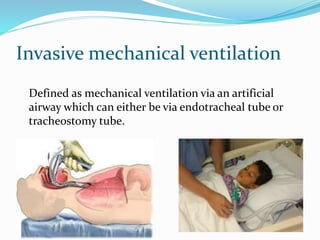
Invasive mechanical ventilation
Defined as mechanical ventilation via an artificial
airway which can either be via endotracheal tube or
tracheostomy tube.
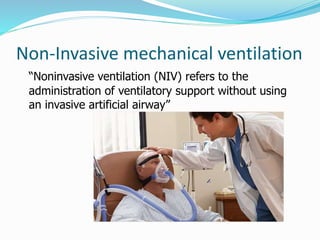
Non-Invasive mechanical ventilation
“Noninvasive ventilation (NIV) refers to the
administration of ventilatory support without using
an invasive artificial airway”
indication
 1. Acute pulmonary oedema
 2. Pneumonia
 3. ARDS
 4. Severe asthmatic attack
 5. Severe acute exacerbation of COPD
 6. Guillain-Barre syndrome
 7. Myasthenia gravis
 8. Drug overdose
 9. Shock
 10. Severe sepsis
COMPLICATION OF LONG TERM
VENTILATION
1.INFECTION
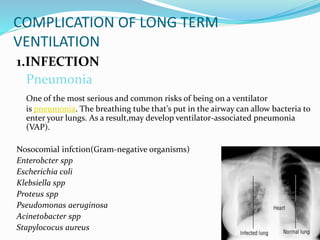
Pneumonia
One of the most serious and common risks of being on a ventilator
is pneumonia. The breathing tube that's put in the airway can allow bacteria to
enter your lungs. As a result,may develop ventilator-associated pneumonia
(VAP).
Nosocomial infction(Gram-negative organisms)
Enterobcter spp
Escherichia coli
Klebsiella spp
Proteus spp
Pseudomonas aeruginosa
Acinetobacter spp
Stapylococus aureus
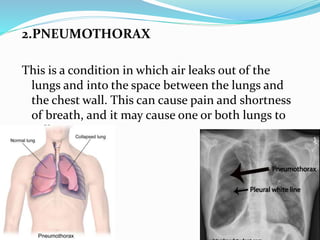
2.PNEUMOTHORAX
This is a condition in which air leaks out of the
lungs and into the space between the lungs and
the chest wall. This can cause pain and shortness
of breath, and it may cause one or both lungs to
collapse.
3.INJURIES TO FACE, LIPS AND
OROPHARYNX
 Trauma to the lip and checks from the tube tie.
 Injuries to the tongue particularly when entrapped
between the endotracheal tube and the lower teeth.
4.LARYNGEAL INJURIES
 Some degree of glottic injury is seen in 94% of patients
intubated for 4 days or longer
 Erosive ulcers of vocal cords.
 Swelling and edema of the vocal cords.
 Granulomas (7% in patients intubated for 4 days or
more)
5.TRACHEAL INJURIES
 Cuff pressure tracheal damage: tracheal ulceration,
edema and submucosal hemmorrhage
 Tracheal dilatation
 Tracheal stenosis
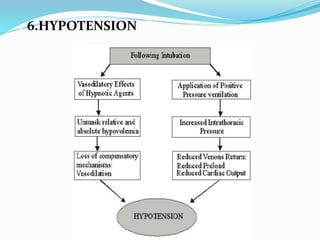
6.HYPOTENSION
7.GASTROINTESTINAL EFFECTS
Esophagus,Stomach and Small Intestine
 Erosive esophagitis (30-50% of patients ventilated >48
hours)
 NG tube
 Poor lower esophageal sphincter tone and reflux
 Opiates and adrenergic agonists
 Duodenogastroesophageal reflux through the action of trypsin
 Upper gastrointestinal hemorrhage:
 Stress
 Decreased gastric mucosal protection secondary to a fall in
splanchnic blood flow
 Decreased motility of stomach and small intestine
Liver and Gallbladder
 Reduction in portal venous flow secondary to the fall
in cardiac output.
 Hepatic engorgement.
 Reduction in drug clearance secondary to reduction of
hepatic blood flow.
Large Bowel
 Constipation
 Abdominal distension
8.RENAL EFFECTS
 The usual renal response to reduction of cardiac
output and mean arterial pressure.
 Reduction in urine output secondary to a fall in the
transmural pressure of the right atrium that results in
reduction of the secretion of atrial naturitic peptide
and the activation of renin-angiotensin-aldosterone
system and pituitary vasopressin secretion
 9.DISRUPT SLEEP
 Noise disruption
 Ventilator alarm:
 inappropriate threshold
 Delayed alarm inactivation
 Humidifier alarms
 Disruption by nursing interventions
o Airway suction
o Nebulizer delivery
 Ventilation-related pharmacological disruption
o Benzodiazepines
o Oipoids
 10.DECUBITUS ULCERS

11.MALNUTRITION

12.DEPRESSHION & ANXIETY

13.DELEIRIUM
Complication of long term ventilation

Complication of long term ventilation

  • 1.
  • 2.
    MECHANICAL VENTILATION “A modeof assisted or controlled ventilation using mechanical devices that cycle automatically to generate airway pressure.” (The American Heritage Medical dictionary)
  • 3.
    MECHANICAL VENTILATION 1.Invasive mechanicalventilation. 2.Non-Invasive mechanical ventilation.
  • 4.
    Invasive mechanical ventilation Definedas mechanical ventilation via an artificial airway which can either be via endotracheal tube or tracheostomy tube.
  • 5.
    Non-Invasive mechanical ventilation “Noninvasiveventilation (NIV) refers to the administration of ventilatory support without using an invasive artificial airway”
  • 6.
    indication  1. Acutepulmonary oedema  2. Pneumonia  3. ARDS  4. Severe asthmatic attack  5. Severe acute exacerbation of COPD  6. Guillain-Barre syndrome  7. Myasthenia gravis  8. Drug overdose  9. Shock  10. Severe sepsis
  • 7.
    COMPLICATION OF LONGTERM VENTILATION 1.INFECTION Pneumonia One of the most serious and common risks of being on a ventilator is pneumonia. The breathing tube that's put in the airway can allow bacteria to enter your lungs. As a result,may develop ventilator-associated pneumonia (VAP). Nosocomial infction(Gram-negative organisms) Enterobcter spp Escherichia coli Klebsiella spp Proteus spp Pseudomonas aeruginosa Acinetobacter spp Stapylococus aureus
  • 8.
    2.PNEUMOTHORAX This is acondition in which air leaks out of the lungs and into the space between the lungs and the chest wall. This can cause pain and shortness of breath, and it may cause one or both lungs to collapse.
  • 9.
    3.INJURIES TO FACE,LIPS AND OROPHARYNX  Trauma to the lip and checks from the tube tie.  Injuries to the tongue particularly when entrapped between the endotracheal tube and the lower teeth.
  • 10.
    4.LARYNGEAL INJURIES  Somedegree of glottic injury is seen in 94% of patients intubated for 4 days or longer  Erosive ulcers of vocal cords.  Swelling and edema of the vocal cords.  Granulomas (7% in patients intubated for 4 days or more)
  • 11.
    5.TRACHEAL INJURIES  Cuffpressure tracheal damage: tracheal ulceration, edema and submucosal hemmorrhage  Tracheal dilatation  Tracheal stenosis
  • 12.
  • 13.
    7.GASTROINTESTINAL EFFECTS Esophagus,Stomach andSmall Intestine  Erosive esophagitis (30-50% of patients ventilated >48 hours)  NG tube  Poor lower esophageal sphincter tone and reflux  Opiates and adrenergic agonists  Duodenogastroesophageal reflux through the action of trypsin  Upper gastrointestinal hemorrhage:  Stress  Decreased gastric mucosal protection secondary to a fall in splanchnic blood flow  Decreased motility of stomach and small intestine
  • 14.
    Liver and Gallbladder Reduction in portal venous flow secondary to the fall in cardiac output.  Hepatic engorgement.  Reduction in drug clearance secondary to reduction of hepatic blood flow.
  • 15.
  • 16.
    8.RENAL EFFECTS  Theusual renal response to reduction of cardiac output and mean arterial pressure.  Reduction in urine output secondary to a fall in the transmural pressure of the right atrium that results in reduction of the secretion of atrial naturitic peptide and the activation of renin-angiotensin-aldosterone system and pituitary vasopressin secretion
  • 17.
     9.DISRUPT SLEEP Noise disruption  Ventilator alarm:  inappropriate threshold  Delayed alarm inactivation  Humidifier alarms  Disruption by nursing interventions o Airway suction o Nebulizer delivery  Ventilation-related pharmacological disruption o Benzodiazepines o Oipoids
  • 18.