Oxygen Therapy
Oxygen is a drug.
When appropriately used, it is extremely beneficial
When misused or abused, it is potentially harmful
OVERVIEW
• Introduction
• Indications
• Oxygen delivery systems
• Complications of oxygen therapy
Goal of oxygen therapy
To maintain adequate tissue oxygenation while
minimizing cardiopulmonary work
O2 Therapy : CLINICAL OBJECTIVES
1. Correct documented or suspected hypoxemia
2. Decrease the symptoms associated with chronic hypoxemia
3. Decrease the workload hypoxemia imposes on the
cardiopulmonary system
O2 Therapy : Indications
• Documented hypoxemia as evidenced by
• PaO2 < 60 mmHg or SaO2 < 90% on room air
• PaO2 or SaO2 below desirable range for a specific clinical situation
• Acute care situations in which hypoxemia is suspected
• Severe trauma
• Acute myocardial infarction
• Short term therapy (Post anaesthesia recovery)
ASSESSMENT
• The need for oxygen therapy should be
assessed by
1. monitoring of ABG - PaO2, SpO2
2. clinical assessment findings.
Oxygen therapy
• is the administration of oxygen as a medical intervention, which can be for
a variety of purposes in both chronic and acute patient care
• Oxygen is often prescribed for people to prevent hypoxia because of the
following conditions:
1. Difficulty ventilating all areas of their lungs
2. Impaired gas exchange
3. Heart failure
• Prescribed by the physician who specifies the following:
1. Concentration
2. Liter per minute
3. Method of delivery
Oxygen supply
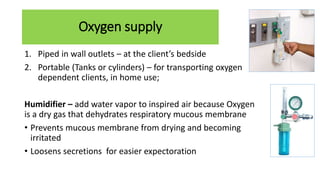
1. Piped in wall outlets – at the client’s bedside
2. Portable (Tanks or cylinders) – for transporting oxygen
dependent clients, in home use;
Humidifier – add water vapor to inspired air because Oxygen
is a dry gas that dehydrates respiratory mucous membrane
• Prevents mucous membrane from drying and becoming
irritated
• Loosens secretions for easier expectoration
Safety Precautions for Oxygen Administration
• Teach family members to smoke only outside away from the client
and oxygen equipment.
• Set up “No Smoking: and “oxygen in Use” signs at the site of
administration and at the door, according to agency policy.
• Instruct the client and visitors about the hazard of smoking with
oxygen in use
• Provide cotton gown and blankets . Synthetics and wool may
generate sparks of static electricity
Safety Precautions for Oxygen Administration
• Avoid the use of volatile, flammable materials such as oils, greases,
alcohol, ether and acetone near clients receiving oxygen
• Remove matches, lighters, ashtrays, and any friction-type or battery
operated toys or devices from bedside
• Be sure that electric monitoring equipment , suction machines, and
portable diagnostic machines are electrically grounded.
• Locate fire extinguishers and oxygen meter turn-off lever.
Various devices used for administration of oxygen.
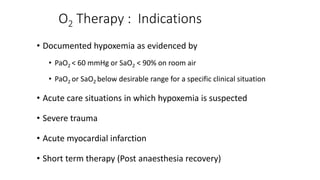
• Pressure regulator - used to control
the high pressure of oxygen delivered
from a cylinder (or other source) to a
lower pressure. This lower pressure is
then controlled by a flowmeter.
• Flowmeter – controls the lower
pressure which may be preset or
selectable, and this controls the flow in
a measure such as litres per minute
(lpm).
PaO2 as an indicator for Oxygen therapy
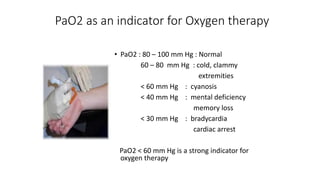
• PaO2 : 80 – 100 mm Hg : Normal
60 – 80 mm Hg : cold, clammy
extremities
< 60 mm Hg : cyanosis
< 40 mm Hg : mental deficiency
memory loss
< 30 mm Hg : bradycardia
cardiac arrest
PaO2 < 60 mm Hg is a strong indicator for
oxygen therapy
Clinical assessment of hypoxia
mild to moderate severe
CNS : Restlessness,
somnolence, confusion
disorientation
impaired judgement
lassitude
loss of co-ordination
headache,
obtunded mental
status
Cardiac : tachycardia, arrhythmia mild hypertension
hypotension
bradycardia, peripheral
vasoconst.
Respiratory: dyspnea, possible
shallow &tachypnea
Increasing dyspnoea
bradypnoea,
laboured breathing
Skin : paleness, cold, clammy
cyanosis
MONITORING
• Physical examination for clinical signs of hypoxemia
• Pulse oximetry ---- SpO2
• ABG analysis
• pH
• PaO2
• PaCO2
• Mixed venous blood oxygenation
O2 Delivery systems
O2 Delivery devices
o Low flow (Variable performance devices )
Nasal cannula
Nasal catheter
Transtracheal catheter
o Reservoir system (Variable performance device)
Simple face mask
Partial rebreathing mask
Non rebreathing mask
Tracheostomy mask
o High flow (Fixed performance devices)
Ventimask (HAFOE)
Aerosol mask and T-piece with nebulisers
Complications of Oxygen therapy
1. Oxygen toxicity
2. Depression of ventilation
3. Retinopathy of Prematurity
4. Absorption atelectasis
5. Fire hazard
1. O2 Toxicity
• Primarily affects lung and CNS.
• 2 factors: PaO2 & exposure time
• CNS O2 toxicity (Paul Bert effect)
• occurs on breathing O2 at pressure > 1 atm
• tremors, twitching, convulsions
How much O2 is safe?
100% - not more than 12hrs
80% - not more than 24hrs
60% - not more than 36hrs
Goal should be to use lowest possible FiO2
compatible with adequate tissue oxygenation
Indications for 70% - 100% oxygen
therapy
1. Resuscitation
2. Periods of acute cardiopulmonary instability
3. Patient transport
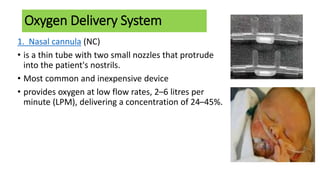
Oxygen Delivery System
1. Nasal cannula (NC)
• is a thin tube with two small nozzles that protrude
into the patient's nostrils.
• Most common and inexpensive device
• provides oxygen at low flow rates, 2–6 litres per
minute (LPM), delivering a concentration of 24–45%.
Cont: Oxygen Delivery System, (NASAL Cannula)
• allows the patient to continue to talk, eat and drink while still
receiving the therapy.
• associated with greater comfort, and improved oxygenation
and respiratory rates than with face mask oxygen.
Limitation of nasal cannula:
• Unable to deliver higher concentration of oxygen
• Can be drying and irritating to mucous membrane
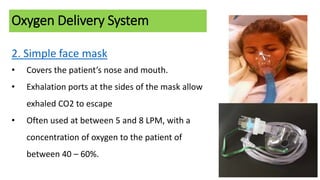
2. Simple face mask
• Covers the patient’s nose and mouth.
• Exhalation ports at the sides of the mask allow
exhaled CO2 to escape
• Often used at between 5 and 8 LPM, with a
concentration of oxygen to the patient of
between 40 – 60%.
Oxygen Delivery System
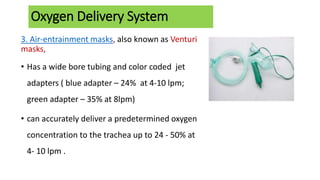
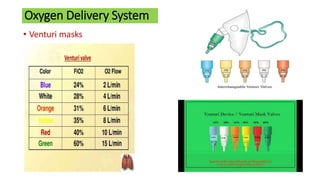
3. Air-entrainment masks, also known as Venturi
masks,
• Has a wide bore tubing and color coded jet
adapters ( blue adapter – 24% at 4-10 lpm;
green adapter – 35% at 8lpm)
• can accurately deliver a predetermined oxygen
concentration to the trachea up to 24 - 50% at
4- 10 lpm .
Oxygen Delivery System
• Venturi masks
Oxygen Delivery System
• 4. Partial rebreathing mask – has
a reservoir bag, which increases
the provided oxygen rate to 60–
90% oxygen at 6 to 10 LPM.
Oxygen Delivery System
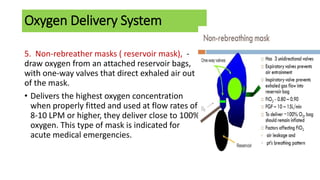
5. Non-rebreather masks ( reservoir mask), -
draw oxygen from an attached reservoir bags,
with one-way valves that direct exhaled air out
of the mask.
• Delivers the highest oxygen concentration
when properly fitted and used at flow rates of
8-10 LPM or higher, they deliver close to 100%
oxygen. This type of mask is indicated for
acute medical emergencies.
Oxygen Delivery System
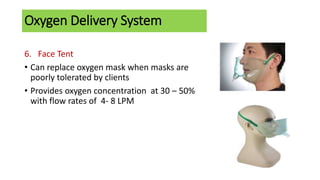
6. Face Tent
• Can replace oxygen mask when masks are
poorly tolerated by clients
• Provides oxygen concentration at 30 – 50%
with flow rates of 4- 8 LPM
Oxygen Delivery System
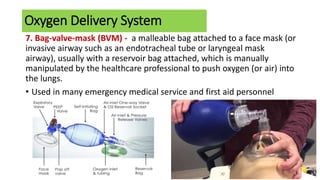
7. Bag-valve-mask (BVM) - a malleable bag attached to a face mask (or
invasive airway such as an endotracheal tube or laryngeal mask
airway), usually with a reservoir bag attached, which is manually
manipulated by the healthcare professional to push oxygen (or air) into
the lungs.
• Used in many emergency medical service and first aid personnel
Oxygen Delivery System
Characteristic Concentration LPM
1. Nasal Cannula provides oxygen at low
flow rates
24–45%. , 2–6 litres per minute
(LPM),
2. Simple face mask 40 – 60%. 5 - 8 LPM
3. Air-entrainment masks
also known as Venturi
masks,
blue adapter – 24%
green adapter – 35%
At trachea : 24 - 50%
4-10 lpm;
8 lpm
4- 10 lpm .
4. Partial rebreathing
mask –
has a reservoir bag 60–90% 6 to 10 LPM.
5. Non-rebreather masks (
reservoir mask),
Delivers the highest
oxygen concentration
Close to 100% of 8-10 LPM or higher,
they deliver close to
6. Face Tent 30 – 50% 4- 8 LPM or higher
Oxygen Delivery System
4.Oxygen therapy.pptx

4.Oxygen therapy.pptx

  • 1.
  • 2.
    Oxygen is adrug. When appropriately used, it is extremely beneficial When misused or abused, it is potentially harmful
  • 3.
    OVERVIEW • Introduction • Indications •Oxygen delivery systems • Complications of oxygen therapy
  • 4.
    Goal of oxygentherapy To maintain adequate tissue oxygenation while minimizing cardiopulmonary work
  • 5.
    O2 Therapy :CLINICAL OBJECTIVES 1. Correct documented or suspected hypoxemia 2. Decrease the symptoms associated with chronic hypoxemia 3. Decrease the workload hypoxemia imposes on the cardiopulmonary system
  • 6.
    O2 Therapy :Indications • Documented hypoxemia as evidenced by • PaO2 < 60 mmHg or SaO2 < 90% on room air • PaO2 or SaO2 below desirable range for a specific clinical situation • Acute care situations in which hypoxemia is suspected • Severe trauma • Acute myocardial infarction • Short term therapy (Post anaesthesia recovery)
  • 7.
    ASSESSMENT • The needfor oxygen therapy should be assessed by 1. monitoring of ABG - PaO2, SpO2 2. clinical assessment findings.
  • 8.
    Oxygen therapy • isthe administration of oxygen as a medical intervention, which can be for a variety of purposes in both chronic and acute patient care • Oxygen is often prescribed for people to prevent hypoxia because of the following conditions: 1. Difficulty ventilating all areas of their lungs 2. Impaired gas exchange 3. Heart failure • Prescribed by the physician who specifies the following: 1. Concentration 2. Liter per minute 3. Method of delivery
  • 9.
    Oxygen supply 1. Pipedin wall outlets – at the client’s bedside 2. Portable (Tanks or cylinders) – for transporting oxygen dependent clients, in home use; Humidifier – add water vapor to inspired air because Oxygen is a dry gas that dehydrates respiratory mucous membrane • Prevents mucous membrane from drying and becoming irritated • Loosens secretions for easier expectoration
  • 10.
    Safety Precautions forOxygen Administration • Teach family members to smoke only outside away from the client and oxygen equipment. • Set up “No Smoking: and “oxygen in Use” signs at the site of administration and at the door, according to agency policy. • Instruct the client and visitors about the hazard of smoking with oxygen in use • Provide cotton gown and blankets . Synthetics and wool may generate sparks of static electricity
  • 11.
    Safety Precautions forOxygen Administration • Avoid the use of volatile, flammable materials such as oils, greases, alcohol, ether and acetone near clients receiving oxygen • Remove matches, lighters, ashtrays, and any friction-type or battery operated toys or devices from bedside • Be sure that electric monitoring equipment , suction machines, and portable diagnostic machines are electrically grounded. • Locate fire extinguishers and oxygen meter turn-off lever.
  • 12.
    Various devices usedfor administration of oxygen. • Pressure regulator - used to control the high pressure of oxygen delivered from a cylinder (or other source) to a lower pressure. This lower pressure is then controlled by a flowmeter. • Flowmeter – controls the lower pressure which may be preset or selectable, and this controls the flow in a measure such as litres per minute (lpm).
  • 13.
    PaO2 as anindicator for Oxygen therapy • PaO2 : 80 – 100 mm Hg : Normal 60 – 80 mm Hg : cold, clammy extremities < 60 mm Hg : cyanosis < 40 mm Hg : mental deficiency memory loss < 30 mm Hg : bradycardia cardiac arrest PaO2 < 60 mm Hg is a strong indicator for oxygen therapy
  • 14.
    Clinical assessment ofhypoxia mild to moderate severe CNS : Restlessness, somnolence, confusion disorientation impaired judgement lassitude loss of co-ordination headache, obtunded mental status Cardiac : tachycardia, arrhythmia mild hypertension hypotension bradycardia, peripheral vasoconst. Respiratory: dyspnea, possible shallow &tachypnea Increasing dyspnoea bradypnoea, laboured breathing Skin : paleness, cold, clammy cyanosis
  • 15.
    MONITORING • Physical examinationfor clinical signs of hypoxemia • Pulse oximetry ---- SpO2 • ABG analysis • pH • PaO2 • PaCO2 • Mixed venous blood oxygenation
  • 16.
  • 17.
    O2 Delivery devices oLow flow (Variable performance devices ) Nasal cannula Nasal catheter Transtracheal catheter o Reservoir system (Variable performance device) Simple face mask Partial rebreathing mask Non rebreathing mask Tracheostomy mask o High flow (Fixed performance devices) Ventimask (HAFOE) Aerosol mask and T-piece with nebulisers
  • 18.
  • 19.
    Complications of Oxygentherapy 1. Oxygen toxicity 2. Depression of ventilation 3. Retinopathy of Prematurity 4. Absorption atelectasis 5. Fire hazard
  • 20.
    1. O2 Toxicity •Primarily affects lung and CNS. • 2 factors: PaO2 & exposure time • CNS O2 toxicity (Paul Bert effect) • occurs on breathing O2 at pressure > 1 atm • tremors, twitching, convulsions
  • 21.
    How much O2is safe? 100% - not more than 12hrs 80% - not more than 24hrs 60% - not more than 36hrs Goal should be to use lowest possible FiO2 compatible with adequate tissue oxygenation
  • 22.
    Indications for 70%- 100% oxygen therapy 1. Resuscitation 2. Periods of acute cardiopulmonary instability 3. Patient transport
  • 23.
    Oxygen Delivery System 1.Nasal cannula (NC) • is a thin tube with two small nozzles that protrude into the patient's nostrils. • Most common and inexpensive device • provides oxygen at low flow rates, 2–6 litres per minute (LPM), delivering a concentration of 24–45%.
  • 24.
    Cont: Oxygen DeliverySystem, (NASAL Cannula) • allows the patient to continue to talk, eat and drink while still receiving the therapy. • associated with greater comfort, and improved oxygenation and respiratory rates than with face mask oxygen. Limitation of nasal cannula: • Unable to deliver higher concentration of oxygen • Can be drying and irritating to mucous membrane
  • 25.
    2. Simple facemask • Covers the patient’s nose and mouth. • Exhalation ports at the sides of the mask allow exhaled CO2 to escape • Often used at between 5 and 8 LPM, with a concentration of oxygen to the patient of between 40 – 60%. Oxygen Delivery System
  • 26.
    3. Air-entrainment masks,also known as Venturi masks, • Has a wide bore tubing and color coded jet adapters ( blue adapter – 24% at 4-10 lpm; green adapter – 35% at 8lpm) • can accurately deliver a predetermined oxygen concentration to the trachea up to 24 - 50% at 4- 10 lpm . Oxygen Delivery System
  • 27.
    • Venturi masks OxygenDelivery System
  • 28.
    • 4. Partialrebreathing mask – has a reservoir bag, which increases the provided oxygen rate to 60– 90% oxygen at 6 to 10 LPM. Oxygen Delivery System
  • 29.
    5. Non-rebreather masks( reservoir mask), - draw oxygen from an attached reservoir bags, with one-way valves that direct exhaled air out of the mask. • Delivers the highest oxygen concentration when properly fitted and used at flow rates of 8-10 LPM or higher, they deliver close to 100% oxygen. This type of mask is indicated for acute medical emergencies. Oxygen Delivery System
  • 30.
    6. Face Tent •Can replace oxygen mask when masks are poorly tolerated by clients • Provides oxygen concentration at 30 – 50% with flow rates of 4- 8 LPM Oxygen Delivery System
  • 31.
    7. Bag-valve-mask (BVM)- a malleable bag attached to a face mask (or invasive airway such as an endotracheal tube or laryngeal mask airway), usually with a reservoir bag attached, which is manually manipulated by the healthcare professional to push oxygen (or air) into the lungs. • Used in many emergency medical service and first aid personnel Oxygen Delivery System
  • 32.
    Characteristic Concentration LPM 1.Nasal Cannula provides oxygen at low flow rates 24–45%. , 2–6 litres per minute (LPM), 2. Simple face mask 40 – 60%. 5 - 8 LPM 3. Air-entrainment masks also known as Venturi masks, blue adapter – 24% green adapter – 35% At trachea : 24 - 50% 4-10 lpm; 8 lpm 4- 10 lpm . 4. Partial rebreathing mask – has a reservoir bag 60–90% 6 to 10 LPM. 5. Non-rebreather masks ( reservoir mask), Delivers the highest oxygen concentration Close to 100% of 8-10 LPM or higher, they deliver close to 6. Face Tent 30 – 50% 4- 8 LPM or higher Oxygen Delivery System