
• Endotracheal suctioning is a
component of bronchial hygiene
therapy involves the mechanical
aspiration of pulmonary secretions
from a patient with an artificial
airway in place.
• ETT suctioning is defined as the procedure
to remove pulmonary secretions
mechanically from the patient’s airway
passages via nose or mouth where ETT
(Endotracheal tube) is in place.
• Endotracheal suctioning is the removal of
secretions from tracheo-broncheal tree
through an endotracheal suction tube with
the help of mechanical suction device.
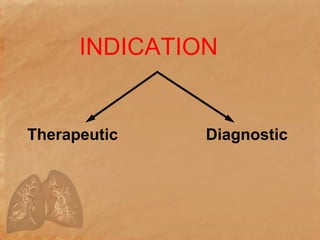
INDICATION
Therapeutic Diagnostic
Therapeutic:
 Noisy breathing
 Visible secretions in the airway
 Decreased SpO2 in the pulse oximeter &
Deterioration of arterial blood gas values
 Patient’s inability to generate an effective
spontaneous cough
 Presence of pulmonary atelectasis or
consolidation, presumed to be associated
with secretion retention
 During special procedures like
Bronchoscopy & Endoscopy
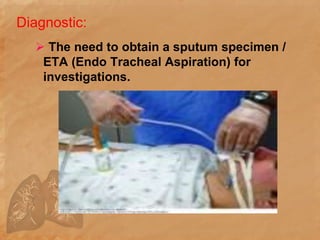
Diagnostic:
 The need to obtain a sputum specimen /
ETA (Endo Tracheal Aspiration) for
investigations.
• To maintain a patent airway by
removing accumulated
tracheobronchial secretions using
sterile technique.
• To improve oxygenation and reduce
the work of breathing.
• Stimulate the cough reflex.
• Prevent infection and atelectasis
from the retained secretion. Cont..
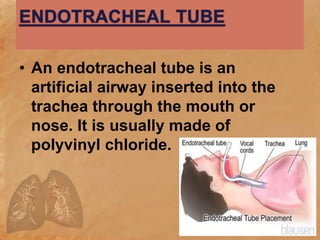
• An endotracheal tube is an
artificial airway inserted into the
trachea through the mouth or
nose. It is usually made of
polyvinyl chloride.
• It is available in various sizes . the size
is indicated by internal diameter (ID) in
millimeters.8/ 8.5 mm ID used for adult
male & 7/7.5 mm ID used for adult
female.
• Hypoxemia ( decreased O2 in the
blood)
• Dysrhythmias
• Nosocomial pulmonary tract
infection (most common complication
of ETT tube suctioning)
• Pulmonary hemorrhage / bleeding
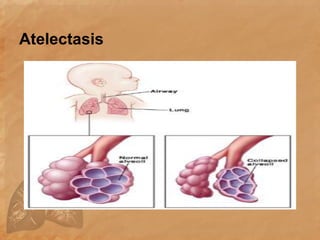
Atelectasis
• Sepsis
• Mucosal trauma with increase
secretions
• Cardiac arrest
• respiratory arrest
• Bronchospasm
• Hypotension / hypertension
• Elevated ICP
ASSESSMENT
PREPARATION OF PATIENT & ARTICLES
IMPLEMENTATION
EVALUATION
ASSESSMENT
Patient should be monitored prior to, during & after the
procedure for following :
 Breath sounds
 Oxygen saturation
 Respiratory Rate & pattern
 Hemodynamic parameters (pulse rate, Blood
pressure)
 Cough effort
 ICP (If indicated and available)
 Sputum characteristics (color, volume,
consistency & odor)
 Ventilator parameters (PIP, Vt & FiO2)
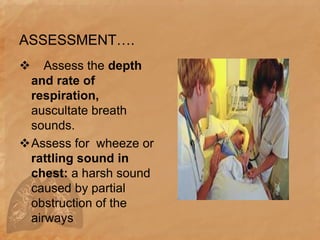
ASSESSMENT….
 Assess the depth
and rate of
respiration,
auscultate breath
sounds.
Assess for wheeze or
rattling sound in
chest: a harsh sound
caused by partial
obstruction of the
airways
Patient Preparation
 Explain the procedure to the patient
if conscious.
 The patient should receive hyper
oxygenation by the delivery of 100%
oxygen for >30 seconds prior to the
suctioning
 Position the patient in supine or
semi fowlers position.
 Auscultate the breath sounds.
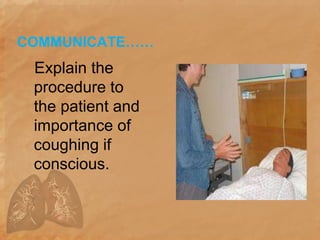
COMMUNICATE……
Explain the
procedure to
the patient and
importance of
coughing if
conscious.
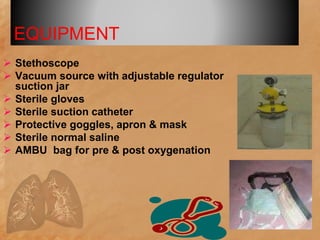
EQUIPMENT
 Stethoscope
 Vacuum source with adjustable regulator
suction jar
 Sterile gloves
 Sterile suction catheter
 Protective goggles, apron & mask
 Sterile normal saline
 AMBU bag for pre & post oxygenation
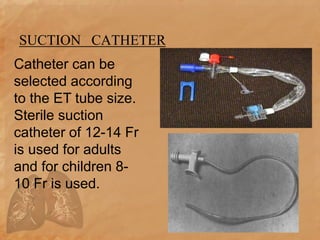
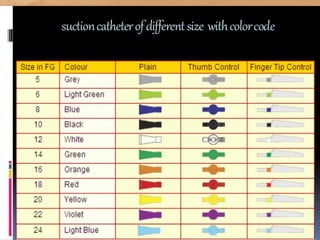
SUCTION CATHETER
Catheter can be
selected according
to the ET tube size.
Sterile suction
catheter of 12-14 Fr
is used for adults
and for children 8-
10 Fr is used.
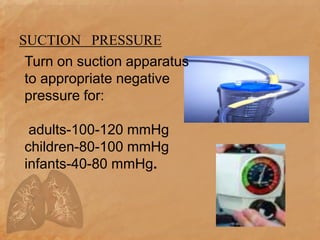
SUCTION PRESSURE
Turn on suction apparatus
to appropriate negative
pressure for:
adults-100-120 mmHg
children-80-100 mmHg
infants-40-80 mmHg.
IMPLEMENTATION
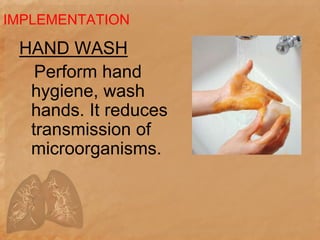
HAND WASH
Perform hand
hygiene, wash
hands. It reduces
transmission of
microorganisms.
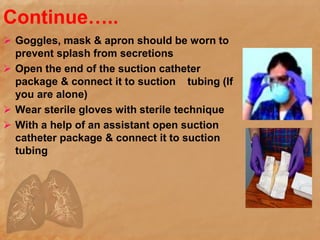
 Goggles, mask & apron should be worn to
prevent splash from secretions
 Open the end of the suction catheter
package & connect it to suction tubing (If
you are alone)
 Wear sterile gloves with sterile technique
 With a help of an assistant open suction
catheter package & connect it to suction
tubing
Continue…..
Continue…..
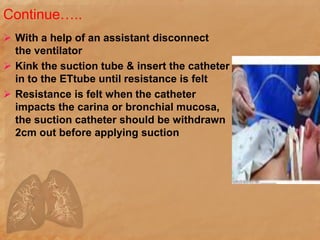
 With a help of an assistant disconnect
the ventilator
 Kink the suction tube & insert the catheter
in to the ETtube until resistance is felt
 Resistance is felt when the catheter
impacts the carina or bronchial mucosa,
the suction catheter should be withdrawn
2cm out before applying suction
Continue.....
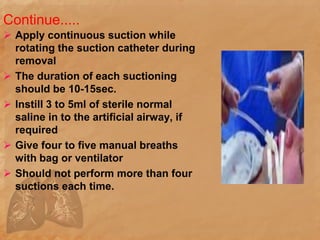
 Apply continuous suction while
rotating the suction catheter during
removal
 The duration of each suctioning
should be 10-15sec.
 Instill 3 to 5ml of sterile normal
saline in to the artificial airway, if
required
 Give four to five manual breaths
with bag or ventilator
 Should not perform more than four
suctions each time.
Continue…..
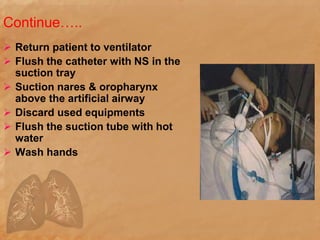
 Return patient to ventilator
 Flush the catheter with NS in the
suction tray
 Suction nares & oropharynx
above the artificial airway
 Discard used equipments
 Flush the suction tube with hot
water
 Wash hands
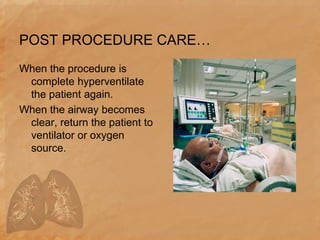
POST PROCEDURE CARE…
When the procedure is
complete hyperventilate
the patient again.
When the airway becomes
clear, return the patient to
ventilator or oxygen
source.
DOCUMENTATION…
Record the time of
suctioning, nature &
amount of secretions.
Document indications
for suctioning & any
changes in vitals &
patient’s tolerance.
CAUTION..
 Suctioning is potentially an
harmful procedure if carried out
improperly.
 Suctioning should be done when
clinically necessary (not
routinely).
 The need for suctioning should
be assessed at least every 2hrs
or more frequently as need
arises.
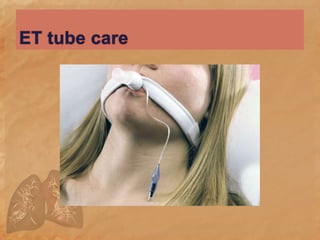
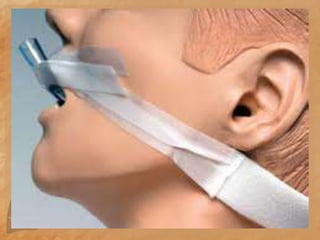
• Observe for the sign and symptoms of need
to perform ET tube care: soiled or loose tape,
pressure sore or nares, lips or corner of
mouth, and excess nasal or oral secretions.
• Observe for factors that increase risk of
complications from ET tube: type and size of
tube, movement of tube up and down
trachea( in and out), duration of tube
placement, cuff over inflation or under
inflation, presence of facial trauma,
malnutrition and neck or thoracic radiation.
• Assess client’s knowledge of
procedure.
• Obtain another nurse’s assistance in
the procedure.
• Explain procedure and client’s
participation including importance of
the following: not biting or moving ET
tube with tongue, trying not to cough
when tape is off ET tube, keeping
hands down and not pulling on tubing,
removal of tape from face can be
uncomfortable.
• Assist client to assume position
comfortable for both nurse and
client(usually supine or semi fowler’s)
• Wash hands and administer
endotracheal, nasopharyngeal and
oropharyngeal suction.
Suctionong

Suctionong

  • 2.
    • Endotracheal suctioningis a component of bronchial hygiene therapy involves the mechanical aspiration of pulmonary secretions from a patient with an artificial airway in place.
  • 4.
    • ETT suctioningis defined as the procedure to remove pulmonary secretions mechanically from the patient’s airway passages via nose or mouth where ETT (Endotracheal tube) is in place. • Endotracheal suctioning is the removal of secretions from tracheo-broncheal tree through an endotracheal suction tube with the help of mechanical suction device.
  • 5.
  • 6.
    Therapeutic:  Noisy breathing Visible secretions in the airway  Decreased SpO2 in the pulse oximeter & Deterioration of arterial blood gas values  Patient’s inability to generate an effective spontaneous cough  Presence of pulmonary atelectasis or consolidation, presumed to be associated with secretion retention  During special procedures like Bronchoscopy & Endoscopy
  • 7.
    Diagnostic:  The needto obtain a sputum specimen / ETA (Endo Tracheal Aspiration) for investigations.
  • 8.
    • To maintaina patent airway by removing accumulated tracheobronchial secretions using sterile technique. • To improve oxygenation and reduce the work of breathing. • Stimulate the cough reflex. • Prevent infection and atelectasis from the retained secretion. Cont..
  • 9.
    • An endotrachealtube is an artificial airway inserted into the trachea through the mouth or nose. It is usually made of polyvinyl chloride.
  • 11.
    • It isavailable in various sizes . the size is indicated by internal diameter (ID) in millimeters.8/ 8.5 mm ID used for adult male & 7/7.5 mm ID used for adult female.
  • 12.
    • Hypoxemia (decreased O2 in the blood) • Dysrhythmias • Nosocomial pulmonary tract infection (most common complication of ETT tube suctioning) • Pulmonary hemorrhage / bleeding
  • 13.
  • 14.
    • Sepsis • Mucosaltrauma with increase secretions • Cardiac arrest • respiratory arrest • Bronchospasm • Hypotension / hypertension • Elevated ICP
  • 17.
    ASSESSMENT PREPARATION OF PATIENT& ARTICLES IMPLEMENTATION EVALUATION
  • 18.
    ASSESSMENT Patient should bemonitored prior to, during & after the procedure for following :  Breath sounds  Oxygen saturation  Respiratory Rate & pattern  Hemodynamic parameters (pulse rate, Blood pressure)  Cough effort  ICP (If indicated and available)  Sputum characteristics (color, volume, consistency & odor)  Ventilator parameters (PIP, Vt & FiO2)
  • 19.
    ASSESSMENT….  Assess thedepth and rate of respiration, auscultate breath sounds. Assess for wheeze or rattling sound in chest: a harsh sound caused by partial obstruction of the airways
  • 20.
    Patient Preparation  Explainthe procedure to the patient if conscious.  The patient should receive hyper oxygenation by the delivery of 100% oxygen for >30 seconds prior to the suctioning  Position the patient in supine or semi fowlers position.  Auscultate the breath sounds.
  • 21.
    COMMUNICATE…… Explain the procedure to thepatient and importance of coughing if conscious.
  • 22.
    EQUIPMENT  Stethoscope  Vacuumsource with adjustable regulator suction jar  Sterile gloves  Sterile suction catheter  Protective goggles, apron & mask  Sterile normal saline  AMBU bag for pre & post oxygenation
  • 23.
    SUCTION CATHETER Catheter canbe selected according to the ET tube size. Sterile suction catheter of 12-14 Fr is used for adults and for children 8- 10 Fr is used.
  • 25.
    SUCTION PRESSURE Turn onsuction apparatus to appropriate negative pressure for: adults-100-120 mmHg children-80-100 mmHg infants-40-80 mmHg.
  • 26.
    IMPLEMENTATION HAND WASH Perform hand hygiene,wash hands. It reduces transmission of microorganisms.
  • 27.
     Goggles, mask& apron should be worn to prevent splash from secretions  Open the end of the suction catheter package & connect it to suction tubing (If you are alone)  Wear sterile gloves with sterile technique  With a help of an assistant open suction catheter package & connect it to suction tubing Continue…..
  • 28.
    Continue…..  With ahelp of an assistant disconnect the ventilator  Kink the suction tube & insert the catheter in to the ETtube until resistance is felt  Resistance is felt when the catheter impacts the carina or bronchial mucosa, the suction catheter should be withdrawn 2cm out before applying suction
  • 29.
    Continue.....  Apply continuoussuction while rotating the suction catheter during removal  The duration of each suctioning should be 10-15sec.  Instill 3 to 5ml of sterile normal saline in to the artificial airway, if required  Give four to five manual breaths with bag or ventilator  Should not perform more than four suctions each time.
  • 30.
    Continue…..  Return patientto ventilator  Flush the catheter with NS in the suction tray  Suction nares & oropharynx above the artificial airway  Discard used equipments  Flush the suction tube with hot water  Wash hands
  • 31.
    POST PROCEDURE CARE… Whenthe procedure is complete hyperventilate the patient again. When the airway becomes clear, return the patient to ventilator or oxygen source.
  • 32.
    DOCUMENTATION… Record the timeof suctioning, nature & amount of secretions. Document indications for suctioning & any changes in vitals & patient’s tolerance.
  • 33.
    CAUTION..  Suctioning ispotentially an harmful procedure if carried out improperly.  Suctioning should be done when clinically necessary (not routinely).  The need for suctioning should be assessed at least every 2hrs or more frequently as need arises.
  • 34.
    • Observe forthe sign and symptoms of need to perform ET tube care: soiled or loose tape, pressure sore or nares, lips or corner of mouth, and excess nasal or oral secretions. • Observe for factors that increase risk of complications from ET tube: type and size of tube, movement of tube up and down trachea( in and out), duration of tube placement, cuff over inflation or under inflation, presence of facial trauma, malnutrition and neck or thoracic radiation.
  • 35.
    • Assess client’sknowledge of procedure. • Obtain another nurse’s assistance in the procedure. • Explain procedure and client’s participation including importance of the following: not biting or moving ET tube with tongue, trying not to cough when tape is off ET tube, keeping hands down and not pulling on tubing, removal of tape from face can be uncomfortable.
  • 36.
    • Assist clientto assume position comfortable for both nurse and client(usually supine or semi fowler’s) • Wash hands and administer endotracheal, nasopharyngeal and oropharyngeal suction.