Semiconduct
ors
A semiconductor is a substance, usually a
solid chemical element or compound, that
can conduct electricity under some
conditions but not others, making it a
good medium for the control of electrical
current.
• The solids having resistivity or conductivity in between
metals and insulators are termed as semiconductors.
Types of semiconductors :-
• Elements of semiconductors. Semiconductors consisting of
a single chemical element are known as elemental
semiconductors.
• For example :- germanium (Ge), silicon (Si), selenium (Se)
etc.
• Compound semiconductor. Semiconductor consisting of
two or more chemical elements are known as compound
semiconductors.
• Foe example :- indium phosphide (InP), lead sulphide (PbS)
etc.
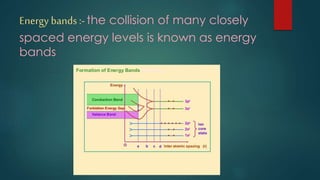
Energy bands:-the collision of many closely
spaced energy levels is known as energy
bands
Conduction band :-
1. a delocalized band of energy levels in a crystalline solid which is partly
filled with electrons. These electrons have great mobility and are
responsible for electrical conductivity.
Forbidden energy gap :-
 The separation between valence band and conduction band is known
as forbidden energy gap. If an electron is to be transferred from valence
band to conduction band, external energy is required, which is equal to
the forbidden energy gap
Valance band:-
1. The valence band is the highest range of electron energies in which
electrons are normally present at absolute zero temperature, while
the conduction band is the lowest range of vacant electronic states.
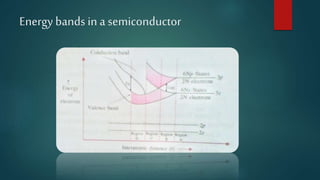
Energy bands in a semiconductor
 1. Region A. when interatomic spacing is very large, each atom in the silicon crystal
behaves independently and has discrete energy levels.
 In silicon crystal, the outermost two subshells namely 3s and 3p contain 2N electrons
each. Therefore, 3s subshell has 2N electrons completely occupying 2Ns- states at the
same energy level. The 3p subshell has 6N possible p-state , only 2Np- states are
occupied by 2N electrons at the same energy level. Thus, 4p- states are empty.
 2. Region B. when atoms are brought closer to each other to form a solid , the
interaction among valence electrons of N atom split 3s and 3p levels into large
number larger number of closely spaced energy levels where the energy of an
electron may be slightly less or more then the energy of an electron in an isolated
atom. Thus, two bands 3s and 3p stats are formed. All the 2N- states in the band are
completely field by 2N electrons. On the other hand, only 2N stats out of 6Np- stats in
the band are filled by 2N electrons and the other 4N stats in 3p level empty. The
energy bands are separated by a definite energy gap.
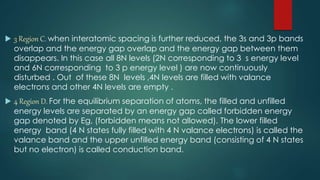
 3 Region C. when interatomic spacing is further reduced, the 3s and 3p bands
overlap and the energy gap overlap and the energy gap between them
disappears. In this case all 8N levels (2N corresponding to 3 s energy level
and 6N corresponding to 3 p energy level ) are now continuously
disturbed . Out of these 8N levels ,4N levels are filled with valance
electrons and other 4N levels are empty .
 4 Region D. For the equilibrium separation of atoms, the filled and unfilled
energy levels are separated by an energy gap called forbidden energy
gap denoted by Eg, (forbidden means not allowed). The lower filled
energy band (4 N states fully filled with 4 N valance electrons) is called the
valance band and the upper unfilled energy band (consisting of 4 N states
but no electron) is called conduction band.
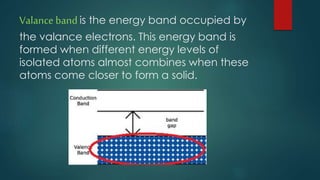
Valance band is the energy band occupied by
the valance electrons. This energy band is
formed when different energy levels of
isolated atoms almost combines when these
atoms come closer to form a solid.
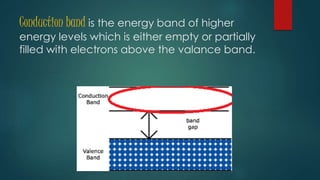
Conduction band is the energy band of higher
energy levels which is either empty or partially
filled with electrons above the valance band.
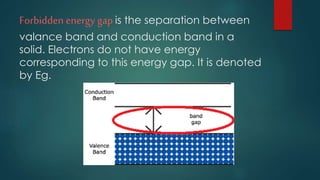
Forbidden energy gap is the separation between
valance band and conduction band in a
solid. Electrons do not have energy
corresponding to this energy gap. It is denoted
by Eg.
Prepared by
nitika Sharma
roll no. -7
stream - medical

Semiconductors

  • 1.
  • 2.
    A semiconductor isa substance, usually a solid chemical element or compound, that can conduct electricity under some conditions but not others, making it a good medium for the control of electrical current. • The solids having resistivity or conductivity in between metals and insulators are termed as semiconductors.
  • 3.
    Types of semiconductors:- • Elements of semiconductors. Semiconductors consisting of a single chemical element are known as elemental semiconductors. • For example :- germanium (Ge), silicon (Si), selenium (Se) etc. • Compound semiconductor. Semiconductor consisting of two or more chemical elements are known as compound semiconductors. • Foe example :- indium phosphide (InP), lead sulphide (PbS) etc.
  • 4.
    Energy bands:-the collisionof many closely spaced energy levels is known as energy bands
  • 5.
    Conduction band :- 1.a delocalized band of energy levels in a crystalline solid which is partly filled with electrons. These electrons have great mobility and are responsible for electrical conductivity.
  • 6.
    Forbidden energy gap:-  The separation between valence band and conduction band is known as forbidden energy gap. If an electron is to be transferred from valence band to conduction band, external energy is required, which is equal to the forbidden energy gap
  • 7.
    Valance band:- 1. Thevalence band is the highest range of electron energies in which electrons are normally present at absolute zero temperature, while the conduction band is the lowest range of vacant electronic states.
  • 8.
    Energy bands ina semiconductor
  • 9.
     1. RegionA. when interatomic spacing is very large, each atom in the silicon crystal behaves independently and has discrete energy levels.  In silicon crystal, the outermost two subshells namely 3s and 3p contain 2N electrons each. Therefore, 3s subshell has 2N electrons completely occupying 2Ns- states at the same energy level. The 3p subshell has 6N possible p-state , only 2Np- states are occupied by 2N electrons at the same energy level. Thus, 4p- states are empty.  2. Region B. when atoms are brought closer to each other to form a solid , the interaction among valence electrons of N atom split 3s and 3p levels into large number larger number of closely spaced energy levels where the energy of an electron may be slightly less or more then the energy of an electron in an isolated atom. Thus, two bands 3s and 3p stats are formed. All the 2N- states in the band are completely field by 2N electrons. On the other hand, only 2N stats out of 6Np- stats in the band are filled by 2N electrons and the other 4N stats in 3p level empty. The energy bands are separated by a definite energy gap.
  • 10.
     3 RegionC. when interatomic spacing is further reduced, the 3s and 3p bands overlap and the energy gap overlap and the energy gap between them disappears. In this case all 8N levels (2N corresponding to 3 s energy level and 6N corresponding to 3 p energy level ) are now continuously disturbed . Out of these 8N levels ,4N levels are filled with valance electrons and other 4N levels are empty .  4 Region D. For the equilibrium separation of atoms, the filled and unfilled energy levels are separated by an energy gap called forbidden energy gap denoted by Eg, (forbidden means not allowed). The lower filled energy band (4 N states fully filled with 4 N valance electrons) is called the valance band and the upper unfilled energy band (consisting of 4 N states but no electron) is called conduction band.
  • 11.
    Valance band isthe energy band occupied by the valance electrons. This energy band is formed when different energy levels of isolated atoms almost combines when these atoms come closer to form a solid.
  • 12.
    Conduction band isthe energy band of higher energy levels which is either empty or partially filled with electrons above the valance band.
  • 13.
    Forbidden energy gapis the separation between valance band and conduction band in a solid. Electrons do not have energy corresponding to this energy gap. It is denoted by Eg.
  • 14.
    Prepared by nitika Sharma rollno. -7 stream - medical