Semiconductor Devices
Dr G.S. Virdi
Director R & D Former Director Grade Scientist
GGS College of Modern Technology CSIR- Central Electronic Engineering
Kharar Mohali Research Institute- Pilani
In the modern world no other technology
permeates every nook and cranny of our
existence as does electronics.
Application of electronics are : Televisions,
radios, stereo equipment, computers,
scanners, electronic control systems (in cars
for example) etc.
Introduction to Electronic Devices
Outline Presentation
 Introduction
 Diodes
 Electrical Properties of Solids
 Semiconductors
 P-n Junctions
 Semiconductor Diodes
 Diode Circuits
Introduction
 This course adopts a top-down approach to the
subject and so far we have taken a ‘black-box’ view
of active components
 It is now time to look ‘inside the box’
 we will start by looking at diodes and
semiconductors
 then progress to transistors
 later we will look at more detailed aspects of
circuit design
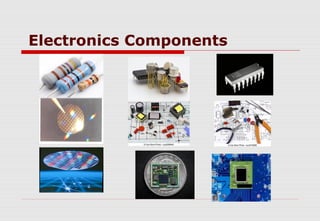
Electronics Components
The p-n junction is at the heart of electronics
technology. Most electronics is silicon based,
that is, the devices are made of silicon. Silicon
wafers are subjected to special procedures
which result in what is called p-type silicon
material and n-type silicon material. Where
these two types of materials meet we have a
p-n junction.
p-n junction
Diodes
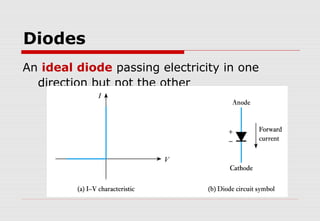
An ideal diode passing electricity in one
direction but not the other
Diodes
One application of diodes is in rectification
 the example below shows a half-wave rectifier
 Inpractice, no real diode has ideal characteristics but
semiconductor p-n junctions make good diodes
 To understand such devices we need to look at some
properties of materials
Atomic Structure of atom,
Semiconductors are materials whose electrical
conductivities are higher than those of insulators
but lower that those of conductors.
Silicon, Germanium, Gallium, Arsenide, Indium,
Antimonide and cadmium sulphide are some
commonly used semiconductors.
Semiconductors have negative temperature
coefficients of resistance, i.e. as temperature
increases resistivity deceases
Electrical Properties of Solids
Energy Band Diagram
Conduction band Ec
Ev
Eg
Band gap
Valence band
• Energy band diagram shows the bottom edge of conduction
band, Ec , and top edge of valence band, Ev .
•
Ec and Ev are separated by the band gap energy, Eg .
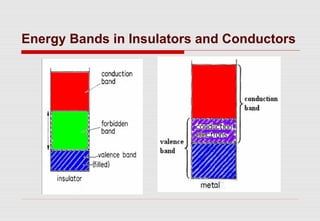
Energy Bands in Insulators and Conductors
Energy Bands in Semiconductors

Forbidden band small for
semiconductors.
● Less energy required
for electron to move from
valence to conduction
band.
● A vacancy (hole)
remains when an electron
leaves the valence band.
● Hole acts as a positive
charge carrier to
conduction band
Energy gap in a conductor, semi conductor, and insulator?.
Conductor - no energy gap
Semi Conductor - 1. 1 ev.
Insulator 6 -9 ev.
Energy Bands in Insulators & Semiconductors
and Metals
Electrical Properties of Solids
 Conductors
 e.g. copper or aluminium
 have a cloud of free electrons (at all
temperatures above absolute zero). If an electric
field is applied electrons will flow causing an
electric current
 Insulators
 e.g. polythene
 electrons are tightly bound to atoms so few can
break free to conduct electricity
Electrical Properties of Solids
Semiconductors
 e.g. silicon or germanium
 at very low temperatures these have the properties
of insulators
 as the material warms up some electrons break free
and can move about, and it takes on the properties
of a conductor - albeit a poor one
 however, semiconductors have several properties
that make them distinct from conductors and
insulators
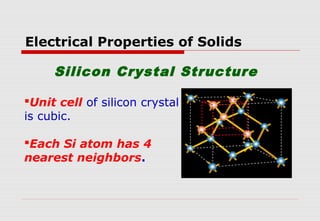
Silicon Crystal Structure
Unit cell of silicon crystal
is cubic.
Each Si atom has 4
nearest neighbors.
Electrical Properties of Solids
Pure semiconductors
 thermal vibration results in some bonds being
broken generating free electrons which move
about
 these leave behind holes which accept electrons
from adjacent atoms and therefore also move about
 electrons are negative charge carriers
 holes are positive charge carriers
 At room temperatures there are few charge carriers
 pure semiconductors are poor conductors
 this is intrinsic conduction
Electrical Properties of Solids
Doping
 the addition of small amounts of impurities
drastically affects its properties
 some materials form an excess of electrons
and produce an n-type semiconductor
 some materials form an excess of holes and
produce a p-type semiconductor
 both n-type and p-type materials have much
greater conductivity than pure semiconductors
 this is extrinsic conduction
Extrinsic Semiconductors / Doping
 The electron or hole concentration can be
greatly increased by adding controlled
amounts of certain impurities
 For silicon, it is desirable to use impurities
from the group III and V.
 N-type Semiconductor can be created by
adding phosphorus or arsenic.
 P -type Semiconductor can be created by
adding Boron or Gallium
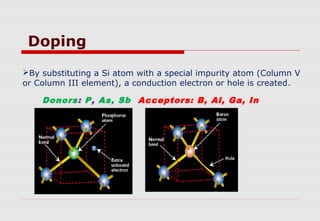
Donors: P, As, Sb Acceptors: B, Al, Ga, In
By substituting a Si atom with a special impurity atom (Column V
or Column III element), a conduction electron or hole is created.
Doping
Electrical Properties of Solids
 The dominant charge carriers in a doped semiconductor
(e.g. electrons in n-type material) are called majority
charge carriers. Other type are minority charge carriers
 The overall doped material is electrically neutral
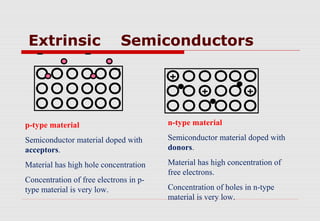
p-type material
Semiconductor material doped with
acceptors.
Material has high hole concentration
Concentration of free electrons in p-
type material is very low.
n-type material
Semiconductor material doped with
donors.
Material has high concentration of
free electrons.
Concentration of holes in n-type
material is very low.
Extrinsic Semiconductors
p-type material
Contains NEGATIVELY charged
acceptors (immovable) and
POSITIVELY charged holes (free).
Total charge = 0
n-type material
Contains POSITIVELY charged
donors (immovable) and
NEGATIVELY charged free
electrons.
Total charge = 0
Extrinsic Semiconductors
donor: impurity atom that increases n
acceptor: impurity atom that increases p
n-type material: contains more electrons than
holes
p-type material: contains more holes than
electrons
majority carrier: the most abundant carrier
minority carrier: the least abundant carrier
intrinsic semiconductor: n = p = ni
extrinsic semiconductor: doped semiconductor
Semiconductor Terminology
The p-n junction is at the heart of electronics
technology. Most electronics is silicon based, that is,
the devices are made of silicon. Silicon wafers are
subjected to special procedures which result in what
is called p-type silicon material and n-type silicon
material. Where these two types of materials meet
we have a p-n junction.

On its own a p-type or n-type semiconductor is
not very useful. However when combined very
useful devices can be made.
The formation of p-n junction
The p-n junction is the basic element of all bipolar
devices. Its main electrical property is that it rectifies
(allow current to flow easily in one direction only).The
p-n junction is often just called a DIODE. Applications;
>photodiode, light sensitive diode,
>LED- ligth emitting diode,
>varactor diode-variable capacitance
diode
 transistors and integrated circuits
The formation of p-n junction
 The p-n junction can be formed by pushing a piece of p-
type silicon into close contact with a piecce of n-type
silicon. But forming a p-n junction is not so simply.
Because;
 There will only be very few points of contact and any
current flow would be restricted to these few points
instead of the whole surface area of the junction.
 Silicon that has been exposed to the air always has a
thin oxide coating on its surface called the “native
oxide”. This oxide is a very good insulator and will
prevent current flow.
 Bonding arrangement is interrupted at the surface;
dangling bonds.
The formation of p-n junction
 A P-N Junction cannot be produced by simply
pushing two pieces together or by welding
etc…..Because it gives rise to discontinuities
across the crystal structure.
 Special fabrication techniques are adopted to
form P-N Junction, e.g. Crystal Preparation ,
Masking, Photolithographic Process ,
Deposition ,Implantation , Diffusion
,Oxidation ,Epitaxy ,Contacts, Interconnects
,Metallization and Planarization.
The formation of p-n junction
To overcome these surface states
problems
p-n junction can be formed in the bulk of
the semiconductor, away from the
surface as much as possible.
Surface states
The formation of p-n junction
PN junction is present in perhaps every semiconductor devi
diode
symbol
N P
V
I
– +
  Building Blocks of the PN Junction Theory
V
I
Reverse bias Forward bias
Donor ions
N-type
P-type
The formation of p-n junction
When p-type and n-type materials are
joined this forms a pn junction
 majority charge carriers on each side diffuse
across the junction where they combine with
(and remove) charge carriers of the opposite
polarity
 hence around the junction there are few free
charge carriers and we have a depletion layer
(also called a space-charge layer)
DEPLETION REGION
Free electrons on the n-side and free holes on the p-side can initially
diffuse across the junction. Uncovered charges are left in the
neighborhood of the junction.
This region is depleted of mobile carriers and is called the
DEPLETION REGION (thickness 0.5 – 1.0 µm).
The formation of p-n junction
The diffusion of positive
charge in one direction and
negative charge in the
other produces a charge
imbalance
 this results in a
potential barrier
across the junction
++++++
++++++
++++++
++++++
++++++
++++++
++++
- - - - - -
- - - - - -
- - - - - -
- - - - - -
- - - - - -
- - - - - -
- - - -
Hole
Movement
Electron
Movement
++++
++++
++++
Fixed positive
space-charge
- - - -
- - - -
- - - -
Fixed negative
space-charge
Ohmic
end-contact
n-type p-type
Metallurgical
junction
The formation of p-n junction
Potential barrier
 the barrier opposes the flow of majority charge
carriers and only a small number have enough
energy to surmount it
 this generates a small diffusion current
 the barrier encourages the flow of minority carriers
and any that come close to it will be swept over
 this generates a small drift current
 for an isolated junction these two currents must
balance each other and the net current is zero
Forward bias to p-n junction

When an external voltage is applied
to the P-N junction making the P side
positive with respect to the N side the
diode is said to be forward biased
(F.B).
The barrier p.d. is decreased by the
external applied voltage. The depletion
band narrows which urges majority
carriers to flow across the junction.
A F.B. diode has a very low resistance.
Forward bias to p-n junction
Forward bias
 if the p-type side is made positive with respect to
the
n-type side the height of the barrier is reduced
 more majority charge carriers have sufficient
energy to surmount it
 the diffusion current therefore increases while the
drift current remains the same
 there is thus a net current flow across the junction
which increases with the applied voltage
When an external voltage is applied to the
PN junction making the P side negative
with respect to the N side the diode is said
to be Reverse Biased (R.B.).
The barrier p.d. increases. The depletion
band widens preventing the movement of
majority carriers across the junction.
A R.B. diode has a very high resistance.
Reversed bias to p-n junction
Reverse bias
 if the p-type side is made negative with respect to
the
n-type side the height of the barrier is increased
 the number of majority charge carriers that have
sufficient energy to surmount it rapidly decreases
 the diffusion current therefore vanishes while the
drift current remains the same
 thus the only current is a small leakage current
caused by the (approximately constant) drift current
 the leakage current is usually negligible (a few nA)
Currents in a pn junction
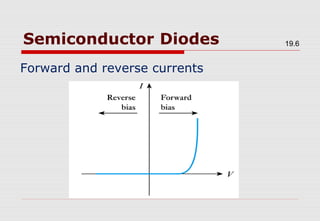
Forward and reverse currents
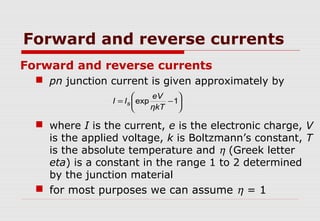
 pn junction current is given approximately by
 where I is the current, e is the electronic charge, V
is the applied voltage, k is Boltzmann’s constant, T
is the absolute temperature and η (Greek letter
eta) is a constant in the range 1 to 2 determined
by the junction material
 for most purposes we can assume η = 1






−= 1exp
ηkT
eV
II s
Semiconductor Diodes
 Thus
at room temperature e/kT ~ 40 V-1
 If V > +0.1 V
 If V < -0.1 V
 IS is the reverse saturation current






−≈ 1exp
kT
eV
II s
( )VI
kT
eV
II ss 40expexp =





≈
( ) ss III −=−≈ 10
Semiconductor Diodes
Forward and reverse currents
19.6
Silicon diodes
Silicon diodes
 generally have a turn-on voltage of about 0.5 V
 generally have a conduction voltage of about 0.7 V
 have a breakdown voltage that depends on their
construction
 perhaps 75 V for a small-signal diode
 perhaps 400 V for a power device
 have a maximum current that depends on their
construction
 perhaps 100 mA for a small-signal diode
 perhaps many amps for a power device
I-V characteristics of electronic components.
Resistor
The I-V plot represents is the dependence of the current I
through the component on the voltage V across it.
V
R
IRIV ×





==>×=
1
;I = V /
R;R = V/I
V
I
R
∆V
∆I
α
tg(α) = 1/R
The I-V characteristic of the resistor
Silicon diodes
Turn-on and breakdown voltages for a silicon
device
 There is no turn-on voltage because current flows in any case.
However , the turn-on voltage can be defined as the forward
bias required to produce a given amount of forward current.
 If 1 m A is required for the circuit to work, 0.7 volt can be
called as turn-on voltage.
VVbb
II00
VVbb ; Breakdown voltage
II0 ;0 ; Reverse saturation current
Forward BiasForward BiasReverse BiasReverse Bias
I(current)
V(voltage)
Ge ~ 0.2 – 0.4 V
Si ~ 0.6 – 0.8 V
Applying bias to p-n junction
The experimental I-V characteristic of a
Si diode
Small leakage
current
Temperature dependence of the volt
ampere of a p-n diode
Diode Circuits
Half-wave rectifier
 peak output voltage
is equal to the peak
input voltage minus
the conduction
voltage of the diode
 reservoir capacitor
used to produce a
steadier output
Diode Circuits
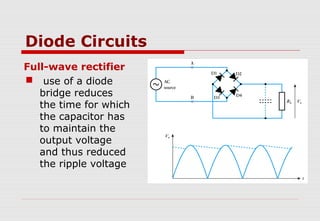
Full-wave rectifier
 use of a diode
bridge reduces
the time for which
the capacitor has
to maintain the
output voltage
and thus reduced
the ripple voltage
Diode Circuits
Signal rectifier
 used to demodulate
full amplitude
modulated signals
(full-AM)
 also known as an
envelope detector
 found in a wide range
of radio receivers from
crystal sets to
super heterodynes
Diode Circuits
Signal clamping
 a simple form of
signal conditioning
 circuits limit the
excursion of the
voltage waveform
 can use a
combination of
signal and Zener
diodes
Key Points of Diode
 Diodes allow current to flow in only one direction
 At low temperatures semiconductors act like insulators
 At higher temperatures they begin to conduct
 Doping of semiconductors leads to the production of p-
type and n-type materials
 A junction between p-type and n-type semiconductors
has the properties of a diode
 Silicon semiconductor diodes approximate the behavior
of ideal diodes but have a conduction voltage of about
0.7 V
 There are also a wide range of special purpose diodes
 Diodes are used in a range of applications
Parameter Germanium Silicon Comments
Depletion layer p.d. 0.15V 0.6V
Germanium can be useful for low
voltage applications.
Forward current
A few milli-
Amperes
Tens of
Amperes
Silicon much better for high
current applications.
Reverse leakage current
A few micro-
amperes
A few nano-
amperes
Germanium 1000 times more
leaky than silicon.
Max. reverse voltage Volts
Hundreds of
volts
Silicon the only real choice for
high voltage applications.
Temperature stability Poor Good
Germanium more sensitive to
temperature. Can be a problem or
can be useful.
Junction capacitance
Very low (point
contact)
Comparativel
y high
This is a useful feature for high
frequency use. Note: low
capacitance silicon diodes are also
available but their capacitance is
still higher than point contact type.
Silicon & Germanium diode Comparison
Semiconductor Devices
G.S.VIRDI
• Crystal Preparation
• Masking
• Photolithographic Process
• Deposition
• Implantation
• Diffusion
• Oxidation
• Epitaxy
• Contacts, Interconnect ,Metalization and
Planarizatiomn
IC Fabrication Techniques
IC Fabrication Laboratory
G.S.VIRDI
Semiconductor Devices
Design of an Integrated Circuit
Thorough Inspection of Design
Fully Processed Wafer
STAGES OF IC FABRICATION
G.S.VIRDI
Semiconductor Devices
60
Micro-Fabrication Facilities, CEERI
Fabricated 4” Silicon Wafer – MEMS Acoustic Sensor
MEMS Devices
Semiconductor Devices
G.S.VIRDI
G.S.VIRDI
Semiconductor Devices

Semiconductor devices

  • 1.
    Semiconductor Devices Dr G.S.Virdi Director R & D Former Director Grade Scientist GGS College of Modern Technology CSIR- Central Electronic Engineering Kharar Mohali Research Institute- Pilani
  • 2.
    In the modernworld no other technology permeates every nook and cranny of our existence as does electronics. Application of electronics are : Televisions, radios, stereo equipment, computers, scanners, electronic control systems (in cars for example) etc. Introduction to Electronic Devices
  • 3.
    Outline Presentation  Introduction Diodes  Electrical Properties of Solids  Semiconductors  P-n Junctions  Semiconductor Diodes  Diode Circuits
  • 4.
    Introduction  This courseadopts a top-down approach to the subject and so far we have taken a ‘black-box’ view of active components  It is now time to look ‘inside the box’  we will start by looking at diodes and semiconductors  then progress to transistors  later we will look at more detailed aspects of circuit design
  • 5.
  • 6.
    The p-n junctionis at the heart of electronics technology. Most electronics is silicon based, that is, the devices are made of silicon. Silicon wafers are subjected to special procedures which result in what is called p-type silicon material and n-type silicon material. Where these two types of materials meet we have a p-n junction. p-n junction
  • 7.
    Diodes An ideal diodepassing electricity in one direction but not the other
  • 8.
    Diodes One application ofdiodes is in rectification  the example below shows a half-wave rectifier  Inpractice, no real diode has ideal characteristics but semiconductor p-n junctions make good diodes  To understand such devices we need to look at some properties of materials
  • 9.
  • 10.
    Semiconductors are materialswhose electrical conductivities are higher than those of insulators but lower that those of conductors. Silicon, Germanium, Gallium, Arsenide, Indium, Antimonide and cadmium sulphide are some commonly used semiconductors. Semiconductors have negative temperature coefficients of resistance, i.e. as temperature increases resistivity deceases Electrical Properties of Solids
  • 11.
    Energy Band Diagram Conductionband Ec Ev Eg Band gap Valence band • Energy band diagram shows the bottom edge of conduction band, Ec , and top edge of valence band, Ev . • Ec and Ev are separated by the band gap energy, Eg .
  • 12.
    Energy Bands inInsulators and Conductors
  • 13.
    Energy Bands inSemiconductors  Forbidden band small for semiconductors. ● Less energy required for electron to move from valence to conduction band. ● A vacancy (hole) remains when an electron leaves the valence band. ● Hole acts as a positive charge carrier to conduction band
  • 14.
    Energy gap ina conductor, semi conductor, and insulator?. Conductor - no energy gap Semi Conductor - 1. 1 ev. Insulator 6 -9 ev. Energy Bands in Insulators & Semiconductors and Metals
  • 15.
    Electrical Properties ofSolids  Conductors  e.g. copper or aluminium  have a cloud of free electrons (at all temperatures above absolute zero). If an electric field is applied electrons will flow causing an electric current  Insulators  e.g. polythene  electrons are tightly bound to atoms so few can break free to conduct electricity
  • 16.
    Electrical Properties ofSolids Semiconductors  e.g. silicon or germanium  at very low temperatures these have the properties of insulators  as the material warms up some electrons break free and can move about, and it takes on the properties of a conductor - albeit a poor one  however, semiconductors have several properties that make them distinct from conductors and insulators
  • 17.
    Silicon Crystal Structure Unitcell of silicon crystal is cubic. Each Si atom has 4 nearest neighbors. Electrical Properties of Solids
  • 18.
    Electrical Properties ofSolids Pure semiconductors  thermal vibration results in some bonds being broken generating free electrons which move about  these leave behind holes which accept electrons from adjacent atoms and therefore also move about  electrons are negative charge carriers  holes are positive charge carriers  At room temperatures there are few charge carriers  pure semiconductors are poor conductors  this is intrinsic conduction
  • 19.
    Electrical Properties ofSolids Doping  the addition of small amounts of impurities drastically affects its properties  some materials form an excess of electrons and produce an n-type semiconductor  some materials form an excess of holes and produce a p-type semiconductor  both n-type and p-type materials have much greater conductivity than pure semiconductors  this is extrinsic conduction
  • 20.
    Extrinsic Semiconductors /Doping  The electron or hole concentration can be greatly increased by adding controlled amounts of certain impurities  For silicon, it is desirable to use impurities from the group III and V.  N-type Semiconductor can be created by adding phosphorus or arsenic.  P -type Semiconductor can be created by adding Boron or Gallium
  • 21.
    Donors: P, As,Sb Acceptors: B, Al, Ga, In By substituting a Si atom with a special impurity atom (Column V or Column III element), a conduction electron or hole is created. Doping
  • 22.
    Electrical Properties ofSolids  The dominant charge carriers in a doped semiconductor (e.g. electrons in n-type material) are called majority charge carriers. Other type are minority charge carriers  The overall doped material is electrically neutral
  • 23.
    p-type material Semiconductor materialdoped with acceptors. Material has high hole concentration Concentration of free electrons in p- type material is very low. n-type material Semiconductor material doped with donors. Material has high concentration of free electrons. Concentration of holes in n-type material is very low. Extrinsic Semiconductors
  • 24.
    p-type material Contains NEGATIVELYcharged acceptors (immovable) and POSITIVELY charged holes (free). Total charge = 0 n-type material Contains POSITIVELY charged donors (immovable) and NEGATIVELY charged free electrons. Total charge = 0 Extrinsic Semiconductors
  • 25.
    donor: impurity atomthat increases n acceptor: impurity atom that increases p n-type material: contains more electrons than holes p-type material: contains more holes than electrons majority carrier: the most abundant carrier minority carrier: the least abundant carrier intrinsic semiconductor: n = p = ni extrinsic semiconductor: doped semiconductor Semiconductor Terminology
  • 26.
    The p-n junctionis at the heart of electronics technology. Most electronics is silicon based, that is, the devices are made of silicon. Silicon wafers are subjected to special procedures which result in what is called p-type silicon material and n-type silicon material. Where these two types of materials meet we have a p-n junction.  On its own a p-type or n-type semiconductor is not very useful. However when combined very useful devices can be made. The formation of p-n junction
  • 27.
    The p-n junctionis the basic element of all bipolar devices. Its main electrical property is that it rectifies (allow current to flow easily in one direction only).The p-n junction is often just called a DIODE. Applications; >photodiode, light sensitive diode, >LED- ligth emitting diode, >varactor diode-variable capacitance diode  transistors and integrated circuits The formation of p-n junction
  • 28.
     The p-njunction can be formed by pushing a piece of p- type silicon into close contact with a piecce of n-type silicon. But forming a p-n junction is not so simply. Because;  There will only be very few points of contact and any current flow would be restricted to these few points instead of the whole surface area of the junction.  Silicon that has been exposed to the air always has a thin oxide coating on its surface called the “native oxide”. This oxide is a very good insulator and will prevent current flow.  Bonding arrangement is interrupted at the surface; dangling bonds. The formation of p-n junction
  • 29.
     A P-NJunction cannot be produced by simply pushing two pieces together or by welding etc…..Because it gives rise to discontinuities across the crystal structure.  Special fabrication techniques are adopted to form P-N Junction, e.g. Crystal Preparation , Masking, Photolithographic Process , Deposition ,Implantation , Diffusion ,Oxidation ,Epitaxy ,Contacts, Interconnects ,Metallization and Planarization. The formation of p-n junction
  • 30.
    To overcome thesesurface states problems p-n junction can be formed in the bulk of the semiconductor, away from the surface as much as possible. Surface states The formation of p-n junction
  • 31.
    The formation ofp-n junction PN junction is present in perhaps every semiconductor devi diode symbol N P V I – +   Building Blocks of the PN Junction Theory V I Reverse bias Forward bias Donor ions N-type P-type
  • 32.
    The formation ofp-n junction When p-type and n-type materials are joined this forms a pn junction  majority charge carriers on each side diffuse across the junction where they combine with (and remove) charge carriers of the opposite polarity  hence around the junction there are few free charge carriers and we have a depletion layer (also called a space-charge layer)
  • 33.
    DEPLETION REGION Free electronson the n-side and free holes on the p-side can initially diffuse across the junction. Uncovered charges are left in the neighborhood of the junction. This region is depleted of mobile carriers and is called the DEPLETION REGION (thickness 0.5 – 1.0 µm). The formation of p-n junction
  • 34.
    The formation ofp-n junction The diffusion of positive charge in one direction and negative charge in the other produces a charge imbalance  this results in a potential barrier across the junction
  • 35.
    ++++++ ++++++ ++++++ ++++++ ++++++ ++++++ ++++ - - -- - - - - - - - - - - - - - - - - - - - - - - - - - - - - - - - - - - - - Hole Movement Electron Movement ++++ ++++ ++++ Fixed positive space-charge - - - - - - - - - - - - Fixed negative space-charge Ohmic end-contact n-type p-type Metallurgical junction The formation of p-n junction
  • 36.
    The formation ofp-n junction Potential barrier  the barrier opposes the flow of majority charge carriers and only a small number have enough energy to surmount it  this generates a small diffusion current  the barrier encourages the flow of minority carriers and any that come close to it will be swept over  this generates a small drift current  for an isolated junction these two currents must balance each other and the net current is zero
  • 37.
    Forward bias top-n junction  When an external voltage is applied to the P-N junction making the P side positive with respect to the N side the diode is said to be forward biased (F.B). The barrier p.d. is decreased by the external applied voltage. The depletion band narrows which urges majority carriers to flow across the junction. A F.B. diode has a very low resistance.
  • 38.
    Forward bias top-n junction Forward bias  if the p-type side is made positive with respect to the n-type side the height of the barrier is reduced  more majority charge carriers have sufficient energy to surmount it  the diffusion current therefore increases while the drift current remains the same  there is thus a net current flow across the junction which increases with the applied voltage
  • 39.
    When an externalvoltage is applied to the PN junction making the P side negative with respect to the N side the diode is said to be Reverse Biased (R.B.). The barrier p.d. increases. The depletion band widens preventing the movement of majority carriers across the junction. A R.B. diode has a very high resistance. Reversed bias to p-n junction
  • 40.
    Reversed bias top-n junction Reverse bias  if the p-type side is made negative with respect to the n-type side the height of the barrier is increased  the number of majority charge carriers that have sufficient energy to surmount it rapidly decreases  the diffusion current therefore vanishes while the drift current remains the same  thus the only current is a small leakage current caused by the (approximately constant) drift current  the leakage current is usually negligible (a few nA)
  • 41.
    Currents in apn junction Currents in a pn junction
  • 42.
    Forward and reversecurrents Forward and reverse currents  pn junction current is given approximately by  where I is the current, e is the electronic charge, V is the applied voltage, k is Boltzmann’s constant, T is the absolute temperature and η (Greek letter eta) is a constant in the range 1 to 2 determined by the junction material  for most purposes we can assume η = 1       −= 1exp ηkT eV II s
  • 43.
    Semiconductor Diodes  Thus atroom temperature e/kT ~ 40 V-1  If V > +0.1 V  If V < -0.1 V  IS is the reverse saturation current       −≈ 1exp kT eV II s ( )VI kT eV II ss 40expexp =      ≈ ( ) ss III −=−≈ 10
  • 44.
    Semiconductor Diodes Forward andreverse currents 19.6
  • 45.
    Silicon diodes Silicon diodes generally have a turn-on voltage of about 0.5 V  generally have a conduction voltage of about 0.7 V  have a breakdown voltage that depends on their construction  perhaps 75 V for a small-signal diode  perhaps 400 V for a power device  have a maximum current that depends on their construction  perhaps 100 mA for a small-signal diode  perhaps many amps for a power device
  • 46.
    I-V characteristics ofelectronic components. Resistor The I-V plot represents is the dependence of the current I through the component on the voltage V across it. V R IRIV ×      ==>×= 1 ;I = V / R;R = V/I V I R ∆V ∆I α tg(α) = 1/R The I-V characteristic of the resistor
  • 47.
    Silicon diodes Turn-on andbreakdown voltages for a silicon device
  • 48.
     There isno turn-on voltage because current flows in any case. However , the turn-on voltage can be defined as the forward bias required to produce a given amount of forward current.  If 1 m A is required for the circuit to work, 0.7 volt can be called as turn-on voltage. VVbb II00 VVbb ; Breakdown voltage II0 ;0 ; Reverse saturation current Forward BiasForward BiasReverse BiasReverse Bias I(current) V(voltage) Ge ~ 0.2 – 0.4 V Si ~ 0.6 – 0.8 V Applying bias to p-n junction
  • 49.
    The experimental I-Vcharacteristic of a Si diode Small leakage current
  • 50.
    Temperature dependence ofthe volt ampere of a p-n diode
  • 51.
    Diode Circuits Half-wave rectifier peak output voltage is equal to the peak input voltage minus the conduction voltage of the diode  reservoir capacitor used to produce a steadier output
  • 52.
    Diode Circuits Full-wave rectifier use of a diode bridge reduces the time for which the capacitor has to maintain the output voltage and thus reduced the ripple voltage
  • 53.
    Diode Circuits Signal rectifier used to demodulate full amplitude modulated signals (full-AM)  also known as an envelope detector  found in a wide range of radio receivers from crystal sets to super heterodynes
  • 54.
    Diode Circuits Signal clamping a simple form of signal conditioning  circuits limit the excursion of the voltage waveform  can use a combination of signal and Zener diodes
  • 55.
    Key Points ofDiode  Diodes allow current to flow in only one direction  At low temperatures semiconductors act like insulators  At higher temperatures they begin to conduct  Doping of semiconductors leads to the production of p- type and n-type materials  A junction between p-type and n-type semiconductors has the properties of a diode  Silicon semiconductor diodes approximate the behavior of ideal diodes but have a conduction voltage of about 0.7 V  There are also a wide range of special purpose diodes  Diodes are used in a range of applications
  • 56.
    Parameter Germanium SiliconComments Depletion layer p.d. 0.15V 0.6V Germanium can be useful for low voltage applications. Forward current A few milli- Amperes Tens of Amperes Silicon much better for high current applications. Reverse leakage current A few micro- amperes A few nano- amperes Germanium 1000 times more leaky than silicon. Max. reverse voltage Volts Hundreds of volts Silicon the only real choice for high voltage applications. Temperature stability Poor Good Germanium more sensitive to temperature. Can be a problem or can be useful. Junction capacitance Very low (point contact) Comparativel y high This is a useful feature for high frequency use. Note: low capacitance silicon diodes are also available but their capacitance is still higher than point contact type. Silicon & Germanium diode Comparison
  • 57.
    Semiconductor Devices G.S.VIRDI • CrystalPreparation • Masking • Photolithographic Process • Deposition • Implantation • Diffusion • Oxidation • Epitaxy • Contacts, Interconnect ,Metalization and Planarizatiomn IC Fabrication Techniques
  • 58.
  • 59.
    Design of anIntegrated Circuit Thorough Inspection of Design Fully Processed Wafer STAGES OF IC FABRICATION G.S.VIRDI Semiconductor Devices
  • 60.
    60 Micro-Fabrication Facilities, CEERI Fabricated4” Silicon Wafer – MEMS Acoustic Sensor MEMS Devices Semiconductor Devices G.S.VIRDI
  • 61.