Tutorial 1
Clare Daniel
Hung Pei Ling
Nithia Rubnee
Puvanasutha
Ras Ameliya

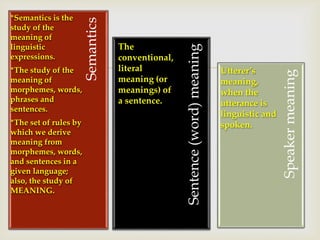
Speakermeaning
Sentence(word)meaning
Semantics
*Semantics is the
study of the
meaning of
linguistic
expressions.
*The study of the
meaning of
morphemes, words,
phrases and
sentences.
*The set of rules by
which we derive
meaning from
morphemes, words,
and sentences in a
given language;
also, the study of
MEANING.
The
conventional,
literal
meaning (or
meanings) of
a sentence.
Utterer’s
meaning,
when the
utterance is
linguistic and
spoken.

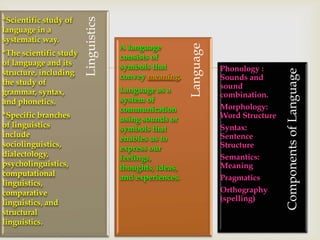
ComponentsofLanguage
Language
Linguistics
*Scientific study of
language in a
systematic way.
*The scientific study
of language and its
structure, including
the study of
grammar, syntax,
and phonetics.
*Specific branches
of linguistics
include
sociolinguistics,
dialectology,
psycholinguistics,
computational
linguistics,
comparative
linguistics, and
structural
linguistics.
A language
consists of
symbols that
convey meaning.
Language as a
system of
communication
using sounds or
symbols that
enables us to
express our
feelings,
thoughts, ideas,
and experiences.
Phonology :
Sounds and
sound
combination.
Morphology:
Word Structure
Syntax:
Sentence
Structure
Semantics:
Meaning
Pragmatics
Orthography
(spelling)

 The 17th-century British empiricist John Locke held
that linguistic meaning is mental: words are used to
encode and convey thoughts, or ideas. Successful
communication requires that the hearer correctly
decode the speaker’s words into their associated
ideas. So construed, the meaning of an expression,
according to Locke, is the idea associated with it in
the mind of anyone who knows and understands
that expression.
Theory of Semantics.

Semantics T1

  • 1.
    Tutorial 1 Clare Daniel HungPei Ling Nithia Rubnee Puvanasutha Ras Ameliya
  • 2.
     Speakermeaning Sentence(word)meaning Semantics *Semantics is the studyof the meaning of linguistic expressions. *The study of the meaning of morphemes, words, phrases and sentences. *The set of rules by which we derive meaning from morphemes, words, and sentences in a given language; also, the study of MEANING. The conventional, literal meaning (or meanings) of a sentence. Utterer’s meaning, when the utterance is linguistic and spoken.
  • 3.
     ComponentsofLanguage Language Linguistics *Scientific study of languagein a systematic way. *The scientific study of language and its structure, including the study of grammar, syntax, and phonetics. *Specific branches of linguistics include sociolinguistics, dialectology, psycholinguistics, computational linguistics, comparative linguistics, and structural linguistics. A language consists of symbols that convey meaning. Language as a system of communication using sounds or symbols that enables us to express our feelings, thoughts, ideas, and experiences. Phonology : Sounds and sound combination. Morphology: Word Structure Syntax: Sentence Structure Semantics: Meaning Pragmatics Orthography (spelling)
  • 4.
      The 17th-centuryBritish empiricist John Locke held that linguistic meaning is mental: words are used to encode and convey thoughts, or ideas. Successful communication requires that the hearer correctly decode the speaker’s words into their associated ideas. So construed, the meaning of an expression, according to Locke, is the idea associated with it in the mind of anyone who knows and understands that expression. Theory of Semantics.