Semantics
Group 4
A sub discipline of linguistics which focuses on
the study of meaning.
Tries to understand what meaning is as an
element of language and how it is constructed
by language as well as interpreted, obscured,
and negotiated by speakers and listeners of
language.
What is semantics?
Types of Meaning
 Conceptual Meaning
 it is the basic propositional meaning which corresponds to the primary dictionary
definition.
 It is the literal meaning of the word indicating the idea or concept to which it refers.
Example:
o Woman = human, female
o Needle = thin, sharp, used for sewing or repairing ripped clothes
 Associative Meaning
 The particular qualities or characteristics beyond denotative meaning that people
commonly think of (correctly or incorrectly) in relation to a word or phrase.
 it can be further divided into following five types:
1. Connotative Meaning
 Is something that goes beyond mere referent of a word and hints at its attributes in
the real world.
 It is something more than the dictionary meaning.
 Examples:
o Woman = prone to tears, emotional, gentle, compassionate, hardworking
o Needle = heartache, pain
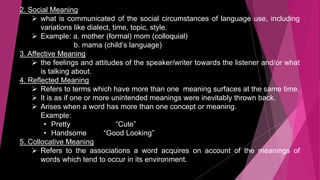
2. Social Meaning
 what is communicated of the social circumstances of language use, including
variations like dialect, time, topic, style.
 Example: a. mother (formal) mom (colloquial)
b. mama (child’s language)
3. Affective Meaning
 the feelings and attitudes of the speaker/writer towards the listener and/or what
is talking about.
4. Reflected Meaning
 Refers to terms which have more than one meaning surfaces at the same time.
 It is as if one or more unintended meanings were inevitably thrown back.
 Arises when a word has more than one concept or meaning.
Example:
• Pretty “Cute”
• Handsome “Good Looking”
5. Collocative Meaning
 Refers to the associations a word acquires on account of the meanings of
words which tend to occur in its environment.
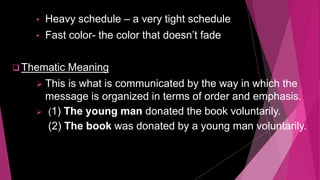
• Heavy schedule – a very tight schedule
• Fast color- the color that doesn’t fade
 Thematic Meaning
 This is what is communicated by the way in which the
message is organized in terms of order and emphasis.
 (1) The young man donated the book voluntarily.
(2) The book was donated by a young man voluntarily.
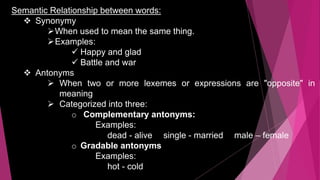
Semantic Relationship between words:
 Synonymy
When used to mean the same thing.
Examples:
 Happy and glad
 Battle and war
 Antonyms
 When two or more lexemes or expressions are "opposite" in
meaning
 Categorized into three:
o Complementary antonyms:
Examples:
dead - alive single - married male – female
o Gradable antonyms
Examples:
hot - cold
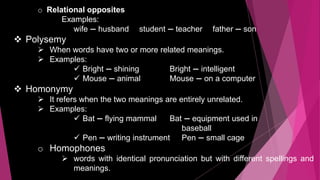
o Relational opposites
Examples:
wife — husband student — teacher father — son
 Polysemy
 When words have two or more related meanings.
 Examples:
 Bright — shining Bright — intelligent
 Mouse — animal Mouse — on a computer
 Homonymy
 It refers when the two meanings are entirely unrelated.
 Examples:
 Bat — flying mammal Bat — equipment used in
baseball
 Pen — writing instrument Pen — small cage
o Homophones
 words with identical pronunciation but with different spellings and
meanings.
 Examples:
o Calm
o Come
o Heteronymy
 Are homonyms that share the same spelling but different pronunciation.
 Examples:
o Desert — to abandon
o Desert arid region
Semantic relationship between sentences:
 Paraphrase
 Revising a sentence or text using own words.
 Different in form yet has the same meaning.
 Have the same truth conditions; if one Is true, the other must also be true.
 Examples:
o Mark likes Sarah = Sarah is liked by Mark.
o The reporter wrote the news = The news was written by the reporter.
 Entailment
 Two sentences don’t mean exactly the same thing, instead, when one sentence entails
another, for the second sentence to be true, the first one must be true.
 Mutual Entailment — Each sentence must be true for the other to be true.
Example:
o Mary is the mother of Beth and Beth is Mary's daughter.
o John is married to Rachel and Rachel is John’s wife.
 Asymmetrical Entailment — only one of the sentences must be true for the
other to be true.
Example:
‘Mary is the mother of Beth’ entails ‘Beth is Mary’s daughter’.
 Contradiction — for a sentence to contradict each other, one must be true but the
other must not be.
Example:
‘Anne has no boyfriend since birth’ and ‘Drew is Anne’s boyfriend.’
Ambiguity
 It is a sentence with two or more possible meanings.
Two Types:
Lexical Ambiguity
 It is a sentence with two or more possible meanings
due to polysemous or homophonous words.
Example:
Prostitutes appeal to the Pope.
Polysemous
Structural Ambiguity
It is a sentence with two or more possible
meanings due to the words it contains
being able to be combined in different
ways which create different meanings.
Example:
“Enraged cow injures farmer with axe”
Factors to Disambiguate Problematic Factors
 Pragmatic factors
 Relate an ambiguous expression to the context.
 For example, the sight of a fishing rod can normally justify our interpretation of the
word bank in the sentence "I saw him at the bank." as "the river bank".
 Lexical or Grammatical Devices
 Use some lexical and/or grammatical devices to alter the linguistic context, i.e. the
words and expressions occurring before or after a lexical item, e.g.
a. the bank of the river
b. the richest bank in the city.
 Phonological Devices
 Stresses can also help to eliminate lexical and/or grammatical ambiguity.
a. Do you know anything about the `greenhouse effect?
b. Do you know anything about the green `house?
Approaches in Semantics
 Traditional Approach
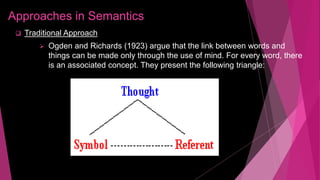
 Ogden and Richards (1923) argue that the link between words and
things can be made only through the use of mind. For every word, there
is an associated concept. They present the following triangle:
 The Functional Approach
 Functional linguists emphasize the social aspect of
language and view language as "social semiotic".
 According to Halliday (1978), a text is what is meant,
selected from the total set of options that constitute
what can be meant.
 context of situation and context of culture
 The Pragmatic Approach
 What the hearer takes to be the speaker's meaning is
the meaning of the utterance.
 sentence meaning and utterance meaning.
Componential Analysis
 Componential analysis — defines the meaning of a lexical
element in terms of semantic components or semantic
features. Each word has certain semantic elements of its
own.
THEORIES IN SEMANTICS
 Referential Theory
 holds that a linguistic sign derives its meaning from something in the
reality.
 For example, words like man, fish, are meaningful in that they each
refer to an individual or a collection of living beings existing in the
reality.
 Representational Theory
 holds that language in general, and words in particular, are only an
icon (or representation) for an actual thing (or form) being symbolized.
 they conjure in our minds pictures of the things, happenings and ideas.

Semantics [Report in Language Study]

  • 1.
  • 2.
    A sub disciplineof linguistics which focuses on the study of meaning. Tries to understand what meaning is as an element of language and how it is constructed by language as well as interpreted, obscured, and negotiated by speakers and listeners of language. What is semantics?
  • 3.
    Types of Meaning Conceptual Meaning  it is the basic propositional meaning which corresponds to the primary dictionary definition.  It is the literal meaning of the word indicating the idea or concept to which it refers. Example: o Woman = human, female o Needle = thin, sharp, used for sewing or repairing ripped clothes  Associative Meaning  The particular qualities or characteristics beyond denotative meaning that people commonly think of (correctly or incorrectly) in relation to a word or phrase.  it can be further divided into following five types: 1. Connotative Meaning  Is something that goes beyond mere referent of a word and hints at its attributes in the real world.  It is something more than the dictionary meaning.  Examples: o Woman = prone to tears, emotional, gentle, compassionate, hardworking o Needle = heartache, pain
  • 4.
    2. Social Meaning what is communicated of the social circumstances of language use, including variations like dialect, time, topic, style.  Example: a. mother (formal) mom (colloquial) b. mama (child’s language) 3. Affective Meaning  the feelings and attitudes of the speaker/writer towards the listener and/or what is talking about. 4. Reflected Meaning  Refers to terms which have more than one meaning surfaces at the same time.  It is as if one or more unintended meanings were inevitably thrown back.  Arises when a word has more than one concept or meaning. Example: • Pretty “Cute” • Handsome “Good Looking” 5. Collocative Meaning  Refers to the associations a word acquires on account of the meanings of words which tend to occur in its environment.
  • 5.
    • Heavy schedule– a very tight schedule • Fast color- the color that doesn’t fade  Thematic Meaning  This is what is communicated by the way in which the message is organized in terms of order and emphasis.  (1) The young man donated the book voluntarily. (2) The book was donated by a young man voluntarily.
  • 6.
    Semantic Relationship betweenwords:  Synonymy When used to mean the same thing. Examples:  Happy and glad  Battle and war  Antonyms  When two or more lexemes or expressions are "opposite" in meaning  Categorized into three: o Complementary antonyms: Examples: dead - alive single - married male – female o Gradable antonyms Examples: hot - cold
  • 7.
    o Relational opposites Examples: wife— husband student — teacher father — son  Polysemy  When words have two or more related meanings.  Examples:  Bright — shining Bright — intelligent  Mouse — animal Mouse — on a computer  Homonymy  It refers when the two meanings are entirely unrelated.  Examples:  Bat — flying mammal Bat — equipment used in baseball  Pen — writing instrument Pen — small cage o Homophones  words with identical pronunciation but with different spellings and meanings.
  • 8.
     Examples: o Calm oCome o Heteronymy  Are homonyms that share the same spelling but different pronunciation.  Examples: o Desert — to abandon o Desert arid region Semantic relationship between sentences:  Paraphrase  Revising a sentence or text using own words.  Different in form yet has the same meaning.  Have the same truth conditions; if one Is true, the other must also be true.  Examples: o Mark likes Sarah = Sarah is liked by Mark. o The reporter wrote the news = The news was written by the reporter.  Entailment  Two sentences don’t mean exactly the same thing, instead, when one sentence entails another, for the second sentence to be true, the first one must be true.
  • 9.
     Mutual Entailment— Each sentence must be true for the other to be true. Example: o Mary is the mother of Beth and Beth is Mary's daughter. o John is married to Rachel and Rachel is John’s wife.  Asymmetrical Entailment — only one of the sentences must be true for the other to be true. Example: ‘Mary is the mother of Beth’ entails ‘Beth is Mary’s daughter’.  Contradiction — for a sentence to contradict each other, one must be true but the other must not be. Example: ‘Anne has no boyfriend since birth’ and ‘Drew is Anne’s boyfriend.’
  • 10.
    Ambiguity  It isa sentence with two or more possible meanings. Two Types: Lexical Ambiguity  It is a sentence with two or more possible meanings due to polysemous or homophonous words. Example: Prostitutes appeal to the Pope. Polysemous
  • 11.
    Structural Ambiguity It isa sentence with two or more possible meanings due to the words it contains being able to be combined in different ways which create different meanings. Example: “Enraged cow injures farmer with axe”
  • 12.
    Factors to DisambiguateProblematic Factors  Pragmatic factors  Relate an ambiguous expression to the context.  For example, the sight of a fishing rod can normally justify our interpretation of the word bank in the sentence "I saw him at the bank." as "the river bank".  Lexical or Grammatical Devices  Use some lexical and/or grammatical devices to alter the linguistic context, i.e. the words and expressions occurring before or after a lexical item, e.g. a. the bank of the river b. the richest bank in the city.  Phonological Devices  Stresses can also help to eliminate lexical and/or grammatical ambiguity. a. Do you know anything about the `greenhouse effect? b. Do you know anything about the green `house?
  • 13.
    Approaches in Semantics Traditional Approach  Ogden and Richards (1923) argue that the link between words and things can be made only through the use of mind. For every word, there is an associated concept. They present the following triangle:
  • 14.
     The FunctionalApproach  Functional linguists emphasize the social aspect of language and view language as "social semiotic".  According to Halliday (1978), a text is what is meant, selected from the total set of options that constitute what can be meant.  context of situation and context of culture  The Pragmatic Approach  What the hearer takes to be the speaker's meaning is the meaning of the utterance.  sentence meaning and utterance meaning.
  • 15.
    Componential Analysis  Componentialanalysis — defines the meaning of a lexical element in terms of semantic components or semantic features. Each word has certain semantic elements of its own.
  • 16.
    THEORIES IN SEMANTICS Referential Theory  holds that a linguistic sign derives its meaning from something in the reality.  For example, words like man, fish, are meaningful in that they each refer to an individual or a collection of living beings existing in the reality.  Representational Theory  holds that language in general, and words in particular, are only an icon (or representation) for an actual thing (or form) being symbolized.  they conjure in our minds pictures of the things, happenings and ideas.